BATTLEAXE
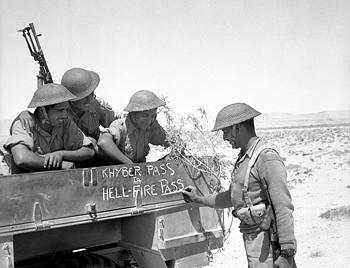
The British launched Operation BATTLEAXE, seeking to clear eastern Cyrenaica of German and Italian forces and lift the Siege of Tobruk. British and Commonwealth desert forces under command of Lieutenant General Noel Beresford-Peirse in North Africa launched Operation BATTLEAXE, an attempt to relieve Tobruk. The German defenders at Tobruk beat off the attack. Despite every available Allied aircraft (105 bombers and 98 fighters) being used in support of ground operations, and the arrival of reinforcements from Egypt, the operation was a failure, and highlighted the need for effective air-ground communication. The British launched the BATTLEAXE offensive toward in Libya at 0200 hours, engaging Axis defenses by 0600 hours. On the first day of the offensive, British troops were able to besiege Halfaya Pass and capture Fort Capuzzo, but at the high price of about half of their tank strength.
Lt. General Noel Beresford-Peirse sends his troops forward around 02:00 and they attack around dawn. It is a long day of attacks and counterattacks, with the British taking ground but scoring no breakthroughs.
At 05:15, Brigadier Reginald Savory leads Coast Force toward Halfaya Pass. His force has Halfaya Group (2nd Battalion Queen’s Own Cameron Highlanders, the 13 tanks (twelve Matildas and one light tank) of C Squadron, 4th Royal Tank Regiment) on the escarpment overlooking the pass. Advancing from the east are the 1st Battalion 6th Rajputana Rifles and 2nd Battalion 5th Mahratta Light Infantry, two troops of A Squadron, 4th Royal Tank Regiment and a few 25-pounder guns.
Opposing them in Halfaya Pass are 15th Panzer Division and assorted German and Italian infantry. British artillery fails to correctly position itself in time to launch a preparatory bombardment, so the British tanks attack at the top of the pass without artillery support at 06:00. The forewarned German and Italian troops — the Germans intercepted news of the offensive from careless Australian wireless transmissions before midnight — quickly open up with anti-tank fire that knocks out all but one of the advancing British Matilda tanks and one light tank.
The German troops respond quickly with a counterattack led by armored cars and motorized infantry in Halfaya Pass. At Fort Capuzzo, the British 7th Royal Tank Regiment has early success, but 8th Panzer Regiment of the 15th Panzer Division launches several counterattacks that the British tank regiment and 22nd Guards Brigade blunt with great difficulty. The British wind up with Fort Capuzzo. Rommel, however, is keeping the bulk of the 15th Panzer Division back for defensive purposes.
The dawn attack by the right-hand column on the Halfaya Pass, made along the top of the escarpment was stopped when “C” Squadron, 4 RTR, supporting the 2nd Cameron Highlanders, ran against the entrenched 88mms which were in stone-built sangars, with only their muzzles visible. The “C” Squadron commander, Major Miles, was last heard on the radio reporting, “They are tearing my tanks apart.”
The fight at Halfaya went on until about 1000 hours when “C” Squadron was down to one Matilda and one light tank, and the Camerons were then forced to withdraw by infantry counter-attacks covered by machine-gun fire, and retreated down the pass with great loss. Other squadrons of 4 RTR engaged the enemy along the wire to keep the enemy busy while, further south, advancing along the escarpment, the center column, led by 7th Royal Tanks, captured Fort Capuzzo, losing five tanks in the process.
Meanwhile the main force of 7th Armoured Division was preparing to hook round the German southern flank, led by 7th Armoured Brigade, which hd been re-equipped with the new Crusaders. To keep these tanks a surprise, the column was led 2nd RTR in A9 and A10 cruisers. The first phase of this advance, to capture the Hafid Ridge, went well, but prior reconnaissance had failed to reveal that the Hafid Ridge was actually three ridges. One Squadron moving forward was decimated with only two tanks surviving an encounter with a line of anti-tank guns concealed behind dummy vehicles.
The Germans counter-attacked with about 35 tanks coming up from the south-east. The British with only 20 tanks left that were fit for action were ordered to hold this force, but they were outgunned and by nightfall five tanks were lost.
The Germans use a favored tactic of launching feints against the British, such as with the 8th Panzer Regiment. These draw the British forward onto concealed anti-tank guns, which blast the advancing tanks from point-blank range. Five British tanks advancing up along Hafid Ridge are knocked out by German 88 mm flak guns being used as anti-tank artillery. Another 11 Crusader tanks are destroyed and six damaged a little later. Late in the day, the 5th Panzer Regiment of the 5th Light Division sends forward 30 panzers to solidify the defenses.
However, when all is said and done, the British overall score minor gains along the frontier during the and take over 500 German and Italian prisoners. The British now hold Fort Capuzzo, but fail to take Halfaya Pass and Hafid Ridge.
The British problem is not their minimal gains, but their very real losses in armor and infantry. They have lost dozens of tanks, with the 2nd Royal Tank Regiment down to 20 cruiser tanks and the 6th Royal Tank Regiment down to 20 out of its original 50 Crusader tanks. The 4th Armoured Brigade winds up with only 48 of its starting allotment of 100 tanks (after 11 are repaired overnight). Perhaps just as importantly, the Germans chase the British off the battlefield and prevent the British from recovering their damaged tanks, of which there are many. Among the British tank losses is that of Major Miles, the Commander of “C” Squadron.
The British learn the expensive lesson that their tanks are no match for German 88 mm guns. The Matildas and others also are out-ranged and outgunned by the panzers, and many of the British shots bounce off the panzers’ armor. Panzer shells, however, have little trouble destroying British tanks.
Overhead, Luftwaffe I./JG 27, 7./JG 26 and 8./ZG 26 shoot down eight Hawker Hurricanes and two bombers at a cost of two Bf 109s.
The biggest lesson from the first day of Operation BATTLEAXE, though, is the importance of knowing when your opponent is going to attack. This is a luxury that the British usually have due to Ultra, but in this instance, the tables are turned and the Germans and Italians are the ones who know the enemy’s intentions. This enables the Germans to position and man their anti-tank guns along projected axes of the British advance and implement tactics to draw the British tanks into kill zones. The British, incidentally, generally are in the dark about Rommel’s intentions because he operates independently from OKW in Berlin and often communicates with his troops directly or via messengers.
The British plan to resume their offensive on the 16th. General Rommel, on the other hand, brings up his 5th Light Division to Sidi Aziz during the evening and night and plans an attack on the advancing British from the rear in order to loosen the stress on the Axis troops defending Halfaya Pass. He orders them to attack before dawn, along with a frontal attack on Fort Capuzzo to pin down the leading elements of the British advance, because he knows from intercepts that the British intend to attack just after dawn.
General Ritchie takes up his position as Deputy Chief of Staff of the Middle East Command.
Italian Foreign Minister Count Galeazzo Ciano informs the Foreign Minister of Hungary that the Soviet Union is poised to attack Hungary. Neither man knows about Operation BARBAROSSA, though there is a possibility that their national leaders do to one extent or another.
Wehrmacht troops continue assembling in their forward positions for Operation Barbarossa. U-boats in the Baltic are given permission to begin attacking any Soviet warships they spot — but there aren’t very many of those at sea. These sinkings, if there are any, are to be excused as “accidents.” This is reminiscent of the Kriegsmarine ordering its U-boats to sea on 15 August 1939 in preparation for the attack on Poland.
An unconfirmed report that Soviet Russia has declared general mobilization and canceled all army leaves was related tonight by Martin Agronsky, National Broadcasting Co. correspondent in Turkey, during his regular broadcast from Ankara.
The Battle of Kiswe (Kissoué) began in Syria at 0400 hours. Indian and Free French troops attacked Kissoué in the French Mandate of Syria and the Lebanon at 0400 hours, capturing it by 0900 hours. 5 miles to the west, Vichy French troops threatened to capture Quneitra. At sea, British destroyers bombarded Sidon in the French Mandate of Syria and the Lebanon and was retaliated against by German Ju 88 aircraft; HMS Jackal, HMS Ilex, and HMS Isis were damaged and were ordered out of the area for repairs. In the evening, aircraft of French 4th Naval Air Group bombed British naval units off the Syrian coast.
Lloyd’s 5 Indian Brigade capture Kiswe, breaking a 5-day deadlock. By 08:30, the Indian troops take the town, and by 09:00, they are probing the hills beyond. By 10:00, the Indian troops have taken Tel Kissoué slightly further north, and Free French marines occupy Mokelbe on the river along the flank. The Free French forces then advance across the river into the hills beyond and take Jebel Kelb, but then run into determined Vichy French resistance at Jebel Abou Atriz just beyond. An artillery battle develops on the extreme right flank, stopping a sortie by Free French tanks. A large Vichy French force then sorties out of Damascus, and other Vichy French advance from the east and take Ezraa.
Brigadier Lloyd then decides that the best defense is a good offense. He sends two companies of Free French troops to the south to hold the Vichy French advancing from the east and orders the Indian brigade to march on Damascus. The Indian troops make some ground, taking Aartouz on the left flank and severing Vichy French lines of communication. As the day ends, the entire sector is in the midst of a wild melee with no clear winner and pockets of troops of both sides scattered in the hills to the south of Damascus.
Central Axis: At Merdjayoun (Merjayun), the Vichy French attack the Australian troops who have been left behind while the main forces moves toward the coast. The French recapture Merdjayoun, but lose a number of their Renault R35 tanks to British 25-pounder anti-tank guns. The French advance stalls after this. Another French counterattack at Jezzine is beaten off.
Overhead, French Dewotine D.520 fighters bounce six Gloster Gladiators above Kissoué and shoot one Gladiator down (Fl-Off J. N. Craigie) and badly damage another. The French lose two fighters, one of which crash-lands at Rayak airfield and is destroyed.
Offshore, Vichy French destroyers Guephard and Valmy once again sortie out of Beirut Harbor. They run into Royal Navy destroyers HMS Jervis and Kimberley, and after a brief fight, the French destroyers retreat back into the harbor. Vichy French bombers attack light cruisers Phoebe and Leander and destroyers Ilex, Isis and Hasty while they are bombarding Sidon. Isis is damaged by a near miss and proceeds to Haifa, and thence to Singapore until 1942.
After a two-day battle, on 15 June 1941 Australian troops of the 21st Brigade walk into Sidon after the Vichy French retreat during the night. While a bit of a hollow victory, it is still a victory and solidifies Australian/British control over the vital coast. French forces counter-attack at Jezzine but are stopped by divisional artillery. Six Gladiators of X Flight are patrolling over Kissoue at 8,000ft when they are bounced by Dewotine D520’s. Fl-Off J N Craigie is shot down and killed in the first pass. Another Gladiator is badly damaged. One Dewoitine crashes in British territory. The pilot is captured. The other, flown by French ace Sous-Lt Le Gloan, crash-lands at Rayak airfield and is written off.
Croatia signed Axis protocol respecting its interests. Croatia, the new state carved from part of vanquished Yugoslavia, joined today the ranks of secondary members of the Rome-Berlin-Tokyo axis. Dr. Ante Pavelic, “poglavnik” or leader of Croatian state, put his signature at a ceremony in Venice, Italy, to a protocol giving his country the right to be present at any tripartite discussions affecting Croatia. The action put Croatia in a class with Hungary, Rumania, Bulgaria and Slovakia, whose envoys also signed today’s document. There now are nine signatories of the Pact, including Germany, Italy, Japan (the original three), Hungary, Romania, Slovakia, Bulgaria, and Yugoslavia. The Soviet Union has asked to join the Pact, but Germany has ignored them. Germany does want Finland to sign, but the Finnish Government knows that signing it would produce a crisis in relations with the United States (with which it is never at war).
Adolf Hitler spends the day at home in Berlin with his cronies, including Propaganda Minister Joseph Goebbels. He is in a good mood, laughing at Goebbels’ jokes and biding his time until Operation Barbarossa opens in one week’s time. The Wehrmacht is used to receiving delays in its invasions, such as of Poland in 1939 and France, Belgium and the Netherlands in 1940, but Hitler has no intention of delaying his grand design.
Hitler, for all his confidence, is having trouble falling asleep. He spends the early morning hours rambling with his attentive minions. This is a pattern that will recur frequently in the coming months, and at times become his daily habit. His personal physician, however, has sedatives for when he really needs some rest.
In German-occupied Gąbin, Poland, German troops stage a public execution of 10 Polish hostages.
The first football game between Germany and Croatia is played at the Vienna’s Prater Stadium. Germany wins 5-1.
The Royal Navy winds up its destruction of the German supply network (the “Etappendienst”) in the Atlantic. Aircraft from the aircraft carrier HMS Eagle disable 10,746-ton German tanker Lothringen, allowing cruiser HMS Dunedin to capture it. The entire crew survives. The tanker is renamed Empire Salvage and used by the Royal Navy. The Lothingren had been seized from the Dutch while under construction.
Acting on Ultra intelligence, Royal Navy submarine HMS Thunderbolt conducts a rare attack on another submarine. It fires a six-torpedo spread at U-557 (Oblt. Ottokar Paulssen), but all six torpedoes miss. U-557, operating with Wolfpack West, never even notices. The two submarines will meet again on 15 December 1941, incidentally, with the tables turned.
Elsewhere, in a classic demonstration of the durability of Catalina flying boats, one flying near Gibraltar fights off four Axis planes. The attackers lose one plane, which crashes in Portugal.
The Soviet light cruiser Voroshilov began participation in a week-long exercise.
Evelyn Underhill, the English poet and mystic, dies at Hampstead. She was 65.
RAF Bomber Command, Day of 15 June 1941
23 Blenheims on sweeps of Dutch and German coasts but most turned back because of lack of cloud cover. Ships off Terschelling and in the Ems estuary were attacked. 1 aircraft lost.
RAF Bomber Command, Night of 15/16 June 1941
Cologne
49 Wellingtons and 42 Hampdens to railway targets but Cologne reports only 3 or 4 bomb loads in the city with minor damage, 1 person killed and 2 injured. 1 Hampden lost.
Düsseldorf
31 Whitleys and 28 Wellingtons to railway targets but visibility was poor and bombing was scattered. No aircraft lost.
Hannover
16 aircraft; a large fire was started. No losses.
Minor Operations: 10 Wellingtons and 2 Whitleys to Dunkirk, 4 Hampdens minelaying in the Frisians, 1 O.T.U. sortie. The 2 Whitley freshmen crews sent to Dunkirk were both lost.
43 Hurricane fighters were delivered to the beleaguered island of Malta yesterday, greatly strengthening the RAF’s air defenses in what has become a key battle in the struggle for control of the Mediterranean, and, indirectly, the battlefields of North Africa. Both Britain and the Axis powers recognize the prime strategic importance of Malta. On the day of Italy’s entry into the war it made eight air attacks on the island, and since the Luftwaffe moved into Sicily and southern Italy last January these attacks have shown a marked increase. The Royal Navy has devoted much effort to keeping Malta supplied so that Malta-based forces can continue to operate against Axis targets. Malta sits astride the main Axis supply route to North Africa, especially to the Libyan port of Tripoli. If the overall Axis aim of securing the Suez Canal is to be achieved, this supply route must be made secure. On the other hand, in order to prevent an Axis build-up in North Africa the British must hang on to the island.
Light cruiser HMS Edinburgh and destroyer HMS Inglefield departed Iceland.
Convoy OB.336 departed Liverpool, escorted by corvettes HMCS Agassiz and HMCS Wetaskiwin. The convoy was joined on the 16th by destroyers HMS Lincoln and HMS Shikari. On the 17th, destroyers HMS Sabre and HMS Venomous, catapult ship HMS Pegasus, corvettes HMS Alisma and HMS Sunflower, and anti-submarine trawlers HMS Lady Elsa, HMS Man O’ War, and HMS Northern Dawn joined the convoy. Minesweepers HMS Gossamer, HMS Hazard, and HMS Hebe were with the convoy on the 18th. The convoy was dispersed on the 22nd.
Destroyer HMS Intrepid arrived at Scapa Flow at 2359 from the Humber where she fitted TSDS equipment.
Destroyer HMS Charlestown arrived at Scapa Flow at 2230 to work up after refitting prior to rejoining the Minelaying Force at Loch Alsh.
Submarine HMS Thunderbolt unsuccessfully attacked U-557 in 42-00N, 47-00W.
British fishing vessel Audacious (7grt) was sunk on a mine in 51-28N, 00-51E. One crewman was rescued from the fishing vessel.
Bombarding Sidon, Light cruisers HMS Phoebe and HMS Leander and destroyers HMS Ilex, HMS Hasty, and HMS Isis off Syria were attacked by French bombers. Destroyer Isis was damaged by German bombing from a near miss at 1700. The destroyer proceeded to Haifa, escorted by anti-aircraft cruiser HMS Coventry. Destroyer ISIS departed Haifa on 26 July, escorted by corvette HMS Hyacinth, for Alexandria. The destroyer was able to depart Alexandria on 8 August for the transit of the Suez Canal. Destroyer Isis with destroyer HMS Nubian arrived at Bombay on 27 September. Destroyer ISIS departed Bombay on 2 October for Colombo. Destroyer ISIS arrived at Singapore on 13 October for repairs. The destroyer was still under repair at Singapore on 17 January 1942. On that date, she was damaged by Japanese bombing. The destroyer was towed in February by destroyer HMS Electra to Batavia arriving on 7 February and later in the month by British steamer Malancha (8124grt) ship to Colombo. Her repairs were completed in March. Destroyer Ilex was also damaged by French bombing at 1900 and taken to Haifa. Partly towed by destroyer HMS Hasty and finally under her own power at daylight on the 16th. Destroyer Ilex was towed from Haifa at 1800/28th by destroyer HMS Decoy and escorted by anti-aircraft cruiser HMS Carlisle and destroyers HMS Hotspur and HMAS Nizam. On arrival at Port Said, destroyer Nizam proceeded to Alexandria. Anti-aircraft cruiser Carlisle and destroyers Hotspur and Decoy returned to Haifa. Destroyer Ilex departed Port Said on 20 July after temporary repairs and arrived at Aden on 24 July. She departed Aden on 15 September and proceeded to Mombasa with engine room problems. The destroyer arrived at Durban in November and departed on 5 February. The destroyer departed Simonstown on 11 February for Freetown and finally Charlestown, South Carolina, arriving on 14 March 1942. Repairs were completed in October. There were only two minor injuries from the damage of the two destroyers.
Destroyer HMS Jackal was struck on the upper deck by a bomb which passed through the deck and into the sea. The bomb exploded in the sea causing superficial damage. The destroyer spent no time out of service.
German tanker Lothringen (10,746grt) surrendered when she was intercepted in Operation Salvage by light cruiser Dunedin and aircraft from aircraft carrier Eagle of Force F in 19-49N, 38-30W. The tanker was taken for British use and renamed Empire Salvage.
Battlecruiser HMS Renown, aircraft carriers HMS Ark Royal and HMS Victorious, and destroyers HMS Faulknor, HMS Fearless, HMS Foxhound, HMS Foresight, HMS Forester, and HMS Hesperus departed Gibraltar for a position 49N, 29-30W. Aircraft carrier Victorious and destroyer Hesperus were detached to return to the UK.
The Italian government announced today that it had taken retaliatory measures, including the ordering of a registration of United States property in Italy, following President Roosevelt’s blocking of Italian and German credits in America. Some observers pointed out that the Italian action might even be the prelude to a diplomatic break in relations with the United States, which at least one Rome newspaper seemed to suggest. Although the official communique referred only to registration of United States property in Italy, it was thought in American circles that this would be interpreted to mean the property of all American citizens.
The U.S. Maritime Commission announced today that six Danish ships would be placed in active service of the United States merchant fleet tomorrow. They are among 84 foreign vessels tied up in American waters which were taken into protective custody some time ago. The six vessels, which will become the property of the commission, are the motorship Nora and the steamships Marna and Jonna, tied up in New York; the steamships Rita Maersk and Herta Maersk, in Boston; and the steamship Jutta, in Portland, Maine. All are freighters.
Congress will rush work this week on all remaining appropriation bills so as to meet the July 1 deadline when the new fiscal year starts. The Senate is to consider the $125,000,000 Defense Access Highways Bill tomorrow, and the House hopes to clear away most of the remaining appropriations bills this week, leaving the last week of the month for Senate approval. First on the list is the District of Columbia Bill, which is scheduled for consideration tomorrow. While this is not expected to take long, it may bring out a fight over the economic ramifications of the Washington defense boom and it may be used by some members as a pretext to protest proposals to transfer the Interstate Commerce Commission and other agencies out of the capital to make room for defense workers.
Senator Pat Harrison of Mississippi, president pro tempore of the senate and chairman of the powerful finance committee, tonight entered emergency hospital for a major intestinal operation Monday. He only recently emerged from an Arkansas hospital and the new development in his long illness made it certain that he would not be in command of the administration’s new $3,600,000,000 national defense tax bill. Associates doubted that he would be able to resume his senate duties this session.
Indications came today that the army is considering removing at least part of its 3,500 troops guarding the big North American Aviation Corp. plant in Inglewood, California. Colonel Charles E. Branshaw, commanding army detachments who seized control Monday in the midst of a strike, said an announcement would be made tomorrow affecting some of the troops, but declined any amplification. Of 4,000 soldiers sent to the scene from Fort MacArthur, Camp Hunter Liggett and Camp Seeley, 600 from Fort MacArthur already have returned to their base 15 miles away. About 800 of those remaining were granted leave today to see Hollywood and the metropolitan area. Liquor sales near the plant were resumed.
Continuing their five-weeks-old walkout, members of striking A.F.L. and C.I.O. machinists’ unions today voted down proposals to return to work in 11 San Francisco bay area shipyards. The A.F.L. unionists’ vote was 400 in favor of going back to work, against 585 opposing. C.I.O. machinists, at a separate meeting, voted 56 in favor, and 359 against. The resolution adopted by the A. F.L. read: “Resolved, that San Francisco lodge 68 do go on record as most reluctantly informing the president that we cannot comply with his wishes.
By a vote of sixty-four to two, union representatives of 50,000 workers in East Coast shipyards today endorsed the two-year no-strike agreement proposed by the Office of Production Management. The delegates represented thirty-three locals of the Industrial Union of Marine and Shipbuilding Workers, C.I.O., and their vote in favor of the pact was cast at Camden, New Jersey’s labor headquarters after John Green, national president of the union, had urged acceptance of the plan designed to speed defense shipbuilding operations to maximum capacity. Mr. Green headed the labor negotiators in the recent conference at Washington where the stabilization agreement was drawn up.
Stating that he had received complaints of nation-wide discrimination against Negroes in defense industries, President Roosevelt called upon the Office of Production Management today to take immediate steps to deal effectively with this “grave” situation.
Seventy-five per cent of the sales made or services performed by commercial establishments must be retail to qualify them for exemption from the Wage Hour Law, instead of 50 percent as hitherto, the Wage and Hour Division of the Labor Department stated in a ruling issued today. A substantial number of the 6,242,000 wage-earners employed in the distribution and selling of goods and services will probably be affected by this new interpretation of the law. Where wholesale, commercial and industrial sales, non-retail in character, total more than 25 percent, the forty-hour week and the 30-cents-an-hour minimum wage will apply.
Reflecting a pessimistic tone to many commencement speeches this year, James B. Conant, President of Harvard University and recently head of a mission to Great Britain on behalf of President Roosevelt, says to the graduating class of Harvard:
“It is conceivable that the next fifty years for the United States will be as black as the last year has been for France.”
He also somewhat cheerlessly notes that the Draft will cause “for most of you some frustration of your ambitions.”
Hidden in a back corridor of the Munitions Building is the nerve center of the Air Corps branch just created to speed delivery of American airplanes to Great Britain. The organization, which as yet exists principally on paper and in charts, outlining one of the most complicated operations under the lease-lend program, is known officially as the Air Corps Ferry Command. Its chief is Colonel Robert Olds, who was assigned to create a new industrial-military operation from the ground up. The primary function of the Air Corps Ferry Command is to pick up completed airplanes at the factories scattered throughout the United States and put them down, ready for fighting, at Atlantic Coast ports, where they will be flown or shipped to Great Britain. The Army will fly no planes across the Atlantic, but within a few weeks it will take every responsibility for getting them started.
U.S. Navy Task Force 3, under command of Rear Admiral Jonas H. Ingram, began patrol operations from the Brazilian ports of Recife and Bahia. The force consisted of four Omaha (CL-4)-class light cruisers and five destroyers.
The U.S. Navy commissions its new Naval Air Station (NAS) at Kodiak, Alaska. This NAS in the Aleutian Islands has been under construction since September 1939. It is to become home to PBY patrol squadrons which patrol 4,000,000 square miles covering the Gulf of Alaska, Bristol Bay, the Bering Sea, and Alaska’s Pacific coast.
General Miles Dempsey takes command of the 46th Infantry Division.
Major League Baseball:
The Red Sox thrilled a capacity crowd of 34,500 today by winning a doubleheader with the White Sox, 8–6 and 6–4. Lefty Bob Grove, who gained his 297th victory last Sunday at Ted Lyons’s expense, made another start against the Chicago veteran but was forced to retire in the fourth inning after being hit on his pitching arm by a line-drive from Joe Kuhel’s bat. The blow caused Grove’s arm to tighten and he was replaced by Mike Ryba after the White Sox clouted him for four of the five runs they made in that frame to gain a 6–5 lead. The Red Sox, who belted Lyons for fifteen hits, scored twice in the sixth and again in the eighth to decide the game in Ryba’s favor.
An eight-run outburst in the sixth inning gave the Phils an 8–4 victory over the Cubs in the second game of a double-header today after the Chicagoans had taken the opener, 6–0, behind Claude Passeau’s steady pitching. The Cubs settled the first game, played in a drizzle, in the first inning, when four singles produced three runs. Only two Phils reached third. This shutout, added to yesterday’s, left Philadelphia scoreless in eighteen innings against the Cubs.
The Cincinnati Reds swept a doubleheader from the New York Giants. Behind the skillful hurling of their rookie right-hander, Elmer Riddle, the world champions routed Hal Schumacher in six innings to win the opener, 5–2. Mel Ott’s sixteenth homer of the year, with one aboard, rescued the Giants from a shut-out in this engagement, which was 1 hour and 13 minutes late in starting because of the heavy downpour. In the nightcap the sun shone brightly, but for Colonel Bill Terry, only briefly. Plucky Bucky Walters, after being floored for three runs in the first inning, hung on tenaciously until his colleagues surged back to win, 6–3. A four-run rally in the eighth, which saw Bob Bowman make his second relief appearance of the day, clinched this one. A circuit blow by Bill Werber, just returned to action after a month’s layoff, sparked the winning explosion.
Second-guessing being infallible, it can be stated that the Indians started the wrong pitcher before 43,962 fans at the Stadium yesterday. Jim Bagby Jr. was touched by the Yankees for four hits and all their runs in three and a third innings, but Lefty Al Smith yielded only one freak safety the rest of the way, as the Yankees beat Cleveland, 3–2.
Unlimbering their bats in the eighth inning, the Athletics came from behind today to down the Browns, 10–4, in the first game of a scheduled double-header. A heavy rainstorm at the end of the first contest washed out the nightcap. Trailing by 3–2 after home runs by Rick Ferrell and Harlond Clift of the Browns, the Athletics piled on Pitchers Bob Herris and Bill Trotter for eight hits in the eighth, including Bob Johnson’s thirteenth four-bagger of the year with one on base. Frank Hayes hit his eighth circuit blow in the second stanza.
The Braves defeated the Pirates, 5–1, in the first game of a double-header today and rain won the decision in the afterpiece. Sailor Bill Posedel’s five-hit pitching subdued the Pirates, as the Braves clubbed five Pittsburgh pitchers for fourteen hits, chasing starting pitcher Aldon Wilkie, a southpaw, and treating his successors equally roughly.
In St. Louis, Brooklyn and the Cards split, with the Dodgers winning the 1st game 8–1, and St. Louis taking the 2nd game 3–0, as Ernie White shut out the Dodgers on two hits. Pete Reiser is hit twice by pitches during the doubleheader. Kirby Higbe won the opener for Brooklyn for his seventh victory of the season.
Detroit and Washington broke even in a double-header today, the Senators taking the first game,7–5, and the Tigers a six-inning nightcap, 4–2. Sid Hudson went the full route for Washington in the first game and hung up his fifth victory. After holding the Tigers to four singles, he weakened in the ninth and yielded four hits and a base on balls, good for three runs.
Chicago White Sox 6, Boston Red Sox 8
Chicago White Sox 4, Boston Red Sox 6
Philadelphia Phillies 0, Chicago Cubs 6
Philadelphia Phillies 8, Chicago Cubs 4
New York Giants 2, Cincinnati Reds 5
New York Giants 3, Cincinnati Reds 6
Cleveland Indians 2, New York Yankees 3
St. Louis Browns 4, Philadelphia Athletics 10
Boston Braves 5, Pittsburgh Pirates 1
Brooklyn Dodgers 8, St. Louis Cardinals 1
Brooklyn Dodgers 0, St. Louis Cardinals 3
Detroit Tigers 5, Washington Senators 7
Detroit Tigers 4, Washington Senators 2
The apparent intention of the Government of Uruguay to repeat its 1917 policy of granting full naval facilities to the United States in wartime is regarded as likely to bring a showdown throughout South America on the question of continental defense.
Winston Churchill sends President Roosevelt a cable warning that the Japanese are preparing an attack toward the southern Pacific sometime later in the year. Churchill asks Roosevelt to station warships in Singapore in order to deter a Japanese attack there, which, all things considered in light of later developments, is not such a bad idea.
Royal Navy light cruiser HMS Emerald collides with light cruiser Dauntless near Malacca Light. Both ships proceed to Singapore for repairs.
Japanese land attack planes bombing Chungking (Chongqing), China, dropped their ordnance near the river gunboat USS Tutuila (PR-4), U.S. military attaché’s office, and a U.S. Navy canteen. Japanese Admiral Shimada Shigetaro expressed regret over the incident and assured U.S. representatives that the bombing was “wholly unintentional.” U.S. military and naval attachés privately concur, however, that the bombing “was either criminal carelessness or [with] deliberate intent to bomb Embassy and gunboat…” After the U.S. files a diplomatic protest, Japanese Admiral Shimada Shigetaro issues an apology and tells the Americans that it was “not intentional.” The U.S. also complains in general about Japanese raids on the civilian population of Chungking.
A Vietnam Independence League (Viet Minh) has been formed to be an army of liberation aimed at eliminating not only Japanese but also French control of Indochina. The League held its first meeting last month under the auspices of the Communist Party at Pao Bo. Although led by the Communists, the Viet Minh aims to provide a united front for all parties who want to end foreign domination of Vietnam. Its driving force is the founder of the Vietnamese Communist Party, Nguyen Van Thanh — better known as Ho Chi Minh, meaning “He Who Enlightens”
The U.S. government arrests Japanese naval officer Itaru Tachibana and Charlie Chaplin’s former valet, Toraichi Kono for espionage. It is a joint operation by the FBI and Office of Naval Intelligence, and evidence is obtained via a break-in of the Japanese consulate in San Francisco. This becomes known as the “Tachibana Affair.” The raid yields a large amount of evidence that effectively destroys the Japanese espionage network on the U.S. West Coast. The U.S. agents, led by Lieutenant Commander Kenneth Duval Ringle, learn to their surprise that the Japanese agents look down on American Japanese as cultural traitors who are not to be trusted.
Lieutenant General Motoyuki Yamashita, head of the Japanese military mission to the Axis powers, was quoted by the Berlin correspondent of the newspaper Nichi Nichi as saying in an interview: “In a short time something great will happen. You just watch and wait.” General Yamashita declined to explain his prediction, but the interview, which was dated Thursday, apparently was given just before the appearance of Propaganda Minister Joseph Goebbels’s suppressed article in the Voelkischer Beobachter, intimating that the conquest of Crete was merely a rehearsal for an invasion of Britain. General Yamashita also said the entrance of the United States into the war “is an American problem, not ours.” He revealed, however, that Adolf Hitler had told the Japanese Military Mission that Japan should mobilize her full force and work harder to achieve a “new order” in the Far East.
Born:
Harry Nilsson, singer-songwriter (“Everybody’s Talkin’”; “One”; “Without You”), in Brooklyn, New York, New York (d. 1994, of a heart attack).
Bruce Dal Canton, MLB pitcher (Pittsburgh Pirates, Kansas City Royals, Atlanta Braves, Chicago White Sox), in California, Pennsylvania (d. 2008).
Tom Hutchinson, NFL tight end and wide receiver (Cleveland Browns, Atlanta Falcons), in Stanford, Kentucky (d. 2007).
Neal Adams, comic book artist (DC Comics and Marvel), on Governors Island, Manhattan, New York (d. 2022).
Died:
Evelyn Underhill, 65, English Anglo-Catholic writer and pacifist.
Naval Construction:
The U.S. Navy transport ship USS Wakefield (AP-21) [launched as SS Manhattan] is commissioned. Her first commanding officer is Commander Wilfred Neville Derby, USCG.
The U.S. Navy transport ship USS Orizaba (AP-24) is commissioned. Her first commanding officer is Commander Richard Drace White, USN.
The U.S. Navy Arcturus-class cargo ship USS Alchiba (AK-23; later AKA-6) [ex-MS Mormacdove,] is commissioned. Her first commanding officer is Commander Allen Prather Mullinix, USN.
The U.S. Navy Arcturus-class cargo ship USS Alcyone (AK-24; later AKA-7) [launched as MV Mormacgull] is commissioned. Her first commanding officer is Commander Daniel Michael McGurl, USN.
The U.S. Navy Arcturus-class cargo ship USS Algorab (AK-25; later AKA-8) [ex-SS Mormacwren] is commissioned. Her first commanding officer is Commander Thomas Browning Inglis, USN.
The U.S. Navy Alhena-class cargo ship USS Alhena (AK-26; later AKA-9) [launched as SS Robin Kettering] is commissioned. Her first commanding officer is Commander Charles Boardman Hunt, USN.
The U.S. Navy Almaack-class cargo ship USS Almaack (AK-27; later AKA-10) [ex-SS Executor] is commissioned. Her first commanding officer is Commander Thomas Ross Cooley, Jr., USN.
The U.S. Navy Hamul class destroyer tender USS Markab (AD-21) [launched as SS Mormacpenn] is commissioned. Her first commanding officer is Commander Allen Dudley Brown, USN.
 History Diaries