10 Days to BARBAROSSA.
The OKW distributes the infamous “Kommissarbefehl” [Commissar order] of 6 June 1941 under the innocuous title “Guidelines for the Conduct of the Troops in Russia.”
German soldiers have been told to eliminate any Russian Commissars they capture. This order, known as the ‘Kommissarbefehl’ [commissar order] was issued by Hitler six days ago under the title ‘Guidelines for the Conduct of the Troops in Russia.’ Other key points are:
- Bolshevism is the mortal enemy of the National Socialist German people; Germany’s struggle is directed against this destructive ideology and its carriers.
- This struggle demands ruthless and energetic measures against Bolshevik agitators, guerrillas, saboteurs and Jews, and the elimination of all resistance.
Hitler met with Romanian leader Ion Antonescu in Munich. They reach an agreement for Romania to participate in Operation BARBAROSSA. Hitler then prepares to return to Berlin.
Hitler’s adjutant, Rudolf Schmundt, travels to a pine forest near Rastenburg in East Prussia. Hitler has ordered him to check to make sure that a forward military headquarters is being built for him there.
Reichsfuhrer-SS Heinrich Himmler begins a three-day conference of senior Schutzstaffel (SS) men (SS-Gruppenführer rank and higher) at Schloß Wewelsburg in Büren, Germany. The SS has been building up fighting (Waffen) forces in anticipation of Operation Barbarossa.
The Wehrmacht is in the final stages of assembling 130 divisions on the border with the Soviet Union. There also are allied forces in Finland and Romania preparing to take part.
The Australian 21st Brigade continues pushing up the key coastal road towards Sidon on 12 June 1941. The Vichy French assemble six battalions, including two French Foreign Legion, and a large group of tanks between Mount Hermon and the desert. The Vichy French also send three Tunisian battalions in the Jebel Druse sector.
The Australian 25th Brigade splits its forces, leaving a skeleton force to hold Merdjayoun (Medjayun) while sending the bulk as flank support for the 21st Brigade on the coast.
Free French troops capture Deraa, Sheikh Meskine, and Ezraa on the road to Damascus in the southwestern French Mandate of Syria and Lebanon. They finally are held up Kissoué (Kiswe). During the battle to take Kiswe, General Paul Legentilhomme of the Free French is wounded and replaced by Lloyd of the Indian 5th Brigade.
Back in Cairo, the British are surprised at the fierce Vichy French defense of Syria and Lebanon. Middle East Commander General Archibald Wavell orders the 16th British Brigade to Syria to add some force to the invasion.
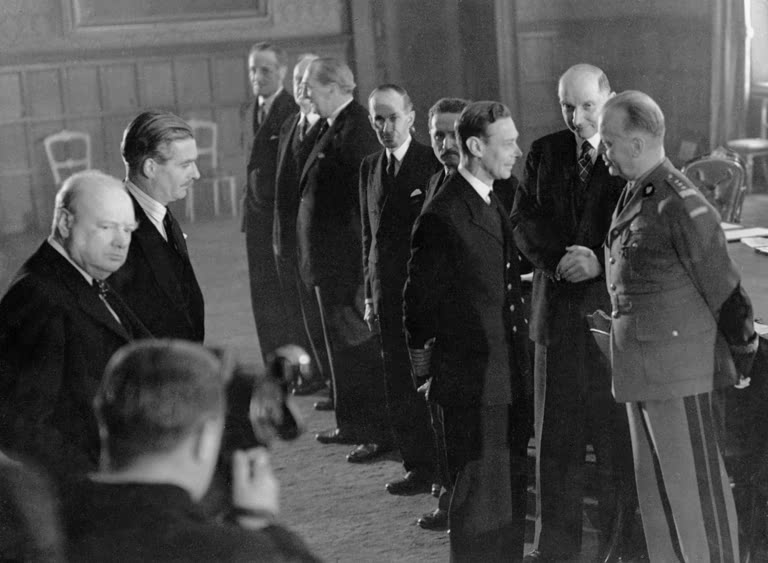
From St. James’s Place in London fourteen Allies vowed to fight until victory is won. The governments and governments in exile of Britain, Canada, Australia, New Zealand, South Africa, Belgium, Czechoslovakia, Greece, Luxemburg, The Netherlands, Norway, Poland, Yugoslavia, and Free France also pledged mutual assistance and to not conclude any separate peace treaties with the Axis alliance. Prime Minister Churchill gives a speech to the delegates, stating in part:
“Hitler may turn and trample this way and that through tortured Europe. He may spread his course far and wide and carry his curse with him. He may break into Africa or into Asia. But it is here, in this island fortress, that he will have to reckon in the end. We shall strive to resist by land and sea.”
The governments agree in the “St. James Agreement” on the following points:
- That they will continue the struggle against German or Italian aggression until victory has been won and they will mutually assist each other in this struggle to the utmost of their respective capacities;
- There can be no settled peace and prosperity so long as free peoples are coerced by violence into submission to domination by Germany or her associates or live under the threat of such coercion;
- That the only true basis for enduring peace is the willing cooperation of the free peoples in a world in which, relieved of the menace of aggression, all may enjoy economic and social security; and that it is their intention to work together with other free peoples both in war and peace to this end.
Notably absent from the conference is an American representative.
It is Anne Frank’s 12th birthday. The family now lives in Amsterdam, The Netherlands. Her father Otto has had to transfer his shares in his company, Pectacon (a wholesaler of herbs, pickling salts, and mixed spices) to a non-Jew, Johannes Kleiman. The company was then liquidated. The family still lives openly on the Merwedeplein, but Otto’s income has been greatly reduced.
In the Warsaw Ghetto, 15-year-old Mary Berg writes in her diary:
“The ghetto is becoming more and more crowded; there is a constant stream of new refugees. These are Jews from the provinces who have been robbed of all their possessions. Upon their arrival the scene is always the same: the guard at the gate checks the identity of the refugee, and when he finds out he is a Jew, gives him a push with the butt of his rifle as a sign that he may enter our Paradise. […] These people are ragged and barefoot, with the tragic eyes of those who are starving. Most of them are women and children. They become charges of the community, which sets them up in so-called homes. There they die sooner or later.”
She concludes her entry: “The community is helpless.”
German heavy cruiser Lützow, light cruiser Emden, light cruiser Leipzig, and destroyers passed through the Kattegat between Denmark and Sweden. Lützow passes out of the Skagerrak on her way to Norway and a later breakout to the North Atlantic. This is UNTERNEHMEN SOMMERREISE (Operation Summer Trip).
The Royal Navy is keeping a close eye on Lutzow’s progress and sends battleship King George V and light cruisers Arethusa and Aurora to reinforce the Northern Patrol. Just before midnight, the British Ultra service decodes German messages indicating where the German ships are. To intercept them, the RAF launches five Bristol Beaufort Mk I torpedo bombers of No. 22 Squadron from Wick and nine Beaufort Mk I machines of No. 42 Squadron from Leuchars in Scotland. Just after midnight on the 13th, a Bristol Blenheim of RAF No. 114 spots the German ships and reports their position.
At Malta, an unusual naval action results when Royal Navy trawler HMS Jade goes out early in the morning to rescue a missing RAF pilot about 17 miles off the coast of Sicily. Two E-boats come out to confront the Jade and fire torpedoes. The torpedoes miss, and Jade opens fire, which returns fire. One man is killed on the Jade and the two E-boats take serious damage. The downed pilot, meanwhile, is never found.
British cruiser HMS Sheffield sank German tanker Friedrich Breme with shellfire in the Atlantic Ocean; 2 were killed 86 survived.
The British cargo ship Empire Dew was torpedoed and sunk north of the Azores by German submarine U-48.
Dutch submarine HNLMS O.24 sank Italian tanker Fianona and auxiliary patrol ship Carloforte 10 miles north of the island of Elba, Italy.
A three-day conference of SS men of SS-Gruppenführer rank began at the SS castle of Schloß Wewelsburg in Büren, Germany.
German Jews are ordered to designate themselves only as without faith (glaubenlos).
RAF Bomber Command, Day of 12 June 1941
12 Blenheims on coastal sweeps and to Brest. There was insufficient cloud for the Brest raid but other Blenheims attacked and hit a cargo ship off Gravelines. No aircraft lost.
RAF Bomber Command, Night of 12/13 June 1941
Soest
91 Hampdens to the railway yards but visibility was poor and only 42 aircraft bombed the primary target. 2 aircraft lost.
Schwerte
80 Whitleys and 4 Wellingtons to railway yards but ground haze was encountered and only 41 aircraft bombed the primary target. 3 Whitleys lost.
Hamm
82 Wellingtons to attack the railway yards claimed good bombing results. No losses. Hamm reports that 7 bombs fell in the town. 6 exploded but did not cause any serious damage. The seventh bomb blew up later, killing 2 bomb-disposal men, the only fatal casualties of the raid.
Osnabrück
61 Wellingtons to railway yards claimed good bombing. 1 aircraft lost. Local records describe this as a ‘lively attack’.
Hüls
11 Halifaxes and 7 Stirlings to the chemical works. Fires were started in the target area. No losses.
Minor Operations: 2 Wellingtons to Rotterdam, 1 Wellington to Emden. No losses.
Total effort for the night 339 sorties, 6 aircraft (12 percent) lost. 4 Wellingtons of 405 (Vancouver) Squadron sent to Schwerte on this night represent the first operational flight by the first of many Canadian squadrons to serve in Bomber Command.
The Luftwaffe has most of its assets in the East. Before dawn, they send one Heinkel He 111 of 1,/KG 28 to bomb Birmingham. The Luftwaffe also raids Dover, killing 16 people.
Hauptmann Herbert Nebenfuhr takes over as Gruppenkommandeur of Erg. Gruppe./JG 27 from Hptm. Erich Gerlitz.
RAF and Italian fighters engage in fierce battles around Malta. The Italians send a formation over Malta from north to south and lose five fighters. The RAF loses two fighters, with one pilot killed and the other badly wounded. A third RAF fighter is damaged. Flight Commander Thomas Francis Neil of RAF No. 249 Squadron claims a Macchi MC-200 Thunderbolt fighter.
While this incident isn’t intended as a war crime, it illustrates how even good intentions can go awry. At Malta, two Hawker Hurricanes are sent up to intercept enemy planes approaching the island. The fighters fire on one of the planes they find, a flying boat, in the darkness. The plane turns out to be an Italian Red Cross plane. The RAF pilots break off the attack when they realize their mistake, but it is too late — the Cant plane crashes into the sea, with unknown casualties.
This kind of incident resulting from the fog of war builds up hard feelings and leads to later incidents. The Italians, of course, don’t know anything about good intentions and mistakes, they only know that the RAF shot down a Red Cross plane. Each side very much notices and keeps a score of these types of incidents.
The South African Air Force embarked on its first combat mission in North Africa.
U-371, commanded by Kapitänleutnant Heinrich Driver, sank British steamer Silverpalm (6373grt) in 51N, 26W. At 0326 hours on 12 June 1941, U-371 hit a vessel of the Kent or Tongario type with two torpedoes and observed it sinking after 38 minutes. This must have been the Silverpalm (Master Richard Long Pallett), which was reported missing in the North Atlantic after being seen the last time on 1 June. On 15 July, a lifeboat with eight bodies was sighted by the British trawler Cave in 62°09N/13°08W. The master, 53 crew members, eleven gunners and three passengers were lost. The 6,373-ton Silverpalm was carrying general cargo and was headed for Glasgow, Scotland.
U-48, commanded by Kapitänleutnant Herbert Schultze, sank British steamer Empire Dew (7005grt) in 51-09N, 30-16W. At 0251 hours on 12 June 1941 the unescorted Empire Dew (Master John Edward Elsdon), detached from convoy OG.64, was torpedoed and sunk by U-48 north of the Azores. 20 crew members and three gunners were lost. The master, 18 crew members and one gunner were picked up by HNoMS St Albans (I 15) on 18 June and landed at Liverpool. The 7,005-ton Empire Dew was carrying ballast and was headed for Father Point, New Brunswick.
U-552, commanded by Oberleutnant zur See Erich Topp, sank British steamer Chinese Prince (8593grt) in 56-12N, 14-18W. At 0414 hours on 12 June 1941 the unescorted Chinese Prince (Master Wilma Finch) was torpedoed and sunk by U-552 south of Rockall. The master, 43 crew members and two gunners were lost. 18 crew members were picked up by HMS Arbutus (K 86) (T/Lt A.L.W. Warren, RNR) and HMS Pimpernel (K 71) (Lt F.H. Thornton, RNR) and landed at Londonderry. The 8,593-ton Chinese Prince was carrying general cargo, including potash, currants, and magnesite and was headed for Liverpool, England.
U-553, commanded by Kapitänleutnant Karl Thurmann, sank British steamer Susan Mærsk (2355grt) in the North Atlantic.At 0122 hours on 12 June 1941, U-553 fired one torpedo at an unescorted freighter about 370 miles north-northeast of the Azores and observed how the ship sank within 90 seconds after being hit underneath the bridge. The U-boat had spotted the ship about five hours earlier and missed with a stern torpedo at 0105 hours. The target must have been the Susan Mærsk (Master Kaj Bjørn Thomsen) which was reported missing after being detached from convoy OG.64. The master, 22 crew members and one gunner were lost. The 2,355-ton Susan Mærsk was carrying ballast and was headed for Curaçao.
U-553 later sank Norwegian tanker Ranella (5590grt) from convoy OG.64 in 43-39N, 28W. At 1505 hours on 12 June 1941 the unescorted Ranella (Master Conrad Mørland), dispersed from convoy OG.64, was hit on the port side in the tank #4 by one torpedo from U-553. After the crew abandoned ship in two lifeboats, the tanker was hit by a coup de grâce at 1635 hours behind the mast and broke in two but remained afloat. The U-boat surfaced and after 1706 hours fired 100 rounds from her deck gun until she sank. The boats were separated the next day in bad weather, but both sailed about 300 miles in twelve days and reached Figueira da Foz, Azores Islands. The 5,590-ton Ranella was carrying ballast and was headed for New York, New York.
Battleship HMS King George V, light cruisers HMS Aurora and HMS Arethusa and destroyers HMS Bedouin, HMS Punjabi, HMS Eskimo, and HMS Nestor departed Scapa Flow at 0127 for 64N, 28-30W. Battleship HMS Nelson and heavy cruiser HMS Devonshire remained at Scapa Flow, but continued on one hour’s notice. On patrol, light cruiser Aurora intercepted Finnish steamer Rolfsborg (1831grt) and sent her into Kirkwall for inspection. Light cruiser Arethusa intercepted Finnish steamer Kronoborg (6537grt) and sent her to Kirkwall also. At 1319 on the 14th, the British ships arrived back at Scapa Flow.
Destroyers HMS Electra and HMS Anthony departed Scapa Flow at 2330 for the Clyde where they arrived at 1630/13th. Destroyer HMS Antelope departed Scapa Flow at 1500/13th to join these destroyers for a special convoy escort.
Ex-US Coast Guard cutter/escort ship HMS Sennen was damaged in a collision with harbor drifter Animate (88grt) in the Clyde.
Heavy cruiser HMS Norfolk departed Freetown to escort convoy SL.77, which had departed Freetown on the 8th, to the UK. The heavy cruiser carried 181 German prisoners from the tankers Esso Hamburg (9849grt) and Egerland (9789grt). Cruiser Norfolk arrived at Scapa Flow on the 29th.
German tanker Friedrich Breme (10,397grt) was sunk by light cruiser HMS Sheffield in 49-48N, 24-00W. Eighty eight German survivors, including twelve wounded of which two died of wounds, were picked up.
New Zealand Division light cruiser HMS Leander and destroyers HMS Jervis and HMS Hasty departed Alexandria, to relieve light cruiser HMS Ajax and destroyers HMAS Stuart, HMS Kandahar, HMS Jaguar, and HMS Hotspur, off Syria.
Corvette HMS Hyacinth arrived at Haifa from Alexandria.
French tanker Adour (1105grt) was damaged by a British torpedo plane off Syria. The tanker was able to proceed to Turkey where she was interned.
Submarine HMS Cachalot departed Alexandria with supplies for Malta.
Submarine HMS Torbay sank Italian schooner Gesue e Maria (239grt) off Skiros Island in 39-10N, 25-20E.
Dutch submarine HNLMS O.24 sank Italian tanker Fianona (6660grt) south of Vada in 43-08N, 10-30E on the 12th. The next day auxiliary patrol ship trawler Carloforte (143grt) was sunk with a demolition charge 36 miles 294° from Gorgara.
President Roosevelt filled two Supreme Court vacancies with new dealers today and simultaneously elevated Associate Justice Harlan F. Stone, who shares his theory of constitutional interpretation, to the post of Chief Justice of the United States. As associate justices, Mr. Roosevelt appointed Attorney-General Robert H. Jackson of New York and Senator James F. Byrnes of South Carolina. There was much conjecture immediately as to who would get Jackson’s cabinet post. The most frequently mentioned was Solicitor-General Francis M. Biddle.
Although a Republican, and before his elevation to the bench not only a director of big corporations but also a Wall Street lawyer with business and family connections with “the Morgans,” Justice Harlan F. Stone has turned out to be one of the leading supporters of President Roosevelt’s progressive legislation on the United States Supreme Court.
The Senate passed and sent to the house today legislation authorizing President Roosevelt to defer from military training all registrants who have reached their twenty-eighth birthday by July 1. This will apply in subsequent years on the same date. In the same bill which conferred authority on President Roosevelt to defer induction for military training of all men past their twenty-eighth birthday, the Senate voted today to empower the government to take over strike-bound defense plants when mediation efforts have failed.
RAF Air Marshal Arthur Harris arrives in the United States. He is head of the RAF purchasing mission.
Acceding to a request of the defense mediation board, the C.I.O. Steel Workers Organizing Committee called off yesterday a strike set for midnight in two plants of the airplane propeller division of Curtiss Wright Co., near Pittsburgh. As this newest threat to American warplane production was removed, the senate acted to strengthen the government’s hand in dealing with strikes in defense industries. It approved, 67 to 7, a measure authorizing President Roosevelt to take over defense plants in cases where production is threatened and management, or labor has failed to make use of mediation agencies.
The executive council of the International Association of Machinists (A.F.L.) tonight asked striking west coast machinists to call off the protracted shipyard walkout in deference to a “direct request” from President Roosevelt. At the same time, the council denied responsibility for the strike in the San Francisco bay area, blaming Its continuance on failure of the Bethlehem Shipbuilding Corp. to sign a master contract for the west coast negotiated in the shipyards last April 23.
The Office of Production Management took two important steps today to speed up construction of merchant ships for the United States and Great Britain. Shipyards will have priority on the allocation of steel.
In his weekly radio address, Los Angeles Mayor Fletcher Bowron states that the Los Angeles Police Department has done a good job handling the recent North American Aviation Strike. He claims that the police were unable to handle the violent confrontation, requiring the presence of US Army troops to secure the plant and return it to operation pursuant to President Roosevelt’s recent executive order.
Philip Murray, president of the C.I.O., today condemned the use of troops in strikes and attacked any attempt by a “mediation board” to “impose compulsory arbitration or to interfere in any way with the basic rights of labor.”
Leaders of unions identified with the left wing of the C.I.O. in this city sent telegrams to Philip Murray, president of the C.I.O., last night endorsing his condemnation of the use of troops in defense strikes and pledging support in his fight for “the protection of fundamental trade union rights.”
The straight-line production methods which have made American automobile manufacture the most efficient in the world have just been adopted — for the first time in American airplane manufacture — at the plant of Vultee Aircraft, Inc., at Vultee Field, Calif., according to Victor Emanuel, president of the Aviation Corporation, which controls Vultee Aircraft.
Organized labor in the United States Has lost substantial public sympathy in recent months — and indeed has fewer friends than at any time in the last five years, including the period of the “sitdown” strikes a few years ago — a nation-wide survey of American voters indicates today.
Prince Bernhard, scion of one of the oldest families in Germany, who became “100 percent Dutch” when he married the Crown Princess Juliana of the Netherlands, declared in Boston today that the German people have gone so far wrong under the Nazi regime that, in his opinion, it is virtually impossible for the old Germany of culture and learning to be reborn even after the Reich’s “defeat.”
Grounded on a reef a mile south of Point Conception, California, during a dense fog early today, the American-Hawaiian line freighter Iowan resisted efforts of the U.S. Coast Guard cutter Perseus to free it. The bow was lifted 13 feet above the water line and a hole was torn in the No. 1 hold, where water stood five feet deep. The sea was calm however, and the ship seemed in no immediate danger.
Leon Henderson, Federal price control administrator, asked the presidents of the Ford Motor Company, Chrysler Corporation, Nash-Kelvinator Corporation, Studebaker Corporation and the Hudson Motor Car Company today to withdraw immediately recent price increases of $15 to $53 for new cars.
Despite all efforts to take up the slack in transportation of oil from Southern fields caused by the diversion of fifty tankers to British use, Secretary Ickes said today that a shortage impended which he feared would inevitably involve restriction of oil and gasoline in the Atlantic Coast area to assure deliveries, especially of fuel oil, for the essential needs of residents of the Eastern States.
All members of the U.S. Naval Reserve, not in a deferred status, were called to active duty.
The Japanese Vice-Consul in Hawaii, Takeo Yoshikawa (a Japanese military intelligence operative under the assumed name Tadashi Morimura), continues spying on U.S. fleet and freighter movements in Pearl Harbor. Today, he reports that transport President Pierce has sailed for the Philippines with about 900 soldiers and 100 pilots on board.
Major League Baseball:
Babe Phelps, who skipped spring training, misses the Dodger train to St. Louis and returns to New York claiming he’s “ill.” A furious Durocher declares he’s “through” with the hypochondriac catcher, fines him $500 and puts Herman Franks behind the plate for the Cards’ series. Phelps returns to Maryland and will not play the rest of the season.
A month after joining the two Waner brothers together, the Braves ship Lloyd (.412) to the Reds for pitcher Johnny Hutchings. The Waners will team up together on the Dodgers in 1944.
Paul Derringer, veteran right-hander who had been bemoaning the five one-run setbacks in his string of seven defeats, gained a 1–0 shutout victory today as the Reds completed the series with the Braves. Derringer topped Art Johnson, young southpaw, in a pitching duel. His team-mates made two of their five hits in the first inning for their run. Johnson had retired the first two batters on infield outs before Harry Craft singled. Frank McCormick walked, and Ernie Koy, who got two hits, singled Craft home. No Red got beyond second base thereafter. Derringer, winner of five previous starts, gave Boston four hits, two by Maxie West, and one base on balls. Only three times did a Brave reach second. Derringer fanned six. Johnson had two strike outs to his credit while issuing as many bases on balls.
Over the vigorous protest of manager Jimmy Dykes and his aroused White Sox, the Yankees tonight attained their longest winning streak of the year, five straight games, as they submerged the Chicagoans, 3–2, in a ten-inning struggle that thrilled 37,102 fans. Joe DiMaggio’s twelfth home run of the campaign decided the issue, after a disputed two-base blow by Charley Ruffing, pinch-hitting for Spud Chandler in the ninth, propelled the Yankees into a tie at 2–2. Two were out in the tenth when DiMaggio’s bat spoke on the fourth pitch served by the left-handed Thornton Lee. The ball arched in the glare of the arc lights, disappeared for a brief moment in the higher darkness and came down in the lower stand in left center as DiMaggio rounded the bases amid deafening cheers from the crowd.
A’s manager Connie Mack played a hunch that rewarded him with a 5–3 victory over the Tigers today. It was the first triumph for the Athletics in eight starts with the American League champions this season. With two out in the ninth and big Al Benton coming to the relief of Johnny Gorsica, Connie decided to string along with Al Brancato, relatively light-hitting shortstop, instead of calling a power hitter from the bench. Rain was pelting the players when Brancato belted a three-run homer, his second of the year, to end a six-game Philadelphia losing streak.
The Giants had no time to waste. They had to catch a train in the evening and the dining car was ready for them. There is nothing like a meal to make a ball player hustle, so they ripped through the Cubs in slightly more than an hour and a half at the Polo Grounds yesterday to head for the West in third place, one point ahead of the Reds, with whom they had been tied. Carl Hubbell plucked a tight game from Bill Lee, 2–0, registering his first shut-out of the campaign. The screwball maestro was touched for eight hits while his rival gave only six, but Hubbell was supreme in the pinches.
Bob Muncrief of the Browns and Mike Ryba of the Red Sox were the stars in relief pitching roles today as the teams divided a double-header, St. Louis winning the opener, 9–4, and the Sox the nightcap, 3–2. Muncrief held Boston scoreless for eight and one-third innings of the first game and Ryba was equally effective after succeeding Earl Johnson in the fourth inning of the second. Ted Williams won for the Red Sox with his eleventh home run of the season with Lou Finney on base in the third inning. Finney’s triple and Manager Joe Cronin’s single accounted for the first run, which the Browns matched on Chet Laabs’s double and Johnny Berardino’s triple.
The scheduled game between the Washington Senators and the Indians at Cleveland was postponed due to rain. The game will be made up as part of a doubleheader on August 19.
Cincinnati Reds 1, Boston Braves 0
New York Yankees 3, Chicago White Sox 2
Philadelphia Athletics 5, Detroit Tigers 3
Chicago Cubs 0, New York Giants 2
Boston Red Sox 4, St. Louis Browns 9
Boston Red Sox 3, St. Louis Browns 2
It was officially announced today that Japan and Russia had concluded a commercial agreement providing for mutual most-favored-nation treatment and a balanced barter exchange of goods up to 30,000,000 yen for the first year.
Dow Jones Industrial Average: 122.98 (+0.8)
Born:
Marvin Philip Aufrichtig [Marv Albert], sportscaster (“NBA on NBC”), in Brooklyn, New York, New York.
Chick Corea, jazz pianist, 27 time Grammy winner, in Chelsea, Massachusetts (d. 2021).
Roy Harper, folk rock musician, in Rusholme, Manchester, England, United Kingdom.
Reg Presley, lead singer of The Troggs, in Andover, Hampshire, England, United Kingdom (d. 2013).
Gerry Arrigo, MLB pitcher (Minnesota Twins, Cincinnati Reds, New York Mets, Chicago White Sox), in Chicago, Illinois.
Naval Construction:
The U.S. Navy Mattaponi-class oiler USS Neches (AO-47) is laid down by Sun Shipbuilding & Drydock Co. (Chester, Pennsylvania, U.S.A.).
The Royal Navy Assurance-class rescue tug HMS Adherent (W 108) is laid down by Cochrane & Sons Shipbuilders Ltd. (Selby, U.K.).
The Royal Indian Navy Basset-class minesweeping trawler HMIS Ahmedabad (T 264) is laid down by the Scindia Steam Navigation Co. Ltd. (Bombay, India).
The U.S. Navy YMS-1-class auxiliary motor minesweeper USS YMS-43 is laid down by the Wheeler Shipbuilding Corp. (Whitestone, Long Island, New York, U.S.A.).
The U.S. Navy YMS-1-class auxiliary motor minesweeper USS YMS-79 is laid down by the Stadium Yacht Basin (Cleveland, Ohio, U.S.A.).
The U.S. Navy YMS-1-class auxiliary motor minesweeper USS YMS-98 is laid down by the Colberg Boat Works (Stockton, California, U.S.A.).
The U.S. Navy 77-foot Elco patrol motor torpedo boat USS PT-49 is laid down by the Electric Launch Company Ltd. (Elco), (Bayonne, New Jersey, U.S.A.). She is transferred to the Royal Navy on completion, commissions as HMS MTB 307.
The Kriegsmarine (German Navy) Type IXC U-boat U-518 is laid down by Deutsche Werft AG, Hamburg (werk 314).
The Royal Navy “U”-class (Third Group) submarine HMS Unshaken (P 54) is laid down by Vickers Armstrong (Barrow-in-Furness, U.K.).
The U.S. Navy Fletcher-class destroyers USS Capps (DD-550) and USS David W. Taylor (DD-551) are laid down by Gulf Shipbuilding Corp. (Chickasaw, Alabama, U.S.A.).
The Royal Navy LCT (Mk 2)-class landing craft, tank HMS LCT 118 is launched by Tees-Side Bridge (Middlesbrough, U.K.).
The Kriegsmarine (German Navy) Type VIIC U-boat U-135 is launched by Bremer Vulkan-Vegesacker Werft, Bremen-Vegesack (werk 14).
The Kriegsmarine (German Navy) Type VIIC U-boats U-581, and U-582 are launched by Blohm & Voss, Hamburg (werk 557 and 558).
The Royal Navy harbor defence motor launch HMS HDML 1008 is commissioned.
The U.S. Navy coastal minesweeper USS Mockingbird (AMc-28) [ex-dragger Rio Douro] is commissioned.
The Royal Navy LCT (Mk 2)-class landing craft, tank HMS LCT 114 is commissioned.
The Royal Navy LCT (Mk 2)-class landing craft, tank HMS LCT 115 is commissioned.
The Royal Navy Fairmile C-class motor gun boat HMS MGB 313 is commissioned.
The Kriegsmarine (German Navy) Type VIIC U-boat U-574 is commissioned. Her first commanding officer is Oberleutnant zur See Dietrich Gengelbach.
The Royal Australian Navy Bathurst-class minesweeper-corvette HMAS Maryborough (J 195) is commissioned. Her first commanding officer is Lieutenant Commander Glen Loftus Cant, RAN.

