Defense ministers of the North Atlantic Treaty Organization said after a two‐day meeting here that they were concerned about a continuing use in the military power of the Warsaw Pact but satisfied that the Atlantic alliance was moving toward countering this threat. These views were expressed in a communiqué issued by the defense ministers of all member countries of the alliance except France and Greece which do not participate in the military side of the organization. The ministers said they were encouraged by the prospect of a substantial increase in United States military spending this year and by reports of force improvements by the various allies. The atmosphere of the meeting appeared unusually relaxed, with none of the bickering about defense cuts by individual nations that had marked previous meetings.
Syria and the Palestinian guerrilla movement disagreed on how to use the “symbolic” peacekeeping force being sent to Lebanon by the Arab League, but outright opposition to any such force was expressed by Lebanon’s right-wing Christian leader, Interior Minister Camille Chamoun, who warned that the league would be responsible for “drowning Lebanon in blood.” The Libyan Prime Minister, Abdel Salam Jalloud, who has taken the role of mediator in Lebanon and who was a supporter of the Syrian position, was said to be leaning toward the Palestinian view that the peace-keeping force should “replace” Syrian troops. After a night of gun battles end shelling duels between Syrian troops entrenched around Beirut’s closed airport and Palestinian guerrillas and their Lebanese leftist and Muslim allies, this capital was again quiet during the day. Meanwhile, there have been no tangible signs so far of any Arab “green helmets,” as the Arab League force has been dubbed by the Beirut press. There were reports from Damascus yesterday that Algerian troops for the Arab League force were arriving in Lebanon, and the Beirut radio said last night that 100 Sudanese had landed at the airport in Beirut. But the radio, which is leftist controlled, said later that the troops might have been Libyans or Algerians and then abandoned the news item, and today there was press speculation that Syrian reinforcements had in fact landed.
Syria reinforced its military occupation of the strategic Bekaa Valley area of Lebanon — where some of the toughest battles of the Lebanese civil war took place — with scores of tanks, communication camps and armed patrols at virtually every passable road leading to the main highway between Damascus and Beirut. It was estimated that Syria now has 350 to 400 tanks in Lebanon, and 12,000 troops, including soldiers stationed outside Beirut and near Saida in the south and Tripoli in the north. The scope and precision of the occupation indicated skepticism that the Lebanese war would be over soon and that Syria was prepared to stay in Lebanon indefinitely. This afternoon, during a four‐hour tour of the occupied Lebanese area conducted by the Syrian Government, a group of Western and Arab reporters saw at least 25 Soviet-made T‐54 Syrian tanks positioned along the north‐south road that interdicts the main Damascus‐Beirut highway. The tank crews sat sweating in or on their vehicles, apparently ready to move on short notice toward the main Syrian force, which is on the other side of the Lebanon Mountains, poised some 12 miles from Beirut. Several times during the afternoon, Syrian tanks, singly or in groups of two or three, moved toward the front at high speed. Alongside roads and in fields in the valley at least three batteries of mobile artillery cannons were aimed at the sky, their crews standing by.
The prolonged fighting in Lebanon has sent Soviet fortunes in the Middle East sliding to their lowest point in nearly a decade, with Moscow unable to exert decisive influence despite its long identification with the Arab cause. The eventual impact could yet compare with the blow that the Soviet Union suffered when Israel defeated its Arab clients in the 1967 war. For this time, the Russians have been reduced to watching the Syrians and Palestinians, whom they have backed politically and materially, fight each other with weapons of Soviet design. Moscow began shifting its hopes in the Middle East to Syria and the Palestine Liberation Organization after Egypt pulled away on an independent course that culminated in President Anwar el‐Sadat’s abrogation of the Soviet-Egyptian friendship pact. Its remaining alternatives are Iraq and Libya, which Soviet insiders say are too radical for comfort.
Egyptian President Anwar el-Sadat says he believes there is enough common ground among Lebanon’s warring factions that a settlement to the 14-month-old war can be found if they sit down for talks with the country’s President-elect, Elias Sarkis.
Prime Minister Indira Gandhi ended a four‐day visit to Moscow today in an extremely friendly atmosphere after talks that she said had strengthened Soviet-Indian ties. Although no concrete new agreements were expected, the warmth with which Mrs. Gandhi was received underscored Moscow’s apparent anxiety over the recent improvements in relations between India and China. New Delhi and Peking have agreed to end a 14‐year chill in their relations by exchanging ambassadors, and the Soviet Union — which has provided huge amounts of economic aid to India in recent years — has gone all out this week to court Mrs. Gandhi.
Fourteen months after they seized power in South Vietnam, the Communist authorities in Saigon have published a decree that seems to tighten controls over farmer members of the old anti‐Communist Government and armed forces. According to the lengthy document broadcast over Saigon radio and monitored by American officials, virtually all former members of the armed forces, as well as security, intelligence and police organizations, “must attend collective re‐education courses for three years.” Many of these officials have already been in these camps for most of the past year, and the decree allows them to count that time spent against the three years.
Prime Minister Pierre Elliott Trudeau has accepted an invitation from President Ford to visit Washington next Wednesday for informal talks and a White House dinner. The Prime Minister will use the occasion to present Canada’s Bicentennial gift to the United Slates, a book of photographs on the 5,500‐mile frontier between the two countries. The announcement said “during previous meetings the President and Prime Minister had agreed on the utility of periodic Informal meetings and they “look forward to this meeting to continue their discussion of subjects of mutual interest.”
Third-world representatives who dominated the United Nations Conference on Human Settlement in Vancouver endorsed sharp restrictions on the private ownership of land and asked that land be managed as a public resource rather than a profit-generating commodity. They also called for the redistribution of land in poor countries and a more equitable share of wealth.
Secretary of State Henry A. Kissinger today appeared to stiffen Washington’s conditions for an improvement of relations with Havana by demanding that all Cuban troops must first be withdrawn from Angola. During a news conference, here. Mr. Kissinger said it was too early to judge whether the total number of Cuban troops in Angola — estimated two months ago at 15,000 — was in fact being reduced. “We are not able to achieve conclusive confirmation, especially confirmation whether there is a net return or just a rotation of troops,” Mr. Kissinger said. “At this moment, the withdrawal is too small to draw any conclusions.”
The Inter‐American Human Rights Commission has appealed to the Cuban Government to take immediate steps, to end what it calls “cruel, inhuman and degrading” treatment of political prisoners. In a report, the commission says that numerous communications from individuals and organizations provide a “solid basis” for the belief that Cuba treats its political prisoners with “complete disdain.” Complaints received by the commission allege that prisoner in Cuba are often victimized by extreme physical and psychological cruelty, lack of medical assistance and adequate food. They allege degrading conditions, forced labor, solitary confinement, prohibition of visits and measures to force acceptance of political indoctrination. The commission declined to identify the sources of the complaints.
The anti-Castro terrorist group Coordination of United Revolutionary Organizations, CORU (Coordinación de Organizaciones Revolutionarias Unidas), was created by two Cuban exiles, Dr. Orlando Bosch and former CIA agent Luis Posada Carriles at a meeting in the Dominican Republic resort of Bonao. According to an FBI internal memo written August 16, 1978, five anti-Castro groups… united in the Dominican Republic on June 11, 1976…. Accion Cubana, Cuban Nationalist Movement, Cuban National Liberation Front, Association of the Veterans of the Bay of Pigs Brigate 2506 and the 17th of April Movement.” CORU’s first terrorist act would be the bombing of Cubana de Aviación Flight 455 on October 6, 1976, killing all 73 people on board.
Heavily armed men stormed into two Buenos Aires hotels before dawn today and took away at least two dozen political refugees including two teenagers, United Nations refugee agency officials said. The gunmen hit the exiles, smashed up rooms and stole money and personal documents, according to refugees who were left behind. Witnesses in one hotel said the gunmen, numbering about 30, shouted “police, police,” but did not produce identification. The raids occurred less than 48 hours after gunmen ransacked the office of a committee aiding refugees and stole master lists containing the names and addresses of perhaps as many as 8,000 political exiles from neighboring nations.
The trial of 13 Britons and Americans charged as mercenaries opened in Luanda, Angola this morning with a sweeping denunciation of a “mercenary war of aggression” against the Angolan people and the People’s Republic of Angola. The state prosecutor accused the governments of Britain and the United States of “acquiescence and complicity” by tolerating the recruitment of mercenaries. In particular, according to the indictments, it was proven that the Federal Bureau of Investigation of the United States had “full knowledge and control” over the mercenary recruiting operation. An American defense lawyer, Robert Cesner Jr., who is defending the two American prisoners, raised three basic legal issues. According to the Nuremburg statute, re said, crimes against peace can be tried only in an international military court; only high ranking officials or military commanders can be tried for war crimes, and the 1966 “combatants’ disciplinary law,” which provides for the death penalty for the enemy, has not been ratified by the Angolan Government.
A spokesman for an Angolan nationalist movement that was defeated in the recent civil war said here today that his faction had rallied support and was scoring gains in a continuing guerrilla campaign. The spokesman, who asked that his name not be used, was known to this reporter in Angola as a confidant of Jonas Savimbi, the leader of the National Union for the Total Independence of Angola. Mr. Savimbi vowed in February after the National Union’s defeat in conventional warfare, that he would remain in Angola “to fight or die” and said his men had hidden away stores of ammunition sufficient for a year. The spokesman had with him letters from Mr. Savimbi asserting that his forces had the support of the southern half of Angola outside of the cities. Through raids, ambushes and sabotage, Mr. Savimbi wrote to the spokesman, the movement has prevented the reopening of the Benguela Railroad across the middle of the country and in isolated clashes has killed 900 Cubans and 400 Government troops in the last two months while losing 100 of its own.
President Idi Amin of Uganda escaped an assassination attempt in Kampala last night when three grenades were thrown at a parade of police recruits, killing one person and wounding 36, the Uganda radio reported today.
The anti-apartheid advocate Dumisa Ntsebeza is arrested in South Africa.
Representative Wayne Hays’ doctor said that according to preliminary tests the Ohio Democrat took at least 10 times the prescribed amount of a sleeping medication that put him into a coma Thursday. Mr. Hays came out of the coma today and began what was described as a “dramatic recovery.” “There is the possibility of a suicide attempt,” his doctor said. A spokesman for the Food and Drug Administration in Washington called Dalmane “one of the safer prescription drugs available for the treatment of insomnia.” He said that in 1974, the latest year for which statistics were available, 569 cases of Dalmane poisoning had been reported to the F.D.A.’s National Poison Clearinghouse, causing the hospitalization of 195 people and the death of one person. Asked if Mr. Hays was the kind of man who would have difficulty withstanding the kind of pressure he has been under since his affair with Elizabeth Ray became public, Dr. Phillips said, “Yes, this is a type of pressure he has never had before.”
Federal investigators, according to sources close to the inquiry, were said to be looking into charges by Elizabeth Ray that she was ordered by former Representative Kenneth Gray of Illinois into a sexual encounter with Senator Mike Gravel, Democrat of Alaska, Mr. Gray, the sources said, had hopes of securing Senator Gravel’s assistance in passing legislation. An independent account of that purported incident, first related by Miss Ray to the Federal Bureau of Investigation two weeks ago, has been provided to The New York Times by Colleen Gardner, a former Capitol Hill secretary, who has said that she saw the encounter. Mrs. Gardner’s version of the encounter coincides with Miss Ray’s description in her new novel, published this week, of her meeting with a “Senator Boulder” aboard a houseboat on the Potomac River some years ago.
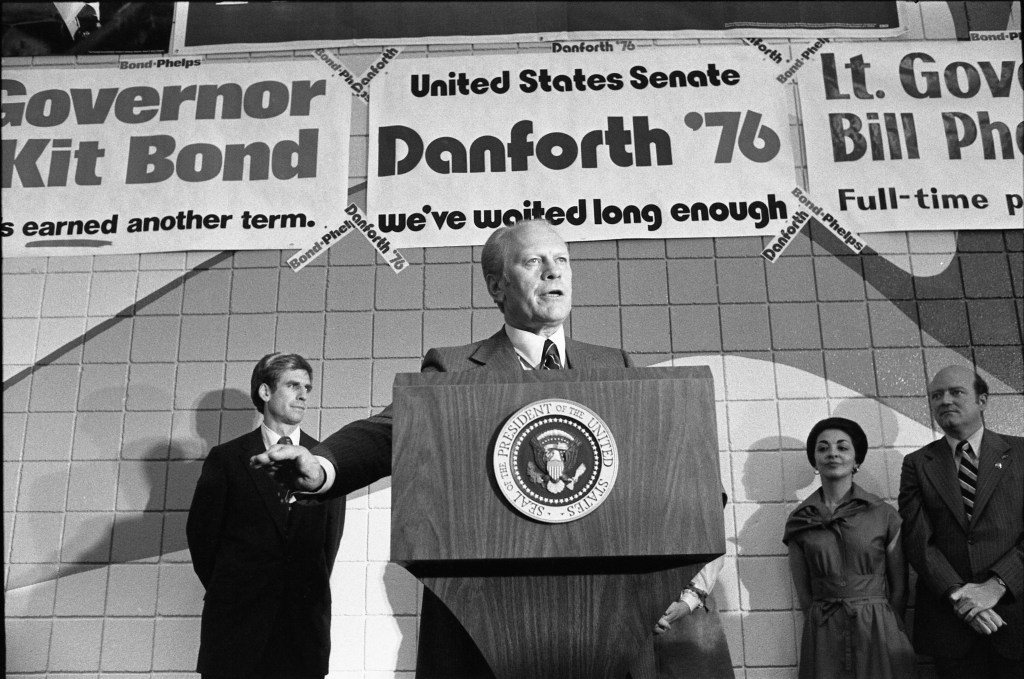
In Springfield, Missouri, President Ford and Ronald Reagan began personal appeals for the support of the remaining Republican National Convention delegates in 11 states who are vital to their campaigns. The President, followed a few hours later by the former California Governor, met privately with clusters of Missouri Republicans who will vote tomorrow on rival slates of 19 at‐large delegates to the August 16 nominating convention in Kansas City. Although the prize at the Missouri Republican convention was but a fraction of the delegates the two candidates need to secure the nomination, the personal appeals for support here by Mr. Ford and Mr. Reagan presaged their struggle in 10 other states where convention delegations are still to be selected. At the Springfield airport, the President told a welcoming crowd dotted with signs supporting his rival that he would “talk affirmatively” to the 1,439 participants in the state convention of “the progress we have made” in the 22 months of his Presidency.
Mr. Reagan was said to be trying at the same time to persuade Missouri Republicans that his victories in such big-state primaries as those in California and Texas had shown he would be a more formidable contender in the November 2 election. The Californian was also thought to be appealing for support on the contention that his ability to fight Mr. Ford to a standoff in the primaries illustrated the weakness of a party ticket led by the President. The latest delegate tally, including the last of the 30 Presidential primaries last Tuesday, gives Mr. Ford 957 and Mr. Reagan 861 of the 1,130 delegates needed to win the nomination. In addition, 162 delegates have been elected but have made no commitment to either rival.
In an unusual spirit of unity, a 15‐member subcommittee began today to draft a Democratic Party platform that will almost certainly reflect the views of former Governor Jimmy Carter of Georgia. “I think we know who the nominee’s going to be, and we’re all prepared to support him,” said Governor Michael S. Dukakis of Massachusetts, chairman of the drafting subcommittee of the Democratic Platform Committee. The subcommittee is scheduled to spend today, tomorrow and Sunday behind closed doors in a small suite at the Mayflower Hotel preparing an initial draft of the platform. The draft is to be presented to the full, 153‐member committee on Monday. The committee will then spend three days writing a final version for submission to the party’s national convention at Madison Square Garden in New York next month.
The government’s inflation-monitoring agency said that recent price increases in the steel industry appeared to be justified by higher costs. William Killey, acting director of the Council on Wages and Price Stability, said both the steel industry’s return on sales and its income as a proportion of equity were below 1972 levels and below the average for all manufacturers.
In a challenge to one of the more revered institutions of Congressional elders, two junior members of the House Armed Services Committee staged a sit‐in today at a meeting of a Senate‐House conference of the Armed Services Committee. Although they are not members of the conference committee, Representative Patricia Schroeder, Democrat of Colorado, and Representative Bob Carr, Democrat of Michigan, insisted on sitting in on a closeddoor meeting of the committee to defend two amendments they had sponsored to a military procurement bill. As Mrs. Schroeder described the action, it was a “case of affirmative action” against a system where the senior members dominate the conference on military matters and quickly, drop what they find to be objectionable amendments offered by junior members of the Armed Services Committee. The purpose of a conference committee, which has considerable power in drafting the final terms of bills passed by Congress, is to reconcile differences in legislation passed separately by the House and Senate.
The Senate Foreign Relations Committee voted approval to day of the nomination of Harry W. Shlaudeman as Assistant Secretary of State for InterAmerican Affairs. The nomination was opposed in the committee by Democrats Dick Clark of Iowa and Joseph R. Biden Jr., of Delaware, who alleged that Mr. Shlaudeman had not been candid about his role as Deputy Chief of Mission in the American Embassy in Chile before the coup that overthrew President Allende Gossens in September 1973. The committee also received letters from Senator Edward M. Kennedy, and Rep. Michael J. Harrington, both Democrats of Massachusetts, opposing the nomination.
The Senate Finance Committee approved today the highly controversial Ford Administration plan to reduce the capital gains tax on property that has been owned for an extended period of time. The committee also made changes in the estate tax that would eliminate these taxes entirely for more than half of those who would have to pay them under present law. These actions, plus dozens of others, were approved as the committee moved toward finishing the tax bill that it has worked on for the last several months. The measure contains several dozen major provisions, which have a broad impact on businesses and individuals, and hundreds of minor ones dealing with the tax problems of a single business or industry or type of income. The addition of the capital gains proposal seemed certain to enrage even further a group of 14 senators who said yesterday they would try to eliminate or amend major sections of the bill that they regard as overly helpful to business and the wealthy or ungenerous to low- and middle‐income individuals. The measure, even as it stood yesterday, was attacked by Senator Edward M. Kennedy, Democrat of Massachusetts, as “a fraud on the name of tax reform.”
Political candidate Robert A. Dufala, who had lost a race on June 8 in the primary election for the Republican nomination for U.S. Representative of New Jersey’s 2nd congressional district, was arrested by undercover agents of the U.S. Secret Service, on charges that he was planning the July 4 assassination of U.S. Vice President Nelson Rockefeller with a cyanide laced bullet. After a jury was unable to reach a verdict on March 11, 1977, Dufala would plead guilty on September 7, 1977.
Inspectors at the grain elevator operated in Baton Rouge, Louisiana by Cargili Inc., one of the two largest grain companies in the world, said that Cargill employees had instructed them to misgrade grain, a Federal Bureau of Investigation agent testified today. The agent, Robert J. Isakson, said in Federal court here that the inspectors had been told to manipulate grades to benefit Cargill—the only one of the three largest grain companies that has not been indicted for cheating its customers. Roy Wallace, a Cargill vice president, reached at the company headquarters in Minneapolis, said that the charge that inspectors would perform illegal activities to protect their jobs as “preposterous.” He said the inspectors were not employed by Cargill and that their job security could be affected only by their employer, the state grain inspection agency, or by Agricultural Department supervisors.
“Magnificent Marble Machine” last airs on NBC-TV.
The blockbuster film “Gone with the Wind” was shown on U.S. television for the first time at 2:30 in the afternoon Eastern time, after the Home Box Office pay television network purchased the rights to telecast it on non-broadcast television for 14 commercial-free and unedited showings on seven separate days (June 11, 13, 15, 18, 24, 26 and 28).
The Australian band AC/DC begins their first headline tour of Britain.
The Beatles “Rock & Roll Music” compilation LP is released in the USA.
Major League Baseball:
Finishing their attack with three homers, the Pittsburgh Pirates defeated the Atlanta Braves, 6–2. After the Pirates took a slim 2–0 lead, Bill Robinson homered in seventh inning, Richie Zisk connected with a man on base in the eighth and Bob Moose, pitching in relief of John Candelaria, hit the first homer of his major league career in the ninth.
Led by George Mitterwald, who collected four hits in four trips, the Cubs defeated the Astros, 8–3. With the score tied, 1–1, the Cubs put the game away with four runs in the fifth inning. Jerry Morales beat out an infield hit with the bases loaded, driving in one run, and when Jerry DaVanon threw wildly, another scored. Mitterwald followed an with identical infield hit and two more runs scored when DaVanon committed another error, this time bouncing a throw that struck Bob Watson and broke the Houston first baseman’s nose.
The Cards score a 5-spot in the first inning against the Reds, and lead 7–2 going into the bottom of the 7th, and were still leading, 7–5, going into the last half of the ninth when disaster struck, and lose 8–7. Tony Perez ends the game with a 3-run homer off Al Hrabosky after Ken Griffey opened the inning with a single and Joe Morgan walked. Dave Concepcion ran for Morgan.
Leading 4–3 in the last of the 11th, White Sox reliever Terry Forster gives up a 2-run pinch homer to Cleveland player-manager Frank Robinson, as the Tribe wins 5–4. Bill Stein drove in a run with a single for the White Sox in the top half of the frame, but Larvell Blanks led off the Indians’ portion with a single for his fourth hit of the game and scored ahead of Robinson on the manager’s two-out wallop. This is a turning point for the Sox, as they will go 37–75 for the rest of season and finish last.
Ron LeFlore beat out an infield hit in the ninth inning and scored on two errors to bring the Tigers a 4–3 victory over the Angels. After his hit, LeFlore scampered to second when Angel reliever Paul Hartzell threw wildly on a pickoff attempt. Alex Johnson then grounded to second baseman Jerry Remy, who made a bad throw to first, allowing LeFlore to score.
Combining on a four-hitter, Doug Bird and Mark Littell pitched the Royals to a 4–0 victory over the Orioles. Bird went seven innings before his shoulder stiffened, forcing him to yield the mound to Littell. Bird did not issue a pass, giving him a streak of 31 consecutive innings without giving up a base on balls. Al Cowens batted in two of the Royals’ runs with a pair of singles.
Steve Garvey rapped a single, double and triple to account for half of the Dodgers’ six hits in a 7–4 victory over the Expos. The Dodgers capitalized on two errors and the wildness of Clay Kirby to score five unearned runs in the first two innings. Garvey accounted for three RBIs.
Gary Sutherland, obtained in a deal with the Tigers, made his first appearance in a Milwaukee uniform and drove in the go-ahead run with a sixth-inning single as the Brewers defeated the Athletics, 4–2. With the A’s leading, 2–1, Sixto Lezcano singled for the Brewers in the sixth and counted the tying run on a triple by Gorman Thomas. Sutherland then bounced his single to send the Brewers in front. The Brewers added a run in the eighth to clinch the victory for Jim Colborn.
After giving up three runs in the first inning and coming back with six in their half, the Twins went on to defeat the Red Sox, 10–4. Bill Singer, who started for the Twins, was knocked out in the fourth after yielding another run to the Red Sox with none out, but Tom Burgmeier relieved and pitched scoreless ball the rest of the way, allowing only two hits.
Graig Nettles hit two homers, connecting for the second time with a man on base in the eighth inning, to give the Yankees a 7–5 victory over the Rangers. Nettles first homered with two aboard in the fourth, but the Rangers erupted for five runs in the fifth to take a 5–4 lead. Roy White led off the Yankee eighth with a homer to tie the score. With two out, Carlos May singled and gave way to pinch-runner Sandy Alomar before Nettles smashed his second circuit clout of the game for the winning blow.
Sparked by Jay Johnstone, who hit a homer, the Phillies rallied for four runs in the eighth inning and defeated the Padres, 4–2. After Johnstone’s blast, other runs followed on a single by Bob Boone, pass to Dave Cash, single by Garry Maddox and double by Mike Schmidt.
John Montefusco posted his third shutout of the season, allowing only three hits and pitching the Giants to a 5–0 victory over the Mets. Bobby Murcer and Marc Hill homered to account for the Giants’ runs. Murcer connected with two on base in the first inning and Hill with one aboard in the second.
Pittsburgh Pirates 6, Atlanta Braves 2
Houston Astros 3, Chicago Cubs 8
St. Louis Cardinals 7, Cincinnati Reds 8
Chicago White Sox 4, Cleveland Indians 5
California Angels 3, Detroit Tigers 4
Baltimore Orioles 0, Kansas City Royals 4
Montreal Expos 4, Los Angeles Dodgers 7
Oakland Athletics 2, Milwaukee Brewers 4
Boston Red Sox 4, Minnesota Twins 10
Texas Rangers 5, New York Yankees 7
Philadelphia Phillies 4, San Diego Padres 2
New York Mets 0, San Francisco Giants 5
Stocks advanced on a broad front yesterday, with the Dow Jones industrial average adding 14.41 points to close at 978.80. The strong rise, extending an upturn that took shape on Thursday, enabled the stock market to break a string of six consecutive weekly declines. The Dow was up 14.90 points for the week. Blue‐chip issues led the rally, which was accompanied by a slight pickup in trading. No single news development triggered the upturn. Brokers suggested it reflected an accumulation of generally positive recent economic reports.
Dow Jones Industrial Average: 978.80 (+14.41, +1.49%)
Born:
Grey Ruegamer, NFL center and guard (NFL Champions, Super Bowl 36-Patriots, 2001, and Super Bowl 42-Giants, 2007; New England Patriots, Green Bay Packers, New York Giants), in Las Vegas, Nevada.
Jared DeVries, NFL defensive end (Detroit Lions), in Aplington, Iowa.
Tai Anderson, American contemporary Christian rock bass player (Third Day, 1992-2015), in Georgia.
Died:
Joseph “Toots” Mondt, 82, American wrestler and promoter whose development of “Slam Bang Western Style Wrestling” in 1919 combined elements of wrestling, costuming and showmanship as entertainment later billed as “professional wrestling”, and who teamed with Vince McMahon Sr. to create the Capitol Wrestling Corporation in 1953, later renamed the World Wide Wrestling Federation, World Wrestling Federation and now World Wrestling Entertainment, Inc.
Jim Konstanty, 59, MLB relief pitcher (MLB All Star 1950; NL MVP 1950; Philadelphia Phillies), of cancer.

