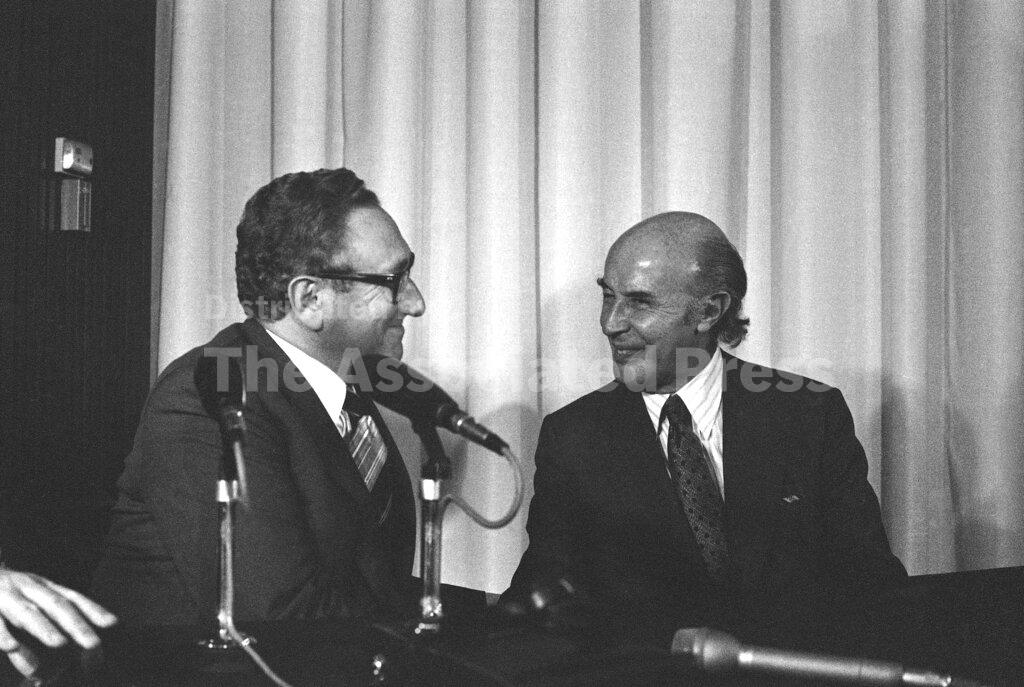
The Soviet‐bloc Warsaw Pact countries today gave an accounting of their troop strengths in Central Europe to Western powers at the Vienna talks on mutual reduction a forces, an Administration official reported. The officials said the information on troop strengths and definition of various military units in the region was the first supplied by the Warsaw Pact, groups since the talks on reduction of forces began in October 1973. The information had been formally sought by the Western participants in the 19‐century Vienna negotiations, and was considered a supplement to an Eastern European proposal on reduction put forth last February. The Administration official said the United States and other Western participants would study the data supplied by Oleg Khlestov, the Soviet delegate and compare it with their own estimates on troop strengths in Eastern Europe. The official stressed that the East Europeans had not made a new proposal in Vienna.
Hundreds of supporters of a general amnesty for political prisoners and exiles discovered today when they sought to meet that it is not enough to pass a law. The amnesty seekers, representing all shades of liberal and leftist political opinion, were planning to gather at dinner in a Madrid restaurant to bolster a campaign that has been going on ever since Generalissimo Francisco Franco died last November and King Juan Carlos I took over with the promise of a change for Spain. Part of the change came two weeks ago when Parliament approved a bill on freedom of assembly. The law provided that indoor meetings of more than 20 persons no longer required official authorization, but the authorities were given discretionary powers to ban them if they appeared to have criminal aims or if their organizers did not furnish sufficient or clear information.
The State Department has expressed its “deep regret” to Yugoslavia over a bomb that exploded outside the Yugoslav Embassy in Washington. U.S. officials in Washington and Belgrade condemned the “senseless act of violence,” which damaged the embassy and caused minor injuries to two Yugoslav employees early Wednesday.
Shirley Temple Black, the former child movie actress, was nominated by President Ford to be the first woman U.S. chief of protocol. Mrs. Black, who has been U.S. ambassador to Ghana since September, 1974, will succeed Henry Catto. The President said he intended to nominate Catto, a millionaire insurance man from Texas, to be U.S. representative to the European office of the United Nations with the rank of ambassador.
The Syrian government announced that it was obliged to take “urgent and appropriate measures” to counter a reported building of Iraqi military forces near the Syrian-Iraqi border. The Iraqi soldiers, the government said, were hurting the efforts of Syria and other Arab nations to stop the war in Lebanon. There were unconfirmed reports in Damascus that Syria had flown troops toward the Iraqi border. There were unconfirmed reports here tonight that Syria had moved troops in transport planes this afternoon toward the Iraqi border. The apparent crisis with Iraq appeared to be placing Syria in a situation where a large party of its army is in Lebanon, up to 12,000 men and up to 350 tanks. Another large part of its military forces is deployed on the edge of the Golan Heights along the United Nations zone separating Syrian troops from the Israelis. The new tension with Iraq, which has been feuding with Syria sporadically for years over political and economic matters, came as Syria was allowing troops from other Arab nations into Lebanon to help achieve and maintain a cease‐fire, under the Arab League agreement reached in Cairo.
The vanguard of a “symbolic” peace-keeping force —100 Sudanese troops — that the Arab League had said it would send to Lebanon arrived at Beirut’s airport today, and Algerian troops were said to be arriving overland from Syria. Fighting in Beirut and elsewhere in the country died down. Despite the arrival of these Arab units, there were reports of sporadic clashes near the airport to the south. The Libyan Prime Minister, Major Abdel Salam Jalloud, was reported seeking a firm ceasefire and some kind of disengagement agreement involving the Syrian expeditionary force, estimated at 12,000 men.
The United States cautiously endorsed today the latest Arab efforts to bring about a ceasefire in Lebanon and forestall a major clash between Syria and Palestinians. But a carefully worded statement by the State Department combined the tentative approval of the Arab League’s plans for a joint Lebanese security force with another in a series of warnings that the outside military intervention into Lebanon risked a wider Middle East conflict. “We welcome efforts that have a possibility of gaining an elective cease‐fire and political accommodation among the parties in Lebanon,” Frederick Z. Brown, a State Department spokesman said. As to the specific Arab League meeting in Cairo that with seeming Syrian approval has authorized other Arab states to send forces into Lebanon to help the Syrians there, Mr. Brown said: “We have noted the decision of Arab foreign ministers and are watching closely the actions flowing from it. At this point, we have no comment on inter‐Arab positions, including these efforts to form an inter-Arab force for a peace‐keeping role in Lebanon.
Indian opposition leader George Fernandes, accused of having been the mastermind of the “Baroda dynamite case”, was arrested in Calcutta almost three months after the first arrests had been made.
Senator Abraham A. Ribicoff said today that there were “strong indications” that despite public assurances to the contrary, the United States supplied India with material essential to its detonation of a nuclear device. Mr. Ribicoff said that investigators for the Senate Government Operations Committee which he heads, had discovered that the United States had supplied India with 21 tons of heavy water, an essential ingredient for enabling the Indian reactor, supplied by Canada, to transform natural uranium into plutonium. Natural uranium is not directly suitable as nuclear explosive and plutonium is. The State Department, in response to inquiries from Senator Ribicoff, acknowledged that the heavy water had been provided but contended that it had been used up four years before the explosion, in 1974.
Quiet efforts by the United States to ease the authoritarian human and civil rights policies of the South Korean Government of President Park Chung Hee show no signs of having any effect, according to interviews with diplomats, South Koreans and other observers here. In public statements and testimony before Congress in recent months, Washington officials, including Secretary of State Henry A. Kissinger, have said they were working behind the scenes to persuade President Park to loosen the repressive policies that have drawn international criticism and threats of reduced American aid. But such efforts, including regular expressions of “concern” by resident and visiting American officials here, have produced no visible results, according to informed sources. “I wouldn’t say our efforts are just a ritual,” one American admitted. “Let’s just say we don’t have very high expectations of results.”
Japan’s investigation into the Lockheed Aircraft Corp. bribery scandal met a setback with the death of a key witness. Tokyo businessman Taro Fukuda, 59, who died from cirrhosis of the liver in a Tokyo hospital, had been questioned intensively by police on meetings between Lockheed executives and ultra-rightist Yoshio Kodama for which Fukuda was the interpreter.
The three-year rule of Uruguayan President Juan Maria Bordaberry may be near an end. Informed sources said he had decided to relinquish his office, and quoted him as saying irreconcilable differences existed between himself and the military. Bordaberry, 48, seized absolute power with the support of the military in June 1973. He had sought an indefinite mandate with the right to rule by decree in order to build a corporate state. The military wants a gradual return to constitutional rule with a two-party system by 1984.
Up to the hour of his airport departure for Mexico today, Secretary of State Henry A. Kissinger had seen large, patient crowds waiting outside his Santiago, Chile hotel and lining the streets as he drove to and from the general assembly of the Organization of American States. Mr. Kissinger was moved according to his aides, by the faces of these people, who often wore shabby cloth coats or just a sweater in the cold drizzle. Sometimes they waved or clapped; more often they looked at him in silence. As Mr. Kissinger noted, “their eyes meet yours.” In a strong statement before the American foreign ministers here, Mr. Kissinger said that human rights violations had “raised obstacles” to close United States‐Chilean relations. He asked for more funds and a stronger mandate for the O.A.S. Human Rights Commission, which has condemned “arbitrary arrest, torture and persecutions” by the Chilean Government.
Argentine left-wing guerrillas killed a university dean and the manager of a meat-packing plant in two separate incidents, police sources said. They said the dean of the economics faculty in central Cordoba city, Juan Nogueira, was shot at the campus by two youths who escaped. In Berisso, 40 miles south of Buenos Aires, leftists in a passing car used machine guns to kill Oscar Fiola, manager of the state-owned Swift meat plant.
A list of the names and addresses of thousands of political refugees in Argentina, maintained by the Catholic International Migrations Committee, was stolen in Buenos Aires when a group of 10 armed men broke into the Committee in headquarters and confiscated records, prompting fears of massive government arrests and disappearances of dissidents. The next day, armed men marched into two Buenos Aires hotels and made 24 arrests.
The leader of the Polisario Front in Mauritania was killed during a skirmish between Mauritania security forces and Polisario guerrillas. Sayed el Wali was secretary general of the front, which is seeking independence for the former Spanish Sahara.
President Ford held friendly talks with Sudanese President Jaafar Numeiri at the White House, a sign of the marked change in U.S.-Sudanese relations after severe strains during the past two years. The United States cut off foreign aid in 1974 when Numeiri released eight Palestinians convicted of murdering the newly named U.S. ambassador, his deputy and a Belgian diplomat in Khartoum the previous year. Numeiri is on a three-week U.S. visit in search of private development capital.
Uganda’s President Idi Amin Dada escaped assassination when a grenade was thrown into his jeep as he was leaving a graduation ceremony for new graduates of the Ugandan police barracks at Nsambya. General Amin had arrived at the barracks in a jeep driven by his chauffeur, Staff Sergeant Moses Abbas, and normally would have been sitting in the passenger seat, where the grenade landed; but Amin had decided to drive when the two departed the barracks. Abbas had moved over to the passenger seat and was killed when the grenade landed on his side. According to other reports at least eight people were killed by gunfire that occurred as Amin was driving off to the Mulago hospital.
Alan Greenspan, the Ford administration’s top economist, told Congress that the general economy this year — productive growth, unemployment, the inflation rate — would probably be better than was forecast at the beginning of the year. He said revisions of the official forecast were not complete, but he gave some tentative estimates, including a decline in the unemployment rate below 7 percent by the end of the year. The rate was 7.3 percent in May. Mr. Greenspan said that he now expected the gross national product, after adjustment for inflation to grow “in the area of” 7 percent compared with the earlier prediction of growth of 6 to 6.5 percent. He stressed, that this was “not a major change” in the forecast. As for inflation, Mr. Greenspan said the council expected to adjust its earlier forecast—for a rise in prices of 6 percent this year — downward “only slightly.” He cautioned that “several of the factors which have been instrumental in the less‐than‐expected price rise in recent months, especially the decline in food and energy prices, do not seem likely to continue.”
Daniel P. Moynihan announced his candidacy for United States Senator from New York yesterday, putting on display his considerable support in labor circles and explaining at length the statement he made last year that it would he “dishonorable” for him to seek political office. “The case for my running is first of all that I can be elected,” Mr. Moynihan said at a news conference in New York City that was crowded with supporters who applauded his witticisms. Mr. Moynihan, former United States representative at the United Nations, alluded with a grin to the weeks of soul-searching that preceded his decision, five days before the party’s designating convention, to become the sixth candidate seeking to run against Senator James L. Buckley, the Conservative‐Republican incumbent. “This is not a decision I have come to easily and, as some of you know, much less have I come to it quickly,” he said. “I have spent the last 20 years as a teacher and a writer and, my time in public life has been as an appointed official. It is the kind of career that at the age of 49 one does not easily give up.”
A former congressional secretary said she was paid a premium salary by Representative John Young, Democrat of Texas, for sexual favors in addition to her assigned work. The woman, 30-year-old Colleen Gardner, said Mr. Young had paid her more than $20,000 a year for more than two years, but did not give her responsibilities commensurate with her salary. Mr. Young, 59 years old, has served 10 terms in Congress and is a member of the House Rules Committee. He is in line to become the next chairman of the congressional Joint Atomic Energy Committee.
An examination of Jimmy Carter’s stands on the range of campaign issues shows that, in nearly every case, he seems to have taken the positions designed to satisfy the most possible voters and alienate the fewest. His opponents and critics in his successful run through the Democratic Presidential primaries contended that the former Governor of Georgia was “fuzzy” on the issues, that he switched his stands on many matters and that he acted like a political chameleon, changing his colors to suit his environs. Mr. Carter now appears assured of the Democratic Presidential nomination in New York next month, and he continued to pick up delegates and endorsements today from, among others, Governor Milton J. Shapp of Pennsylvania and Senators Robert C. Byrd of West Virginia and James O. Eastland and John C. Stennis of Mississippi. Assuming he is the nominee. the charge of fuzziness on issues is likely to be revived by his Republican opponent in the general election campaign.
Rosalynn Carter, the Democratic front‐runner for First Lady, says the grueling 14‐month pre-nomination campaign that she and her husband, Jimmy, have just concluded was like “being in a tunnel don’t know any of the new books, I don’t know any of the new movies, I don’t know anything.” Yesterday, however, there was light at the end of that tunnel as Rosalynn Carter saw that her husband had the Democratic Presidential nomination virtually sewed up. Unlike many candidates’ wives of the past, Mrs. Carter, 48 years old, who was resting in Plains, Georgia, campaigned on her own rather than with her husband in the Carters’ attempt to reach as many, voters as possible. “She campaigned exactly the way Jimmy did, except she didn’t make any major policy speeches,” said Madeline MacBean, a former Delta Airlines stewardess who is now Mrs. Carter’s social secretary, scheduler and closest friend. “She didn’t do only women’s teas. She showed up at factories at 4 in the morning, at Democratic meetings, church gatherings, shopping centers and public festivals — she held her own news conferences and she did television interviews.”
There is opposition in Washington to the prospective appointment of the son of Representative James Delaney of Queens to the Securities and Exchange Commission. There are charges that Mr. Delaney is trying to use his influence to put his son, Patrick, on the public payroll. The Delaneys have lined up congressional leaders of both parties to press Patrick’s candidacy with President Ford. He may not, by law, name a Republican because three of the four present commissioners are Republicans. But the appointment is opposed by the S.E.C., some members of Congress and the White House.
A six-member panel of engineers will investigate what caused the collapse of Idaho’s Teton Dam, announced Interior Secretary Thomas S. Kleppe and Idaho Governor Cecil D. Andrus. The dam burst Saturday while it was almost full for the first time, killing at least nine persons and destroying thousands of homes and livestock. Wallace L. Chadwick of Los Angeles was appointed to head the panel. Two other experts named were Thomas M. Leps of Atherton, California and H. Bolton Seed, U.C. Davis professor.
The new Senate Intelligence Committee has unanimously recommended a six-month moratorium on CIA plans to destroy files of improper and illegal activities, Chairman Daniel K. Inouye (D-Hawaii) disclosed in a letter to Senate Majority Leader Mike Mansfield of Montana and Minority Leader Hugh Scott of Pennsylvania. The recommendation said “the CIA and other intelligence agencies should submit an inventory of the records to be destroyed” to the committee. The controversy was prompted when CIA Director George Bush wrote to Mansfield and Scott to tell them he planned to destroy the files now that congressional investigations into allegations of improper conduct had been completed.
Doctors and a nursing home ethics committee in Morristown, New Jersey, agreed that Karen Anne Quinlan had no reasonable possibility of recovering and they would not administer extraordinary care if the comatose patient’s condition worsened. A spokesman said Miss Quinlan’s parents, Julia and Joseph Quinlan, and the committee met for several hours and unanimously agreed they would not reconnect her to a respirator but that “normal levels of nutrition and antibiotics will be given.” Mrs. Quinlan added: “We could never, never stop her feeding… it would be against our conscience.”
Claudine Longet, the French-born actress and singer, pleaded not guilty today to a charge of felony manslaughter in the March 21 shooting death of her lover, Vladimir (Spider) Sabich, the ski racing champion. The case had generated so much publicity that District Court Judge George Law imposed a “gag” order on attorneys and barred press and public from the preliminary hearing today. Thirteen Colorado news organizations fought unsuccessfully to void Judge Law’s restrictions. However, at the close of the hearing late this afternoon, Judge Law lifted the order and said that transcripts of today’s session would be made public later. The start of the trial was set for August 30.
A 1,700-foot section of the trans-Alaska pipeline, installed last fall, floated to the top of the Sagavanirktok River from a 20-foot-deep open trench, pipeline spokesman John Ratterman said. The section, unlike the remaining 3,300 feet of pipe involved in the river and flood plain crossing, had not been backfilled when it was installed because the dirt had become frozen and it was not backfilled this spring because of the possibility of welding irregularities.
Officials of the National Council on Alcoholism attacked a Rand Corporation study suggesting that some alcoholics could resume “normal” drinking. They said that the report was “dangerous and misleading” and should not have been made public. But the officials said they had not seen a copy or read any part of the report. A Rand spokesman said that the report had been “very carefully” reviewed by experts, and that it would have been “absurd” to withhold publication.
A Federal judge in Brooklyn excluded both the press and spectators yesterday from a $5 million negligence trial involving the rape of singer Connie Francis. The judge acted after her lawyer charged that press coverage was creating “a carnival atmosphere” and “arousing prurient interests.” Chief Judge Jacob Mishler of the Eastern District said he believed the action, by Judge Thomas C. Platt, was the first time a Federal court anywhere in the country had excluded the press and public in a civil case. “The press has had its field day and has exhausted its interest in Connie Francis,” said her lawyer, Richard Frank. “This is not a criminal proceeding where the public has a right to know. This is a private litigation by private parties.”
Adolph Zukor, a pioneer motion picture producer who offered the American public its first feature length movie, died in Los Angeles at the age of 103. He was chairman of the board emeritus of the Paramount Pictures Corporation.
The United States launched Marisat 2, the second of its series of geosynchronous maritime communications satellites to aid navigation for ships at sea, and stationed it at the 176th meridian east over the Equator near the Gilbert Islands in the Pacific Ocean.
49th National Spelling Bee: Tim Kneale wins spelling narcolepsy.
67,000 fans attends Paul McCartney & Wings concert at the Kingdome in Seattle, Washington.
Major League Baseball:
Going into the eighth inning on the short end of a 5–2 score, the Oakland Athletics erupted for six runs and defeated the Boston Red Sox, 8–5. A single by Bert Campaneris, double by Don Baylor and single by Joe Rudi produced the first two runs in the rally. After Matt Alexander, running for Rudi, was thrown out stealing, the A’s resumed their attack with a double by Sal Bando, who scored on a two-base throwing error by Steve Dillard. Following an intentional pass to Billy Williams, Phil Garner doubled to drive in one run and Tim Hosley also doubled to add the final pair of tallies.
The Cubs ended a six-game losing streak with a 7–6 victory over the Braves, who were stopped on their string of six victories in a row. With the wind blowing out and gusting up to 25 miles an hour, five batters hit homers. Ken Henderson and Earl Williams connected in succession for the Braves in the fourth and Darrel Chaney hit a two-run homer in the sixth. The Cubs, who had a two-run blow by Jose Cardenal in the third, won with a five-run outburst in the fifth. Dave Rosello walked and Rick Monday homered. Cardenal tripled and scored on an infield out by Bill Madlock. A single by Jerry Morales, double by Pete LaCock and single by Steve Swisher then added two more runs to enable the Cubs to gain their victory.
Amos Otis and John Mayberry each homered with a man on base in the seventh inning to climax the Royals’ scoring in a 7–0 victory over the Orioles. Paul Splittorff pitched the shutout, handing the Orioles their sixth straight loss.
A homer by Dick Allen ignited a four-run outburst in the 12th inning and brought the Phillies a 10–6 victory over the Dodgers. After Allen’s blast broke the tie, Phils added their other runs on singles by Ollie Brown and Garry Maddox, a triple by Bob Boone and single by Dave Cash.
With run-producing support from Buddy Bradford and Jim Spencer, Francisco Barrios observed his 23rd birthday by making his first major league start and pitching the White Sox to a 12–5 victory over the Brewers. Bradford smashed a three-run homer and accounted for another RBI with an infield out, in addition to hitting a triple. Spencer homered with a man on base and drove in a third run with a single. The Brewers joined in the slugging with homers by Jimmy Rosario, George Scott and Don Money, accounting for all their runs. Rosario’s homer was his first in the major leagues.
The six-hit pitching of Frank Tanana (8–4), who struck out 10, and a two-run triple by Ron Jackson combined to give the Angels a 2–0 victory over the Yankees. Rudy May (4–3) took the loss for New York.
George Foster, who leads the National League in runs batted in, raised his season’s total to 52 with a pair of RBIs as the Reds defeated the Pirates, 6–1. Foster knocked in one run with a double in the fifth inning and another with a single in the seventh.
Dave Kingman, who leads both major leagues in homers, smashed his 22nd of the season and Jon Matlack (7–1) pitched a five-hitter as the Mets ended their four-game losing streak by defeating the Padres, 6–0.
The Giants’ inability to turn a double play on an infield roller in the eighth inning enabled the Expos to score the run that produced a 6–5 Montreal victory. Andre Thornton and Barry Foote each hit two-run homers for the Expos. In the eighth, Gary Roenicke singled and took third on a single by Thornton. With one out, Larry Parrish grounded into a forceout of Thornton, but beat the throw to first, preventing a double play, as Roenicke scored what proved to be the Expos’ winning run.
Oakland Athletics 8, Boston Red Sox 5
Atlanta Braves 6, Chicago Cubs 7
Baltimore Orioles 0, Kansas City Royals 7
Philadelphia Phillies 10, Los Angeles Dodgers 6
Chicago White Sox 12, Milwaukee Brewers 5
California Angels 2, New York Yankees 0
Cincinnati Reds 6, Pittsburgh Pirates 1
New York Mets 6, San Diego Padres 0
Montreal Expos 6, San Francisco Giants 5
Stocks advanced markedly yesterday and, powered by a strong last half hour, finished at their highs for the day. The Dow Jones industrial average climbed 6.30 points to 964.39. As has been the case in recent weeks, Thursday trading reflected a certain amount of watchful waiting for the latest word on the nation’s money supply, released after the markets’ 4 PM close by the Federal Reserve Bank of New York.
Dow Jones Industrial Average: 964.39 (+6.30, +0.66%)
Born:
Rob Skrlac, Canadian NHL left wing (New Jersey Devils), in Port McNeill, British Columbia, Canada.
Esther Ouwehand, Dutch politician, leader of the Party for the Animals and elected representative (2006 -), in Katwijk, Netherlands.
Mariana Seoane, Mexican TV actress and telenovela star; in Mexico City, Mexico.
Died:
Adolph Zukor, 103, American film producer who created the Paramount Pictures Corporation.

