13 days to BARBAROSSA.
At Berchtesgaden, Germany, Adolf Hitler issued the summons for his top military leaders to gather for the final planning meeting for Operation BARBAROSSA. While the plan is finalized, there remains quite a bit of disagreement about the proper objectives of the advance — Hitler prefers to focus on the southern prong to secure the grain of the Ukraine and Soviet oilfields, while some generals feel that Moscow in the center is the proper objective.
The Wehrmacht continues assembling along the Soviet border. The Luftwaffe now is transferring planes to forward airfields. Operation BARBAROSSA, the invasion of the Soviet Union, remains scheduled to begin on 22 June.
Hitler issued Directive No. 31, German Military Organization in the Balkans:
The Führer And Supreme Commander Of The Armed Forces.
The Führer’s Headquarters. 9th June, 1941. 20 copies
Directive No. 31
In order to establish a clear and unified system of command in the occupied areas of the Balkans I issue the following orders:
- As Commander Armed Forces Southeast, with headquarters in Salonika, I appoint Field Marshal List. Commander Armed Forces Southeast is the highest representative of the Armed Forces in the Balkans and has full powers in all areas occupied by German forces. Commander Armed Forces Southeast is, as such, directly subordinate to me.
- The following are under the command of the Commander Armed Forces Southeast: (a) Old Serbia area: Commanding General Serbia (General Of Antiaircraft Artillery von Schröder). (b) Salonika area and the islands of Lemnos, Mytilene, Chios and Skyros: Commanding General Salonika-Aegean (appointment to be filled by the High Command Of The Army). (c) Athens, Crete, Cythera, Antikythera, and Melos areas: Commanding General Southern Greece (appointment to be filled by Commander In Chief Airforce).
- The Commander Armed Forces Southeast will exercise central control over military problems (apart from offensive air operations) arising from the occupation, security, supply, transport, and intelligence of all three branches of the Armed Forces in the occupied southeast area. He will decide them within the framework of the general task to be performed by our forces in the southeast. This will ensure a simpler system of command, and will relieve the High Command Of The Armed Forces and the various branches of the Armed Forces from dealing with matters of detail and differences of opinion which are bound to arise between the Staffs of the various Armed Forces working in the same area. In particular Command Armed Forces Southeast will be responsible for: (a) Ensuring the coordinated defense against enemy attack or civil disturbance of those parts of Serbia and Greece, including the Greek islands, which are occupied by German troops. Apart from the above mentioned Commanders, who are responsible for the defense of their respective territories in accordance with his general instructions, Admiral Southeast and Airforce Commander Balkans are also subordinate to him. The Staffs of both these Officers will be incorporated in the Staff Of Commander Armed Forces Southeast. He himself will decide to what extent the Staffs of his subordinate Commanders in the Salonika-Aegean area and in southern Greece are to be incorporated in the Staffs of other branches of the Armed Forces. (b) Ensuring the unified command and protection of the extensive movements of sea transport to and from Crete which will be necessary in the near future. (c) Control of cooperation with the Italian and, as far as necessary, with the Bulgarian forces in the Balkans. (d) Arranging supplies by land and sea to all forces stationed in the Balkans, in accordance with their requirements and with the transport available at any given time. (e) Supervising the military administration of the Commanders in all areas occupied by German troops.
- The Commander Armed Forces Southeast has all the powers of a Territorial Commander in those parts of Serbia and Greece occupied by German forces, including the Greek islands. The areas extensively occupied by German forces will be operational areas. Here Command Armed Forces Southeast will exercise full powers through his subordinate Commanders. Where German troops are stationed in territories occupied by the Italians, he will exercise military command over all branches of the Armed Forces in so far as the military duties of the German forces require. For delimitation of the powers of Commander Armed Forces Southeast in relation to those of Plenipotentiary Of The Reich In Greece see Appendix.
- The island of Crete occupies a special position in the southeast area. It is an operational area from which the air war in the eastern Mediterranean is to be prosecuted in conjunction with operations in North Africa (see paragraph 7). The organization and establishment of this base, its supply and protection, is at the moment the most urgent task confronting us in the southeast. As a base of operations for the Airforce, Crete will be placed as a fortress under the command of a special Airforce Commander as Commandant. He will exercise executive powers in accordance with general instructions of Commander Armed Forces Southeast as a Deputy Of Commanding General Southern Greece. He is responsible for the coordinated defence of the island with all forces stationed there and placed under his command for this purpose. He will also command the Army establishments necessary for administration. The Italian area of occupation is the eastern part of the island, up to a general line from the western edge of Merambelo Bay to the town of Hierapetra inclusive. In all tactical matters relating to the coordinated defence of the island, the Italians will be subordinate to the Commandant of the island.
- The air war in the eastern Mediterranean will be conducted according to the orders of Commander In Chief Airforce. The necessary arrangements will be made by him direct with the Italian Airforce.
- The transport of troops and the movement of supplies by sea and their protection by sea and air will be controlled by Commander Armed Forces Southeast through Admiral Southeast, in cooperation with the Italian Navy and X Air Corps. Cooperation between Admiral Southeast and the Romanian and Bulgarian navies, should they appear in the eastern Mediterranean, will be regulated by Commander In Chief Navy direct with Admiral Southeast.
- Directive 29 of 17th May, 1941, is cancelled, in so far as it is superseded by the above orders.
(signed) Adolf Hitler.
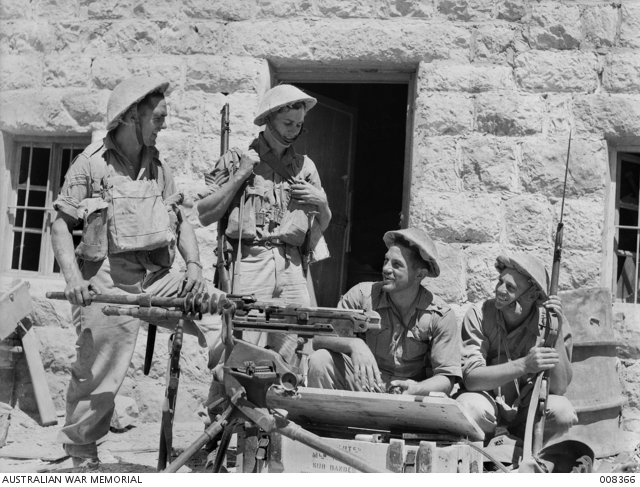
The Battle of the Litani River was fought in French Lebanon, resulting in Allied victory. As the British commando raid to secure crossings on the Litani River in French Mandate for Syria and the Lebanon had been delayed by weather, Australian troops (2/16 Aust Bn) crossed the river under fire in canvas boats. The commandos later arrived and joined the Australians in the assault. French destroyers Valmy and Guépard bombarded Allied troops in the Litani River area, but they were driven off by New Zealand cruiser HMNZS Leander and British destroyers HMS Janus, HMS Hotspur, HMS Isis, HMS Jackal (HMS Janus was badly damaged in the engagement). Further off the coast, French submarine Caiman attacked British cruiser HMS Phoebe, but without success. The Allies were able to secure several strongpoints on the opposite shore of the Litani River by the end of the day.
The British invasion of Syria, Operation EXPORTER, continues on 9 June 1941. The main battle is at the mouth of the Litani River. The 21st Australian Brigade heading for Beirut must cross the river to reach its goal of Beirut, but the British Commandos sent to seize the important Qasmiye bridge over the river can’t land due to rough seas. The French thus have time to destroy the bridge.
The 420 Commandos (British No. 11 (Scottish) do land — but in daylight. This deprives them of the element of surprise, a key advantage of Commando forces. They arrive in three different places, and the French barely notice them because they are fighting the advancing Australians. Subsequently, the Commandos under Lieutenant Colonel R.L. Pedder (Highland Light Infantry) serve as infantry and take heavy casualties (including Pedder himself, who is replaced by Geoffrey Keyes). By dint of hard fighting, the Commandos and some Australian troops of the 2/16 Australian Brigade do land on the other side of the river by using canvas boats. Australian engineers immediately begin building a pontoon bridge, which they complete after midnight.
The French use armored cars to counterattack the bridgehead, but the Commonwealth troops hold their position. The war then becomes active out at sea. Vichy French destroyers Valmy and Guépard sortie to bombard the British troops in the bridgehead. It is one of the few times during the war when British troops face naval bombardment (which turns out to be quite inaccurate).
The Royal Navy quickly responds by sending destroyer HMS Janus, followed by New Zealand Division light cruiser HMS Leander and. Destroyers HMS Kandahar and Kimberley are nearby bombarding the Khan Bridge, and they also sally against the Vichy French destroyers. The Australian shore-based artillery also fires at the attacking French ships.
Faced with overwhelming firepower, the French ships withdraw to Beirut, chased by destroyers Hotspur, Isis, and Jackal. However, before they go, the French ships damage two of the British ships, destroyers Janus and Jackal, the former badly. Janus must be towed to Haifa by Kimberley, taking two British ships out of the fray. Jackal, only slightly damaged by one shell strike, stays in service.
French submarine Caiman is operating off the Syrian coast. It attacks British light cruiser HMS Phoebe. However, the attack fails and the Phoebe is undamaged. The incident induces the British to withdraw their ships to Haifa.
Elsewhere, Australian troops capture Fort Khiam but are stopped there. Free French 1st Infantry Brigade and 2nd Infantry Brigade advance to Kissoue south of Damascus.
The Luftwaffe, as in Iraq, has a very minimal presence in Lebanon and Syria. The Vichy French, though, have a formidable array of new fighters, including the new Dewoitine D.520. The RAF sends Gloster Gladiators from Amman to support the advancing British trips on the road to Damascus.
The outcome of the day’s fighting is that the advancing Commonwealth troops are slightly behind schedule but still crossed the river. The road to Tyre, and beyond to Beirut, is now accessible.
The Vichy French assemble forces to defend their colony. General de Verdilhac (Vichy Dep. C-in-C) orders II/6 Battalion French Foreign Legion and 6th Chasseurs d’Afrique (armored) to assemble in Nahr el Awaj area for a counterattack.
The British continue assembling their forces for Operation Battleaxe, another attack on the Libyan frontier south of Tobruk. Tanks finally arrive at the front in General O’Moore Creagh’s units. Operation Battleaxe now is scheduled for 15 June. The 15th Panzer Division (General Walter Neumann-Silkow) is the main defender of the frontier.
In Malta, there is an uproar because they find out there is an Axis informant on the island. Lord Haw-Haw, who makes propaganda broadcasts from Berlin, mentions that gas respirators on Malta feature yellow flaps. The flap is to differentiate British soldiers from enemy invaders who also are wearing gas masks. However, the islanders get some good news when two captured Italian aviators deny that an invasion force is being assembled in Sicily.
The 3/15th Punjab Regiment in Aden prepare to invade Assab, the last Italian port on the Red Sea, on 10 June. This is Operation Chronometer. Destroyer HMS Dido heads out during the night to bombard the port just before sunrise on the 10th.
The funeral of ex-Kaiser Wilhelm II was held in Doorn. Although Hitler had wanted a state funeral in Berlin with himself in a prominent role, Wilhelm’s family insisted on respecting instructions he’d given in 1933 that he was to be buried in Doorn if Germany was not a monarchy at the time of his death. However, a delegation of Nazi officials led by Arthur Seyss-Inquart was allowed to attend as well as a Wehrmacht guard of honour, and Wilhelm’s wishes that Nazi regalia not be displayed at his funeral were ignored.
At Churchill’s suggestion, Lord John Simon meets with Rudolf Hess and pretends to negotiate Hess’ peace proposal. In reality, Simon is only pumping Hess for information and has no authority to negotiate. Simon is accompanied by Ivone Kirkpatrick.
The United Kingdom established a national Fire Service Council. This results from issues arising during the Blitz from fire services in one town not wishing to help fight fires elsewhere — or only doing so for a price. The 1400 local fire brigades are merged into 32 regional brigades.
Light cruiser HMS Neptune arrives in Gibraltar. It lands German prisoners and captured documents from German supply ship Gonzeneheim.
Archbishop De Young bans priests cooperating with Rijks radio.
Oblt. Werner Machold of 7./JG 2, flying a Bf 109E “White 15″ on a fighter-bomber (Jabo) raid, crash-lands near Swanage, Dorset. Machold holds the Ritterkreuz and enters his POW camp with 32 victories in over 250 combat missions.
RAF Bomber Command, Day of 9 June 1941
18 aircraft — 12 Blenheims, 4 Wellingtons, 2 Stirlings — operated on enemy coasts. Ships were attacked off Dunkirk, The Hague and Terschelling but without sure sinkings. 2 Blenheims and 2 Wellingtons lost.
RAF fighters shoot down an Italian SM-79 bomber off Malta, and perhaps another, and two others are damaged. The RAF loses a Hurricane.
U-46, commanded by Kapitänleutnant Engelbert Endrass, sank British steamer Phidias (5623grt) in 48-25N, 26-12W. At 0001 hours on 9 June 1941 the Phidias (Master Ernest Holden Parks), dispersed from convoy OB.330, was hit by one torpedo from U-46 north of the Azores, but it did not explode. The U-boat was now out of torpedoes, so they opened fire at 0010 hours with the deck gun. The ship first fought back, but soon she caught fire and stopped shooting because the crew abandoned ship. At 0045 hours, the U-boat ceased fire after firing 71 rounds and left the burning and sinking wreck. The master and seven crew members were killed. 40 crew members and three gunners were picked up by Embassage and landed at Sydney. The 5,623-ton Phidias was carrying government stores, including ammunition and 14 aircraft and was headed for Capetown, South Africa.
U-101, commanded by Kapitänleutnant Ernst Mengersen, sank British steamer Trevarrack (5270grt) in 48-46N, 29-14W. At 1835 hours on 9 June 1941 the unescorted Trevarrack (Master William Hambly Freeman), dispersed on 5 June from convoy OB.329 in 51°48N/20°48W, was hit on the starboard side underneath the bridge by one G7e torpedo from U-101 and sank by the bow in less than three minutes after a boiler explosion about 600 miles east of St. John’s, Newfoundland. The U-boat had spotted the ship coming out of fog at 1710 hours and reported seeing three lifeboats after the sinking. However, the master, 36 crew members and seven gunners were lost. The 5,270-ton Trevarrack was carrying ballast and was headed for Montreal, Canada.
Heavy cruiser HMS Suffolk rejoined the Home Fleet at Scapa Flow after escorting convoy HX.129 and searching for German supply ships.
Light cruiser HMS Kenya sailed from Iceland for the Iceland Faroes passage.
Light cruiser HMS Manchester departed Scapa Flow for Iceland.
Destroyers HMS Inglefield, HMS Icarus, and HMS Achates departed Scapa Flow at 1200 for Reykjavik where they arrived during the afternoon of 10 June.
Destroyers HMS Impulsive and HMS Anthony departed Scapa Flow at 0600 for Loch Alsh to escort minelayers during minelay SN.64.
British steamer Diana (942grt) was sunk by German bombing in 62-04N, 13-40W. One gunner was lost on the steamer. The survivors were picked up by anti-submarine trawler Cape Portland and taken to Thorshavn.
British steamer Dagmar (844grt) was sunk by German bombing in 50-35N, 1-48W. Three crewmen were lost on the steamer.
Finnish steamer Fenix (1894grt) was sunk by German bombing in 61-56N, 12-14W. One crewman was lost on the steamer.
Spanish steamer Sabina (2421grt) was sunk on a mine forty miles from Genoa. The entire crew was rescued.
Aircraft carrier HMS Victorious and light cruiser HMS Neptune, escorted by destroyers HMS Wivern, HMS Wild Swan, and HMS Vansittart, were met at sea by battlecruiser HMS Renown, aircraft carriers HMS Ark Royal and HMS Furious, light cruiser HMS Sheffield, and destroyers HMS Faulknor, HMS Fearless, HMS Foxhound, HMS Forester, and HMS Fury. Light cruiser Neptune was sent into Gibraltar, arriving on the 9th to land German prisoners and captured documents from the German ship Gonzeneheim. Destroyer Wivern was sent into Gibraltar on the 9th and destroyers Wild Swan, Vansittart, and Wrestler arrived on the 10th. Force H arrived safely at Gibraltar on the 11th. Aircraft carrier Furious, after transferring personnel and aircraft to aircraft carrier Victorious, returned to England, accompanied by light cruiser Sheffield and destroyer Fury. Light cruiser Sheffield was detached from the aircraft carrier and ordered to patrol an area bounded by 45N, 23W and 44N, 25W. The destroyer was also detached to rejoin Force H. The aircraft carrier arrived in the Clyde on the 14th. Light cruiser Sheffield joined convoy SL.76 on the 14th to return to England for refitting. The light cruiser arrived at Scapa Flow on the 18th.
Light cruiser HMS Neptune departed Gibraltar for Freetown.
Light cruiser HMS Phoebe was attacked by a French submarine Caiman off the Syrian coast, but was not damaged. At this point, Admiral King withdrew his cruisers to Haifa. French destroyers Valmy and Guepard from Beirut bombarded British positions in Syria. Destroyer HMS Janus, alone off Sidon, engaged the French destroyers and was badly damaged. Destroyers HMS Hotspur, HMS Isis, and HMS Jackal joined and drove the French destroyers off. Destroyers HMS Kimberley and HMS Kandahar were bombarding the Khan Bridge and also joined destroyer Janus. Destroyer Janus was towed to Haifa by destroyer Kimberley at a speed of 12 knots while destroyers Isis, Hotspur, and Jackal pursued the French destroyers. Destroyer Jackal sustained slight damage from a shell hit. She had no time out of service. Destroyer Kandahar covered destroyer Janus’ retirement and recovered the pilots from a French fighter and a British Hurricane which collided during the raids on Janus. The French destroyers arrived back at Beirut. Destroyer Janus arrived at Haifa on the 10th. The destroyer was towed from Haifa by netlayer HMS Protector and escorted by sloop HMS Flamingo on the 11th to Port Said, arriving on the 12th. Netlayer Protector and sloop Flamingo returned to Alexandria. The destroyer was eventually taken to Simonstown for repair through the end of 1941.
Australian destroyer HMAS Stuart and Destroyers HMS Jaguar, HMS Griffin, and HMS Defender departed Alexandria to reinforce Force B.
British submarine HMS Urge unsuccessfully a steamer northwest of Lampedusa.
New Zealand Division light cruiser HMS Leander departed Alexandria for Port Said to have her catapult removed. The cruiser returned to Alexandria on the 10th.
British troopship Glenearn, towed by netlayer HMS Protector and escorted by sloop HMS Flamingo, departed Alexandria for Port Said. After arriving, netlayer Protector and sloop Flamingo proceeded to Haifa to tow damaged destroyer HMS Janus.
Leading Airman W. McCulloch of 31 SFTS Kingston, Ontario, was killed when his Battle crashed near Gananoque, Ontario.
In Washington today, President Roosevelt issued an Executive Order directing the Army to take over the strike-closed North American Aviation warplane plant at Inglewood, California, and talked with Harvey W. Brown, president of the International Association of Machinists, A.F.L., in regard to the strike in San Francisco Bay shipyards.
The Senate heard proposals for amending the Selective Service Act, passed the bill extending powers of the Federal Housing Authority and recessed at 3:19 PM until noon tomorrow. The Interstate Commerce Committee resumed questioning of James L. Fly, chairman of the Federal Communications Commission.
The House passed the $9,826,509,402 War Department appropriation bill with amendments to prevent defense strikes and adjourned at 6:28 PM until noon tomorrow. The Appropriations Committee approved the $885,905,000 Relief Appropriation Bill; a military affairs subcommittee continued investigation of camp construction awards, another subcommittee questioned Army officials on underground air corps facilities program, and a third subcommittee disapproved proposals for deferment of Selective Service registrants by age groups.
U.S. President Franklin D. Roosevelt suspended the planning for the joint occupation of the Azores after intelligence sources indicated that Germany had no plans for invading Spain and Portugal.
The House of Representatives passed today a record-breaking $10,009,655,187 army appropriation bill containing a provision which would require both employees and employers engaged in defense production to comply with recommendations of the National Defense Mediation Board. The vote on the big measure was announced by Speaker Rayburn as 350 to 1. Representative Marcantonio, New York American Labor, voted “no.” The measure, which now goes to the senate, also would prohibit interference with men returning to work in a strike which the board had decided would critically impede the defense program.
The former Governor of Ohio and Democratic candidate for US President in 1920 (with Franklin D. Roosevelt as his running mate), James Cox, gives the commencement address at the Georgia School of Technology in Atlanta. In his speech, entitled “We are Now Nearing the Fateful Hour,” Cox states in part:
“I have never believed, nor do I now, that the need will come of sending our soldiers overseas. It is machines not men that we must supply.”
This capsulizes the Isolationist view, that the US should not get entangled in overseas wars, but it is fine to give them the weapons with which to fight.
The Los Angeles Police Department tries to escort a worker across the picket line at North American Aviation in Inglewood, California early in the morning, but that just causes a fight to break out. President Roosevelt, as he has warned he will do, decides to end the strike.
President Roosevelt issued Executive Order 8773, authorizing the Secretary of War to take over the striking North American Aviation plant in Inglewood, California. The president explained in a statement that the work stoppage could not be allowed to continue because it had created a situation that was “seriously detrimental to the defense of the United States..” President Roosevelt, in an effort to end strikes endangering the defense program, ordered the army today to take over and operate the North American Aviation Corp. plant at Inglewood, California, and also ordered the immediate reclassification under the selective service program of all deferred defense strikers. The “work or fight” policy, similar to the one invoked by President Woodrow Wilson during the World war to end a strike of munitions workers at Bridgeport, Connecticut, was proclaimed shortly after soldiers had taken over the North American plant.
Inside a ring of steel-helmeted soldiers who drove away C.I.O. pickets with bayonets and machine-guns, the army last night put the strike-bound North American Aviation Corp. plant at Inglewood back into at least partial operation. The army took over the huge factory under President Roosevelt’s orders. Clashes between pickets and workers late yesterday were broken up quickly by soldiers.
A military patrol to guard the homes of workers who returned to their jobs at North American Aviation plant after soldiers broke a picket line of C.I.O. United Automobile Workers was announced tonight by army officers. Company officials pointed out that about 60 per cent of the employees live in the southwest portion of Los Angeles County, in Inglewood, El Segundo, Redondo Beach and southwest part of the city of Los Angeles. “The area will be divided into squares and motorized patrols will be on duty throughout the night to prevent possible intimidation of the workers or their families,” Colonel Charles E. Branshaw said.
A long-threatened strike halted work today in Cleveland at the sprawling plant of Aluminum Company of America, where 7,000 men have been turning out aircraft parts and other defense goods. The C. I. O. die casters’ union said it called the strike because Washington negotiations on wage demands were “getting nowhere.” It declared union members had concluded that “government actions were aiding the Aluminum Company of America in its attempts to deny our membership the wages and working conditions that this greatest of all monopolies can well afford to grant.”
A.F.L. machinists announced that a strike vote against the San Diego-based Consolidated Aircraft Corp. would begin at 5:30 AM tomorrow despite progress made in labor contract negotiations with company officials tonight. Balloting will continue until 10:30 p.m. The announcement came after a five-hour conference of company and union negotiators which had been called by Harry Malcom, federal conciliator, in hope of reaching an agreement which would obviate the balloting. The union contends it represents 14,000 of the firm’s employees, but that not all of them are union members. One spokesman said the union probably had 7,500 members. Consolidated currently holds $700,000,000 in defense orders.
In the House of Representatives today, Representative Barden, North Carolina Democrat, said the strike situation was more disturbing “than anything except Hitler. It outranks Mussolini,” he added.
Acting under a growing urge to “do something” about strikes in defense industries, but more immediately under the impetus of labor troubles on the West Coast, the House moved today to put teeth into recommendations issued by the National Defense Mediation Board. By decisive majorities, it placed in the $9,800,000,000 War Department appropriation bill two amendments which would bar use of the money as compensation to any person, firm or corporation failing or refusing to comply with the board’s recommendations and to any person taking part in picketing or otherwise forcibly preventing return of workers to defense plants when further stoppage would impede the defense program.
The Selective Service Administration gave orders by telegraph today that local draft boards reclassify immediately registrants formerly deferred. as essential defense workers, where they “have ceased to perform the jobs.” The step was taken by Brigadier General Lewis B. Hershey, Acting Selective Service Director. The order was made public at a special press conference called this afternoon by Secretary Stimson, who invited General Hershey to read the telegram. “I might say that that statement is issued with the express approval of the President,” the Secretary of War explained. General Hershey’s telegram made no mention of strikes, and he declined, in response to questions, to estimate how many deferred workers might be involved. He stated, however, that 6,500 local boards have jurisdiction and that all were notified simultaneously to act wherever the order applies.
Harvey W. Brown, president of the International Association of Machinists, had a conference today with President Roosevelt and afterward arranged for a meeting in this city Thursday of members of the union’s executive board to arrange for a return to work of striking shipbuilding workers in the San Francisco Bay area.
Charles A. Lindbergh denied emphatically yesterday that he had referred to President Roosevelt when he appealed for a “change in leadership” in his speech for the America First Committee in Philadelphia on May 29. He declared that the “change in leadership” reference was directed at interventionists — “the leadership of the opposition which we [the nation] have been following in recent months,” and added: “Neither I nor any one else on the America First Committee advocates proceeding by anything but constitutional methods.”
A bill proposing $885,905,000 for the Work Projects Administration for the fiscal year 1942, or $482,156,357 less than it had for relief purposes in the current year, was reported favorably today by the House Appropriations Committee.
Major League Baseball:
At Crosley Field, the Reds spot the Dodgers 4 runs after 7 innings, then win 9–7 on Lonnie Frey’s game tying 2-run homer in the eighth inning and game winning 2-run double in the ninth. For five innings yesterday Hugh Thomas Casey of the Atlanta Caseys was the greatest pitcher in baseball. He was headed for a perfect game against the Reds. Not a man had reached first base against him in the series final at Ebbets Field. When Jimmy Gleeson opened the sixth with a single the no-hitter was lost, but few seemed to mind that, for a quick double play followed. However, it was not long afterward that Casey blew sky-high and the Dodgers, having blown a five-run lead, ultimately went down to a galling setback, their third straight.
Forty-two-year-old Charlie Root coasted to an easy victory today as the Cubs bombarded four Braves’ pitchers for twenty-one hits in capturing their third decision of the four-game series, 13–6. Every Chicagoan hit safely at least once. Lou Stringer, with four for five, including a double, and Tiny Dom Dallessandro, who collected a single, double and homer, led the assault. Boston hopped into an early two-run lead, and in the fourth the teams deadlocked at 3–3. The Cubs broke out in the sixth, chasing seven runs across while they knocked starter Tom Earley and relief Pitcher Frank Lamanna out of the box. Jim Tobin and Joe Sullivan finished the pitching chores.
The weather cooled perceptibly yesterday, and so did the Giants. Forgetting all the reasons that had prompted Bill Terry, their skipper, to trade Harry Gumbert to the Cardinals, the New Yorkers permitted Harry to trip them in the series final at the Polo Grounds, 5–2. The victory, which split the four-game series in half, sent Billy Southworth’s sizzling St. Louisans bounding back into first place, a length ahead of the Dodgers, who blew another game to the Reds. As for the Giants, who had been living in the clouds after their dazzling twin victory on Sunday, the defeat fetched them back to earth and life’s sterner realities with a dull thud. For their hold on third place was shaved to a half game over the onrushing Reds.In vain the Giants strove to convince a crowd of 4,754 that Terry made the right move when he traded Gumbert for Bill McGee about a month ago. Gumbert allowed four hits, and only one was any good. That was Mel Ott’s fifteenth homer of the season, which Ott struck with Dick Bartell on base in the sixth.
With Aldon Wilkie allowing only six hits, the Pirates scuttled the Phillies today, 5–0. Lee Handley started things for Pittsburgh in the. fourth inning when he singled and advanced to third on Merrill May’s wild heave. Bob Elliott followed with a triple off the right-field wall. The Pirates put over two more runs in the seventh on a walk and successive singles by Al Lopez and Wilkie. They added an additional pair in the eighth when Handley walked, Elliott and Maurice Van Robays hit safely and Elbie Fletcher poled a long fly to the outfield.
Cincinnati Reds 9, Brooklyn Dodgers 7
Chicago Cubs 13, Boston Braves 6
St. Louis Cardinals 5, New York Giants 2
Pittsburgh Pirates 5, Philadelphia Phillies 0
The NEF continues expanding its support services at St. John’s when auxiliary oiler HMS Clam arrives.
Leading Airman W. McCulloch of 31 SFTS Kingston, Ontario, is killed when his Battle crashes near Gananoque, Ontario during training.
American Naval Intelligence through the use of counter-espionage rounded up today a Japanese naval officer and a Japanese servant in Hollywood and charged them in a complaint authorized by William F. Palmer, Federal attorney, with “conspiracy to obtain national defense information to be used for the injury of the “United States and to the advantage of a foreign power.”
Light cruiser HMS Dauntless completed refitting at Singapore.
An ominous note was struck in the press yesterday following preliminary examination of the Netherlands reply to Japan’s “final” note in the trade negotiations with the Netherlands Indies conducted by departmental heads of the Foreign Ministry and the Ministries of War, Navy, Finance, Commerce and Overseas and the Planning Board.
Dow Jones Industrial Average: 120.16 (+1.27)
Born:
Jon Lord, composer and rock keyboardist (Deep Purple — “Smoke on the Water”), in Leicester, England, United Kingdom (d. 2012).
Billy Hatton, English rock bassist (The Fourmost — “A Little Loving”), born in Liverpool, England, United Kingdom (d. 2017).
Naval Construction:
The Kriegsmarine (German Navy) Type VIIC U-boat U-359 is laid down by Flensburger Schiffsbau-Ges, Flensburg (werk 478).
The U.S. Navy Benson-class destroyer USS Parker (DD-604) is laid down by the Bethlehem Steel Corp. (Staten Island, New York, U.S.A.).
The Royal Navy LCT (Mk 2)-class landing crafts, tank HMS LCT 100 and HMS LCT 101 are launched by Harland & Wolff (Belfast, Northern Ireland).
The Royal Navy LCT (Mk 2)-class landing craft, tank HMS LCT 116 is launched by Tees-Side Bridge (Middlesbrough, U.K.).
The Royal Canadian Navy Bangor-class (VTE Reciprocating-engined) minesweeper HMCS Canso (J 21) is launched by the North Vancouver Ship Repairs Ltd. (Vancouver, British Columbia, Canada).
The Royal Navy Flower-class corvette HMS Coriander (K 183) is launched by Hall, Russell & Co. Ltd. (Aberdeen, Scotland). She is transferred to the Forces Navales Françaises Libres (Free French Naval Forces) upon completion and commissions as Commandant Detroyant.
The Royal Navy Hunt-class (Type II) escort destroyer HMS Beaufort (L 14) is launched by the Cammell Laird Shipyard (Birkenhead, U.K.).
The Royal Navy Fairmile B-class motor launch HMS ML 236 is commissioned.
The U.S. Navy transport ship USS Hunter Liggett (AP-27) is commissioned. Her first commanding officer is Captain Louis W. Perkins, USCG.
The Royal Australian Navy auxiliary minelayer HMAS Bungaree (M 29) is commissioned.
The Royal Navy Dance-class ASW trawler HMS Veleta (T 130) is commissioned. Her first commanding officer is T/Lieutenant Roger Crawford Heron, RNVR.
The Royal Navy Vosper 70-foot motor torpedo boat HMS MTB 218 is commissioned.
The U.S. Navy 77-foot Elco patrol motor torpedo boat USS PT 20 is commissioned.
The Royal Canadian Navy Flower-class corvette HMCS Saskatoon (K 158) is commissioned. Her first commanding officer is T/Lieutenant Joseph Stewart Scott, RCNR.
The Royal Navy Flower-class corvette HMS Vervain (K 190) is commissioned. Her first commanding officer is Lieutenant ugh Parker Crail, RNR.

