The War comes to Syria and Lebanon
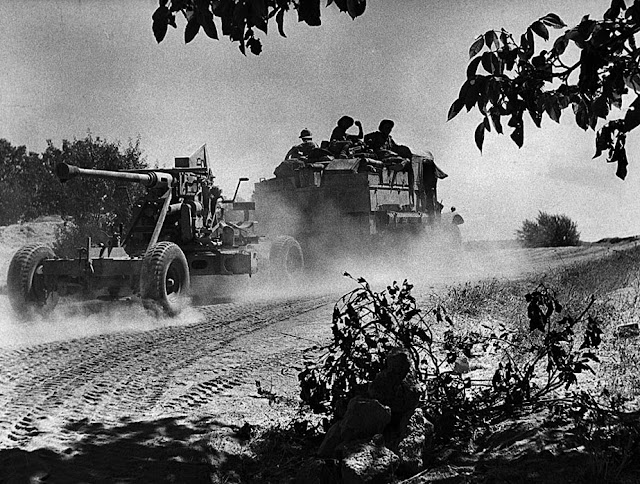
After some initial covert operations late on the 7th, Operation EXPORTER, the British invasion of Syria and Lebanon, begins in earnest at 02:00 on 8 June 1941. The British, directed by General Henry Maitland Wilson in Jerusalem, believe that French morale in Syria is collapsing based on reports from defectors, so they plan on a very short campaign with little resistance. In fact, the British are so confident that they have scheduled an offensive on the Libyan frontier which now is scheduled to begin on 15 June. In a grand strategic sense, the British campaign is defensive in nature, designed to protect their flank in the eastern Mediterranean and prevent future Axis adventurism further east in oil-rich Iraq.
While the British are confident, in fact, the Vichy French under General Dentz greatly outnumber the attacking British (all figures here are given differently in different sources, but everyone agrees that the Vichy French have more men). Dentz commands 45,000 men organized in 18 regular battalions that have 120 guns, 90 tanks, and about 100 aircraft. The British force comprises about 35,000 troops (18,000 Australians, 2000 Indian troops, 9,000 British troops, and around 6,000 French). The RAF has a large collection of aircraft available in Cairo, but allocate only about 70 to Operation EXPORTER. Both sides have modern fighters, the RAF P-40 Kittyhawks and Hawker Hurricanes, the French Dewoitine D.520 fighters, but both sides also have a motley assortment of planes from earlier eras.
The RAF (Hurricanes of No. 80 Squadron) raids the French airbase at Rayak, with the goal of the destruction of recently arrived Martin Maryland 167F bombers of French 39 Squadron, 1st Bomber Group. Australian 3rd Fighter Wing also raids Rayak with their P-40s, which confuses the French defenses because they are unfamiliar with US fighters.
Things in the air do not particularly well for the British in the air. The cutting edge French D520 fighters shoot down three Fulmar fighters of No. 803 Squadron, while the RAF claims one Potez 63 fighter. French ace Sous-Lt Pierre Le Gloan claims a Hurricane of RAF No. 208 Squadron, his 12th wartime victory and first in Syria.
The main British advantage lies in their control of the Mediterranean and the ability to blockade the Levant. The British also have a very handy jump-off point in Palestine and a massive infrastructure built up just behind the front in Cairo, Suez, and Alexandria. The recent British occupation of Iraq allows them to attack from the east as well, though that does not happen right away.
Three British columns and a Free French General Paul Legentilhomme) commands 6000 men) columns set out. Things begin to go wrong early when 420 men of the Scottish No. 11 Commando unit from Cyprus is unable to land due to rough seas at the mouth of the Litani River to capture key bridges and block reinforcements. The troopship, HMT Glengyle, returns to Port Said along with its escorts, with orders to try again on the 9th.
The Royal Navy assembles light cruisers HMS Ajax and Phoebe, and destroyers Jackal, Janus, Kandahar, and Kimberley, off the Syrian coast. Kandahar is assigned to bombard a French shore battery. Late in the day, Vichy French destroyers Guépard and Valmy sail from Beirut to bombard the Australians advancing along the coast on the 9th.
However, the war on land is unaffected by the weather. There are four lines of advance. The 5th Indian Brigade (Brigadier Wilfrid Lewis Lloyd) has the most success on the first day, advancing on the eastern front toward Quneitra and Deraa.
On the vital coast road, which offers the greatest potential tactical profit and the shortest and quickest way to isolate the French, the 7th Australian Division under Major-General John Lavarack advances from Palestine from Haifa toward Beirut. The division notices how little notice the world is taking of its fighting and takes to calling itself the “silent seventh.”
In the center of the front, the Australian 25th Brigade attacks toward the large Vichy French airbase at Rayak.
The fourth axis of advance is planned from the east, comprised of British forces in Iraq (Iraq Command). The 10th Indian Infantry Division is to advance northwest along the Euphrates River from Haditha in Iraq toward Deir ez Zor. The plan is for it to advance toward the French airfield at Aleppo and also Raqqa. This would open the road to Beirut. Habforce, which recently advanced east from Palestine to occupy Baghdad, is to advance toward Palmyra and secure the oil pipeline from Haditha to Tripoli.
Captain Moshe Dayan, of the Palestine Regiment, leading a section of the Allied attack, receives an eye injury when a stray bullet hits his binoculars, near Beirut. He was a company commander in the Palmach. His company was acting as scouts for the Allied forces.
The Palmach was a paramilitary organization sponsored by the British — it was not a part of the British army; it was created, commanded and manned by the Haganah which was the underground military organization of the Jewish Agency — the quasi-government body of the Yishuv, Palestine’s Jewish community (The British liaison officer with the Palmach was Major Aubrey Eban — a Cambridge educated South African Jew serving in British Army intelligence — would later move to Israel change is fist name to Abba and become the “face of Israel” while serving as Israel’s Foreign Minister form 1966-74). At the time the Haganah did not use military ranks such as “captain” but functional titles such as “company commander”. The Palmach was created in May 1941, to undertake scouting and “commando” missions for the British in the Middle East. In 1942, the SOE took over the sponsorship of the Palmach and trained them to act as stay behind guerillas in the event of a German occupation of Palestine (which at the time was a very real threat.) In 1943, when the threat of invasion passed and the Palmach and Haganah were caught stealing and hoarding British arms, Britain’s sponsorship of the Palmach stopped and the organization went underground.
After recovering from his wounds Dayan opted instead to continue his work with the Haganah. In 1942, he set up a radio network through Palestine in preparation for the expected German invasion. In 1943, he headed the Arab Department (Arab Intelligence unit) of the Jewish Agency. He remained in the post until the end of the War.
The Free French under Charles De Gaulle attempt to turn the people of Syria and Lebanon against the Vichy colonial government by promising full independence.
In a supplement to Hitler’s Commissar Order of two days ago, the OKH directs that political commissars shall be summarily shot.
The Wehrmacht sends troops to Finland for contemplated operations in the far North aimed at Murmansk.
General Walter Neumann-Silkow is appointed commander of the 15th Panzer Division. He has primary responsibility for the Egyptian frontier, though General Erwin Rommel keeps a very close eye on things there.
C.S. Lewis preached his famous sermon The Weight of Glory at the University Church of St. Mary the Virgin in Oxford.
Invasion fears continue on Malta. Governor Dobbie issues an alert to the island’s inhabitants over the island’s Rediffusion radio service, saying in part:
“Malta is better able to resist attack than Crete…. circumstances justify quiet confidence…. [T]he Government and fighting services are doing their utmost to see that Malta gives a good account of itself.”
British troops have been laying defensive mines on Malta, and today they claim two victims — both island locals. One (14 years old) is killed, and the other (56) is badly wounded in her legs.
Royal Navy submarine HMS Clyde fires on an Italian destroyer off Naples but misses. Later in the day, though, the Clyde surfaces and uses its deck gun to sink 1196 ton Italian freighter Sturla about five miles (8 km) off Policastro.
In a daring operation, Royal Navy submarine HMS Taku lands some men at Benghazi Harbor. They manage to damage a freighter in the harbor, then return safely for pickup.
The Egyptian Government begins evacuating 40,000 civilians from Alexandria following a heavy Luftwaffe raid on the 7th.
The British at Aden are preparing for a landing at Assab, the last Italian-held port on the Red Sea. This will be Operation CHRONOMETER. It is scheduled for 10 June.
The British cargo ship Kingston Hill was torpedoed and sunk southwest of Cape Verde by the German submarine U-38.
The Turkish government will observe a hands-off policy towards invaded Syria, taking only such action as is necessary to defend its own national frontiers, the British embassy was reliably informed today. The Turks, with the Germans already installed on their European frontiers and dominating the entrance to the Dardanelles, were said in informed quarters to view the allied drive into the French territory to the south with considerable satisfaction.
RAF Bomber Command, Night of 8/9 June 1941
Dortmund
37 Whitleys; poor bombing owing to industrial haze. No losses.
After two German air raids on Alexandria, Egypt killed 400 people, 40,000 residents were evacuated from the city.
U-108, commanded by Kapitänleutnant Klaus Scholtz, sank British steamer Baron Nairn (3164grt)at 47-35N, 39-02W. At 0006 hours on 8 June 1941 the Baron Nairn (Master John Kerr), dispersed on 2 June from convoy OB.328, was torpedoed and sunk by U-108 west of Cape Race. One crew member was lost. 18 crew members were picked up by the Canadian corvette HMCS Chambly (K 116) (Cdr J.D. Prentice) and landed at St.Johns. The master and 20 crew members were rescued after 19 days in a lifeboat and landed at Galway, Ireland on 27 June. Master John Kerr was awarded the Lloyd´s War Medal for bravery at sea. The 3,164-ton Baron Nairn was carrying ballast and was headed for Nuevitas, Cuba.
U-38, commanded by Kapitänleutnant Heinrich Liebe, sank British steamer Kingston Hill (7628grt) at 9-35N, 29-40W. At 0108 hours on 8 June 1941 the unescorted Kingston Hill was hit by two torpedoes from U-38 and sank slowly southwest of the Cape Verde Islands after the last torpedo proved to be a dud at 0125 hours. Twelve crew members and two gunners were lost. 16 crew members were picked up by HMS Achates (H 12) (LtCdr Viscount Jocelyn, RN) and landed at Greenock. 26 crew members and six gunners were picked up by the American steam tanker Alabama and landed at Capetown. The 7,628-ton Kingston Hill was carrying coal and general cargo and was headed for Alexandria, Egypt.
U-107, commanded by Kapitänleutnant Günter Hessler, sank British steamer Adda (7816grt) at 8-30N, 14-39W. At 0442 hours on 8 June 1941 the Adda (Master John Tate Marshall), the ship of the convoy commodore from the dispersed convoy OB.323, was hit aft by a G7a torpedo from U-107 and sank slowly 82 miles west-southwest of Freetown. The commodore (W.H. Kelly, CBE, DSO, RD, RNR), seven crew members and two passengers were lost. The master, 141 crew members, four gunners, five naval staff members and 264 passengers were picked up by HMS Cyclamen (K 83) (Lt H.N. Lawson, RNR) and landed at Freetown on 8 June. The 7,816-ton Adda was carrying general cargo and passengers and was headed for Lagos, Nigeria.
U-108 also sank Greek steamer Dirphys (4240grt) in 47-44N, 39-02W. At 0604 hours on 8 June 1941 the unescorted Dirphys was hit amidships by a G7e torpedo from U-108 about 600 miles east of Newfoundland. The ship broke in two and sank after a boiler explosion. The Germans tried to question the survivors, but most of them were swimming in the water or clinging to debris and were picked up by the only lifeboat that could have been launched. On 10 June, the U-boat encountered this lifeboat again and this time took a German speaking radio operator (Robert Conine from Hasselt, Belgium) aboard for questioning. He told them that he had been three months in prison in Liverpool after the Secret Intelligence Service filed a charge against him because he had met a former crew member of Admiral Graf Spee in Rosario and asked to be taken home, but the commander refused. The Germans gave the radio operator the course to the nearest coast and sent him back to the boat, which was provided with water, bread, two bottles of rum, aspirin and a box of matches. The 4,240-ton Dirphys was carrying anthracite and was headed for Montreal, Canada.
U-103, commanded by Korvettenkapitän Viktor Schütze, sank British steamer Elmdene (4853grt) at 8-16N, 16-50W. At 1234 hours on 8 June 1941 the unescorted Elmdene (Master Ernest Fear), dispersed from convoy OB.324 on 27 May, was torpedoed and sunk by U-103 about 200 miles west-southwest of Freetown. The master and 35 crew members were rescued by the Carlton in 08°47N/16°37W and taken to Freetown. The 4,853-ton Elmdene was carrying coal, munitions, and 20 aircraft and was headed for Alexandria, Egypt.
U-46, commanded by Kapitänleutnant Engelbert Endrass, damaged British tanker Ensis (6207grt) in 48-46N, 29-14W. At 1325 hours on 8 Jun 1941, U-46 fired a spread of two torpedoes on the unescorted Ensis in 48°46N/29°14W (grid BD 3748). The tanker was en route from London to Curaçao in ballast. Both torpedoes hit, but one was a dud. The damaged ship proceeded under own power to St. Johns, arriving on 15 June. The 6,207-ton Ensis was carrying ballast and was bound for Curacao.
U-48, commanded by Kapitänleutnant Herbert Schultze, sank Dutch tanker Pendrecht (10,746grt), from dispersed convoy OB.329, in 45-18N, 36-40W. At 1545 hours on 8 June 1941 the Pendrecht (Master Albert Meinsma), dispersed on 5 June from convoy OB.329, was hit on the port side amidships and the stern by two torpedoes from U-48 about 500 miles northwest of the Azores. The tanker was en route to the USA for permanent repairs of the torpedo damage received by U-96 (Lehmann-Willenbrock) on 18 December 1940. The master tried to stabilize her by counter flooding, but the tanker caught fire and sank by the stern within minutes after being hit underneath the funnel by a coup de grâce at 1617 hours. All crew members had abandoned ship in three lifeboats, twelve in each one. On 10 June, the survivors in the lifeboat in charge of the master were picked up by the British steam merchant Alresford and taken to Sydney, Nova Scotia. On 18 June, the men in the second boat were picked up by HMS Pandora (N 42) (Lt Cdr J.W. Linton, DSC, RN) in 43º20N, 28º02W and brought ashore on 28 June in Portsmouth, NH. The occupants of the third lifeboat were picked up by the American passenger ship Excalibur on 22 June and were taken to New York, arriving on 28 June. The 10,746-ton Pendrecht was carrying ballast and was headed for New York, New York.
U-69 was unsuccessfully attacked by a British Sunderland aircraft as she approached St Nazaire. U-69, commanded by Kapitän-Leutnant Jost Metzler arrived in St Nazaire later that day to a huge welcome having spent 65 days at sea, and covered 7,680 nautical miles. Metzler had made, at the time, the longest voyage ever undertaken by a Type VIIC, demonstrated the feasibility of operating long-range mining missions, tied up British naval resources and sank at least seven ships.
Battleship HMS Nelson, escorted by destroyers HMS Electra, HMS Impulsive, and HMS Antelope, arrived at Scapa Flow at 0030 to rejoin the Home Fleet after duty in the South Atlantic.
Light cruiser HMS Kenya departed Iceland to reinforce light cruiser HMS Edinburgh on Denmark Straits patrol. However, light cruiser Kenya was recalled to fuel and proceed to the Iceland Faroes passage patrol.
Destroyers HMS Tartar, HMS Punjabi, and HMS Eskimo arrived at Scapa Flow at 1930 after escorting battleship HMS Rodney.
Naval drifter Cor Jesu (97grt) was sunk by German bombing off Alnmouth, 55-29N, 1-27W. The entire crew was rescued.
British trawler Remagio (174grt) was damaged by German aircraft near Bamburgh in 48-46N, 29-14W during the night of 8/9 June. The trawler was abandoned ashore one quarter mile north of Bamburgh. The trawler was refloated on the 26th and brought to Holy Island.
British trawler Hopton (202grt) was sunk on a British mine off Iceland, 62-56N, 12-30W. Eleven crewmen were lost. Master of trawler British trawler Hondo (229grt), which was in charge of Hopton, was subsequently suspended for navigating in a prohibited area.
British troopship Glengyle with destroyers HMS Ilex and HMS Hero returned to Port Said when the landing was cancelled due to heavy surf on the beach at Litani (Leontes) River. Orders were received to land the troops before dawn on the 9th. Troopship Glengyle and destroyers Ilex and Hero departed Port Said and the troops were landed as planned. Light cruisers HMS Phoebe and HMS Ajax and destroyers HMS Kandahar, HMS Kimberley, HMS Jackal, and HMS Janus arrived off Syria on the 8th to support the Army. Destroyer HMS Kimberley engaged a French shore battery near Kahn Bridge. Two Fulmars of 803 Squadron from Dekheila were shot down. Lt J.M. Christian with Sub Lt N. Cullen and Petty Officer J.A. Gardner with Leading Airman H. Pickering were lost.
Destroyer HMS Kelvin and gunboat HMS Aphis departed Alexandria for Port Said. Gunboat Aphis went for repairs at Port Said. Destroyer Kelvin continued on to Bombay for repairs, arriving on the 19th. The destroyer’s repairs were completed at the end of December. She sailed from Bombay on 31 December and arrived at Aden on 4 January. Destroyer Kelvin arrived back at Suez 6 January.
Submarine HMS Clyde unsuccessfully attacked an Italian destroyer off Naples. That evening, the submarine sank Italian steamer Sturla (1195grt) with gunfire five miles off Policastro.
Submarine HMS Taku sent a shore party into Benghazi Harbor and damaged a steamer in harbor.
Submarine HMS Parthian sank two schooners and a lighter in Mitylene Harbor.
Convoy OB.331 departed Liverpool escorted by destroyers HMCS Assiniboine and HMS Bulldog, corvettes HMCS Arrowhead, HMS Aubretia, HMS Carnation, HMS Hollyhock, and HMS Primrose, and anti-submarine trawlers HMS Angle, HMS Daneman, and HMS King Sol. The convoy was joined on the 9th by minesweepers HMS Britomart and HMS Salamander and catapult ship HMS Ariguani. The catapult ship was detached on the 11th. On the 11th, sloops HMS Aberdeen and HMS Londonderry and corvette HMS Camellia joined. Destroyer Bulldog, corvettes Aubretia, Carnation, and Hollyhock, the minesweepers, and the anti-submarine trawlers were detached on the 12th.Sloop Londonderry and corvette Arrowhead were detached on the 13th and destroyer HMS Harvester joined. The convoy was dispersed on the 18th.
Convoy OB.332 departed Liverpool, escorted by corvettes HMS Dianthus, HMS Nasturtium, and HMCS Spikenard and catapult ship HMS Maplin. Destroyer HMS Chesterfield and corvettes HMCS Hepatica, HMCS Mayflower, HMS Trillium, and HMCS Windflower joined on the 9th. Destroyer Chesterfield was detached on the 10th. On the 10th, destroyers HMS Harvester and HMS Havelock, sloop HMS Sandwich, and anti-submarine yacht HMS Philante joined. Destroyer Harvester was detached on the 12th. On the 13th, sloop HMS Londonderry and corvettes HMCS Arrowhead, HMCS Eyebright, and HMCS Snowberry joined. Destroyer Havelock was detached on the 18th.Sloop Sandwich and corvettes Hepatica, Snowberry, Trillium, and Windflower were detached on the 19thThe convoy arrived at Halifax on the 23rd.
Convoy SL.77 departed Freetown escorted by armed merchant cruiser HMS Arawa to 2 July, corvettes HMS Gardenia and HMS Marguerite to 13 June, and anti-submarine yacht HMS Surprise from 8 to 13 June. Corvette HMS Cyclamen escorted the convoy on 10 and 11 June. Heavy cruiser HMS Norfolk joined on the 15th and continued to 27 June when she was detached to Scapa Flow. On the 23rd, ocean boarding vessels HMS Cavina and HMS Hilary joined to 3 July. Destroyers HMS Bath to 2 July, HMS Vanoc, and HMS Walker and corvettes HMS Hydrangea and HMS Wallflower joined on the 29th, and arrived at Liverpool on 3 July.
U.S. Senator Harry Flood Byrd Sr. (D.-West Virginia) states that there are 67 strikes in the defense industries and threats of 19 more. The most prominent is at North American in Los Angeles.
Richard T. Frankensteen, head of the C.I.O.’s aviation division, tonight suspended his assistant, Wyndham Mortimer, three international organizers and all officers of the United Automobile Workers’ local at strikebound North American Aviation Corp. Frankensteen’s action came a few hours after he was booed as he attempted unsuccessfully to bring striking workers back to their jobs. An order for the army to take over in the morning awaits President Roosevelt’s signature. Frankensteen appeared at a mass meeting in a bean field near the factory to read a plea from C.I.O. President Philip Murray for resumption of work, but local leaders blocked any vote on the matter. Frankensteen, head of U.A.W. aircraft division, last night accused Communist party of fomenting North American Aviation Corp. strike.
With the War Department acting to take over the strike-bound plant of the North American Aviation Company at Inglewood, California, developments here today indicated that this C.I.O. dispute and that of the strike of C.I.O. woodworkers in the Northwest had precipitated a showdown between leaders of the Communist-dominated unions in the C.I.O. and those leaders adhering to the policies of President Philip Murray. Threats made recently to Mr. Murray and now renewed disclosed that leaders of the Communist-dominated unions have been talking of forming a new and independent organization and seceding from the C.I.O. Mr. Murray, however, regards these threats as “bluffs” and has defied the left-wing Communist leaders to do their worst. The signal for the showdown fight between the Communists and their “fellow-travelers” on one side and the anti-Communist leadership in the C.I.O. was given by Mr. Murray in his support of the government Mediation Board in the aviation and woodworkers cases and in the decision of R. J. Thomas, president of the United Automobile Workers Union-C.I.O. to oust Wyndham Mortimer, the union’s representative in the aircraft field on the West Coast.
Secretary of Labor Frances Perkins, in a last minute appeal, urged striking C.I.O. aircraft workers early today to return to work at the North American Aviation Corp. Inglewood, California, plant. “Millions of your fellow Americans in and out of the labor movement and the people of the United States expect you to return to work promptly,” Miss Perkins said.
Mayor Fletcher Bowron of Los Angeles tonight attempted to avert the use of troops in opening the strike-bound North American aviation plant by announcing that police would keep the factory gates open “if it takes 1,000 officers.” Because the huge aircraft plant sits on the boundary between Inglewood and Los Angeles on property owned by the city of Los Angeles at its municipal airport, Mayor Bowron bluntly announced that it was the obligation of his officers to see that there was no “breach of the peace.” Mayor Bowron made his announcement after learning that the C.I.O. United Automobile Workers had voted to continue its strike and was summoning every available picket for duty tomorrow morning when management said it would resume production of military aircraft.
The Aircraft, the independent union at the Curtiss-Wright Buffalo airplane division, declared in a telegram to President Roosevelt today that the strike at the North American Aviation plant was “unpatriotic and subversive” and called on the President “to use full powers to put an end to efforts of un-American labor agitators and opportunists who seek to capitalize on the national emergency.”
The increase of strikes in key defense industries is strengthening the conviction here that Congress will move soon to provide for compulsory settlement of labor disputes. Pointing out that any extension of the war would mean a greater drain on our war supplies, administration leaders indicated that they could not hesitate much longer on legislating against strikes which reduce the nation’s war effort.
While the United States trains men and produces machines for a defense force without peacetime precedent, a whole new industry that will cost billions of dollars is being geared to supply the army with munitions alone. This industry is almost overlooked, in the interest centering on the human side of the military program, and yet it is the heart of the whole effort. In cold analysis, an army and a navy and the supporting air forces exist for one purpose only — to destroy. The destructive force used by these services is ammunition. A hundred-million dollar battle ship is effective only in the degree with which its guns can throw shells weighing a ton or more; an airplane fulfills its mission by spitting machine-gun bullets and small shells at air or ground objectives and by dropping bombs. The complicated paraphernalia of land warfare, from Garand rifles to massive tanks all are designed primarily to “throw lead.” Therefore, as the defense forces assume form, they must be supplied with the tools of their trade.
Charles F. Kettering, one of America’s foremost inventors, predicted today that German submarines would be driven from the seas by development of a device to catch them on the surface at night.
Major League Baseball:
Brooklyn’s Whitlow Wyatt’s luck against the Reds hasn’t changed. Yesterday he faced the faded world champions in the ninth inning with the crowd of 21,663 Ebbets Field fans poised and eager to cheer him for turning in his third straight shut-out and his fifth of the year, only to have the game blow up suddenly in his face. The Reds, all the breaks going in their favor, pushed across three runs — two after two were out — and Wyatt and the Dodgers went down to a 3–2 defeat instead of gaining the anticipated 2–0 triumph. Although the Dodgers lost, the twin setback suffered by the Cardinals at the hands of the Giants moved Brooklyn back into first place, 8 points ahead of St. Louis. The teams are even in games.
The Braves shook off their batting lethargy in the nightcap of today’s doubleheader to shell three Cub hurlers for a 13-1 triumph before more than 16,000. Larry French, Paul Erickson and Wallington Quinn, who was making his mound debut in professional ball, were pounded as Boston scored six and four run clusters in the second and sixth innings. Bill Lee pitched for Chicago in the opener and duplicated yesterday’s feat of Claude Passeau in holding the Braves to five hits while winning by 5–1.
In game 1 at Comiskey in Chicago, Red Sox veteran Lefty Grove (4–1) goes 10 innings topping the White Sox, 4–1. It is Lefty’s 297th win. Ted Williams walks 3 times but goes hitless, ending his consecutive-game hitting streak at 23 games. The Splinter is also hitless in game 2, though he scores a run in Boston’s 3–0 shutout tossed by Dick Newsome. Ted is now hitting .416. The Bosox manage just 3 hits off Thornton Lee.
The Indians went back into high gear today by taking a doubleheader to sweep the four-game series with the Athletics, 7–4 and 8–6, with the veterans Mel Harder and Clint Brown receiving the credit. Cleveland thus increased its league lead to four games. After reaching Johnny Babich and Tom Ferrick in the first game for eight hits, the Indians were paced by Ken Keltner’s homer in the nightcap, in which Phil Marchildon lasted just two innings, yielding six hits and six runs. Keltner’s single, following Lou Boudreau’s double in the first, started the second-game scoring. His homer followed Rollie Hemsley’s triple in the second. Triples by Gerald Walker and Roy Weatherly helped add single runs in the fourth and fifth.
Landing on Paul (Dizzy) Trout and his successor, Buck Newsom, for eight hits and seven runs in the sixth inning, the Senators today gained a 9–3 victory over the Tigers. The Tigers led, 3–2, going into the sixth. Then Buddy Lewis led off with his fourth homer of the season. After Roger Cramer had singled to left and Cecil Travis had fanned, Jim Vernon drove his fifth homer of the year into the right field stands. That was all for Trout. Newsom, essaying his second relief job of the season, was anything but a puzzle to the Senators. In two-thirds of an inning he was belted for five hits and four more runs. Dutch Leonard scattered ten hits for his fourth victory against seven defeats.
The New York Giants sweep a doubleheader and knock the Cards out of first place. With the St. Louis Cardinals apparently having made a shambles of Hal Schumacher Day by routing Prince Hal and the Giants for a 5–0 lead in eight innings, Rowdy Richard, who subbed in both games for Billy Jurges, singled the first two New York runs across in a thrilling five-run rally that tied the score in the ninth. Then, in the tenth, with Johnny Rucker on base, the indomitable Bartell blazed a homer into the stands to sink Billy Southworth’s clan, 7–5. This done, the aroused Giants rallied magnificently around a heavily bombed Carl Hubbell to win the nightcap, 12–7.
The Pirates spoiled Tommy Hughes’s Day by beating the Phillies, 12–2, in the first game of a doubleheader today, but the Phils took the second, 5–2, behind the effective pitching of Johnny Podgajny. Hughes, rookie right-hander, who hurled a one-hitter against Chicago on Tuesday, engaged in a pitchers’ battle with Joe Bowman for eight innings. He weakened in the ninth, however, and Pittsburgh went on a nine-run scoring spree. A double by Maurice Van Robays with the bases full drove Hughes to cover and started the parade. The Phillies made only four hits off four Pirate hurlers in the nightcap, but two of them, coupled with an error and two walks, accounted for four runs in the first inning.
Yankee catcher Bill Dickey pulls off the only unassisted double play of his career in the first of two with the Browns. Dickey catches Bob Swift’s pop foul along the first base line and tags first to double off the straying runner, Johnny Berardino. The Yanks sweep the Browns, 9–3 and 8–3, in a nightcap called after seven innings on account of darkness. DiMaggio collects 7 RBIs on the afternoon, with 2 homers in the opener and 2 hits in the nightcap. He has now hit in 24 straight. From today’s 2nd game to July 26th, Joe will jolt 11 homers without striking out.
Cincinnati Reds 3, Brooklyn Dodgers 2
Chicago Cubs 5, Boston Braves 1
Chicago Cubs 1, Boston Braves 13
Boston Red Sox 5, Chicago White Sox 3
Boston Red Sox 3, Chicago White Sox 0
Philadelphia Athletics 4, Cleveland Indians 7
Philadelphia Athletics 6, Cleveland Indians 8
Washington Senators 9, Detroit Tigers 3
St. Louis Cardinals 5, New York Giants 7
St. Louis Cardinals 7, New York Giants 12
Pittsburgh Pirates 12, Philadelphia Phillies 2
Pittsburgh Pirates 2, Philadelphia Phillies 5
New York Yankees 9, St. Louis Browns 3
New York Yankees 8, St. Louis Browns 3
En-route to Rio Hato, Panama, for a training flight from France Field, Panama in an OA-46A aircraft, three men are lost when their plane goes down.
Brazilian freighter Osorio rescues 11 survivors of U.S. freighter Robin Moor, sunk by German submarine U-69 on 21 May.
The removal by Japanese of Chinese-American cargoes from warehouses in Haiphong, French Indo-China, is being carried out without the permission of French authorities, according to an official French statement in Hanoi relayed here today by the French news agency, Havas. Statements in London that the government of Indo-China had consented to the removals were specifically denied. Ownership of the goods is in dispute, the statement said. Japan asserts that the seized goods are all war materials owned by the Chinese Nationalist Government in Chungking. China and the United States assert that the goods belong to two American-registered corporations — the United States Far Eastern Trading Corporation and the North American Syndicate. French authorities protested when the Japanese started the removals last month, according to the Hanoi statement, but Japan persisted. Meanwhile, a Hanoi report yesterday said that Japanese removals of the seized goods were continuing.
While the Japanese Foreign Office authorities are giving a preliminary technical study to the Netherland reply to Japan’s “final” note concerning the trade negotiations with the Netherlands Indies, Domei, the official news agency, and the government radio announced today that the negotiations were drifting beyond the mere matter of trade and were becoming a political issue involving the fate of the “Greater East Asia Co-prosperity Sphere.”
A report from Melbourne outlines the problems the Australian’s are having with her soldiers in the Middle East. While the countries of Europe are rationing their food supplies increasingly, Australia has too much. Food ships can make three or four trips between Europe and the United States or Canada to every trip to Australia, whose surpluses thus are largely unexportable. She must eat the surpluses herself, store them, or destroy them… What is going to happen to the farmers in this period of wasted and partially wasted surpluses is another problem of Australia’s government. It is part of the larger problem of Australia’s wartime economic readjustment, including the matter of manpower that can be allocated to different industries.
Born:
Fuzzy Haskins, R&B and funk musician (The Parliaments, P-Funk), in Elkins, West Virginia (d. 2023).
Robert Bradford, minister and politician, in Limavady, Northern Ireland, United Kingdom (d. 1981).
George Pell, Australian Catholic Cardinal and treasurer of the Vatican, convicted, and then acquitted, of child sex abuse, in Ballarat, Australia (d. 2023).
Joop van den Berg, Dutch 2nd Chamber member (PvdA), in Bartlehiem, Netherlands.
Naval Construction:
The Kriegsmarine (German Navy) Type VIIC U-boat U-263 is laid down by Bremer Vulkan-Vegesacker Werft, Bremen-Vegesack (werk 28).
The Royal Navy harbor defence motor launch HMS HDML 1043 is commissioned.
 History Diaries