About 40 nations around the world will be able to produce enough plutonium from nuclear reactors in the next 10 years to build “at least a few bombs,” a nuclear expert, Henry Rowen of Stanford University, told the House subcommittee on international security. Rowen, former president of the Rand Corp. “think tank,” said that many countries “could be days, even hours, from having a bomb without violating existing safeguards” even though their nuclear programs are labeled “peaceful.”
The United States will press its proposal for creation of an international resources bank, already rejected once by developing nations, at negotiations starting in Paris between rich and poor countries, informed sources reported. The rejection of the bank was a setback for U.S. Secretary of State Henry A. Kissinger at a U.N. trade meeting in Nairobi, Kenya. The new forum for the plan is the so-called “north-south dialogue,” a complex series of economic negotiations involving 27 non-Communist industrial nations, big oil exporters and developing countries.
To help support the declining British pound, the United States and other industrialized countries provided Britain with a $5.3 billion standby line of short-term credit. The United States contributed $2 billion of the total. The pound promptly rose strongly in foreign exchange markets, closing at $1.77 in New York. This compared with a low of $1.70 touched briefly last Thursday after a sustained decline. The decline of the pound’s exchange rate was damaging, in different ways, to both Britain and the other leading nations. It exacerbated inflation in Britain, where prices rose almost 19 percent in the 12 months ended in April, and gave Britain an artificial competitive advantage in selling its goods abroad. The unremitting decline also posed a psychological threat to the British Government.
The battered British pound staged a strong recovery today, buoyed by domestic economic developments as well as by a $5.3 billion international line of credit. Prime Minister James Callaghan’s announcement that he would postpone further moves toward nationalizing the shipbuilding and aircraft industries — an issue that has aroused furious opposition in the House of Commons — was regarded favorably in the foreign exchange markets. Moreover, the often militant miners agreed to accept stiff wage restraints that will mean declining living standards for them. In the winter of 1973 and 1974, the same men forced Britain into a three‐day work week and helped bring down the Conservative Government of Edward Heath.
Leaders of more than 1 million Asian and West Indian immigrants living in London said they were setting up vigilante patrols to counter fears of a race war. About 70 Asian students, angered by the stabbing death of a Pakistani teen-ager and other racial clashes, chanted, “We want blood!” in the latest protest march. Scotland Yard said five youths were charged in connection with the Pakistani’s murder.
The organizers of Britain’s principal air show have stirred a controversy by barring an Israeli fighter plane from participating. The Israelis simply applied too late, according to Desmond Clough, the spokesman for the Society of British Aerospace Companies, the sponsor of the Farnborough Air Show, scheduled for September 5 through 12. But an official of the Israeli Aircraft Industries said today that the Farnborough representatives agreed on May 25 to allow the plane, the Kfir, to be entered but then reversed that decision two days later. An Israeli newspaper asserted that pressure from Saudi Arabia was to blame. A report in the Tel Aviv newspaper Maariv last week said Saudi Arabia had warned the British that their lucrative Arab export market for military planes would be jeopardized if the Israeli Kfir were permitted to show its capabilities at Farnborough.
In an apparent effort to break a two-year deadlock delaying a conference of European Communist parties, a senior Soviet negotiator conferred with President Tito of Yugoslavia today on “problems facing the international workers’ movement.”
U.N. Secretary General Kurt Waldheim said a six-month extension of the mandate of the U.N. peacekeeping force in Cyprus had been agreed on by the parties concerned. The Security Council is expected to meet this week to renew the mandate of the eight-nation force.
Beirut was held in a stranglehold by Syrian troops. Syrian armored columns were reported to have advanced toward the city from positions taken last week in eastern Lebanon. Reports from the stronghold of the Progressive Socialist Party of Kamal Jumblat in the mountains east of Beirut said that the Syrians had pushed from the advance positions at Makse, 21 miles east of Beirut, to Mureijat, within 19 miles of Beirut on the Beirut-Damascus road. Reports from the Jumblat stronghold at Aleih, south of the highway about eight miles from the capital, were uncertain, but if the Syrians were to advance there it would seem the aim is to neutralize a heavily contested front in the 14‐month‐old civil war. Sunday night, Syrian tanks apparently penetrated into the resort town of Bhamdun — and yesterday there was one wrecked tank in the nearby village of Russat Solar, 12 miles east of the capital. Mr. Jumhlat said that a total of four tanks were knocked out when Syrian armor thrust into Mdeirej along the Beirut‐Damascus highway. The thickly Palestinian neighborhood of Burj al‐Barajinah was reported heavily shelled yesterday, apparently by pro‐Syrian forces stationed in the hills south of the capital.
In Cairo, the Arab League called an emergency meeting. The meeting was requested by the Palestine Liberation Organization last week after Syrian troops had marched over the border into Lebanon. It was originally set for Wednesday morning but changed to tomorrow evening because of the deteriorating situation in Lebanon an Arab League spokesman said. Syria increasingly isolated from the other Arab states since its intervention in Lebanon was expected by diplomatic sources here to boycott the meeting. Lebanon also was expected to stay away because of President Suleiman Franjieh’s sympathy for the Syrian role in his country. If these two key countries do stay away, diplomats here find it hard to imagine what could come out of the meeting other than a statement urging Syria to leave Egypt, however, may push for its earlier suggestion that a joint Arab peace‐keeping force be sent to Lebanon.
The Indian delegation rejected as “groundless” today a complaint from the International League for the Rights of Man charging the Indian Government with suppressing individual freedom and permitting torture of political dissidents.
North Vietnam said that no American prisoners of war are still alive in Vietnam and that any claim to the contrary is erroneous. The North Vietnamese Embassy in Paris issued a clarification of a meeting there last week with three Americans who reported that Hanoi officials had indicated some Americans were still being held captive. “This is an erroneous interpretation,” the embassy said of the comments by the Americans, two of whom traveled to Paris as representatives of a Veterans of Foreign Wars post in Fraser, Michigan.
South Korea’s New Democratic Party — the only remaining major political opposition to the Government of President Park Chung Hee — is severely split and consumed these days with bitter internal factional disputes. The political squabbling, charges and countercharges within the minority party centered recently on its organization and the role of its president. At one time the disputes even erupted into club‐swinging street melees. But the widening rift is seen by many here as a perhaps inevitable result of years of frustration among minority opposition leaders harassed and hamstrung by government controls, restrictions, surveillance and, some charge, active intervention.
China has confirmed that Yeh Chien‐ying still holds the key post of Defense Minister. For months there had been speculation that Mr. Yeh, a 77year‐old deputy chairman of the Communist Party and former associate of the disgraced Deng Xiaoping, might have relinquished the job. Last night Hsinhua, the Chinese press agency, referred to him as Defense Minister in reporting a meeting he had here with General Guy Mery, French Chief of Staff. It was the first time since the campaign against “capitalist roaders” gathered force last January that the press agency had named Mr. Yeh as Defense Minister.
The McDonald’s hamburger restaurant chain opened its first New Zealand franchise, located in Porirua, a suburb of Wellington.
Cuban Prime Minister Fidel Castro acknowledged that Cuba is gradually withdrawing its troops from Angola. Havana Radio quoted Castro as saying the length of the withdrawal would be the time needed to guarantee the defense of the Angolan people against outside aggression while the Angolan army is being trained and equipped.
Prime Minister Fidel Castro categorically denied his government had anything to do with the assassination of President John F. Kennedy. But he implied that he would reply in kind to further terrorist attacks on Cuban property or diplomats overseas. In a speech reported over Havana radio, referring to President Kennedy’s death, Castro said. “Some imply that such an action could have been retaliation by the Cuban revolution for the actions carried out against the lives of our leaders at that time… I can categorically affirm that the Cuban revolution never had the most minor participation” in the death.
In Asunción, the capital of Paraguay, a Croatian nationalist attempted to assassinate Yugoslavian Ambassador Mancillo Vucekovic, but mistakenly wounded Uruguay’s Ambassador, Carlos Abdala in a case of mistaken identity. The gunman shouting “Free Croatia” shot Uruguay’s ambassador to Paraguay in the head, apparently mistaking him for the Yugoslav ambassador, who had been expected to be in the same area of Asuncion, Paraguay. The Uruguayan ambassador, Carlos Abdala, was reported in serious condition at a hospital where he underwent surgery. The gunman, Danziv Danjanovic, 39, was arrested immediately. Nationalist groups in Croatia, Yugoslavia’s second largest republic, seek autonomy for the region.
Chile’s military government was accused by the Inter-American Human Rights Commission of “arbitrary jailings, persecutions and torture” of political prisoners while issuing decrees and statements to “tranquilize or confuse” world opinion. The commission made many specific charges in a report issued at a meeting in Santiago of the foreign ministers of the Organization of American States. The commission is an affiliate of the O.A.S. The 191‐page report on human rights in Chile, circulated by the commission at the annual meeting of American foreign ministers, contained many specific charges of killings and torture of prisoners and said there had been “a very high number” of arbitrary arrests up to March. Secretary of State Henry A. Kissinger arrived in Santiago today, after stopovers in the Dominican Republic and Bolivia, to join the deliberations of the general assembly of the Organization of American States that began Friday. He is expected to remain until Thursday. The conference is scheduled to last until June 19.
Government investigators have asked for the death penalty for two Americans and 11 other prisoners who are to be tried on charges of having fought as mercenaries in the Angolan civil war. An attorney from Columbus, Ohio, who is to defend the two Americans, said tonight after spending four hours with them: “They don’t understand why they are on trial for their lives. They never fired a shot. They haven’t violated any law or committed any war crimes.” The two American prisoners are Gary Martin Acker, a 21year‐old former marine of Sacramento, California, and Daniel Francis Gearhart, 34, a Vietnam war veteran from Washington, D.C. They and the 11 other prisoners were captured last February while with the pro-Western nationalist movement called the National Front for the Liberation of Angola. One of the 11, Gustavo Marcelo Grillo, 27, who was born in Buenos Aires but served with the United States Marines in Vietnam, said he was not an American citizen. He has indicated that he does not want to be defended by the American lawyer, Robert Cesner Jr. Mr. Cesner, who arrived here yesterday, said that he expected the trial to start on Friday and to last “more than a few days.”
A woman and her two young daughters have died in a landmine explosion, raising to five the number of white civilians killed in Rhodesia’s guerrilla war in the last two days, security force headquarters announced in Salisbury today. The blast was thought to have occurred near Chifinga, on Rhodesia’s eastern border with Mozambique.
South African Prime Minister John Vorster warned that a Communist-dominated southern Africa would endanger the entire free world. In an interview with U.S. News & World Report, Vorster said control over southern Africa would give the Communists mastery over the key sea lanes running around the Cape of Good Hope.
The Snake River, swollen out of its banks by waters that broke through a controversial new dam two days ago, rampaged through two more southeastern Idaho towns today, leaving an other 200 or so families homeless. The known death toll in the flood rose to nine persons with the sighting of three more bodies in the swirling currents. About 100 persons were reported missing in the flood area, which stretched 30 miles on either side of Idaho Falls. There were no solid estimates of how many homes and businesses had been destroyed or damaged or how much farmland had been severely inundated. But some disaster workers were talking in terms of 3,500 homes and businesses beyond repair and more than 50,000 acres silted over or badly eroded. To the north of Idaho Falls. cleanup operations were beginning in the hard‐hit communities of Sugar City, Rexburg and Roberts. To the south, the water was still too deep for any cleanup, particularly in Firth and Blackfoot, the two towns hit today. Idaho Falls escaped serious damage as the flood crest passed through its downtown late last night. Thousands of volunteers converged on the waterfront and constructed sandbag dikes in a successful effort to hold back the surging, debris‐choked water.
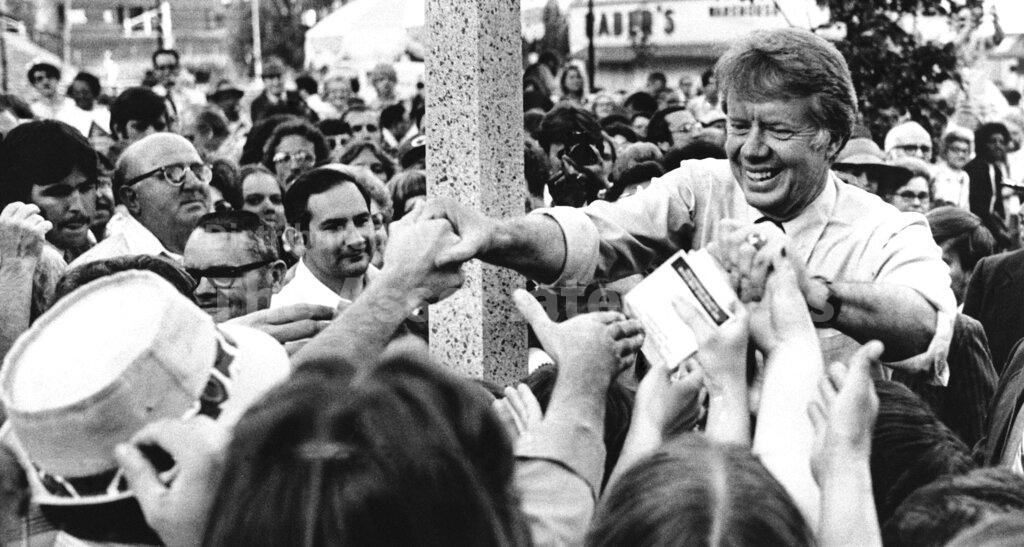
The last of this year’s 30 presidential primaries will he held tomorrow in three of the 10 largest states: New Jersey, Ohio and California. It seems that Jimmy Carter will win enough delegates to put him in relatively easy hailing distance of the Democratic nomination. Senator Hubert H. Humphrey of Minnesota, who said last week that he would probably begin an active search for delegate support if Mr. Carter stumbled tomorrow, remarked in Chicago today that victories in Ohio and New Jersey would “propel” Mr. Carter to the nomination. Neither President Ford nor Ronald Reagan seems likely to resolve in these primaries their contest for the Republican nomination. Republicans in the three states will choose 331 convention delegates, a quarter of the total needed for nomination. Democrats will choose 540 delegates, more than a quarter of the total needed for nomination.
Mr. Ford was in Ohio, stumping with Senator Robert Taft Jr. and Governor James A. Rhodes and reminding Republicans there of what happened to their party in 1964 when they nominated Mr. Reagan’s ideological twin, Senator Barry Goldwater. Mr. Carter campaigned today both in Ohio and New Jersey, having abandoned plans to return to California. Among his active rivals, Representative Morris K. Udall of Arizona and Senator Frank Church of Idaho concentrated on Ohio, and Gov. Edmund G. Brown Jr. of California, confident of the fealty of Democrats at home, drew big New Jersey crowds. The former Georgia Governor made further strides in combating one of his most persistent problems, his lack of support among Jews. Senator Abraham A. Ribicoff of Connecticut endorsed Mr. Carter in a Senate speech, and Senator Richard Stone of Florida has announced his support. They are the only Democratic Senators who are Jewish.
President Ford announced the signing of documents that will lead to quotas on imports of specialty steel. Unemployment in the specialty steel field has been reported as high as 40 percent last year. Mr. Ford made the announcement at Middletown, Ohio, the home of the Armco Steel Corporation, a leading producer of specialty steel. He had said earlier that he would establish quotas unless voluntary restraints were observed by the main exporters. President Ford told the Ohio audience that the quotas would mean more jobs for workers in the Middletown area. Steel industry officials have put unemployment in the specialty steel field as high as 40 percent last year. This was traced both to the recession and to imports. About 65,000 workers are employed in the specialty‐steel side of the industry. Specialty steels include stainless steels, tool and die steels, high temperature alloys, electrical, magnetic, refractory, electronic and reactive alloys and specialty tubing.
The Supreme Court ruled that a statute or other official act is not unconstitutional because it places a “substantially disproportionate” burden on one race. The Court said it was also necessary to prove a “racially discriminatory purpose” in a case that challenged an examination given to police force applicants in the District of Columbia, in which blacks failed in a higher proportion than whites. The Court rejected the challenge 7 to 2. The Court’s ruling rejects the more expansive view that many lower Federal courts have taken in numerous recent cases. It also appears to contrast somewhat with the language in the Supreme Court’s earlier rulings. The Court sought to depict today’s holdings as consistent with its earlier holdings. However, at least some of the lower Federal court rulings were based in part on interpretations by lower courts of earlier Supreme Court decisions. Also, the Supreme Court itself conceded that “there are some indications to the contrary [of today’s ruling] in our cases.”
The Supreme Court ruled today that Ralph Nader, the consumer advocate, could sue an airline that had “bumped” him from a flight because it had sold more tickets than it had seats. The decision was a victory for Mr. Nader’s battle to end the airline practice of overbooking flights as a hedge against passengers who make reservations but fail to show up. The Supreme Court, in a unanimous opinion, ordered the United States Court of Appeals for the District of Columbia, which had refused jurisdiction over the case, to decide whether Mr. Nader had presented enough evidence to support his claim for damages.
The new Senate Intelligence Committee will retain and review 100,000 classified intelligence documents, despite a Central Intelligence Agency plea that the agency be allowed to resume the routine destruction of outdated files, it was announced today. The request was made last Wednesday by George Bush, the Director of Central Intelligence, in a letter addressed to Senators Mike Mansfield of Montana and Hugh Scott of Pennsylvania, the majority and minority leaders. Mr. Bush noted that the predecessor of the Senate Intelligence Committee, the Select Committee to Study Governmental Operations With Respect to Intelligence Activities, completed its legislative lifetime June 1. Therefore, he said, “it is our intention to proceed with destruction of records.” Mr. Bush wrote to Senators Mansfield and Scott because they demanded last January 27 that the Federal Government’s intelligence agencies “not destroy” any records, pending completion of the select committee’s investigation into intelligence activities.
As a result, the agency halted its normal destruction operations in its McLean, Va., headquarters. The destruction, as at virtually all other major government agencies, is done to get rid of unnecessary files. In the C.I.A. case this applied also to “ordinary administrative files,” an agency spokesman said. A spokesman for the new intelligence committee, which was formally constituted June 1 under Senator Daniel K. Inouye, Democrat of Hawaii, said that the select committee had already returned a large number of documents lent it by the agency for its investigation. What remains, he said, are 45 file cases containing documents supplied by the C.I.A., the National Security Council, the National Security Agency, the Defense Intelligence Agency and the Federal Bureau of Investigation. After informal discussions between the Inouye committee and Senator Mansfield, it was decided that the new intelligence committee might want to retain some of the C.I.A. documents for its permanent classified records as a basis for future recommendations to the executive branch on intelligence matters. As a result, the Mansfield-Scott order to delay the file destruction is being continued.
The Senate narrowly rejected an attempt to limit a company’s liability for treble damages in antitrust cases to only those citizens who can prove they were victims of price fixing. No final vote was in sight on the legislation, which is designed to change long-standing federal law governing price fixing and other activities in restraint of trade. Senate Majority Leader Mike Mansfield of Montana, referring to a conservative coalition’s efforts to block the bill, said “if this kind of delay and stall continues” he intends to object to any committee meetings while the Senate is in session.
Internal review panels at the U.S. Military Academy in West Point handed up accusations that 34 more cadets had violated the school’s sternly enforced honor code. The charges bring to 168 the number of third-classmen accused of cheating on a take-home problem in electrical engineering last March. That is nearly one-fifth of the class of 1977. In another development. Academy officials released 650 members of the junior class to go on leave or to other assignments. The class had been ordered held a week to 10 days beyond last Wednesday’s graduation to be available as witnesses before the hearings.
Patrick Cunningham, who was forced to step down as New York state Democratic Party chairman after his first indictment last May 25, was indicted in New York City for the second time, this time on charges of trying to gag a Bronx weekly newspaper. Both indictments were obtained by special state prosecutor Maurice Nadjari. The latest indictment charged that Cunningham and two others threatened to deprive the Bronx City News of legal advertising if it did not “discontinue critical news coverage… of their activities.” The first indictment charged Cunningham with arranging the sale of a judgeship to a former city councilman.
Firestone Tire & Rubber Co. of Akron said it contributed about $330,000 to domestic politics from a corporate fund and paid what it called small “questionable or improper” amounts in foreign countries from November, 1970, through May, 1973, when the fund was ended. The recipients were not named. Richard Riley, Firestone president and chief executive officer, said $40,000 dealt with an attempt to obtain tire-price increases in a foreign country and $35,000 involved import permits. He said “somewhat more than half” of the domestic payments were in cash to political organizations and the rest reimbursed company officers who had made contributions by personal check, himself among them. The disclosure was in a report to the Securities and Exchange Commission and to stockholders.
A joint Roman Catholic-Anglican report on mixed marriage, released yesterday by the two churches, has proposed changes that would further relax the requirements for recognition of such marriages.
“NBC Nightly News” changes to a dual-anchor show with John Chancellor and David Brinkley.
Major League Baseball:
The Texas Rangers outlasted the Baltimore Orioles, 6–4, with Gene Clines driving in two runs and scoring another. Mike Cuellar, making his first relief appearance in eight seasons with the Orioles, yielded three hits in the last 3 ⅔ innings and threw a wild pitch that gave the Rangers their sixth run.
Butch Wynegar lined into the first triple play of the major league season in the fifth inning, then hit a two-run homer in the eighth as the Twins beat the Indians, 7–2. With runners at first and second bases in the fifth Wynegar lined to reliever Stan Thomas who threw to Frank Duffy, doubling Larry Hisle. Duffy’s relay caught Dan Ford off first.
Mike Tyson, who had singled and advanced to third on a single by Jerry Mumphrey, scored the winning run on a wild pitch by Gene Pentz in the eighth inning when the Cardinals downed the Astros, 7–6. Roger Metzger’s error led to five unearned runs for the Cardinals in the first.
Frank White drove in five runs with a triple and single and Hal McRae had four hits, including a homer, in the Royals’ 10–0 rout of the Tigers. Steve Busby pitched six innings for his first victory since May 1.
Ron Cey hits a 1st-inning grand slam but the Dodgers fall to the first-place Phillies, 8–6, and remain 2 games behind the Reds in the National League West. Dodgers’ reliever Charlie Hough takes his first defeat after seven victories. With the score tied, 5–5, the Phillies scored two runs in the sixth when Hough was nicked for a single by Larry Bowa and a double by Ron Reed and issued three walks, one with the bases full.
In a 5–4 Pirates win over the Reds, the two teams combine for a major league record-tying seven homers. Joe Morgan (2) and Pete Rose homer for Cincy, while Al Oliver, Willie Stargell, Richie Zisk, and Bill Robinson go deep for the host Pirates. The record for most homers by both clubs with none on base in a nine-inning game was last accomplished June 18, 1974, when the White Sox beat the Indians, 5–2.
Alan Foster pitched the Padres to a 5–1 triumph over the Mets, allowing only four hits in his first victory since June 1, 1975, and first complete game since May 20, 1975. Dave Winfield hit a three-run homer in the eighth.
Texas Rangers 6, Baltimore Orioles 4
Minnesota Twins 7, Cleveland Indians 2
St. Louis Cardinals 7, Houston Astros 6
Detroit Tigers 0, Kansas City Royals 10
Philadelphia Phillies 8, Los Angeles Dodgers 6
Cincinnati Reds 4, Pittsburgh Pirates 5
New York Mets 1, San Diego Padres 5
Stock prices moved lower again yesterday in continued light trading. Declines in Du Pont and General Motors, two of the 30 components of the Dow Jones industrial average, accounted for almost half of the day’s total loss of 5.81 points.
Dow Jones Industrial Average: 958.09 (-5.81, -0.60%)
Born:
David Diaz, American boxer (WBC lightweight title 2007-08), in Chicago, Illinois.
Jermaine Jackson, NBA shooting guard and point guard (Detroit Pistons, Toronto Raptors, Atlanta Hawks, New York Knicks, Milwaukee Bucks), in Detroit, Michigan.
Mirsad Turkcan, Bosniak Serbian NBA power forward (New York Knicks, Milwaukee Bucks), in Novi Pazar, SR Serbia, Yugoslavia.
Esix Snead, MLB pinch runner and centerfielder (New York Mets), in Fort Myers, Florida.
Cassidy Rae, American actress (Sarah-Models Inc, Clarissa), in Clermont, Florida.
Necro (stage name for Ron Braunstein), American rap artist; in Brooklyn, New York, New York.
Died:
Admiral Shigetarō Shimada, 92, convicted Japanese war criminal for his actions as Admiral of the Imperial Navy and as Japan’s Minister of the Navy during World War II. Shimada was sentenced to life imprisonment in 1945 but paroled in 1955 after the end of the U.S. occupation.
Bobby Hackett, 61, American jazz musician.

