The Commissar Order
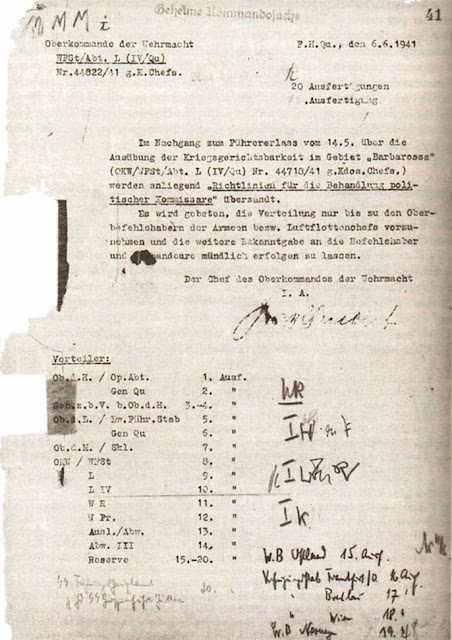
Commissar Order: Hitler ordered that commissars of the Red Army captured in battle or in resistance were “to be disposed of by gunshot immediately..” Hitler implemented the Kommissarbefehl, or Commissar Order, which would bring about the summary execution of any captured Soviet political commissars. Hitler orders the Wehrmacht to eliminate all commissars — Communist Party officials — in the planned assault on the USSR; he says: “Any German soldier who breaks international law will be pardoned. Russia did not take part in the Hague Convention and thus has no rights under it.”
The order singles out political commissars as “The originators of barbaric, Asiatic methods of warfare.” The commissars are:
“…to be separated from the prisoners of war immediately, i.e., already on the battlefield…. These commissars are not to be recognized as soldiers; the protections due to prisoners of war under international law does not apply to them. Whey they have been separated, they are to be liquidated.”
The order leaves it to the local commander’s discretion as to whether the commissar is “guilty” and thus should be “finished off” based on the commander’s “personal attitude and bearing of the commissar.”
Commissars are attached to all military units in the Red Army. They have dual command authority over the troops, which includes military operations. They primarily are responsible for the political indoctrination of the troops.
This is a blatantly illegal order that flouts all principles of international law. The Reich is bound by the terms of the Geneva Convention of 1929 regardless of the fact that the Soviet Union did not sign it, as the Geneva Convention specifically provides:
“In case, in time of war, one of the belligerents is not a party to the Convention, its provisions shall nevertheless remain in force as between the belligerents who are parties thereto.”
Hitler argues that the Soviet Union is not protected by any terms of the Geneva Convention because it did not sign the Convention. There is little doubt, however, that the OKW does consider the Commissar Order, regardless of its perceived appropriateness, illegal.
Only the most senior commanders receive the order, and they are instructed to tell their troops of its contents verbally. Some do, and some don’t.
British Intelligence receives reliable information that Germany will attack Russia on 22 June.
German troops arrived in Finland. Talks occur in Kiel between military representatives regarding naval coordination in the event of hostilities with the Soviet Union. The Germans begin sending troops to Finland by air and sea to prepare for Operation Barbarossa. However, the Finns remain unaware, at least officially, of German plans to invade the Soviet Union within weeks. The top-level talks between the two sides in Salzburg conclude today.
The Waffen-SS has been recruiting in Finland. Today, the first 120 Finnish volunteers head to Germany for training. They are to form the Finnish Volunteer Battalion of the Waffen-SS (German: Finnisches Freiwilligen-Bataillon der Waffen-SS) of the SS-Regiment Nordland of the SS Division Wiking. The men have signed up for a two-year commitment.
There are now sixteen days to Operation BARBAROSSA.
Australian 7th Division is in position on the Palestine-Syria border. The Australian Official Historian observes, “it was the first time in this war, or the one before, that British troops had hidden, like Germans, near a peaceful frontier, ready to make a surprise invasion”.
Since one of the post-war claims against former Reich officials after the war is that Germany practiced “aggressive war,” this is a surprising admission.
British military intelligence believes, based on statements by Vichy French defectors, that morale in Syria is low and the French will not resist. In fact, the French have positioned the 24th Colonial, 22nd Algerian and 6th French Foreign Legion Regiments along the main coast road, supported by seven battalions of artillery.
British preparations, in general, are minimalist, with commanding General Maitland Wilson in Jerusalem relying on 1:200,000 maps and only 70 RAF planes allotted for Operation Exporter by Cairo (versus 100 Vichy French planes, including the most modern fighters in the French arsenal, the Dewoitine D.520). Some information is provided by Palestinian Jews attached to the British Army.
As the invasion progresses British air power will be enhanced, eventually including: 80 Sqn RAF (Hurricanes) based at Haifa, 3 Sqn RAAF (Curtiss Tomahawk IIBs) based at Jenin, 208 Sqn RAF (Hurricanes) at Aqir, 203 Sqn RAF (Blenheim fighters), 803 and 806 Sqns FAA (Fulmars). Bomber support will consist of 84 and 11 Squadrons RAF (Blenheim) and 815 Squadron FAA (Swordfish). Finally, ‘X’ Flight RAF is formed at Habbaniyah this day from the Gloster Gladiators remaining after the Iraqi Revolt.
The RAF shoots down a French reconnaissance plane over Palestine. It is a Martin Maryland, or Model 167F in French military terminology.
Operation BATTLEAXE, the planned British offensive on the Libyan frontier, is pushed back from 7 June to 15 June. The reason is the failure of British tanks to reach the units of General O’Moore Creagh.
Operation ROCKET, the latest supply mission from Gibraltar to Malta, reaches its climax as Royal Navy aircraft carriers HMS Ark Royal and Furious send 44 Hawker Hurricanes to the island. Of the 44 planes, 43 make it successfully and one turns back with mechanical problems. There are 25 of the faster Mark II model of the Hurricane. The RAF divides the planes among Malta’s three airfields.
The aircraft carriers HMS Ark Royal (91) and HMS Furious (47) delivered a cargo of Hurricanes from Gibraltar to within flying distance of Malta.
During the day, Admiral Raeder meets with Hitler to discuss the war in the Mediterranean, which Raeder strongly believes is the key to defeating the British. Hitler, however, is not interested, his focus now is on the East.
Adolf Hitler received Dr. Ante Pavelić, chief of the new Croat State, at his Berchtesgaden retreat today in the latest of several closely guarded diplomatic negotiations between Axis and Balkan leaders believed to deal with trade problems. Dr. Pavelić and Herr Hitler had a two-hour conversation in the presence of Reichsmarshal Hermann Göring and Foreign Minister Joachim von Ribbentrop.
Having just captured numerous Italian prisoners, the Nigerian 23rd Infantry Brigade heads south from the Omo River at Abalti in Galla-Sidamo. Italian defenders from Abalti begin withdrawing toward Jimma in Galla-Sidamo.
Aircraft from HMS Eagle sank German blockade runner Elbe in the South Atlantic.
The 1941 Birthday Honours of King George VI were published.
More than one-third of the 15,000,000 Jews in the world are now in countries under German domination, subject to discriminatory anti-Jewish regulations that make sound economic and social existence impossible, Joseph A. Schwartz, vice chairman of the European field of the Joint Distribution Committee, reported in an address before the national conference of Jewish Social Welfare in New York today.
The Luftwaffe sends a bomber over Durham which drops a single 500 kg bomb near the Liner Railway line at East Jarrow. Another bomber damages some houses at Whitefield Pit, Penshaw, causing three injuries.
RAF Bomber Command, Day of 6 June 1941
3 Blenheims to Cherbourg. Nothing was seen.
The British Air Ministry issued a contract to Avro for the supply of 454 Lancaster Mk I heavy bombers powered by four Merlin XX engines, plus two prototype Lancaster Mk II fitted with four Bristol Hercules VI engines.
The Luftwaffe attacks Malta three times during the day. The targets are Kala Bay, Ta Qali airfield, and Luqa airfield. No planes are lost by either side, and not much damage is caused.
RAF fighters shot down a French 167F bomber over Palestine.
U-106, commanded by Kapitänleutnant Jürgen Oesten, sank British steamer Sacramento Valley (4573grt) at 17-10N, 30-10W. At 0503 hours on 6 June 1941 the Sacramento Valley (Master Harold L. Sharp), dispersed on 27 May from convoy OB.324 in 53°00N/29°30W, was hit on the port side just abaft amidships in the engine room by one torpedo from U-106 while steaming on a zigzag course at 9.5 knots about 250 miles northwest of the Cape Verde Islands. The explosion killed the third engineer and two Indian fireman on watch below and destroyed the port lifeboat. The master, 39 crew members and six gunners (the ship was armed with one 4in, one 40mm and four machine guns) abandoned ship in the starboard lifeboat and two jolly boats within five minutes when the ship settled by the bow with a list to port. The radio operator sent distress signals on the emergency aerial, but got no reply and left the ship as last together with the master. The ship sank vertically by the bow about 10 minutes after the hit. The U-boat surfaced, questioned the survivors in the lifeboat and gave them the direction to the nearest land before leaving. The boats remained at the sinking position for about 7 hours after sending further distress signals with the emergency set, but when no help arrived they set sail towards the Cape Verde Islands. The lifeboat in charge of the second officer had 34 men aboard, including a greaser with a broken leg and drew ahead of the smaller jolly boats. On 9 June, they were picked up by the British motor merchant Caithness, which later that day also located the jolly boat in charge of the master and took its five occupants aboard. The ship searched in vain for the third boat and then proceeded to Freetown, where the survivors were landed on 14 June. The seven men in the jolly boat in charge of the bosun had lost contact with the others during the second night and then decided to steer west, observing three ships passing them without being spotted. In the evening on 24 June, they were picked up by the Panamanian steam tanker Stanvac Calcutta in 09°30N/56°30W and landed at Aruba on 3 July. The 4,573-ton Sacramento Valley was carrying coal and was headed for Pernambuco, Brazil.
U-46 attacked a tanker south of Greenland. The submarine heard a very heavy detonation, but did not observe a hit. The submarine was rammed while submerged by the tanker running in a circle. No identity is available on the tanker.
U-43, commanded by Kapitänleutnant Wolfgang Lüth, sank Dutch steamer Yselhaven (4802grt), from dispersed convoy OB.328, in 49-25N, 40-54W. At 2024 hours on 6 June 1941 the Yselhaven (Master M.P. de Waard), dispersed from convoy OB.328 on 2 June, was hit by two torpedoes from U-43 and sank within two minutes about 600 miles east of Newfoundland. The master and eight crew members were lost. The remaining crew members abandoned ship in two lifeboats, but one of them with 15 occupants was never seen again. The other boat with 10 men under command of the first mate A. Boutkan set sail for Cape Race but was hit by a gale, so they had to lower the mast and dropped a sea anchor. On 15 June, the survivors were picked up by the Finnish steam merchant Hammarland and taken to Norfolk, Virginia. The 4,802-ton Yselhaven was carrying ballast and was headed for Canada.
U-48, commanded by Kapitänleutnant Herbert Schultze, sank British steamer Tregarthen (5201grt) in 46-17N, 36-20W. At 2325 hours on 6 June 1941 the unescorted Tregarthen (Master Leonard Daniel), dispersed on 5 June from convoy OB.329 in 51°48N/20°48W, was hit in the stern by two torpedoes from U-48 north-northwest of the Azores. The ship capsized and sank within three minutes. The master, 41 crew members and three gunners were lost. The 5,201-ton Tregarthen was carrying coal and was headed for Kingston, Jamaica.
Italian submarine Marconi attacked convoy OG.63 in 35N, 11W in the same vicinity of convoy HG.64. British steamer Baron Lovat (3395grt) was sunk in 35-30N, 11-30W. There were no casualties on the steamer. Swedish steamer Taberg (1392grt) was sunk in 35-36N, 11-12W. Fifteen crewmen were lost on the Swedish steamer. The Italian submarine reported sinking one more ship and damaging another, but no information is available. Italian submarines Velella and Emo joined in the attack on the convoy. The two submarines claimed sinking two steamers each, but no confirmation is available.
Italian submarine Veniero attacked convoy HG.64 in 34N, 11W. British steamer Ariosto (2176grt) was missed by torpedoes. The Italian submarine reported attacking another steamer in this convoy.
Italian submarines Emo and Velella also participate in the attack on Convoy HG 64, but their claims of successes are not supported by the Allied records.
Destroyer HMS Anthony departed Scapa Flow at 0900 and met steamer Amsterdam and Lady of Mann off the entrance to Aberdeen. The ships were escorted to the Orkneys; steamer Lady of Mann to Long Hope and destroyer Anthony and steamer Amsterdam to Kirkwall arriving at 2200. Destroyer Anthony and steamer Amsterdam departed Kirkwall at 0430 for Lerwick where they arrived at 1000. Destroyer Anthony escorting steamer Amsterdam departed Lerwick at 0430/8th.Steamer Lady of Mann departed Scapa Flow at 0930 and joined off Duncansby Head. On arrival at Aberdeen at 1545, destroyer Anthony parted company and returned to Scapa Flow, arriving at 2130.
Battlecruiser HMS Repulse arrived at Conception Bay after escorting convoy HX.129.
German blockade runner Elbe (9179grt), which had left Darien on 20 April, sunk by a Swordfish, flown by sub Lt (A) J.B. Murray of 824 Squadron, from aircraft carrier HMS Eagle in the South Atlantic at 23-30N, 36-09W. A search for survivors was unsuccessful. On the 21st, ocean boarding vessel HMS Hilary rescued nineteen survivors from the German ship.
British steamer Glen Head (2011grt) was sunk by German bombing in 35-40N, 10-30W. Twenty seven crewmen were lost on the steamer.
Norwegian steamer Taurus (4767grt) was sunk by German bombing in 56-47N, 2-15W. The entire crew was rescued.
British trawler Emulator (168grt) was damaged by German bombing seven to eight miles east of Scarborough.
Destroyers HMS Wivern, HMS Wild Swan, and HMS Vansittart arrived at Gibraltar after escort duty with convoy WS.8X for refueling.
Aircraft carrier HMS Argus and troopship Nea Hellas, escorted by destroyers HMS Wivern, HMS Wild Swan, and HMS Vansittart, departed Gibraltar to meet aircraft carrier HMS Victorious and light cruiser HMS Neptune. The destroyers would return with Victorious and Neptune to Gibraltar. Argus and steamer Nea Hellas (16,991grt) arrived in the Clyde on the 14th. At 1100/8th, the destroyers joined Victorious and Neptune. Destroyer Wrestler, after reinforcing the OG.63 escort, also joined the Victorious escort.
Submarine HMS Torbay damaged French tanker Alberta (3357grt) with artillery eight miles 75° from Cape Hellas. The tanker was boarded and further damage was done to the tanker. When Turkish tug Taxiarchis tried to tow the damaged tanker on the 9th, submarine Torbay fired a torpedo which missed. Submarine Torbay sank tanker Alberta on the 10th.
Convoy HX.131 departed Halifax, escorted by armed merchant cruiser HMS Cheshire and corvettes HMCS Pictou and HMCS Rimouski. Convoy BHX.131 departed Bermuda on the 4th escorted by ocean escort armed merchant cruiser HMS Wolfe. The convoy rendezvoused with convoy HX.131 on the 9th and the armed merchant cruiser was detached. The convoy was joined on the 12th by corvette HMS Honeysuckle. All these escorts were detached on the 17th. Joining on the 17th were destroyers HMS Beagle, HMS Boadicea, and HMS Salisbury, catapult ship HMS Maplin, corvettes HMS Gladiolus, HMS Nigella, HMS Orchis, and HMS Polyanthus, minesweepers HMS Seagull and HMS Sharpshooter, and anti-submarine trawlers HMS Ayrshire, HMS Lady Madeleine, and HMS St Loman. Corvette Gladiolus was detached on the 18th, destroyers Beagle and Salisbury and corvette Polyanthus on the 19th, and destroyer Boadicea and corvette Nigella on the 20th. The remainder of the escort arrived with the convoy arrived at Liverpool on the 23rd.
President Roosevelt signed a bill (Act of June 6, 1941, 55 Stat 242, “The U.S. Ship Requisition Act”) allowing the U.S. Navy to requisition all idle foreign merchant ships in US ports. He also signs an executive order (9848) authorizing the Maritime Commission to operate or dispose of the ships in the interest of national defense. These new laws affect 84 foreign vessels in US ports.
Legislation authorizing President Roosevelt to defer induction into armed forces of selective service registrants who have reached their twenty-eighth birthday was approved today by the senate military affairs committee. Scheduled for senate consideration Tuesday, the measure would permit the president to narrow service age limits so only men’ from 21 through 27 years old would be called up, instead of the present bracket of 21 through 35.
President Roosevelt said during a press conference that many Americans were being duped by German propaganda into believing that Britain was on the verge of collapse and would soon be suing for peace. President Roosevelt, in an aroused and aggressive mood, accused Germany today of planting reports in the United States that Ambassador John G. Winant had brought word from London that England was “all in” and ready to seek peace. Going to the unusual length of permitting direct quotation, he told a press conference Winant had brought “not even a tenth cousin of a peace offer or anything like it; absolutely nothing like it, provided you use this not as a denial by the president but as an accusation by the president.”
The United States issued a pointed reminder of its interest in the status quo of the Netherlands East Indies to day and indicated also Japan must change its own policy to improve relations with the American government. Secretary of State Hull recalled earlier declarations of policy on the East Indies in connection with apparent refusal of that Dutch colony to meet fully Japan’s demands for increased supplies of rubber, tin and other important war materials.
Former Presidential Candidate Wendell L. Willkie makes a radio broadcast entitled “Let Us Not Be Divided.” He notes:
“I cannot tell you the point at which we may become involved in war. Neither can any other American. All we can know is that if and when Hitler thinks it is to his advantage, he will make war upon us.”
Willkie notes, however, that the is “not divided but the United States of America.”
A spokesman for the Ford Motor Co. said tonight that a slow-down strike was In progress on the Ford motor assembly line at the River Rouge plant and that as a result assembly of automobiles and trucks at River Rouge and 14 branch plants would be halted tomorrow.
Strikes continue at North American Aviation and Walt Disney Studios.
The U.S. Government is prepared to take over the strike-bound plant of the North American Aviation Company at Inglewood, California, high officials said today. An important defense official said that “action was imminent,” and at the Department of Justice it was learned that the legal aspects of the step were being investigated. It was stated that President Roosevelt approved the plan today, but that no time had been fixed. One version was that the step would be taken early next week, while in other quarters it was indicated that earlier action was possible. Some of those who are delving into the precedents and working up information for President Roosevelt in connection with the situation feel that action should be deferred to await developments at a mass meeting of the strikers to be addressed Sunday night by Richard T. Frankensteen, aircraft director of the United Automobile Workers (C.I.O.). If the strikers decide to go back to work on Monday, in the opinion of these advisers, it would be unwise to have the government take possession of the property. Other advisers, however, believe that excellent reasons would still remain for the more drastic course of action which was decided upon today by the President.
By a substantial majority the membership of the American Federation of Teachers voted to revoke the charters of the communist-dominated Teachers Union and College Teachers Union of New York City and the Philadelphia Teachers Union, it was announced yesterday by the federation’s executive council.
Units of the U. S. battle fleet which have been stationed in Hawaiian waters since the political situation in the Pacific became acute will visit Pacific coast ports In small groups, navy headquarters announced today. Men of the fleet will be returned to the mainland for recreation and to visit their families. Navy spokesmen did not announce definite plans or the date the first ships will sail for the coast. The fleet has been based in Hawaii waters since spring of 1940.
Louis Chevrolet, the co-founder of the Chevrolet automobile company, passes away at age 62.
Boeing starts production engineering for 264 service-model B-29s, 15 months before the first experimental prototype, the XB-29, is test-flown.
Major League Baseball:
The Dodgers still are in first place. Tonight before a crowd of 32,061 cheering fans at Ebbets Field they turned back the Cubs, 4–1, behind the five-hit pitching of young Kirby Higbe. The triumph restored their half-game lead over the second-place Cardinals, who had put it squarely up to the Dodgers by beating the Braves in the afternoon. The margin of victory was three unearned runs because of an error in the sixth by Bobby Sturgeon, Chicago shortstop. However, there was also some timely hitting in that fruitful sixth, one of the most potent blows being a double by Higbe that drove in two runs. Peewee Reese also starred today with three hits including a triple.
Lon Warneke notched his sixth victory of the campaign by letting the Braves down with six hits and one tainted tally to bring the Cardinals a 3–1 decision today. Only in the seventh inning did Boston threaten Warneke seriously, but a spectacular play by Martin Marion on Pinch Hitter Paul Waner’s belt retired Gene Moore at the plate with what would have been the tying tally. Marion dived and just managed to knock down the whistling drive. Moore, heading for the plate, was tagged out cleanly by Gus Mancuso, who caught the shortstop’s perfect throw. The game developed into a pitching duel between Warneke and Manny Salvo. The Braves’ second-inning tally looked big until the fourth. In that frame Salvo’s spotty pitching got him into trouble and a pair of walks turned into as many counters to give St. Louis the lead.
Home runs accounted for all of Boston’s tallies today as the Red Sox whipped the Chicago White Sox, 6–3, for their sixth straight victory and climbed within one game of second place in the American League. Boston got only six hits off Johnny Rigney and Buck Ross, but three of them were homers and two were doubles. Jimmy Foxx collected his eighth circuit smash of the season with two on the bases in the first inning. Ted Williams got his tenth with one on in the third and Jim Tabor followed with another in the fourth.
Bob Feller proved again today that the Indians couldn’t get along without him. He hurled a four-hit, 2–0 victory over the onrushing Athletics for his twelfth of Cleveland’s thirty-one triumphs this season. It was the young strike out king’s fourth triumph since any of his pitching mates had won even one. The last Cleveland victory not pitched by Feller was the 4–2 decision for Jim Bagby against the Browns on May 24. The Indians have skidded sadly since that time, but their closest rivals have done nearly as badly. As a result today’s victory pulled Cleveland two games ahead of the beaten White Sox. Connie Mack’s surprising Athletics had won fourteen of their last eighteen starts, but they met their master today. Rapid Robert not only gained his seventh triumph in succession and his fourth shutout, but struck out eleven men to run his season total to 101, and issued no walks.
The Tigers spotted the Senators seven runs, then scored seven in a single inning and went on to win today, 11–8, in the opener of a three-game series. Neither starting hurler was around when the blasting stopped. Detroit hammered Ken Chase in the third when it turned five hits and an error into seven runs, tying the count. Washington had sent Floyd Giebell, who was making his first start this year, to the showers with a six-run outburst before a man was retired in the second. The Senators nipped at Schoolboy Rowe for single tallies in the third and fourth, but the veteran braced the remainder of the way and registered his third victory.
The Giants use plastic batting helmets for the first time against the Pirates but lose a doubleheader to the Bucs 5–4 and 4–3. In game 2, Pittsburgh pitcher Rip Sewell sets an National League record by handling 11 assists and the infield handles a record-tying 25 putouts. The opener saw the Pirates rout Bill McGee inside of six rounds and go on to win, with the help of a homer by Arky Vaughan, 5–4. Max Butcher bagged this one after staving off closing rallies which included a circuit blow for Joe Orengo. In the nightcap, despite two home runs by Mel Ott, which boosted Master Melvin’s season total to fourteen, the Giants went down again, 4 to 3, with Sewell outhurling Bill Lohrman.
Danny Litwhiler’s 2nd inning infield single is the only hit given up by Johnny Vander Meer as the Reds beats the Phils, 7–0. The Reds shortstop Eddie Joost has both hands on Litwhiler’s grounder but fumbles it and it is ruled a hit. Chuck Aleno hits his only Major League homer, off Si Johnson, in support of Vandy, who strikes out 12. Aleno had opened the season by hitting in 17 straight games.
Chicago Cubs 1, Brooklyn Dodgers 4
St. Louis Cardinals 3, Boston Braves 1
Boston Red Sox 6, Chicago White Sox 3
Philadelphia Athletics 0, Cleveland Indians 2
Washington Senators 8, Detroit Tigers 11
Pittsburgh Pirates 5, New York Giants 4
Pittsburgh Pirates 4, New York Giants 3
Cincinnati Reds 7, Philadelphia Phillies 0
U.S. Naval Air Station, Balboa, Canal Zone, is established.
The Chinese 5th Pursuit Group receives six Soviet I-153s to use as night fighters. The need for such fighters became very clear on the 5th, when a Japanese raid in the evening hours, caused thousands of deaths in the Nationalist capital of Chungking.
Brigadier General Leonard Gerow recommends to Army Chief of Staff General George C. Marshall that the Philippine forces not be called into Federal service. He further recommends MacArthur be given command of the Philippine Department.
Dow Jones Industrial Average: 118 (-0.13)
Born:
Alexander Cockburn, Scottish-born American journalist, in Scotland, United Kingdom (d. 2012).
Howie Kane [Howard Kirshenbaum], American rock singer (Jay and the Americans — “Come a Little Bit Closer”), in Brooklyn, New York, New York (d. 2023).
Marshall Johnston, Canadian NHL defenseman (Minnesota North Stars, California Golden Seals), in Birch Hills, Saskatchewan, Canada.
Willie Ross, AFL fullback (AFL champions-Bills, 1964; Buffalo Bills), in Helena, Arkansas.
Les Murdock, NFL kicker (New York Giants), in Boston, Massachusetts.
Al Lawson, AFL wide receiver (New York Jets), in Washington, District of Columbia (d. 2004).
Died:
Louis Chevrolet, 62, Swiss-born American race car driver and co-founder of the Chevrolet automobile company, of a heart attack.
Naval Construction:
The Royal Navy Bar-class boom defense vessel HMS Barfount (Z 190) is laid down by W. Simons & Co. Ltd. (Renfrew, Scotland).
The U.S. Navy YMS-1-class auxiliary motor minesweeper USS YMS-18 is laid down by the Herreshoff Manufacturing Co. (Bristol, Rhode Island, U.S.A.).
The U.S. Navy YMS-1-class auxiliary motor minesweeper USS YMS-42 is laid down by the Wheeler Shipbuilding Corp. (Whitestone, Long Island, New York, U.S.A.).
The U.S. Navy YMS-1-class auxiliary motor minesweepers USS YMS-94, USS YMS-95, USS YMS-97, and USS YMS-99 are laid down by the Colberg Boat Works (Stockton, California, U.S.A.).
The Royal Navy Bangor-class (VTE Reciprocating-engined) minesweeper HMS Ingonish (J 69) is laid down by North Vancouver Ship Repairs Ltd. (Vancouver, British Columbia, Canada). She is transferred to the Royal Canadian Navy upon completion, commissioning as the HMCS Ingonish (J 69).
The U.S. Navy 77-foot Elco patrol motor torpedo boat USS PT-48 is laid down by the Electric Launch Company Ltd. (Elco), (Bayonne, New Jersey, U.S.A.).
The U.S. Navy PC-461-class (173-foot steel hull) submarine chaser USS PC-550 is laid down by the Leatham D. Smith Shipbuilding Co. (Sturgeon Bay, Wisconsin, U.S.A.).
The Royal Navy modified Black Swan-class sloop HMS Chanticleer (U 05) is laid down by William Denny & Brothers (Dumbarton, Scotland).
The Kriegsmarine (German Navy) Type 1936B destroyer Z35, lead ship of her class of 5 (3 more cancelled), is laid down by AG Weser (Deschimag), Bremen (werk 1005).
The U.S. Navy Accentor-class coastal minesweeper USS Dominant (AMc-76) is launched by the Gibbs Gas Engine Co. (Jacksonville, Florida, U.S.A.).
The U.S. Navy 77-foot Elco patrol motor torpedo boat USS PT-32 is launched by the Electric Launch Company Ltd. (Elco), (Bayonne, New Jersey, U.S.A.).
The U.S. Navy minelayer USS Terror (CM-5), sole ship of her class completed (2 sisters converted to landing ships, vehicle) is launched by the Philadelphia Navy Yard (Philadelphia, Pennsylvania, U.S.A.).
The Royal Navy harbor defence motor launch HMS HDML 1045 is commissioned.
The U.S. Navy coastal patrol yacht USS Sapphire (PYc-2) is commissioned.
The U.S. Navy coastal minesweeper USS Bunting (AMc 7) [former purse seiner Vagabond] is placed in service. Her first commanding officer is Ensign Paul H. McBride, USNR.
The U.S. Navy coastal minesweeper USS Flamingo (AMc-22) [former fishing dragger Harriet N. Eldridge] is placed in service. Her first commanding officer is Lieutenant Leonard Scott Bailey, USNR.
 History Diaries