A former senior Yugoslav intelligence official said today that Soviet intelligence officers in Vienna were told “in late 1947 or early 1948” that Kurt Waldheim was sought by Yugoslavia for involvement in war crimes. The disclosure is significant because of speculation that the Soviet Union might have subjected Mr. Waldheim to political pressure or blackmail while he was Foreign Minister of Austria or Secretary General of the United Nations. But the former Yugoslav intelligence official, Anton Kolendic, said he did not know whether the Soviet officers had sought to use the information to put pressure on Mr. Waldheim or to enlist him in their service. Mr. Waldheim is favored to win the Austrian presidency in a runoff election Sunday. In a conversation at his home here, Mr. Kolendic, 72 years old, said he presented a list of “about 25 or 27” Austrians sought for war crimes, including Mr. Waldheim, to a Soviet Army officer he identified as Colonel Gonda, whom he described as “a senior officer in the Soviet intelligence service.” He said he did not know the officer’s first name because he usually referred to him as Comrade Gonda. Mr. Kolendic denied a Yugoslav newspaper report quoting him as saying the Russians would seek to use the information to blackmail Mr. Waldheim. “They promised simply to initiate a search for the persons on the list, and reply immediately,” he said. “But we never received an answer.”
Kurt Waldheim’s foes in Austria’s presidential election have virtually dropped the issue of his war record, judging that accusations about war crimes have done him more good than harm. Pollsters are unanimous that most voters in their 20’s and 30’s back Mr. Waldheim, the 67-year-old conservative candidate.
“Waldheim is a liar,” read the first placard of the group of 16 young protesters today as they rounded Breinsbach Street and entered the packed Hauptplatz, where Kurt Waldheim had just begun to speak. The demonstrators were immediately surrounded by burly Waldheim supporters, who, swinging their fists and shouting curses, ripped down the stick-borne placards. Beate Klarsfeld, the German-born Nazi hunter, looked frightened and close to tears. From an elevated platform, Mr. Waldheim raised his long fingers in a spectral gesture that has become one of his campaign trademarks and intoned, “So here you see an example of the abuse of Western democratic liberties!”
In a key paragraph in the German-language edition of his memoir, “In the Eye of the Storm,” Kurt Waldheim writes that he returned to service in the German Army after recovering from a leg wound early in World War II and was in the area of Trieste when German troops capitulated in Italy. The paragraph was omitted from the English-language edition of the book, published in the United States by Adler & Adler of Bethesda, Maryland, and in the edition published in Britain by George Weidenfeld & Nicholson Ltd. of London. The omission from the English edition of Mr. Waldheim’s of return to military service was noted by Louis Halasz of Mahopac, N.Y., who is acknowledged by Mr. Waldheim as one of the many friends and colleagues who helped contribute to the Waldheim memoir. The memoir was published in 1985 and covered Mr. Waldheim’s formative years and rise to Secretary General of the United Nations.
A new version of the disputed extradition treaty between the United States and Britain has won the support of a majority of the Senate Foreign Relations Committee, committee sources said today. But the compromise immediately ran into difficulty when the State Department’s chief lawyer, Abraham D. Sofaer, objected to several provisions. A meeting of the Foreign Relations Committee scheduled for this morning, at which the new version of the treaty would probably have been approved, was canceled because of the State Department objections. The British Government also requested more time to study the revisions. The revised treaty, negotiated a year ago, would make it easier to extradite Irish Republican Army fugitives wanted for prosecution by the British for terrorist acts. It lists several crimes for which a fugitive would no longer be able to invoke the defense that the motive was political. The compromise removes from this list possession of firearms and conspiracy.
A $75 million “final offer” of compensation from the publisher Rupert Murdoch was decisively rejected by 5,500 former employes, whose unions have been picketing and demonstrating at his new plant for more than four months. When the offer was made 10 days ago, Brenda Dean, the leader of the union with the most members involved in the dispute, said she believed that the Australian-born publisher was not bluffing and that this was their last chance to get compensation for the jobs they had lost. But members of the Society of Graphical and Allied Trades, Miss Dean’s union, voted by a margin of 3 to 2 against accepting the $63 million that would have been their share of the total package. Two other unions, the National Graphical Association and the Amalgamated Engineering Union, voted down the Murdoch offer by even heavier margins. The union ballots appear to mean that Britain’s most violent labor confrontation since the yearlong coal miners’ strike of 1984-85 may now continue indefinitely.
Two Libyans were convicted in Turkey today of possession of explosives in the attempted bombing of a United States officers’ club, and a state security court sentenced them to five years in prison. The defendants, Ali Ecefli Ramadan and Recep Muhtar Rohoma Tarhuni, both 31 years old, were arrested April 18. The Libyans hurled a bag stuffed with six Soviet-made hand grenades at a van parked outside the club, but no one was hurt. The three-judge court acquitted the two men on a charge of conspiring to kill a group of people. The court ruled Thursday that three other Libyans charged in connection with the plot were protected by diplomatic immunity and could not be prosecuted.
The United States called on Israel today to provide “full cooperation” in the investigation of the evidence turned over by a former Navy analyst who has admitted spying for Israel. State Department officials said the repeated demand for cooperation had also been conveyed to the Israelis through diplomatic channels. The officials said the Israelis had been cautioned that the case of the Navy analyst, Jonathan Jay Pollard, could generate considerable tension in relations if the Israelis are perceived to be covering up information. Senior Justice and White House officials have said the Israeli Government has not been fully cooperative in the investigation. William H. Webster, the Director of the Federal Bureau of Investigation, said in an interview Wednesday that Israel had given only “selective cooperation” in the investigation of Mr. Pollard, who pleaded guilty Wednesday to selling secrets to the Israelis. His wife, Anne Henderson Pollard, pleaded guilty on lesser counts.
An uneasy truce took hold overnight at three Palestinian districts on the southern outskirts of Beirut, but it was broken today as Palestinian and Shiite Moslem fighters resumed clashes with rockets and machine guns. Explosions resounded around Sabra, Shatila and Burj al Brajneh as a security committee met to consider ways to enforce the cease-fire. The committee, which consists of representatives of the combatants and 10 Syrian military observers, was formed a year ago.
A high-ranking Iraqi official was quoted today as saying that his government and Syria would soon hold talks, a step that could end two decades of antagonism. The official, Foreign Minister Tariq Aziz, said Syrian and Iraqi officials would meet after Ramadan, the Moslem month of daily fasting, on the frontier between the two countries. Ramadan ends this weekend. The statement was the first official confirmation of persistent speculation in the Arab press about an imminent reconciliation between Damascus and Baghdad, which are ruled by rival factions of the Socialist Arab Baath Party and which have been at odds since President Saddam Hussein seized power in a military coup in Iraq in 1968.
Five Sikhs charged with possessing explosives with intent to injure were denied bail today. A judge in provincial court here ruled that the men should remain jailed because they posed a threat to the public, Reports here have said that the five, all residents of Montreal, are suspected of having plotted to plant a bomb aboard a jetliner leaving Kennedy International Airport in New York for London last week. The judge, Claude Joncas, set June 9 as the date for a meeting to determine the date of a preliminary hearing, the next stage in the Canadian judicial process. The hearing, which will determine if there is sufficient evidence to warrant a trial, could be held within a week.
A federal judge Friday ordered the U.S. Customs Service to return to deposed Philippine President Ferdinand E. Marcos millions of dollars in money, jewelry and other belongings his party carried to exile in Hawaii. U.S. District Judge Harold Fong said the Customs Service had no authority to hold the goods it seized after Marcos fled the Philippines on February 26. The property was not confiscated in connection with any investigation into potential violation of U.S. law, he said. The new Philippine government of Corazon Aquino contends that the money and property were stolen. In March, it released a Customs inventory of $7.7 million in goods it said accompanied Marcos, his wife, Imelda, and an 89-member entourage when they left the Philippines at the end of Marcos’ 20-year rule. The inventory included designer bags stuffed with jewelry, one piece valued at $1.5 million, as well as 22 cardboard boxes stuffed with $1.2 million in Philippine pesos. An aide to Marcos said the former president is happy with the ruling. “He said, ‘I told you about American justice, that we have always believed in this,”” Arturo Aruiza said.
A high-ranking Haitian official, moving to defuse the country’s latest political crisis, announced today that there would be presidential elections within 18 months. The calling of presidential elections has been one of the principal demands of the Haitian people since President Jean-Claude Duvalier fled into exile on February 7. Since then, the Government has been racked by protests and occasional violence.
President Reagan today renewed his drive for $100 million in aid for the Nicaraguan rebels, saying that the failure to finance their effort to overthrow the Sandinistas could mean a “divided war-torn region with Nicaragua as a refuge for terrorism.” Mr. Reagan, expressing strong doubt about Managua’s interest in a negotiated peace settlement with the rebels, suggested that the House of Representatives was “falling victim” to a Nicaraguan Government strategy of seeking to delay such a peace agreement while it destroys all internal opposition. The Administration has argued that the aid is necessary to put pressure on Managua to negotiate with the rebels. “The strategy of the Sandinistas should now be clear to everyone,” Mr. Reagan said to a group of Republican candidates and elected officials at the White House. “It’s a strategy of delay, dragging out negotiations, never taking a serious position so they can wipe out their opposition, while Congress waits to see if a peace treaty is around the corner.”
The Nicaraguan Government has freed 308 prisoners pardoned earlier in the week, including some who had been bodyguards for Anastasio Somoza Debayle, the former dictator. A spokesman for the Interior Ministry said the prisoners who were freed included five Hondurans and five Costa Ricans. The Nicaraguan Parliament granted the pardons late Tuesday at the request of President Daniel Ortega Saavedra and the Government Human Rights Commission. The prisoners were released Thursday from the Modelo Penitentiary on the outskirts of the capital.
A leading Ethiopian relief official said today that he was quitting his post and would not return home. The official, Berhane Deressa, Deputy Commissioner of Relief and Rehabilitation, said in an interview: “I have found out that serving my country and serving a regime — especially a regime whose primary purpose is implanting a foreign ideology and an alien socio-politial system — is not only a contradiction in terms but also diametrically opposed to what I have always believed in: service to country.” The head of the same Ethiopian relief unit, Dawit Wolde Georgis, who came to the United States late last year, said recently that he had also decided not to return home.
Liberia’s President, General Samuel K. Doe, announced today that he had pardoned 34 people accused of conspiring to overthrow the government. The Liberian Information Ministry said General Doe granted “a complete and unconditional pardon to all persons implicated and detained after the failed coup of November 12, 1985.” Among those pardoned was Ellen Johnson-Sirleaf, a prominent opposition politician and former Citibank vice president whose case drew substantial attention in the United States. In a broadcast, General Doe said the pardon was an “act of mercy” to show “that we harbor no evil intention against any of our citizens, including those who may wish us ill.”
A group of Commonwealth leaders has decided to give up its attempt at mediation between the South African Government and its main black nationalist opponents, a diplomat close to the group said here today. The seven leaders, known as the Eminent Persons Group, visited Cape Town in March, meeting both President P. W. Botha and Nelson Mandela, the imprisoned leader of the outlawed African National Congress. They returned again in May after receiving diplomatic signals that the Botha Government was prepared to talk about legalizing the outlawed movement and releasing Mr. Mandela and others. A message from the South African Government reportedly was waiting for the group Wednesday when it reconvened here at the Commonwealth headquarters at Marlborough House. It was described as tough in tone. According to the source, the group’s reply said the Government’s own actions and intransigent attitudes had doomed the attempt to initiate discussions between the main opposing forces in South Africa.
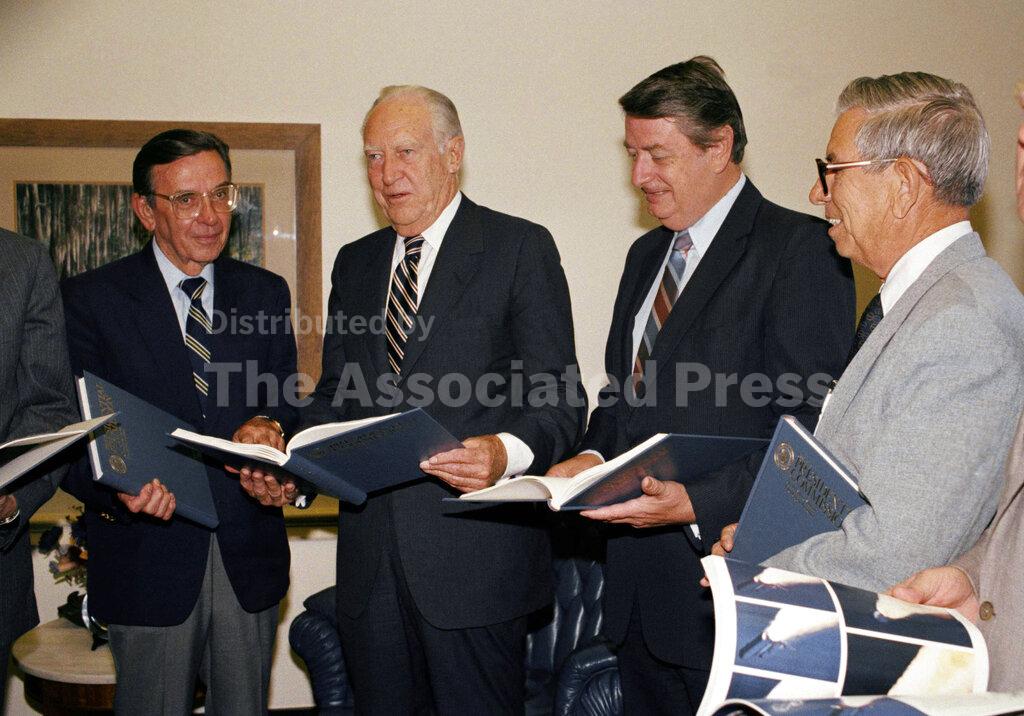
The chairman of the President’s commission on the space shuttle and the only Nobel laureate on the panel were at odds from the beginning. But now, after four months of investigating the Challenger disaster, the 13-member commission has reached a remarkable consensus, helped in part by the enormous, steadying influence of the first man to walk on the moon and by a two-star Air Force general. The full story behind the work of the commission, whose report is to be issued Monday, will not be known until all transcripts of secret meetings are made public and the participants have provided full accounts. But interviews conducted in recent days with most of the commissioners shed new light on the individuals and influences that shaped the commission’s work. The panel’s conduct of the investigation is being hailed by many observers and by most of the commission members. But some commissioners quarreled over whether the final draft was tough enough on the space agency, so it is not unreasonable to suppose there will be criticism from some quarters on this issue.
The chairman, William P. Rogers, described the report as “a historic document,” and the astronaut Sally K. Ride, a member of the group, said she believed it would be considered “a significant piece of work, just because the accident itself was so significant, such an important part of our history.” One analyst of Government commissions, Dr. Richard Haass of the Kennedy School of Government at Harvard University, said he gave the Rogers commission “high marks” for “coming on the scene after a national trauma” and projecting a sense of great knowledge and integrity. The result, he said, was that the commission appeared to be “getting close to the bottom” of the mystery of what caused the disaster, although no final judgment can be made until its report is issued. The commission was notable, most participants say, for its speed and general unanimity and because its members performed an enormous amount of work themselves rather than delegating it to staff members. By virtually all accounts, the person most responsible for the commission’s performance was its chairman, Mr. Rogers, a former Secretary of State and former Attorney General. Although Mr. Rogers lacked any technical background, commission members said he thrived in the shuttle investigation, where his skills as an analyst, negotiator and tactical decision-maker kept a diverse group moving quickly and functioning as a team. The chief conflict, according to several participants, was between Mr. Rogers and Dr. Richard P. Feynman, the Nobel Prize-winning physicist from the California Institute of Technology. They repeatedly clashed not only on how harshly to criticize NASA but also on how to conduct the investigation and deal with the press.
Indeed, only last week Dr. Feynman threatened to dissent from the commission’s final report unless a section that he had written, which Mr. Rogers considered too harsh and emotional, was included as he had composed it. That last-minute fracas was resolved through the mediation of Maj. Gen. Donald J. Kutyna of the Air Force, a commission member who, through the course of the proceedings, became a close friend of Dr. Feynman. General Kutyna cautioned today that the issue involved only a few words and had been resolved to the satisfaction of all. From the start, Dr. Feynman, known for his brilliant and original intellectual forays, was impatient with committee meetings, bureaucratic planning, formal hearings and detailed discussions of the best way to word reports. As far as he was concerned, the way to investigate a problem was to venture out as an individual and have long talks with the technical people who could explain everything they knew about the shuttle technology and its problems. But Mr. Rogers was determined to conduct what he called an “orderly investigation,” with designated individuals and panels of commission members systematically looking into the major issues. He was leery from the start of allowing Dr. Feynman to venture into the field on his own, which he occasionally did.
The unemployment rate jumped two-tenths of a percentage point in May as the nation’s economy generated only one new job for every two people who joined the labor force, the Government reported today. The rise in the overall jobless rate, to 7.2 percent, was considered a disappointment by most analysts and suggested that economic expansion continued at a lackluster pace despite a boom in housing and some service industries. “We’re seeing fairly reasonable growth in service output but a continued shrinkage in manufacturing and mining,” said James E. Annable, chief economist at the First National Bank of Chicago. The national pattern was reflected in increasing unemployment in New York and New Jersey, although joblessness in New York City dropped by eight-tenths of a point, to 7.9 percent. The nationwide civilian unemployment rate, excluding the armed forces, rose by the same two-tenths of a point as the overall rate, to 7.3 percent, last month.
President Reagan participates in a meeting to discuss federal payments to farmers.
The President and First Lady have lunch with Suzanne R. Massie, co-author of “Nicholas and Alexandra,” a Soviet affairs historian.
The jury that convicted Ronald W. Pelton of espionage Thursday went to extraordinary lengths to decide that he had confessed voluntarily, according to three jurors. “If it was not voluntary, how could we make this decision?” Dwardka Goswami, the jury foreman, asked in an interview today. The defense for Mr. Pelton, a former employee of the National Security Agency, had rested primarily on his contention that he had been tricked into confessing. He said that when agents of the Federal Bureau of Investigation questioned him twice in a hotel in Annapolis, Md., on Nov. 24, 1985, he thought the agency was considering using him as a double agent instead of prosecuting him for selling intelligence secrets to the Soviet Union. . Prosecuting attorneys said Thursday on the courthouse steps after the verdict that the F.B.I.’s investigative techniques had been vindicated by the jury’s decision.
The head of the Communications Workers of America insisted today that he had “the full support of every union in America” and would increase pressure on the American Telephone and Telegraph Company to settle its nationwide strike. The union president, Morton Bahr, told reporters he had met with labor leaders and citizen groups around the country and planned to increase the pressure on the company with rallies and marches. Both sides said there had been no new contract talks on behalf of 155,000 telecommunications workers to settle the strike, now in its sixth day.
Six thousand flight attendants strike Trans World Airlines. The strike is broken by hiring new workers, and 4,400 attendants lose their jobs with little complaint from other unionists. The American Telephone and Telegraph Company is struck by 150,000 communications workers , but service continues with little disruption, with supervisors filling in and new workers hired to replace strikers. Fifteen hundred meatpackers strike Geo. A. Hormel & Company in Austin, Minn. The parent union, infuriated by tactics, places the local in trusteeship, asking workers to renounce the strike. How long has it been since things looked so dismal for unions? Plants continue to close. Bargaining on management demands for concessions continues. The willingness of companies to hire employees to take strikers’ jobs weakens strikes, as at T.W.A. and A.T.&.T, and computer technologies mean work can often be performed automatically, also weakening strikes, as at A.T.&.T. In 1981 more than 11,000 air traffic controllers were dismissed for their strike, which was illegal, and numerous strikes since have been lost or ended with employees returning to work largely on employers’ terms. “The labor movement is taking it on the chin like it hasn’t since the early 1920’s,” Ronald Schatz, associate professor of history at Wesleyan University, said this week.
New York State is a leader among states striving to restructure their economies. Across the country, state and local agencies are taking over an economic development role that was traditionally assumed by the Federal Government. In 1984, New York set up a new agency to aid companies that show promise of success but cannot obtain all the financing they need from private banks, and Governor Cuomo is now proposing three more assistance programs.
The Senate today approved a $3.9 billion supplemental appropriation bill for 1986 that includes anything from funds to keep the Commodity Credit Corporation operating to such election-year gems as a pilot project to speed blackbird migration. The vote of 71 to 8 came after two long days of debate, carrying past 2 A.M. today and resuming just before 10 o’clock. Some weary senators, who call themselves members of the ad hoc Quality of Life Committee, moved this afternoon to quicken the debate by opposing as many amendments as possible on procedural points of order to defeat them quickly without much discussion. By the time of the final vote, 21 senators had apparently left for the weekend. In votes Thursday and today, the Senate helped several Republicans up for re-election by approving key amendments, refused to reduce the limit on outside income for senators, and approved an amendment to take away $80.6 million in research funds for 11 universities, including two in Kansas, the home of Bob Dole, the Senate Republican leader. Three of them, the Rochester Institute of Technology, Cornell and Syracuse, are in New York State.
Two gunmen walked into a branch bank in this rural community today and without saying a word opened fire, killing three bank employees and critically wounding a bank manager and a customer, the police said. Two suspects, one a former prison guard, were arrested nearly three hours later at a roadblock. “This is an extremely violent crime for this area, or any other place in the commonwealth,” said Lieutenant Robert Werts of the state police. Lieutenant Werts said the two men said nothing about a robbery before they started shooting at a branch of the First National Bank of Bath at 11:13 AM. The four employees were shot at their work stations, the officer said. One bank employee fled out the back door and provided the police with a description of the gunmen and their automobile. One other person also escaped unharmed, the police said. As the shooting victims lay on the floor of the bank, the gunmen walked behind the teller counter where there are drawers of cash, Lieutenant Werts said. However, he said it remained unclear whether the gunmen actually took any money.
A man who said he received a transfusion of blood tainted with the AIDS virus from a Milwaukee County medical center is seeking $2.5 million from the county, the man’s lawyer said today. The man, Wendell J. Glessner, 71 years old, of Dixon, Illinois, received the transfusion in July 1983 at Milwaukee County Medical Complex, his lawyer, George P. Kersten, said. He said Mr. Glessner was notified in March that the blood was tainted with the virus that causes acquired immune deficiency syndrome, a lethal ailment that destroys the body’s defenses against infection. He said tests have found that Mr. Glessner had the AIDS antibody. The presence of the antibody means a person has been exposed to the virus; Scientists believe that about 10 percent of those with the antibody will develop the disease. The Red Cross is combing records to find others who might have received blood transfusions tainted with the AIDS virus and says there may be 1,000 to 2,000 people who had received such transfusions before a test was developed to detect the virus.
As more and more air travelers have sought to overcome slow baggage-handling by carrying their luggage aboard themselves, the airlines have been facing a mounting problem of where to stow it. As a result, the Secretary of Transportation, Elizabeth Hanford Dole, has proposed a uniform restriction on the number and size of carry-on baggage items, largely because of the possible safety hazard involved. “Passengers are carrying excessive amounts of baggage on with them on flights, causing confusion and possible safety problems finding space to store it,” Mrs. Dole said, citing a 1984 inspection of airlines. “Improperly stowed bags can be dislodged during turbulence and injure passengers or crew members.”
Her face raked with deep gashes, Marla Hanson said yesterday that the terrifying razor attack and wounds she suffered at the hands of thugs on a dark West Side street had not crushed her dreams of a modeling career or her faith in New York. “I love New York — I’m not going to leave because of this,” the 24-year-old fashion model told reporters at St. Vincent’s Hospital a day after the attack by two men who, according to the police, were hired by her former landlord to disfigure her in a dispute over $850. In Manhattan Criminal Court, the three men charged in the attack were held in high bail, and the prosecutor in the case said the man accused of hiring the assailants “knew the importance of her face” and intended to “ruin the career of the victim.” Draped in a hospital gown and seated beside the plastic surgeon who closed her wounds with 100 stitches, Miss Hanson said she hoped to go back to modeling, perhaps on television, if her face can be restored. And if that does not work out, she said, she will pursue other careers.
[Ed: Remarkably resilient lady.]
The Smithsonian Institution, after consulting with a private security company and the Federal Bureau of Investigation, will close an underground parking garage to the public Saturday as part of a larger effort to forestall terrorist acts in the capital. Alvin Rosenfeld, a spokesman for the Smithsonian, said no specific threats had been received. But “the decision was made to move on it before the major public tourist season,” he said. The garage is at the National Air and Space Museum, which with nine million visits a year asserts a claim as the most popular museum in the world. The move comes as part of heightened concern over the last year in Washington about terrorist attacks.
A conservative student newspaper at Dartmouth College has settled a $3 million lawsuit filed by a former college chaplain who asserted that the paper had permanently damaged his reputation. The Dartmouth Review, in a public apology, said that it printed false information in 1983 and 1984 about the Rev. Richard Hyde when he was an associate chaplain at the Ivy League school.
A Massachusetts Republican candidate for Governor has admitted that he claimed falsely to have been a captain in the Special Forces in Vietnam, and political leaders say the incident was a further blow to an already weakened Republican Party here. The disclosure this week by the candidate, State Representative Royall H. Switzler of suburban Wellesley, is the latest in a series of damaging disclosures about Republican candidates for Governor. Mr. Switlzer was endorsed by the state Republican convention in April in a surprise move after allegations of poor job performance and erratic behavior were made against Gregory S. Hyatt, who was then the leading Republican candidate. The allegations were made by Mr. Hyatt’s employer, Associated Builders and Contractors.
The developer Donald J. Trump will rebuild the Wollman Memorial Skating Rink in New York’s Central Park at the city’s expense under an agreement announced yesterday by Mayor Koch. The agreement calls for Mr. Trump to complete the work by Dec. 15 and to make no profit. The price is still under negotiation, city officials said, but they estimated it at $2.5 million. Once the price is set, Mr. Trump will be responsible for completing the reconstruction of the problem-plagued rink within that budget.
Kathy Ormsby, a 21-year-old member of the North Carolina State track team jumps off a bridge permanently paralyzing herself (d. 2026).
“Storms of Life” debut album by Randy Travis is released (Billboard Album of the Year, 1987).
Kathy Ormsby, the North Carolina State runner who bolted from a race and jumped off a bridge in an apparent suicide attempt Wednesday night, is paralyzed from just above the waist down, the physician in charge of her case said today. Dr. Peter V. Hall, the chief of neurosurgery at Wishard Memorial Hospital, said Miss Ormsby remained in serious but stable condition. She was being treated in the hospital’s surgical intensive care section. Dr. Hall is also an associate professor at the Indiana University Medical School here. In a news conference, Dr. Hall confirmed an earlier hospital statement that Miss Ormsby had multiple spinal fractures in the thoracic region, a punctured lung and a fractured rib. He said that the paralysis was permanent and that Miss Ormsby had full use of her arms.
Jurgen Schull sets a world discus record (74.07 m).
Major League Baseball:
The Chicago White Sox downed the Oakland A’s, 6–4. Ozzie Guillen and Julio Cruz each drove in two runs for Chicago. Guillen had a double and two singles, and Cruz singled twice. The White Sox scored three runs in the fourth inning to break a 1–1 tie. Rich Dotson (4–5) came within two outs of going the distance for the first time since September 26, 1984. He left after giving up eight hits, and Bob James gave up a two-run pinch double by Jerry Willard. James was then replaced by Joel McKeon, who got the final two outs.
The Cleveland Indians shut out the California Angels, 3–0. Ken Schrom outdueled Kirk McCaskill with a two-hitter, holding California hitless after the second inning, and the Indians snapped a three-game losing streak. Joe Carter, who extended the major league’s longest hitting streak of the season to 19, hit a two-run home run, his eighth, to give Schrom a three-run cushion in the eighth.
The Blue Jays crushed the Tigers, 12–2. Jesse Barfield hit a three-run homer and finished with four runs batted in to lead Toronto to a rout of Detroit behind Doyle Alexander. The Blue Jays, who outhit the Tigers, 15–6, scored four runs in the second inning off Walt Terrell (6–3). They scored four more in the third and two in the fourth — all off Dave LaPoint.
The Royals topped the Twins, 6–1. Charlie Leibrandt checked Minnesota on six hits, and George Brett went four-for-four and drove in two runs as Kansas City won for the eighth time in nine games. Leibrandt (6–3) retired 12 batters before Tom Brunansky led off the fifth with a single.
Mike Marshall hit a sacrifice fly with the bases loaded in the eighth inning, lifting the Los Angeles Dodgers to a 3–2 victory over the Astros. Mariano Duncan led off the eighth with a single against Bob Knepper, 9–3, and took second when catcher Mark Bailey made a bad throw on Steve Sax’s bunt for an error. Both runners advanced on a ground ball and Bill Madlock was walked intentionally, setting up Marshall’s sacrifice fly.
Roger Clemens pitched a four-hitter for his 10th straight victory and Wade Boggs raised his average to .404 and drove in three runs tonight, giving the Boston Red Sox a 3–0 victory over the Milwaukee Brewers. Clemens (10–0) pitched his first shutout of the season and fourth complete game. He struck out eight and walked two. Clemens allowed only one hit after the third inning, a double by Mike Felder. Boston has won six of its last seven and 10 of its last 12 games.
The Expos beat the Phillies, 10–9, in extra innings. Tim Wallach led off the 10th inning with a home run and the Expos broke a five-game losing streak. Wallach hit the second pitch from Dave Rucker (0–2) over the left-field fence for his ninth homer of the season. Tim Burke (3–1) pitched one inning to pick up the victory for the Expos, who overcame a seven-run deficit.
This was not what the Yankees had in mind for the start of their 27-game period of games against their division rivals. They lost to the Baltimore Orioles, 5–2, last night in a game that produced these results: 1. The Orioles leapfrogged past the Yankees into second place, marking only the second day in the first one-third of the season that the Yankees have slipped below second. They were tied for third place after dividing the first two games of the season. 2. The victory, in the first game between the teams this season, halted a 10-game losing streak for the Orioles at Yankee Stadium and was their first here since June 17, 1984. It matched their victory output in 13 games against the Yankees last season. 3. Ron Guidry suffered his fourth consecutive loss, marking the first time in his glittering career that he has lost four straight decisions. 4. Scott McGregor beat Guidry for the first time in the nine years they have matched left-handed pitches. McGregor, who began his professional career in the Yankees’ organization a year after Guidry, had suffered a 0–5 record in major league duels with Guidry.
In the first of two games, Bobby Bonds hits a 2-run homer off Ron Darling and Rick Rhoden pitches into the 8th inning despite being involved in a bench-clearing fifth-inning brawl, as Pittsburgh beat the Mets, 7–1. In game 2, the Mets amass 15 hits to win, 10–4, as Darryl Strawberry, Mookie Wilson, and pitcher Rick Aguilera all homer for the Mets. . New York will finish the year with a 17–1 record against Pittsburgh.
Hey, they’re just home videos! Padres manager Steve Boros gets tossed out of the game with the Braves even before it starts when he tries to give umpire Charlie Williams a videotape of a disputed play in last night’s 4–2 loss to Atlanta. In tonight’s game, Marvell Wynne drove in three runs, including an RBI single with two outs in the 11th inning that led the San Diego Padres to a 3–2 win over the Braves. Jeff Dedmon 2–2, retired the first two batters in the 11th before Leon Roberts singled for his third hit of the game. Roberts took second on a single by Tony Gwynn and scored his third run of the game when Wynne singled to left, his third hit of the night.
Ron Oester drove in a run and scored one in a four-run second inning Friday night, helping the Cincinnati Reds snap San Francisco’s four-game winning streak with a 5–3 victory over the Giants. Chris Welsh, 1–1, was the winner. Ron Robinson earned his fourth save by holding the Giants scoreless over the final three innings. Loser Scott Garrelts, 5–6, gave up only four hits in pitching six innings, but all four came in the second. Cincinnati’s Pete Rose extended his career record for hits to 4,219 with an eighth-inning single.
The Cubs set back the Cardinals, 9–3. Chris Speier hit two home runs and Gary Matthews and Leon Durham also hit homers to power Chicago. Jay Baller (2–3) pitched two and one-third innings for the victory. Danny Cox (1–5) took the loss.
The Rangers edged the Mariners, 6–5. Pete Incaviglia and Ruben Sierra hit ninth-inning home runs to tie the score, and Oddibe McDowell drove in the winning run with a 10th-inning double for Texas. The Rangers were trailing, 5–3, when Incaviglia belted his 11th homer with one out, and Sierra tied it with two out when he hit his third home run. Geno Petralli led off the Rangers 10th with a single. One out later, McDowell doubled into the right-field corner to score Petralli and give the reliever Mitch Williams his fourth victory without a loss.
Oakland Athletics 4, Chicago White Sox 6
California Angels 0, Cleveland Indians 3
Toronto Blue Jays 12, Detroit Tigers 2
Minnesota Twins 1, Kansas City Royals 6
Houston Astros 2, Los Angeles Dodgers 3
Boston Red Sox 3, Milwaukee Brewers 0
Philadelphia Phillies 9, Montreal Expos 10
Baltimore Orioles 5, New York Yankees 2
New York Mets 1, Pittsburgh Pirates 7
New York Mets 10, Pittsburgh Pirates 4
Atlanta Braves 2, San Diego Padres 3
Cincinnati Reds 5, San Francisco Giants 3
Chicago Cubs 9, St. Louis Cardinals 3
Seattle Mariners 5, Texas Rangers 6
The Dow Jones industrial average closed at a record level yesterday, as blue-chip issues outperformed other market segments in a session of mixed prices and light trading. The Dow, which measures the stock performance of 30 of the nation’s biggest companies, closed up 6.46 points, bringing it to a high of 1,885.90. The previous record was 1,882.35, set on May 29. For the week, the average was up 9.19 points.
Dow Jones Industrial Average: 1885.9 (+6.46)
Born:
Junichi Tazawa, Japanese MLB pitcher (World Series champions-Red Sox, 2013; Boston Red Sox, Miami Marlins, Los Angeles Angels), in Yokohama, Japan.
Collin Balester, MLB pitcher (Washington Nationals, Detroit Tigers, Cincinnati Reds), in Huntington Beach, California.
Tyson Jackson, NFL defensive end, defensive tackle, and linebacker (Kansas City Chiefs, Atlanta Falcons), in New Orleans, Louisiana.
Kevin Malast, NFL linebacker (Tennessee Titans), in Manchesrer, New Jersey.
Bhavana Balachandran [Karthika Menon], Indian actress, in Thrissur district, Kerala, India.

