Britain’s big Middle Eastern army was believed tonight ready to move into French-mandated Syria, possibly within a day or two. There also were unofficial reports that large units of the British Mediterranean fleet were concentrating off the Syrian coast. Reliable reports said Britain was ready for definite action, with a showdown inevitable soon. A British attempt to beat the Germans to occupation of Syria was seen as a logical development if persistent reports of heavy German troop movements into the region are true.
The British Middle East Command is ironing out the details of its planned invasion of Syria, Operation Exporter. General Maitland Wilson, who is planning the operation, will command the initial stages of the operation from the King David Hotel in Jerusalem. Then, he will hand off the direction of operations to Major-General John Lavarack of the 1st Australian Corps once Damascus and Beirut have fallen and the campaign effectively has been decided.
Brigadier Sydney Rowell, chief of operations of the Corps, argues that control of operations should vest in the local commanders from the start, but Thomas General Blamey, on Middle East Commander General Archibald Wavell’s staff in Cairo, overrules him. The British feel, from intelligence information gathered from French defectors, that the invasion of Syria will be a simple affair, and Blamey wants to “not rock the boat.” Rowell and Blamey have a lack of respect for each other which rapidly is turning personal.
Rowell and headquarters for the 1st Australian Corps move to Nazareth in anticipation of the invasion.
The Royal Navy continues re-deploying its ships to support the invasion of Syria. Anti-aircraft cruiser HMS Coventry and destroyers Hero and ISIS leave Alexandria. They are to rendezvous with troopship Glengyle at Port Said, which is to embark on invasion troops.
The RAF sends three Blenheims to raid Aleppo airfield in Syria on 5 June 1941. The Luftwaffe and Italian Regia Aeronautica have used Aleppo as a transit hub for flights to Iraq, and the Italians still have CR.42 fighters and SM.79 transports there. Defending French Morane 406 fighters fail to avert the attack, which destroys a hanger and plane on the ground.
French High Commissioner General Henri Dentz in a radio proclamation to his Syrian defense forces tonight announced that France has “decided to modify its political line regarding Germany” and called for a grim defense of Syria against any British attack. Germany, he said, has demanded that Syria be defended to the death in exchange for Nazi guarantees to provide the French people with food and defeat the British blockade as well as to release thousands of French prisoners of war.
In Iraq, the British occupy Kirkuk.
Germany announced that 15,000 British and Commonwealth prisoners of war were captured at Crete, Greece. This number generally is considered a little high, the number is probably closer to 12,000, but there is no question that a lot of Allied troops become POWs on Crete. Many British and Commonwealth troops still remain at large, hiding in caves and with local villagers.
From Alexandria the Greek Prime Minister-in-exile Emmanouil Tsouderos made a broadcast to the people of occupied Greece. “Unite as one man more closely than ever around our national symbols, around our flag and our heroic King,” Tsouderos said. “Keep your heads high as men who have been victorious. Do not trust the enemy; and have confidence in the final victory. Help each one of you, with every means at your disposal in order that we may achieve the final victory. Help our country to overcome the present misfortunes until the glorious day of liberation of a Greece great and new..”
Greek resistance to the occupying German troops is heightening due to recent atrocities committed against civilians on Crete at Kandanos and elsewhere.
Operation ROCKET is in progress. This is another in a regular series of operations from Gibraltar to fly fighter aircraft to Malta. Aircraft carriers HMS Ark Royal and Furious carry Hawker Hurricanes, escorted by battlecruiser Renown and six destroyers. The two carriers, leading two separate groups, intend to fly off 43 Hurricanes once they are within range of Malta.
At Alexandria, Royal Navy submarine HMS Rorqual departs with a load of supplies for Malta. These trips take almost a week now because of the Luftwaffe’s control over the skies now that Crete is in German hands. Australian destroyers HMAS Vendetta and Voyager also depart, carrying supplies to Tobruk. Vendetta and Voyager complete the journey after dark, quickly unloading and returning to Mersa Matruh before dawn.
The British reinforce Cyprus with Australian troops. The Germans, however, have their eyes fixed on the East and no longer are interested in more island adventures in the Mediterranean.
At Malta, the military government sends the War Office a warning that the island is not prepared to withstand a Luftwaffe invasion using airborne troops, as on Crete. The cable notes that local air superiority has been lost. On the bright side, the cable bravely states that “Malta is in a much better position to stand up to it than was Crete.” The problem is that the risk of airborne landings requires defenses inland, while the danger of seaborne landings requires troops guarding the beaches. The British forces on Malta have insufficient troops to guard against both possibilities simultaneously. The cable concludes with a request for three squadrons of fighters (meaning an additional squadron to add to the two already present), two infantry battalions and additional artillery.
East African 22nd Infantry Brigade captures over 1000 Italian troops near the Omo River at Sciola in Galla-Sidamo.
The Royal Navy continues landing ground reinforcements in Iceland. This month, an infantry battalion and artillery battalion arrive. The British occupation presence is rapidly building to a total of 25,000 men. The Icelandic government remains officially neutral but offers no resistance to the British. The British build numerous facilities at Reykjavik and elsewhere, including No. 30 General Hospital and No. 50 General Hospital. The British are preparing to hand off occupation duties to the United States, but that process has not yet begun.
Stored ammunition at historic Smederevo Fortress in Yugoslavia, located about 45 km to the southeast of Belgrade, explodes under mysterious circumstances. It kills about 2,500 people. Shrapnel lands as far as 10 km away. The blast destroys most of the southern wall of the fortress, and many casualties result from the destruction of a nearby railway station where many people are waiting for trains. Half the population of the city is killed or wounded, a total of 5,500 people.
Raids upon Jews accused of being foreign agitators and upon persons engaged in alleged illicit activities were conducted today in the Marseille district and along the French Riviera under orders of Admiral Francois Darlan as Minister of Interior, it was announced today. The bulletin announced that forty-seven foreign Jews arrested in the raids had been sent to internment camps. More than 400 others were transferred to residences elsewhere and the round-up is continuing, the bulletin declares.
British submarine HMS Triumph sank Italian gunboat Valoroso and two small transports, Frieda and Trio Frassinetti, off the coast of Libya with her deck gun.
Speaking at the Labour Party’s annual conference, MP, Manny Shinwell says: ‘Roosevelt’s statement on our shipping losses did not disclose all the facts. It was a triumph of understatement. The position is much worse than he said. Unless we can speedily repair our vessels … and replace ships lost … I do not know whether victory is within sight, because ultimate victory rests upon the inviobility of seapower.’
The Royal Navy gets another victory in its campaign to eradicate the German supply fleet from the North and South Atlantic. British cruiser HMS London and destroyer HMS Brilliant, using Ultra intercepts, intercepted and attacked German tanker Egerland 700 miles southwest of Cape Verde islands. Egerland’s crew scuttled the ship; all 94 aboard survived.
The German Kriegsmarine issued orders for 102 new submarines to be constructed.
Turkish and foreign quarters exchanged reports tonight that Germany was putting heavy pressure on the Soviet Government for access to the wheat granarles of the Russian Ukraine, even to the extent of planning a joint German-Rumanian invasion by mid-June.
Before dawn, the Luftwaffe bombs Birmingham, England. However, bombing accuracy is extremely poor, and the bombs generally fall in the countryside.
Luftwaffe ace Heinz Wiest (six victories) of JG 51 perishes in a flying accident.
RAF Bomber Command, Day of 5 June 1941
9 Blenheims on sweeps from Belgium to Norway. Ships were attacked off Zeebrugge. No aircraft lost.
The overnight bombing raids on Alexandria Wednesday killed about 150 people and injured 200, it was announced.
Vichy French planes bombed the Transjordanian capital of Amman.
Three British Blenheims raid Aleppo airfield, where a number of Italian CR.42 fighters and SM.79 transport aircraft had been observed. One aircraft and a hangar were demolished. Three French Morane 406 fighters tried in vain to ward off the attack.
U-48, commanded by Kapitänleutnant Herbert Schultze, sank British tanker Wellfield (6054grt) in 48-34N, 31-34W. At 0131 hours on 5 June 1941 the unescorted Wellfield (Master James Edward Smith), dispersed from convoy OB.328, was hit aft by two torpedoes from U-48 southeast of Cape Farewell. The tanker had been spotted at 1409 hours the day before and was sunk by one G7e coup de grâce at 0156 hours. The master and seven crew members were lost. 19 crew members were picked up by British Ardour and landed at New York. On 11 June, 15 crew members were picked up by Heina and landed at Halifax. The 6,054-ton Wellfield was carrying ballast and was headed for Curaçao.
Light cruisers HMS Aurora and HMS Kenya arrived at Iceland after searching for German supply ships. Aurora continued on to Scapa Flow, arriving on the 7th.
Light cruiser HMS Hermione arrived at Iceland after Denmark Strait patrol.
Armed merchant cruiser HMS Aurania arrived at Iceland after being withdrawn from Northern Patrol after a submarine was reported in her area.
Destroyer HMS Matabele struck a submerged object after leaving Barrow at 2200/4th for Scapa Flow. The destroyer returned to Barrow, arriving at 1700/5th, for repairs completing in August.
Destroyer HMS Intrepid departed Scapa Flow at 0001 for Immingham to fit TSDS and carry out repairs. The destroyer arrived off the Humber at 1700.
Naval trawler HMS Ash (505grt, Lt A.G. Newell, NZRNVR) was lost on a mine in the Thames Estuary. There were some rating casualties in the trawler.
German tanker Egerland (9789grt) scuttled herself when she was intercepted by Heavy cruiser HMS London and destroyer HMS Brilliant at 07N, 31W. The entire crew of ninety four officers and ratings were rescued.
British coal hulk Himalaya (3540grt) was sunk by German bombing at Portland.
British balloon barrage drifter Lavinia L. (73grt) was sunk by German bombing at Sheerness. One crewman was lost on the drifter.
British steamer Myrmidon (6278grt) was damaged on a mine in Crosby Channel. The steamer returned to Liverpool. Permanent repairs were accomplished at New York.
Battlecruiser HMS Renown, aircraft carriers HMS Ark Royal and HMS Furious, and six destroyers departed Gibraltar to fly off 43 Hurricanes to Malta on the 6th in Operation ROCKET. Group 1 was battlecruiser Renown, aircraft carrier Furious, and destroyers HMS Faulknor, HMS Foresight, HMS Forester, and HMS Foxhound. Group 2 was aircraft carrier Ark Royal, light cruiser HMS Sheffield, and destroyers HMS Fearless and HMS Fury. Force H safely returned to Gibraltar on the 7th after the fly off.
Anti-aircraft cruiser HMS Coventry and destroyers HMS Isis and HMS Hero departed Alexandria to join troopship Glengyle at Port Said.
Submarine HMS Rorqual departed Alexandria with supplies for Malta where she arrived on the 11th.
Australian destroyers HMAS Voyager and HMAS Vendetta departed Alexandria to deliver supplies to Tobruk during the night of 5/6 June. The destroyers unloaded and returned to Mersa Matruh.
Submarine HMS Triumph sank small Italian gunboat Valoroso and steamers Frieda (245grt) and Trio Frassinetti (244grt) in 31-39N, 15-39E.
Today in Washington, President Roosevelt sent to Congress a request for an authorization to complete the $285,000,000 St. Lawrence seaway project and urged quick action upon it. He also sent to the Senate the nomination of James E. Mulcahy to be United States Marshal for the southern district of New York. He conferred with Cordell Hull, Secretary of State, and other visitors and lunched with Charles Evans Hughes, retiring Chief Justice.
The Senate completed Congressional action on the bill making the Office of Government Reports a permanent agency and on the bill broadening the authority of the Reconstruction Finance Corporation; passed a bill authorizing refusal of visas to politically undesirable aliens; considered the bill for civilian guards for naval establishments; confirmed the nominations of Edward O. Hunter as WPA Commissioner, Ganson Purcell 88 SEC Commissioner and Claude L. Draper as FPC Commissioner, and recessed at 4:06 PM until noon on Monday.
The House passed the Labor-Federal Security Appropriation bill, approved the conference report on the bill extending the RFC’s authority, completed Congressional action on the resolution authorizing postponement of Finland’s debt payments, passed the Cole bill authorizing pipeline construction, heard discussion of the defense-labor situation and criticism of the Administration’s labor policies, heard Representative Woodruff denounce the property seizure bill, and adjourned at 4:59 PM until 11 AM tomorrow.
A bill carrying $9,826,509,492 for the Army for the 1942 fiscal year was approved today by the House Appropriations Committee and sent to the Senate, which immediately began consideration of it. The amount, a record for peacetime and second in history only to the $10,400,000,000 for the Army in 1917, swelled to $30,115,051,142 the amount for defense appropriated by Congress or pending for the fiscal years 1941 and 1942. This figure represented $19,993.051,728 for the Army, $7.836,691,861 for the Navy and $2,285,307,553 for other agencies. After more than a month of consideration of the Army’s needs, the committee allowed $648,158,934 more than was requested by President Roosevelt. The amount of the bill was $1,345,915,222 in excess of appropriations for the current year. Included in the amount were funds for 12,856 planes, 10,000 of them combat, which were requested only last week by Mr. Roosevelt. When orders for these are placed the Army will have on order or on hand the full 40,000-plane program. With 10,000 planes for the Navy, the nation by July 1, 1942, is expected to have on hand a total of 56,000 planes.
President Roosevelt requested of Congress in a special message today quick legislation to authorize construction of the St. Lawrence seaway and power project under an executive agreement of March 19 with the Canadian Government. The President said that the undertaking, which will cost the United States an estimated $285,000,000, of which New York State is to supply $92,000,000, was of vital importance to defense. “I am advised,” said Mr. Roosevelt, “that we can build the St. Lawrence project in four years. Under emergency pressure it may be completed in less time. I should like to agree with the people who say that the country’s danger will be over sooner than-that. But the course of world events gives no such assurance; and we have no right to take chances with the national safety. I know of no single project of this nature more important to this country’s future in peace or war.”
The United States served a scarcely veiled notice on France today it would sacrifice American friendship and assistance if it cooperated with Germany in a policy of “aggression and oppression.” The public statement issued by Secretary of State Hull was regarded as giving France a last chance to renounce such a policy. However, Hull said preliminary official reports indicated France already had made the choice in favor of becoming an “instrument of aggression.”
The War Department’s proposed property-draft bill faced quick and probably brisk public discussion today as the Senate Military Affairs Committee voted to begin public hearings upon it on June 16. This decision was reached while a rapid division of opinion was being shown on Capitol Hill, and about the time that a public statement in defense of the measure was made by Henry L. Stimson, Secretary of War. Mr. Stimson, at a press conference, defended the bill and scoffed at its critics, although he offered to accept a time limitation on its operation.
The United States faces two alternatives if Germany defeats England, complete preparedness or the life of “a bug in a bottle,” Attorney General Robert H. Jackson said tonight. “Not only would German success make force instead of principle the law of our external relations, but it would require us to become a militarized nation, militarized mentally, economically and legally,” he told graduates of the Albany Law School in a commencement address broadcast by station WOKO. “The race for armament that would follow defeat of England would have only the sky as limit,” he added. “Such a development would greatly affect our culture and way of life and our legal institutions. But our alternative to complete preparedness would be to live meanly as well as precariously, like a bug in a bottle.” Mr. Jackson, mentioned for appointment to succeed Charles Evans Hughes as Chief Justice of the Supreme Court, was graduated from. the school in 1912.
The U.S. Maritime Commission today invoked emergency powers of the 1916 shipping act to take over virtually complete control of the merchant marine and the shipbuilding industry. The commission disclosed that Atlantic and gulf coast ship operators have agreed to contribute 50 percent of their tonnage to an emergency national defense shipping pool, as requested by the commission yesterday. It said the ships all will be of 3,500 deadweight tons or more. The announcement coincided with disclosure by Secretary of the Treasury Henry Morgenthau Jr., that more than 3,000 members of the U.S. Coast Guard will be transferred to the navy to man transport and auxiliary vessels which the navy is taking over from private merchant fleets.
The House Appropriations Committee recommended today expenditure of $92,000,000 for long-range guns along the coast so that warships and planes might be freed from harbor defense “to seek the enemy wherever he may be.” Much of the money would be spent in the Northeast. “Our Navy wants to be left free so that it can get out and seek the enemy and be able to defend our sea lanes,” Major Gen. Joseph A. Green told the committee in advocating the appropriation. “The primary mission of the air force is not to defend our harbors from an enemy but to seek the enemy wherever he may be.”
New plant facilities and equipment costing $17,500,000 for bomber construction by the Boeing Airplane Company at Wichita, were authorized in a lease agreement announced to-day by Jesse Jones, Federal Loan Administrator.
Restrictions on the use of petroleum products, primarily gasoline, in Atlantic seaboard States within a month were predicted today by Secretary Ickes. He also revealed that the Office of Production Management had asked him to make plans for increasing electricity supplies in excess of 1,000,000 kilowatts by 1943 and 1944 to alleviate a growing shortage of power for defense needs.
A strike for higher wages closed the huge Inglewood, California, plant of the North American Aviation Corp. today, halting production on $200,000,000 worth of military orders. The C.I.O. United Automobile Workers union, ‘which claims as members 7,000 of the company’s 9,000 production employees, called the strike at 2:45 a.m. The shutdown also affected some 2,240 office workers and other non-production employees. Pickets, surrounding the plant, paraded placard-laden in double lines before each gate, completely barring entrance. At 6 A.M., an hour before the day shift was to begin, company officials abandoned plans to keep in partial production and ordered employees to remain off duty “pending future instructions from the national defense mediation board in Washington.” The union demands the minimum wage of 50 cents an hour be increased to 75, and all employees receive a blanket increase of 10 cents an hour.
Strikes in defense industries moved into the foreground of government activities today, with the aviation, coal and lumber industries claiming the attention of the National Defense Mediation Board and members of Congress. Faced by a surprise strike by the C.I.O.-United Automobile Workers Union at the North American Aviation Corporation plant in Inglewood, California — a tie-up estimated to have paralyzed one-fifth of the nation’s military airplane production — the board indefinitely postponed conferences between corporation and union negotiators. The adjournment was granted to permit the union chiefs to fly back to California to consult with the local leaders of the 9,000 to 11,000 workers in an effort to persuade them to return to work. The contract negotiations, it was stated, would be resumed at the call of the board.
A representative of the office of production management arrived in San Diego today to participate in labor contract negotiations between A.F.L. machinists and the Consolidated Aircraft Corp. Charles W. Gillis, San Francisco field agent of the O.P.M., said he had been sent here in an effort to avert a possible strike of 14,000 employees of the firm, which holds $700,000,000 in defense orders.
The National Defense Mediation Board today recommended that the wage differential of 40 cents a day between Northern and Southern bituminous coal mines in the Appalachian area be eliminated, and that the contract between the union and all Appalachian operators provide a uniform pay scale of $7 a day, the wage granted by Northern producers.
Retiring Chief Justice Charles E. Hughes was a luncheon guest of President Roosevelt at the White House today. The 79-year-old jurist had nothing to say to reporters as he left the White House except that he would start on a vacation soon.
Seven New York City teachers, named by previous witnesses as members of the Communist party, refused to testify in their own behalf yesterday at the open hearings of the Rapp-Coudert committee and now face possible contempt proceedings in addition to outright dismissal from their school posts.
Infant mortality in the United Stales has declined by 45 percent over a period of twenty years, and the death rate among children aged 1 to 14 years has decreased by 60 percent. Dr. Louis I. Dublin told the annual meeting of the American Institute of Actuaries today.
American basketball coach Red Auerbach (23) weds Dorothy “Dot” Lewis (21) in Washington, D.C., they remain married until her death in 2000.
Sandor Szabo won the National Wrestling Association World Heavyweight Championship over Bronko Nagurski in St. Louis by disqualification.
Major League Baseball:
The Philadelphia Athletics enjoyed two big innings today to rout the White Sox, 9–3, and advance within four games of the American League lead. Chicago, by virtue of Cleveland’s loss to Boston, remained a game behind the pace-setting Indians. Largely responsible for Philadelphia’s triumph, its fourteenth in eighteen games, was Pitcher Jack Knott, who held his former teammates to seven hits and permitted only one run until the ninth.
The Red Sox turned sixteen hits into a 14–1 victory today and gave the Indians their worst beating of the year. Mickey Harris handcuffed the Cleveland batters, allowing six hits, while the Boston sluggers knocked the ball into every corner of League Park, to garner two homers, a triple and three doubles off four pitchers. Southpaw Al Milnar started for the Indians but lasted only two and one-third innings, during which the Sox scored four times on five hits.
Resuming command of the Yankees today at Briggs Stadium, Manager Joe McCarthy subjected the team to a severe shake-up, sat back expectantly -and saw the New Yorkers skid clumsily into fourth place in the American League standing, half a game from sixth place. For the Tigers, in a fiery tenth inning, sank them, 5 to 4, sweeping the two-game series, to the joy of 8,230 spectators. A bounder that soared too high and came down too slowly for Red Robert Rolfe to make a play at the plate sealed the outcome. Bruce Douglas Campbell hit this tantalizing blow with the bases full.
The Browns and new skipper Luke Sewell had cause for rejoicing today as St. Louis defeated the Senators, 4–2. It was the third straight victory for the Browns-their longest winning streak this year-and made Sewell’s debut as manager a success. He replaced Fred Haney last night. Denny Galehouse weakened in the ninth and was replaced by Johnny Allen, but until the late innings he kept the Senators under control. Galehouse scored the first run in the third after doubling to right.
The scheduled game between the Chicago Cubs and the Dodgers at Brooklyn was postponed due to rain. The game will be made up as part of a doubleheader on July 15.
The scheduled game between the Cincinnati Reds and the Phillies at Philadelphia was postponed due to rain.
The scheduled game between the St. Louis Cardinals and the Braves at Boston was postponed due to rain. The game will be made up as part of a doubleheader on August 20.
Philadelphia Athletics 9, Chicago White Sox 3
Boston Red Sox 14, Cleveland Indians 1
New York Yankees 4, Detroit Tigers 5
Washington Senators 2, St. Louis Browns 4
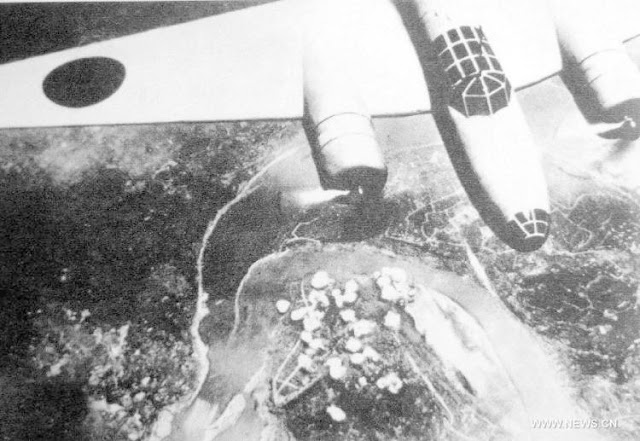
Japanese aircraft flew more than 20 sorties against Chungking (Chongqing), China over a 3-hour period, dropping bombs on civilian sections of the city. During the air raid more than 2,500 residents fled to shelter in one of the Jiaochangkou Tunnel in central Chungking. More than 700 suffocated as they waited for the end of the assault. Some sources list the death toll today at 4,000 or even 10,000.
The Chinese have built enormous air-raid shelters from sandstone caves in cliffs overlooking the city, and they are packed tight with people during air raids. Guards lock the public shelters’ gates during raids so that people can’t leave until the all-clear sounds. The shelters have some flaws: they are narrow, have no outlets aside from the front doors that are locked, no sources of air aside from that entrance (which, as noted, is closed during raids), and they are literally jammed with people standing one against the other. It does not take much imagination to see some problems developing from that design.
Today, the raid begins at about 18:00. During the three-hour raid, guards flee the Jiaochangkou air raid shelter tunnel downtown, leaving it locked and jammed with people. Finally, two hours after the raids end at midnight, someone arrives with the keys. About 700 people inside have suffocated.
There are problems at other shelters, too. The Japanese raids are intermittent, and following some attacks, the Chinese leave the shelters thinking the raid is over. However, as soon as the bombers return, the people surge to re-enter the shelters. Many people are trampled and killed. How many is impossible to say, but pictures alone suggest it was a lot of people.
Some reports state that 4,000 Chinese perish in this incident, but there are widely varying estimates of the number killed. The higher figures may include people who perish during the mass panics at shelters during the raid, along with victims of the raid itself. Many victims result from stampedes of people on flights of stairs outside the shelters bored into the hills above town. Reporters Mac Fisher of United Press and Mel Jacoby snap pictures of dead people on one such set of stairs leading to a shelter that receives worldwide distribution. For many people, these pictures become their image of the war in China — and it isn’t pretty.
Ambassador Joseph C. Grew of the United States called on Foreign Minister Yosuke Matsuoka today and, it was reported in reliable quarters, protested against the Japanese seizure of United States goods in French Indo-China and the bombing of American property in Chungking, China.
Japan’s year-long efforts to draw from the Indies great quantities of such war essentials as rubber, oil and tin tottered tonight on what the chief Japanese negotiator himself called “the edge of a precipice.” With friendly relations thus delicately poised, the Dutch have promised to reply formally to Japanese demands Friday. Reliable sources indicated the Dutch would offer fractional concessions and the Japanese would refuse. Extent of the Japanese demands has not been disclosed and the Dutch said their answer also was not likely to be published.
Japanese luxury ocean liner Hikawa Maru departed Yokohama for Vancouver, with some Jewish refugees on board. This is a continuation of a very roundabout escape route used by small numbers of Jews during the first two years of the war.
The government of the Dutch East Indies closes the Karimata Strait and Sunda Strait to Vichy French vessels. The French in Indochina is completely dominated by Japanese Imperial forces.
Australian heavy cruiser HMAS Australia and New Zealand Division light cruiser HMS Achilles escorted convoy VK.2 of two ships from Sydney to Wellington, where they arrived on the 9th.
Dow Jones Industrial Average: 118.13 (+0.45)
Born:
Robert Kraft, American owner of the New England Patriots, in Brookline, Massachusetts.
Duke Sims, MLB catcher, first baseman, and outfielder (Cleveland Indians, Los Angeles Dodgers, Detroit Tigers, New York Yankees, Texas Rangers), in Salt Lake City, Utah.
Brad Hubbert, AFL fullback (AFL All-Star, 1967; San Diego Chargers), in Boligee, Alabama.
Spalding Gray, actor (“Beaches”, “Clara’s Heart”, “Heavy Petting”) and writer, in Providence, Rhode Island (d. 2004).
John Lawlor, American character actor (“Phyllis”, “The Facts of Life”), in Troy, New York (d. 2025).
(McGavock) “Mac” Gayden, American Nashville rock and country session guitarist, record producer and songwriter (“Everlasting Love”), in Nashville, Tennessee (d. 2025).
Martha Argerich, Argentinian-born Swiss pianist, in Buenos Aires, Argentina.
Naval Construction:
The Kriegsmarine (German Navy) Type VIIC U-boats U-247, U-248, U-249, and U-250 are ordered from F. Krupp Germaniawerft AG, Kiel (werk 681–684).
The Kriegsmarine (German Navy) Type VIIC U-boats U-280, U-281, U-282, U-283, U-284, U-285, U-286, U-287, U-288, U-289, U-290, and U-291 are ordered from Bremer Vulkan-Vegesacker Werft, Bremen-Vegesack (werk 45–56).
The Kriegsmarine (German Navy) Type VIIC U-boats U-309, U-310, U-311, and U-312 are ordered from Flender Werke AG, Lübeck (werk 309–312).
The Kriegsmarine (German Navy) Type VIIC U-boats U-349 and U-350 are ordered from Nordseewerke, Emden (werk 221 and 222).
The Kriegsmarine (German Navy) Type VIIC U-boats U-425, U-426, U-427, and U-428 are ordered from Danziger Werft AG, Danzig (werk 126–129).
The Kriegsmarine (German Navy) Type VIIC U-boats U-481, U-482, U-483, U-484, U-485, and U-486 are ordered from Deutsche Werke AG, Kiel (werk 316–321).
The Kriegsmarine (German Navy) Type IXC/40 U-boats U-539, U-540, U-541, U-542, U-543, U-544, U-545, U-546, U-547, U-548, U-549, and U-550 are ordered from Deutsche Werft AG, Hamburg (werk 360–371).
The Kriegsmarine (German Navy) Type VIIC U-boats U-675, U-676, U-677, U-678, U-679, and U-680 are ordered from Howaldtswerke Hamburg AG, Hamburg (werk 824–829).
The Kriegsmarine (German Navy) Type IXC/40 U-boats U-853, U-854, U-855, U-856, U-857, U-858, U-859, U-860, U-861, U-862, U-863, and U-864 are ordered from AG Weser, Bremen (werk 1059–1070).
The Kriegsmarine (German Navy) Type VIIC U-boats U-959, U-960, U-961, U-962, U-963, U-964, U-965, U-966, U-967, U-968, U-969, U-970, U-971, U-972, U-973, U-974, U-975, U-976, U-977, U-978, U-979, U-980, U-981, and U-982 are ordered from Blohm & Voss, Hamburg (werk 159–182).
The Kriegsmarine (German Navy) Type VIIC U-boats U-1051, U-1052, U-1053, U-1054, U-1055, U-1056, U-1057, and U-1058 are ordered from F. Krupp Germaniawerft AG, Kiel (werk 685–692).
The Kriegsmarine (German Navy) Type VIIC U-boats U-1101 and U-1102 are ordered from Nordseewerke, Emden (werk 223 and 224).
The U.S. Navy YMS-1-class auxiliary motor minesweeper USS YMS-57 is laid down by the Gibbs Gas Engine Co. (Jacksonville, Florida, U.S.A.) .
The U.S. Navy Gleaves-class destroyer USS Frankford (DD-497) is laid down by the Seattle-Tacoma Shipbuilding Corp. (Seattle, Washington, U.S.A.).
The Kriegsmarine (German Navy) Type IXC U-boat U-517 is laid down by Deutsche Werft AG, Hamburg (werk 313).
The Royal Navy Bangor-class (Turbine-engined) minesweeper HMS Dunbar (J 53) is launched by the Blyth Shipbuilding & Drydock Co. Ltd. (Blyth, U.K.); completed by Whites M.E.
The Kriegsmarine (German Navy) Type IXC U-boat U-157 is launched by AG Weser, Bremen (werk 999).
The Kriegsmarine (German Navy) Type VIIC U-boat U-655 is launched by Howaldtswerke Hamburg AG, Hamburg (werk 804).
The Royal Fleet Auxiliary Ranger-class fleet support tanker RFA Blue Ranger (X 57; postwar A 157) is commissioned.
The Kriegsmarine (German Navy) Type VIIC U-boat U-573 is commissioned. Her first commanding officer is Kapitänleutnant Heinrich Heinsohn.
The Royal Canadian Navy Flower-class corvette HMCS Sherbrooke (K 152) is commissioned. Her first commanding officer is Lieutenant Commander (retired) Eric George Mackay Donald, RN.
The Royal Canadian Navy Flower-class corvette HMCS Buctouche (K 179) is commissioned. Her first commanding officer is T/Lieutenant William Watt Hackney, RCNR.

