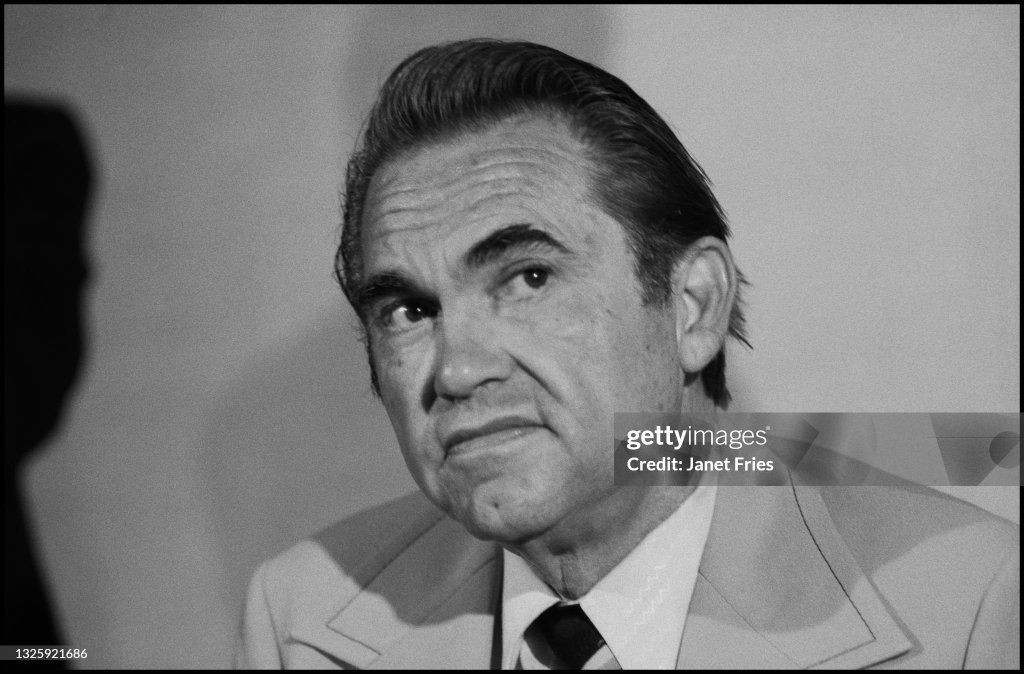
The United States lost its fight to keep the Palestine Liberation Organization out of the 132-nation World Employment Conference in Geneva. The governing body of the International Labor Organization, which had decided by the margin of one vote last Saturday to bar the P.L.O. from the conference, reversed itself under pressure from the League of Arab States, the Organization of African Unity and the Soviet bloc. Despite the rebuff, the American delegates decided not to walk out, but they will boycott sessions in which the P.L.O. participates. The Americans had earlier hinted that a reversal by the world labor body and the admission of the Palestinians might cause the United States to invoke immediately the formal notice it had given of intention to quit the I.L.O. in November, 1977, unless it “depoliticizes” its activities. The governing body’s reversal came by a vote of 31 to 23, with one member abstaining, after the executive group had rejected a contention by the American delegation that last Saturday’s vote was not subject to review under the organization’s rules. The initial vote had been 24 to 23 against the P.L.O. The shift reflected a vigorous drive by the Arabs and their backers to round up members of the executive board who had been absent the first time. Representatives of four African nations had been among the absentees. Tonight all of the governing body’s members were on hand, except for the empty chair China refuses to fill.
Four persons were wounded tonight when right‐wing and left‐wing groups battled each other and the police in the Piazza Venezia in downtown Rome. The Incident came amid a rising wave of political violence that has marked this electoral campaign. Exactly a week ago, a young Communist, Luigi di Rosa, was shot dead in a town near Rome by persons believed to be neo‐Fascists. Tonight’s clash occurred between members of the neo-Fascist Italian Social Movement‐National Right Wing who were holding a pre‐electoral rally in the nearby Piazza Santissimi Apostoli, and about a hundred left‐wing extremists in the Piazza Venezia. The battle began during the evening rush hour, under a light rain, when streets were crowded with throngs of Romans hurrying along sidewalks; waiting at bus stops and stalled in traffic jams. Suddenly, scores of police and carabinieri in full riot gear charged into the piazza. They were preceded by the infuriated extremists, who retreated before the tear‐gas attack to a corner of the square and responded to the police barrage by hurling Molotov cocktails. Terrified passers‐by raced for cover at the sounds of the shots.
A drum rolled, soldiers of the Republican Guard in dress blues snapped themselves and their rifles to attention, and at precisely 3 P.M. two officers with raised sabers escorted the presiding officer of the French National Assembly into the parliamentary chamber for the third day of the capital gains tax battle a pocketbook issue that is arousing more personal concern in France than Lebanon, nuclear proliferation and many other problems combined. Inside the chamber of the 18th-century building still called the Palais Bourbon, the members were ready to slaughter, or at least maim, the proposed tax, which is the centerpiece of President Valery Giscard d’Estaing’s announced efforts to reform some aspect of French society. The legislation—which would impose taxes on stock transactions but not, for example, on gold sales—has driven the Assembly beyond the usual right‐versus‐left polemics to a level of maliciously animated debate it has not experienced for months, perhaps years. It recalls for some politicians the parliaments of the Fourth Republic, which expired in 1958 with a reputation for a maximum of heated, confused talk and relatively little action.
King Juan Carlos I of Spain arrived in New York yesterday, stressing that he expected development in his country to remain in an orderly and stable framework. “We are determined to maintain order and stability, political and social, so that capital, management and labor may work together harmoniously for the good of the whole society,” he told 1,800 guests at a banquet at the Waldorf‐Astoria Hotel, sponsored jointly by the Spain‐United States Chamber of Commerce and the Spanish Institute. Earlier, at a private meeting with a group of businessmen with interests in Spain, the King answered questions about labor troubles and the strength of the Communist Party. Participants would not disclose just what he said, other than to say that he spoke in general terms that they found reassuring.
A judge ordered the arrest of two opposition politicians today who returned to Spain from exile following the death of Franco. The Public Order Court ordered the arrest of Santiago Alvarez, a leading Communist, and of Rafael Calvo Serrer, a philosophy professor and former newspaper publisher, who returned only 24 hours earlier after almost five years in exile.
The renegade Lebanese Arab Army and the head of the leftist-Moslem coalition, Kamal Jumblat, made appeals today that indicated that the groups were more interested in talking than fighting with the Syrian armed forces that have intervened in Lebanon. The Lebanese Arab Army, made up largely of Moslem deserters from the regular army issued an appeal to Libya and Algeria to send representatives to Beirut to discuss with Syrian Army officers “the Syrian invasion of Lebanon.” Mr. Jumblat made an appeal to the Syrian Army and people as well as to Secretary General Kurt Waldheim of the United Nations for efforts to avoid a military confrontation. But it was announced tonight that all Palestinian guerrilla organizations — except the Syrian-run As Saiqa — and the Lebanese Arab Army as well as leftist militia groups had agreed to form a joint command. Some shelling was reported in the mountainous region around the town of Ain Tura, where leftists and Palestinians face rightist forces to the west and Syrian armor to the east, in the heights above the Bekaa Valley town of Zahle. But visitors to the area found it generally calm. A leftist spokesman said that a reported Syrian ultimatum for evacuation of the mountain village of Hizzerta, above Zahle by midnight “passed without incident and our men are still in their positions.”
Syria and the Soviet Union declared in a communique today that they were determined to pursue their efforts for ending the bloodshed in Lebanon and preserving the country’s sovereignty, independence and territorial unity. The communiqué, broadcast by Damascus radio, was issued at the end of a four‐day visit to Syria by the Soviet Prime Minister, Aleksei N. Kosygin, who had earlier visited Iraq. Mr. Kosygin returned to Moscow after having said at the Damascus airport that his talks with President Hafez al-Assad and Prime Minister Mahmoud al‐Ayubi had deepened the relations and cooperation between the two countries. Western diplomatic sources believe the reference to Lebanon is a point in favor of the Syrian intervention, which the Russians had opposed in the past. Moscow‐oriented Arab Communists have been waging a vehement campaign against the Syrian action. The communiqué, however, upheld the Soviet view that the 14‐month crisis in Lebanon was the making of “imperialist powers.”
Six Arab countries have agreed to attend an emergency meeting of foreign ministers of the Arab League members to discuss the Syrian military intervention in Lebanon, a league spokesman said today. At least five more of the 20 members must agree before the meeting can be held.
All 45 people on Air Manila Flight 702 and a truck driver were killed when the Lockheed Electra turboprop crashed on takeoff from Agana at Guam. The aircraft “struck a hill, bounced over a highway and hit a pickup truck” then burst into flame.
Canada will unilaterally extend its fishing jurisdiction to 200 miles offshore later this year to take effect by next January l, Foreign Secretary Allan MacEachen said today.
Submachine-gun fire from two speeding cars killed six policemen and wounded six others lined up for roll-call, this morning in the Mexico City suburb of Ciudad Azteca, the police said.
President Augusto Pinochet, Chile’s military ruler, called on Latin America today to stand cohesively with the United States in an “ideological war” against Communism. Citing the “armed expansionism” of what he termed Soviet imperialism, General Pinochet said at a meeting of hemisphere foreign ministers here that “there is no room for comfortable neutralism” in the Americas, and he scoffed at peaceful coexistence.” President Pinochet spoke at the opening session of the ministerial conference of the Organization of American States. Secretary of State Henry A. Kissinger is expected to join the conference on Monday. Cuba which was excluded from the regional organization in 1962, and Mexico, which tines not maintain diplomatic relations with the Pinochet Government, were not represented at the meeting.
Ethiopia’s ruling military council has halted the advance of a peasant army outside the boundaries of rebellious Eritrea, apparently pending a last-minute attempt at talks with, rebel, leaders.
A Soviet jetliner missing since Tuesday crashed in West Africa shortly before it was, to land at Malabo, in Equatorial Guinea, with 36 passengers and 10 crew members aboard, TAG, the Angolan national airline, reported today. There was no word of any survivors. Dense fog was reported near the Malabo airport at the time of the crash. The Angolan Information; Ministry said the passengers included 32 Angolans, three Soviet citizens and a Hungarian. Other sources said 20 of the Angolans were wounded soldiers going to Moscow for treatment, and most of the others were students.
South Africa, which has been ostracized in the West for several years because of its apartheid policies, warmly welcomed the coming meeting between Secretary of State Henry Kissinger and Prime Minister John Vorster. The state-owned South African radio said that the meeting would be “in itself, apart from the outcome, a historic occasion.” But the enthusiasm was tempered by a sense of the difficulty that the two men are likely to have in finding common ground on the principal issues they are to discuss.
The State Department said today that a major goal of Secretary of State Henry A. Kissinger’s coming meeting with Prime Minister John Vorster of South Africa would be the coordination of views on how to avoid a race war in southern Africa. The department said that the two‐day meeting was “exploratory “ and that the two men would exchange analyses of southern African issues such the tension over white minority rule in Rhodesia, the time table for granting independence to South‐West Africa, and the apartheid policy of South Africa.
The unemployment rate in May was the lowest for any month since December 1974, the Labor Department said, The rate declined to 7.3 percent after holding steady at 7.5 percent in the two preceding months. The total number of people holding jobs also increased substantially, rising by 300,000 to a record 87.7 million. The department also had encouraging news about the inflation rate. The index of wholesale prices rose by three-tenths of 1 percent in May and wholesale prices of industrial commodities, which are regarded as the most accurate measure of underlying inflationary pressures, rose by only one-tenth of 1 percent.
The big decrease in unemployment, to the lowest overall rate in 17 months, was among adult women, whose jobless rate dropped in May by five‐tenths of 1 percent to 6.8 percent, while the unemployment rate for adult men has remained essentially unchanged at 5.6 percent, for the last three months. A typically much higher percentage for teen‐agers brought the rate for the labor force as a whole to 7.3 percent. The relatively greater improvement in the job picture, for women reflects the facts, that they work largely in service industries, where job opportunities have grown almost without interruption, whereas employment in manufacturing and construction, where men are concentrated, is still far below procession levels. The failure of employment opportunities for men to expand was noted by George Meany, president of the A.F.L.‐C.I.O., in a comment on the jobless figures. Mr. Meany said that “the nation must not be misled into believing that the economy is in good shape.”
President Ford said that the anti-busing legislation he plans to send to Congress would require that every future court case ordering busing be reopened every three years to decide whether court jurisdiction could be lifted. He said that the court would have to give up its jurisdiction “unless it was affirmatively found that there had been no correction of the unconstitutional abuses” of desegregation laws. He also said that Attorney General Edward Levi had been asked to determine whether the proposed legislation would apply retroactively. Mr. Ford’s plan, as he outlined it, apparently would allow school systems to escape court supervision after three years if they could prove at least minimal integration. The President’s statement was the first hint that the Administration would like to reduce the length of time that a court may supervise school integration plans.
Jimmy Carter has purchased simultaneous five‐minute spots on the three commercial television networks in an effort to reverse an undercurrent of negative feelings about his candidacy that has been showing up in recent polls and interviews with voters. His taped talk, which will be broadcast nationally at 10:55 PM, Eastern daylight time, Sunday, is already showing as a political commercial here in Ohio, where the Democratic front‐runner faces a crucial primary test on Tuesday. In the talk, Mr. Carter speaks in inspirational terms and cadences about his “vision” of the country. In the process, he seeks to reconcile two sides of his character— the soft‐spoken peanut farmer and the relentless politician — that have evidently struck some voters as contradictory and raised the criticism among political opponents that although Mr. Carter has broad appeal, he inspires no intense loyalty. “Our people,” he says, “want a President to be both tough and gentle, both statesman and politician, both dreamer and fighter. You expect him to have the drive and stamina to reach the White House, and the wisdom and patience to govern wisely.”
California Governor Edmund G. Brown Jr. announced today that he would return to New Jersey on Monday for a last-minute flurry of campaigning for the uncommitted slate in that state’s Democratic Presidential election Tuesday. Running well ahead of former Governor Jimmy Carter of Georgia in the California contest to be held the same day, according to the latest polls, Mr. Brown abandoned earlier plans to devote the remaining time before the primary to his home state.
If there is any influential Republican politician in this state who expects President Ford to do anything other than decisively defeat Ronald Reagan in next Tuesday’s Ohio, primary, that politician has not yet made his opinion known. Senator Robert Taft Jr. has even predicted that Mr. Ford could shut Mr. Reagan out entirely, 97 convention delegate to zero. And from the time it was announced earlier this week, Mr. Reagan’s scheduled two‐day campaign swing through the Buckeye State starting tomorrow has had a futile air about it. He was coming, Mr. Reagan said the other night, just to “show the flag.” “We know we can’t win” in Ohio, he said.
The American political left — so visible and so vocal in earlier Presidential campaigns in its support of civil rights and its opposition to the Vietnam War — has been dormant in this year’s national political contests. Opposition to the war four and eight years ago galvanized various elements of the left ranging from such long‐lived, but politically weak, organizations as the Communist and Social Workers parties to the New Left ad hoc groupings of disaffected students and adults who protested during the 1960’s and early 1970’s. “The war is gone and it’s a lot more difficult to get people excited by the power of the Pentagon,” said former Senator Eugene J. McCarthy, the Minnesota Democrat who was the focus in 1968 of a vast outpouring of support from youth opposed to the American presence in Vietnam.
Talk about the Presidential primaries has diminished. The debate on legislation each day seems more listless than usual. The House of Representatives, which normally thrives on talk and gossip, is uncomfortably distracted these days by gossip about itself, worried about how the voters are reacting back home, and trying — not always successfully — to find a lighter side to the gloom. Representatives have been exchanging unprintable limericks and barracks jokes on the House floor since the disclosure of allegations by Elizabeth Ray that Representative Wayne L. Hays had put her on his House Administration Committee payroll at $14,000 a year to do virtually no work except be his mistress. Some secretaries in the Longworth House Office Building, where Miss Ray had an office, have been seen wearing “I can type” buttons.
House Democrats negotiated further disciplinary action today against Representative Wayne L. Hays of Ohio, but one attempt to strip him quickly of a second committee chairmanship failed. Several prominent Democrats, including Representative Thomas P. “Tip” O’Neill Jr. of Massachusetts, the majority leader, and Representative John Brademas of Indiana, the chief deputy whip, sought to call an emergency meeting of the House Democratic Caucus to put to a vote Mr. Hay’s continued chairmanship of the House Administration Committee. They contended that Mr. Hays was a political liability to the party, especially in an election year, and that they had the votes to oust him. But they were dissuaded by the counterargument that, as one member put it, “It smacked of a lynch party.” Mr. O’Neill, who is in line to succeed Carl Albert as Speaker and is seeking to demonstrate his authority, is determined to further demote Mr. Hays and intends to do so when the caucus holds its regular meeting on June 16.
Merrill Lynch, Pierce, Fenner & Smith, the country’s largest brokerage concern, agreed to settle two anti-discrimination suits by paying $1.9 million to persons it had allegedly wrongfully failed to hire or promote and by establishing a $1.3 million employment plan, under which specified percentages of women and minority group members will be hired.
Although he had been severely reprimanded last March for accepting hospitality from a major defense contractor, Dr. Malcolm Currie, a high-ranking Pentagon official, has been put in charge of the development and acquisition of all weapons by the Defense Department. He had been director of defense research and engineering, supervising the development of all weapons. In an unannounced promotion, he was recently made “acquisition executive” with the responsibility for the procurement as well as the development of new weapons. A Pentagon spokesman declined to say what conclusion has been reached by Defense Secretary Donald H. Rumsfeld as a result of an investigation into Dr. Currie’s role in the production of the Condor missile, which was developed by the Rockwell International Corporation. In a letter of May 6 to Senator Thomas F. Eagleton, Democrat of Missouri, who had demanded the suspension of Dr. Currie, Richard A. Wiley, the Defense Department general counsel, said the Pentagon was “investigating all aspects” of Dr. Currie’s relationship with Rockwell International.
A New York state Supreme Court jury has ordered CBS to pay more than $250,000 to a Manhattan restaurant because the network’s television camera crew, on a story about health code violations in restaurants, entered without permission and took pictures. The restaurant was Le Mistral at 14 East 52nd Street. A lawyer for CBS said the verdict was a threat to all reporters seeking information on private property, but Justice Martin Stecher said that “the right to publish does not include the right to enter upon or trespass upon the property of these plaintiffs.”
“The Architecture of Luis Barragán” exhibition opens at MOMA, New York bring the Mexican architect’s work to international notice.
In what has later been called “the gig that changed the world,” the Sex Pistols appear at the Lesser Free Trade Hall in Manchester, England, helping to launch the punk era.
The Boston Celtics defeated the Phoenix Suns 128–126 in triple overtime in Game 5 of the NBA Finals at the Boston Garden. In 1997, the game would be selected by a panel of experts as the greatest of the NBA’s first 50 years. The game had been tied 95–95 at the end of regulation, then 101–101 and 112–112.
At Baltimore, the Minnesota Twins edge the Orioles, 8–6. Larry Hisle hit for the cycle, capping his performance with a two-run homer in the 10th inning to lift the Twins. Hisle previously had doubled in the fourth, tripled for two RBIs in the fifth and singled in the eighth.
The Red Sox twice passed Bruce Bochte intentionally and both times the strategy backfired with singles by Bill Melton that enabled the Angels to gain a 5–4 victory in 10 innings. In the eighth, Bobby Bonds walked and advanced to second on an infield out. The Red Sox then passed Bochte, but Melton foiled the move with a single that drove in Bonds. In the 10th, Tommy Davis reached second base on an error by Rico Petrocelli. Bochte again was passed intentionally and Melton again came through with a single, this time driving in pinch-runner Rusty Torres with the deciding marker.
A double and triple by Jorge Orta proved the most potent blows for the White Sox, who defeated the Indians, 4–1, behind the pitching of Rich Gossage. Orta’s double drove in one of the White Sox’ two runs in the first inning. The third baseman’s triple then accounted for one of his club’s final pair in the fifth.
Although collecting only two hits off Rick Reuschel, the Astros defeated the Cubs, 1–0, behind the pitching of Mike Cosgrove, who posted the first shutout of his major league career. The game’s only run scored because of an error by Reuschel in the second inning. Jose Cruz bounced a grounder to the right of the mound for an infield hit and raced to third when Reuschel threw wildly to first on the play. Cruz then crossed the plate on a groundout by Enos Cabell. The Astros’ other hit was a single by Cesar Cedeno in the first inning.
Two batters who were hit by pitches both scored with the final run counting in the 10th inning to enable the Royals to defeat the Brewers, 4–3. Hal McRae, who was nicked by Jim Slaton in the fourth, scored one of the Royals’ initial tallies of the game. After the contest went into overtime, John Mayberry was hit by a pitch in the 10th and raced home with the winning run on a double by McRae to bring Dennis Leonard his fifth straight victory.
Snapping out of a 1-for-18 slump, Dave Kingman hits 3 home runs and knocks in a tem-record 8 runs during a Mets 11–0 drubbing of the Dodgers at Chavez Ravine. Tom Seaver posted the shutout on a three-hitter and gained his first victory since May 4. Kingman broke the Mets’ record of seven RBIs by Donn Clendenon against the Giants July 28, 1970. Kingman also was the first Mets’ player with three homers in a game since Jim Hickman did it against the Cardinals September 3, 1965.
Pepe Mangual’s 9th-inning single is the only hit against the Andy Messersmith, as the Braves down the Expos, 2–0. The Braves scored on a walk, sacrifice and single by Ken Henderson in the first and on a walk to Jim Wynn, another single by Henderson and wild pitch by Don Carrithers in the third.
Pinch-hitting in the 11th inning, Ken McMullen knocked in a run with a single and Sal Bando hit a sacrifice fly to carry the Athletics to a 6–4 victory over the Yankees. Bert Campaneris doubled and Don Baylor was passed intentionally before McMullen batted for Matt Alexander and hit his single to score Campaneris with the tie-breaking tally. Baylor took third on the play and counted the final run after Bando flied out.
Dave Freisleben, who had pitched two successive shutouts, was knocked out in the second inning by the Pirates, who piled up four runs en route to a 7–2 victory over the Padres. Freisleben yielded a walk and single before Rennie Stennett doubled to drive in the Pirates’ first run. Richie Hebner followed with a two-run single and Al Oliver added a double for another run to chase Freisleben.
After eight consecutive victories, Jim Lonborg suffered from a bad first inning and absorbed his initial defeat of the season when the Giants beat the Phillies, 5–1. In the first, the Giants rapped Lonborg for four runs on six hits, starting with a double by Larry Herndon. A sacrifice bunt by Derrel Thomas and sacrifice fly by Bobby Murcer scored Herndon. Gary Matthews, Willie Montanez and Chris Speier singled to make it 2–0 and, after Ken Reitz beat out an infield hit, Dave Rader doubled to drive in Montanez and Speier.
Led by George Foster, who collected three hits and drove in four runs, the Reds romped over the Cardinals, 11–2. The Reds wasted no time, deciding the outcome in the first inning when they scored five runs. Ken Griffey led off the fireworks with a one-out triple and scored on a sacrifice fly by Joe Morgan. The Reds then followed with six successive singles for three more runs to kayo Lynn McGlothen. Eric Rasmussen relieved and walked Pete Rose to force in the fifth run of the frame. Foster hit a homer with two men on base in the seventh inning as Gary Nolan coasted to his first victory since May 11. Davey Concepcion has 5 hits
Danny Thompson, starting his first game since being obtained in a trade with the Twins, smashed four hits in four trips, including a homer, and drove in four runs to pace the Rangers’ slugging in a 14–3 rout of the Tigers. Thompson singled in the first inning, hit his homer with two aboard in the second, drove in another run with a double in the sixth and singled again later in the same stanza before leaving the game with a slight muscle pull in his back. The Rangers’ attack also included a triple by Roy Howell with the bases loaded.
Minnesota Twins 8, Baltimore Orioles 6
California Angels 5, Boston Red Sox 4
Cleveland Indians 1, Chicago White Sox 4
Chicago Cubs 0, Houston Astros 1
Milwaukee Brewers 3, Kansas City Royals 4
New York Mets 11, Los Angeles Dodgers 0
Atlanta Braves 2, Montreal Expos 0
Oakland Athletics 6, New York Yankees 4
San Diego Padres 2, Pittsburgh Pirates 7
Philadelphia Phillies 1, San Francisco Giants 5
Cincinnati Reds 11, St. Louis Cardinals 2
Detroit Tigers 3, Texas Rangers 14
The stock market, reacting to higher loan charges announced by major banks, fell sharply yesterday, the Dow Jones industrial average dropping 9.90 points to close at 963.90, its lowest level in more than three months.
Dow Jones Industrial Average: 963.90 (-9.90, -1.02%)
Born:
Alexei Navalny, Russian lawyer and Progress Party politician, jailed opponent of Vladimir Putin, and the victim of a poisoning attempt; in Butyn, Moscow Oblast, Russian SFSR, Soviet Union (d. 2024).
Kasey Chambers, Australian country singer-songwriter and musician (“Not Pretty Enough”), in Mount Gambier, South Australia, Australia.
J.C. Romero, Puerto Rican MLB pitcher (World Series champions-Phillies, 2008; Minnesota Twins, Los Angeles Angels, Boston Red Sox, Philadelphia Phillies, Colorado Rockies, St. Louis Cardinals, Baltimore Orioles), in Rio Piedras, Puerto Rico.
Chang-Yong Lim, Korean MLB pitcher (Chicago Cubs), in Gwangju, South Korea.
Wayne Primeau, Canadian NHL centre (Buffalo Sabres, Tampa Bay Buccaneers, Pittsburgh Penguins, San Jose Sharks, Boston Bruins, Calgary Flames, Toronto Maple Leafs), in Scarborough, Ontario, Canada.

