Kandanos
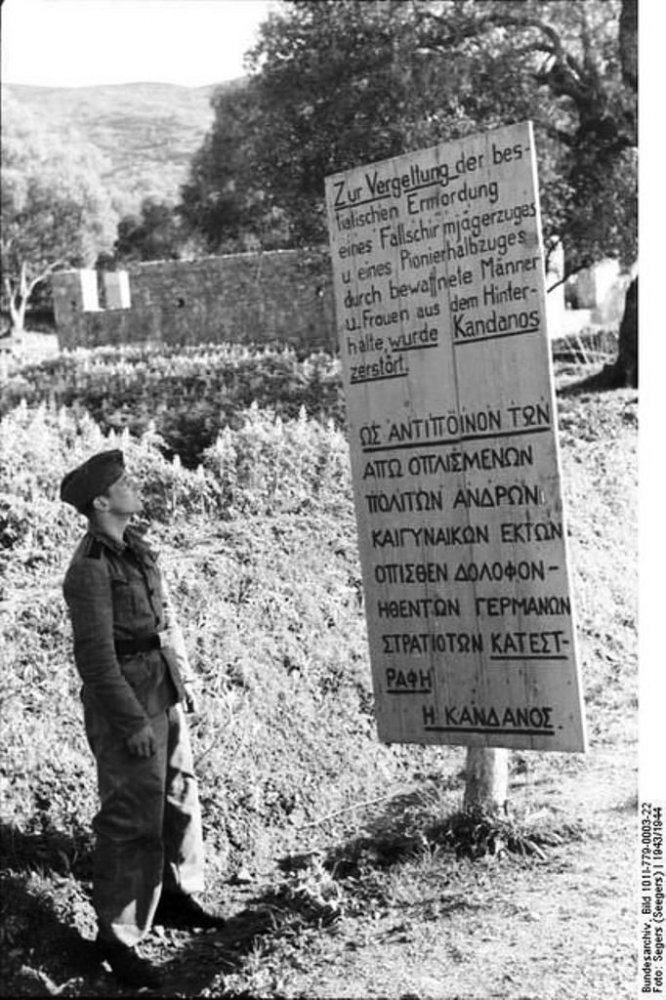
A War Crime, to be sure.
Razing of Kandanos: German occupying forces in Crete completely destroyed the village of Kandanos in retaliation for the resistance of the local population during the Battle of Crete. Following on atrocities committed at Kondomari and Alikianos, Crete on 2 June, the German 1III Battalion of the 1st Air Landing Assault Regiment (most probably led by Oberleutnant Horst Trebes) storms into the village of Kandanos. Acting pursuant to standing orders of temporary island commandant General Kurt Student, the Germans destroy the town. This is in retaliation for civilian resistance during Operation Mercury. The German troops execute most of the population, about 180 people, and kill the livestock.
The Germans declare Kandanos a “dead zone” which nobody can visit or inhabit. The Germans post two warnings in both German and Greek, one of which reads: “Here stood Kandanos, destroyed in retribution for the murder of 25 German soldiers, never to be rebuilt again.” A war memorial using this exact language will be built after the war at the site of the village.
The Germans also attack the villages of Floria and Kakopetro.
The Finnish High Command granted the German General Staff permission to use northern Finland as a staging area for the planned attack on the Soviet Union. From today until the 6th of June, the Finnish and German military leadership negotiate at Helsinki on co-operation in event of a Russo-German war. An agreement regarding the Finnish Army and Air Force is reached. Although formally the idea of a Russo-German war is hypothetical, the Finns have already understood that the Germans are in all probability about to invade the USSR.
Hitler received Japanese ambassador Hiroshi Ōshima at the Berghof and informed him of the plan to attack the Soviet Union. Adolf Hitler meets with Japanese ambassador Hiroshi Ōshima at the Berghof. He informs Ōshima of the upcoming Operation Barbarossa. There are some hopes within the German high command that Japan will join Germany in attacking the Soviet Union.
Now that the situation in Iraq has stabilized on 3 June 1941, the British turn their full attention to Syria. The Vichy French hold on Syria only has become an issue because of the French decision to allow its use to the Axis as a transport hub to Iraq, but even though that is no longer an issue, the ball is rolling toward a British invasion. Today, the RAF bombs and strafes oil installations in Beirut, French Lebanon.
The Vichy French government states that it will defend both Syria and Tunisia against the British.
The British begin stockpiling landing craft and equipment in Port Said for Operation Exporter, the invasion of Syria. Royal Navy troopship Glengyle heads there from Alexandria, while two destroyers (HMS Hotspur and Ilex) leave Alexandria for Famagusta, Cyprus to embark commandos for transfer to Glengyle for upcoming Exporter.
In Iraq, the British continue mopping up. Gurkha troops (2/4 Gurkha Rifles) fly into Mosul and occupy it. Baghdad settles down after the two-day Farhud of 1-2 June, with the British and local police enforcing a strict curfew. The hundreds of dead are being buried.
Invasion fears are rampant in Malta. The British troops garrison Gozo, normally uninhabited, and practice fighting paratroopers. The War Office issues an alert to expect an invasion within a week by a force of 6,000 Axis troops based on spy sources.
A large Italian force that includes light cruisers Atttendolo, Duca D’Aosta, and Eugenio D’Savoia of the 7th Cruiser Squadron, and light cruisers Bande Nere and Di Guissano of the 4th cruiser squadron, lays two minefields northeast of Tripoli. This is an area where Royal Navy submarines like to lie in wait for Axis convoys coming and going from Tripoli.
An Italian convoy of six transport ships/freighters departs Naples bound for Tripoli.
A fierce battle on the approaches to Gondar, a key Italian stronghold in Abyssinia, develops. The British take Debarech, but then the Italians take it back. The town seesaws back and forth, but ultimately the British wind up with it. It is about 100 miles west of Amba Alagi, which fell in May, and the fierce battle shows that the Italians are going to put up a fierce battle for their remaining bastions in East Africa.
German occupiers stamp “J” on Jewish passports in the Netherlands.
Attack on the telephone exchange in Schiphol.
Premier Petain, supported by his Council of Ministers, refuse to ratify Vice Premier Admiral Darlan’s recently negotiated Paris Protocols. However, they have gone into effect anyway.
A memorandum drafted by Clement Attlee which provides that “A necessary prelude to a just peace is a total victory” is approved at a Labour Party conference by 2,430,000 to 19,000.
In order to prevent more German surface raiders from emerging like the Bismarck, and also to crimp the U-boat offensive, the Royal Navy has made it a priority to hunt down the Kriegsmarine’s overseas supply network of disguised oil tankers and freighters. The Germans have nine such supply ships cruising the Atlantic in support of the abortive German Operation RHEINÜBUNG. British cruisers HMS Aurora and HMS Kenya attacked German tanker Belchen 80 miles southwest of Greenland as the tanker refueled submarine U-93. U-93 escaped, but Belchen was damaged by shellfire and a torpedo from Aurora; her crew scuttled the ship. 5 were killed during the attack; U-93 later returned and picked up 50 survivors. The attack on Belchen was enabled by Ultra intercepts. To the south, U-48 and U-75 attacked Allied convoy OB-327 950 miles west of Brest, France, sinking Dutch ship Eibergen (4 killed; 35 survived) and British tanker Inversuir (45 survived).
British passenger liner Mamari, modified to look like carrier HMS Hermes, was attacked by German aircraft off Cromer, Norfolk, England, United Kingdom. She became stuck on the wreck of tanker Ahamo while evading the attack. After sundown, German E-boats arrived and hit Mamari with torpedoes.
Following up on preliminary negotiations held in Salzburg on 25 May 1941, German members of the OKW arrive in Helsinki to discuss upcoming operations. President Ryti, Foreign Minister Witting, Defence Minister Walden, Field Marshal Mannerheim, and Lt Gen Heinrichs agree to military cooperation, but not to Finnish initiation of hostilities.
Specifically, agreements are negotiated regarding Finnish use of its army and air force against the Soviet Union in certain circumstances, both of which the Germans consider top quality. Tentative plans are formed for the Germans to occupy northern Finland and use that as a springboard to invade the Soviet Union in the far north and take the Soviet port of Murmansk. The Finns are not doing the Germans any favors — they want assistance to recover their historic territory lost during the Winter War.
The Finns remain wary about granting the Germans a “blank check.” Heinrichs even warns them that any attempt to mount a coup in Finland and install a puppet government favorable to Germany would be met with absolute resistance. However, overall the talks are cordial and the Finns begin preparations for some kind of military activity. Based on the agreements reached at this meeting, Luftwaffe transport planes carrying service personnel begin arriving at Finnish airfields.
While the Germans are coy about the likelihood of Operation BARBAROSSA, it is hard to believe that the Finns can’t figure out that the Germans intend to invade the Soviet Union, and soon.
These meetings last until 6 June.
German Ambassador Graf von Schulenburg is strongly opposed to Operation BARBAROSSA. He violates his duty by telling the head of Soviet International Affairs that Adolf Hitler had decided to begin a war with the Soviet Union on June 22. The Soviets treat this as proof that the Germans are engaging in a disinformation campaign and that there will not be any invasion.
A German He 111 bomber encountered a British de Havilland Dragon aircraft en route back to France and shot it down. The aircraft turned out to be a civilian joy-riding aircraft from St Mary’s island of the Isles of Scilly off the tip of southwestern England, United Kingdom. The pilot and all 5 passengers, including two girls aged 9 and 11, were killed.
Before dawn, German bombers attacked Hull and Tweedmouth in England, United Kingdom in the early hours of the day. There are strafing attacks across northern England.
Three wounded German airmen owe their lives to the gallantry of the second officer of a British merchant vessel which they had tried to bomb. When their aircraft was shot into the sea by the ship’s gunners they scrambled on to a raft, and in a heavy swell the ship was maneuvered alongside and ropes were thrown to the men, but they were too badly injured to help themselves. Though he knew the risk of being crushed against the ship’s side, the second officer climbed down a ladder, jumped on to the raft, and roped the three men so that they could be hoisted on board.
On Malta, RAF Martin Maryland and Blenheim bombers of No. 89 and 139 Squadrons on patrol claim to attack a convoy off Tunisia and sink a freighter while setting fire to another. The sunk ships apparently are the Italian freighters Montello and Beatrice C.. The RAF loses a Blenheim during the patrol, hit by flying debris as the first ship hit explodes.
There is one minor bombing raid on Malta by the Luftwaffe which causes no damage, while the RAF claims a victory over an Italian tri-motor transport west of Malta.
U-48, commanded by Kapitänleutnant Herbert Schultze, damaged British motor tanker Inversuir, dispersed from convoy OB.327, in 48° 30’N, 28° 30’W, at 0101 hours. The wreck was sunk by U-75 later this day (see below).
U-75, commanded by Kapitänleutnant Helmuth Ringelmann, sank Dutch steamer Eibergen (4801grt), from dispersed convoy OB.327, in 48-02N, 25-06W. At 0345 hours on 3 June, the unescorted Eibergen (Master R. Hilbrandie), dispersed from convoy OB.327 on 1 June, was hit aft by one torpedo from U-75 about 650 miles north of the Azores. The U-boat had chased the ship for more than 9 hours, missed with a first torpedo at 0237 hours and then a spread of two torpedoes at 0253 hours before hitting the ship with the fourth. The Germans observed how the ship settled by the stern and the crew began to abandon ship in two lifeboats, but suddenly the U-boat was illuminated by a searchlight and opened fire with the AA gun to destroy it. U-75 then turned around and fired its stern torpedo as coup de grâce at 0400 hours. The torpedo struck amidships and caused the Eibergen to break in two and sink within one minute. Two crew members on watch below were killed and two British gunners failed to leave the ship. The survivors were not questioned by the Germans because the identity of the victim was known from its distress signals. HMCS Niagara (I 57) (Lt Cdr E.L. Armstrong, RCN) from the dispersed convoy OB.328 and the ocean boarding vessel HMS Malvernian were sent to the area to search for the lifeboats, but were unable to find them. On 7 June, the survivors were picked up by HMS Cairo (D 87) (Capt I.R.H. Black, RN) and later landed at Gourock. The 4,801-ton Eibergen was headed for West Africa.
U-75 sank British tanker Inversuir (9456grt) in 48-28N, 28-20W. At 0101 hours on 3 June 1941 the Inversuir, dispersed on 1 June from convoy OB.327 in 52°42N/22°18W, was hit in the foreship by one torpedo from U-48 (Schultze) north of the Azores in 48°28N/28°20W. The ship stopped and developed a heavy list to port after being hit amidships by a coup de grâce at 0111 hours. The U-boat then fired 51 rounds from the deck gun and set the tanker on fire. At 0359 hours, a second coup de grâce hit her in the bow and she was left in a sinking condition. The wreck of Inversuir was finally sunk by U-75 with two coups de grâce fired at 2033 and 2051 hours. The master and 23 crew members from the Inversuir (Master Robert Charles Loraine) were picked up by the Norwegian steam merchant Para, transferred to the British ocean boarding vessel HMS Corinthian (F 103) (Cdr E.J.R. Pollitt) and landed at Greenock on 21 June. Nine crew members were picked up by HMS Wanderer (D 74) (Cdr A.F.St.G. Orpen, RN) and landed at Holyhead. The remaining 12 crew members were rescued by an unknown ship and landed at Quebec. The 9,456-ton Inversuir was carrying ballast and was headed for Aruba.
Battleship HMS Rodney, escorted by destroyers HMS Tartar, HMS Punjabi, HMS Eskimo, and HMS Icarus, departed the Clyde at 2200 for refitting in the U.S. Also sailing in company was British liner Windsor Castle (19,141grt). The battleship arrived at Boston on the 13th.
Destroyers HMS Electra, HMS Impulsive, and HMS Antelope departed Scapa Flow at 0200 to Londonderry to refuel prior to joining the escort of arriving battleship HMS Nelson. The destroyers arrived at 1330 and departed at 1900 to meet the battleship in 49N, 23W. On the 4th, destroyer Electra damaged her ASDIC dome to hitting a whale. Destroyer HMS Icarus was ordered to leave battleship Rodney and join the Nelson group.
Minesweeper HMS Franklin was damaged by two near misses of German bombing in the North Sea. The minesweeper spent no time out of action.
Decoy ship Mamari (Fleet Tender C) struck the sunken wreck of tanker Ahamo in 53-22N, 0-59E. The ship remained fast and attempts to remove the ship during the day were unsuccessful. During the night of 3/4 June, German S-boats attacked the decoy ship with a torpedo striking the Ahamo. The crew of the decoy ship was rescued by rescue tug Sabine and landed at Grimsby.
In an attack on German shipping, a British Swordfish of 816 Squadron from Thorney Island was shot down. P/T/Sub Lt (A) C.M. Richards RNVR, observer, and Leading Airman A.J. Atkin were killed. T/A/Sub Lt (A) E.K. Margetts RNVR, pilot, was taken prisoner.
German tanker Belchen (6367grt) was sunk by light cruisers Aurora and Kenya in the Greenland area near 59N, 47W. U-93 rescued some fifty survivors.
British steamer Royal Fusilier (2187grt) was badly damaged by German bombing in 55-22N, 1-21W. The steamer sank four miles 200° from May Island. The entire crew was rescued.
British steamer Dennis Rose (1600grt) was damaged by German bombing five miles west by south of Start Point.
British troopship Glengyle departed Alexandria, escorted by two Greek destroyers, for Port Said to load equipment and landing craft for EXPORTER, the invasion of Syria. Destroyers HMS Ilex and HMS Hotspur departed Alexandria for Famagusta to embark special service troops and transfer them to troopship Glengyle. The destroyers joined the troopship at Port Said on the 4th.
Australian sloop HMAS Parramatta, after duty in the Red Sea, arrived at Alexandria for duty with the Mediterranean Fleet.
Italian 7th Cruiser Squadron of light cruisers Eugenio D’savoia, Duca D’aosta, and Attendolo and 4th Cruiser Squadron of light cruisers Bande Nere and Di Guissano with destroyers Pigafetta, Da Mosta, Da Verazzano, Da Recco, Usodimare, Gioberti, and Scirocco laid two minefields northeast of Tripoli.
An Italian convoy of steamers Aquitania (4971grt), Nirvo (5164grt), Montello (6117grt), Caffaro (6476grt), Beatrice C. (6132grt), and Pozarica (7599grt) escorted by destroyers Aviere, Geniere, Dardo, and Camicia Nera departed Naples for Tripoli. Distant cover was provided by cruisers Duca Degli Abruzzi and Garibaldi and destroyers Granatiere, Fucliere, Bersagliere, and Alpino from Palermo. The convoy was attacked twenty miles northeast of Kerkenah by British aircraft on the 4th and steamers Beatrice C. and Montello were sunk.
Submarine HMS Parthian torpedoed Italian tanker Strombo (5232grt) in Salamis Bay in 39-57N, 25-38E. The tanker was beached off Dardanelles a total loss.
Submarine HMS Unique damaged Italian steamer Arsia (736grt) off Lampedusa. The steamer had departed Tripoli on the 1st in a convoy of steamer Costanza (582grt) and tug Costante Neri (100grt) and escorted by gunboat Grazioli Lante for Trapani.
Submarine HMS Torbay sank a caique, carrying oil drums, off Mitylene with artillery.
Motor torpedo boat MTB.215 sank Turkish auxiliary schooner Iki Kardeshler in 35-56N, 32-52E. The schooner was carrying petrol and was suspected of sailing under false orders.
Corvette HMS Aster departed Gibraltar for Bathurst.
Submarine HMS P.32 arrived at Gibraltar from Holy Loch.
Convoy WS.9A departed off Oversay with steamers Samaria (19,597grt), Highland Brigade (14,134grt), Eastern Prince (10,926grt), Aagtekerk (6811grt), Capetown Castle (27,000grt), Empress of Japan (26,032grt), Franconia (20,175grt), Mooltan (20,952grt), Orbita (15,495grt), Llangibby Castle (11,951grt), Durban Castle (17,388grt), Empire Condor (7773grt), Empire Curlew (7101grt), Empire Egret (7248grt), and Empire Widgeon (6736grt). Anti-aircraft cruiser HMS Cairo and destroyers HMS Richmond, HMS Ramsey, HMS Cossack, HMS Maori, HMS Sikh, HMS Zulu, HMCS Ottawa, HMCS Restigouche, HMS Vanquisher, and HMS Winchelsea were with the convoy form 3 to 7 June. Armed merchant cruiser HMS Ausonia was with the convoy from 3 to 6 June. Armed merchant cruiser HMS Dunnottar Castle and light cruiser HMS Birmingham, which departed the Clyde, were with the convoy from 3 to 18 June. Destroyers HMS Vansittart and HMS Wild Swan joined the convoy on the 13th and escorted it to Freetown arriving on the 18th. Destroyers HMS Highlander, HMS Velox, HMS Boreas, and HMS Brilliant were with the convoy from 16 to 18 June when the convoy arrived. The convoy and steamers Bergensfjord (11,015grt), Aronda (4062grt), Thysville (8351grt), and Christiaan Huygens (16,287grt) departed Freetown on the 20th. They were escorted by destroyers Boreas, Velox, Wild Swan, and Vansittart as local escort from 20 to 22 June and light cruiser Birmingham as ocean escort. Steamers Eastern Prince, Capetown Castle, Empress of Japan, Llangibby Castle, Durban Castle, and Empire Widgeon arrived at Capetown on 1 July. The remaining ships and light cruiser Birmingham continued towards Durban. Heavy cruiser HMS Hawkins relieved the light cruiser on 2 July. The convoy arrived at Durban on 4 July. The Capetown ships departed Capetown on 5 July escorted by light cruiser Birmingham. Durban ships Aronda, Aagtekerk, Thysville, Empire Condor, Empire Egret, and Empire Curlew departed on 8 July escorted by heavy cruiser Hawkins. They rendezvoused on 9 July with the Capetown section and light cruiser Birmingham was detached. Steamers Empress of Japan, Capetown Castle, and Durban Castle were detached at 9-10N, 51-40E with armed merchant cruiser HMS Hector as convoy WS.9 AX for Bombay. The convoy arrived on 24 July. Convoy WS.9 AX departed Bombay escorted by armed merchant cruiser HMS Antenor and arrived at Colombo on 30 July. Steamers Empress of Japan and Capetown Castle departed Colombo on 1 August escorted by light cruiser HMS Mauritius. The light cruiser was relieved later by light cruiser Durban. The convoy arrived at Singapore on 5 August. The remaining ships arrived at Aden on 21 July and proceeded independently to Suez.
In Washington today, President Roosevelt had conferences with John G. Winant, Ambassador to Great Britain; William S. Knudsen, Director General of the Office of Production Management, and Congressional leaders.
The Senate approved the Sugar Act amendment, heard Senator Byrd criticize Secretary Perkins, amended and passed the $185,124,813 Interior Appropriations Bill, reported the Walsh bill to authorize $300,615,000 for naval construction and naval stations, heard Senator Tydings urge prohibition of defense industry strikes and recessed at 3:55 PM until noon Thursday. The Defense Investigating Committee heard John J. Dempsey of the Maritime Commission and the Interstate Commerce Committee continuing questioning of James L. Fly, chairman of the Communications Commission.
The House considered the Labor-Federal Security appropriation bill, passed the bill authorizing criminal penalties for subversive interference with naval forces, approved the conference report on the bill making the Office of Government Reports permanent and adjourned at 5:58 PM until noon tomorrow. The Ways and Means Committee heard Treasury recommendations on excess-profits taxes; the Rules Committee considered a resolution for an investigation of leakage of war materials to Axis powers; the Banking and Currency Committee considered amendment of the bill extending the Commodity Credit Corporation.
President Roosevelt indicated today that one purpose of the administration’s new property seizure bill was to end any irreconcilable strikes or lockouts in defense industries. It is to be used in other situations involving a stoppage of deliveries, he said, but he cited just one past instance as a reason for the measure and that was the protracted strike at the Allis-Chalmers plant in Milwaukee.
If the Administration could find some means of preventing strikes in defense industries, this would make up and possibly more than make up for losses of defense shipments to Great Britain, as the result of German attacks, Senator Tydings asserted in the Senate today.
Asserting that “more recent developments make united national action doubly urgent on all fronts,” President Roosevelt called upon the nation last night to support the $10,765,000 drive of the United Service Organizations for National Defense, which, through its member organizations, plans to operate 360 service clubs in defense centers throughout the nation. President Roosevelt declared tonight that “because recreation is part of our total defense program, it is the first concern of every citizen,” in a message opening the $10,765,000 campaign of the United Service Organizations for national defense. The president’s message was read by Paul V. McNutt, federal security administrator, as part of nationwide program carried on all three major radio networks.
President Roosevelt held a conference of an hour today with John G. Winant, Ambassador to Great Britain, receiving a first-hand report on conditions in England. Subsequently Mr. Winant spent three hours at the Executive Mansion with Harry L. Hopkins, Lend-Lease supervisor. The Ambassador had a long conversation also with Secretary Hull, from which he emerged to say that he expected to make a public statement after further conferences with these and other Administration officials in the next few days.
In a new move to strengthen Britain’s Atlantic lifeline, the United States Maritime Commission announced today that American vessels would henceforth handle all British shipping services from Canada and the United States to Australia and New Zealand. “This will release a dozen British vessels for Great Britain’s own war effort,” said an announcement from the commission. The neutrality act forbids American vessels to carry supplies to Britain because it is in a war zone. However, such vessels are not forbidden to go to Australia and New Zealand.
The critical need for shipping to replace Great Britain’s mounting losses today prompted governmental action in several quarters to squeeze tonnage out of this country’s dwindling reserves and to step up production in yards already jammed with government contracts. The moves included a suggestion by Secretary Knox, made before a large group of shipbuilders, that the Navy pay rewards for expedited production, and a strong statement by John J. Dempsey of the Maritime Commission hitting at the “few” ship operators who were not cooperating in the program to divert tonnage to Great Britain while maintaining reasonable freight rates.
Due to a shortage of pilots, the U.S. Army has decided that it needs to train enlisted men as pilots. There have long been enlisted pilots in the Army (the Air Corps Act of 1926 authorized their training, but trained pilots have served beginning in 1912), but the educational requirements are stiff and few enlisted men can meet them to get trained. To meet that need, Public Law 99 goes into effect today. For the first time, it authorizes the U.S. Army Air Corps (and its successors) to take men without a college education. With the introduction of Sergeant pilots, the average age of pilots goes down to between 18 and 22. Enlisted pilot candidates will train six days a week in class or in the air and spend Sundays doing drills.
A Senate study of the advisability of lowering the age minimum under the Selective Service Act appeared to be in prospect today. It was learned that the Senate Military Affairs Committee had asked for a full report on the subject.
Senator Byrd, Virginia Democrat, called upon President Roosevelt yesterday to remove Francis Perkins as Secretary of Labor or to take from her department the power to certify strikes to the Defense Mediation Board.
Gasless Sundays and other restrictions throughout the United States, and possible conservation measures affecting the whole of the western hemisphere, were suggested by the oil industry today as means of meeting expected shortages in petroleum. The industry’s report said the eastern U.S. would begin to feel a petroleum deficiency by July 1 and this would be intensified progressively into autumn and the next year.
The Federal Communications Commission promised Senator Tobey, New York Republican, today that it would investigate to determine whether any radio stations give a one-sided presentation of foreign policy issues. Tobey said at a senate hearing that he had been told by “a representative of one of the large chain broadcasting companies that many individual stations refrain from carrying the speeches of members of congress who advocate that this country remain out of the war.
Mass indictments returned in San Francisco today charged 194 corporations and individuals with price-fixing and monopolistic control of a defense industry and many foods carried from California to the nation’s dinner table.
By votes of 18 to 0 and 54 to 0, respectively, the New Jersey Senate and Assembly passed today and Governor Charles Edison signed tonight a bill repealing the charter and incorporation of the German-American Bund Auxiliary and directing the trustees of the organization to dispose of its property in this State forthwith.
48-year-old Mrs. Simon Olson of Moorhead, Minnesota, drowned in Avalanche Creek in Glacier National Park, Montana, after falling in while posing for a photograph on a log beside the creek.
Statistics from a Gallup Poll show that 83% of the American people are against entering the war.
The American ‘United Press Agency’ reported: “It is rumored that an American air force unit has already arrived in Greenland, where it is conjectured that they are busy with the preparation of airfields.”
Cape Town, South Africa-bound British ship City of Wellington rescues 35 survivors of U.S. freighter Robin Moor, sunk by German submarine U-69 on 21 May (see 8 June).
American novelist Irving Wallace (25) weds American writer Sylvia Kahn (24), they remain married until his death in 1990.
Major League Baseball:
Brooklyn tops the Cards 6–0 as Whitlow Wyatt tosses another shutout, beating Mort Cooper. Pete Reiser homers in the 1st, and Dolph Camilli adds another round-tripper in the 4th. To bag this one the Dodgers performed flawlessly, with Peewee Reese and Billy Herman turning in great defensive jobs. It was Reese who came up with two great stops and throws to retire the first two St. Louis batters, going far to his right for the first drive and in the opposite direction for the second. Then, after Terry Moore had singled and Don Padgett and Enos Slaughter had strolled, Reese again saved the situation.
Although outhit, the Pirates defended their sixth position in the National League against the Braves today by rallying behind Lefty Ken Heintzelman for a 9–5 victory in the series finale. Pittsburgh clinched the game in the third inning, driving starter Frank LaManna from the mound while pulling into a 6–1 lead. Two passes and two singles gave the Pirates two runs in the second and they scored four more after two were out in the third. LaManna filled the bases and then gave way to Jim Tobin. Singles by Al Lopez, Heintzelman and an error by Sebby Sisti enabled four to score. Floyd Vaughan connected for his second homer of the season when the Pirates added two more runs in the fourth and they scored their final tally against Joe Sullivan, the fourth Boston flinger to see action, in the ninth.
One bad inning sufficed to sink the Yankees at Briggs Stadium today, as the former champions, saddened by the news of Lou Gehrig’s death, launched hostilities against the Tigers. In the very first inning Del Baker’s champions fell on the frail-looking Steve Peek for four runs and forthwith had more than enough for the day. At the finish the Yankee setback was measured by 4–2. Trouble came Peek’s way with two out, fastening on the rookie right-hander his first major league defeat. Paddy Mullin had died on a pop fly and Charley Gehringer, who had walked, was forced by Rip Radcliff. But a pass to Rudy York was followed by Bruce Campbell’s single that scored Radcliff. Pinky Higgins’s double to the right-field corner chased in York and Campbell and a double by Birdie Tebbetts off the center-field wall sent Higgins home. And that was the ball game.
Just by way of variety, the Giants had excellent pitching and robust hitting in the very same ball game yesterday, and the New Yorkers toppled the Reds, 7–3, at the Polo Grounds to gain an even split in the series. Bill Terry’s operatives wrapped the starting barrier around the neck of Paul Derringer as they hammered him for six hits and fourteen total bases before the last out was made in the second inning. In fact, the Giants made only six singles all afternoon, but three doubles, two triples and two homers more than compensated for that minor deficiency. Meanwhile Bob Carpenter was doing a magnificent job on the hill. Of course the Reds haven’t been hitting much of late anyway, but the Jersey City graduate made them look even more feeble as he held them to only three scratch singles in the first seven frames.
The Phillies top the Cubs 7–0 on a one-hitter by pitcher Tommy Hughes. Lou Novikoff’s single to lead off the 8th is the only hit. In the eighth Hughes gave up two walks-his first and last of the game-besides Novikoff’s single, but a hidden-ball play worked by Shortstop Bobby Bragan prevented Chicago from getting a man on third base. Hughes fanned six, got two hits and drove in a run. The Phils hopped on Bill Lee in the first for a pair of runs on Merrill May’s single, Nick Etten’s double and Danny Litwhiler’s single. They added three more in the second-on Harry Marnie’s triple, Stan Benjamin’s double and singles by May and Litwhiler. Hughes’s single in the third scored Marnie.
In a slugfest under the lights in St. Louis, the Browns outlast the Senators to win, 14–12. The two teams combine for 38 hits, with St. Louis collecting 20. In the 9-run 5th inning, Roy Cullenbine sets a night game mark with two extra base hits, a double and a triple. It was the Browns’ biggest scoring spree of the year. Only twice before this season had they put across more than nine runs in an entire game. Yet they did not come out of the slugging match with much to spare. The Senators pecked away stubbornly at the lead and wound up by outhitting the Browns, 20 to 18.
The scheduled game between the Philadelphia Athletics and the White Sox at Chicago was postponed due to rain. The game will be made up as part of a doubleheader on August 19.
The scheduled game between the Boston Red Sox and the Indians at Cleveland was postponed due to rain. The game will be made up as part of a doubleheader on July 13.
St. Louis Cardinals 0, Brooklyn Dodgers 6
Pittsburgh Pirates 9, Boston Braves 5
New York Yankees 2, Detroit Tigers 4
Cincinnati Reds 3, New York Giants 7
Chicago Cubs 0, Philadelphia Phillies 7
Washington Senators 12, St. Louis Browns 14
Secretary of State Cordell Hull said today that the United States was interested in the question of shipments of strategic war materials reaching Germany from South America by way of the Far East, but he was not prepared to indicate whether any measures were under consideration for curtailing that trade. Recent reports of shipments from the West Coast of South America proceeding by way of Vladivostok prompted questions at his press conference on that score. Mr. Hull said the State Department was giving the problem attention. He also said the department was watching with interest the trade negotiations between Japan and the Netherlands Indies, but without indicating that they were any cause for alarm.
Lieutenant Colonel Kunio Akiyama, official spokesman for the Japanese Army in China, declared today that 36,134 Chinese were killed and 20,000 captured in recent fighting along the Yellow River in Shansi Province. He said Japanese forces were continuing mopping up in the area.
More than forty Japanese wounded war prisoners were killed Saturday during a Japanese air raid on Tahu, northwest of Foochow, in Fukien Province, the Chinese Central News Agency reported today.
The new Nakajima Ki-43 Type 1 Fighter ‘Hayabusa’ (Allied codename “Oscar”) is allocated to the Japanese 59th Sentai at Hankou. The unit begins transferring them from Japan. The Ki-43, however, turns out to have wing problems that requires repair.
Light cruiser HMS Danae departed Singapore.
Dow Jones Industrial Average: 117.38 (+1.2)
Born:
Lee Roy Caffey, NFL linebacker (NFL championship, 1965, 1966, 1967-Packers; 1971-Cowboys; Super Bowl I and II champions, 1966, 1967; Super Bowl VI-Cowboys, 1971; Pro bowl, 1965; Philadelphia Eagles, Green Bay Packers, Chicago Bears, Dallas Cowboys, San Diego Chargers), in Thorndale, Texas (d. 1994, of colon cancer).
Steve Barnett, NFL tackle and guard (Chicago Bears, Washington Redskins), in Sand Springs, Oklahoma (d. 2018)
Died:
Andy Cooper, 44, American Baseball HOF pitcher (East-West All-Star 1933, 36; Negro NL pennant 1929; 3 x Negro AL pennants; Detroit Stars, Kansas City Monarchs), from a heart attack.
Naval Construction:
The U.S. Navy Fletcher-class destroyers USS Halford (DD-480) and USS Leutze (DD-481) are laid down by the Puget Sound Navy Yard (Bremerton, Washington, U.S.A.).
The U.S. Navy Aloe-class net tender USS Ebony (YN-10; later AN-15) is launched by the General Engineering and Dry Dock Co. (Alameda, California, U.S.A.).
The U.S. Navy Accentor-class coastal minesweeper USS Tapacola (AMc-54) is launched by the Snow Shipyards Inc. (Rockland, Maine, U.S.A.).
The Royal Navy LCT (Mk 2)-class landing craft, tank HMS LCT 108 is launched by Vickers Armstrong (Newcastle-on-Tyne, U.K.).
The Royal Navy MMS I-class motor minesweeper HMS MMS 20 (J 520) is commissioned. Her first commanding officer is T/Lieutenant John Harries Berry, RNR.
The U.S. Navy Accentor-class coastal minesweeper USS Chimango (AMc-42) is commissioned. Her first commanding officer is Ensign John T. G. Nichols, III, USNR.
The Svenska Marinen (Royal Swedish Navy) Göteborg-class destroyer HSwMS Gävle (J9) is commissioned.
The U.S. Navy Gleaves-class destroyer USS Nicholson (DD-442) is commissioned. Her first commanding officer is Lieutenant Commander John Stuart Keating, USN.

