Kondomari
The Wehrmacht High Command announced: “The battle for Crete is over. The whole island has been freed from the enemy. Yesterday German troops occupied the last base of the beaten British, the port of Sfakia, capturing 3,000 more prisoners in the process. The German Luftwaffe effectively supported these final mopping-up actions. In the sea territory between Crete and Alexandria, German bombers demolished a British destroyer with three direct hits as it was traveling with a naval formation.” For once, the Germans understate their achievement — they actually capture more than 3,000 men at Sfakia.
In light of the successful campaign at Crete, Greece, Göring boasted that there was no such thing as an unconquerable island, hinting a similar fate for Britain. As for the killings of German paratroopers by civilians at Crete, Göring officially ordered reprisals to be conducted as if the killers were partisan fighters.
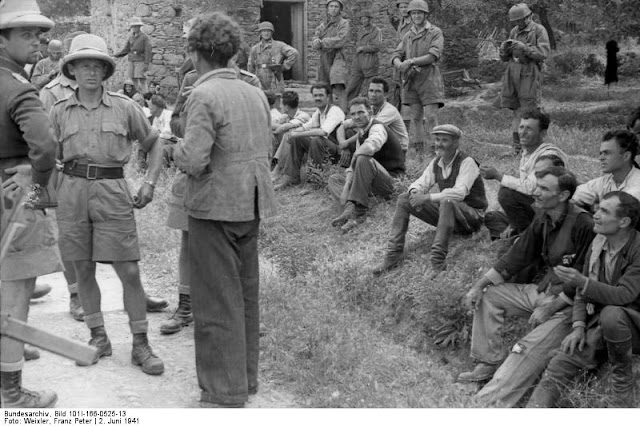
The Massacre of Kondomari: On 2 June 1941, German Fallschirmjäger rounded up the civilians of the Cretan village of Kondomari in one of a long series of mass reprisals on the Greek island of Crete. The execution of the men of Kondomari was orchestrated by Wehrmacht Generaloberst Kurt Student in retaliation for the civilian participation during the Battle of Crete, which had ended in a German victory only two days prior. Throughout the Battle of Crete, the Allied forces and Cretan civilians had inflicted heavy losses of lives on the Wehrmacht soldiers. In particular, the unprecedented resistance from the local population exasperated the German sense of military order, according to which no one but professional soldiers should be allowed to fight. Generaloberst Student in particular, blamed the civilians of Kondomari for the death of a few German soldiers whose bodies had been found near the village. Four trucks full of German Fallschirmjäger (paratroopers) from the III Battalion of Luftlande-Sturm-Regiment 1 under the command of Oberleutnant Horst Trebes surrounded the village. Men, women and children were forced to gather in the village square. Then, a number of hostages were selected among the men while women and children were released. The hostages were led to the surrounding olive groves and shot by an ad hoc firing squad. The exact number of the victims is unclear. According to German records, a total of 23 men were killed, but other sources raise the toll to about 60. The whole event is filmed by a Wehrmacht war correspondent, Franz-Peter Weixler, who secretly opposes the action.
Other Fallschirmjäger troops surround the village of Alikianos. The Germans take 42 men from the village to a churchyard and execute them. Other civilians are executed at Agia (12 men shot) and Kyrtomado (25 men shot).
These incidents will be included in charges of war crimes made after the war against General Student and others.
Under a top-secret order from Winston Churchill, Cyprus is being prepared for long-term guerrilla warfare. After a string of disasters in the Middle East, few believe that the island could hold out for more than a few weeks against the kind of assault that took Crete. Engineers are building a series of “hides ” in the Troodos mountains — filling them with weapons, ammunition and medical supplies — to acts as “mini-bases” for clandestine British hill fighters. Churchill believes that several German divisions could be pinned down by a “ghost army” should Cyprus be invaded. The Greek government would like to set up its capital in Cyprus, and there is some support within the British government for ceding the island to Greece for that purpose. The Cabinet concludes that the entire matter should be left to postwar peace settlement discussions.
In Malta, the British notice a new, large incendiary bomb being used by the Italian bombers. The anti-aircraft defenses claim to have shot down a Junkers Ju 52 transport off the coast.
Adolf Hitler and Benito Mussolini met at the Brenner Pass once again. During the five-hour conference Hitler ranted about Rudolf Hess and other recent events, but kept Mussolini in the dark about the upcoming invasion of the Soviet Union. For two hours the two dictators were alone, and Hitler did most of the talking, dropping hints about German plans for action “if the shipping losses do not suffice” to knock Britain out of the war. At the end Mussolini departed for Rome no wiser than when he had arrived. Not so the Japanese ambassador in Berlin, Hiroshi Oshima who was given the same “hint hint” treatment by Hitler. Oshima told his foreign ministry in Tokyo that Hitler was about to attack Russia. However, major Italian troop movements in the Balkans around this time suggest that the Italian government was likely aware of Hitler’s intentions anyway. Mussolini reportedly told Count Ciano after the meeting, “I wouldn’t be at all sorry if Germany in her war with Russia got her feathers plucked..”
It is believed that Mussolini urges a joint strategy against Great Britain in the Mediterranean, which Hitler rejects. This would jibe with Kriegsmarine Admiral Raeder’s “peripheral strategy” which has been working well to date.
According to Joseph Goebbels, Hitler tells Mussolini about Operation Barbarossa at this meeting. However, Ciano writes in his diary, “The general impression is that for the moment Hitler has no precise plan of action.” If Hitler does tell Mussolini, the latter does not tell even his closest government cronies. The official communique simply states that the meeting lasted for several hours and was cordial.
British forces quelled the violent Farhud (pogrom) against the Jews of Baghdad by imposing a curfew and shooting violators on sight. Jamil al-Midfai is named Prime Minister of Iraq on 2 June 1941. In Baghdad, the “Farhud” attacks continue against the Jewish Quarter. While the instigation and causes of the Farhud are subject to debate, but what is known for certain is that it ends today during the afternoon. It is unknown exactly how many deaths result from the Farhud, but estimates range from 100-1000, wich larger numbers of wounded.
Regent Abdul Illah (Abdullah) ends the Farhud riots, according to the Iraqi Commission Report, when he orders forces loyal to him into Baghdad. They use machine guns to kill many rioters. Another version of events is that the British are the ones that restore order. The two versions may be reconciled by assuming that the Regents ask the British to restore order, but that is unclear. In any event, hundreds of people on both sides of the Farhud — rioters and Jewish victims — perish. This incident begins the gradual elimination of the centuries-old Jewish presence in Baghdad.
Vichy French aircraft claimed a British Blenheim aircraft shot down over Syria-Lebanon.
The Vichy government grants the use of Bizerta port facilities in Tunis to the Axis. Pursuant to the Paris Protocols, the Vichy French government grants the Reich the use of port facilities in Bizerte, Tunis (Tunisia). While this is farther from the Libyan front, it also is closer to Naples than Tripoli. This makes Bizerte ideal for quick and relatively safe convoys across the Tyrrhenian Sea for items that are not time-critical. However, for the time being, only non-military supplies are allowed through the port.
East African 22nd Infantry Brigade begins crossing the Omo at Sciola in Galla-Sidamo.
Hitler is worried about the defense of the Channel Islands. He asks to have maps of them brought to him.
Vichy French government published anti-Semitic legislation based on German laws; among it was the banning of Jews from holding public office. A law is passed authorizing the “administrative internment” of all Jews in France, whether French-born or foreign-born. The Vichy French government orders a census of Jews. It also bans Jews from holding public office.
The Turkish government informs the British government that it prefers to remain neutral and declines a request to join an invasion of Vichy French Levant.
German submarine U-147 was sunk off Ireland by depth charges from British warships.
The British cargo ship Michael E was torpedoed and sunk in the North Atlantic by the German submarine U-108.
Before dawn, German bombers attacked Manchester and Salford in England, United Kingdom in the early hours of the day. The Luftwaffe attacks Manchester during the night of 1-2 June, killing 70 and injuring 86. This is the Manchester Blitz.
The Luftwaffe bombs Park Grove, Hull. This is Hull’s fiftieth raid of the war. There are 27 killed and 11 wounded, and the tragedy is that the “all clear” mistakenly had sounded and the victims had just exited their shelters.
The RAF shoots down a Junkers Ju 88A northeast of Tynemouth at 22:29. There are two deaths, and two crewmen become POWs.
RAF Bomber Command, Day of 2 June 1941
44 Blenheims on extensive shipping operations in cloudy weather. Some of the Blenheims tried again to block the Kiel Canal and several ships were bombed in that area. It is believed that 2 ships were sunk in the canal, blocking it for at least 10 days. 2 Blenheims lost.
RAF Bomber Command, Night of 2/3 June 1941
Düsseldorf
150 aircraft — 68 Wellingtons, 43 Hampdens, 39 Whitleys — to two aiming points but cloud conditions caused difficulties and only 107 aircraft claimed to have bombed Dtisseldorl 2 Hampdens and 1 Whitley lost. Düsseldorf records only light and scattered damage with 5 people killed and 13 injured.
Duisburg
25 Wellingtons; thick haze prevented accurate bombing. No aircraft lost.
Berlin
8 Stirlings and 3 Wellingtons. 1 Stirling lost.
U-147, commanded by Oberleutnant zur See Eberhard Wetjen, damaged Belgian steamer Mokambo (4996grt) in 56-38N, 10-24W. On 2 Jun 1941, the Mokambo in convoy OB.329 was torpedoed and damaged by U-147 (Wetjen) in 56°38N/10°24W. The U-boat was sunk after the attack by the convoy escorts. The ship had been en route from Liverpool for Freetown and Matadi with general cargo. No casualties among the 43 crew members and four gunners aboard. She was taken in tow for the Clyde, arriving on 4 June, was repaired and returned to service in August 1941. The 4,996-ton Mokambo was carrying general cargo and was bound for Freetown, Sierra Leone. The U-147 would subsequently be sunk by the Mokambo’s escorts.
U-147 was then sunk northwest of Ireland in 56-38N, 10-24W. The U-147, commanded by Oberleutnant zur See Eberhard Wetjen, was sunk northwest of Ireland in the northern Atlantic Ocean by depth charges from the destroyer HMS Wanderer (D 74) and the corvette HMS Periwinkle (K 55). All of the ship’s complement of 26 died. During its career under two commanders the U-147 sank 2 ships for a total of 6,145-tons, damaged 1 ship for a total of 4,996-tons, and damaged irreparably 1 ship for a total of 2,491-tons.
U-108, commanded by Kapitänleutnant Klaus Scholtz, sank catapult aircraft merchant ship HMS Michael E (7628grt) in 58-50N, 29W. At 2043 hours on 2 June 1941 the Michael E. (Master Murdo MacLeod), dispersed on 1 June from convoy OB.327, was hit on the port side at the after end of #5 hold by one of two torpedoes from U-108 while steaming on a non-evasive course at 10 knots in hazy weather about 700 miles southwest of Cape Clear. Two hours earlier, the U-boat had spotted three ships from the dispersed convoy and decided to attack the second one at dusk. The explosion opened a large hole in the port side and the upper deck, blew the hatch covers onto the top deck and broke the shaft which stopped the engines immediately. After sending a distress signal and discussing the possibility of launching the Hurricane fighter from its catapult, the crew of 35, five gunners (the ship was armed with one 4in, one 12pdr and four machine guns) and eleven FAA personnel, including two pilots and a fighter direction officer (FDO), began to abandon ship in four lifeboats as the ship quickly settled by the stern without a list. The torpedo had hit underneath the mess used by the naval ratings, killing two and wounding twelve others, three of them seriously. At 2221 hours, the ship sank vertically by the stern. The U-boat surfaced shortly afterwards and questioned the survivors in each lifeboat before leaving. The boats then set sail and two of them were spotted by Alcinous, the ship of the convoy commodore from the dispersed convoy OB-328, in the afternoon on 3 June in 49°46N/27°42W. The ship picked up the occupants and afterwards searched for the other two boats, locating them about 5 miles away. However, a crew member died of injuries and was buried at sea on 9 June. On 10 June, the survivors were landed at Halifax and the injured men were taken to a hospital where an air fitter died of injuries later that day. The 7,628-ton Michael E. was carrying ballast and was headed for Halifax, Nova Scotia.
Light cruiser HMS Birmingham departed Scapa Flow for the Clyde for escort of convoy WS.9A. The light cruiser arrived in the Clyde on the 3rd. Following this duty, the light cruiser proceeded for duty in the South Atlantic.
Light cruiser HMS Nigeria undocked at Rosyth. The light cruiser departed Rosyth on the 3rd for Scapa Flow.
Destroyer HMS Bedouin arrived at Scapa Flow at 2230 after escorting steamer Ben My Chree to Cape Wrath from Iceland.
Minelayer HMS Plover, escorted by patrol sloop HMS Guillemot, laid minefield BS.57 off the east coast of England. Minesweepers HMS Elgin, HMS Sutton, and HMS Albury of the 4th Minesweeping Flotilla accompanied the minelay.
Submarine HMS P.32, on passage to Gibraltar, was damaged by German bombing off Finisterre. Considerable damage was done to the batteries. The submarine arrived at Gibraltar on the 3rd.
Ex-US Coast guard cutter/escort ship HMS Hartland, which had arrived at Londonderry on 29 May from the US, was damaged in a collision with British steamer Welsh Coast (646grt). The escort ship sustained minor damage which was repaired at Falmouth, during a scheduled refit from 8 June to 18 July.
Dutch submarine HNLMS O.14 was damaged in a collision, and repaired at Grangemouth from 8 June to 9 July.
British steamer Beaumanoir (2477grt) was badly damaged by German bombing eight cables 180° from 19 Buoy, Robin Hood’s Bay. The steamer was taken in tow. The steamer was sunk after a second air attack.
British steamer Prince Rupert City (4749grt) was sunk by German bombing in 58-46N, 4-41W. Four crewmen were lost on the steamer.
Belgian trawler John (197grt) was sunk by German bombing ninety miles south by east of Inglos Hofdi. There were no casualties on the trawler.
British steamer Thorpebay (2183grt) was damaged by German bombing six miles off Coquet Lighthouse. The steamer returned to the Tyne. The ship arrived at Scapa Flow on the 17th in tow.
Finnish steamer Kasteholm (5417grt) was sunk by a mine in 63-07N, 11-18W. One crewman was lost on the steamer. The rest of the crew was landed at Thorshavn.
British trawler Ben Screel (195grt) was damaged by German bombing in 55-30N, 1-30W. The trawler returned to the Tyne.
Naval whaler Kos XXII (353grt, Lt H.D. Foxon RNR) was sunk on passage from Crete.
Submarine HMS Clyde made an unsuccessful torpedo attack on a small steamer off Terranova.
New Zealand Division light cruiser HMS Leander arrived at Suez and arrived at Alexandria on the 5th for duty with the 7th Cruiser Squadron.
Convoy OB.330 departed Liverpool, escorted by corvette HMS Alisma and anti-submarine trawler HMS Northern Dawn. The convoy was joined on the 3rd by destroyers HMS Lincoln, HMS Sabre, and HMS Venomous, corvettes HMCS Arrowhead, HMS Kingcup, and HMS Sunflower, catapult ship HMS Springbank, and anti-submarine trawlers HMS Lady Elsa and HMS Man O’ War. The convoy was dispersed on the 7th.
Today in Washington, the Senate considered the bill to amend the Sugar Act, received the Reynolds bill for requisitioning of property, received the President’s message asking for $125,000,000 authorization for access highways and bridges for national defense, received the resolution of thirty-seven Senators urging food relief for occupied European countries and recessed at 4:29 PM until noon tomorrow. The Interstate Commerce Committee opened hearings on the White resolution for investigation of the FCC report on broadcasters; the Appropriations Committee approved the $185,119,813 Interior Department Appropriation Bill; the Banking Committee considered the bill to extend the life of the FHA.
The House received and considered the $1,155,927,222 Labor Department-Federal Security Administration Appropriation Bill, received a War Department letter requesting authority for requisitioning of property, received the Mansfield bill to carry out an agreement with Canada for development of the St. Lawrence Seaway and adjourned at 5:15 until noon tomorrow. The Ways and Means Committee considered the new tax bill; the Banking and Currency Committee heard administration support for a bill to extend the life of the Commodity Credit Corporation.
The Supreme Court adjourned its Spring term.
The U.S. Army-Navy Board officially adopts the U.S.-British Commonwealth joint Basic War Plan, or, as it later became known, Rainbow Five. In the event of a worldwide conflict, the plan is for the Allies to make their priority defeating Italy and Germany first. As for Japan, the Allied “strategy, in the Far East will be defensive” because “the United States does not intend to add to its present military strength” there. Rainbow Five basically foresees the loss of the Philippines. However, no plans are made for evacuating the Americans in the islands.
President Roosevelt prepared today for conferences in Washington tomorrow which likely will be of far-reaching importance. Meanwhile he signed two defense measures, one imposing mandatory priorities of wartime scope on industry. The other permits Canadian ships to carry ore between American Great Lakes ports during the 1941 transportation season and is intended to assure an adequate supply of steel. Mr. Roosevelt will confer tomorrow with John G. Winant, Ambassador to Great Britain; Secretary Hull and, probably, his military and naval staff chiefs. He spent much time today in telephone conversation with Washington, according to William D. Hassett, Presidential secretary.
A request by the War Department that President Roosevelt be given blanket powers to take over property “of any kind” for defense purposes aroused mixed reaction tonight on Capitol Hill. Some legislators expressed quick approval, others indicated opposition, while still others would not comment pending further study.
Former 1936 Presidential candidate Alf Landon gives a speech at the commencement of Simpson College in Indianola, Iowa. He urges caution and deliberation before going to war. Landon notes, in reference to the rush to war:
“We find a fatalistic acceptance of the inevitable.”
He warns that the country runs the risk of falling into “dictatorship, of the right or of the left,” due to the “weakening [of] our checks upon the majority.” Landon said today that he was convinced that President Roosevelt has not yet made up his mind about the role this country should play in the European war.
President Roosevelt accepted tonight the request of Chief Justice Charles Evans Hughes that he be permitted to retire from the U.S. Supreme Court on July 1. The Chief Justice, in a letter made public by the temporary White House, informed the president that “consideration of health and age makes it necessary that I should be relieved of the duties which I have been discharging with increasing difficulty.” It was predicted in Washington that Attorney-General Robert H. Jackson would succeed Justice Hughes.
After more than seven and one-half months of consideration the Supreme Court gave orders today that the contempt cases of Harry Bridges and The Los Angeles Times should be reargued in October, to which date the tribunal took a recess.
Wage increases and bonuses totaling approximately $15,000,000 for 70,000 Chrysler Corp. workers were announced tonight at conclusion of negotiations between representatives of the United Automobile Workers-C.I.O. and the corporation. A new agreement offered the union, replacing a contract signed last November, calls for an eight cents an hour increase and payment of a $45 bonus in December to all workers with a year’s seniority. The contract will be retroactive to June 1.
The U. S. Circuit Court of Appeals today unanimously affirmed the sentences imposed upon five objectors to the Selective Service Act. It was the court’s first ruling on appeals from enforcement of the punitive provisions of the law.
The presence of subversive agents at key positions at Army posts and cantonments in the New York and New Jersey area who “could wreck the entire defense of the New York area,” was charged today by Representative J. Parnell Thomas, Republican of New Jersey, who has just returned from an inspection tour in that region.
Francis Biddle, United States Solicitor General, told the National Conference of Social Work tonight that in the emergency now confronting this nation the government would take all measures considered necessary to protect the country against sabotage and other subversive activities, but the essential civil rights would be protected.
Joseph Rochefort reported to the main U.S. Navy building at Pearl Harbor, Territory of Hawaii for his new duty heading up a cryptanalysis section.
Rear Admiral Edward J. Marquart becomes Commandant, New York Navy Yard.
A $250,000 four-motored Consolidated bomber crashed and sank in San Diego Bay today, shortly after taking off from Lindbergh Field. Consolidated Aircraft Corp. officials said four of the crew members apparently perished. The 25-ton craft was camouflaged and ready for delivery to Great Britain. William B. Wheatley, 39, Chester, N.Y., chief test pilot for the Consolidated Aircraft Corp., apparently was at the controls. The Navy had taken over rescue operations, and details and names of crew members were not immediately available. Witnesses said the huge plane left the airport on what appeared to be a normal takeoff, but that the bomber pulled up steep into a vertical climb instead of leveling off. At about 500 feet the plane apparently was in a stall.
Major League Baseball:
Baseball superstar Lou Gehrig dies of amyotrophic lateral sclerosis (ALS), or “Lou Gehrig’s disease,” in New York City at age 37. Gehrig died at his home in the Bronx. From that time on, the illness is known primarily as Lou Gehrig’s Disease. Gehrig, the son of German immigrants, was signed by the New York Yankees and played in the minor leagues in 1923 and 1924; he was brought up to the Yankees at the end of both seasons and played in 23-games. In 1925, he became the regular first baseman, replacing Wally Pipp, and held the position until 1939 when he retired due to his illness. At the time of his death, he held the record for the number of consecutive games played, 2,130; this record held for 59-years until Cal Ripken, Jr. broke it in 1998. “The Iron Horse,” as he was known, had a lifetime batting average of .340 with 493 home runs; he batted over .300 every season between 1926 and 1937. He also appeared in 34 World Series games batting .361 and hitting ten home runs. Gehrig was admitted to baseball’s Hall of Fame in 1939. Mayor Fiorella La Guardia ordered flags in New York to be flown at half-staff. His remains are interred at Kensico Cemetery in Valhalla, New York.
The Cards move back into sole possession of first with a 5–4 victory over Brooklyn. Johnny Hopp triples, then scores the winner in the 9th. The Dodgers’ loss breaks a nine-game winning streak. A ladies’ day Ebbets Field crowd of 28,281, including 17,858 who paid admission, cheered as their favorites tied the score at 4–4 in the eighth inning, only to groan when St. Louis pushed over a run in the ninth to break the first-place tie and regain undisputed leadership. Stocky Johnny Hopp, substituting for the injured John Mize, snatched the game from the Dodgers. With one away in the ninth, Hopp tripled off the right-field wall and a moment later raced home after Joe Medwick had snared Jimmy Brown’s high fly near the foul line. Curt Davis, fourth Brooklyn hurler, was charged with the loss. while Clyde Shoun, third pitcher called in by Manager Billy Southworth, received credit for the triumph.
The Braves scored their first 1941 shutout victory today when Dick Errickson whitewashed the Pirates, 2–0. Errickson, who lost his first five mound starts, was in fine form, giving only five hits, two of them doubles by Elbie Fletcher. Gene Moore, returning after a briet rest on the bench, led the Boston assault on Johnny Lanning with three hits, including two triples Sibby Sisti knocked in both Boston runs. In the third, Moore opened with a triple, Ray Berres walked. Moore was run down between third and home on Errickson’s bounder to Lanning, but Sisti drove in Berres with a hit. The other run came in the seventh after Carvel Rowell and Moore singled. Rowell was forced at third. but singles by Errickson and Sisti brought home Moore.
The Senators drop the White Sox out of first place, winning 8–3, and beating Bill Dietrich, coming off a one-hit win over the Browns. Joe Kuhel slammed his seventh homer in the third inning to give the Sox a one-run lead but that wasn’t enough to save the game for Bill Dietrich, who had pitched a one-hitter his last time out. Steve Sundra scattered six Chicago hits until the ninth, when four singles produced two runs. Buddy Lewis has 2 hits to reach the 1,000 level at age 24. He’ll barely make 1,500 hits because of three and a half years in the service.
In Cleveland, the Indians defeat the Yankees, 7–5, behind Bob Feller. Feller had been unscored upon in 31 innings before New York got to him. DiMaggio has a single and double, improving his consecutive hit streak to 19 games, and also robs Ken Keltner of an extra base hit with a running catch in center. Tommy Henrich belted Feller for two homers over the right-field wall. driving in three runs. But the rest of the Yankees were handcuffed, and Rapid Robert notched his sixth straight triumph, his eleventh of the campaign, and Marius Russo, young Yankee southpaw, is still striving to regain the victory path after four outings in which he dropped three decisions and tied one. Roy Weatherly’s single with one down in the first inning opened a ten-hit assault on Russo. After Joe Gordon booted Ken Keltner’s grounder and Russo threw out Jeff Heath, Gee Walker singled to score Weatherly and Keltner with an unearned pair.
Buck Newsom, no puzzle at all for American League clubs this year, was just as easy for the Red Sox today. Joe Cronin’s boys rapped the luckless Buck, last year Detroit’s top hurler, for six hits and five runs — four of them the result of homers — in the two innings he worked and registered a third straight triumph over the Tigers, 9–1. It was Newsom’s seventh setback this year against three victories. Joe Dobson, on the other hand, was brilliant in gaining his second victory. He limited the Tigers to four singles and, after the first inning, when Detroit scored an unearned run, no Tiger runner advanced beyond second. In addition, the 24-year-old righthander led Boston’s attack with three safeties, including the first home run of his baseball career. Jimmy Foxx was Dobson’s big helper. Foxx drove in five of Boston’s runs, three of them coming on his seventh round-tripper in the first inning.
Fiddler McGee was still slightly off key yesterday, so the Giants dropped a 4–3 decision to the Reds in the comparative privacy of the Polo Grounds. The former Cardinal, who has yet to win for Bill Terry, gave up only four hits in six and two-thirds innings, but two were homers by Eddie Joost and Ernie Lombardi. Add to these a clean single by Elmer Riddle, the winning Cincinnati pitcher, in the seventh and the reason for McGee’s most recent failure becomes apparent. McGee had a lot of stuff yesterday, but was wild at times and too accurate at others. In the fifth, after he had fanned Lombardi, he tossed a ball to Harry Craft’s liking and a line single to right gave the world champions their initial hit. Joost was up next and promptly lofted a fly into the lower right-field stands to make it 2–0. This one was fair by about three feet and just as much over the wall, but it counted just the same.
Danny Litwhiler’s sixth and seventh home runs of the season and Johnny Podgajny’s seven-hit pitching gave the Phillies a 3–2 victory today, their first over the Cubs this year. Litwhiler’s four-ply blows came in the third and sixth innings with none on base. He also singled to pace the nine-hit assault on Southpaw Larry French. Nick Etten batted in the first Phil run in the opening inning with a single to score Joe Marty, who had doubled. Chicago picked up a run in the sixth on singles by Dominic Dallessandro and Lou Novikoff, followed by Phil Cavarretta’s long outfield fly, and added another in the seventh on French’s single, a walk to Stan Hack and another single by Lou Stringer.
The scheduled game between the Philadelphia Athletics and the Browns at St. Louis was postponed due to rain. The game will be made up as part of a doubleheader on August 21.
St. Louis Cardinals 5, Brooklyn Dodgers 4
Pittsburgh Pirates 0, Boston Braves 2
Washington Senators 8, Chicago White Sox 3
New York Yankees 5, Cleveland Indians 7
Boston Red Sox 9, Detroit Tigers 1
Cincinnati Reds 4, New York Giants 3
Chicago Cubs 2, Philadelphia Phillies 3
For the fourth time within a year the British Embassy in Chingking, wartime capital of China, was bombed by the Japanese today. The raid caused widespread destruction, especially to foreign property. The attack was carried out by a squadron of twenty-seven bombers. Six bombs fell in the British Embassy compound, damaging two buildings. The embassy’s bomb shelter withstood a direct hit and staff members inside were all unhurt. A few hours after the bombing the British Embassy staff was back at work within the shattered quarters. The near-by French Consulate was virtually demolished by a direct hit. The French Catholic Hospital and the municipal hospital were also damaged in the raid. In the previous day’s raid the American Methodist Hospital, the Methodist Church, and the Catholic St. Mary’s Cathedral were damaged. Casualties in today’s bombing were unusually heavy. They were estimated at 100 killed and 200 injured. The authorities posted warnings throughout the city urging the people to take shelter in dugouts.
The Chinese (commander of the Chinese 3rd PG, Lo Ying-Teh) decline a shipment of Hawk 81A (P-40C) fighter aircraft. They thus become the property of Claire Chennault’s Flying Tigers.
Japan’s expansionist venture in China, which will have rounded out four full years on July 7, has cost the Empire more than 17,000,000,000 yen [about $4,000,000,000] or a sum equal to the entire Japanese national income in 1936, says a booklet by T.Y. Hu which was issued here today by the Chinese Council for Economic Research.
General Grunert asks the U.S. War Department to call up Philippine Army and to dedicate $52 million in the Sugar Excise Fund to Philippine defense. This was rejected.
The RAAF established its No. 3 Base Stores Depot at Spring Hill in Australia.
Dow Jones Industrial Average: 116.18 (+0.42)
Born:
Charlie Watts, British rock and roll drummer for The Rolling Stones, in Kingsbury, London, England, United Kingdom (d. 2021).
Stacy Keach, American actor (“Mickey Spillane’s Mike Hammer”), in Savannah, Georgia.
William Guest, American soul singer (Gladys Knight & the Pips — “Midnight Train to Georgia”, “I Heard it Through the Grapevine”), in Atlanta, Georgia (d. 2015).
Lou Nanne, Canadian-American U.S. National Team and NHL defenseman and right wing (Olympics, 1968; Minnesota North Stars), in Sault Ste. Marie, Ontario, Canada.
Bob Saverine, MLB second baseman, centerfielder, and shortstop (Baltimore Orioles, Washington Senators), in Norwalk, Connecticut.
Died:
Lou Gehrig, 37, MLB first baseman (Hall of Fame; twice American League MVP; seven-time MLB all-star; New York Yankees), of amyotrophic lateral sclerosis (now commonly referred to as Lou Gehrig’s Disease).
Naval Construction:
The U.S. Navy YMS-1-class auxiliary motor minesweepers USS YMS-84 and USS YMS-85 are laid down by the Henry C. Grebe Co. (Chicago, Illinois, U.S.A.).
The U.S. Navy YMS-1-class auxiliary motor minesweeper USS YMS-125 is laid down by the J. M. Martinac Shipbuilding Corp. (Tacoma, Washington, U.S.A.).
The Royal Canadian Navy Bangor-class (VTE Reciprocating-engined) minesweepers HMCS Vegreville (J 257) and HMCS Grandmere (J 258) are laid down by Canadian Vickers Ltd. (Montreal, Quebec, Canada).
The U.S. Navy 77-foot Elco patrol motor torpedo boat USS PT-46 is laid down by the Electric Launch Company Ltd. (Elco), (Bayonne, New Jersey, U.S.A.).
The U.S. Navy SC-497-class (110-foot wooden hull) submarine chaser USS PC-518 (later SC-518) is laid down by the Elizabeth City Shipyard (Elizabeth City, North Carolina, U.S.A.).
The U.S. Navy SC-497-class (110-foot wooden hull) submarine chaser USS PC-519 (later SC-519) is laid down by the Vineyard Shipbuilding Co. (Milford, Delaware, U.S.A.).
The U.S. Navy Cleveland-class light cruiser USS Tallahassee (CL-61) is laid down by the New York Shipbuilding Corp. (Camden, New Jersey, U.S.A.). After Pearl Harbor, she was converted to an Independence-class light aircraft carrier and completed as USS Princeton (CVL-23).
The Royal Navy Bangor-class (VTE Reciprocating-engined) minesweeper HMS Caraquet (J 38) is launched by North Vancouver Ship Repairs Ltd. (Vancouver, British Columbia, Canada). She is transferred to the Royal Canadian Navy on completion and commissions as HMCS Caraquet (J 38).
The U.S. Navy 77-foot Elco patrol motor torpedo boat USS PT-31 is launched by the Electric Launch Company Ltd. (Elco), (Bayonne, New Jersey, U.S.A.).
The Royal Canadian Navy local defense force vessel HMCS Suderoy V (Z 04) is commissioned. Her first commanding officer is Lieutenant Ralph Meredith, RCNR.
The Royal Navy harbor defence motor launch HMS HDML 1001 is commissioned. Her first commanding officer is T/Lieutenant Donald Campbell Waylen, RNVR.
The Royal Navy MMS I-class motor minesweeper HMS MMS 24 (J 524) is commissioned. Her first commanding officer is T/Lieutenant Richard Flint Hawthorn, RNVR.
The Royal Navy British Power Boat 63-foot motor anti-submarine boat HMS MA/SB 24 is commissioned.
The Sjøforsvaret (Royal Norwegian Navy) Thornycroft 75-foot motor torpedo boat HNoMS MTB 51 is commissioned.
The U.S. Navy escort aircraft carrier USS Long Island (AVG-1; later ACV-1; finally CVE-1) is commissioned. Her first commanding officer is Commander Donald Bradley Duncan, USN. The USS Long Island was converted from the Maritime Commission C-3 type freighter Mormacmail in just 67 working days. The USS Long Island was the first of a type of what come to be classified as “escort carriers” that would prove invaluable in the prosecution of the war in both Atlantic and Pacific theaters.

