The Farhud
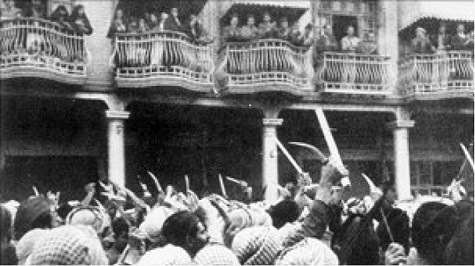
British forces entered Baghdad. Regent Emir Abdul Illah, the uncle of King Faisal, returned to Iraq and the monarchy and a pro-British government were put back in place. Prince ‘Abd al-Ilah (Abdullah), who has been waiting patiently at the British airbase at Habbaniyah, returns to Baghdad as the Regent on 1 June 1941. The pro-British monarchy and government are put back in place. British troops, by and large, remain outside Baghdad because they are vastly outnumbered by Iraqi troops and the city’s populace.
There now begins two days of violence in Baghdad that occur during the Jewish holiday of Shavuot, with the departure of Rashid Ali al-Kaylani. This is known as the Farhud (pogrom, literally “violent dispossession”) and is directed against the Jewish Quarter. The incident begins (this is disputed) when a delegation of Jewish Iraqis leaves their homes to journey to the Palace of Flowers (Qasr al Zuhur) to pay their respects to the newly returned regent. An Arabic mob attacks them as they cross Al Khurr Bridge. The riot builds in intensity throughout the day. Mobs attacked Jewish neighborhoods across Baghdad. By the end of two days, there were perhaps 180 Jews dead, many hundreds more were injured, and thousands of Jewish homes and businesses had been looted and many destroyed. The Iraqi Jewish community had never experienced anything like it.
This begins a long process and persecution that virtually eliminates historic communities of Sephardic Jews from the Arab world. This incident is sometimes referred to as the “forgotten pogrom.” It apparently is a spontaneous reaction to the British defeat of the Rashid Ali government, because Jews have lived in Iraq for hundreds and hundreds — 1200 — years.
Everything about the Farhud is disputed, including what actually happens during it and its long-term effect. It is estimated that 130-180 Jews — maybe hundreds more — are killed during the Farhud pogrom. There also are 1,000 injured. Many non-Jews also are killed, some when they attempt to intervene to protect Jews. Some 900 Jewish homes are destroyed and there is widespread looting of Jewish property. Some call this part of the Holocaust, others define it as a separate event.
The Farhud pogrom will be virtually forgotten until the 21st Century. Then, beginning around 2005, some books will mention it. The United Nations designates June 1, 2015, as International Farhud Day.
The Battle of Crete ended in a Pyrrhic victory for the Axis. Crete falls to the Germans. Hitler now has a strategic Mediterranean base for the dispatch of reinforcements and supplies to his desert troops in North Africa, which are poised for an assault against Egypt and the Suez Canal. But the cost to his paratroopers has been prohibitive; there will be no further such actions in the Mediterranean. In the final analysis, Hitler and the Luftwaffe assaulted the wrong island. Taking Malta would have been more useful by choking off the Med to the Royal Navy, and securing his lines of communication to Libya.
On Crete, 3,710 British troops and others are taken off by the Royal Navy during the night of 31 May/1 June. After that, evacuations end. A total of about 16,511 people out of the starting force of 32,000 make it off the island to safety in Egypt.
During the day, the embarkation port of Sfakia falls to the Wehrmacht. About 5,000 Commonwealth troops (Australian Lieutenant Colonel Theo Walker) defending Sfakia surrender and immediately go into captivity. It is estimated that about 12,000 British and Dominion troops and uncounted thousands of Greek troops remain on the island. Some of them surrender now, some of them surrender later at some point during 1941, some of them go into hiding in the numerous caves on the island and work with partisans, and some still attempt to somehow make it to Egypt, with little success.
The remnants of Layforce, Australian 19th Infantry Brigade, and Brigadier Vasey all surrender. A large group of Commonwealth troops that defended Retimo (Rethymno) also surrenders.
Approximately 15,000 British troops have already left Crete and arrived in Egypt. However, it must be mentioned that the battle on Crete has taken a heavy toll of our forces. It is believed in London that General Freyberg has left Crete altogether with our troops. An official report confirms that General Freyberg is still alive.
The light cruiser HMS Calcutta (D 82), commanded by Captain Dennis M. Lees, was on passage with the light cruiser HMS Coventry (D 43) from Alexandria to provide additional AA protection for the light cruiser HMS Phoebe (43) and other ships returning with more troops from Sfakia when it was attacked by German Ju-88 bombers. The HMS Calcutta was hit by 2 bombs and sank in the Eastern Mediterranean, about 100 nautical miles west-northwest of Alexandria, Egypt. 255 of the ship’s company were rescued by the HMS Coventry.
The British Air Ministry announces:
After twelve days of the bitterest fighting of the war so far, it has been decided to withdraw our forces from Crete. Although the enemy has suffered massive losses of men and material, we would not in the long term have been able to continue successful troop operations on the island without substantial support from the aerial and naval forces.
The battle for Crete is over: German Operation MERCURY has been a resounding success. That the Germans have scored an impressive victory using a new kind of warfare — airborne troops — is undeniable. However, in achieving the victory, the Germans have taken a lot of casualties (as have the British). The numbers lost on both sides have been studied endlessly, and all of the results have methodological assumptions that call into question how accurately they reflect the fighting on Crete during May 1941. Let’s go through this briefly.
The tendency is to overestimate the number of German troops lost during Operation MERCURY. Winston Churchill claims that the Germans have lost over 15,000 casualties, while Admiral Andrew Cunningham pegs the figure well above there. Over Allied assessments place the figure in that general vicinity. The United States Army Center of Military History places the number of German casualties around 6,000-7,000 men.
The actual number almost certainly is far lower than the amounts claimed by the Allies. Figures as low as 1,990 Germans killed, 2,131 wounded, and 1,995 missing for a total of 6,116 total casualties have been thrown out. Generally, German sources place the figure far lower. Daniel Marcus Davin, in his “The Official History of New Zealand in the Second World War, but the figures at 2,124 Germans killed and 1,917 missing men, totaling 4,041 killed and missing. Add to that 2,640 wounded and 17 Germans captured and you come up with 6,698 total German casualties during Operation MERCURY — some of whom could be healed and returned to action. So, realistically the Germans lost roughly 5,500 soldiers to death and incapacitating wounds in taking Crete, but any number you use is subject to attack.
British losses are vastly higher than the German losses. The British began the Crete battle with about 32,000 men. Their losses on Crete are listed as 1,742 killed, 1,737 wounded, and 11,835 taken prisoner. British Major General I.S.O. Playfair and his colleagues in 1956 come up with 3,579 British Commonwealth men killed and missing (presumed to be the same thing), with an additional 1,918 wounded and 12, 254 captured for 17,754 total British permanent losses on land.
However, to those British land losses must be added 1,828 Royal Navy crewmen killed and 183 wounded. In addition, 5,255 of 10,000 Greek refugees from the mainland are listed as captured. In addition, thousands of civilians are lost during the battle, partly due to bombing, but also partly due to the fact that many take up guns and try to defend their own villages. The best figures on Cretan deaths during Operation Mercury are 6,593 men, 1,113 women, and 869 children. The Cretan civilian casualties, however, are just beginning, so it is difficult to attribute some to Operation MERCURY and others to post-battle German reprisals.
The Royal Navy has lost cruisers HMS Calcutta, Fiji and Gloucester and destroyers Greyhound, Hereward, Juno Kashmir, and Kelly. It also has incurred serious damage to aircraft carrier Formidable, battleships Barham and Warspite, cruisers Ajax, Dido, and Perth, submarine Rover, and destroyers Kelvin and Nubian. Heavy cruiser York, beached on 26 March and used thereafter as a gun platform, now is a total write-off.
The Luftwaffe certainly has taken losses, as the British claim 22 aircraft definitely destroyed, 11 probably destroyed, and 21 damaged. However, the Luftwaffe has thousands of planes available. In the broadest sense, the battle between the Luftwaffe and the Royal Navy — the RAF barely intervened in the battles off Crete — has proven decisively that airpower is superior to naval power. Big ships cannot operate when the skies are dominated by the enemy.
In sum, the battle for Crete has been a complete disaster for the Royal Navy and the British Commonwealth in general. Its strength is now reduced to two battleships and three cruisers. The Italian Navy in the Mediterranean now outnumbers it with four battleships and eleven cruisers, but the Italians don’t use their big ships very often, preferring to maintain them as a “fleet in being.”
Operation MERCURY also proves something more troubling to the British: simply knowing in advance what the Germans are going to do doesn’t mean they can be stopped. It is certain that the British government knows before the first airborne troops land on Crete that it is going to be invaded, and how. This, however, does not prevent the German victory — though it likely contributed to the size of Wehrmacht casualties. When Adolf Hitler decides to no longer use airborne troops in offensive operations, it is a wise decision because the British Ultra decrypts enable the British to kill the descending German soldiers at their most vulnerable points and isolate those that survive. Hitler doesn’t know about Ultra — but his decision to shelve future projects such as an airborne invasion of Malta probably avoids some disasters due to Ultra.
The war on Crete is not over — in some respects it is just beginning. The Germans already have standing orders from temporary island commander Luftwaffe General Kurt Student to enact reprisals against Greek civilians. Crete is a hugely valuable German defensive bulwark against British attacks on southeastern Europe, but otherwise, it is a relatively useless victory that brings little profit.
The balance of the German 15th Panzer Division is now present in North Africa.
Also this month, Petain’s Vichy government introduces a series of “Jewish statutes.” Leon Berard, Vichy ambassador at the Holy See, reports to Petain that the Vatican does not consider such laws in conflict with Catholic teaching, and merely counseled that no provisions on marriage be added to the statutes.
Major General Erich Muller relieves Rudolf von Schmettow as military governor of the Channel Islands. Von Schmettow, however, remains in command of Jersey. During the month, Infantry Division 319 relieves ID 216 on the islands.
German cruiser Prinz Eugen arrived in Brest, France to join battlecruisers Scharnhorst and Gneisenau docked there for refits. They all sit idle in the port with no plans for use, which likely would have been the fate of battleship Bismarck as well had it survived. German warships no longer will challenge Royal Navy supremacy on the high seas, though there will still be occasional deadly encounters. The U-boat fleet, however, remains as deadly as ever and is increasing in size and range.
The Royal Navy now begins a concerted effort to find and eliminate the Kriegsmarine’s highly effective overseas supply network. These “milch” ships have been supplying both German surface raiders and the U-boat fleet. The German supply ships typically sail under false flags, but their true defense is simply operating in areas outside the shipping lanes and depending upon the vastness of the Atlantic to hide them.
Pope Pius XII defended the right and duties of the individual and families against too extensive state interference in a radio broadcast today commemorating the fiftieth anniversary of Pope Leo XIII’s social encyclical “Rerum Nova-rum.” The pontiff, speaking in Italian over the Vatican radio, upheld man’s right to freedom in his “physical, spiritual, religious and moral movements.” He warned against the “error” of the belief that “the scope of man on earth is society.” “Society is not an end in itself,” the Holy Father asserted.
Catholic journals in Nazi Germany no longer receive printing paper.
Clothing rationing was introduced in Britain. People were taken completely by surprise by today’s announcement that clothes are now rationed and that they must give up their margarine coupons to buy them until special ration cards have been printed. Each man, woman or child will be given 66 coupons to last until a year from today. The number of coupons to be given up varies according to the garment and the consumer; for example a man’s raincoat or overcoat requires 16 coupons, a woman’s 14, and a child’s 11. Men need 13 coupons for a jacket, eight for trousers and five for a waistcoat, so a three-piece suit takes 26. A woman can get a woolen dress for 11 coupons, and one in any other material for a skirt or a skirt for seven, a blouse for five, stockings for two, and shoes or boots for five. Men’s shoes need seven, and a pair of socks three. Even a tie or two handkerchiefs need a coupon. So do two ounces of knitting wool. Husbands can give up their coupons to their wives (and vice-versa), and both can give them up for their children. Second-hand clothes are unrationed. There was a run on second-hand shops today. None of the traders in Petticoat Lane market were taking coupons.
HMS Edinburgh was ordered to patrol the Denmark Strait.
In the Soviet Union, 793,500 conscripts were called up.
Soviet sleeper spy Richard Sorge makes another covert wireless transmission to Moscow. He tells them that German Lieutenant Colonel Edwin Scholl has told him that the Germans have massed 170-190 divisions along the Soviet border and plan to invade on 15 June. In Moscow, Stalin is tired of reading these endless warnings. The transmission is marked “suspicious” and “provocative.” If Sorge were to return to Moscow at this time, he likely would be cashiered and perhaps imprisoned. However, the staff in the Kremlin maintains a record of the warnings for possible future use.
In order to cover up the movement of the mass of its planes to the East, 110 German aircraft bombed Manchester. A heavy raid was made on Manchester on Sunday night, when thousands of incendiary bombs and many tons of high-explosive were dropped indiscriminately. Present reports indicate that fatal casualties are believed to be particularly heavy, considering the fierceness with which the town was bombarded. Once again, churches, hospitals and the homes of the people were among the buildings damaged. One of the worst incidents occurred at a nurses’ home, which was wrecked by a heavy bomb. Rescue work was still going on yesterday and one of the workers said that it was known that at least two of the people underneath were alive because some of the men had spoken to them and had heard their faint reply. By dawn, five bodies had been recovered, and a few hours later, after some soldiers and an airman, together with civil defense workers, had dug and torn their way through the heap of rubble, a doctor from the hospital was able to crawl through an opening where it was found that one nurse was trapped by her arm. With the light of miners’ lamps he administered an anesthetic on the severely injured young woman and amputated her arm on the spot. Soon afterwards she was got out but the shock and her injuries proved too much, and she died within a few minutes. Another nurse was extricated after being buried for nearly 12 hours. She is a first-year probationer at the hospital and her home is in St Asaph. She was unconscious when rescued and the matron told a reporter that she would have an immediate blood transfusion. “She is suffering badly from shock, the effect of many hours’ [sic] buried under the heavy debris, and from cuts and bruises,” the matron added. Four of the missing are young nurses who entered the hospital for preliminary training a few weeks ago. The hospital to which the home is attached was not damaged, and there were no casualties among patients. Two other hospitals received damage through fire or explosive bombs, but fortunately the patients had been removed to safety. Five [ARP] wardens were killed on patrol and a curate was killed on shelter duty outside his church.
Another force of about 130 planes bombs Merseyside (Liverpool).
The Luftwaffe begins making command appointments preparatory to Operation Barbarossa. Oblt. Wilfried Balfanz becomes Gruppenkommandeur of I / JG 53. Major Joachim Seegert is made Gruppenkommandeur of I./JG 77.
Premier fighter squadron JG 26 (Adolf Galland) moves to new bases. I group to Clairmarais near St. Omer, II Gruppe to Maldegem in Belgium and III Gruppe to Ligescourt (Liegescourt) north of Abbeville. While elements of JG 26 fight at various times in the Mediterranean and the Soviet Union, most of the formation remains on the Channel Front throughout the war.
First flight of the Blohm & Voss BV 141 tactical reconnaissance aircraft. Its distinctive design includes a separate, engine-less fuselage that serves as an observation gondola. A total of 20 will be built, but the Luftwaffe prioritizes other planes that use engines that are more readily available.
Belfast city hall was damaged in a recent air raid. Fire bombs fell on the roof over the ballroom, and though the roof was damaged and some portraits in the ballroom were destroyed, good work by firefighters saved the main structure. Thirty Belfast churches have been wrecked or damaged.
This month, USAAC Col. Donald J. Keirn of Wright Field sent to England to study Gloster jet aircraft and its Whittle-I engine. AAF decision to produce Whittle engine made in September, and the XP-59 flew a year later.
No. 120 Squadron, RAF Coastal Command, formed at Nutts Corner, Northern Ireland, with American-built Consolidated Liberator long-range maritime patrol aircraft to fly against the U-Boat threat in the war in the North Atlantic.
Air Vice-Marshal Arthur Tedder was appointed AOC-in-C of RAF Middle East Command.
Air Vice-Marshal Hugh Lloyd appointed Air Officer Commanding in succession to Air Commodore F. H. M. Maynard.
U-105, commanded by Kapitänleutnant Georg Schewe, sank steamer Scottish Monarch (4719grt) at 12-58N, 27-20W. At 0022 hours on 1 June 1941 the Scottish Monarch (Master Graham Clegg Winchester), dispersed from convoy OB.319, was hit in the bow by one torpedo from U-105 southwest of the Cape Verde Islands. The ship had been spotted at 0700 hours the day before and missed with a spread of two torpedoes at 1535 hours. One crew member was lost. The survivors abandoned ship after the hit and the U-boat fired at 0036 and 0052 hours two coups de grâce. The first was a dud but the second detonated near the bridge and caused the ship to sink by the bow after a boiler explosion. The U-boat then questioned the survivors before leaving the area. The master and 23 survivors were picked up on 8 June by the Dutch motor merchant Alphard and landed at Freetown five days later. The chief officer M. Macleod and 19 survivors were picked up on 11 June by the British steam merchant Christine Marie and landed at Freetown on 19 June. The 4,719-ton Scottish Monarch was carrying coal and was headed for Freetown, Sierra Leone.
U-107, commanded by Kapitänleutnant Günter Hessler, sank steamer Alfred Jones (5013grt) at 8N, 15W. At 1409 hours on 1 June 1941 the Alfred Jones (Master Harold Harding), the ship of the convoy commodore from the dispersed convoy OB.320, was hit by three torpedoes from U-107 and sank within 30 minutes 140 miles west-southwest of Freetown. 14 crew members were lost. The master, the commodore (Vice-Admiral G.T.C.P. Swabey, CB, DSO, RN), six naval staff members, 38 crew members, four gunners and 12 passengers were picked up by HMS Marguerite (K 54) (LtCdr A.N. Blundell, RNR) and landed at Freetown. Hessler was wrong in assuming that this vessel was either a Q-ship or an armed merchant cruiser. During the winter 1939/40, a total of eight British merchants were fitted out as Q-ships, but they all had been withdrawn from service by early March 1941. A small number of such vessels were commissioned by the US Navy during 1942/43, all being withdrawn at the end of 1943. Thus at the time of Hessler´s attack there were no Allied Q-ships in service. The 5,013-ton Alfred Jones was carrying RAF planes, lorries and steel and was headed for Bathurst, Gambia.
Italian submarine Marconi sank Portuguese fishing trawler Exportador I (318grt) with artillery 137 miles southwest of Cape St Vincent, 35-40N, 10-30W. Two crewmen were killed and twenty rescued.
Home Fleet Status at the first of June at Scapa Flow: Battleship HMS King George V, light cruisers HMS Manchester and HMS Galatea, and seven destroyers. Heavy cruiser HMS Suffolk and light cruisers HMS Kenya and HMS Aurora were at sea sweeping for supply ships. Battleship HMS Nelson, light cruisers HMS Neptune and HMS Sheffield, and fourteen destroyers would be available to the Home Fleet by 20 June.
Light cruiser HMS Edinburgh (CS.18) departed Scapa Flow on Denmark Strait patrol. She arrived in Iceland on the 3rd and after refueling departed on the 4th to relieve light cruiser HMS Hermione.
Light cruiser HMS Arethusa departed the Denmark Strait patrol when relieved by light cruiser HMS Hermione, which departed Hvalfjord on 31 May, and arrived in Iceland. Arethusa departed Iceland for patrol in the Iceland-Faroes Channel.
Destroyers HMS Cossack, HMS Zulu, HMS Maori, and HMS Sikh departed Scapa Flow for the Clyde to escort convoy WS.9A, and arrived in the Clyde on the 2nd.
Destroyers HMS Punjabi, HMS Eskimo, and HMS Icarus departed Scapa Flow at 1500 for the Clyde to screen battleship HMS Rodney. The destroyers arrived in the Clyde at 0730/2nd, joining destroyer HMS Tartar already there.
Minelayer HMS Teviotbank, escorted by destroyer HMS Holderness, laid minefield BS.63 off the east coast of England.
German heavy cruiser Prinz Eugen arrived at Brest.
Norwegian steamer Fernbank (4333grt) was damaged by German bombing off Peterhead, arrived at Aberdeen on the 1st, and later went on to the Tyne for repairs.
Tanker Pass of Balmaha (758grt), escorted by sloop HMS Auckland and trawler HMS Southern Maid, departed Alexandria for Tobruk, where whey arrived at 2330/3rd. Then after unloading, and escorted by Auckland, departed Tobruk during the night of 4/5 June.
Submarine HMS Clyde sank Italian steamer San Marco (3076grt) five miles 90° from Capo Carbonara, southeast of Sardinia. A second torpedo attack on another steamer on this date was unsuccessful.
Submarine HMS Torbay sank a caique, carrying German troops and stores, in the Doro Channel with artillery.
Submarine HMS Severn departed Gibraltar for patrol in the Atlantic.
Convoy HX.130 departed Halifax, escorted by battleship HMS Ramilles, corvettes HMCS Pictou and HMCS Rimouski, and auxiliary patrol vessel HMCS Rayon D’Or. Convoy BHX.130 departed Bermuda on 30 May escorted by ocean escort armed merchant cruiser HMS Alaunia. The convoy rendezvoused with convoy HX.130/5th and the armed merchant cruiser was detached. On the 4th, corvettes HMCS Agassiz, HMCS Alberni, and HMCS Wetaskiwin joined. Destroyers HMS Burnham and HMS Churchill joined on 7 June. Battleship HMS Ramillies was detached on the 9th and armed merchant cruiser HMS Derbyshire joined on the 11th. The two destroyers were detached on 14 and 13 June, respectively. The three corvettes and the armed merchant cruiser were detached on the 15th. Destroyers HMS Sardonyx and HMS Watchman, corvettes HMS Heliotrope, HMS Petuna, HMS Verbena, and HMS Violet, escort ships HMS Banff, HMS Culver, HMS Fishguard, and HMS Hartland, and catapult ship HMS Ariguani joined on the 15th. Destroyer Watchman and escort ship Banff were detached on the 18th. Destroyer Sardonyx and escort ships Culver, Fishguard, and Hartland were detached on the 19th.Anti-submarine trawlers HMS Northern Gem and HMS Northern Pride escorted the convoy in Home Waters. The convoy arrived at Liverpool on the 20th.
Convoy SC.33 departed Sidney, Cape Breton, escorted by armed merchant cruiser HMS Derbyshire, destroyer HMCS St Croix, and auxiliary patrol vessel HMCS Raccoon. The destroyer was detached on the 3rd and the escort vessel on the 4th. On the 4th, corvettes HMCS Agassiz and HMCS Wetaskiwin joined the convoy. Destroyer HMS Burnham and corvette HMCS Alberni joined on the 7th.Escort ship HMS Fishguard joined on the 13th. Destroyer Burnham was detached on the 14th and the armed merchant cruiser the next day. On the 15th, destroyer HMS Bulldog, corvettes HMS Aubretia and HMS Carnation, escort ship HMCS Banff, minesweepers HMS Britomart and HMS Salamander, catapult ship HMS Ariguani, and anti-submarine trawlers HMS Daneman and HMS St Apollo joined. The two escort ships were detached on the 18th. Destroyer Bulldog was detached on the 19th. The rest of the escorts, except for the two minesweepers, were detached on the 20th. The convoy, escorted by the two minesweepers, arrived at Liverpool on the 21st.
Light cruiser HMS Emerald departed Basra for Singapore.
President Roosevelt will sign the ship-seizure bill soon after his return to Washington Tuesday and will move administratively to insure permanent acquisition by the United States of Axis ships taken into custody some weeks ago in American ports. This action is expected to supply the first test of whether the Axis powers are bluffing at the moment or mean to take reprisals against the United States, including a start of hostilities threatened by a Nazi Foreign Office spokesman and authoritative Italian circles. The ship bill, enacted Thursday, is understood to be having the usual scrutiny for technical mistakes before signing. According to William D. Hassett, Presidential secretary, it has not been among measures sent to Hyde Park for executive action. For a third consecutive day, the President was secluded at his estate, remaining in the house until late afternoon, when he went to the Hyde Park Library for a bit of work upon the state papers of his Administration which are being filed there.
Great Britain’s loss of Crete led two Democratic senators today to renew proposals the United States lead an attempt to negotiate peace in Europe. Senator Johnson, Colorado Democrat, told reporters he thought the sooner peace was established the better the terms on which Great Britain and Germany could agree. Agreeing with Johnson, Senator Clark, Idaho Democrat, said he believed the United States, “instead of talking war ought to be talking peace.”
With the Secretary of War and Secretary of the Navy unalterably opposed to measures which could be used to enforce prohibition within wide but unspecified areas around Army and Navy centers, it appears unlikely that such legislation will pass Congress or be signed if it does pass.
Stacy May, an official of the Office of Production Management, expressed the view today defeat of the axis powers could not be insured unless the United States diverted $40,000,000,000 a year into arms production, a sum double the present schedule of expenditures. In spending that amount annually for armaments, he added, “we should be doing in proportion to our strength no more than Canada or England or Germany are doing now.”
The nation counted a death toll of 432 holiday celebrants as the three-day Memorial Day weekend observance drew to a close. The majority of fatalities occurred in traffic accidents, in which 289 persons were killed. Seventy-one others drowned, 59 lost their lives by miscellaneous causes and 13 died in train mishaps. California led the states with 52 deaths, 35 by motor vehicles, 9 by drowning and 8 miscellaneous.
C.I.O, warehousemen, 4,500 strong, go on strike at San Francisco Bay Area warehouses at 8 AM tomorrow unless operators at the last moment agree to boost wages of women workers 10 cents an hour. Spokesmen for both sides indicated, however, there was little likelihood the walkout would be averted. It will be the first major tie-up of San Francisco warehouses since the four-month “hot cargo” strike in 1938.
The second National Anti-War Congress voted at a stormy session today to recommend immediate confiscation of “all defense industries, all national resources, basic industries and the American banking and credit system” to banish war from the shores of the New World. Overriding protests that the resolution constituted an acceptance of the Socialist “party line,” the congress, at the conclusion of a three-day session, refused, by a vote of 155 to 67, to tone down the resolution.
Archbishop Fulton J. Sheen delivers a speech at the commencement of Notre Dame University in South Bend, Indiana. He tags “the decline of patriotism in America” to “a decline of religion” which causes people to “cease to love their neighbor.” The speech is pro-intervention in Europe, with Sheen noting:
“And if there are certain things that are not worth fighting for, there are some things that are; above all else, that one thing is the foundation of our rights and liberties.”
More pointedly, he concludes:
“Democracy has within itself no inherent guarantee of freedom; these guarantees are from without. That is why I say our Declaration of Dependence on God is the condition of a Declaration of Independence of Dictatorship.”
Sheen equates being religious with defeating what he views as anti-religious impulses in the world, which can only mean the Axis.
While weary, smoke-begrimed firemen continued tonight to pour water on the smoldering embers of what was described as “the worst fire in Jersey City’s history,” Fire Chief Frank Ertle officially estimated the damage from last night’s disastrous waterfront blaze at $25,000,000. Sabotage is discounted as a cause.
Fire destroyed the administration building of Boeing’s $2,000,000 Sea Island aircraft plant today, but this will not delay construction of flying boats for Great Britain, according to Stanley Burke, president of Boeing Aircraft of Canada.
The First Issue of U.S. Technical and Tactical Trends is published.
Dallas Morning News headline: “Darlan Accuses British of Piracy, Indicates Full Confidence in Axis.”
New York Times headline: “Darlan Threatens to Resist British — Assailing Bombings, He Says French Will Force Respect — Sfax is Raided Again” While it only includes excerpts of the Darlan’s nearly 2,500 word statement, the article does note Darlan’s anger at British actions against French interests including vessels seized while at sea, supposedly enumerating ships seized that totaled 792,000-tons and worth 120 billion francs.
South Greenland Patrol, under command of Commander Harold G. Belford, USCG, was established to operate from Cape Brewster to Cape Farewell to Upernivik, The Coast Guard cutters USCGS Modoc, USCGS Comanche, and USCGS Raritan, together with the unclassified auxiliary vessel Bowdoin (IX-50) made up the force.
American actress Gene Tierney (20) weds Russian-Italian fashion designer Oleg Cassini (28); they divorce in 1952.
12.59″ (31.98 cm) rainfall, in Burlington, Kansas (state 24-hr record).
Major League Baseball:
After losing 6 straight games in mid-May, the Dodgers begin to show the results of the trades by Larry MacPhail and Leo Durocher. They win their 9th-straight game, beating the ailing Cards, 3–2, and are now tied for first place. Kirby Higbe is a winner over Lanier. Suffering Red Birds include Mize, out with a broken finger for 30 games, and Walker Cooper, suffering from a broken shoulder blade, who will be out two months.
Jimmy Dykes’s White Sox sneaked into first place in the American League today, splitting a double-header with the Senators while the Indians were losing twice to the Yankees. The Indians still are ahead by a half game on won-lost calculations, but Chicago leads in the percentage table, having & mark of .605 to Cleveland’s .604. Dykes’s club barely escaped losing a double-header. Shoddy fielding enabled Washington to win the first game, 3–2, despite John Rigney’s three-hit’ pitching. The Sox took the second in the eleventh inning, 4–3. Sid Hudson scattered eight hits in the opener and had a shut-out until the ninth. Errors by Luke Appling and Don Kolloway figured in the Senators’ three-run splurge in the second. Rigney then pitched hitless ball until Buddy Myer singled in the ninth. In the nightcap the Sox tied the score in the eighth with two runs and went on to win, on Jimmy Bloodworth’s error. In the eleventh frame Mike Tresh walked and advanced to second on Edgar Smith’s bunt. Kolloway rolled out and Appling was purposely passed. Bloodworth then let in the winning run while Joe Kuhel’s grounder rolled between his legs.
The Yankees swept a doubleheader with the Indians today. Before 52,081 fans in Cleveland’s huge Municipal Stadium, Charley Ruffing spun his first shutout of the year as the McCarthymen topped the Tribe in the opener, 2–0. In the nightcap Lefty Vernon Gomez, in a steady pitching effort for eight innings, subdued the Indians while his mates came through with an eighth-inning home-run attack that brought them the victory, 5–3. Gomez wasn’t around at the finish. He weakened in the ninth, when the Tribe launched a two-run rally that was checked by Marv Breuer. But Lefty got credit for the victory, his fourth against three losses. Joe DiMaggio extends his current hitting streak to 18 games by getting hits in both ends of the twin-bill that resulted from a rained-out game on Saturday.
Joe Cronin and his Red Sox mates squared the season’s accounts at four victories each with the Tigers today by taking a pair of close games, 7–6 and 6–5. In the opener Dominic DiMaggio doubled in the eighth with the score 6–6 to send home Pinch-hitter Frankie Pytlak, who had singled and had been sacrificed to second. Jimmy Foxx hit his sixth home run of the season in the sixth with a mate on base. Mike Ryba, who replaced Lefty Grove in the seventh, was the winning pitcher and Archie McKain the loser.
Mel Ott’s 2-run homer, the 400th of his career and his 1,500th RBI, gives the Giants a 3–2 win over the Reds. In the second game, the tables are turned: The Reds win it, by the same score of 3–2 as Lonnie Frey homers for Cincinnati.
In Philadelphia, the Cubs sweep a pair from the Phillies, winning 9–5 and 1–0. In game 1, Chicago overcomes a grand slam by the Phillies’ Bobby Bragan, the only one of his career. Journeyman Jake Mooty applies the whitewash in game 2, throwing his lone career shutout. Dom Dallessandro knocks in the lone run with a 5th inning double.
The Athletics swept the Browns today in St. Louis, winning 5–2 and 5–3. The A’s took the opener with little trouble after scoring three times in the third inning against young Bob Muncriet. But they were forced to fight for the second victory with a 3-run rally in the ninth. They put together four doubles with two Brownie errors to turn the trick after St. Louis had tied the score at 2–2 in the eighth. Not one of the four starting pitchers was able to finish. Bump Hadley, who went out of the opener in the eighth, was credited with his third triumph against two setbacks.
The scheduled game between the Pittsburgh Pirates and the Braves at Boston was postponed due to rain. The game will be made up as part of a doubleheader on July 18.
St. Louis Cardinals 2, Brooklyn Dodgers 3
Washington Senators 3, Chicago White Sox 2
Washington Senators 3, Chicago White Sox 4
New York Yankees 2, Cleveland Indians 0
New York Yankees 5, Cleveland Indians 3
Boston Red Sox 7, Detroit Tigers 6
Boston Red Sox 6, Detroit Tigers 5
Cincinnati Reds 2, New York Giants 3
Cincinnati Reds 3, New York Giants 2
Chicago Cubs 9, Philadelphia Phillies 5
Chicago Cubs 1, Philadelphia Phillies 0
Philadelphia Athletics 5, St. Louis Browns 2
Philadelphia Athletics 5, St. Louis Browns 3
The United States military commissions a naval and air base at Chaguaramas, Trinidad. This has been in the works since the USS St. Louis brought a party of workers to the site on 10 October 1940. It is not yet at full operation (that doesn’t happen until 1943). British Governor Young of Trinidad is unhappy — he does not like that the US base displaces locals and closes the nearby beaches. Authority is pursuant to the Lease Land Agreement, the Defence Regulations, and the Trinidad Base Agreement. This base will remain open (as Waller Air Force Base) until 1949, with some Americans remaining there until 1977.
The declaration of Secretary of State Cordell Hull that the United States intends to negotiate for the abolition of American extraterritoriality in China, together with his pronouncement last week that United States policy toward Japan is unchanged, has done much to reassure China that the American attitude remains firmly pro-Chinese and opposed to Japanese aggression against China.
A Japanese air raid destroys four Chinese Soviet SBs of the 12th BG at Zhaotung.
Japanese companies still hold approved licenses to purchase 7.1 million barrels of ordinary U.S. petroleum (gasoline) and 21.9 million barrels of American crude oil.
The Japan Times Advertiser, which often reflects the view of Foreign Minister Yosuke Matsuoka, in a long editorial Sunday denounced Mr. Roosevelt’s extension of United States export control regulations to the Philippines as “highly provocative” and urged Filipinos to “brook no artificial measures of blockade.”
Born:
Dean Chance, MLB pitcher (All-Star, 1964, 1967; Cy Young Award, 1964; no-hitter, 1967; Los Angeles-California Angels, Minnesota Twins, Cleveland Indians, New York Mets, Detroit Tigers), in Wooster, Ohio (d. 2015).
Edo de Waart, Dutch conductor (New Zealand Symphony, 2016-19; Milwaukee Symphony, 2009-17; Minnesota Orchestra, 1986-96; San Francisco Symphony, 1977-85), in Amsterdam, the Netherlands.
Richard Donat, Canadian actor (“Haven, My American Cousin”), in Kentville, Nova Scotia, Canada (d. 2026).
Alexander V. Zakharov, Russian astronomer, in Moscow, Russian SFSR, Soviet Union.
Died:
Hugh Walpole, 57, English novelist (“Jeremy”, “Maradick at 40”).
Hans Berger, 68, German psychiatrist (suicide).
Jenny Dolly, 48, American dancer and actress, one-half of The Dolly Sisters identical twin performers.
Naval Construction:
The Royal Navy Bar-class boom defense vessel HMS Barflake (Z 184) is laid down by George Philip & Sons Ltd. (Dartmouth, U.K.).
The U.S. Navy Accentor-class coastal minesweeper USS Power (AMc-96) is laid down by the Noank Shipbuilding Co. (Noank, Connecticut, U.S.A.). She will be renamed in September 1941 and will eventually enter service as the USS Reaper (AMc-96).
The Royal Navy harbor defence motor launch HMS HDML 1096 is launched by Thornycroft (Singapore).
The Regia Marina (Royal Italian Navy) Acciaio class submarine Platino is launched by Cantieri Odero Terni Orlando (O.T.O.), (La Spezia, Italy).
The Royal Navy MMS I-class motor minesweeper HMS MMS 6 (J 506) is commissioned. Her first commanding officer is T/S. Lieutenant Geoffrey Holder Jones, RNVR.

