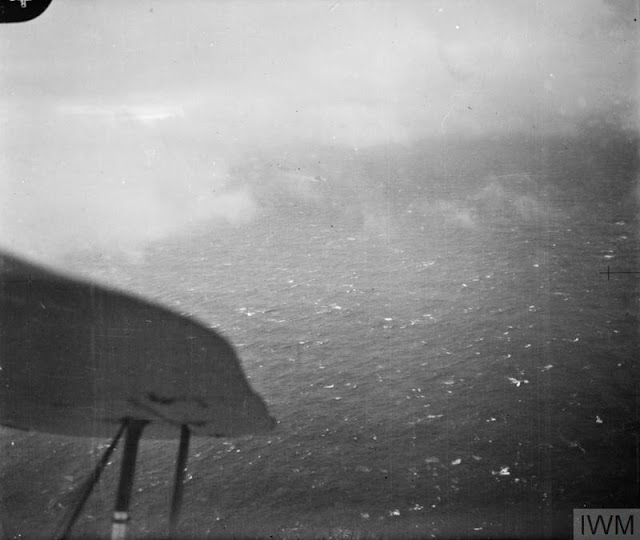
The last battle of the German Kriegsmarine battleship Bismarck began in the Atlantic Ocean. That morning a British Catalina reconnaissance aircraft spotted the Bismarck. Starting at dusk, ships and aircraft of the Royal Navy and Royal Air Force attacked the battleship with torpedoes. A hit from a Fairey Swordfish torpedo bomber flown by John Moffatt damaged the Bismarck’s rudder.
In the morning of 26 May, as the Bismarck was approaching the French coast, the crew was ordered to repaint the top of the main and secondary turrets yellow. Hard job considering the state of the seas, nevertheless it was carried out although the yellow paint washed off at least once.
A few hours earlier, at 0300, two Coastal Command Catalina flying boats had taken off from Lough Erne in Northern Ireland on a reconnaissance mission in search for the Bismarck. At about 1010, Catalina Z of 209 Squadron commanded by Dennis Briggs sighted the German battleship that immediately answered with very accurate anti-aircraft fire. The Catalina was fitted with a recently improved ASV radar device. The Catalina jettisoned her four depth charges and took evasive action after her hull was holed by shrapnel. Then reported: “One battleship, bearing 240º, distance 5 miles, course 150º. My position 49º 33′ North, 21º 47′ West. Time of transmission 1030/26.” After more than 31 hours since the contact was broken, the Bismarck had been located again. Unfortunately for the British, however, Admiral Tovey’s ships were too far away from the German battleship. The King George V was 135 miles to the north, and the Rodney (with a top speed of 21 knots) was 125 miles to the northeast. They would never catch up with the Bismarck unless her speed could be seriously reduced.
Winston Churchill spends the day in the Admiralty War Room. He orders Admiral John Tovey aboard King George V to close on the Bismarck even if it means running out of fuel. In fact, cruiser Repulse has to pull out to refuel, but battleship Rodney takes its place.
Only the Force H, under the command of Vice-Admiral Sir James F. Somerville, sailing from Gibraltar, had a chance to intercept Bismarck. The battlecruiser Renown (Captain Rhoderick R. McGriggor) was in the best position, but having lost the Hood only two days earlier, the Admiralty did not permit Renown to engage the Bismarck. The best hope for the British was to launch an air strike from the carrier Ark Royal. The Ark Royal had already launched 10 Swordfish at 0835 to try to find the Bismarck, and once the report of the Catalina sighting arrived, the two closest Swordfish altered course to intercept. At 1114, Swordfish 2H located the German battleship too, followed seven minutes later by the 2F. Shortly afterwards two more Swordfish, fitted with long-range tanks, were launched to relieve 2H and 2F and keep touch with Bismarck.
At 1450, fifteen Swordfish commanded by Lieutenant-Commander J. A. Stewart-Moore took off from the Ark Royal (Captain Loben E. Maund) to attack the Bismarck. At 1550, they obtained radar contact with a ship and dived to attack. The attack, however, turned out to be a failure since the ship sighted was actually the light cruiser HMS Sheffield (Captain Charles A. Larcom) which had been detached from Force H to make contact with the Bismarck. Luckily for the British, the Sheffield was not hit by any of the 11 torpedoes launched because they had faulty magnetic pistols. Two torpedoes exploded upon hitting the water, three on crossing the cruiser wake, and the other six were successfully avoided. The Swordfish returned to the Ark Royal where they landed after 1700, but not without trouble because of the terrible weather conditions. The rise and fall of the stern was measured to be 56 feet, and three aircraft smashed their undercarriages against the flight deck. Shortly afterwards, at 1740, the Sheffield obtained visual contact with the Bismarck.
The British put every effort on one last attack. It would be dark soon, and they knew this was their last real chance to stop or at least slow down the Bismarck. If they failed again, the Bismarck would reach the French coast on the next day, since another air strike late at night was unlikely to succeed. Therefore, at 1915, another group comprised of fifteen Swordfish, mostly the same used in the previous attack, took off from the Ark Royal, and this time their torpedoes were armed with contact pistols.
Meanwhile, the pursuing British forces had run across U-556 (Lieutenant Herbert Wohlfarth) which sighted the Renown and the Ark Royal at 1948. The German submarine was perfectly placed for an attack, but could not do so as it had no torpedoes left. Wohlfarth had spent his last “fishes” on the ships of convoy HX.126 a few days back. Therefore, U-556 could only make signals reporting the position, course and speed of the enemy.
The Swordfish striking force, this time under the command of Lieutenant-Commander T.P. Coode, first approached the Sheffield to get the range and bearing to the Bismarck, and at 2047, began the attack. Bismarck’s anti-aircraft battery opened fire immediately. During the course of the attack, the Bismarck received at least two torpedo hits. One torpedo (or two) hit the port side amidships, and another struck the stern in the starboard side. The first hit did not cause important damage, but the second jammed both rudders at 12º to port. The Bismarck made a circle and then began to steer northwest involuntarily into the wind. As before, none of the Swordfish were shot down although some were hit several times.
The damage to the Bismarck was so serious that at 2140, Admiral Lütjens sent the following message to Group West: “Ship unable to maneuver. We will fight to the last shell. Long live the Führer”.
At 2238, the Polish destroyer ORP Piorun (Commander Eugeniusz Plawski) sighted the Bismarck. The German battleship responded shortly thereafter with three salvoes. The destroyers proceeded to attack, but Bismarck defended herself vigorously in the dark. At 2342, splinters knocked down Cossack’s antennas. Shortly after 0000, star shells from the destroyers began to illuminate the area. About an hour later, a star shell fell on Bismarck’s bows starting a fire there that had to be extinguished by some crew members. Throughout the night the destroyers attacked the German battleship. These attacks were carried out in heavy seas, rain squalls and low visibility, and no torpedo hits were obtained on Bismarck, which time after time repelled every attack with heavy and accurate fire from her main and secondary batteries. By 0700 on the 27th, a total of 16 torpedoes had been fired by the destroyers of the 4th Flotilla.
Galatas, Crete, was occupied. Allied forces were desperately trying to defend Chania. Major General Bernard Freyberg noted the dire circumstances the Allied forces were on Crete.
The Germans continue expanding eastward, pushing the Greek 1st Regiment defenders from Kastelli after a bitter three-day fight and approaching Canea (Chania), the island’s capital. The Allies muddle through a troop changeover in front of the city which goes disastrously wrong, leading to the Germans surrounding the arriving 1000 Commonwealth troops. The Allied troops retreat to the east. The Luftwaffe mistakenly bombs the German troops advancing from Galatas toward Canea, aiding the Allies’ retreat.
However, the pace of advance is slowing, and only so many troops can be brought in by air to Maleme airfield. Elsewhere on Crete, at Retimo and Heraklion, the German troops are barely hanging on in hopes of a quick advance from Maleme.
Despite the increasingly precarious British position, the Germans pessimistically conclude that it is beginning to look as if a long-term stalemate might develop. One of local air commander Wolfram von Richthofen’s liaison officers returns from Crete today and reports that German morale is plummeting on the island. He states that there is an “absolute and critical need” for “reinforcement by sea shipment of heavy weaponry if the operation is to get ahead at all.” The OKW thus contacts Italian Duce Mussolini and requests that he send Italian Army units. Mussolini agrees and begins preparations for a seaborne landing which would bring tanks.
The British, however, also are unhappy with the battle, and they try to reinforce the embattled troops there with multiple missions. The Royal Navy covers its bets by landing at Suda Bay about 800 men from No. 7 and No. 8 Commandos under the command of Colonel Robert Laycock, part of “Layforce.” Their orders are to cover evacuation from the port, though it is still hoped that some portion of the island can be retained indefinitely. Another convoy containing reinforcements, led by commando ship Glenroy, comes under attack by the Luftwaffe and is forced to return to Alexandria. Convoy AN.3 of three Greek ships containing reinforcements also sets out from Alexandria today, but it also is forced to return to port as the situation on Crete deteriorates.
The problem for the British, however, is that the only way they can remain on the island is by holding ports on Crete’s north shore, and already they are threatened. General Bernard Freyberg, the commander on Crete, becomes the first to broach the idea of an overall evacuation from the island in a message to Middle East Commander General Archibald Wavell, a proposal that is not acted upon at this time.
Also during the night, British minelayer HMS Abdiel and destroyers HMS Hero and HMS Nizam arrived at Suda Bay from Alexandria, Egypt and disembarked about 800 British “Layforce” commandos under Colonel Robert Laycock. Almost as soon as they landed it was decided that they could not be employed in an offensive role and would instead be used to cover the withdrawal route towards Sfakia to the south. As such upon landing they were ordered to leave all their heavy equipment, including radios and transport behind. This was a role that they were poorly equipped for, though, as they were lacking in the indirect fire support weapons such as mortars or artillery and were armed only very lightly mainly with rifles and a few Bren light machine guns. Nevertheless, by sunrise on 27 May they had taken up a defensive position along the main road that led inland from Sfakia. From then until 31 May they were engaged in carrying out a number of rearguard actions to enable the main body of troops to be taken off the beaches by the Royal Navy. Throughout the entire time they were almost constantly under aerial attack.
At Kandanos and other hot spots on Crete, the Germans begin to develop a negative attitude toward the locals. The Germans have been taking heavy casualties despite their success, and they develop what may be characterized as a grudge against the local citizenry. Brutal repression is their response to those who oppose their rule.
The situation at sea off Crete is, if anything, deteriorating for the Royal Navy. A destroyer sweep off Milos must be canceled due to the Luftwaffe attacks on Formidable.
In Operation MAQ.3, Royal Navy aircraft carrier HMS Formidable, escorted by a powerful force including battleships Barham and Queen Elizabeth, launches six Fairey Albacore planes around 02:00 to attack the Junkers Ju 87 Stuka airfield on Scarpanto. Due to mechanical issues, two planes return to the carrier, and the four remaining planes bomb their airfield between 05:05 and 05:15. Some Wellingtons from Malta arrive as planned at the same time and participate in the raid. Four Fairey Fulmars then arrive from Formidable and strafe the airfield around 05:45. The pilots report at least two aircraft destroyed on the ground, but also note 15 Junkers Ju 87 Stuka dive bomber and 15 Italian CR-42 fighters untouched by the attack.
As the British withdraw, the Stukas (led by II/StG2 led by Major Walter Enneccerus) hit the Formidable with two 1000 kg bombs, damaging it severely. In addition, destroyer Nubian is badly damaged by a Stuka and a Junkers Ju 88 but makes it back to port. There are a dozen deaths on the Formidable, with ten more wounded, and fifteen deaths on the Nubian, with six wounded. The Luftwaffe loses two Stukas. After fighting off further attacks, Formidable reaches Alexandria around dawn on the 27th.
On the Libyan border, Afrika Korps Commanding General Erwin Rommel prepares to launch Operation SKORPION. Colonel Maximilian von Herff, in command of Kampfgruppe von Herff, assembles his troops at the foot of Halfaya Pass, the operation’s objective. The plan is to bluff the British into giving up the pass voluntarily by simulating an outflanking attack in force to the east. The attack is scheduled for the morning of the 27th.
Italian torpedo boats (Calliope, Circe, Clio, and Perseo) lay mines east of Malta.
An Italian supply convoy of six large freighters leaves Naples bound for Tripoli.
Iraqi forces received supplies by train from Vichy French forces in Syria, including 8 155mm guns, 6,000 shells, 30,000 grenades, and 32 trucks. By this date, all German fighters in Iraq had become unserviceable after 10 days of engagements with British fighters; the Germans then evacuated their main base at Mosul, Iraq before the Commonwealth forces could overrun it.
The British take the Luftwaffe airfield at Mosul, with the Germans evacuating before they arrive. Reinforcements in the form of 11 Italian Fiat CR-42 fighters of Italian 155th Squadriglia arrive at Kirkuk during the day. The Italian fighters immediately attack the advancing British troops, who are in the Fallujah sector and approaching Baghdad. The British hope to capture Baghdad on the 27th.
There are media reports, such as in the Malaya Tribune, that 9,000 Italian troops have been captured in the Abyssinian Lake region. The reports state that Sudanese troops “captained by British officers” have rounded up the Italians, who had fled from Addis Ababa.
Adolf Hitler met with tank generals and tank designers at his residence Berghof in southern Germany. In a similar meeting three months prior he had asked for 75-millimeter guns for Panzer III and Panzer IV tanks. Because 75-millimeter guns relied on special tungsten shells, Hitler now asked for 88-millimeter guns to be used for future heavy tanks. He also demanded 100-millimeter frontal armor and 60-millimeter side armor.
Himmler assigns a group of Waffen-SS to what he calls the Kommandostab Reichsführer SS, which in effect becomes his own private army.
In Hannover, Bunker No. 8 is ready for use. It’s rated capacity is 698 people to shelter during air raids, but many more people will pack into it. Its construction is an indication of growing German realization that the war is going to last and air raids are not preventable. Bunker No. 8 remains intact as of this writing, a vivid reminder of World War II in the heart of Hannover.
Courts-martial are begun of military personnel aboard HMT Dunera, used to transport evacuees from England in the summer of 1940. The captain and others on the vessel are accused of malicious and predatory conduct, including but not limited to theft and savage beatings. The hearings are held at Chelsea Barracks, London, on 26th and 27th May 1941. This is an incident shrouded in some mystery and receives no press at the time. Specifically, the commanding officer, a regimental sergeant major, and a serjeant are put on trial.
Technically, these are not war crimes, as they do not involve enemy combatants. However, the actions of the British military personnel are alleged to have violated their military oaths and duties during wartime to the detriment of others, so this seems like the appropriate category.
Irish Prime Minister Éamon de Valera sends British Prime Minister Winston Churchill a message about proposed British conscription in Northern Ireland:
“Before your final decision is taken I feel that I should again put before your Government as earnestly as I can my view that the imposition of Conscription in any form would provoke the bitterest resentment amongst Irishmen and would have the most disastrous consequences for our two peoples.”
Churchill very strongly feels that Ireland is not doing enough to help the war effort, but he takes this plea under earnest consideration.
Minister of Economic Warfare Hugh Dalton confides to his diary that there is a “general sense of gloom.” After listing the various recent Royal Navy losses, Dalton comments:
“Thus, says the PM [Churchill], the Germans have established a “unit superiority” over us. This is the most injurious and distressing naval incident [apparently referring to the Bismarck sinking the Hood] since we missed the Goeben [referring to a failed pursuit in the Mediterranean in 1914, when Churchill was First Lord of the Admiralty].”
It is clear that these are Churchill’s thoughts, not just Dalton’s, considering the references.
Private Secretary Alexander Cadogan similarly notes in his diary that “Poor Winston very gloomy — due of course to Hood and Crete. In the latter place, things look black.” He notes that there was “A tiresome and most acrimonious discussion” on a minor point about publicizing shipping losses, reflecting the tense nature of the evening War Cabinet meeting.
Foreign Secretary Anthony Eden, no doubt hearing of Churchill’s “gloom,” sends Churchill an inspirational (but odd) note:
“This is a bad day; but tomorrow — Baghdad will be entered, Bismarck sunk. On some date the war will be won, and you will have done more than any man in history to win it.”
Churchill does not respond.
RAF Bomber Command, Day of 26 May 1941
12 Blenheims on uneventful shipping sweeps off the Frisian Islands.
RAF Bomber Command, Night of 26/27 May 1941
38 Hampdens minelaying off Brest. No losses.
Battleship HMS Ramillies rejoined convoy HX.127 after an uneventful part in the Bismarck chase. Destroyers HMS Farndale and HMS Hambledon and sloops HMIS Sutlej and HMS Stork departed Scapa Flow at 0700/26th to join the convoy. Destroyer Hambledon arrived at Loch Ewe for refueling at 2300/31st. Destroyer Hambledon and sloops Sutlej and Stork arrived back at Scapa Flow after this duty on 1 June at 1400.
Submarine HMS P 32 departed Holy Loch for the Mediterranean. On the 31st, the submarine was damaged by German bombing near miss off Cape Finisterre. Submarine P 32 arrived at Gibraltar on 3 June and was under repair 4 June to 4 July.
Submarine HMS H 31 ran aground at Lagan. The submarine was repaired at Belfast from 28 May to 9 June.
British steamer Gros Pierre (297grt) was damaged by German bombing off Sunderland. The steamer was beached. She was refloated and repaired.
British trawler H. E. Stroud (214grt) was damaged by German bombing ten miles 135° from Lamb Head, Stromsay. One crewman was killed. The trawler was towed by another trawler to Kirkwall and later repaired.
British commando ship Glenroy departed Alexandria on the 25th escorted by anti-aircraft cruiser HMS Coventry and destroyers HMAS Stuart and HMS Jaguar. The movement was covered by Force A. The mission was abandoned later in the day after damage to the commando ship by bombing attack. The Glenroy force returned to Alexandria.
Convoy AN.31 of three Greek ships departed Alexandria for Crete escorted by and sloop HMS Auckland. Convoy AN.31 was joined by anti-aircraft cruiser HMS Calcutta and destroyer HMS Defender. Greek steamer Alfios (5116grt) returned to Alexandria after an engine failure. The convoy was ordered back to Alexandria on the 27th.
Aircraft carrier HMS Formidable launched six Albacore aircraft for an air raid on Scarpanto in Operation MAQ 3. Aircraft carrier Formidable (Captain A. W. La T. Bissett) was hit by two bombs and disabled. Twelve ratings were killed and ten were wounded on the aircraft carrier.
Destroyer HMS Nubian (Cdr R. W. Ravenhill) was hit by a bomb in the stern which destroyed the stern above the water line, but left the screws and rudder intact. Destroyer NUBIAN was escorted back to Alexandria by destroyer HMS Jackal. Fifteen ratings were killed on destroyer NUBIAN and six were wounded.
Light cruisers HMS Ajax and HMS Dido and destroyers HMS Jervis and HMS Decoy joined the Force late on the 26th.
The carrier returned to Alexandria at daylight on the 27th with light cruisers HMS Ajax and HMS Dido and destroyers HMS Nubian, HMS Jackal, HMS Decoy, HMS Hereward, HMS Jaguar, HMAS Voyager, and HMAS Vendetta. After emergency repairs, aircraft carrier HMS Formidable departed Alexandria on 23 July and passed through the Suez Canal on 24 July. She arrived at Norfolk, Virginia for repairs on 26 August. Repairs were completed on 12 December 1941.
Destroyer HMS Nubian after emergency repairs proceeded to Port Tewfik arriving on 13 June. She was drydocked at Port Ibrahim from 23 July to 10 August. The destroyer was accompanied by damaged destroyer HMS Isis to Aden where she waited a month for the monsoon season to pass. The destroyer arrived at Bombay on 27 September in company of destroyer Isis for repairs completed in September 1942.
Minelayer HMS Abdiel and destroyers HMS Hero and HMAS Nizam departed Alexandria on the 26th landed the troops, originally embarked on troopship Glenroy, then destroyers HMS Isis, HMAS Nizam, HMS Decoy, and HMS Hero, at Suda Bay during the night of 26/27 May. Seven hundred and fifty troops were landed. Nine hundred and thirty unnecessary personnel were embarked. The movement was covered by battleships HMS Queen Elizabeth and HMS Barham with destroyers HMS Hasty, HMS Janus, HMAS Napier, HMS Jervis, and HMS Kelvin.
A sweep off Milos by destroyers HMS Nubian, HMS Kandahar, and HMS Janus in the night of 26/27 May with a feint staged by light cruiser HMS Ajax and HMS Dido and destroyers HMAS Napier, HMS Kelvin, and HMS Jackal was cancelled after air attacks which damaged aircraft carrier HMS Formidable and destroyer HMS Nubian.
Greek steamer Emmanuel Pteris (145grt) was sunk by German bombing in Candia Harbour.
Greek steamer Rokos (6426grt) was sunk by German bombing in Suda Bay.
Italian torpedo boats Circe, Calliope, Clio, and Perseo laid mines east of Malta.
An Italian supply convoy of steamers Andrea Gritti (6338grt), Sebastiano Venier (6311grt), Marco Foscarini (6342grt), Rialto (6099grt), Ankara (4768grt), and Barbarigo (5293grt), escorted by destroyers Vivaldi and Da Noli and torpedo boats Cigno, Pegaso, and Procione, departed Naples for Tripoli. Distant cover was given by cruiser Cardona and destroyers Maestrale and Grecale. An air attack on the convoy from aircraft from Malta damaged steamers Sebastiano Venier and Marco Foscarini. The convoy arrived at Tripoli on the 28th.
In Washington today, President Roosevelt approved four bills. They were the crop loan measure providing for loans to farmers on some crops up to 85 percent of parity; the bill authorizing purchase or construction of 550,000 tons of naval auxiliary veàsels; the $228,601,828 War Department civil functions bill, and a measure calling for $174,409,630 for defense housing and other defense projects.
The Senate approved a bill authorizing $20,000,000 toward completion of inter-American highway; received a bill calling for pay increases for officers and enlisted men of the armed forces, heard Senator Clark of Missouri criticize statements of Secretaries Stimson and Knox, urging repeal of the Neutrality Act, received the Byrd joint resolution to place Congress on record as condemning strikes in defense industries, and recessed at 2:43 PM, until noon Thursday.
The House considered the bill to extend the President’s monetary powers; received a committee report approving a bill authorizing an unlimited number of vice admirals; received Secretary Knox’s letter asking legislation broadening powers of ship commanders, and adjourned at 4:41 PM, until noon tomorrow. The Dies Committee heard Richard Krebs (Jan Valtin), and the Ways and Means Committee continued the tax bill hearing.
President Roosevelt today proclaimed July 1 as draft registration day for young men who have become 21 years old since the first “R-day’ Oct. 16, 1940. The new nationwide registration will bring to selective service lists the additional names of an estimated 1,250,000 to 1,300,000 men. Mr. Roosevelt called on the governors of 48 states and of Hawaii, Puerto Rico and Alaska, the commissioners of the District of Columbia and officials of local governments to “do and perform all acts and services necessary to accomplish effective and complete registration.”
President Roosevelt will speak to the nation by radio tomorrow night and, officials said today, will reaffirm the doctrine of the freedom of the seas and the right of American naval vessels to cruise anywhere. This, they said, will be the answer to the Nazi threat, voiced by Grand Admiral Erich Raeder, that American ships which protect merchant vessels in the blockade zones proclaimed by Germany will be sunk. The President, they said, will make clear that this nation’s policy is to continue sending aid to Britain to assure defeat of the totalitarian powers. At the White House it was stated that Mr. Roosevelt was revising his entire speech because of late developments, understood to include Admiral Raeder’s statement to the Japanese and German press and the naval action in which the German battleship Bismarck sank the British battle cruiser Hood. It was made clear that the President’s speech would be one of the most important he ever made.
The American Federation of Labor, in a statement by its executive council tonight, put the whole weight of its membership of 5,000,000 behind any step in foreign affairs which President Roosevelt may announce tomorrow night in his radio talk to the nation.
Story of a vast German espionage and reporting service in the United States and a German policy of attacking the United States through development of close ties in Latin America was told to the House Committee on Un-American Activities today by Richard Krebs, 36-year-old author and former agent of Germany and Russia. The German-born witness, who used the pen name of Jan Valtin in writing a current book, “Out of the Night,” about his experiences in Europe, first told how Russia sent him to Germany to do undercover work against Hitler in 1933, how he was betrayed by Nazi spies and subsequently embraced Nazi philosophies. Then he related activities of the German gestapo directed against the United States an account which Acting Chairman Starnes, Alabama Democrat, of the committee said showed “clearly Hitler’s policy of penetration and encirclement of the country he hopes later to destroy economically and politically.”
The U.S. Supreme Court of the United States decides United States v. Classic, 313 U.S. 299 (1941). It empowers (or affirms the right of) the U.S. Congress to regulate primary elections and political nominations procedures. The “right of participation” is extended to primary elections. This is the first decision in a series that find that primaries are part of “two stages” of state and federal elections, both essential to the voting process and worthy of protection by appropriate laws.
President Roosevelt signed today the Farm Loan Bill, providing for government “loans” to farmers for 85 percent of the parity value of five basic commodities, but emphasized in a statement that he had an agreement with Congressional leaders by which pending farm appropriations would be reduced so that farm prices would not exceed the 1909-14 “parity” levels.
The Senate passed unanimously today a bill to permit prosecution of persons who enter naval stations with intent to sabotage construction or commit other illegal acts. Under existing law, saboteurs cannot be prosecuted until after their illegal acts have been committed.
A bill designed to keep the Military Academy at West Point up to its full authorized strength was also passed unanimously and sent to the House. The academy has been-about 180 below full strength because of the failure to make or accept appointments and because many appointees have failed to pass the entrance requirements.
Attacks were made on several of the Treasury’s excess profits tax proposals by witnesses today before the Ways and Means Committee, which neared the end of its hearings on the proposed $3,500,000,000 defense revenue measure.
The United Auto Workers (UAW) prepares to strike pursuant to a vote held on 24 May at the North American Aviation plant located at 5701 Imperial Highway in Inglewood, California. This is considered a key event in Los Angeles and U.S. labor history.
Senator Byrd of Virginia introduced a joint resolution today declaring that “strikes in industries that affect the national defense effort are contrary to sound policy and they are hereby condemned.”
America’s first experimental blackout takes place at Newark, New Jersey. New York Mayor Fiorella La Guardia’s Office of Civilian Defense (OCD) conducts one of a series of air raid drills in the Northeast, this one a blackout in Newark, New Jersey.
The American Flag House (Betsy Ross’ Home) is given to the city of Philadelphia.
U.S. Naval observer Ensign Leonard B. Smith, USNR, flying in an RAF Catalina (Coastal Command No. 209 Squadron), sights the German battleship Bismarck. British fleet units alter course accordingly and converge on the lone German capital ship. The same day, another naval observer, Lieutenant James E. Johnson, flying another RAF Catalina (Coastal Command No. 240 Squadron) maintains contact with the German battleship as well.
Marine Commander Ross Daggett, from the Bureau of Ships, and Major Ernest Linsert, of the Marine Equipment Board, observe the testing of the three landing craft designed by businessman Andrew Higgins. The tests in Newport News, Virginia, involve off-loading a truck and embarking and disembarking 36 of Higgins’ employees, simulating troops. The design passes the test and later is designated LCVP—Landing Craft Vehicle, Personnel.
Major League Baseball:
Everything happens in Brooklyn, it has been said, and so it seemed at yesterday’s game at Ebbets Field. The Phillies got two runs in the fourth inning even though the only time the ball went out of the infield was when Babe Phelps threw it there. Then, in the fifth, Joe Marty dropped an easy fly that allowed three to cross the plate. In this manner did the Phillies hand the Dodgers a 6–4 victory. Freddy Fitzsimmons got the win but needed help from Kirby Higbe after two were out in the sixth, and with Higbe turning in a masterful one-hit job, the triumph was secured.
Doubles by Chuck Aleno and Ernie Lombardi and a home run by Harry Craft in the fifth inning broke a 2–2 tie and gave the Reds a 7–3 victory over the Pirates before 20,567 fans tonight. Bucky Walters yielded ten hits in chalking up his fifth victory, but he gave only one walk. Pittsburgh went out in order in the last two frames, two fanning. Cincinnati’s four-run victory splurge was started by a walk to Frank McCormick, who counted when Chuck Aleno doubled to the scoreboard. John Lanning relieved Nick Strincevich and was greeted by another double to the scoreboard off Ernie Lombardi’s bat, Aleno scoring. Craft then smashed a homer over the left-field wall. Joe Bowman hurled the final two frames for the losers.
A ninth-inning rally, paced by Bruce Campbell’s two-run double against relief flinger Joe Heving, gave the Tigers a 5–3 triumph over the Indians today and broke the league-leaders’ victory streak at five games. Cleveland entered the ninth with a 3–2 lead and Buck Newsom appeared destined to suffer his seventh setback. Instead, Detroit chased Lefty Al Smith and finished against Heving to give Buck his third victory. Frank Croucher started the ninth with a double. Eric McNair batted for Newsom and got an infield single. Shortstop Lou Boudreau took Pat Mullin’s smash and tagged out Bob Harris, who ran for McNair, as Croucher scored the tying run. Gehringer’s fly went for a single and after Rip Radcliff had popped up to make it two out, right-hander Heving was sent in to pitch to slugging Rudy York. Manager Roger Peckinpaugh’s strategy didn’t pay off, for York walked on four pitches, filling the bases. Then Lefty Campbell, who not so long ago patrolled the outfield for the Indians, lined a two-bagger against the right field wall to bring in the decisive runs. Luther Thomas set Cleveland down one, two, three in the ninth to give Newsom the victory and Smith his third defeat against as many triumphs. York had a home run for the Tigers and Gerald Walker produced one for the Indians against his former mates. The bases were empty on each occasion.
The Cubs overcame a nine-run deficit today, but eventually lost to the National League leading Cardinals, 12–11. Home runs by Jimmy Brown and Don Padgett in the eleventh provided the winning margin as the rampaging Cards marked up their seventh consecutive victory. In the first of the eleventh Bill Nicholson hit a home run that put Chicago ahead, 11–10. After three innings, the Cubs had neither a hit nor a run and trailed, 9–0. St. Louis had scored two runs in the second and seven in the third, when the team batted around and drove Vern Olsen to the showers. In this inning Brown accounted for three of the five runs he drove in, his double clearing the bases. Jimmy Wilson’s club came right back in the fourth with six runs. Stan Hack led off with the first hit off Shoun, Phil Cavarretta doubled him to third and both scored on Dom Dallessandro’s two-bagger. The second time Hack came up this inning he drove in Charles George with the sixth run. Another run was added by the Cubs in the fifth and Lou Novikoff’s three-run homer in the seventh put them into the lead.
Philadelphia Phillies 4, Brooklyn Dodgers 6
Pittsburgh Pirates 3, Cincinnati Reds 7
Detroit Tigers 5, Cleveland Indians 3
Chicago Cubs 11, St. Louis Cardinals 12
Dutch gunboat HNLMS Van Kinsbergen captured Vichy French steamer Winnipeg (8379grt) east of Madagascar.
Convoy BA.2 departed Bombay, escorted by armed merchant cruiser HMS Kanimbla, which was detached on the 31st. The convoy arrived at Aden on 8 June.
Japanese fighters intercepted 18 I-15 fighters of the Chinese 29th Pursuit Squadron while in transit in Gansu Province, China; nearly all Chinese fighters were destroyed.
Several Japanese merchant ships arrived in Haiphong today, reportedly to load $10,000,000 worth of Chinese-American cargo seized from warehouses in the port city yesterday. Squadrons of Japanese planes circled over Haiphong today. Americans here believed the demonstration was designed to impress French authorities against any effort to prevent removal of the seized goods. The number of Japanese planes based on Haiphong and Hanoi was said to have been greatly increased.
The Kayaba Ka-1, Army Model 1 Observation Autogyro makes its maiden flight. In 1939, the Japanese Army purchased a Kellet KD-1A single-engine two-seat autogyro from the U.S. (The USAAC purchased nine KD-1s and designated them YG-1s.) Unfortunately for the Japanese, the machine was damaged beyond repair in a crash during flight tests at low altitude. The wreck was delivered to the Kayaba Industrial Co. Ltd. (K.K. Kayaba Seisakusho) and they were told to develop a similar machine. A two-seat observation machine was built based on the KD-1A but modified to Japanese production standards. This machine makes its first flight today. About 240 Ka-1s were built. The plane is useful because it is easy to maintain and has a short 98 foot (30 meters) take-off run.
Dow Jones Industrial Average: 115.73 (-0.91)
Born:
Aldrich Ames, American CIA officer convicted of espionage for the Soviet Union, in River Falls, Wisconsin.
Louis Guy, NFL and AFL defensive back (New York Giants, Oakland Raiders), in McComb, Mississippi.
Art Sharp, British rock singer (Nashville Teens — “Tobacco Road”), in Woking, Surrey, England, United Kingdom.
Imants Kalniņš, Latvian classical, choral and rock composer (“Hey, You There!”), in Riga, Latvian SSR, Soviet Union.
John Maxwell Geddes, Scottish composer and pedagogue, in Maryhill, Glasgow, Scotland, United Kingdom (d. 2017).
Naval Construction:
The U.S. Navy YMS-1-class auxiliary motor minesweeper USS YMS-55 is laid down by the Gibbs Gas Engine Co. (Jacksonville, Florida, U.S.A.).
The Royal Indian Navy Bathurst-class minesweeper-corvette HMIS Punjab (J 239) is laid down by the Morts Dock & Enginering Co. Ltd. (Sydney, New South Wales, Australia).
The Royal Navy Flower-class corvette HMS Lotus (K 93) is laid down by Charles Hill & Sons Ltd. (Bristol, U.K.); completed by Ailsa Shipbuilding Co. Ltd. (Troon, Scotland). She is transferred to the Free French upon completion on 23 May 1942 and enters service as the Forces Navales Françaises Libres (Free French Naval Forces) Commandant d’Estienne d’Orves (K 93).
The U.S. Navy Gleaves-class destroyer USS Doyle (DD-494; later high speed minesweeper DMS-34) is laid down by the Seattle-Tacoma Shipbuilding Corp. (Seattle, Washington, U.S.A.).
The U.S. Navy heavy cruiser USS Baltimore (CA-68), lead ship of her class of 18 (6 more cancelled), is laid down by the Bethlehem Shipbuilding Corp. (Quincy, Massachusetts, U.S.A.).
The Royal Navy Bangor-class (VTE Reciprocating-engined) minesweeper HMS Bayfield (J 08) is launched by North Vancouver Ship Repairs Ltd. (Vancouver, British Columbia, Canada). She is transferred to the Raoyal Canadian Navy on completion, commissioning as HMCS Bayfield (J 08).
The Royal Navy Flower-class corvette HMS Acanthus (K 01) is launched by Ailsa Shipbuilding Co. Ltd. (Troon, Scotland). She is transferred to the Royal Norwegian Navy before completion and commissions as HNLMS Andenes.
The Royal Navy Fairmile B-class motor launch HMS ML 243 is commissioned.
The Royal Navy Bangor-class (Reciprocating-engined) minesweeper HMS Eastbourne (J 127) is commissioned. Her first commanding officer is T/A/Lieutenant Commander Norman Eyre Morley, DSC, RNVR.
The Royal Navy Vosper 70-foot motor torpedo boat HMS MTB 38 is commissioned.
The U.S. Navy patrol gunboat (motor torpedo boat tender) USS Jamestown (PG-55) [ex-yacht Savarona, later Alder] is commissioned. Her first commanding officer is Commander Andrew Petrie Lawton, USN.
The Royal Navy Flower-class corvette HMS Starwort (K 20) is commissioned. Her first commanding officer is Lieutenant Commander Norman Winder Duck, RD, RNR.

