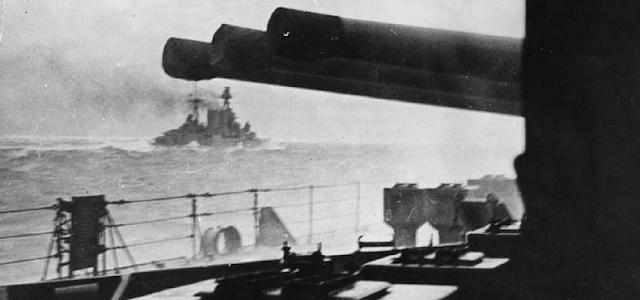
Operation RHEINÜBUNG: The German battleship Bismarck and the heavy cruiser Prinz Eugen were sighted by the heavy cruisers HMS Norfolk and HMS Suffolk. Battleship Bismarck sighted British cruiser Suffolk on her portside at 1922 hours, then cruiser Norfolk at 2030 hours. The Bismarck fired five salvos at the HMS Norfolk but scored no hits. The concussion of the Bismarck’s guns damaged the radar and the Bismarck had to drop behind the Prinz Eugen. At 2200 hours, Bismarck reversed course to chase Suffolk, but the Suffolk picked up the Bismarck making the turn on her radar and was able to out run the Bismarck.
Hitler issued Directive No. 30, Support of anti-British Forces in Iraq:
The Führer and Supreme Commander of the Armed Forces
Führer Headquarters,
23 May 1941.
Directive No. 30
The Arab Freedom Movement is our natural ally against England in the Middle East. In this context the uprising in Iraq is of special importance. This strengthens the forces hostile to England in the Middle East beyond the Iraqi frontier, disrupts English communications, and ties up English troops and shipping at the expense of other theaters.
I have therefore decided to hasten developments in the Middle East by supporting Iraq. Whether and how it may be possible, in conjunction with an offensive against the Suez Canal, finally to break the British position between the Mediterranean and the Persian Gulf is a question that will be answered only after Barbarossa.
In connection with my decision I order the following for the support of Iraq:
Support by the air force.
Dispatch of a military mission.
Arms deliveries.
The military mission (cover name — ‘Special Staff F’) will be under the command of General Felmy. Its tasks are:
To advise and support the Iraqi armed forces.
Where possible, to establish military contacts with forces hostile to England outside of Iraq.
To obtain experience and intelligence in this area for the German armed forces.
The composition of this organization will be regulated, in accordance with these duties, by the Chief of the High Command in the Armed Forces. Chain of command will be as follows:
All armed forces personnel sent to Iraq, including liaison staff in Syria, will be under the command of the head of the military mission with the proviso that orders and guidelines for the aviation units will come exclusively from the High Command of the Air Force.
The head of the military mission will be subordinate to the Chief of the High Command in the Armed Forces, with the proviso that orders and guidelines for the aviation units will come exclusively from the High Command of the Air Force.
The members of the military mission are, for the time being, to be regarded as volunteers (in the manner of the Condor Legion). They will wear tropical uniforms with Iraqi badges. Also, Iraqi markings will be worn by German aircraft.
The Air Force: The employment of the air force in limited numbers is intended, apart from direct effects, to increase the self-confidence and fighting spirtit of the Iraqi people and armed forces.
Arms Deliveries: The Chief of the High Command in the Armed Forces will issue the necessary orders in this respect. (Deliveries to be made from Syria, in accordance with the agreement reached with the French in this matter, and from Germany.)
The direction of propaganda in the Middle East is the responsibility of the Foreign Office, which will cooperate with the High Command in the Armed Forces, Operations Staff — Propaganda Section. The basic idea of our propaganda is: ‘The victory of the Axis will free the countries of the Middle East from the English yoke, and will give them the right to self-determination. All who love freedom will therefore join the fight against England. No propaganda is to be carried out against the French in Syria.
Should members of the Italian Armed Forces be employed on duties in Iraq, German personnel will cooperate on the lines laid down in this directive. Efforts will be made to ensure that they come under the command of the Head of the German Military Mission.
The Supreme Commander of the Armed Forces
[signed] ADOLF HITLER
The battle on and around Crete continues to go catastrophically for the British. In effect, they lose any chance of holding Crete today.
Operation Mercury, the German invasion of Crete, has developed into a classic confrontation between an air force opposing a navy, and the navy is taking a vicious beating. Royal Navy Mediterranean Commander Admiral Andrew Cunningham admits:
“The operations of the last four days have been nothing short of a test of strength between the Mediterranean Fleet and the German Air Force. I am afraid that, in the coastal area, we have to admit defeat and accept the fact that losses are too great to justify us in trying to prevent seaborne attacks on Crete. This is a melancholy conclusion, but it must be faced.”
In the evening, Cunningham signals the Admiralty that daylight operations are too hazardous, but their response is to accept the risk.
The Germans continued to exploit their hold on Maleme on Crete by sending in artillery units and fighter aircraft. The Maleme airfield becomes usable for operation by the Luftwaffe as the Allies are pushed back, so the Germans bring in fighters to operate there. The end of the airfield is a tangled mess of dozens of transports that have wrecked immediately upon landing under fire, but the field is no longer under Allied fire.
On the island, bitter fighting continued. During the day, German reinforcements arrived at Maleme airfield, but the attempts to land troops by sea were rebuffed. The Germans now controlled the west end of the island. On the same day, German bombing of Suda Bay sank 5 British motor torpedo boats.
The Germans also hold a coastal perimeter east of Heraklion. The Luftwaffe sends Junkers Ju 87 Stuka dive bombers against New Zealand troops trying to hold a line without any air cover of their own, and this opens a hole in the Allied lines. Luftwaffe General Ramcke exploits this by having his forces break through to Galatas, where the German 3rd Fallschirmjaeger Regiment under Oberst Heidrich forces that attacked Candea Airfield are trapped.
The Germans already have attempted seaborne landings, but they have all been blocked aside from less than a handful of small ships. The Wehrmacht’s only means of supplying supplies and reinforcements to Crete is Junkers Ju 52 transport planes, and they are landing in a chaotic fashion at Maleme airfield. They bring in the men of the 100th Mountain Regiment, adding to the few who managed to cross over on the 22nd in the few ships that got to Crete.
The destroyers HMS Kelly (G 01, commanded by Lord Louis Mountbatten, great grandson of Queen Victoria) and HMS Kashmir (F 21) of the 5th Destroyer Flotilla were sunk by heavy and sustained air attacks by German aircraft south of Gavo, Crete as they were withdrawing to Alexandria. Late in the day, the Royal Navy begins pulling ships from their exposed position north of Crete despite the wishes of the Admiralty. Lord Louis Mountbatten, commanding a destroyer flotilla composed of HMS Kashmir, Kelly and Kipling is ordered to round the western coast of Crete and proceed to Alexandria. It is too late, however: the Luftwaffe (24 Junkers Ju 87 Stukas) catches them and bombs and sinks destroyers HMS Kashmir and Kelly. The Kipling dodges 83 bombs and rescues 279 men from the Kashmir and Kelly (on which Mountbatten flew his flag). Mountbatten, on the bridge when the ship flips over immediately after being hit by a bomb amidships, manages to swim out from underneath the wreck and swim to shore. There are 128 survivors of Kelly and about 153 from Kashmir.
Survivors of the sinkings of the Kelly and Kashmir in the waters off Crete later report that Luftwaffe planes intentionally machine-gunned survivors in the water. These reports always must be taken with a grain of salt, because it is usually impossible to prove that killing survivors is the intent of such fire — but that is the testimony of witnesses who were fired upon.
King George II of Greece and the Greek political leadership were evacuated from the Crete on the destroyer HMS Decoy bound for Egypt during the night.
In London, the government has a completely incorrect picture of the battle on Crete. The War Cabinet, Defence Committee minutes note that:
“The situation appeared to be in hand except for the Maleme area where the Germans had formed a lodgement and airborne landings were taking place. It was unfortunate that the defenders had not been able to stamp out the parachutists in this area and it was essential that the German lodgment west of Canea should be obliterated by vigorous counter-attacks as soon as possible. The Fleet could not protect the island indefinitely from seaborne landings and if the situation could be fully restored while the power of the Fleet lasted, then the enemy would be faced with the prospect of beginning all over again.”
The Defence Committee minutes are a masterpiece of admitting, but minimizing, the dire condition of the situation on and around Crete. In fact, the situation is not “in hand” at all, but is deteriorating hourly.
The Defence Committee minutes also reflect Winston Churchill’s continued slights of Middle East Commander General Archibald Wavell. The evening’s minutes note:
“The Prime Minister… was somewhat surprised to see that General Wavell referred to Crete as a “commitment,” when the island was, in reality, part of this outpost position in the Eastern Mediterranean.”
Wavell is correct, defending Crete is a commitment to the Greek people in addition to housing British bases. This is another in a string of incidents in which Churchill interprets things in the worst possible light for Wavell’s reputation.
Separately, Churchill cables Wavell and tells him, in part, “Crete battle must be won.” He adds, “Hope you will reinforce Crete every night to the fullest extent.” He adds a personal message for Wavell to pass on to Crete commander General Freyberg: “The whole world is watching your splendid battle, on which great events turn.”
Privately, Churchill already is blaming Wavell for the loss of Crete. Churchill’s private secretary John Colville notes in his diary that, following a tank inspection, Churchill, he writes:
“…laments very strongly that the tanks which he asked Wavell to send to Crete were not sent. They might have made the whole difference to the battle.”
Wavell is now faced with three separate fronts: in Crete, on the Libyan border, and now in Syria. So far, the tanks brought by the Tiger Convoy have not been allocated to any of those sectors.
Australian destroyer HMAS Waterhen makes a nightly run to Tobruk with supplies.
Greek King George II arrives safely in Alexandria along with his government.
In fact, the situation in Iraq will completely resolve before Operation Barbarossa begins. The only statement in Directive 30 of lasting importance is the opening sentence: “The Arab Freedom Movement is our natural ally against England in the Middle East.”
The Luftwaffe already has a presence in Iraq, though it has been worn down already through combat losses. The Italians send eleven Fiat CR-42 fighters of No. 155 Squadron to Iraq from Italy. They arrive in Rhodes today, which is occupied by Italy.
At Fallujah, Iraq, fighters of the German Fliegerführer Irak squadron strafed British positions. The Luftwaffe based at Mosul strafes British troops advancing from Fallujah toward Baghdad. However, the Iraqi ground troops are rapidly losing ground there. The RAF loses a Gloster Gladiator, but the crew reaches British lines.
Vichy Vice-Premier François Darlan made a radio broadcast to the French people denying that he was ever asked to hand over the French Navy or any colonial territory during his recent conversations with Hitler. “France freely is choosing the road she is taking,” Darlan stated. “On her depends her present and her future. She will have the peace which she makes herself. She will have the place in the organization of Europe which she will have made for herself..”
Winston Churchill sends General Ismay a memo in which he states that any “arrangements” with the French Admiral at Alexandria are “suspended” due to the use by the Luftwaffe of airfields in Syria. Thus, he orders:
“We should now seize the French ships by complete surprise, killing without hesitation all who withstand us. It should be possible to cut off a good man of the crews while on shore.”
The French ships have been interned in Alexandria without any incidents since the fall of France.
The British Special Operations Executive (SOE) sends a female agent, Chilean citizen Gillian Gerson, into the unoccupied zone of Vichy France.
Churchill’s secretary, Alexander Cadogan, notes in his diary that he overhead the Defence Committee deciding that it was “wasn’t worth the risk” to bomb a German freighter heading north within Spanish territorial waters.
Herbert Austin, 1st Baron Austin passes away at age 74. Known familiarly as Sir Herbert Austin, he is a former MP and, more significantly, he was one of the most famous automobile pioneers. Austin Car Works in Longbridge is one of the greatest car plants of the 1930s and 1940s, and during World War II makes aircraft; Horsa glider fuselages; specialist army vehicles; hydraulic motors for gun turrets; ammunition boxes, magazines for machine guns, Tommy guns, Oerlikon anti-aircraft guns; marine engines for ships lifeboats; and pressings for jerrycans. During the late 1930s, Austin coordinated a plan by the Air Ministry to treble aircraft production by converting motor vehicle manufacturers to aircraft producers via grants and loans (a similar program takes root in the United States). Among other things, the Northfield bypass is called “Sir Herbert Austin Way” after him.
Gustav Siegfried Eins (GS1), a British “black propaganda” station which purports to be run by extremist German diehards, begins broadcasting. It uses colorful language, calling Winston Churchill “a flat-footed bastard of a drunken old Jew,” part of its strategy to offend ordinary Germans and collaborators with its over-the-top militaristic and hateful rhetoric.
The Norway Theater Strike continues after a vote of directors and actors in Oslo. This is despite the German threats of reprisals.
The Finns send a military delegation led by Chief of Staff Lieutenant General Erik Heinrichs to Germany. This is to coordinate activities related to Operation BARBAROSSA, still scheduled for 22 June 1941. It is fair to say that, at this point, German/Finnish relations are roughly comparable to Anglo/US relations in terms of military coordination.
Hermann Göring ordered the plunder and destruction of Soviet industrial centers since the conquered Soviet population would be no more than low laborers for Germany. The Economic Staff, East, Agricultural Group, part of Hermann Göring’s economic apparatus, renders a top-secret report in preparation for Operation BARBAROSSA. It contains a set of policy directives for the economic exploitation of Soviet agriculture. The gist of the directives is to turn agricultural regions of the (conquered) Soviet Union into industry-free zones so that food production for the benefit of the Reich is maximized. The death of uncounted Soviet citizens from starvation due to diversion of food to the Reich is accepted as inevitable.
RAF Bomber Command, Day of 23 May 1941
20 Blenheims on coastal sweeps. 1 ship was hit off Holland. No losses.
RAF Bomber Command, Night of 23/24 May 1941
Cologne
51 aircraft — 24 Hampdens, 22 Wellingtons, 5 Stirlings. None lost. The target was completely cloud-covered and bombing was poor. Cologne records only 13 high-explosive bombs and 200 incendiaries in the city, with 25 buildings damaged and 11 people injured.
2 Whitleys attacked Boulogne without loss.
During the early morning hours, Lt Frederick Ronald Bertram Fortt, RNVR, and Lt Denis James Patrick O’Hagan RCNVR disarm a “G” type of Luftwaffe parachute mine at Nuneaton. The mines have a photoelectric boobytrap that explodes when exposed to sunlight, so work has to be done at night. After a lot of digging (the bomb is at 22 feet), the two men remove the primer, magnetic primer and finally the fuse.
Just to show the danger of this type of work, two Royal Navy Bomb & Mine Disposal officers are killed today doing similar work on Malta.
Air attacks by Luftwaffe fighter-bombers (Jabos) continue on Crete, and at the key naval port of Suda Bay, they sink five Motor Torpedo Boats (MTBs) (MTB.67, MTB.213 (Lt G. L. Cotton RNVR), MTB.214, MTB.216 (Lt C. L. Coles RNVR), and MTB.217) there. There are no casualties. The Royal Navy scuttles HMT Kos XXIII at Suda Bay, and the Germans later raise it and return it to service as UJ-2104.
U-38, commanded by Kapitänleutnant Heinrich Liebe, sank Dutch steamer Berhala (6622grt), from dispersed convoy OB.318, at 9-50N, 17-50W. At 1925 hours on 23 May 1941 the unescorted Berhala (Master Lieuwe Jan Tijmons), dispersed from convoy OB.318 on 10 May, was hit on the port side in the engine room by one of two G7a torpedoes fired by U-38 while steaming on a non-evasive course in calm weather about 280 miles west-northwest of Freetown. The explosion killed three crew members on watch below and destroyed the port lifeboats. In their haste to leave the ship that developed a list the Chinese crew members cut through the ropes of both starboard lifeboats and rowed away in them. The survivors left behind were forced to jump overboard and swim to the boats when a G7a torpedo struck the ship on port side amidships as coup de grâce at 1951 hours, causing the ship to break in two and sink within nine minutes. The U-boat did not question the survivors as it immediately departed the scene to chase and sink the Vulcain which had been spotted in the distance during this attack. Shortly after the sinking of Berhala, the survivors were picked up by HMS Boreas (H 77) (Lt Cdr D.H. Maitland-Makgill Crichton, DSC, RN) and taken to Freetown. The 6,622-ton Berhala was carrying general cargo, including tinplates, locomotives, and aircraft and was bound for Turkey and Greece.
During heavy weather in the North Atlantic, a lookout on U-46 broke his arm.
Minefield SN.64 in the Faroes-North Rona field was postponed due to the German activity.
Destroyer HMS Farndale departed Scapa Flow at 0400 for Rosyth. The destroyer met armed merchant cruiser HMS Mooltan and Norwegian destroyer HNoMS Sleipner off May Island and escorted them to Pentland Firth, where they arrived at 0400/24th having been delayed by bad visibility. Destroyer HMS Blankney departed Scapa Flow and relieved destroyer Farndale of the escort.
Sloop HMS Black Swan departed Scapa Flow at 0230 for Dundee for machinery repairs. The sloop arrived at 1800.
Destroyer HMS Brighton arrived at Scapa Flow at 0700 from Loch Alsh and berthed alongside destroyer depot ship HMS Tyne for repairs.
Submarine HMS Trooper, under construction at the Scotts yard, was damaged by German bombing at Greenock.
Destroyers HMS Kelly and HMS Kashmir sank two caiques in Canea Bay. Destroyers Kelly (Captain Lord Louis Mountbatten GCVO, DSO) and Kashmir (Cdr H. A. King) were attacked by German bombers. Both destroyers were sunk. Destroyer HMS Kipling rejoined this force during the attacks and was able to rescue survivors from both ships. Paymaster Lt Cdr H. J. Reeder, Paymaster Lt E. R. Pattison RNR, Lt M. V. Sturdy, Surgeon Lt V. J. R. Sheridan DSC, MB, ChB, A/Sub Lt E. W. Money RNR, Midshipman G. R. Mortimer-Booth RNR, Gunner (T) H. W. T. Brownjohn, Commissioned Engineer E. W. Cole and ninety ratings were lost (three dead and eighty seven men missing) in destroyer Kelly. Destroyer Kashmir had P/T/Surgeon Lt J. N. Lennox, LRCP & S RNVR, and eighty two ratings missing. Lt Cdr The Lord Hugh Beresford of destroyer Kelly and Lt J. E. S. Bush of destroyer Kipling were lost rescuing men from the water. Destroyer Kipling was badly damaged when the bow of destroyer Kelly’s submerged wreck punctured her fuel tanks, while Kipling was alongside the sinking ship. Destroyer Kipling was slowed to 20 knots and had a heavy list to port. The destroyer ran out of fuel seventy miles from Alexandria early on the 24th. Netlayer HMS Protector refueled the destroyer and Kipling arrived in Alexandria under her own power. Destroyer Kipling departed Alexandria on the 27th for repairs at Suez.
Forces A-1 and C returned to Alexandria to refuel and take on ammunition. All forces arrived at Alexandria early on the 24th.
Destroyers HMS Defender and HMS Jaguar with ammunition for Suda Bay were detached from Force A-1, as it retired to Alexandria. The ammunition was delivered early on the 24th and the destroyers then returned to Alexandria alone, arriving on the 24th.
At Suda Bay, motor torpedo boats MTB.67, MTB.213 (Lt G. L. Cotton RNVR), MTB.214, MTB.216 (Lt C. L. Coles RNVR), and MTB.217 were sunk in a heavy German dive bombing attack. There were no personnel casualties.
Damaged corvette HMS Salvia arrived at Alexandria from Suda Bay.
Australian destroyer HMAS Waterhen delivered stores to Tobruk during the night of 23/24 May.
The French gunboat FS Meuliere is wrecked off Ajjacio, Corsica.
Italian submarine Scire passed into the Atlantic. Late on the 24th, the submarine sent up the Guadalite River to Cadiz where SLC crews waited in the interned Italian tanker Fulgor (6504grt). Early on the 25th, submarine Scire departed Cadiz.
On the 26th, the SLCs were launched against Gibraltar. However, they were discovered entering Gibraltar and no damage was done.
Heavy cruiser HMS London, destroyers HMS Havelock and HMS Harvester, and troopship Arundel Castle departed Gibraltar for the UK.
Submarine HMS Pandora departed Gibraltar for the UK. The submarine proceeded to the United States. She arrived on 28 June and was refitting at Portsmouth, New Hampshire, completing on 18 December. The submarine departed after trials on 7 January 1942. En route on the 23rd, the submarine sighted and pursued an Italian submarine in 41-12N, 11-00W. Anti-submarine trawler HMS Imperialist was sent to assist.
In Washington this day, President Roosevelt sent to the Senate the nomination of Colonel Henry H. Arnold, chief of the Air Corps, to be a major general, and of seven brigadier generals to be major generals. He conferred with William S. Knudsen and other callers.
The Senate completed Congressional action on the $1,147,624,384 Treasury-Post office Appropriation Bill, the bill to permit Canadian ships to transport ore between United States lake ports, the bill authorizing sale of naval material to the Philippine Islands and the bill authorizing widespread priorities and rationing of defense materials. It passed a bill authorizing the Commodity Credit Corporation to withhold from commercial channels the cotton now held under loan, heard Senator Lee of Oklahoma urge the declaration of a national emergency and Senator Nye of North Dakota criticize United States interference in European affairs, received the Reynolds bill for the creation of a Civilian Air Reserve Corps and adjourned at 2:53 PM until noon on Monday.
The House was in recess.
In a fervent appeal for stronger measures to defeat Germany, Secretary of the Navy Knox declared today: “This is a fight for control of the high seas, and God help us if we don’t bear our share in that fight for the control of the sea and against human slavery.” Following his recent denunciation of the Neutrality Act as a terrific blunder, Knox told the Society of Naval Architects & Marine Engineers if the nation is to keep its self-respect it must “recapture a principle for which we fought twice, the principle of the freedom of the seas.” Near the naval secretary as he spoke sat Lord Halifax, British ambassador, who did not speak, but received a rising ovation as he was escorted into the banquet by Rear Admiral Emory S. Land, chairman of the maritime commission and president of the society.
Charles A. Lindbergh, making his second anti-war address in New York under the auspices of the America First Committee, joined with Senator Burton K. Wheeler of Montana last night in attacking President Roosevelt’s foreign policy and in demanding leadership at Washington to keep this country out of war and to return to isolationism. They spoke to a capacity crowd of 22,000 at Madison Square Garden. An estimated 8,000 to 14,000 listened at loudspeakers in the street. Senator Wheeler appealed to the President to issue an appeal for peace to the peoples of Germany, Italy, England and Japan, and to demand that the “war makers,” among whom he classed Henry L. Stimson, Secretary of War; Frank Knox, Secretary of the Navy; former Ambassador William C. Bullitt and Colonel William J. Donovan with “the Hitlers in Germany and the Churchills in England,” step down and out. He urged a “just” peace, not in the interests of either British Tories and imperialists or of power or land-hungry dictators.
Official Washington waited eagerly today for signs of approval or disapproval from President Roosevelt of proposals to repeal or change the Neutrality Act as a way to tilt the scales in favor of the democracies in the Battle of the Atlantic. No definite word is likely to come before the President’s “fireside chat” Tuesday night, when he is expected to give a report to the nation on the intentions of this government. Although non-interventionists in Congress opened fire on suggestions of changing the Neutrality Act, by which American merchant ships are prevented from calling at ports of belligerents or from cruising in “combat areas,” as defined by the President, Mr. Roosevelt was non-committal on the subject this afternoon at his press conference. When asked for his reaction to criticisms of the law made by Secretary Stimson and Secretary Knox, the President said he only knew what he had read in the papers. He added, however, that one of the two Cabinet members named had informed him that he had been misquoted.
The Senate, by a vote of 35 to 25, approved today and sent to the White House the conference report on a bill giving the government power to impose priorities on American industry in the interests of national defense. The President is empowered by the bill to halt production of civilian industry, such as the manufacture, for example, of automobiles, if such drastic action is deemed necessary to insure the production of war materials.
Call for immediate government intervention, by force if necessary, to end a dispute which has tied up five San Francisco area shipyards was made before a senate committee today by Rear Admiral Emory S. Land, maritime commission chairman. The committee, investigating the defense program, heard a half-dozen witnesses, and then suspended the hearing until Monday with hope expressed by Chairman Truman, Missouri Democrat, current negotiations on the west coast might close the dispute before then.
Secretary of Agriculture Wickard received a request from the American Federation of Labor today to cancel plans to buy up $1,000,000 of surplus California citrus fruit because California growers, it was said, have refused to bargain with striking A.F.L. fruit pickers. The request was made by George Meany, A.F.L. secretary-treasurer; Meyer Lewis, A.F.L. western organizer, and Mathew Tobriner, A.F.L. western counsel. In a statement issued after the A.F.L. group met Wickard, Aleany said the “California fruit growers exchange has brazenly flouted the now generally recognized principle that employers must engage in collective bargaining with their employees.”
The United Automobile Workers (C.I.O.) voted tonight to strike next Wednesday at North American Aviation Co., which is working on orders for planes for the United States and Great Britain.
“Too Many Blondes” starring Rudy Vallee, Helen Parrish, Lon Chaney Jr, Jerome Cowan, Shemp Howard, Iris Adrian, and Eddie Quillan premieres.
World heavyweight boxing champion Joe Louis retains his title with a win over Buddy Baer by disqualification in the seventh round at Griffith Stadium in Washington. The referee makes the disqualification due to stalling by Baer’s manager. This is the last of Louis’ “Bum of the Month Club” string of title defenses against low-ranked opponents. Baer is the brother of former heavyweight champion Max Baer.
Major League Baseball:
Battling back from the depths of the National League, the world champion Cincinnati Reds beat the Chicago Cubs today, 8–4, before a ladies’ day crowd of 11,729. The Reds, who have won five of their last six games, knocked Claude Passeau out of the box in the third inning. But Johnny Vander Meer couldn’t locate home plate and yielded three Chicago runs on no hits in the third. Three walks, a hit batsman, an infield out and Eddie Joost’s error accounted for these tallies. Vandy was replaced in the fourth when his control was no better. Elmer Riddle took over and allowed only two hits until the ninth, when Charley George’s single, Stan Hack’s double and Phil Cavarretta’s outfield fly scored a run. The Reds hopped on Passeau for two runs on a pair of walks and two singles in the first inning and added four in the third. Ernie Lombardi led the Reds offense with four singles.
Ken Keltner’s triple with the bases full in the first inning powered the Indians to a 4–2 victory over the Browns tonight in Cleveland Stadium. Ray Mack’s single drove in the other run in the same inning. Southpaw Al Milnar racked up his sixth victory and gave Denny Galehouse his first defeat. Each pitcher allowed five hits. More than 40,000 saw the contest. Galehouse walked Lou Boudreau and Roy Weatherly in the first. After Gee Walker sacrificed, Hal Trosky flied out and Jeff Heath was purposely passed. Keltner tripled, then scored on Mack’s single.
Paul (Dizzy) Trout hurled the first shutout of his three-year major league career and enabled the Tigers to divide a double bill today with the second-place White Sox. Trout won the nightcap, 9–0, after Ted Lyons had dominated the opener for a 7–1 victory. Trout, in his first starting role of the season, silenced the Chicago bats that in the opener blasted Tommy Bridges from the mound in less than an inning. Dizzy was backed by a fourteen-hit attack on two pitchers that included two homers by Bruce Campbell good for four runs. Rip Radcliff, recently acquired from the Browns, gathered four Detroit hits in the nightcap for the day’s top total of six. The 40-year-old Lyons spaced eleven hits masterfully to achieve his fourth 1941 victory against one defeat. Up to the ninth he permitted no Tiger to advance beyond second base, and Detroit’s run came with two out in the ninth on Billy Sullivan’s pinch single. The White Sox filled the bases against Bridges in the first inning and scored five times on an error and two doubles, including Myril Hoag’s three-run blow. Luther (Bud) Thomas, who finished, yield-ed two more runs in the seventh.
What happened yesterday at Yankee Stadium was so much wasted effort — 3 hours and 5 minutes of it. The Yankees finished all even at 9–9 with the crippled Red Sox squad because the wind shifted suddenly, storm clouds blanketed the field in almost impenetrable blackness and Umpire Cal Hubbard had to call the game at the end of the ninth inning because of darkness. No one in the crowd of 11,564 fans. 2,980 of them ladies’ day guests, objected. You couldn’t see the ball from the grandstand. By that time, everybody had had enough, anyhow. It was that kind of game.
The Cardinals increased their National League lead to two games tonight, defeating the Pirates, 2–1, in a pitching duel between Mort Cooper and Max Butcher. It was the first St. Louis night game of the season, drawing 18,555 spectators. Cooper, in scoring his fifth victory against one defeat, limited Pittsburgh to five hits and struck out nine batters, Elbie Fletcher three times and Arky Vaughan twice. He was scored on in the second inning when he walked Fletcher. Vince DiMaggio and Al Lopez followed with singles. Thereafter only one Pirate reached second base, Maurice Van Robays advancing on an error after an infield single. Butcher yielded nine safe blows but might have had a shutout with tighter support: In the fourth inning Enos Slaughter opened with a triple but held third while Frank Crespi and Martin Marion grounded out. Gus Mancuso then walked and Cooper hit a fly to short center field. Vaughan raced back but let the ball get away for a hit as Slaughter sprinted in with the tying run. In the next inning the Cards scored the winning tally without pushing the ball out of the infield. Terry Moore got an infield single and moved to third on an error and an out. Lee Handley went to the grass back of third base for Crespi’s grounder but let the ball slip away for a single as Moore scored.
The scheduled game between the Washington Senators and the Athletics at Philadelphia was postponed due to rain. The game will be made up as part of a doubleheader on September 6.
Cincinnati Reds 8, Chicago Cubs 4
St. Louis Browns 2, Cleveland Indians 4
Chicago White Sox 7, Detroit Tigers 1
Chicago White Sox 0, Detroit Tigers 9
Boston Red Sox 9, New York Yankees 9
Pittsburgh Pirates 1, St. Louis Cardinals 2
Newfoundland Command and Newfoundland Escort Force (NEF) established. There were virtually no naval facilities in existence in St. Johns and initially, ships of the Royal Navy provided from operational support alongside.
New Zealand Division light cruiser HMS Leander departed Trincomalee for Aden where she arrived on the 29th.
All indications reveal that the Chinese forces will become increasingly active soon, defending Chinese cities against Japanese raiders and attacking Japanese-held points in China, Formosa, and perhaps even Japan. In the last eighteen months Chungking has established numerous air fields in Western China where Chinese aviators have been trained under foreign instructors and now are reported ready to engage Japanese air fighters. China has obtained numerous fighting and bombing planes from the United States and Britain and it is expected these will figure in the proposed retaliation against Japan. Foreign air missions to Chungking are believed to have warned the government that planes sent to fight Japan must not be used for other purposes. Numerous Chinese Government officials appropriate planes for government business, some for private purposes. The excuse reportedly given for the lack of planes’ military activity was that China was not the aggressor and therefore could not attack Japan or Japanese positions in China. However, renewed Japanese raids in Chungking and other Szechwan cities and Japanese offensives in Shansi and Chekiang caused officials to decide to strike back at the Japanese.
The reappearance of Chinese planes in the sky will increase Chinese morale while having the opposite effect on the Japanese. Already the Japanese, whose espionage organization has reported the new Chinese planes, are strengthening anti-aircraft defenses in China, Formosa and Japan. Although the exact relationship between Chungking and the Communist Eighth Route Army is obscure, the Communists have asked Chungking for the immediate delivery of several American-made bombers and fighters. The Communists have training fields at Yenan, their headquarters in Shensi, but their planes are old Russian machines, useless against Japan’s air force. The Chinese feel confident that the threat to use planes will prevent Japan from moving southward. Air activity on Japan’s Chinese flank would tie up many planes and pilots and also might cause serious disruption of Japanese communications on the mainland.
The Japanese Government is beginning to display impatience with the protracted economic negotiations with the Netherlands Indies. Koh Ishii, spokesman of the Cabinet Information Board, said today that negotiations were entering “an important stage,” which suggests a showdown is near. The newspaper Kokumin has been urging the government to “liberate itself from the yoke of these negotiations” and adopt “more positive, larger strides in the construction of a Greater East Asia co-prosperity sphere.” According to Mr. Ishil, the main difficulty is the attitude of the Netherlands Indies Government. He refused to discuss suggestions in the Japanese press that “third powers are responsible for this attitude.”
Dow Jones Industrial Average: 116.73 (-0.08)
Born:
Rod Thorn, NBA shooting guard and point guard (Hall of Fame, 2018; Baltimore Bullets, Detroit Pistons, St. Louis Hawks, Seattle SuperSonics), coach, and executive, in Princeton, West Virginia.
Bryan Hextall, Canadian NHL centre (New York Rangers, Pittsburgh Penguins, Atlanta Flames, Detroit Red Wings, Minnesota North Stars), in Winnipeg, Manitoba, Canada.
Tom Costello, NFL linebacker (New York Giants), in Queens, New York, New York.
General Johnson, American soul singer and songwriter (Chairmen of the Board — “Give Me Just a Little More Time”), and songwriter (“Patches”; “Want Ads”), in Norfolk, Virginia (d. 2010).
Jackson Hill, American composer and educator (Voices of Autumn), in Birmingham, Alabama.
Died:
Herbert Austin, 74, English automobile designer and builder (founder of Austin Motor Company).
Naval Construction:
The U.S. Navy YMS-1-class auxiliary motor minesweeper USS YMS-39 is laid down by Robert Jacob Inc. (City Island, New York, U.S.A.).
The U.S. Navy SC-497-class (110-foot wooden hull) submarine chaser USS PC-534 (later SC-534) is laid down by the Luders Marine Construction Co. (Stamford, Connecticut, U.S.A.).
The Royal Canadian Navy Flower-class corvette HMCS Woodstock (K 238) is laid down by Collingwood Shipyards Ltd. (Collingwood, Ontario, Canada).
The U.S. Navy Barnegat-class small seaplane tenders USS Barnegat (AVP-10) and USS Biscayne (AVP-11) are launched by the Puget Sound Navy Yard (Bremerton, Washington, U.S.A.).
The Royal Canadian Navy Flower-class corvette HMCS Quesnel (K 133) is commissioned. Her first commanding officer is T/Lieutenant John Alexander Gow, RCNR.
The U.S. Navy Gar-class submarine USS Grampus (SS-207) is commissioned. Her first commanding officer is Lieutenant Commander Edward Shilingford Hutchinson, USN.

