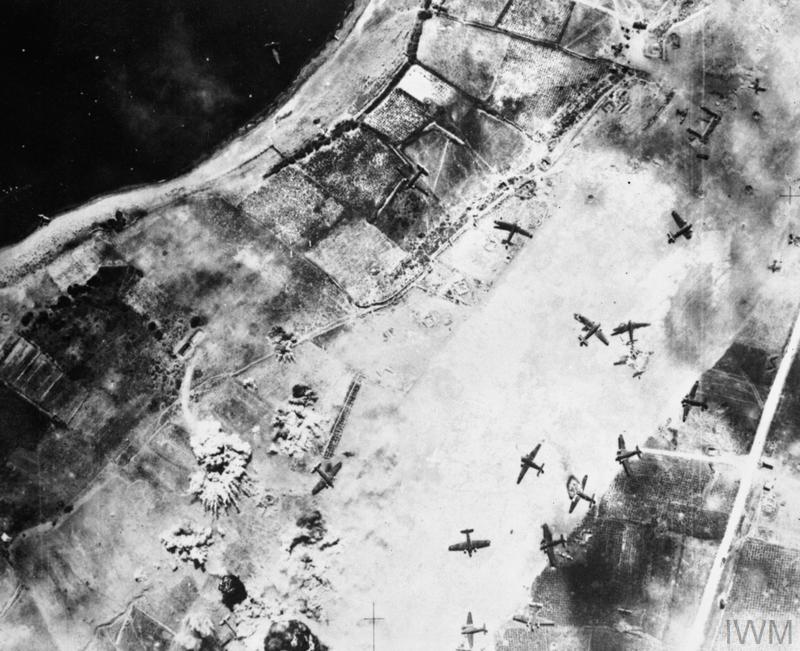
Two completely separate, but inextricably intertwined — battles develop at Crete. The British lose both of them.
Everyone on both sides by this point understands that Maleme airfield in the western portion of Crete is the key to the German invasion of Crete (Operation Mercury). From the British perspective, the goal is preventing German reinforcements and supplies to that location, which can only come in by two routes: Junkers Ju 52 transport planes flying from the north, and caiques from Greek ports. The Luftwaffe understands that, if it cannot maintain effective communications with its troops on Crete, they are doomed and the entire invasion will fail.
Both German routes to Crete depend upon airpower. The commander of the Luftwaffe VIII Air Corps, General Freiherr Wolfram von Richthofen, has a powerful force of Bf-109s, Bf 110s, Junkers Ju 87 dive bombers, and Dornier Do-17 and Junkers Ju-88 medium bombers. These oppose Royal Navy Admiral Cunningham’s Mediterranean Fleet, which has gathered 14-19 large warships (including battleships HMS Valiant and Warspite) to block the German supply routes. The Germans and Italians have no naval presence worth mentioning, and the RAF is too distant to play much of a role (considering that it evacuated Crete on 19 May). The events of Operation Mercury on 22 May 1941 thus develops into a classic confrontation between air and naval power, something that has been debated by all major powers for over twenty years.
While little recognized, the real problem for the Royal Navy is far away. Two desperately needed aircraft carriers are far away, at Gibraltar with Force H, after having just completed Operation Splice (sending planes to Malta). They could steam east… but the Bismarck is on the loose, and the carriers will be needed in the Atlantic. The Royal Navy is being stretched, and the ships off Crete are paying the price.
Luftwaffe reconnaissance identifies the locations of the Royal Navy units at first light. Stukageschwader 2, commanded by Lt. Col. Oskar Dinort, takes off immediately. The Junkers Ju-87 dive bombers spot two cruisers and two destroyers about 25 miles north of Crete. Cruisers HMS Fiji and Gloucester are slightly damaged by near misses, while the Germans ignore destroyers Greyhound and Griffin. After the Luftwaffe planes leave, the Royal Navy flotilla heads west to join the rest of the fleet about 30 miles off the coast.
East of Crete, the Royal Navy has gotten out of position due to its successful blocking of a German convoy during the night. Admiral Cunningham (in Alexandria) has ordered the ships to pursue the caiques and destroy them. This has brought them far to the north and them easy to attack. The Stukas fall on them next, slightly damaging cruisers HMS Carlisle and Naiad. These ships also escape to the west without being able to destroy the German convoy.
The early success of the Royal Navy ships in defending themselves is due to their use of massive quantities of anti-aircraft ammunition. Already, their stocks are running low, and should their guns fall silent, they would become easy prey to the accurate Luftwaffe Stukas. Gloucester has only 18% of its ammunition left, and Fiji only 30.
Around 10:30, British Force C spots an Axis convoy, escorted by torpedo boat Sagittario, south of Milos. The British ships open fire and damage Sagittario and some caiques. However, the British are soon chased off by the Luftwaffe, and light cruiser HMS Naiad suffers four near misses and has two turrets knocked out. While the ship can still steam at 16 knots, the damage is structural and thus severe. Light cruiser Carlisle is hit on the bridge, killing Captain T.C. Hampton. The entire force heads back to Port Said for repairs. Light cruiser Perth also suffers damage.
Shortly after noontime, Bf 109s escort Dornier Do-17 bombers to attack the Royal Navy ships that are heading west. While the Dorniers are usually thought of as level bombers, every bomber in the Luftwaffe is designed to serve as a dive bomber, too. The planes destroy battleship Warspite’s starboard 4- and 6-inch batteries. The planes cause chaos on the deck by strafing and killing many sailors manning guns.
The first flight of Luftwaffe planes of Stukageschwader 2 now has had time to return to base, rearm and refuel, and return to battle. They catch destroyer Greyhound off Antikythera, east of Crete, where it has been sent to intercept a reported German seaborne convoy to Crete. Greyhound sinks quickly. Cunningham orders several ships to the area to pick up survivors, but he has not been told that the ships have expended their anti-aircraft ammunition. The Luftwaffe pounces again and sets cruiser Gloucester ablaze. It sinks at 16:00. Out of a crew of 807, 722 perish.
At this point, Rear Admiral Edward King, in local command, gives up. He leaves all of the survivors of both Gloucester and Greyhound to their fate and runs back toward Alexandria with cruiser Fiji and destroyers Kandahar and Kingston. The Luftwaffe sends floatplanes to help pick up more than 500 British sailors who otherwise would perish, along with some Royal Navy destroyers who return during the night.
King’s ships, however, are still exposed. A single Bf 109 fighter-bomber (Jabo) carrying a 550-pound bomb spots the fleeing Fiji. The bomb is a near miss which opens the cruiser’s plates and causes extensive flooding. The pilot radios in the position and half an hour later a Junkers Ju 88 (Lieutenant Gerhard Brenner) arrives and hits the cruiser with three 110-pound bombs in the forward boiler room. Fiji sinks around 18:00.
The Admiralty is furious at King’s “lack of aggression.” After the battle, he is court-martialed for his decision and relegated to a desk job at the Admiralty. He will never go to sea again and will retire on 15 June 1944.
The Admiralty decides to reinforce failure and sends five more destroyers from Malta. Two of them, Kashmire and Kelly, shell Maleme after dark. However, this exposes their position to the Germans, who radio Athens to send more planes early on the 23rd.
The Luftwaffe also attacks Force A1 west of Crete, damaging battleship HMS Valiant. The Luftwaffe loses five Junkers Ju-87s and five Junkers Ju-88s and has sixteen more planes damaged. Significantly, the Luftwaffe does not lose any fighters because the RAF has withdrawn theirs.
After dark, the Royal Navy maintains patrols off Crete, but the Luftwaffe continues attacking. Destroyer Havock suffers damage to its boiler room from a near miss. There are 15 deaths and ten wounded.
In Suda Bay, half-sunk cruiser York, which is beached and has been used as a gun platform, finally is abandoned after being hit by more bombs. The Royal Navy opens the seacocks and does other things to render it unusable to the Germans.
Seeing the way things are going, the Admiralty orders Royal Navy destroyers HMS Decoy and Hero to evacuate Greek King George and the rest of the Greek government from Crete.
Submarine Rorqual lays mines in the Gulf of Salonika. The ships of Operation Splice, the air-ferry mission to Malta, arrive back in Gibraltar. At Malta, it is a fairly quiet day, with reconnaissance patrols spotting an Axis convoy off the eastern Tunisian coast (likely returning from Tripoli). The RAF launches attacks and claims a sinking, though apparently, the Axis ships suffer no damage.
According to his Private Secretary John Colville’s diary, Prime Minister Winston Churchill in the evening dismisses the losses of Fiji and Gloucester and the other ships, saying:
“What do you think we build the ships for?”
Churchill, of course, is the former head of the Royal Navy. It is interesting to compare this sort of statement with the endless criticism that Adolf Hitler receives for similarly callous statements about Wehrmacht casualties.
On the island of Crete, Greek, Australian and New Zealand troops counterattacked at Maleme at 0330 hours, but German 5. Gebirsjäger Division troops repulsed the attack.
Overnight on 21st/22nd, the New Zealander defenders on Hill 107 withdrew from their positions fearing they would be outflanked. The empty positions were found early this morning. More and more JU52’s began to land on the airfield at Maleme, no longer under artillery fire. The Gebirgsjäger commander, General Ringel, lands and Ramcke hands over command of German forces in the west of the island. He then joins his battlegroups who had broken out to the east and taken part in the fierce fighting for the Platanias Ridge, which overlooked the northern coast toward Chania.
During the day, additional Ju 52 aircraft brought two more battalions of troops to Maleme. Australian and New Zealand troops were pulled back from Maleme to Suda Bay to protect the main supply point while regrouping for another counterattack.
The New Zealand troops at Maleme require time to be relieved by other troops in order to counterattack the vital Hill 107 which overlooks Maleme airport. The British still worry about a sea landing, so they keep many available forces on the coast nearby. Two New Zealand battalions, the 20th Battalion of the 4th Brigade and the 28th Maori Battalion of the 5th Brigade, finally launch a counterattack. While planned for 02:00, it does not get into motion until after daylight. The Allied counterattack under New Zealand Second Lieutenant Charles Upham fails despite wreaking havoc on machine-gun nests and other positions, and the Germans tighten their grip on the airfield. Upham, who goes out of his way to rescue several isolated soldiers, wins the Victoria Cross.
Maleme airfield is still under artillery fire throughout the day. The Luftwaffe continues feeding planes into the inferno with reinforcements and supplies. While able to land, most either crash into other planes at the chaotic end of the runway or are blasted by shellfire. Still, enough planes get through to maintain the German position and enable it to expand as the day goes on. The Luftwaffe loses dozens of transports but saves the bridgehead.
The Allies, meanwhile, are utterly confused about German intentions, and some commanders believe the German transports are taking Fallschirmjäger (German paratroopers) off the island rather than bringing them in.
The Australian 19th Infantry Brigade contains the Fallschirmjäger attacking Retimo. The German 1st Fallschirmjäger Regiment withdraws under heavy pressure to positions east of Heraklion. With the main effort now clearly at Maleme, the goal of other German forces on the island is first and foremost to avoid capture or death.
The British commander Major General Bernard Freyberg canceled a counterattack against Maleme for the night of May 22-23rd and ordered a withdrawal instead. A German convoy was turned back but was not pursued because the Luftwaffe intervened.
The Reuters News Agency reported: “Reports this morning state that violent struggles took place on Crete on Wednesday and that often the opposing troops were locked in hand-to-hand fighting. The battle also extended to the mountains and the tableland.”
Elsewhere in North Africa, there is little ground activity. RAF bombers raid Benghazi.
Churchill makes a statement to the House of Commons about Crete, his third in the past three days. He states in part:
“Fighting is continuing with intensity, and, although the situation is in hand, the Germans have gained some local successes, at heavy cost. They are using large numbers of airborne and parachute troops, and these are increasing daily…. At Maleme Aerodrome, 10 miles South-West of Canea, it appears that the enemy are now in occupation of the aerodrome and the area to the West of it, but the aerodrom is still under our fire. Elsewhere in this sector the coastal line remains in our hands.”
Churchill is silent on the Royal Navy losses at sea, which his private secretary confirms he is well aware of at this time. He simply says, “I am sorry to say that I have got no definite information as to the results, but I feel they can hardly be other than satisfactory.”
In fact, the results are sea are far from satisfactory for the Royal Navy, as he well knows. Churchill also does not mention the issue of German troops wearing New Zealand uniforms, something he has claimed to be the case in the previous two statements.
The real action in the Iraq war on 22 May 1941 has shifted far to the east. All German supplies to the Rashid Ali government must pass through Vichy Syria, which has given the Luftwaffe transit rights. The British are gearing up to invade Syria in response. General Maitland Wilson, who is drawing up plans for the invasion, today meets with Major General John Lavarack, who will command British troops in the assault, at Sarafand.
Wilson plans to invade Syria in three separate brigade columns along isolated roads — a risky gambit, as the columns would not be able to support each other. However, British military intelligence reports that French morale in Syria is very low and the invasion will be easy.
At Fallujah, the Iraqi 6th Infantry Brigade counterattacks. They have Italian-made light tanks, but the RAF provides critical support with 56 sorties. The RAF destroys an Iraqi relief column of 40 vehicles heading for Fallujah, losing an Audax biplane (the crew reaches British lines by removing the Lewis machine gun and using it to hold off Iraqis trying to capture them). The British hold their ground and capture six light tanks.
Six sailors from HMAS Yarra go undercover to conduct reconnaissance at Maqil, Iraq. This is pursuant to Operation SCOOP, the full-scale invasion of Iraq.
British forces in Iraq established new positions only 20 miles from Baghdad.
The Allies (East African 22nd Infantry Brigade) capture Sodo (Soddu) in Abyssinia. The Italian 21st and 24th Colonial Divisions withdraw across the Omo River in Galla-Sidamo.
German Battleship Bismarck and heavy cruiser Prinz Eugen continue up the Norwegian coast. At 04:14, the destroyers detach from the Flotilla and head to Trondheim. At the very end of the day, around midnight, Admiral Lütjens orders the turn toward the northwest for the breakout through the Denmark Strait.
British aerial reconnaissance confirmed the German battleship Bismarck and cruiser Prinz Eugen had left Grimstadfjord, Norway. The German aerial reconnaissance to Scapa Flow, Scotland, United Kingdom, seeing dummy warships, reported that the British fleet was still in port.
At 23:00, Battleship HMS King George V, battlecruiser Hood, fleet carrier HMS Victorious, cruisers and destroyers head to sea to support the ships (cruisers Birmingham and Manchester and five trawlers) guarding the Denmark Strait.
Churchill has an unpleasant meeting with Irish High Commissioner John Dulanty, as reported in the War Cabinet minutes. Churchill claims that Dulanty has used “the usual arguments” in opposition to an Irish draft in Northern Ireland, such as the likelihood of violent protests. Churchill responds that British public opinion is “hard and bitter” and would lead to a “permanent embitterment of feeling after the war.” The War Cabinet minutes suggest that plans for a draft in Ireland will proceed despite objections, but be limited to those already in the Home Guard.
Great Britain warned France of the danger of collaboration with Germany: “If the Vichy government, in pursuance of their declared policy of collaboration with the enemy, take action or permit action detrimental to our conduct of the war or designed to assist the enemy’s war effort, we shall naturally hold ourselves free to attack the enemy wherever he may be found, and in so doing we shall no longer feel bound to draw any distinction between occupied and unoccupied territory in the execution of our military plans.”
Vichy continues its drift toward further collaboration.
Himmler formed a Norwegian SS organization, modeling it after the German counterpart.
The German occupation authorities call striking theatrical workers in to remonstrate with them. The workers are told to get back to work “or else.”
Hitler ends his brief stay at his old apartment in Munich and heads up to Berchtesgaden. He holds a war conference, and Admiral Raeder notifies Hitler about the Bismarck mission. Hitler, who at one point during the war confesses that he “can’t sleep a wink with large ships operating, first asks somewhat plaintively, “Herr Grossadmiral, can’t we fetch the ships back?” However, he reluctantly consents to Operation Rheinübung due to the effect it would have on Kriegsmarine’s morale. Hitler is worried about the effect the Bismarck operation will have on the United States.
Hitler’s adjutant and personal friend, Walther Hewel, writes in his diary for 22 May:
“… Drove up the mountain. Conference with the Chief [Ribbentrop], Raeder, and Keitel on naval strategy, convoy issue, the Raeder “interview,” and on Dakar, the Canaries and the Azores! Very interesting. The Führer still vacillates in his attitude toward America, as “you cannot peer into Roosevelt’s mind.” If he wants a war, he will always find the means, even if legally we are in the right. Japan holds the key.”
Adolf Hitler ends his two-day vacation in Munich and meets with Admiral Erich Raeder. They discuss a possible Kriegsmarine invasion of the Azores. Hitler sees it as a base for Luftwaffe bombers. Raeder reports that, should the Germans take the Azores, they would have no way of defending them.
Jews in Croatia are required to wear a Yellow Badge, also known as the Yellow Star of David, reflecting similar medieval practices. The practice will spread around Occupied Europe. The badges include the word “Jew” in local languages.
Reich Ambassador Friedrich Werner von der Schulenburg with Soviet Foreign Minister Vyacheslav Molotov in Moscow, Russia. Schulenburg, who knows about Operation BARBAROSSA (or at least strongly suspects it), reports that it is a friendly meeting.
Field Marshal Albert Kesselring moves his headquarters of Luftflotte 2 from the Channel coast to Bielany, a suburb of Warsaw. The Air Fleet will operate in support of Army Group Center under Field Marshal Fedor von Bock, whose target is Moscow. Kesselring and von Bock established a close working relationship during the invasion of Poland and, later, of the Netherland and Belgium. Airfields in Poland, however, are not yet complete for all of the Luftwaffe units — many Poles are being impressed into service to clear land and build structures.
RAF Fighter Command conducts Rhubarb operations during the day. RAF Bomber Command sends 16 planes on anti-shipping missions. There is extensive reconnaissance on both sides regarding the Bismarck/Prinz Eugen sortie to the North Atlantic.
RAF Bomber Command, Day of 22 May 1941
16 Blenheims on coastal sweeps from Holland to Denmark. 1 ship was attacked but not sunk. No losses.
The first flight of the Curtiss Hawk 81 fighters, known as Kittyhawk I to the British and P-40D to the Americans, was ordered by both the British Royal Air Force and the US Army.
U-111, commanded by Kapitänleutnant Wilhelm Kleinschmidt, sank British steamer Barnby (4813grt) in 60-30N, 34-12W. At 1340 hours on 22 May 1941 the Barnby (Master Arthur John Gale), dispersed from convoy HX.126, was torpedoed and sunk by U-111 southwest of Iceland. One crew member was lost. The master, 35 crew members and eight gunners landed at Reykjavik. The 4,813 ton Barnby was carrying flour and was bound for Hull, England.
U-103, commanded by Korvettenkapitän Viktor Schütze, sank British tanker British Grenadier (6857grt) in 6-15N, 12-59W. At 2252 hours on 22 May 1941 the unescorted British Grenadier (Master Henry George Jeary) was hit amidships by one torpedo from U-103 while steaming on a zigzag course southwest of Freetown. The ship stopped and was then hit amidships by a coup de grâce, but remained afloat. At 2359 hours, the U-boat fired a second coup de grâce that hit in the engine room, causing the tanker to settled slowly by the stern. The British Grenadier was left in a sinking condition and later foundered in 06°20N/12°50W. The master, 22 crew members and two gunners were picked up by the Ganda and 24 crew members were rescued by the Spanish tanker Jose Calvo Sotelo and landed at Freetown. The 6,857 ton British Grenadier was carrying ballast and was bound for Aruba.
Dutch minelayer HNLMS Nautilus sunk due to a collision with the British merchantman Murrayfield at 0023 near Saltfleet in position 53.36N, 00.25E. There were no fatalities.
Battlecruiser HMS Hood and battleship HMS Prince of Wales with destroyers HMS Achates, HMS Antelope, HMS Anthony, HMS Echo, HMS Electra, and HMS Icarus departed Scapa Flow at 0100 to cover cruiser on patrol in the Denmark Strait. In the Iceland-Faroes Channel were light cruisers HMS Manchester and HMS Birmingham and five trawlers. The two light cruisers refueled in the Faroes to refuel on the 22nd. Light cruiser HMS Arethusa, which arrived at Reykjavik on the 21st, was sent to reinforce these ships. Heavy cruiser HMS Norfolk was patrolling in the Denmark Strait. Heavy cruiser HMS Suffolk, after refueling at Hvalfjord on this date, returned to reinforce this patrol.
Light cruiser HMS Hermione arrived at Scapa Flow. The cruiser had a defect involving one of her turrets. This defect had been discovering during her working up the month before. The repairs would require fourteen days once personnel and facilities were available to do the work.
Destroyers HMS Inglefield and HMS Escapade at 0545 and HMS Intrepid at 1000 arrived at Scapa Flow after supporting convoy HX.125.
British troopship Britannic departed the Clyde at 1315 escorted by battleship HMS Rodney, en route to the US for extensive overhaul, and destroyers HMS Somali, HMS Eskimo, HMS Tartar, and HMS Mashona. Destroyers HMS Bedouin and HMS Impulsive with minelayer HMS Southern Prince had departed Loch Alsh on the 21st en route to the US. The minelayer carried equipment for battleship Rodney’s refitting and specialist naval ratings en route to Canada. The two groups joined at sea for the Atlantic crossing. The minelayer arrived at Bermuda on 2 June.
The Home Fleet departed Scapa Flow at 2300 with battleship HMS King George V, aircraft carrier HMS Victorious, light cruisers HMS Galatea, HMS Aurora, HMS Kenya, and HMS Hermione, and destroyers HMS Active, HMS Punjabi, HMAS Nestor, HMS Lance, HMS Windsor, HMS Inglefield, and HMS Intrepid. Destroyer Lance returned to Scapa Flow with boiler defects. The destroyer was able to depart again at 1315/23rd for Skaalefjord, arriving at 0500/24th. She departed at 0700 sailing westward to join the fleet.
Battlecruiser HMS Repulse was already at sea, putting out from the Clyde at 1600 with destroyers HMS Legion, HMCS Saguenay, and HMCS Assiniboine. The battlecruiser and destroyers rendezvoused with Tovey off the Butt of Lewis at noon on the 23rd.
Destroyers HMS Anthony and HMS Antelope were detached on the 23rd from the battlecruiser Hood force to refuel at Hvalfjord. The destroyers refueled and departed at 2100 to rejoin.
At 2000/23rd, the Battlecruiser Group was in 62-45N, 25-30W. Tovey’s force was in 61-30N, 22-00W.
At 2032, heavy cruiser HMS Norfolk sighted the German ships Bismarck and Prince Eugen in 66-50N, 25-30W. Heavy cruiser HMS Suffolk also sighted the ships and the two cruisers shadowed the German force through the night.
Light cruiser HMS Galatea and HMS Hermoine proceeded to patrol to the northeast of Iceland should the German ships attempt to turn back, but these ships were later recalled to the Tovey group and light cruisers HMS Manchester, HMS Birmingham, and HMS Arethusa carried out the patrol.
Destroyer HMS Active refueled at Hvalfjord on the 24th and departing the same day. Destroyer HMAS Nestor refueled at Iceland, departing on the 26th. Destroyer HMS Windsor was detached to Iceland on the 24th, but remained until 26 May. Destroyers HMS Punjabi, HMS Inglefield, and HMS Lance refueled in Iceland arriving and departing on the 26th. Destroyer HMS Intrepid arrived in Iceland to refuel on the 26th, but did not depart due to machinery defects until at 0930/31st. Destroyer Intrepid arrived at Scapa Flow at 1630 from Iceland.
On the 24th, destroyer HMCS Saguenay was detached to Hvalfjord to refuel. The destroyer departed the same day to rejoin. On the 26th, destroyers HMS Legion and HMCS Assiniboine arrived at Hvalfjord to refuel and departed the same day to rejoin. On the 27th, all three destroyers arrived at Londonderry.
Aircraft carrier HMS Victorious refueled at Hvalfjord on the 27th. Light cruiser HMS Galatea on the 27th and departed on the 28th. Light cruiser HMS Aurora on the 27th and departed 30 May. Light cruiser HMS Kenya on the 27th and departed 30 May. Light cruiser HMS Hermione on the 26th and departed Hvalfjord on the 31st to relieve light cruiser HMS Arethusa on Denmark Strait patrol.
On the 25th, battlecruiser HMS Repulse was ordered to proceed for refueling and arrived at Conception Bay, Newfoundland, on the 27th. The battlecruiser departed Conception Bay on the 29th to escort convoy HX.129.
Destroyer HMS Hambledon arrived at Scapa Flow at 1715 to work up after completion of large repairs.
Lt R. M. S. Brewer, Leading Airman E. G. E. Collyer, and Leading Airman G. R. Grant were killed when their Albacore of 817 Squadron crashed off Arbroath.
Minelayer HMS Teviotbank, escorted by destroyer HMS Cattistock, laid minefield BS.61 off the east coast of England. Paddle minesweepers HMS Snaefell and HMS Thames Queen accompanied the minelayer.
Heavy cruiser HMS London with destroyers HMS Havelock and HMS Harvester departed Gibraltar to escort steamer Arundel Castle and convoy SL.75 to England.
British steamer Empire Progress (5249grt) was damaged by German bombing three miles southwest of Needles. Four crewmen were killed. The steamer was beached in Totland Bay on the 23rd. She was refloated the same day and taken to Southampton for drydocking.
German steamer Ditmar Koel (5088grt) was sunk on a mine near Juist.
Light cruisers HMS Gloucester and HMS Fiji of Force B, with destroyers HMS Griffin and HMS Greyhound, returning from an uneventful sweep through Matapan Strait, were bombed for an hour and a half from 0630 as they were returning to join Force A-1. Cruiser Gloucester received some splinter damage from near misses. Cruiser Fiji received slight hull damage from near misses. Cruiser Gloucester only had 18% of her anti-aircraft ammunition remaining. Cruiser Fiji only had 30% remaining. Force B joined Force A-1 at 0830.
British Force C, composed of light cruisers HMS Naiad and HMAS Perth, anti-aircraft cruisers HMS Calcutta and HMS Carlisle, and destroyers HMS Kandahar, HMS Kingston, and HMS Nubian attacked the Italian Sagittario convoy at 1045 in 36-30N, 24-20E. Torpedo boat Sagittario was hit several times and at least one caique was set on fire. The attack was broken off due to air attacks. The force withdrew to the southwest, but was hampered in that Carlisle’s maximum speed was only twenty one knots, due to various defects. Light cruiser Naiad sustained four near misses and her speed was limited to 16 knots. Two of her turrets were knocked out. The damage was structural. T/Sub Lt W. F. Page RCNVR, and six ratings were killed and thirty one were wounded. Light cruiser Naiad was able to proceed to Alexandria arriving on the 23rd.
Anti-aircraft cruiser HMS Carlisle was hit on the bridge by a bomb and badly damaged. Captain T. C. Hampton was killed on the cruiser. The cruiser was also struck by a second bomb. Fourteen ratings were killed on the cruiser and twenty five, including P/Lt D. S. Craig, RM, and A/Cdr W. Pope, were wounded. The cruiser was repaired at Port Said from 26 May to 20 June. Destroyer HMS Kingston closed to take off survivors from cruiser Carlisle, but was ordered away. The cruiser was able to continue unassisted. Destroyer Kingston was damaged by a near miss which caused damage to her machinery and hull. One rating was killed and two were wounded on the destroyer.
Light cruiser HMAS Perth was damaged by a near miss which damaged her six inch fire control. She sustained no personnel casualties. The cruiser arrived at Alexandria on the 23rd.
Force C joined Force A-1 at 1500. The German air attacks continued.
Battleship HMS Warspite was hit by a bomb at 1332 that put her starboard 4″ and 6″ batteries out of action. Her speed was reduced to 18 knots. Commissioned Boatswain A. E. Harding and seven ratings were killed, twenty four were missing, eleven died of wounds, and sixty nine were wounded. The battleship arrived at Alexandria on the 24th. On 25 June, battleship Warspite departed Alexandria for repairs at Bremerton, Washington, arriving on 11 August. Repairs were completed on 18 December 1941.
Battleship HMS Valiant was struck by two bombs aft that caused no serious damage or any personnel casualties.
At about noon, destroyer HMS Greyhound (Cdr W. R. Marshall-A’Dean) was detached to sink a caique, sighted by battleship HMS Warspite, between Pori and Antikithera. The destroyer sank the caique, but then was sunk herself by bombing while rejoining the Fleet. Lt H. H. Brasher, P/T/Surgeon Lt B. R. Bray RNVR, and seventy four ratings were lost on the destroyer. Lt R. Scott DSC, Lt Cdr (E) R. E. G Bremner, Gunner (T) J. W. Chase, and several ratings were killed when their whaler was machine gunned by two ME 109 aircraft. Four ratings were make prisoners of war. Destroyers HMS Kandahar and HMS Kingston picked up survivors, including Marshall-A’Dean, from the destroyer. Destroyer Kingston was damaged by near misses of air bombs. Light cruisers HMS Fiji and HMS Gloucester were ordered to support destroyers Kandahar and Kingston.
Light cruisers HMS Fiji and HMS Gloucester, returning to join Force C, came under heavy air attack at 1550. Light cruiser Gloucester (Captain H. A. Rowley) was hit by bombs and sunk. Cruiser Fiji dropped rafts for the survivors and continued with destroyers HMS Kandahar and HMS Kingston. Captain H. W. Rowley, Lt Cdr C. R. Barnett Rtd, Commissioned Gunner D. Cull, Captain R. Formby, RM, Midshipman J. Hutton-Attenborough, Lt (E) W. B. Setten, and Lt Cdr W. A. Timmis Rtd were killed. A/Commissioned Gunner (T) F. A. H. Bond, T/Chaplain the Reverend W. Bonsey RNVR, Lt Cdr J. Brett DSC, Lt R. S. Brooke, Cdr (E) H. C. Brown DSO, Lt M. C. Brown, RM, Paymaster Midshipman A. L. Browning, Paymaster Lt J. Chetwode RNR, Instructor Lt Cdr J. H. Cooke, Warrant Engineer J. W. Costelloe, Warrant Shipwright L. A. Dalling, Lt E. O. Daniel DSC, Midshipman J. R. d’E. Darby, Midshipman J. W. Darling, Surgeon Lt Cdr R. G. Dingwall, OBE, T/Midshipman E. De B. F. Elliott RNR, Paymaster Midshipman P. A. Espeut, Midshipman L. W. Evans, Paymaster Lt W. C. F. Grant-Dalton, T/Paymaster Sub Lt R. O. C. Hay RNVR, A/Paymaster Sub Lt R. J. E. Haynes, Commissioned Gunner E. E. Houshold, Lt E. G. Hughes RNVR, T/Sub Lt C. F. Kebble RNR, Lt Cdr J. O. Mansell, Commissioned Electrician J. E. Mitchell, Warrant Engineer A. E. G. Northcott, sub Lt (E) R. J. Orok, Midshipman R. E. M. Pole, sub Lt (A) N. Q. Reading, Cdr R. J. Robertson DSC, Lt (E) I. M. Robertson-Walker, Midshipman C. A. M. Rombulow-Pearse, sub Lt H. Q. Rose, A/Warrant Ordnance Officer T. R. G. Scutt,Sub Lt (A) P. E. Starmer, Midshipman G. L. Stevens, Cdr R. P. Tanner DSC, Lt R. N. Weir RNVR, Schoolmaster C. F. Williamson, Midshipman P. N. Wyllie, and A/Gunner A. Young were missing. Three ratings were killed and six hundred and seventy three ratings, including Petty Officer Airman P. J. Branford and Petty Officer Airman C. A. Day, were missing. One Marine died in captivity. Lt Cdr R. A. F. Heap, Surgeon Lt H. G. Singer, MRCS, LRCP, and eighty ratings were made prisoners of war.
Light cruiser HMS Fiji (Captain P. B. R. W. William-Powlett) was sunk at 1830 by air bombs. Destroyers HMS Kandahar and HMS Kingston dropped rafts and left the area, returning after dark to rescue survivors. Kingston picked up 339 survivors and Kandahar picked up 184. There were 523 survivors of the 780 man crew. Warrant Engineer T. E. C. Hallett, Lt Cdr D. A. H. Hornell MVO, Commissioned Gunner C. W. H. Parrott, Midshipman M. N. Machin, and T/Chaplain the Reverend C. C. Tanner RNVR, were killed on the cruiser. T/Electrical Lt H. H. Balean RNVR, Paymaster Midshipman B. A. Blockley, Surgeon Lt Cdr C. D. D. de Labilliere, Midshipman P. A. de S. C. de Soissons, Warrant Engineer G. Dunstone, Schoolmaster F. W. D. Hawkins, T/Lt R. H. Lake RNVR, A/Warrant Mechanic A. T. O’Neill, Cdr (E) J. E. Saunders, T/Lt R. H. Scales RNVR, and Warrant Shipwright H. E. Wilcox were lost. One rating was killed and one rating died of wounds. One hundred and ninety two ratings were missing. Thirty Marines were missing and two NAAFI staff were missing. Cdr Marshall-A’Dean, formerly of destroyer HMS Greyhound, drowned during rescue operations. Gunner L. C. C. Eades, Lt (E) E. F. Le Flufy, and Commissioned Gunner (T) F. P. Morley were wounded.
Destroyers HMS Kandahar and HMS Kingston were able to refuel from the battleships in Force A-1. Destroyers HMAS Stuart, HMAS Voyager, and HMAS Vendetta coming from Alexandria were also ordered to pick up Fiji survivors, but they were unable to locate any. Destroyers HMS Kelly, HMS Kashmir, HMS Kipling, HMS Kelvin, and HMS Jackal from Malta joined Force A-1 at 1745/22nd. At 1930, the destroyers were detached to search of survivors of cruisers Gloucester and Fiji. Destroyers HMS Decoy and HMS Hero were detached from Force A-1 to pick up the King of Greece, the Greek Prime Minister, and other important personages at Suda Bay.
Commando ship Glenroy with 900 troops departed Alexandria for Tymbaki escorted by anti-aircraft cruiser HMS Coventry and sloops HMS Auckland and HMS Flamingo. They were ordered at 2335/23rd to return to Alexandria.
Destroyers HMS Jaguar and HMS Defender with ammunition for the troops on Crete departed Alexandria and joined Force A-1 off Crete. The destroyers were detached to Suda Bay at 2359 on the 23rd.
Heavy cruiser HMS York was abandoned after further damage by air bombs.
During the night of 22/23 May in Crete operations:
Destroyer HMS Decoy picked up the King of Greece and his party from Crete. Destroyer HMS Hero in company picked up other important personages. Both destroyers rejoined Force A-1 on the 23rd. The destroyers were sent on ahead later on the 23rd.
Destroyers HMS Kelly, HMS Kashmir, and HMS Kipling were on patrol in the Canea Bay area. Destroyer Kipling experienced steering defects and withdrew to the west to correct it.
Destroyers HMS Jackal and HMS Kelvin patrolled in Kissamo Bay without event and returned to Force A-1 at dawn.
Destroyers HMS Jervis, HMAS Nizam, HMS Ilex, and HMS Havock patrolled Heraklion.
Light cruisers HMS Orion and HMS Ajax were to join, but were unable to rendezvous in time and returned to Force D.
Destroyer HMS Ilex was damaged by a near miss from German bombing during the morning of 23 May. There was damage to her propeller, but sustained no personnel casualties.
Destroyer HMS Havock was near missed by German bombing with damage to the boiler room. Fifteen men were killed and ten were wounded.
Force E arrived at Alexandria at 2000/23rd.
Submarine HMS Rorqual laid mines in the Gulf of Salonika.
British troopship Arundel Castle arrived at Gibraltar from Freetown.
Convoy WS.8B departed the Clyde with steamers Christiaan Huygens (16,287grt), Abosso (11,030grt), Georgic (27,759grt), Martand (8000grt), Duchess of Richmond (20,022grt), Almanzora (15,551grt), and Orduna (15,507grt). The convoy was escorted by heavy cruiser HMS Exeter, anti-aircraft cruiser HMS Cairo, and destroyers HMS Cossack, HMS Sikh, HMS Maori, HMS Zulu, ORP Piorun, HMCS Ottawa, HMCS Restigouche, and HMS Eridge. All were detached on the 26th except cruiser Exeter. Included in this convoy were aircraft carriers HMS Victorious and HMS Argus. Aircraft carrier Victorious was soon detached from the convoy for Fleet operations. Liners Orduna and Almanzora collided on the 31st. Destroyer HMS Boreas and HMS Duncan joined the convoy on 2 June and remained until 4 June. Corvette HMS Marguerite joined the convoy on 3 June and remained until 4 June. The convoy arrived at Freetown on 4 June. The convoy, less Christiaan Huygens and Abosso, departed Freetown on 6 June escorted by destroyers Boreas, Duncan, and Highlander from 6 to 8 June. Heavy cruiser Exeter proceeded with the convoy. On 20 June, the convoy arrived at Durban. The convoy, plus steamer Nieuw Zeeland (11,069grt) departed on 23 June, escorted by heavy cruiser Exeter. The convoy arrived off Aden on 4 July and proceeded independently to Suez.
Churchill gives a candid evaluation of the fighting on Crete to President Roosevelt, calling the battle “severe, because, having no airfields within effective range, we cannot bring any Air Force into action.” He adds:
“Two of our cruisers and two destroyers sunk today. We are destroying many of highest-class German troops and have sunk at least one convoy.”
This is an extremely accurate appraisal, and much more honest than what the statement he issues to the House of Commons.
Regarding the Bismarck and Prinz Eugen, Churchill comments that “Should we fail to catch them going out, your Navy should surely be able to mark them down for us.” All pretense of US neutrality, of course, is long gone.
Today in Washington, President Roosevelt conferred with Mayor La Guardia on civilian defense and with members of his “war cabinet.” He worked on the radio address he will make on May 27.
The Senate was in recess.
The House adopted conference reports on the Vinson Priorities Bill and the $1,147,264,384 Treasury-Post office Appropriation Bill, passed a bill creating a police force for naval shore establishments and adjourned at 4:07 PM until noon on Monday. The Ways and Means Committee heard further testimony on the tax program and the Naval Affairs Committee approved legislation authorizing the naming of additional vice admirals.
Strong criticism by two cabinet officers of the United States Neutrality Act today caused speculation an effort to repeal the act might be in the making, and stirred spirited controversy on Capitol Hill. Secretary of War Stimson told his press conference the act violates “America’s most sacred and important tradition of foreign policy, freedom of the seas.” Yesterday Secretary of the Navy Knox had called the act a terrible blunder. The neutrality law, among other things, prevents American ships from carrying supplies to England, in a combat zone.
The United States struck back today at what officials considered Nazi efforts to disturb American relations with Martinique, and indicated France’s new world possessions still were considered harmless. Secretary of State Hull said there had been no recent developments that changed the general situation in these western hemisphere colonies. His statement was interpreted as meaning the American government had no intention of occupying Martinique and other French territories unless it was established France would allow Germany to use them for a foothold in this hemisphere.
On the strength of an official report which stated that “hundreds of German and Communist agents” were operating in United States naval bases, the House voted today to authorize Secretary Knox to establish a special under-cover detective force in all key shore establishments.
President Roosevelt asserted today that “more and faster ships” will be built in this country and, “manned by trained American seamen,” they “will carry through the open waters of the seven seas implements that will help destroy the menace to free people everywhere.”
The United Automobile Workers (C.I.O.) won collective bargaining rights in the Ford Motor Co.’s giant River Rouge and smaller Lincoln plants in yesterday’s employee elections and announced tonight it would immediately seek negotiations for a contract. When the national labor relations board finished counting tonight the votes of approximately 80,000 Ford employees it was shown production workers in the Rouge and Lincoln factories and pattern makers in the Rouge all had voted overwhelmingly in favor of the U.A.W.-C.I.O. over the American Federation of Labor.
Secretary of Labor Frances Perkins tonight certified a threatened strike at the North American Aviation Co.’s Inglewood, California, plant to the national defense mediation board. Negotiations between North American Aviation Co. and tho C.I.O. United Automobile Workers over a union contract have broken off and a strike will be called next Wednesday if authorized by a strike vote now being taken, it was announced tonight by Richard Frankensteen, international representative of the union. Frankensteen accused the aviation company, a subsidiary of General Motors, of not bargaining in good faith and declared that the walkout would start next Wednesday provided a favorable vote ia received from the 11,000 workers now balloting.
Secretary of the Interior Harold L. Ickes today described as “the rankest kind of hearsay” charges of a Dies committee investigator that the bituminous coal division of his department is “packed from top to bottom with Communists.”
Identification badges of 10,000 workers at the Ravenna ordnance plant in Ohio were declared invalid by S.E. Hunkin, vice president of the Hunkin-Conkey Construction Company, late today after all work on the $47,000,000 shell-loading plant came to a halt.
Hannah Arendt and her husband, Heinrich Blucher, along with many other refugees fleeing the Gestapo and the death camps in Europe, arrive at Ellis Island in the United States aboard the SS Guine.
U.S. Navy transferred ships from the Pacific Fleet to the Atlantic Fleet.
Both the U.S. Army Air Corps and the RAF place orders for the P40D/Kittyhawk I/Curtiss Hawk 81 fighter.
The motion picture “Blood and Sand” is released in the U.S. Based on Vicente Blasco Ibanez’s novel, this drama is directed by Rouben Mamoulian and stars Tyrone Power, Linda Darnell, Rita Hayworth, Anthony Quinn, J. Carrol Nash, John Caradine and Lynn Bari. The film is about naive bullfighter Power who ignores his true love (Darnell) for a hot temptress (Hayworth). The film is nominated for two technical Academy Awards and wins one.
Major League Baseball:
The Browns solved the mysteries of Charlie Wagner’s soft pitching in the eighth inning today. coming from behind for a 4–1 victory in the series finale. Making his first major league start a winning one, Bob Muncrief, rookie right-hander from San Antonio, held Boston to four hits in seven innings before being relieved by Jack Kramer. Passes to Joe Cronin and Odell Hale, an infield out and Johnny Peacock’s fly to deep center gave the Red Sox their tally in the fifth. This slim margin appeared safe until St. Louis suddenly pounced on Wagner’s delivery. The Browns scored three runs in the eighth on singles by Harlond Clift, Pinch Hitter Joe Grace, Johnny Lucadello and George McQuinn and Hale’s error on Roy Cullenbine’s grounder, and added another tally against Les Fleming in the ninth on three more singles.
A smart play by the Reds’ Lonny Frey helps Cincy to a 6–4 win over the Giants. With one out and the sacks full in the 1st, Chuck Aleno hits a double play grounder to short. Frey, running from second, allows the ball to hit him for an out, stopping play and putting Aleno on first base. Ernie Lombardi then hits a grand slam. Frank McCormick adds a 2-run home run in the 3rd. Paul Derringer gets the win for Cincy. Mel Ott hit two home runs for the Giants, and Jo-Jo Moore added another.
The Yankees continue to cut them pretty fine, but at least they are thoughtful enough these daysto carve off the larger slice of the victory cake for themselves. For the third day in a row they triumphed by a one-run margin at the Stadium yesterday as they vanquished the Tigers, 6–5. This result was achieved by a couple of rookie pitchers, Steve Peek and Norman Branch, in competition with a pair of veterans, the singular Bobo Newsom and the left-handed Archie McKain. But it was a home run by Bill Dickey in the eighth, seemingly a harmless gesture when made, that provided the winning tally in the face of a last-minute Detroit uprising. Joe DiMaggio also homered for the New Yorkers.
With Johnny Rigney pitching six-hit ball, the White Sox downed the Athletics, 4–1, today to stop their rivals’ four-game winning streak and tie the current series. A ladies’ day crowd of 13,127 saw the contest. Rigney was backed by a sparkling defense that made four double plays. His mates made the most of eight hits off Bill Beckman and Chubby Dean, who pitched the ninth inning. Bill Knickerbocker scored two of Chicago’s runs, blasting a home run in the third inning and coming home after he had doubled in the sixth.
Eight days ago Leo Durocher’s Dodgers were leading the National League by two and one-half games after sweeping a two-game series with the Reds, and were heading toward Pittsburgh with the pennant bee buzzing merrily about their ears. They haven’t won a game since. Today they dropped their sixth straight, their second to the Cardinals, 7–6, and tonight they headed home a game and a half behind Billy Southworth’s club. The debacle of this Western invasion wasn’t completed, however, before the Dodgers made a desperate last-minute counter-attack. Dolph Camilli hit his eighth homer of the year off Lon Warneke in the eighth, and in the next frame the aroused Flatbush crew scored three times to drive Warneke from the mound. Cookie Lavagetto was on second base with the tying run after his long two-run double to right center when Southpaw Max Lanier strode in to replace Warneke and face Camilli. Max pitched three wide balls to Dolph, and when the next one came in, Camilli swung hard. It was futile, the ball going directly on the ground to Creepy Crespi, who knelt in front of it to be sure, then tossed to Johnny Mize to end the game.
Cleveland staged a two-run rally in the ninth inning today to beat the Senators, 4–3, getting four straight hits with one out in the final inning to deal Sid Hudson his fourth defeat. The Indians, trailing by 3–2 after Cecil Travis’s sixth-inning triple with the bases full, touched off the winning rally when Lou Boudreau doubled and Roy Weatherly singled to send in the tying run. Weatherly was out stealing, but Gerald Walker looped a double to left and Hal Trosky scored him with a sharp single to right.
The scheduled game between the Boston Braves and the Pirates at Pittsburgh was postponed due to wet grounds. The game will be made up as part of a doubleheader on September 11.
The scheduled game between the Philadelphia Phillies and the Cubs at Chicago was postponed due to rain. The game will be made up as part of a doubleheader on June 15.
St. Louis Browns 4, Boston Red Sox 1
New York Giants 4, Cincinnati Reds 6
Detroit Tigers 5, New York Yankees 6
Chicago White Sox 4, Philadelphia Athletics 1
Brooklyn Dodgers 6, St. Louis Cardinals 7
Cleveland Indians 4, Washington Senators 3
Throughout the Far East, especially in Manchukuo, the effects of Japan’s recently signed pact with Russia are becoming evident. Travelers arriving in Shanghai from North China and Manchukuo say Japanese Army divisions with artillery, mechanized units and hospital and supply corps are sailing southward from ports in Korea, North China and Manchukuo. The troops are believed destined
for Formosa or South China. Japan has been watching European and Middle Eastern affairs closely, awaiting her chance for further southward expansion, so it is surmised these troops, previously stationed along the Manchukuoan-Soviet border, are being transferred to strike at the Netherlands East Indies and Singapore. However, reliable reports in Shanghai declare all is not well on the Japanese front. The Premier, Prince Fumimaro Konoe, supported by business men, financiers and politicians, is declared to be unwilling to risk. further adventures because of United States opposition and the perilous economic position of Japan.
Communist headquarters here reported last night a successful guerrilla attack in Shansi Province in reply to charges that the Eighth Route Army was not fighting the Japanese. This army was said to have attacked the Japanese along the new Paikwei-Chungcheng Railway, killed thirty Japanese, captured twenty rifles and machine guns and to have torn up a mile of the railway. Ta Kung Pao, Chungking’s lead ing newspaper, had published “ugly rumors” that virtually alleged the Communist troops had a truce with the Japanese and might transfer their support to the Nanking regime. The newspaper emphasized that the Chinese must retain their positions in the Chungtiao Mountains in South Shansi to maintain a foothold in North China, stressing that Shansi forms a plateau of North China and that control of it gives command of North China.
25 G3M bombers of Japanese Mihoro Kokutai (based in Tainan, Taiwan) with A6M Zero fighters in escort attacked Lanzhou, Gansu Province, China. Gao Youxin, flying an I-16III fighter temporarily based in Chung Chuan Chun Airfield to the north of the city, dispersed several bombers making an attack run on the airfield, allowing five I-16III fighters to take off. Gao went on to shoot down one G3M bomber (Lieutenant Shintaro Hashimoto) and damaged another. Most of the G3M bombers, however, bombed the city uncontested.
The Chinese redirect 17 I-153s of the 5th Pursuit Group to Lanzhou to defend against the attack. However, while refueling at Tianshu (Gansu Province), all of the planes are destroyed on the ground by bombing. Lu Enlung, leader of the 5th Pursuit Group, is relieved of command.
Japanese aircraft of the 12th Kokutai also attack Chengu during the day.
Dow Jones Industrial Average: 116.81 (-1.01)
Born:
Menzies Campbell, Scottish politician (Member of Parliament for North East Fife), in Glasgow, Scotland, United Kingdom (d. 2025).
Martha Langbein, West German sprinter (Olympics, silver medal, 4 × 100 metre relay, 1960), in Heidelberg, Germany.
Sebastian Forbes, British conductor, composer and music professor (The Aeolian Singers), in Buckinghamshire, England, United Kingdom.
Naval Construction:
The U.S. Navy Aloe-class net tender USS Yew (YN-32; later AN-37) is laid down by John H. Mathias Co. (Camden, New Jersey, U.S.A.).
The U.S. Navy Auk-class minesweeper USS Nuthatch (AM-60) is laid down by the Defoe Boat and Marine Works. (Bay City, Michigan, U.S.A.).
The U.S. Navy SC-497-class (110-foot wooden hull) submarine chaser USS PC-517 (later SC-517) is laid down by the Elizabeth City Shipyard (Elizabeth City, North Carolina, U.S.A.).
The U.S. Navy Accentor-class coastal minesweeper USS Demand (AMc-74) is launched by the Gibbs Gas Engine Co. (Jacksonville, Florida, U.S.A.).
The Royal Navy LCT (Mk 2)-class landing craft, tank HMS LCT 105 is launched by Swan Hunter and Wigham Richardson Ltd. (Wallsend-on-Tyne, U.K.).
The Вое́нно-морско́й флот СССР (ВМФ) (Soviet Navy) Project 7-class (Gnevny-class) destroyers Razyaryonny (Разъярённый, “Enraged”) and Revnostny (Ревностный, “Enthusiastic”) are launched by Zavod imeni Leninskogo Komsomola (Komsomolsk-na-Amur, U.S.S.R.) / Yard 199.
The U.S. Navy Woban-class district harbor tug USS Hoga (YT-146) is placed in service. Hoga was at Pearl Harbor on 7 December 1941.
The Royal Navy Fairmile B-class motor launch HMS ML 237 is commissioned.
The Royal Navy Fairmile B-class motor launch HMS ML 239 is commissioned.
The Royal Navy Fairmile B-class motor launch HMS ML 260 is commissioned.
The Royal Navy harbor defence motor launch HMS HDML 1014 is commissioned.
The Royal Navy Isles-class minesweeping trawler HMS Cumbrae (T 154) is commissioned. Her first commanding officer is T/Lieutenant Clive Edward Midwinter, RNR.
The Royal Navy British Power Boat 70-foot motor gun boat HMS MGB 18 is commissioned. Her first commanding officer is S.Lieutenant Peter Bentley James, RNVR
The Kriegsmarine (German Navy) Type VIIC U-boat U-373 is commissioned. Her first commanding officer is Oberleutnant zur See Paul-Karl Loeser.
The Kriegsmarine (German Navy) Type VIIC U-boat U-571 is commissioned. Her first commanding officer is Kapitänleutnant Helmut Möhlmann.
The Royal Canadian Navy Flower-class corvette HMCS Arvida (K 113) is commissioned. Her first commanding officer is T/Lieutenant Alastair Ian MacKay, RCNR.

