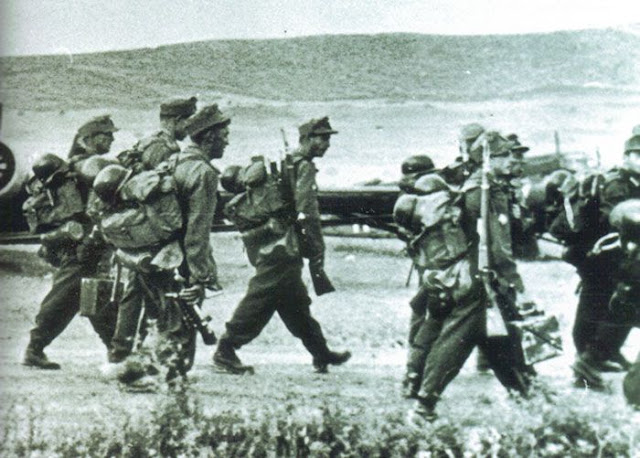
As the day opens, the invasion of Crete — Operation MERCURY — is not going well for the Germans. They have not secured a single airfield, and without an airfield, the Luftwaffe has no way to effectively reinforce the paratroopers (Fallschirmjäger) who have been dropped at widely separated points on the island. Thus, the pattern is following that of previous paratrooper landings in Norway and Belgium — an initial lodgment that cannot be supported and thus faces annihilation unless a supply route can be opened.
In the King George Hotel in Athens, the commanding general of the XI. Fliegerkorps, Major General Kurt Student, has a difficult strategic decision to make. On it, the fate of his fledgling Fallschirmjäger creation rests, along with the fate of Wehrmacht interests in the Mediterranean. If he fails, the heretofore unstoppable success of German troops will be ended in truly humiliating fashion, and his entire command virtually wiped out.
With few and fragmentary reports coming from the island, General Student has little to go on. However, he knows that he has to act fast because the airborne troops already are running out of ammunition. However, a reconnaissance flight over Maleme airfield reports no antiaircraft fire, and during a desperate supply flight of Junkers Ju 52s, one carrying boxes of needed ammunition manages to put down under fire on the nearby beach and come to a stop just short of some rocks. General Student makes his decision: send reinforcements of the 5th Mountain Division to land at Maleme and forget about the other landing sites on the island.
On the British side, the New Zealand 22nd Battalion under Lieutenant Colonel Leslie Andrew has pulled back from a vital hill, Hill 107, overlooking Maleme airfield. The men feel they can retake the hill, which virtually controls the airfield, but Brigadier James Hargest does not issue the order to attack because he is confused as to where the main German effort will be. The New Zealanders watch helplessly as Junkers Ju 52 transport planes carrying reinforcements and supplies begin landing on Maleme airfield at about 16:00. The field is still being shelled by Allied artillery fire, but enough men of the 100th Regiment of the Mountain Division put down to secure that section of the airstrip.
The German planes continue landing throughout the evening and night, with new arrivals crashing into planes already there, creating a mass of wrecked and intermingled planes. Gradually and painfully, the Fallschirmjäger consolidate their hold on the airfield. At 16:00, Luftwaffe Colonel Bernhard Hermann Ramcke, accompanied by 500 reinforcements, drops in by parachute east of the airfield to take command.
As the day ends, the Germans have a tenuous hold on Maleme airfield. British commander General Bernard Freyberg finally realizes that the Germans’ attack spearhead — schwerpunkt — is Maleme. He orders a counterattack by the New Zealand 20th Battalion, but it needs to hand off its own position to attack, so the 2/7th Battalion — which has no transport — is ordered to march 18 miles (29 km) north. The counterattack must wait for them arrive at 23:30, and then the 20th Battalion prepares to counterattack as soon as it can get into position on the 22nd.
Elsewhere on Crete, the Germans are in trouble. the 10th Infantry Brigade uses its light tanks to launch a successful assault on Cemetery Hill near Canea (Chania), but the Germans manage to break out to the village of Galatas. The Germans at Galatas are not far from the developing German bridgehead at nearby Maleme, so their efforts contribute to the dispersal of British forces and confusion with the British command.
The Germans consolidated their hold on Maleme, Crete, and occupied the airport and flew in the first troops of the 5th Mountain Division. Student decides to deploy all his remaining forces on the island to seize the airfield at Maleme. The wounded General Meindl is succeeded by Colonel Ramcke, who parachutes in today. At dawn Dr. Neumann, acting commander of I. Battalion Sturm regiment, overseas the storming of Hill 107 that dominate Maleme airfield. By 1700 hours Maleme is in German hands and several Ju 52s had already landed. The first companies of the German 100th Mountain Infantry Regiment land at Maleme. At 1800 on May 21st, Ramcke and 500 Fallschirmjäger reinforcements drop into Crete west of the Tavronitis and east of the airfield at Maleme. Upon landing, Ramcke is briefed on the current situation by Oberleutnant Göttsche, the Nachrichtenoffizier of Luftlande Sturmregiment Stab. Oberst Meindl had been evacuated, many of the Sturm Regiment officers had been killed or wounded in the fighting. However, there was some good news. Maleme airfield had been captured but allied artillery spotters were dug in on the slopes of Hill 107, which overlooked the airfield and were directing fire on to the airstrip. One assault group was about to launch an attack on Hill 107 and the first of the Ju 52’s carrying the badly needed Mountain Troops had just landed, although under heavy artillery fire. Once grouped, the Gebirgsjäger were ordered to head south and outflank the enemy positions. Two battle groups of Fallschirmjäger were ordered eastwards to try and break through to Group Centre at Chania. In the evening of the 21st, Ramcke was informed that the assault on Hill 107 had failed. Hours later he was informed that the seaborne armada had been destroyed whilst en-route to Crete. During the night New Zealand forces counterattacked at Maleme and although they had some success they did not penetrate to the airfield.
In the early hours of the day, 3 British cruisers and 4 destroyers intercepted and sank 11 small Axis vessels, killing 297 Germans. In the morning, 650 men of the German 5. Gebirsgäger Division landed on Crete, Greece in time to support the paratroopers already in position against a British counter attack at Maleme airfield. Many of the transport aircraft that delivered the troops would be damaged or destroyed on the airfield before they could take off. New Zealand General Freyberg held back his reserves despite German presence at Maleme, believing that the main German invasion was still to come at the beaches. At the nearby island of Milos, 19 fishing boats and 2 small passenger ships disembarked 2,331 German infantry. Out at sea, German aircraft damaged HMS Dido, HMS Orion, and HMS Ajax while Italian bombers sank HMS Juno (128 killed, 97 survived).
A large force of Royal Navy destroyers departs Malta at twilight for operations north of Crete. These are HMS Jackal, HMS Kashmire, HMS Kelly, and HMS Kelvin.
Italian destroyer Carlo Mirabello hits a mine and sinks in the Ionian Sea off Cephalonia. German freighters Kybfels and Marburg also sink from mines in the same area. The loss of the Marburg is particularly damaging, as it carries 60 tanks and 683 men of Panzer Division 2.
In London, Winston Churchill professes to be optimistic about Crete. The War Cabinet Defence Committee minutes show that he:
“…saw no reason why we should not retain our hold on the Island provided that General Wavell was able to land reinforcements on the southern side and that the Navy could prevent anything in the way of a German seaborne landing.”
In this, Churchill appears to be subtly planting the idea of Middle East Commander Wavell as a future scapegoat. There are no plans to land anyone on the rough southern coast of Crete, and there is plenty of British manpower — but also lots of muddle and poorly equipped soldiers.
In a cable to Wavell, Churchill is a bit more honest about the true state of affairs on Crete. He notes that General Freyberg “declares he is hard-pressed.” He adds somewhat gratuitously, “Presume you are already reinforcing him to the utmost to master enemy airborne attack,” when in fact there is no way for Wavell to “reinforce” Freyberg. If the airfields on Crete and surrounding seas cannot be held, sending more troops to buttress the large numbers already there would be merely sacrificial.
Over the Libyan Front, planes from the 3rd Staffel of I./JG 27 shoots down five RAF Blenheims.
The aircraft carriers HMS Ark Royal (91) and HMS Furious (47) flew off a cargo of 48 Hurricanes to Malta. Royal Navy aircraft carriers, during Operation Splice, launch 48 Hawker Hurricanes and four Fulmars (as guide planes) to Malta. All but two Hurricanes reach the island, and the carriers and accompanying ships return to Gibraltar. Seventeen of the Hurricanes refuel and fly on immediately to Cairo. In addition to these planes, Some Bristol Blenheim Mk IV bombers of RAF No. 82 Squadron also fly into Malta directly from Cornwall, England (one lost at sea).
While the planes are arriving on Malta from Operation Splice, a major Luftwaffe attack occurs. They raid Luqa airfield, destroying two Wellingtons and damaging one Blenheim, one Hurricane, and one Beaufighter.
In order to prevent more German reinforcements from getting through to Iraq by using Vichy French airfields, British Middle East Commander General Archibald Wavell on 21 May 1941 orders General Maitland Wilson to prepare plans for an invasion of Syria. Wilson will have 7th Australian Division (less one brigade), 5th Indian Brigade and 5,000 Free French. Altogether the initial invasion force will be about 34,000 – 18,000 Australians, 9,000 British, 5,000 Free French and 2,000 Indians. The Vichy commander General Dentz has about 35,000 troops comprising 20 battalions of French-led Senegalese, Algerian and Moroccan troops, plus four battalions of 6th French Foreign Legion Regiment. These 3,000 mixed French, Spanish, Germans, Russians and Irish will prove the best troops on the Vichy side and will frequently be shifted to threatened sectors. Crucially, General Dentz has 90 first-line tanks, whereas the British have none, and only limited Australian light armour. The allies have 70 aircraft versus 100 French aircraft. The French Dewoitine S520 will prove the equal of Commonwealth Hurricanes and Tomahawks. Both sides will make use of naval bombardment on the coastal axis, however the allies have a stronger naval force. Vice-Admiral King RN has three cruisers, six destroyers and a landing ship versus several French destroyers.
A French defector, Colonel Collet, informs the Free French that the Vichy French army in Syria would not oppose arrival of German air units and would fight the Allies. They had already assumed defensive positions along the border.
Fighting continues in Fallujah, where the Iraqis make a stand against the advancing British troops of Kingcol.
Operation RHEINÜBUNG continues. German battleship Bismarck and cruiser Prinz Eugen stopped in Grimstadfjord, Norway to refuel Prinz Eugen. At 1315 hours, RAF Flying Officer Michael Suckling, flying a Spitfire fighter, spotted the warships near Bergen. There, they take on supplies and paint over their Baltic camouflage with standard “outboard grey.” They are anchored in a fjord south of Bergen when more RAF reconnaissance spots them during the evening. British Home Fleet commander Admiral John Tovey dispatched all available warships to prevent the Germans from breaking out to the North Atlantic. The German ships completed refueling at 1900 hours and began moving westwards. After dark, British bombers attacked the empty Grimstadfjord.
The Admiralty details two capital ships, battlecruiser HMS Hood and unfinished battleship Prince of Wales, to sail from Scapa Flow, Scotland to reinforce the standing patrol in the Denmark Strait on two hour’s notice. Prince of Wales still has engineers working on its faulty guns. The many reconnaissance photos and missions by the British are the start of their “German battleship obsession” that the Germans will put to good use in the coming years with their handling of the Tirpitz.
The East African 22nd Infantry Brigade captures Colito in Galla-Sidamo.
Jan Smuts, South Africa’s Prime Minister and war overlord, was today given a present for his 71st birthday: a field marshal’s baton. “Your promotion to the highest military rank will be warmly welcomed,” King George cabled, “not only for your great and devoted services, but as a leader of a people whose fighting men have been playing a most brilliant part in the victorious campaign in East Africa.” The esteem in which Smuts is now held in Britain is not without its ironies; in the Boer War he had been the leader of a Boer kommando group against the British forces. Later, after the peace negotiations, he was widely regarded as the architect of South Africa’s Dominion status.
The Women’s Land Army in the United Kingdom was declared to have over 11,000 members.
Singer Johannes Heesters visits Dachau concentration camp, and purportedly performs for the German soldiers and officers. According to German author Volker Kühn, Heesters performed for the SS at the Dachau concentration camp. Kühn cites as evidence the testimony of a Dachau inmate, Viktor Matejka, who worked for the SS and told Kühn he pulled the curtain when Heesters performed in 1941.
Adolf Hitler spends a day alone at his old apartment in Munich.
Germany requested that foreign diplomatic agents evacuate Paris by June 10, 1941. Paris area was regarded as “an extended zone of operations.” German authorities ordered the United States to withdraw their representatives in Paris from the city by June 10.
The Natzweiler-Struthof concentration camp opens near Strasbourg, France. It is the only German-run camp on (future) French territory.
A Vichy French military court sentenced 56 enlisted soldiers who sided with de Gaulle to death or hard labor, in absentia.
Vichy France government confiscated all property owned by Free French troops.
A theatre strike began in Norway as a response to the revocation of working permits for six actors who refused to perform on Nazi-controlled radio.
Coinciding with a new visit to Oslo by the German Gestapo chief, Heinrich Himmler, who arrived there this morning, the German Commissioner for Norway, Josef Terboven, promulgated a series of decrees extending the powers of the German occupation authorities in Norway to the detriment of Major Vidkun Quisling’s party, Nasjonal Samling, which henceforth is to all intents and purposes separated from the Norwegian State.
German submarine U-69 sank unarmed American freighter Robin Moor by torpedo and gunfire 800 miles off the coast of British West Africa at 0525 hours; Robin Moor was the first American merchantman to be sunk by a German submarine in WW2. All 46 aboard survived. U.S. President Roosevelt protested the sinking and unsuccessfully demanded compensation from Germany.
At a meeting of the Central Committee War Section in Moscow, Russia, the intelligence reports, provided by Communist sympathizers in Germany, that an attack on the Soviet Union was imminent, was greeted with much apprehension. Stalin however still refused to accept the intelligence, believing that the reports must be either deliberate provocation of misinformation by the British to get the Soviet Union involved in the war. When General Proskurov, the head of Soviet Intelligence, argued personally with Stalin, telling Stalin he is wrong and that the Germans are about to attack, he was duly arrested. Proskurov is immediately arrested and replaced by General Filipp I. Golikov. Proskurov will be shot in October 1941.
RAF Bomber Command raids Grimstadfjord, which reconnaissance planes report is the location of battleship Bismarck and cruiser Prinz Eugen. However, by the time the bombers get there, the German ships have sailed.
RAF Bomber Command, Day of 21 May 1941
45 Blenheims on extensive coastal sweeps and on Circus operation to Bethune. No ships were seen but Heligoland town was attacked by machine-gun fire and an oil depot near Bethune was bombed. 2 Blenheims were lost.
U-98, commanded by Kapitänleutnant Robert Gysae, sank British steamer Marconi (7402grt) in 58N, 41W. At 0512 hours on 21 May 1941 the unescorted Marconi (Master Frank Emmanuel Hailstone), dispersed from convoy OB.322, was hit by one torpedo from U-98 and sank after 33 minutes south-southeast of Cape Farewell. The ship had already been missed by the same U-boat at 1836 hours on 20 May. The master and ten crew members were lost. The survivors abandoned ship in the lifeboats but eight of them died before they were picked up by USCGC General Greene (WPC 140) and landed at St. John’s, where three others died in a hospital. 52 crew members and four gunners survived. The 7,402-ton Marconi was carrying ballast.
U-93, commanded by Kapitänleutnant Claus Korth, sank Dutch tanker Elusa (6235grt) from convoy HX.126 in 59N, 38-05W. On 21 May 1941 the Elusa (Master J.J. Beckeringh) was in convoy HX.126 which had already lost seven ships the day before. Her crew witnessed the explosion of the British Security, which was also carrying gasoline and was sunk with all hands by U-556 U-93 had tried for hours to come into a position from which an attack was possible, and when at last a torpedo was launched it missed the target, a tanker. In a second attack at 0522 hours two single torpedoes were launched on a freighter and on a tanker, but missed the targets again. However, the torpedo aimed at the freighter hit the Elusa at 0529 hours. Immediately after the tanker was hit, the cargo caught fire, mainly in the rear section of the vessel where the crew quarters were located. According to regulations they had stopped the main engines. Some crewmembers at the rear of the ship did not wait for orders to abandon ship. They immediately lowered the lifeboats and left the vessel, which saved their lives. Amidships some Chinese crewmembers also lowered a lifeboat without orders, and rowed away before the other crewmembers could enter it. Remembering the fate of the British Security, doubtless they wished to waste no time distancing themselves from their explosive cargo. The other crew members succeeded in lowering another lifeboat, in which all the remaining crew members found a place. The master coolly remained on board the Elusa, throwing the classified documents overboard and succeeding in leveling the vessel, which was listing to starboard. Thirty minutes after the hit a British destroyer arrived, rescued the crew members in the three lifeboats and took the master aboard. The destroyer stayed near the burning ship during the night. Soon it became clear that the first engineer was missing (caught by surprise by the fire). Moreover two Chinese, the third cook and a donkeyman drowned when they tried to get into the lifeboats. In the next morning the master, the first mate and the second engineer re-boarded the Elusa and they saw how devastating the fire had been, but they also discovered that the boilers of the vessel were still in good shape. But fact was that the vessel was not able to sail under its own power and the distance to the nearest tug was too big, so they left the Elusa who was still afloat (She sank later in 5830N/3810W). The 49 survivors were disembarked at Reykjavik on 25 May. The 6,235-ton Elusa was carrying gasoline and was bound for the United Kingdom.
U-69, commanded by Kapitänleutnant Jost Metzler, sank American steamer Robin Moor (4999grt) in 6-10N, 25-40W. At 0525 hours on 21 May 1941 the unescorted, unarmed and neutral American-flagged Robin Moor (Master Edward W. Myers; Seas Shipping Co. Inc, New York) was ordered to stop with a Morse lamp by U-69 about 750 miles west of Freetown. After questioning the chief mate that came aboard the U-boat, Metzler told him that he has to sink the ship in accordance with the prize rules and ordered the crew to leave their ship in 30 minutes. The nine officers, 29 crewmen and eight passengers (four men, three women and one child) abandoned ship in four lifeboats and the boat with the master then came alongside U-69 However, the cargo manifest shown to Metzler only confirmed his view that the ship was carrying contraband. The Germans gave four tins of bread, two tins of butter, some cognac and bandages to the lifeboats and then submerged. At 1005 hours, the U-boat fired one G7e torpedo from the stern torpedo tube that hit Robin Moor on port side amidships, but surfaced again 40 minutes later because the ship only settled slowly and began shelling her with the deck gun, firing 39 rounds and causing the ship to sink by the stern after 17 minutes. The wooden crates carried as deck cargo floated free and were sunk with gunfire from the anti-aircraft guns. The lifeboats initially remained together, but one of them became separated after three days. The occupants of three boats were picked up after sailing about 600 miles in 13 days by the City of Wellington and landed at Capetown on 18 June. The ten crew members and one passenger in the boat in charge of the third officer were rescued by Ozório on 9 June in position 00°46N/37°37W and two days later landed at Recife, Brazil. The 4,999-ton Robin Moor was carrying general cargo, including engines and vehicles and was bound for Lourenço Marques, Mozambique. The incident helped prompt U.S. President Franklin D. Roosevelt to announce an “unlimited national emergency” on May 27, 1941.
U-69 also sank British steamer Tewkesbury (4601grt) in 5-49N, 24-09W. At 2342 hours on 21 May 1941 the unescorted Tewkesbury (Master Theodore Pryse) was hit on the starboard side underneath the bridge by one G7a torpedo from U-69 about 540 miles south of the Cape Verde Islands. The explosion threw up a terrific column of water that washed over the ship, sweeping away the starboard jolly boat and pouring water into the engine room through the skylight and ventilators. The men on watch below immediately secured the engines and the crew of 38 men and four gunners (the ship was armed with one 4in and four machine guns) began to abandon ship in two lifeboats when she developed a 10° list to starboard. The master tried to collect the confidential books from the bridge, but found them buried under the collapsed cement protection. He then brought a sextant and chronometer to the starboard lifeboat before abandoning ship in the port boat after helping the chief officer to launch it. Shortly after the boats had rowed away, the U-boat fired a star shell to illuminate the target at 2358 hours and then commenced shelling the ship from the port bow with 21 incendiary shells, but all failed to ignite upon impact. At 0036 hours on 22 May, the Tewkesbury was struck on the port side in the stokehold by a coup de grâce and sank by the bow about 7 minutes later. The Germans then left the area without questioning the survivors as the ship had already been identified by her distress signal. The radio officer had managed to send the distress signal several times, so the lifeboat waited 24 hours in the vicinity for assistance but then decided to sail for Fernando de Noronha, about 760 miles to the southwest. In the meantime the master had transferred to the starboard boat and left the chief officer in charge of the port boat, but the boats soon lost contact in the morning of 23 May. On 26 May, the master and 20 survivors were picked up by the American steam merchant Exhibitor in position 05°09N/24°54W. The ship then unsuccessfully searched the area for the other lifeboat in a radius of 30 miles until noon the next day. As she was bound for Bombay, the survivors were transferred to HMS Cilicia (F 54) (Capt V.B. Cardwell, OBE, RN) after a week and eventually landed at Freetown after 12 days. On 2 June, the chief officer and 20 survivors were picked up with their lifeboat by the Antinous (Master Hamilton Powell) in position 04°35N/24°30W and taken to Capetown. All survivors were found in good health. The master Theodore Pryse was awarded the OBE for his actions, but when this was published in the London Gazette he had already been lost while in command of Newbury which was sunk by U-94 (Ites) on 15 September 1941. The 4,601-ton Tewkesbury was carrying general cargo, wheat and canned meat and was bound for Oban, Scotland.
German battleship Bismarck and heavy cruiser Eugen departed Korsfjord, near Bergen, for a shipping sweep in the North Atlantic, in Operation RHEINÜBUNG.
At 1830, all available Home Fleet warships came to two hours’ notice for sailing as a result of air reconnaissance of the German ships at Korsfjord.
On the 22nd, a Martin Maryland of 771 Squadron from Hatston advised the German ships had sailed. The crew of the Maryland was Lt N. E. Goddard, Cdr G. A. Rotherham, Leading Airman J. D. Milne, and Leading Airman J. W. Armstrong.
Destroyer HMS Farndale departed Scapa Flow at 0800 and met steamers Amsterdam and Lady of Mann off the entrance to Aberdeen at 1500. After providing escort for these two ships, the destroyer arrived back at Scapa Flow at 2130.
Destroyer HMS Walpole departed Scapa Flow to return to the Nore following her working up exercises.
Anti-aircraft ship HMS Alynbank departed Scapa Flow at 0530 and escorted convoy WN.29 to the southward. During the afternoon, the ship transferred to convoy EC.22. The ship remained with convoy EC.22 until night in the Pentland Firth. At 0600/22nd, she met convoy WN.30 in Pentland Firth and provided cover for the convoy to Methil where they arrived at 0830/23rd.
Lt J. P. Eustace was killed when his Hurricane of 759 Squadron crashed near Sparkford.
Armed yacht HMS Hanyards (16.5grt) was lost.
Lt P. J. Connolly and Lt Cdr G. Hare, in a Fulmar of 801 Squadron from Hal Far, were captured when they landed on the North African coast near Cape Bon. The officers were made prisoners of war.
Italian torpedo boat Lupo departed Milos early on the 21st with a convoy for Canea.
Italian torpedo boat Sagittario departed Piraeus with a convoy for Heraklion.
Italian torpedo boat Sagittario was accidently attacked by German bombers, but was not damaged.
At about the same time, Italian destroyer Sella was seriously damaged by German bombers out of a group of five destroyers which had just departed Piraeus.
Both convoys for Crete were being sent due to lack of success of the German paratroop landing. British air reconnaissance located these convoys and Force C was sent to the northwest of Crete to intercept.
Australian destroyers HMAS Stuart, HMAS Voyager, and HMAS Vendetta departed Alexandria to join A-1.
Destroyer HMS Juno (Cdr St. J. R. J. Tyrwhitt) was hit by three bombs and sank in two minutes in 34-35N, 26-34E. Lt J. N. Beazley, Lt G. G. Garrard RNVR, A/Gunner (T) G. F. Healy, Lt W. A. Starkie, Lt Cdr (E) G. H. Way, and 123 ratings were lost with the destroyer. Twenty one men were wounded. Tyrwhitt and five other officers and nine one ratings were picked up by destroyers HMS Kandahar, HMS Kingston, and HMS Nubian.
Light cruiser HMS Ajax was damaged by the near miss of an air bomb. There were no casualties. The cruiser sustained some shaft distortion.
Force A-1, B, and D operated southwest of Kithera to draw out the Italian for action. These were battleships HMS Warspite and HMS Valiant, light cruisers HMS Fiji, HMS Gloucester, HMS Dido, HMS Ajax, and HMS Orion and destroyers HMS Isis, HMS Imperial, HMS Kimberley, HMS Janus, HMAS Napier, HMS Decoy, HMS Griffin, and HMS Hotspur.
Destroyers HMS Kelly, HMS Kashmir, HMS Kipling, HMS Jackal, and HMS Kelvin of 5th Destroyer Flotilla departed Malta at dusk to join the Mediterranean Fleet operating off Crete. Destroyer HMS Foresight left at the same time to rejoin Force H.and arrived at Gibraltar on the 23rd.
Anti-aircraft cruisers HMS Calcutta and HMS Carlisle joined Force C on the 21st.
Destroyers HMS Jervis, HMS Ilex, and HMAS Nizam arrived at Alexandria to refuel. British Force E, after refueling, departed Alexandria at 0030/21st to return to the Kaso Strait area.
Australian destroyers HMAS Stuart, HMAS Voyager, and HMAS Vendetta departed Alexandria to join Force A-1.
Sloop HMS Auckland departed Alexandria with British oiler RFA Cherryleaf (5934grt) to refuel destroyers in a position one hundred miles northwest of Alexandria. On the 22nd, the escort of the oiler was taken over by Greek destroyer RHS Aetos.
At 2330/21st northeast of Canea, the Italian Lupo convoy was attacked by Light cruisers HMS Dido, HMS Ajax, and HMS Orion and destroyers HMS Kimberley, HMS Hasty, HMS Hereward, and HMS Janus of Force D. The bow of cruiser Ajax was bent through ramming a caique. Light cruiser Orion sustained some damage to her bridge from pom pom fire from cruiser Dido. Two men were killed and nine were wounded. Light cruiser Dido expended 70% of her ammunition, light cruiser Orion 62%, and light cruiser Ajax 58%. Ten schooners were sunk by the British ships. Roumanian steamer Carmen Sylva (1601grt) was sunk. Torpedo boat Lupo was hit by 18 six inch shells and survived despite heavy damage. The action was broken off at 0400/22nd. Italian torpedo boat Lira rescued some of Lupo convoy survivors.
Force D joined Force A-1 at 0800 outside of Kithera Straits. At 1045, due to the ammunition shortages in the cruisers, Force D was detached to Alexandria.
Cruisers HMS Orion and HMS Ajax were detached to join Force E, but when it was found they could not reach the rendezvous in time, they returned to Force D
Force D arrived at Alexandria at 0700/23rd.
Ocean boarding vessel HMS Maron departed Gibraltar on Western Patrol.
Italian coastal steamer Gladiator (248grt) was sunk on a mine at Sebenico.
Convoy OB.325 departed Liverpool, escorted by destroyer HMS Saladin and corvette HMS Gladiolus. The escorted was joined the next day by destroyer HMS Leamington, corvette HMS Clarkia, and anti-submarine trawler HMS St Zeno. The escort was detached when the convoy was dispersed on the 25th.
Unarmed U.S. freighter Robin Moor, en route to South Africa and Mozambique, is stopped and sunk by German submarine U-69 (torpedo and gunfire) about 700 miles off the west coast of Africa, 06°10’N, 25°40’W. Robin Moor–her nationality prominently reflected in the U.S. flags painted on her sides–is the first American merchantman sunk by a U-boat in World War II. There are no casualties among her 38-man crew and eight passengers, and U-69’s commanding officer, Kapitanleutnant Jost Metzler, provides the Americans with rations (see 3, 8 and 20 June).
U-69 (Kapitanleutnant Metzler), on its third patrol and operating about 750 miles west of Freetown, Sierra Leone, spots 4999 ton US freighter Robin Moor traveling independently. The Robin Moore flies the flag of a neutral country, and normal U-boat practice is to leave US vessels alone. However, Robin Moor is carrying cargo from New York City to Mozambique via South Africa which includes items that can be interpreted as military cargo, including shotgun shells and .22 caliber rifles. The bulk of its crew is 450 autos and trucks — which also can be characterized as war equipment under some interpretations.
Metzler stops the Robin Moor and orders the passengers and crew to disembark, so they take to lifeboats. Someone on the U-boat tells the mate of the Robin Moor that Metzler simply decided to “let us have it.” U-69 then sinks the Robin Moor using a torpedo and the deck gun. Metzler then gives the survivors some tins of black bread and butter, states that the ship was sunk for carrying war contraband and leaves the scene and the 37 survivors are left adrift, but all eventually are saved by two different freighters. Their survival somewhat mitigates the impact on public opinion.
According to a later investigation, it will be determined that Duquesne Spy Ring member Leo Waalen had sent a radio signal to Germany with the ship’s expected sailing date. Thus, the interception of the Robin Moor by U-69 may not have been accidental, though Adolf Hitler is on record as opposing any action that could bring the United States into the war. It must be noted that the Royal Navy routinely stops and confiscates neutral ships found to be in the service of the Reich, so this is not in violation of international law. However, this will become a major international incident once news of the sinking reaches Washington, D.C.
In Washington, President Roosevelt discussed the sending of food to Eire with Norman H. Davis, chairman of the Red Cross, conferred with Secretary Wickard and Representative Cannon of Missouri on farm problems and talked with a group headed by Leon Henderson on legislation to fix price ceilings.
The Senate was in recess. Its Foreign Relations Committee approved a bill authorizing United States cooperation in completion of the Inter-American Highway and a conference committee approved the Vinson Priorities Bill.
The House approved a bill making the Coast Guard a part of the Navy, passed and sent to the President a bill authorizing the training of Army enlisted men as plane pilots, refused to accept Senate amendments to a bill putting the Office of Government Reports on a permanent basis and sent the bill to conference and adjourned at 2:28 PM until noon tomorrow. The Dies Committee resumed hearings on Communistic activity in New York State, while the Rules Committee deferred action on a bill giving the RFC additional power.
Prime Minister Winston Churchill sends a cable to President Roosevelt in which he states that “We are at a climacteric of the war, when enormous crystallizations are in suspense but imminent.” He says somewhat optimistically that “Battle for Crete has opened well,” but concludes in grim fashion:
“Whatever happens, you may be sure that we shall fight on, and I am sure we can at least save ourselves. But what is the good of that?”
The somewhat brief (for Churchill) message is one of the most downbeat that Churchill sends throughout the war.
Roosevelt promises six additional small escort aircraft carriers to Churchill. The first three should be available in three or four months. These were six Bogue/Prince William Class ships that the US Navy identified as BAVG’s, i.e., British Aircraft Escort Vessels.
A hint that the United States is rushing preparations to employ numbers of relatively small aircraft carriers to safeguard merchant ships came today from Secretary Knox, who said guardedly that the navy was “very busy” on the undertaking. Without explaining whether such craft might be used except under actual war conditions, the secretary said that in connection with the controversy over delivery of munitions to Great Britain, it was “silly” to dwell exclusively on World war methods of protecting convoys from surface and undersea attack alone. A speedy former cargo ship already is being rebuilt experimentally as a carrier, and a score of new-type “transports” and conventional plane carriers are under construction or planned, but Knox declined to divulge just what steps were being taken to cope with the problem presented by Germany’s aerial blockade of Britain.
William S. Knudsen, Director General of the Office of Production Management, disclosed today that the government had asked the Ford Motor Company to manufacture and assemble the Consolidated four-engines bomber at its new Ypsilanti, Michigan plant and was requesting three other aircraft companies to increase their output of heavy bombers to bring United States production up to 500 a month by the Fall of 1942. As the OPM moved to carry out President Roosevelt’s instructions. for creating here the most powerful. bombing fleet in the world and for a further increase in production to make possible the transfer of additional equipment to Great Britain for blasting Nazi supply lines on the Continent of Europe, Jesse H. Jones, Secretary of Commerce and Federal Loan Administrator, announced that the Reconstruction Finance Corporation had set aside $650,000,000 for expansion of productive capacity in aircraft, aluminum and magnesium to accommodate the accelerated heavy bomber production schedule.
The Navy, meanwhile, reported that its air force had grown from 2,172 aircraft to 3,476 in the first ten months of the all-out defense program. About 600 additional combat planes have been added and the program was said to be slightly ahead of schedule. Secretary Frank Knox expressed confidence that the Navy would attain its 15,000-plane goal by July 1, 1943.
Repeal of the “terrible blunder” of the Neutrality Act was urged today by Frank Knox, Secretary of the Navy, who suggested forcefully that his country should return to its traditional policy of freedom of the seas.
The New York City League of Women Voters, in annual convention yesterday at the Hotel Astor, applauded the statement of Benjamin J. Buttenwieser that this country has a place in the battle between dictatorships and democracy, and later voted to endorse whatever measures the government might decide upon to make aid to England effective.
In a back-to-work move that meant the crossing of C.I.O. and A.F.L. picket lines, about 800 A.F.L. shipyard workers returned to three struck plants today. All branches of construction and repair crafts were represented except machinists who have been on strike for 12 days in 11 big shipyards on San Francisco bay. The yards have defense contracts totaling more than $500,000,000. How long the reopened plants could operate without machinists was the big unanswered question. Some of those who reported today left a short time later, saying there was no work for them to do. There was no violence.
During March 28,685 more civilian workers were employed by the Executive Branch of the Federal Government than at the end of February, the Civil Service Commission announced today, bringing the total to an all-time high of 1,202,348, as compared with 949,229 in March, 1940.
Warden James A. Johnston revealed tonight that four life term convicts were thwarted today in their attempt to escape from Alcatraz penitentiary. The convicts overcame and bound three officers who caught them in the act of attempting to cut through steel bars in the metal shop with an emery wheel. When Captain Paul Madigan, fourth officer to enter the shop, came upon them, the men surrendered and Madigan summoned aid with the emergency alarm. Johnston said the prisoners were Lloyd H. Bardoll, convicted of robbing an Oregon bank in 1937; Joseph Paul Cretzer, Los Angeles robber and murderer, who later escaped from McNeil federal prison and killed a U. S. Marshall at Tacoma, Wash.; Arnold Thomas Kyle, Cretzer’s brother-in-law, convicted of the same crimes, and Sam R. Schokleu, Muskogee, Okla., bank robber and kidnaper.
The Machita incident ended in southern Arizona when the elderly O’odham chief and medicine man Pia Machita was arrested for inciting his people to dodge the draft. The Bureau of Indian Affairs arrests Pia Machita (O’odham: Pi ’Am Maccuḍḍam, meaning “He Has no Metate”). Machita is a leader in the Native American community in Pima County, Arizona. He has been using his influence to tell his people to refuse to report for the draft, and some violent incidents have resulted. Machita is arrested at his town of Stoa Pitk and will be sentenced to jail time. This ends the Machita Incident.
The U.S. Navy begins work on a liquid-fueled assisted takeoff unit for use on patrol planes which became known as jet assisted takeoff (JATO).
Major League Baseball:
The lowly Browns hit four homers to one for the Red Sox today, but the latter came from behind to gain an 8–6 victory. This success returned Boston to third place over the heads of the unsuccessful Tigers. All except one of the St. Louis runs were provided by their long-range slugging. Johnny Lucadello opened the game by poling a pitch into the right field stands. In the second inning, with a runner on, Harlond Clift connected for his third homer in two days and Rick Ferrell and Johnny Allen hit consecutive pitches out of the park in the fifth. The Sox put on a three-run rally in the seventh, when Johnny Peacock doubled, Stan Spence lashed a pinch-hit homer into the Browns’ bullpen in right center, Lou Finney was passed and Ted Williams and Jimmy Foxx rapped consecutive singles for a 6–5 lead. Singles by Roy Cullenbine and Ferrell and the former’s stolen base enabled the Browns to tie the count in the eighth, but the Sox came back in that frame and scored twice on singles by Lamar Newsome, Peacock and Finney, Dick Newsome’s sacrifice and Dom DiMaggio’s fly.
At Wrigley, Bill Nicholson snaps a 2–2 tie with a 5th inning grand slam, off young lefthander Frank Hoerst, and the Cubs roll to a 7–3 win over the Phillies. Jake Mooty, who recorded the victory in relief, entered the game in the second after Rookie Paul Erickson’s wildness had helped the Phillies to a 2–0 lead on one hit. Mooty yielded only three hits in the last seven and one-third innings for his second relief triumph of the Spring. The lone tally off him was Danny Litwhiler’s fourth homer in the eighth.
The Giants, trailing the Reds, 3–0 in the ninth, rally to tie the game, and then win it in the tenth, 6–3. The Giants lashed into Reds’ ace Bucky Walters in the ninth for three doubles, the last a pinch two-bagger by Ken O’Dea, to score three runs and deadlock the battle. And in the tenth they routed the renowned Bucky, and also Joe Beggs, as they rammed three more tallies across the plate to win. A single by Jo-Jo Moore with the bases full provided the highlight of the winning rally. There were, in fact, two out in the ninth before the first Giant run of the day skipped home. There already had been one out when Harry Danning doubled, and when Moore attempted to get on with a bunt it merely provided the second out while Danning pushed on to third. But Billy Jurges singled, scoring Harry the Horse, and then swept on to third on Joe Orengo’s double. O’Dea, batting for Adams, also doubled, driving in Jurges and Orengo, and the score was tied.
The Yankees beat the Tigers, 5–4, and dropped the Detroiters from third place to fifth. This was a rousing struggle that saw Tommy Henrich send in the two tying runs with a double in the ninth and Red Rolfe administer the clincher with a triple that drove in the winning marker in the extra frame. The Bombers should have triumphed without all those flourishes. They hit Schoolboy Rowe freely and were not too kind to Alton Benton, his successor. In fact, they slashed away for fourteen hits, while Atley Donald and Charlie Stanceu yielded only seven. But what almost brought about the New York downfall was the Yankee allergy to enemy home runs. Donald shot one in to rookie Pat Mullin with one on in the seventh and the Tiger freshman promptly shot it into the right-field stands to give the Tigers a 3–2 lead. An inning later they made it 4–2 when Rip Radcliff doubled and Eric McNair singled.
Wally Moses’s ninth-inning homer with two out and one on base snapped the White Sox’s five-game winning streak today as the Athletics counted their fourth consecutive victory, 7–6. The Chicago rookie hurler Jack Hallett went into the last inning with a one-run lead. But Dee Miles got a pinch single and then Moses clouted for the circuit. The second of Third Baseman Dario Lodigiani’s two home runs had given the Sox their slim margin. The visitors trailed until the fifth, when a three-run uprising sent Phil Marchildon from the mound. Frank Hayes, Philadelphia catcher, homered to tie the count, however, before the last Lodigiani circuit blow. Bill Knickerbocker and Sam Chapman also garnered home runs.
Vince DiMaggio’s fifth home run of the season started an assault today which brought the Pirates from far back to an 8–4 victory over the Braves. The triumph, with Cincinnati’s loss to the Giants, put Pittsburgh in fifth place. DiMaggio’s tremendous clout over the left field wall came in the third inning and accounted for the first run off Big Jim Tobin. Boston jumped off to a 4–0 lead in the first inning by capitalizing on the wildness of Lefty Ken Heintzelman, who gave four walks and two hits before he was removed with nobody out. Young Aldon Wilkie pitched the final four innings and was credited with his first major league victory.
Billy Southworth’s Cardinals, aided no little by the pitching of ex-Giant Harry Gumbert and the terrific hitting of that long-time minor league menace, Herman Coaker Triplett, blasted the Brooks into submission by a 9–3 score and strengthened their hold on first place. They now lead the Dodgers by a half game. Triplett, retired only in the first inning by Kemp Wicker, made four straight hits thereafter, the first one a home run into the left-field bleachers. He made a single off Wicker and then added a double and a single off Curt Davis, driving in a total of three runs. His one official error and two unofficial ones therefore were not held against him by any of the 6,543 St. Louis fans who paid to see the fun. Gumbert scattered nine hits, including four doubles. Thanks to some brilliant defensive work, especially by Creepy Crespi, he turned back all Brooklyn scoring threats after the fifth inning.
In Washington, Bob Feller allows 4 hits in 11 innings and the Indians score 4 in the top of the 11th to win, 4–0. It was Feller’s first shutout of the season, and his eighth win. Feller strikes out 4 times at the plate. The Senators’ Ken Chase yielded ten hits but held the Indians scoreless until the 11th inning. Chase opened the fatal eleventh inning by walking Lou Boudreau and Roy Weatherly singled to send him to third. Ken Keltner walked, filling the bases, and Boudreau scored on Gerald Walker’s fly to deep left field. Jeff Heath singled, driving in Weatherly, and Beau Bell singled to score Keltner. When Chase walked Ray Mack, again filling the bases, he was replaced by Bill Zuber and Heath scored the last run on a sacrifice.
St. Louis Browns 6, Boston Red Sox 8
Philadelphia Phillies 3, Chicago Cubs 7
New York Giants 6, Cincinnati Reds 3
Detroit Tigers 4, New York Yankees 5
Chicago White Sox 6, Philadelphia Athletics 7
Boston Braves 4, Pittsburgh Pirates 8
Brooklyn Dodgers 3, St. Louis Cardinals 9
Cleveland Indians 4, Washington Senators 0
German raider Komet makes rendezvous with a whaler previously captured by raider Pinguin, now renamed Adjutant. The two ships head east toward the Pacific.
Seven I-15III fighters of 21st Pursuit Squadron of Chinese 4th Pursuit Group intercepted 27 unescorted G3M bombers of Japanese Mihoro Kokutai (based in Tainan, Taiwan) over Lanzhou, Gansu Province, China; one G3M bomber was shot down and another returned with damage (70 bullet holes were found). The bombers are based in Taiwan. This is the first victory by the Chinese Polikarpov fighters over Japanese planes.
The authoritative Shanghai newspaper Ta Kung Pao today accused Communist troops in North China of failure to cooperate with Chungking’s troops during the recent Japanese offensive in Southern Shansi Province. It said the Communist Eighth Route Army should go immediately to the aid of central troops trapped in the Chungtiao Mountains. These forces, it said, were trapped by the Japanese only because the Communists had refused to cooperate. In Nanking the Japanese Army spokesman branded as “subversive propaganda” reports that Japan was seeking peace with General Chiang Kai-Shek. He said these reports were “aimed at alienating Japan from Germany and Italy, disturbing the healthy growth of the Wang Ching-Wei regime in Nanking and dividing public opinion in Japan and occupied areas of China “
Kaga was made the flagship of Carrier Division 1 of the Japanese Navy First Air Fleet at Sasebo, Japan.
U.S. Secretary of War Henry L. Stimson receives a call from a Manila telephone official, Joseph Stevenot, that Philippines defenses need to be improved. He proposes that General Douglas MacArthur be recalled to duty. MacArthur is a field marshal in the Philippine Army since 24 August 1936, but has retired from the U.S. Army, but remains an informal advisor to Philippines President Manuel Quezon. He is considered the top U.S. expert on Asian affairs. Stimson decides to pass the suggestion along to Chief of Staff George Marshall, but notes in his diary that Marshall already has decided to restore General MacArthur to the command of the Philippines Department should there be an emergency. Whether or not MacArthur had something to do with Stevenot’s phone call is unclear.
U.S. Major General George Grunert, commander of the Philippine Department, independently requests that a conference be held with a view of improving Philippine defenses. He proposes that this be accomplished with $52 million derived from sugar excise taxes and currency devaluations. Grunert recommends to Marshall that a conference be held at the Philippine Department Headquarters at Fort McKinley to develop plans for defense of the islands, this to be paid for from the $52 million in impounded “Sugar Excise Funds”. This was either ignored or not approved. Marshall informs Stimson that MacArthur would command when the Philippine forces were mobilized.
Dow Jones Industrial Average: 117.82 (+0.17)
Born:
Bobby Cox, MLB third baseman (New York Yankees) and manager (Hall of Fame, 2014; World Series Champions-Braves, 1995; 5 N.L. pennants; Atlanta Braves, Toronto Blue Jays), in Tulsa, Oklahoma.
Ronald Isley, American singer (Isley Brothers — “Twist and Shout”; “This Old Heart Of Mine”), in Cincinnati, Ohio.
Anatoly Levchenko, Soviet cosmonaut (1988 Cosmonaut Group; Soyuz TM-4/returned on Soyuz TM-3, 1987, was to be a Buran pilot), in Krasnokutsk, Ukrainian SSR, Soviet Union (d. 1988).
Giuseppe Giacomo Gambino, Sicilian mafiaso, part of a reputed “death squad” of the Corleonesi, in Palermo, Sicily (d. 1996, suicide in prison).
Naval Construction:
The U.S. Navy YMS-1-class auxiliary motor minesweepers USS YMS-104 and USS YMS-104 are laid down by Frank L. Sample, Jr. (Boothbay Harbor, Maine, U.S.A.).
The U.S. Navy YMS-1-class auxiliary motor minesweeper USS YMS-109 is laid down by the Burger Boat Co. (Manitowoc, Wisconsin, U.S.A.).
The Royal Navy Isles-class minesweeping trawler HMS Earraid (T 297) is laid down by John Crown & Sons Ltd. (Sunderland, U.K); completed by Whites M.E.
The U.S. Navy Accentor-class coastal minesweeper USS Energy (AMc-78) is laid down by W.A. Robinson Inc. (Ipswich, Massachusetts, U.S.A.).
The U.S. Navy Accentor-class coastal minesweeper USS Skipper (AMc-104) is laid down by H.G. Marr (Damariscotta, Maine, U.S.A.).
The U.S. Navy 77-foot Elco patrol motor torpedo boat USS PT-45 is laid down by the Electric Boat Company Ltd. (Elco Works), (Bayonne, New Jersey, U.S.A.)..
The Kriegsmarine (German Navy) Type IXC/40 U-boat U-170 is laid down by Deutsche Schiff und Maschinenbau AG, Bremen (werk 709).
The Royal Canadian Navy Bangor-class (VTE Reciprocating-engined) minesweeper HMCS Drummondville (J 253) is launched by Canadian Vickers Ltd. (Montreal, Quebec, Canada).
The Kriegsmarine (German Navy) Type IXC U-boat U-156 is launched by AG Weser, Bremen (werk 998).
The Kriegsmarine (German Navy) Type VIIC U-boat U-208 is launched by F. Krupp Germaniawerft AG, Kiel (werk 637).
The Royal Navy Fairmile B-class motor launch HMS ML 227 is commissioned.
The Royal Navy British Power Boat 70-foot motor gun boat [ex-French] HMS MGB 67 is commissioned.
The Royal Navy White 73-foot motor torpedo boat HMS MTB 45 is commissioned.
The Kriegsmarine (German Navy) Type IXC U-boat U-129 is commissioned. Her first commanding officer is Kapitänleutnant Nicolai Clausen.
The Kriegsmarine (German Navy) Type VIIC U-boat U-402 is commissioned. Her first commanding officer is Kapitänleutnant Freiherr S. von Forstner.

