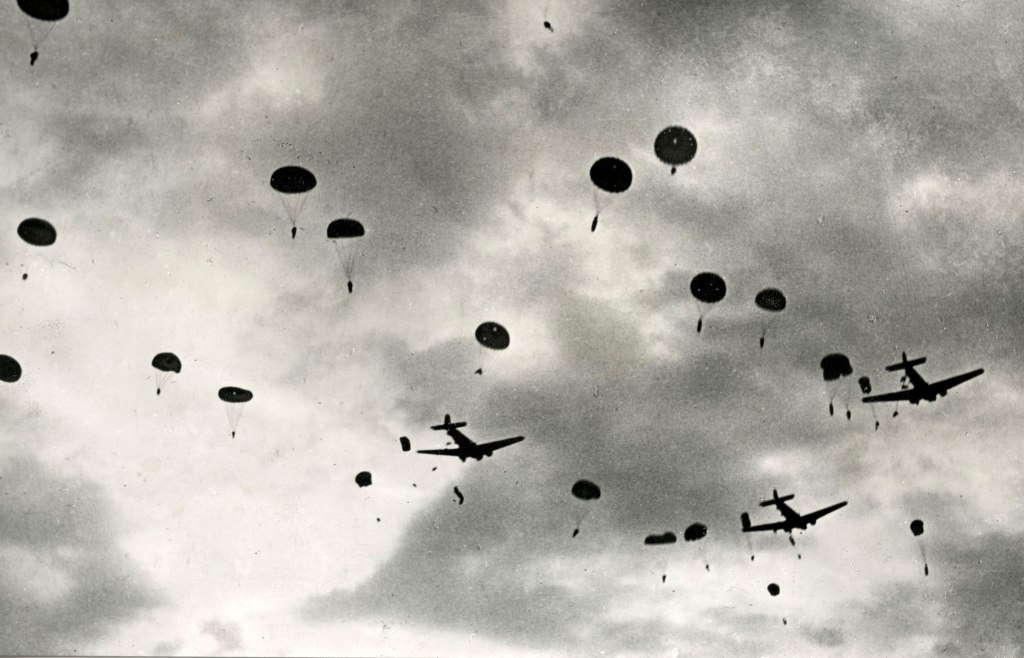
Unternehmen MERKUR — Operation MERCURY — commences. It is treated lightly by the Wehrmacht, almost as an afterthought to Operation MARITA, and Adolf Hitler spends little time on it. The operation is directed by General Kurt Student in the King George Hotel in Athens and is exclusively a Luftwaffe operation (though reinforcement of the initial lodgement by sea is contemplated). The British know the Germans are coming from their Ultra decrypts, but there remains a gap between knowing the invasion is coming and being able to stop it.
The Battle of Crete began with an airborne invasion by the Germans. Operation MERKUR (“Mercury”) began at 6:30 AM as German aircraft take off from fields in Greece. The airborne assault began at 0800 hours, targeting Maleme airfield on the northern coast of Crete. The drop of the first wave of German paratroops went off almost without a hitch and contrary to expectations, losses of transport aircraft were few. Only 7 of the Ju52s deployed failed to return to their bases in Greece. But during descent and landing, the paratroops were met by strong defensive fire. Many companies of troops were too widely dispersed; they suffered heavy losses and were virtually incapable of going on the offensive. Thus they failed to capture the important Hill 107 near Maleme airfield which was being held by New Zealanders. German airborne infantry who made glider landings in the rocky terrain, also met surprisingly vigorous Allied fire and suffered far higher losses than they predicted. Instead of carrying out their assignment to secure the landing zone, they were immediately put on the defensive. General Meindl was one of the casualties of the first wave. When news reached Greece that Meindl was out of action, Hermann Bernhard Ramcke, who was then between assignments, decided to accompany the next wave of Fallschirmjaeger jumping into the Maleme perimeter. He landed at Maleme and took charge of that sector. I. Battalion of the Sturm Regiment is left almost leaderless. The regimental chief surgeon, Dr. Heinrich Neumann, takes over the battalion.
At 1615 hours and 1730 hours, the second airborne assault was conducted at Rethimnon and Heraklion, respectively; 1,856 German airborne troopers were killed during the second attack wave. Meanwhile the second wave of German paratroop regiments were standing by at Greek airfields, waiting for the return of the transport aircraft that were due to drop them on Crete that same afternoon. But the first wave transports were delayed in arriving back at their takeoff bases and most had to be refueled out of portable fuel drums, which was a slow process. It was no longer possible to relay new orders because British agents had cut all the telephone cables between Luftwaffe XI Corps. The Germans therefore attacked Rethimnon and Heraklion at 3.15 PM just as the second wave were about to take-off, the second wave was expected by the defenders and they were shot to pieces by tanks which appeared before they could free themselves from their parachutes, the attacks on the airfields failed. The Germans subjected the towns of Chania, Rethymnon, and Heraklion to severe bombardment prior to dropping their elite parachutists. German gliders and 7th Airborne Division paratroopers landed near the principal airports on Crete, with the mission of securing them for the transport of the 5th Division troops. Many of the gliders crashed and many paratroopers were shot in the air. Local confrontations took place between German paratroopers and allied forces reinforced by the local population.
Second Lieutenant Roy Farran (in command of “C” Squadron of the 3rd King’s Own Hussars) earns the Victoria Cross for actions near Canea. He manages to block a key road with tanks and has his men shoot a group of Fallschirmjäger who have captured a group of 40 hospital patients. Farran later writes that his troops encountered some Fallschirmjäger attempting to surrender. Farran claims to have ordered the surrendering Germans shot. He claimed that this was done on the spur of the moment.
New Zealand General Freyberg, commander of Crete, reporting to Wavell: “At dawn on Tuesday, powerful German forces began heavy assault on Crete. Large numbers of paratroops jumped onto the island, and according to reports received so far, airborne troops have landed in transport aircraft. British and Greek units have engaged the enemy. A number of German paratroops have been killed and captured. The battles are continuing.”
German troops occupy the island of Antikythera, near Crete.
At Suda Bay, Crete, German bombers sank British minesweeper HMS Widnes. After sundown, British destroyers HMS Jervis, HMS Nizam, and HMS Ilex bombarded the German-controlled airfield on the Greek island of Karpathos.
As the day ends, the Germans are in the best shape at Maleme, but even there they have not secured the airfield. During the night, General Student decides to concentrate his entire effort on Maleme and basically leaves the other forces to fend for themselves. He bases this decision on a report that a Ju 52 flown by Captain Kleye managed to land at the airport while only subject to small arms fire. While the planes may be destroyed, this may be a way to get reinforcements to the island.
On the other side, General Bernard C. Freyberg authorizes a pullback at Maleme during the night, leaving Hill 107 uncontested. Freyberg makes plans for a set-piece attack on the 21st using the handful of British tanks available on the island. The entire invasion and control of Crete now depend upon who can concentrate the most force at one point: Maleme airfield.
Wavell has limited options to help on Crete, as he already has a full commitment of the Royal Navy and RAF.
Winston Churchill announces the invasion in the House of Commons in the evening, saying:
“The third matter is not yet known to the House. For the last few day our reconnoitring aeroplanes have noticed very heavy concentrations of German aircraft of all kinds on the aerodromes of Southern Greece…. It is now clear that these concentrations were the prelude to an attack upon Crete. An airborne attack in great strength started this morning, and what cannot fail to be a serious battle has begun and is developing.”
Churchill may be correct in stating that he knew about the German preparations for the invasion due to reconnaissance aircraft, but he is careful not to mention the real source of his information: the Ultra decrypts.
Churchill elaborates on the invasion in a statement:
“After a good deal of intense bombing of Suda Bay and the various aerodromes in the neighborhood, about 1,500 enemy troops, wearing New Zealand battle-dress, landed by gliders, parachutes and troop carriers in the Canea-Maleme area.”
It is unclear why Churchill states that the Fallschirmjäger are wearing Allied uniforms, which would be a violation of the rules of warfare. What is clear now is that they were not, so either Churchill is misinformed or he is lying to the House of Commons intentionally for some reason.
In Malta, there are more Luftwaffe attacks. They damage Luqa airfield, damaging the control tower and destroying Beaufighter on the tarmac. There is one death.
Another mission to ferry planes to Malta, Operation Splice, reverses its feint into the Atlantic from Gibraltar and heads into the Mediterranean. HMS Ark Royal and Furious carry 48 planes for the island.
In London, Prime Minister Winston Churchill on 20 May 1941 decides to support Free French General Catroux in an invasion of Syria. As the War Cabinet minutes state, he decides that “It was worth taking a chance which might come off, rather than watch the Germans establishing themselves in Syria.”
British Middle East Commander General Archibald Wavell transfers the 7th Australian Division (Major General John Lavarack) from Mersa Matruh, Egypt to Palestine. This is a key step in preparing for an invasion of Syria, which the Luftwaffe is using as a transit point for operations in Iraq.
During an appearance in the House of Commons, Prime Minister Winston Churchill describes the recent victory over the Italians at Amba Alagi in Abyssinia. He is careful to give credit to local army commanders Generals Cunningham and Platt, who he says “discharged so well the task assigned to them by the Commander-in-Chief in the Middle East, Sir Archibald Wavell.”
Viceroy of Italian East Africa Prince Amedeo, the Duke of Aosta, surrendered himself into British captivity.
German battleship Bismarck and cruiser Prinz Eugen reach the Norwegian coast, and the accompanying minesweepers are sent back to base. Aerial reconnaissance shows that the Royal Navy Home Fleet remains at anchor at Scapa Flow, Scotland. Pursuant to Operation Rheinübung, Bismarck and Prinz Eugen continue northward along the Norwegian coast to Bergen. At 13:00, neutral Swedish seaplane-cruiser Gotland sights the Bismarck and Prinz Eugen and reports this (through circuitous means) to the Royal Navy. The information was passed on to the British naval attaché in Stockholm, Sweden Henry Denham, who in turn passed it to the British Admiralty.
Apparently completely unconcerned about Operation MERCURY, Adolf Hitler drives down to Munich to spend two days at his old apartment there — and not at nearby Berchtesgaden. What he does during such solitary visits is not known. His next meeting will be on the 22nd.
Prime Minister Churchill takes questions in the House of Commons. Among other things, he refuses requests to appoint a Minister of Civil Defence or a minister devoted to the development of military armored formations.
Prime Minister Churchill noted that he was not prepared to make a statement on the arrival of Rudolf Hess in Britain.
Thomas Adlerson of British Air Raid Precautions was presented the George Cross award by King George VI.
German submarines U-94, U-98, U-109, and U-556 attacked Allied convoy HX.126, 250 miles southeast of Cape Farewell, Greenland, sinking 7 ships.
Former Dutch PM Hendrikus Colijn says the Dutch Indies are not ready for independence
Polish Lieutenant J. Just, a prisoner of war of Oflag IV-C at Colditz Castle in Germany, escaped from the hospital at Villingen, Germany but was captured near Basel on the Swiss-German border.
The Gestapo arrest the Communist and Resistance leader Gabriel Peri in Paris, France.
Minister Karl Schnurre arrives in Helsinki as the German Special Envoy to meet the Finnish President Ryti. He depicts an increasingly tense relationship between the Reich and the USSR. Schnurre also warns about a possible Soviet preemptive attack somewhere along the border, perhaps in Finland.
The Finns agree to his suggestion that they send a delegation to Berlin to coordinate possible responses to a Soviet attack. Field Marshal Mannerheim prepares a delegation to be sent within a few days, led by the Chief of the General HQ, Lieutenant General Heinrichs, accompanied by four other high-ranking officers. They will not be authorized to enter agreements but simply perform some fact-finding.
Completing an arduous journey to which they were not suited, the last of four Italian coastal submarines, Perla, completes its journey to Bordeaux, France from Massawa on the Red Sea. The submarines are too small to carry enough supplies for lengthy journeys, and the sailors become malnourished on the trip around the Cape of Good Hope, but they complete the journey rather than surrender. The submarines now join the other Italian submarines operating in the Atlantic.
A circular issued by the central office of emigration tells German consulates that Göring has banned all emigration of Jews from France and Belgium because of the “doubtless imminence of the final solution.” This is one of the first official references to the “Final Solution” (Endlosung).
It is another quiet day on the Channel Front, with no major air raids. The Luftwaffe engages in some aerial reconnaissance in support of Operation Rheinübung, the sortie into the Atlantic by battleship Bismarck and cruiser Prinz Eugen. The British continue to dig out from the May Blitz which recently ended.
RAF planes attack the Luftwaffe planes based at Mosul, while the Luftwaffe bombs Habbaniya. There are dogfights over Fallujah, just occupied by the British. Four of Habbaniya’s Gloster Gladiators tussle with four ZG 76 Bf 110s. One of the Gladiators is damaged and the German (future night fighter ace) Martin Drewes takes credit for a victory.
Luftwaffe General Hellmuth Felmy takes command of Sonderstab F, which controls air operations in Iraq. He is not the overall commander of German operations in Iraq, though, which are projected to include ground troops.
U-boats attacked convoy HX.126.
U-94, commanded by Kapitänleutnant Herbert Kuppisch, sank British steamer Norman Monarch (4718grt) in 56-47N, 40-55W. At 0458 hours on 20 May 1941 the Norman Monarch in station #91 of convoy HX.126 was torpedoed and sunk by U-94 (Kuppisch). The Harpagus (Master James Valentine Stewart) in station #93 was the designed rescue ship for the column and dropped back to rescue survivors. After picking up the whole complement of 48 men, she set course to regain the convoy. The 4,718-ton Norman Monarch was carrying wheat and was bound for Barry Roads, England.
U-109, commanded by Korvettenkapitän Hans-Georg Fischer, sank British steamer Harpagus (5173grt) in 56-47N, 40-55W. At 0453 hours on 20 May 1941 the Norman Monarch (Master Thomas Alexander Robertson) in position #91 of convoy HX.126 was hit on the starboard side by one of two torpedoes from U-94 and sank about 200 miles south-southeast of Cape Farewell. The Harpagus in station #93 was the designed rescue ship for the column and dropped back to rescue survivors. After picking up the master, 41 crew members and six gunners the ship tried to rejoin the convoy, but was torpedoed and sunk by U-109 (Fischer). The master 19 crew members and six gunners from the Norman Monarch did not survive the second sinking, the remaining 22 crew members were picked up by HMS Burnham (H 82) (Cdr J. Bostock, DSC, RN) and landed at Reykjavik. The 5,173-ton Harpagus was carrying grain and was bound for Barry Roads, England.
U-94, commanded by Kapitänleutnant Herbert Kuppisch, also sank Naval requisitioned Norwegian tanker John P. Pedersen (6128grt) in 57N, 41W. At 1817 hours on 20 May 1941 the John P. Pedersen (Master Hans A. Nilsen), dispersed from convoy HX.126 the same day, was torpedoed by U-94 about 160 miles south of Greenland. One British gunner was lost and 37 survivors abandoned ship in two lifeboats. The tanker was sunk by the U-boat with two coups de grâce fired at 1850 and 1920 hours. 16 survivors in one boat were picked up by the Dutch rescue ship Hontestroom on 23 May and taken to Reykjavik. Four of them joined the Norwegian Navy there, while eight continued to Gourock on board the Dutch vessel. Another three were sent to Preston, while one was briefly admitted to a hospital at Reykjavik. The other lifeboat with 21 survivors, including the master (13 Norwegians, two Dutch, two Swedish and four British) was never found. The 6,128-ton John P. Pedersen was carrying Admiralty fuel oil and was bound for the United Kingdom.
U-556, commanded by Kapitänleutnant Herbert Wohlfarth, sank British tanker British Security (8470grt), British steamer Cockaponset (5995grt), and British steamer Darlington Court (4974grt) in 57-28N, 41-07W. At 1448, 1450 and 1516 hours on 20 May 1941, U-556 fired torpedoes at the convoy HX.126 south of Cape Farewell and sank three ships, the Darlington Court, British Security and Cockaponset.
The British Security (Master Arnold James Akers) caught fire after she was hit and burned for three days until she sank in 57°14N/39°23W. The master, 48 crew members and four gunners were lost. The 8,470-ton British Security was carrying benzine and kerosene and was bound for Bowling, England.
The master and 40 crew members from the Cockaponset (Master Benjamin Green) were picked up by the Dutch rescue ship Hontestroom and landed at Reykjavik on 27 May. The 5,995-ton Cockaponset was carrying steel, carbon black, TNT, trucks, and general cargo and was bound for Cardiff, Wales.
The master, ten crew members and one gunner from the Darlington Court (Master Charles Hurst) were picked up by the rescue ship Hontestroom and landed at Reykjavik on 27 May. 22 crew members, three gunners and three passengers were lost. The 4,974-ton Darlington Court was carrying wheat and aircraft and was bound for Liverpool, England.
U-111, commanded by Kapitänleutnant Wilhelm Kleinschmidt, damaged British tanker San Felix (13,037grt) in 57-32N, 40-21W. At 1644 hours on 20 May 1941 the unescorted San Felix (Master George Wentworth Highley), dispersed from convoy OB.322, was hit by one of two torpedoes from U-111 about 175 miles southeast of Cape Farewell. She escaped in a rain squall with a slight list to starboard after evading a second attack by zagging. The tanker arrived in St. John’s on 26 May. After temporary repairs, she continued to New York after two months and returned to service in October 1941. The 13,037-ton San Felix was carrying ballast and was bound for Curaçao.
U-98, commanded by Kapitänleutnant Robert Gysae, sank British steamer Rothermere (5356grt) in 57-48N, 41-36W. At 1729 hours on 20 May 1941 the unescorted Rothermere (Master George McCartney Sime), dispersed from the convoy HX.126 the same day, was hit in the engine room by one torpedo from U-98 southeast of Cape Farewell. The ship sank by the stern after being hit by a coup de grâce at 1756 hours. The master, 18 crew members and three gunners were lost. 32 crew members, one gunner and one passenger were picked up by the Icelandic steam merchant Bruarfoss and landed at Reykjavik. The 5,356-ton Rothermere was carrying steel, newsprint, and paper pulp and was bound for London, England.
U-138, commanded by Oberleutnant zur See Franz Gramitzky, sank British steamer Javanese Prince (8593grt) in 59-46N, 10-45W. At 2124 hours on 20 May 1941 the Javanese Prince (Master George Gillanders) was hit in the engine room by one of three torpedoes from U-138 and sank slowly 155 miles northwest of the Butt of Lewis, Outer Hebrides. Two crew members were lost. The master, 45 crew members, eight gunners and four passengers were picked up by HMS Faulknor (H 62) (Capt A.F. de Salis, RN), HMS Lincoln (G 42) (Lt R.J. Hanson, RN) and HMS Assurance (W 59) (SubLt E.E. Litts). All survivors were transferred to the rescue ship Toward (Master Arthur James Knell) and landed at Gourock on 28 May. The 8,593-ton Javanese Prince was carrying ballast and was bound for New York, New York.
Italian submarine Otaria badly damaged British steamer Starcross (4662grt) from convoy SL.73 in 51-45N, 20-45W. The entire crew was rescued by Canadian destroyer HMCS St Francis. The steamer was scuttled by the convoy escort.
Heavy cruiser HMS Exeter departed Scapa Flow after refitting, and arrived in the Clyde on the 21st.
Destroyer HMS Brighton departed Scapa Flow at 2000 for Loch Alsh after repairs.
Submarine HMS Truant departed Gibraltar to refit in the U. S. The submarine arrived at Portsmouth, N. H. on 10 June for refitting completed on 16 September.
Status of the Mediterranean Fleet at daylight on the 20th:
Force A-1: battleships HMS Warspite and HMS Valiant with destroyers HMS Kimberley, HMS Isis, HMS Janus, HMS Griffin, and HMS Imperial were west of Crete.
Force B: light cruisers HMS Gloucester and HMS Fiji were en route to join A-1.
Force C: light cruisers HMS Naiad, HMAS Perth and destroyers HMS Kandahar, HMS Nubian, HMS Kingston, HMS Juno were in Kaso Strait.
Force D: light cruisers HMS Dido, HMS Orion, HMS Ajax with destroyers HMS Hasty, HMS Hereward, HMS Hero, and HMS Greyhound were in Antikithera Strait.
Mediterranean Fleet night deployment for 20/21 May:
Force B: light cruisers HMS Gloucester and HMS Fiji swept off Cape Matapan. They were to join A-1 at dawn on the 21st.
Force C: light cruisers HMS Naiad, HMAS Perth with destroyers HMS Nubian, HMS Kingston, HMS Juno, and HMS Kandahar passed through the Kaso Strait to be off Heraklion by dawn on the 21st. In Kaso Strait, the force engaged five Italian MAS boats. No damage was done to either side. Anti-aircraft cruiser HMS Calcutta departed Alexandria to join the Force at daylight on the 21st off Heraklion.
Force D: light cruisers Dido, Ajax, and Orion and destroyers Isis, Kimberley, Imperial, and Janus. They swept through the Antikithera Strait and were to be off Canea by daylight on the 21st to join Force A 1.
Force E: destroyers HMS Jervis, HMAS Nizam, and HMS Ilex departed Alexandria at 1400/20th. They bombarded Scarpanto airdrome at 0242 on the 21st, and were joined by anti-aircraft cruiser HMS Carlisle at dawn for protection and joined Force C at daylight.
At 0115/21st, Italian submarine Onice attacked destroyer HMAS Nizam of Force E, eight miles south of Kaso Strait without success.
Force C was attacked by torpedo carrying aircraft near Kaso Strait at 2040. The attacks were unsuccessful. An hour later, six Italian motor torpedo boats attacked Force C and were engaged by anti-aircraft cruiser HMS Naiad and destroyers HMS Juno and HMS Kandahar. The British force claimed sinking one MAS boat and damaging two, but no damage was done to either side. Italian steamer Padre Eterno (52grt) was sunk north of Canea by Gunfire.
Greek steamer Aghios Georgios (194grt) was sunk by shell fire off Crete.
Italian destroyer escort Curatone was sunk by Greek mines in the Gulf of Athens.
Minesweeper HMS Widnes (Lt Cdr R. B. Chandler) was badly damaged by German bombing at Suda Bay. The minesweeper was run aground a total loss.
Armed trawler HMS Kos XXIII (353grt, Lt Cdr J. J. Reid RNVR) was badly damaged by German bombing in Suda Bay. The trawler was declared a total loss on the 23rd. T/Lt (E) S. N. Gustavsen RNR and T/Lt (E) R. S. Taylor RNR, were taken as prisoners of war.
British cruiser minelayer HMS Latona arrived at Gibraltar with stores and personnel for the Eastern Mediterranean. After embarking Oerlikon guns from aircraft carrier HMS Furious, the minelayer departed Gibraltar on the 21st for Freetown and beyond. The minelayer was ordered to return to Gibraltar on the 23rd, but the message was not received and the ship continued to Freetown.
Submarine HMS Urge unsuccessfully attacked Italian destroyer Alpino in 35-42N, 12-24E.
Italian steamer Zeffiro (5165grt) was sunk and Italian steamer Perseo (4856grt) damaged 5.8 miles 130° from Cape Bon on a newly laid Italian minefield.
Convoy HX.128 departed Halifax, escorted by armed merchant cruiser HMS California, corvettes HMCS Alberni and HMCS Rimouski, and escort ships HMCS Sennen, HMCS Totland, and HMCS Walney. The corvettes were detached later that day.
Convoy BHX.128 departed Bermuda on the 18th escorted by ocean escort armed merchant cruiser HMS Montclare. The convoy rendezvoused with convoy HX.128 on the 27th and the armed merchant cruiser was detached.
Battleship HMS Revenge joined the convoy on the 28th. On the 30th, destroyer HMS Burwell joined the escort. Corvettes HMCS Hepatica, HMS Hydrangea, HMS Tulip, and HMCS Windflower joined on the 31st. On 1 June, battleship Revenge and corvettes Hepatica and Windflower were detached and minesweepers HMS Hebe, HMS Seagull, and HMS Sharpshooter joined. On the 2nd destroyers HMS Malcolm and HMS Scimitar and corvette HMCS Mayflower joined and corvette HMCS Trillium, which had joined, was detached. Destroyer HMS Ripley joined on 3 June. Destroyers Burwell and Malcolm and corvette HMCS Spikenard, which had joined, were detached. The convoy arrived at Liverpool on 6 June.
In Washington today, President Roosevelt announced the appointment of Mayor La Guardia of New York to head the Home Defense program. His callers included Secretary Stimson, W. Bostrom, Swedish Minister; Senator George, chairman of the Foreign Relations Committee, and Bernard Baruch.
The Senate passed the bill making the Office of Government Reports an independent agency, received the President’s relief appropriation message, completed Congressional action on the bill calling for acquisition of fifty-nine naval auxiliary vessels, and adjourned at 5:29 PM until noon Friday. The Education and Labor Subcommittee heard C.I.O. opposition to the Ball Strike Mediation Bill; the Naval Affairs Committee heard support of the bill to prohibit unauthorized photographing of naval equipment; the Interstate Commerce Subcommittee questioned James L. Fly, FCC chairman, on a possible Western Union-Postal Telegraph merger.
The House passed the bill authorizing the Maritime Commission to establish a shipping priorities program, received the Connery bill for an amusement tax on radio stations, received the President’s relief appropriation message, received the President’s letter on the oil situation and the Cole bill for construction of oil pipe lines to the Atlantic Coast and adjourned at 3:18 PM until noon tomorrow. The Ways and Means Committee continued hearings on the new tax bill; the Rules Committee approved rules for the bill extending the President’s monetary powers and for the bill authorizing special civilian police for naval shore stations.
In a special message to Congress today, President Roosevelt called for a reduction of $109,000,000 in his original budgetary request of $995,000,000 to operate the Work Projects Administration during the fiscal year beginning July 1. The President said, however, in asking for $886,000,000 to provide direct employment for an average of 1,000,000 persons on relief jobs, that “we cannot anticipate an increase in employment in the same proportion as the increase in expenditures” under the defense and lease-lend programs. He called for removal of Congressional curbs against employing persons on WPA jobs more than eighteen months at a time and against the employment of aliens. Mr. Roosevelt’s request for the relief appropriation followed the intimation by Secretary Wickard in a Kansas speech that the President intended to approve a bill providing $450,000,000 in farm loans in addition to $500,000,000 to be awarded the farmers under the soil conservation program, and Mr. Roosevelt’s own statement indicating that funds for the National Youth Administration and Civilian Conservation Corps should not be cut.
Speculation over the next foreign-policy move of President Roosevelt continued at high pitch tonight after the President had gone through another press conference without disclosing more than his plan for civilian defense in the United States.
The House adopted today a drastic new emergency program for United States shipping. The lower chamber passed and sent to the Senate a bill empowering President Roosevelt to control the movements, cargoes and rates of all ships registered or doing business in this country. The bill has two main objectives: first, to force United States ships to cooperate with the Administration’s policy of building up the defense of this country and the belligerent democracies; and second, to control import commodity prices by limiting transportation costs. A move by a Republican minority to amend the measure to forbid the entrance of United States ships into the Red Sea was defeated by voice vote. The amendment was introduced by Representative James C. Oliver of Maine, who urged the House either to keep American vessels out of the Red Sea or to have them convoyed.
Charles A. Lindbergh, scheduled to speak in Philadelphia May 29 under the sponsorship of the America First committee, today was denied the use of the Academy of Music. John Frederick Lewis, president of the Academy Corp., said he refused to rent the academy to the committee “because the audiences Lindbergh attracts are Communists and Nazis and enemies of our American form of government.” “The heads of the America First committee are not objectionable,” he said, “they’re isolationists and idealists, but the mobs that come to hear Lindbergh are lovers of Germany and haters of democracy.”
In an article entitled “Reaffirmation,” published by The Atlantic Monthly yesterday, Anne Morrow Lindbergh, wife of Charles A. Lindbergh, said her “heart” urged her to aid Britain but her “mind” questioned the wisdom of such a course and warned of its dangers to this country.
A drive to recruit a million or more volunteers to man the home defenses in any wartime emergency tonight became one of the first objectives of the newly created office of civilian defense. Officials obviously expected a large proportion of the men to come from the vast reservoir of young, physically-able man power known to the draft organization as class 6-A men given a deterred status because they have dependents to support.
Relations between the United States and the Vichy government were the subject of plain talk during an hour’s conference in Washington today between Secretary of State Cordell Hull and Gaston Henry-Haye, the French Ambassador. It was their first meeting since the agreement for collaboration between Vichy and Berlin was announced. The immediate purpose of the ambassador’s call was to protest against the taking into protective custody of the liner Normandie and ten other French ships in American ports, but the conversation ran far beyond that incident. M. Henry-Haye outlined plainly the difficulties his country had faced ever since its capitulation. He declared that France would resist any attempt to take over any part of her empire.
The Saturday Evening Post, which previously has followed a non-intervention policy, gives its support to the administration in the “American crusade” against totalitarianism in an editorial this week.
Striking A.F.L. and C.I.O. machinists today overwhelmingly rejected California Gov. Culbert L. Olson’s personal plea that they recede from their wage and hour demands and go back to their jobs in 11 bay area shipyards.
C.I.O. workers voted tonight to strike at the Carborundum Co.. manufacturer of abrasive wheels and materials which, the firm said, are used in “practically every defense industry in the nation.” Charles A. Doyle, C.I.O. district organizer, announced the vote as 582 for a strike and 32 against. The strike has been called for May 26.
The 48 states again will celebrate Thanksgiving on the traditional last Thursday in November because, in the words of President Roosevelt, advancing the date failed to accomplish its purpose. The change will not occur until next year, however, so calendars, football schedules and sales campaigns will not be thrown out of kilter. For 1941, as he has done for the last two years, Mr. Roosevelt will proclaim the next to the last Thursday in November to be Thanksgiving day. That will be Nov. 20. When he announced in August, 1939, that he was advancing the date, the president said retailers wanted the change because they figured business would bo better if there were a longer interval between Thanksgiving and Christmas. Besides, he said, Thanksgiving had not always been celebrated on the final Thursday in November. A check was made on the economic aspects of the situation, and Mr. Roosevelt told his press conference today that the commerce department had found that a majority of retail stores agreed that the shift had made little difference in their sales. The net results of the surveys made it appear that Thanksgiving had little relation to business.
U.S. President Franklin D. Roosevelt issued Executive Order 8757 creating the Office of Civilian Defense (OCD) within the Office of Emergency Planning in the Executive Office of the President. The OCD replaced the Council of National Defense and Roosevelt named New York mayor Fiorello La Guardia as its first director.
TG 2 (Rear Admiral Robert C. Giffen), comprising carrier USS Wasp (CV-7) (VF 71, VS 72, VMB 2), heavy cruiser USS Quincy (CA-39) and destroyers USS Livermore (DD-429) and USS Kearny (DD-432), departs Bermuda to conduct a 4,170-mile neutrality patrol that will conclude at Bermuda on 3 June.
Royal Navy submarine HMS Truant departs from Gibraltar to refit in the United States at Portsmouth, New Hampshire.
Ninth “Lake”-class Coast Guard cutter, authorized for transfer on 10 April under Lend-Lease, is turned over to the Royal Navy: The USCGS Shoshone became the HMS Landguard (Y 56) (see 30 May).
The Los Angeles Times reports that the mother of Desi Arnaz, who is a U.S. citizen at least since marrying Lucille Ball on 30 November 1940, is told that she must return to Cuba (which she has left for Mexico) in order to emigrate to the United States with a quota number. The Arnaz family is not welcome in Cuba since Fulgencio Batista seized the family’s properties in the 1930s. Note that Arnaz did not mention this in his autobiography “A Book” (1976), where he states that the family fled to Miami.
Major League Baseball:
Earl Johnson, youthful Red Sox left-hander, ruined Hal Newhouser’s twentieth birthday party today, letting the Tigers down with four hits as his team snapped its five-game losing streak with a 4–2 triumph. Johnson held the Detroit team in complete subjection, mowing the Bengals down virtually in order in the first five innings. The first blow off his delivery was Frank Croucher’s double in the sixth but Earl erased that threat with a pair of strikeouts. Charlie Gehringer doubled in the seventh but died on base. Not until the ninth did the Tigers cross the plate. Then Paddy Mullin singled and came home on Rudy York’s home-run hoist into the left field screen. The Sox gave Johnson an early start in the first when Dom Di Maggio and Lou Finney drew successive walks. After Ted Williams had driven into a twin killing, DiMaggio romped home on a solid single to right by Jimmy Foxx. In the seventh Williams singled and Foxx drew a pass, both advancing on Joe Cronin’s infield tap. Odell Hale was walked intentionally and Lamar Newsome singled sharply to left to send home Williams and Foxx. Hale scored the final tally on Johnny Peacock’s infield roller.
Today the Cubs finished the sweep of the three-game series with the Dodgers behind the first-class pitching of Bill Lee, the score being 9–1. Kirby Higbe made his ninth start and for the second consecutive time failed to finish, being charged with his third setback against three victories. One big inning, prevented from being much more fruitful by Peewee Reese’s great defensive play on Augie Galan’s infield hit, sufficed to put the game in the Cubs’ locker. That was the fourth, when they assailed Higbe for six singles and three runs. Peewee’s play came on the fourth hit of the frame, with one run in and Cubs on first and second. He went far to his right to snare Galan’s blow and tossed the ball to Cookie Lavagetto, who fired it home to Mickey Owen. Phil Cavarretta was trapped and eventually run down for the first out. Singles by Clyde McCullough and Lou Stringer followed to complete the inning’s run total. Then an attempted double steal by McCullough and Stringer brought nothing but a bitter protest from Manager Jimmy Wilson to Al Barlick. In the eighth, against Newell Kimball, who took over after Higbe had gone out for a pinch-hitter, the Bruins reversed the procedure of the fourth by collecting six runs on three hits.
At Crosley Field, the Reds score 6 runs in the 9th to defeat the Braves, 9–6. Frank McCormick’s seventh home run of the year, coming with the score tied, two out and two on, capped the six-run explosion that knocked Casey Stengel’s crew out of what looked like an easy decision in the final game of the series. Up to that time the Braves had pecked away at Gene Thompson, who has yet to win a game for the Reds this year, Whitey Moore and Elmer Riddle for their six runs.
In the ninth inning of the Yankees-Browns game today, two were out and Tommy Henrich was on second, when Charlie Keller slapped a grounder to George Caster. The St. Louis pitcher wrestled with it for a moment and then threw wide to first. Meanwhile, Henrich was tearing around the bases. By the time Tommy discovered that the Killer was safe at first, he himself was halfway home. So he kept moving, slid under the throw by the proverbial eyelash and won a weird battle for New York, 10–9. Red Ruffing started on the hill for the Yankees, but gave way to Johnny Murphy in the seventh. Johnny was thumped nobly and was driven to shelter in the ninth, Norman Branch staggering to his first major league victory in a wild last frame. Elden Auker started for St. Louis, but was removed in the eighth, Caster finishing.
The Athletics mauled the league-leading Indians again today, 6–5, to sweep the three-game series. Rookie Pitcher Tom Ferrick starred once more in a relief role. Ferrick, who gave the Indians only four hits in four and two-third innings after replacing Johnny Babich in Sunday’s game, succeeded Nelson Potter in the eighth today after Potter had walked the first two men to face him. Ferrick ended the game in prompt fashion, not permitting a man to reach first base in the two innings he pitched. The victory, however, went to Bump Hadley, his second since joining the A’s recently. Hadley went into the seventh with a 6–2 lead but was knocked out before retiring a man. Jeff Heath led off with a homer. Walker and Ray Mack followed with singles and Luman Harris replaced Hadley. Walker later scored on Campbell’s grounder and Mack came home on Lou Boudreau’s single. Potter started the eighth, but lacked control and gave way to Farrick.
With a reckless abandon quite astounding, the Giants dropped two runs in the laps of the Pirates. To these notable contributions Pittsburgh added a few lusty blows, including triples by Loe Handley and Elbie Fletcher and a homer by Arky Vaughan, and it all added up to a 7–5 victory for the Corsairs. That gave the Pirates the series, two out of three, elevated them from seventh to sixth place and sent the Giants rather dejectedly on his way to Cincinnati. The decisive blows fell-in the seventh when, with Hal Schumacher and Bob Klinger locked in a 4–4 deadlock, the Pirates resolutely took matters in their own hands. Handley tripled to right center and Bob Elliott singled him home, where. upon Cliff Melton replaced Schumacher on the mound. Vaughan promptly homered to right field.
With the Phillies down 4–0, the Phillies’ George Jumonville hits a pinch homer into the left-field bleachers, his only home run in the majors, and the Phillies come back to top the Cards in 11 innings, 6–4. It is Jumonville’s last Major League at bat. The game went into extra innings after a play at the plate cut off a threatening Philly rally in the ninth. After one out, Ben Warren and Harry Marnie singled in succession. Ike Pearson, who had relieved Si Johnson on the mound, was safe at first as Eddie Lake fumbled his infield blow, but Lake recovered in time to nip Warren at home. In the eleventh Emmett Mueller was hit by a pitch of Ira Hutchinson. Bob Bragan forced him at second. Warren singled Bragan to third and Marnie drove him home. After Pearson struck out, Merrill May singled Warren across the plate. Pearson received credit for the victory, allowing only one hit in his five innings of relief work.
Outfielder Taft Wright of the Chicago White Sox doubles to drive in a run and sets an American League record by driving in at least one run in 13 consecutive games. Wright has 22 RBI in the streak, although in 6 of the games he knocked in a run without a hit. Lefty Thornton Lee held the Senators to five hits and recorded the 5–2 victory for the Sox. Dutch Leonard took the loss for Washington.
Detroit Tigers 2, Boston Red Sox 4
Brooklyn Dodgers 1, Chicago Cubs 9
Boston Braves 6, Cincinnati Reds 9
St. Louis Browns 9, New York Yankees 10
Cleveland Indians 5, Philadelphia Athletics 6
New York Giants 5, Pittsburgh Pirates 7
Philadelphia Phillies 6, St. Louis Cardinals 4
Chicago White Sox 5, Washington Senators 2
Thirty-two members of the Popular Socialist Vanguard organization, formerly known as Chile’s Nazi party, were held tonight in Santiago, Chile on charges of plotting a second Putsch against the government.
In the Indian Ocean, German raider Orion turns toward home. It will have to round the Cape of Good Hope, and South Africa is a British ally, so this is a dangerous trip. This will be a leisurely journey. The Orion carries a Japanese floatplane, which it acquired from supply ship Münsterland on 1 February.
The Japanese launch the Jidong Operation. Its goal is to capture the eastern part of Hebei Province.
Chinese Communists form the CCP Central China Bureau.
A Mitsubishi A6M “Zero” fighter is shot down by the Chinese over the city of Chengdu, north of Chungking. The wreckage is examined and details sent to the U.S. Naval Attaché. Marine Corps Major James McHugh gets drawings and data on the plane and passes them along both to the Navy Department in Washington and (much later) to Flying Tigers commander Claire Chennault. The Chinese drawings and analysis are good as far as they go, but the Zero’s tail has been destroyed and this part of the fuselage remains a mystery to the Allies. Important information about the Zero is ignored because senior officers in the USAAF do not believe that the Japanese Zero could be capable of such performance.
Secretary of State Cordell Hull’s speech in defense of free trade and freedom of the seas aroused Japanese press charges that the United States and Great Britain had killed both, thus precipitating the present war.
Japanese ambassador to Washington Kichisaburō Nomura sent confirmation to Tokyo that the Americans were reading some of their coded messages. However, he claims that the most important diplomatic codes are still secure — when in fact they are not.
The resolution adopted by the United States, Congress applying the export licensing system to the Philippines will have if it becomes law the greatest effect on Japanese residents having large investments in hemp plantations. Their exports to Japan presumably would be cut off entirely through application of the control system.
New Zealand Division light cruiser HMS Achilles escorted British steamer Rangatira (6152grt) from Auckland to Fiji, and arrived back at Wellington on 2 June.
Dow Jones Industrial Average: 117.65 (+1.5)
Born:
Goh Chok Tong, 2nd Prime Minister of Singapore (1990-2004) and Senior Minister (2004-11), in Singapore, Strait Settlements.
Gia Maione Prima, American singer and fifth wife of band leader Louis Prima, in Roebling, New Jersey (d. 2013).
John Strasberg, American acting teacher and founder of John Strasberg Studios, in New York, New York.
Naval Construction:
The U.S. Navy YMS-1-class auxiliary motor minesweeper USS YMS-54 is laid down by the Gibbs Gas Engine Co. (Jacksonville, Florida, U.S.A.).
The U.S. Navy PC-461-class (173-foot steel hull) submarine chaser USS PC-552 is laid down by the Sullivan Dry Dock and Repair Co. (Brooklyn, New York, U.S.A.).
The Kriegsmarine (German Navy) Type VIIC U-boats U-615 and U-616 are laid down by Blohm & Voss, Hamburg (werk 591 and 592).
The Royal Navy Flower-class corvette HMS Pink (K 137) is laid down by Henry Robb Ltd. (Leith, U.K.); completed by the Ailsa Shipbuilding Company Ltd. (Troon, Scotland)and N.E. Marine.
The U.S. Navy Benson-class destroyer USS Barton (DD-599) is laid down at the Bethlehem Steel Co. (Quincy, Massachusetts, U.S.A.).
The U.S. Navy 77-foot Elco patrol motor torpedo boat USS PT-28 is launched by the Electric Boat Co., Elco Works, Bayonne, New Jersey.
The U.S. Navy acquires three ships which will be converted to escort aircraft carriers, one for the U.S. and two for the Royal Navy, entering service as the USS Charger (AVG-30, later CVE-30), HMS Avenger (BAVG-2, later D 14), and HMS Biter (BAVG-3, later D 97).
The Royal Navy Fairmile B-class motor launch Motor Launch ML 185 is commissioned.
The Royal Navy Fairmile B-class motor launch Motor Launch ML 264 is commissioned.
The Koninklijke Marine (Royal Netherlands Navy) submarine depot ship HrMs (HNMS) Colombia [former passenger ship] is commissioned at Dundee, Scotland, U.K. Her first commanding officer is kapitein-luitenant ter zee (Cdr.) Cornelis Hellingman, DSO, RNN.
The Royal Navy Banff-class sloop HMS Landguard (Y 56) [formerly the USCGS Shoshone] is commissioned. Her first commanding officer is Lieutenant Commander (emergency) Rowland Etienne Sinclair Hugonin, RN.

