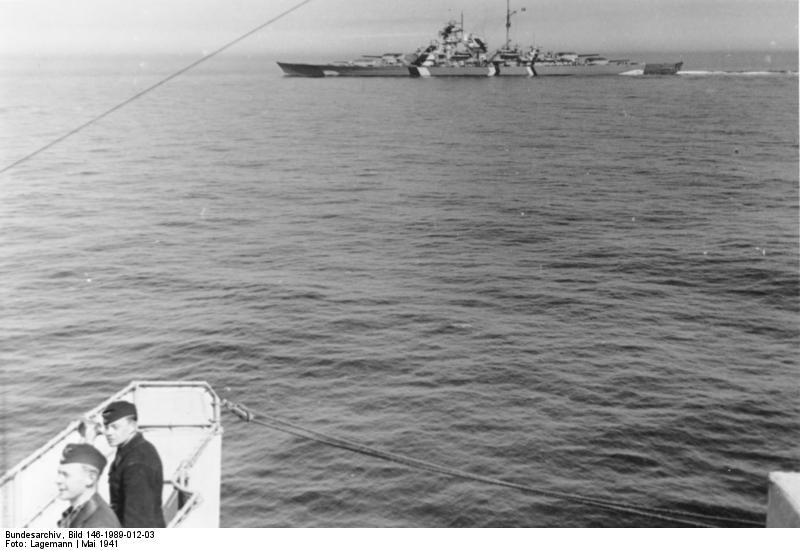
The Germans launched Operation RHEINÜBUNG, a sortie into the Atlantic to block Allied shipping to England. The German battleships Bismarck and Tirpitz made a six hour maneuver early in the day. This was the only time the two ships ever operated together. Bismarck and heavy cruiser Prinz Eugen make preparations to leave Gdynia (Gotenhafen). Admiral Lutjens, a hero of the invasion of Denmark and Norway (Operation WESERÜBUNG) and the daring sortie by heavy cruisers Scharnhorst and Gneisenau earlier in the year (Operation BERLIN), and also Commander of Battleships and the third Flottenchef (Fleet Commander) of the Kriegsmarine, is in command of the operation. At 10:00, Lutjens inspects Prinz Eugen’s crew, then holds a commanders’ conference on Bismarck with Kapitän zur See Harald Netzband (Lütjens Chief of Staff), Generaladmiral Alfred Saalwächter (Commanding Officer, Group West) and the two commanding officers of Bismarck (Lindemann) and Prinz Eugen (Brinkmann). Lutjens briefs them on the mission and informs them that the ships will sail north along the Norwegian coast and refuel from tanker Wesenburg, then proceed through the Denmark Strait to the open Atlantic.
Prinz Eugen leaves port for Operation RHEINÜBUNG at 21:00. The Bismarck waits until the morning of the 19th. In Scapa Flow, Admiral Tovey has received reports (possibly through Ultra) of such a sortie, and today he gives cruiser HMS Suffolk, on patrol in the Denmark Strait, orders to keep a close watch for German ships.
A key feature of Operation RHEINÜBUNG is the Kriegsmarine’s supply network in the Atlantic, so far relatively undisturbed by the Allies. German 9789-ton tanker Egerland relieves tanker Nordmark today, and the latter proceeds to the Bay of Biscay and, ultimately, Hamburg.
The Italian High Command in Rome issues a communique stating in part that “Our counteroperations against the Allies in North Africa have been completely successful.” This is close to the truth, as the British still retain Halfaya Pass but otherwise have relinquished their recent gains from Operation BREVITY. That Rome is announcing this success rather than Berlin is an expression of Hitler’s desire to make Mussolini and his military seem more imposing than most think that they are.
The activity on the Operation BREVITY front in southeast Libya dies down, and the opposing forces settle down to garrison duty. General Erwin Rommel, in command of the Afrika Korps, begins planning an attack on Halfaya Pass to restore his original lines.
Everyone’s attention now shifts to Crete, which the Luftwaffe is preparing to invade with airborne troops and British Prime Minister Winston Churchill knows is next on the German docket of operations through Ultra decrypts. Churchill sends messages full of foreboding to Mediterranean Fleet commander Admiral Sir Andrew Cunningham and the commander of British forces on Crete, General Freyberg, telling Freyberg that these are “fateful days” and Cunningham that the outcome of the battle will “affect whole world situation. Hitler, meanwhile, has pawned the difficult Operation MERCURY off on Hermann Göring and shows very little interest in it. The British codename for the defense of Crete is Operation SCORCHER.
The British continue reinforcing Crete, which already is packed with soldiers who basically are refugees from the failed campaign on the mainland. After sunset, 700 Argyle and Sutherland Highlanders arrive at Tymbaki, Crete from Port Said on troopship Glengyle.
German dive bombers attacked British hospital ship Aba 50 miles south of Crete, Greece. Petty Officer Alfred Sephton of British light cruiser HMS Coventry won the Victoria Cross for directing anti-aircraft fire against the German aircraft despite being partially blinded by a machine gun bullet; he would die from his injuries on the next day. In anticipation of a German invasion of Crete, Greece, 700 Argyle and Sutherland Highlanders were transported from Port Said, Egypt, on troopship Glengyle; they would land at Tymbaki, Crete after sundown.
At Malta, it is another quiet day, as the Luftwaffe merely carries one reconnaissance flight without incident. RAF reconnaissance reports that a hospital ship, apparently the Aba which had been attacked by Luftwaffe planes on the 17th, was approaching the island.
A force of 23 men from the Hagenah’s maritime section leaves the port of Haifa bound for Tripoli. Their mission is to blow up refineries there and blow them up. The mission is a complete failure and, after landing, the force disappears.
British aircraft from RAF Habbaniyah bombed Iraqi positions in Fallujah throughout the day. Meanwhile, Arab troops loyal to Britain relieved the besieged RAF Habbaniyah which was defended only by out-of-date training aircraft. The base had been under attack from the pro-German forces of General Rashid Ali using Bf 110 and He 111 aircraft.
Luftwaffe Special Force Junck (Sonderkommando Junck), after only a few days at Mosul, already as of 18 May 1941 has suffered a 30% attrition rate. Luftwaffe Oberst Werner Junck now has 8 Messerschmitt Bf 110s, 4 Heinkel He 111s, and 2 Junkers Ju 52s. Oberst Junck also has few bombs or supplies, so repairing his planes requires cannibalizing others. After his fierce introduction to the theater, Junck begins husbanding his forces and avoids engagements pending further reinforcements — whenever they might arrive.
The British advance on land continues, with a company of King’s Own Royal Regiment being transported by air on the road to Baghdad. The RAF pounds Fallujah, which troops of column Kingcol are approaching. In addition, the British bomb airfields in Syria being used as transit points by the Luftwaffe.
Air Vice-Marshal Harry George Smart, who heroically has been in command at Habbaniyah, is relieved of command now that Kingcol has arrived. In a murky incident, Smart suffers some kind of mental breakdown due to the strain of command. He is taken to Basra aboard a DC-2 for transport back to England and is replaced by Air Vice Marshal John Henry D’Albiac in command of the RAF in Iraq.
General Mosley Mayne, British commander of Indian 5th Division, had lunch with Italian commander Duke of Aosta at Amba Alagi, Abyssinia. The Italian duke agreed to not destroy guns, to not destroy supplies, and to dismantle or identify mines.
With surrender to the British agreed to on the 17th, the Duke of Aosta prepares to march out of his fortress of Amba Alagi with his 18,000 troops on the 19th. The Italians will exit in parade formation and temporarily be permitted to keep their rifles. The entire affair is quite cordial, and the Duke lunches with General Mosley Mayne, the British commander of the 5th Indian Division in the Duke’s mountain cave. Both sides adhere to the agreement scrupulously, with the Italians leaving their installation intact and the British not molesting their captives.
Prince Aimone was designated King of Croatia in a ceremony at the Quirinal Palace in Rome. He accepted the title and took the regnal name of Tomislav II but would never actually rule in Croatia. The governments of the Independent State of Croatia and Italy concluded an agreement called the Contracts of Rome. Among other items the agreement created the Kingdom of Croatia with the Italian Duke of Spoleto becoming King Tomislav II. The Duke of Spoleto would never visit his kingdom. Count Ciano writes: “The Croatians arrive with Pavelich at their head. They are in good humor and well-disposed toward us. I should say that they are better disposed than the Albanians when they offered the crown. The ceremony is more or less the same as that with the Albanians. In the streets, few and undemonstrative people. Not many realize the importance of the event. When His Majesty designated the Duke of Spoleto and the delegates saw him, there was a murmur of approval among them. Let us hope that it will be the same when they hear him speak. Everything went in due form; also the signing of the Acts, the content of which seemed to those who had knowledge of them to bear a better political meaning than was expected. It now remains to be seen if what we have built will be lasting. Maybe I am mistaken in my personal impression, but there is a feeling in the air that Italian domination in Croatia is to be temporary. And this is why the public is indifferent…”
The new king gets off to a bad start by refusing to go to Duvno (Tomislavgrad) in Croatia for the investiture, preferring to remain in Rome. This is probably prudent since within the past few days an assassination attempt on King Victor Emmanuel failed while he was visiting Albania. Prince Aimone never will go to Croatia, preferring to rule from Italy and Hungary. In any event, Prince Aimone is merely a figurehead for Pavelić.
Italy annexed Dalmatia into its borders. The Italians get the coastal area of Split and Kotor and a large area around Zara. Italian troops are permitted access to all areas of Croatia. The Germans also maintain a military sphere of their own in Croatia which is unaffected by the Italian/Croatian agreements.
While the Germans have reached an agreement with Vichy French Vice Premier Admiral Darlan on several matters, the agreement remains uncertain. Adolf Hitler is unhappy with Foreign Minister Ribbentrop and Ambassador Abetz for making too many concessions (release of French prisoners in exchange for transit rights in Syria), and lets loose one of his famous rants at Ribbentrop’s expense. Hitler also has mixed feelings about how to treat France, feeling that the Vichy regime is unstable and the entire country will have to be invaded at some point. At this time, however, no changes are made in any agreements with the French. Somewhat tellingly, he is more concerned about the French today than he is about the imminent invasion of Crete.
Winston Churchill responds to a request by General Ismay and Viscount Cranborne for armaments sales to the government of Eire by stating in part:
“I do not object to the ten Hector aircraft being given to Southern Ireland, nor to their purchasing the one Hurricane and one Hudson which are interned there. I do not like giving them Vickers guns, or all these demolition materials… because they are much more likely to be used against us if we march down from the North than against German invaders, of whose coming there is very little chance.”
He adds that he views the proceeds from any arms sales to Eire as “petty cash.”
In Paris, the Gestapo arrests prominent French Communist journalist and politician Gabriel Péri (Peri). Peri is a strident anti-fascist, and his arrest (and later execution on 15 December at Fort Mont-Valérien) is a galvanizing moment in the growth of the French Resistance.
The Strike of the 100,000 officially ended in Belgium after the German occupiers agreed to raise wages. The German authorities agree to a wage increase of 8 percent, ending the Belgian “Strike of the 100,00.” The strike actually never involved 100,000 workers (more like 70,000), and from now on the occupying force keeps a close eye out for similar disturbances. The Germans also bear a grudge against the Belgian communists who organized the strike, but for the time being, they decide not to act against them to avoid provoking the Soviet Union.
U-126 (Kptlt. Ernst Bauer) is virtually within sight of Bismarck and Prinz Eugen at Gdynia (Gotenhafen) when it collides with U-boat Depot Ship for the 27th U- Boat Flotilla Seeburg. The U-126 is still working up for its first war patrol, and the damage to both ships is relatively minor.
Just after midnight the German commerce raider Atlantis narrowly missed being spotted by the battleship HMS Nelson (28) and an aircraft carrier that were on their way to Gibraltar to join Force H, being assembled to assist in the pursuit of the battleship Bismarck. The British warships passed as close as 7,000 meters of the Atlantis without spotting her.
Soviet leadership began a purge against Soviet Air Force officers. Around this time, the Politburo becomes concerned about the high accident rate in the Red Air Force. The members also are perturbed about a mysterious incident in which a German transport manages to fly into Moscow and land without being detected by the Soviet Air Defense. This incident is poorly understood, with few known facts (it may have been a Junkers Ju 52, a Junkers Ju 88 reconnaissance plane, or perhaps a DC-2 in German civil service). However, what is known with certainty is that it sends Soviet paranoia about pro-German conspiracies within the Red Air Force skyrocketing.
It is a rare day in the northwest European theater when neither the Luftwaffe nor RAF Bomber Command launches any major operations.
RAF Bomber Command, Night of 18/19 May 1941
Kiel
70 aircraft — 33 Wellingtons, 19 Whitleys, 18 Hampdens — to shipyards and the city. No losses. Kiel reports only a light raid with no serious damage but 5 people killed and 10 injured.
Minor Operations: 3 Whitleys to Emden, 4 Hampdens minelaying off Kiel. No losses.
The Luftwaffe lands planes on mainland Greece, in the north, and in Attica in the south, in preparation for Operation Mercury.
U-107, commanded by Kapitänleutnant Günter Hessler, sank British steamer Piako (8286grt) in 7-52N, 14-57W. At 2227 hours on 18 May 1941 the unescorted Piako (Master Benjamin Evans) was hit underneath the bridge by one torpedo from U-107 about 130 miles southwest of Freetown, stopped, sent distress signals and was abandoned by the crew. A coup de grâce was fired at 2243 hours, which hit in the after part, broke off the stern and caused the ship to sink. Ten crew members were lost. The master, 62 crew members and two gunners were picked up by HMS Bridgewater (U 01) (Cdr H.F.G. Leftwich, RN) and landed at Freetown. The 8,286-ton Piako was carrying refrigerated goods, zinc, butter, meat, and mail and was bound for Liverpool, England.
U-126 collided in Danzig Bay with the German Seeburg and suffered severe damages.
Battleship Bismarck anchored in the bay at Gotenhafen at 1200 hours to embark supplies and fuel for Operation Rheinübung. After sundown, German battleship Bismarck and heavy cruiser Prinz Eugen departed Gotenhafen (now Gdynia). From Cape Arkona on the 19th, the ships were escorted by Sperrbrechers 13 and 31 and destroyers Friedrich Eckholdt and Z 23. Off the Belt, the German ships were joined by destroyer Lody and minesweepers of the 5th Minesweeping Flotilla.
Heavy cruiser HMS Norfolk arrived at Hvalfjord and departed the same day to reinforce heavy cruiser HMS Suffolk on Denmark Strait patrol.
Light cruiser HMS Edinburgh departed Scapa Flow to patrol in the Bay of Biscay.
Light cruisers HMS Manchester and HMS Birmingham departed Scapa Flow to relieve light cruisers HMS Nigeria and HMS Kenya on Faroes Iceland patrol. Light cruisers Nigeria and Kenya were relieved by light cruisers Manchester and Birmingham. Light cruisers Nigeria and Kenya arrived at Scapa Flow from patrol on the 19th. Light cruiser Nigeria departed Scapa Flow on the 19th for repairs at Rosyth, arriving on the 20th.
Naval drifter HMS Jewel (84grt, T/Sub Lt G H.J Cresswell RNVR) was sunk on a mine one mile 215° from Pile Light, Belfast Lough. Cresswell and 13 ratings were lost.
British steamer Begerin (483grt) was sunk by German bombing 17 miles 295° from South Bishops. The entire crew was rescued.
British steamer Eskburn (472grt) was damaged by German bombing off Blyth. The steamer arrived in the Tyne in tow on the 19th.
Free French fishing vessel La Brise (51grt) was damaged by German bombing ten miles west, northwest of Seven Stones Light Vessel. The vessel arrived at Newlyn on the 19th.
After being relieved by German tanker Egerland (9789grt), German tanker Nordmark returned to Germany. The tanker was met on the 18th by destroyers Erich Steinbrinck, Bruno Heinemann, and Friedrich Ihn in the Bay of Biscay. The destroyers were relieved on the 19th in 49-36N, 00-02W by German minesweepers M3, M.4, and M.20. The tanker proceeded up the coast and arrived at Hamburg on the 20th.
Battleships HMS Warspite and HMS Valiant, light cruiser HMS Ajax, and destroyers HMAS Napier, HMS Kimberley, HMS Janus, HMS Isis, HMS Hereward, HMS Decoy, HMS Hero, and HMS Griffin departed Alexandria at 2000 as Force A 1 to relieve Force A off Crete.
Air attacks on Suda Bay damaged heavy cruiser HMS York and corvette HMS Salvia. Both ships were damaged by near misses. The cruiser was further damaged on 18, 19, 20, and 22 May.
Naval tanker RFA Olna (12,667grt) was badly damaged by German bombing in Suda Bay and run aground.
Submarine HMS Tetrarch sank Italian steamer Giovinezza (2362grt), which departed Tripoli for Benghazi escorted by torpedo boat Polluce, in 31-55N, 19-54E off Benghazi.
Battleship HMS Nelson and aircraft carrier HMS Eagle departed St Helena to proceed to Freetown. Destroyers HMS Duncan and HMS Highlander joined on the 21st and were detached for refueling on the 23rd. On the 24th, destroyers HMS Boreas and HMS Velox joined the battleship and aircraft carrier and later that day destroyers Duncan and Highlander rejoined after refueling. All ships arrived at Freetown on the 25th.
Convoy OB.324 departed Liverpool, escorted by destroyer HMS Wanderer and corvettes HMS Auricula, HMS Dianthus, HMS Marigold, HMS Nasturtium, and HMS Periwinkle. The escorted was joined on the 19th by destroyers HMS Campbeltown and HMS Westcott, sloops HMS Fleetwood and HMS Rochester, and sloop HMS Primrose. On the 24th, destroyers Campbeltown, Wanderer, and Westcott, sloops Fleetwood and Rochester, and corvettes Auricula, Dianthus, Marigold, Nasturtium, Periwinkle, and Primrose were detached. Destroyers HMS Chelsea, HMS Verity, and HMS Veteran, and corvette HMS Convolvulus joined. The escort was detached on the 27th when the convoy was dispersed.
U.S. Secretary of State Cordell Hull made a radio broadcast from Washington D.C. in which he stated: ” And so, for the present, our foreign trade consists more and more, and will consist more and more, of making and placing in the hands of nations which are resisting unlawful attack the tools of self-defense. This trade, like all trade, is futile if the goods produced do not reach those for whom they are intended.” Enunciating for the first time the principles which the administration feels should guide the world in the peace following the war, Secretary Hull asserted tonight the United States’ own safety “requires that we see to it that Britain receives adequate supplies.” He declared a paramount purpose of the axis was to secure control of the seas in a program of “world domination.” Discussing delivery of goods to Britain, Hull said in a broadcast address, “We will find a way.” The Secretary of State mentioned no methods, but he made clear his own view that whatever steps were necessary must be taken. It is a wide-ranging speech that emphasizes the importance of free trade despite foreign “conquest.” He enumerates five principles for “world economic reconstruction”:
- Extreme nationalism must not again be permitted to express itself in excessive trade restrictions.
- Non-discrimination in international commercial relations must be the rule, so that international trade may grow and prosper.
- Raw-material supplies must be available to all nations without discrimination.
- International agreements regulating the supply of commodities must be so handled as to protect fully the interests of the consuming countries and their people.
- The institutions and arrangements of international finance must be so set up that they lend aid to the essential enterprises and the continuous development of all countries, and permit the payment through processes of trade consonant with the welfare of all countries.
These principles will guide the main strains of post-war trade theory for decades.
With 200 aliens in custody as a result of the round-ups staged late Saturday night and early yesterday morning in important cities on the Atlantic and Pacific Coasts by immigration authorities, aided by local police forces, spokesmen for the Immigration Service said definitely yesterday that the check-up on individuals who were here illegally would continue.
The Office of Production Management announced today an important priorities innovation, a plan which will be tried experimentally with 500 producers of important tools vital to the defense program and probably will be extended if it fulfills the hopes of E.R. Stettinius Jr., Priorities Director, and other defense officials who believe it will speed defense production and solve many problems confronting manufacturers.
A tentative agreement that will cut short the work stoppage of 91,000 anthracite coal miners, scheduled to become effective this morning, appeared in sight yesterday between representatives of hard coal operators and the United Mine Workers after another conference at the Hotel Commodore.
A strike at the Goodrich rubber plant in Akron, Ohio ends when the CIO workers agree to a $0.06/hour raise. There currently are about 18 other strikes with national defense implications.
Representatives of 18,000 shipyard workers who have been kept from their jobs by the eight-day-old strike of A.F. of L. and C.I.O. machinists in eleven San Francisco Bay area yards voted today to send their men through the picket lines.
Franklin D. Roosevelt Jr., son of the president, was injured early today when his automobile overturned in Walpole while he was en route to Newport, Rhode Islant, naval station where he is on active duty as an ensign. He was taken by a motorist to Phillips house of Massachusetts general hospital where it was said his condition was not serious, and was expected to return to duty shortly. State police said a blowout was responsible for the accident.
Along with the rest of the country, New York City celebrated “I Am an American Day”. Locally the big attraction was on the Mall at Central Park, where hundreds of thousands of persons attended a mass meeting, officially designated as the greatest patriotic gathering the city has ever seen. It was a double-message mass meeting. There were the usual serious speakers, who reminded their hearers that we live in dangerous times. And there were representatives of the lighter side of American life — lusty, shouting singers and comedians — who demonstrated most satisfactorily that to be an American is not merely a matter of grave responsibility but is also a lot of fun. Bill Robinson, the Black tap dancer, promised, for instance, that if Hitler ever started for Harlem he personally would guarantee that he’d never get past Yankee Stadium.
A crowd of 100,000 at Soldier Field and a vast radio audience heard William S. Knudsen, director general of the Office for Production Management, appeal today for more force behind the armament program. Many stage and screen personalities took part in Chicago’s celebration of “I Am an American” Day.
The Bay Cities Metal Trades council voted unanimously today to send 15,000 workers through picket lines at 11 bay area shipyards where work on $500,000,000 in defense contracts has been at a standstill for the past week because of an A.F.L.-C.I.O. machinists strike. The decision was announced by John Frey, international head of the American Federation of Labor Metal Trades union, after a stormy meeting of the council.
A terrific explosion aboard the excursion boat Nightingale off Little River inlet, South Carolina, today killed seven of the 39 passengers and injured 14, one seriously. The boat burned to the water’s edge. The blast occurred while the craft was anchored in a calm sea about 12 miles out. At the time many of the men and women aboard were fishing from the boat under the mid-day sun. Four bodies were recovered. The other three persons missing were given up for dead. Coast guard boats went to the scene but the search for the bodies had to be abandoned at dark.
U.S. Navy auxiliary ship USS Bear (AG-29) reaches Boston, Massachusetts, winding up her work in support of the U.S. Antarctic Service’s 1939-1941 expedition.
Major League Baseball:
Two infield errors in the eleventh inning gave the Tigers two unearned runs and a 6-5 victory over the Red Sox today before 23,000 fans. This easy triumph, the fourth straight, boosted Detroit to third place. The Sox now have dropped their last four games. With one out in the eleventh, Paddy Mullin singled and Dick Newsome, who had relieved Lefty Bob Grove in the eighth, passed Bruce Campbell. Rudy York grounded to Jim Tabor and Campbell was forced at second. While attempting a double play Odell Hale threw the ball into Boston’s dugout and Mullin scored to break the deadlock. York came home from second when Manager Joe Cronin bobbled Charley Gehringer’s grounder. In Boston’s half Jimmy Foxx poled his fifth homer of the season. The Red Sox put on a four-run rally, marked by a Tabor homer, to tie the count against Buck Newsom in the seventh. Al Benton took over and became the winning pitcher.
In a contest of unearned runs today before 26,357 wildly rooting and booing fans, the Cubs proved themselves better harvesters of tainted tallies than the National League leading Dodgers and beat them, 7–4. It was the opener of a three-game set. John Whitlow Wyatt’s string of consecutive triumphs was snapped at seven games and the Dodgers now have a losing streak of two for the first time since they beat the Braves in their fourth game of the season. The only favorable Brooklyn streak that remained is owned by Joe Medwick, whose single in the fifth inning extended his safe hitting to seventeen consecutive games. The defeat snipped a game off the Dodgers’ lead, making their margin over the second-place Cardinals one length. Two Brooklyn errors and three Chicago misplays spotted the game, but in justice to Larry French, he and the Cubs deserved to win. The veteran southpaw outpitched Wyatt and, had both received errorless support, the result would have been a 3–0 Chicago victory.
Paul Derringer, whose victory over Chicago a week ago yesterday was followed by the Reds’ longest losing streak in more than 300 games, ended the setback string at six today by whipping the Braves 4–3. A crowd of 10,599, smallest Sunday turnout here in two years, saw the game. Derringer got into trouble in the second and third when Boston scored its three runs, but he blanked Casey Stengel’s team from there on. He allowed seven hits and fanned nine. Helped by two timely singles by Chuck Aleno, rookie called up from Indianapolis to play third for the ailing Bill Werber, the Reds staged rallies in their halves of the frames in which Boston scored.
Lefty Vernon Gomez baffled the St. Louis Browns with an impressive six-hit pitching exhibition, while the Yankees, battering Bob Harris and Johnny Niggeling for sixteen hits, crushed the Browns, 12–2. Joe Gordon drove his seventh homer along with a single to set the pace with five runs batted in. But every Yankee hit at least once. Joe DiMaggio, with three hits, Frankie Crosetti, Bill Dickey, Charley Keller, Red Rolfe and Gordon blasted the runs home. Johnny Lucadello’s double paved the way for a Brown tally in the first, but Tommy Henrich’s double in the Yankee half touched off a four-hit attack that brought two tallies. In the second Harlond Clift exploded a homer into the lower left- field stand and the score was tied. But the Browns were finished then while the Yankees were just warming up. Gomez opened the home second with a single, and made the mistake of being picked off second base after Johnny Sturm walked But Rolfe doubled, as did DiMaggio, and the Yanks had two more runs. The Yankees added four in the fourth, and the rout was on.
Rookie Tommy Ferrick did a brilliant relief job today to score his first victory of the season as the Athletics won, 10–3, and ended the Indians’ five-game winning streak. Ferrick was rushed to the mound in place of Johnny Babich with one out in the fifth inning when Babich’s shoulder muscles became stiff. He uncorked a wild pitch that let in a run, but thereafter only one Cleveland runner reached second. Altogether he gave up four hits to complete a six-hitter. Babich, making his first appearance since hurting an arm in Spring training, allowed only two hits. One of them was a two-run homer by Jeff Heath in the second inning.
Pittsburgh takes an early second-inning 4–0 lead, but the Giants rally for two in the fourth and 3 more off Truett Sewell in the seventh to eke out a 5–4 win. Frank Gustine doubled twice and Joe Orengo and Harry Danning belted triples for New York. Four rounds of gilt-edged relief pitching by Ace Adams and three more by Walter Brown also played a major part in bagging this fourth straight victory for the New Yorkers while snapping a winning streak of three for the Pirates.
The Cards rally to beat the Phillies, 6–5, but they lose rookie catcher Walker Cooper who fractures a scapula bone and dislocates a collarbone. Cooper is bowled over by Harry Marnie, who scores in the 5th. Johnny Mize, whose bat has broken up many a ball game, singled with the bases loaded in the ninth inning today to give the Cardinals the victory and lift them within one game of first place. Mize also doubled and scored on a single by Martin Marion to square accounts at 5–5 in the eighth inning. Morton Cooper held the last-place Phillies hitless until the fifth, when they scored four runs on four hits, a walk and an error to take a 4–1 lead. Cooper was relieved by a pinch batter in the seventh and Howard Krist finished, allowing fust one hit.
The White Sox beat the Senators, 10–5, today. Luke Appling singled, Joe Kuhel, Taft Wright and Mike Kreevich doubled and Myril Hoag followed with a triple to account for four runs in the first inning. Wright made four hits in all. Steve Sundra remained in the box for Washington until the seventh, when he gave way to a pinch hitter.
Detroit Tigers 6, Boston Red Sox 5
Brooklyn Dodgers 4, Chicago Cubs 7
Boston Braves 3, Cincinnati Reds 4
St. Louis Browns 2, New York Yankees 12
Cleveland Indians 3, Philadelphia Athletics 10
New York Giants 5, Pittsburgh Pirates 4
Philadelphia Phillies 5, St. Louis Cardinals 6
Chicago White Sox 10, Washington Senators 5
Troops of the Chinese Communist Eighth Route Army are taking action in support of the Central Government forces against the Japanese in Shansi Province, General Chou En-lai, Communist representative in Chungking, told newspaper men today.
Born:
Diane McBain, American actress (“Surfside Six”, “Spinout”, “Donner Pass”), in Cleveland, Ohio (d. 2022, from liver cancer).
Miriam Margolyes, English actress (“Babe”; “Romeo and Juliet”), in Oxford, England, United Kingdom.
Lobby Loyde [John Lyde], Australian rock guitarist and songwriter (The Purple Heart; Wild Cherries; Billy Thorpe & The Aztecs), in Longreach, Queensland, Australia (d. 2007).
Malcolm Longair, British physicist (Jacksonian chair at Cavendish Laboratory), in Dundee, Scotland, United Kingdom.
Died:
Werner Sombart, 78, German economist and sociologist.
Naval Construction:
The Royal Navy harbor defence motor launch HMS HDML 1010 is commissioned.
The Royal Navy harbor defence motor launch HMS HDML 1073 is commissioned.
The Royal Canadian Navy Flower-class corvette HMCS Baddeck (K 147) is commissioned. Her first commanding officer is T/Lieutenant Alan Herbert Easton, RCNR.
The Royal Navy “L”-class destroyer HMS Lightning (G 55) is commissioned. Her first commanding officer is Commander Richard Graham Stewart, RN.

