Hitler issues Führer Directive 29, regarding the disposition of captured Greek territory and preparations for Operation MERCURY:
The Führer and Supreme Commander of the Armed Forces
Führer Headquarters,
17th May 1941.
25 copies
Directive No. 29
The aim of German operations in the south-east, which was to drive the English from the Balkans and to widen the base for German air operations in the Eastern Mediterranean, has been achieved, and will be further improved by completion of ‘Operation MERCURY’.
The defense of Greek territory will in future, with the exceptions mentioned below, be an Italian responsibility. Therefore German authorities must not intervene in general matters relating to the defense and administration of the country. They will, in particular, refuse any Greek requests for mediation.
For the delivery of supplies, an agreement is to be made with the Italian Armed Forces concerning supply routes and their protection.
The following apply to the German Armed Forces:
Army:
The only forces remaining in Greece will be those which are indispensable for the supply of ‘Operation MERCURY’ (and which will be closely concentrated locally) and one division in Salonika (see paragraph 3) which will also be responsible for the security of Lemnos and for any other islands which may need to be occupied.
However, until the conclusion of ‘Operation MERCURY’ areas required as jumping-off points for German troops, including the islands designated for this purpose, must remain in German hands. All forces not required according to these instructions will be withdrawn as soon as possible.
The Italian High Command will be notified that arrangements for a quick hand-over in Greece are to be made with Commander-in-Chief 12th Army. The latter will then transfer his headquarters to Salonika as ‘Commander-in-Chief of German troops in the Balkans’ as soon as the situation (‘Operation MERCURY’) allows.
Air Force:
X Air Corps, even after moving into Greece, will execute the war in the air independently under orders from Commander-in-Chief Air Force to whom it is directly subordinate. For the defense of the Balkan area it will co-operate with Commander-in-Chief 12th Army (Commander of German Troops in the Balkans) and for the war in North Africa with the Africa Corps. Orders concerning territorial matters which need co-ordinated ruling for the Balkan area will be given by Commander-in-Chief 12th Army to X Army Corps also.
Ground organizations in Greece and the islands will be at the disposal of Commander-in-Chief Air Force for the execution of the air war in the Eastern Mediterranean.
Airfields and installations which are not required will be handed over to the Italian forces.
After the occupation of Crete the defense of the island will be the responsibility of Commander-in-Chief Air Force (Airborne Corps) who will decide upon the moment at which these forces can be relieved. I reserve to myself the right to issue orders in this respect and for the future occupation of the island.
Navy:
Apart from Salonika, the port of Athens and the coastal strip between the two ports, in so far as this is necessary for traffic along the coast, will remain in the hands of the German Navy. Commander-in-Chief Navy will make the necessary arrangements for this with the Italians. The defense of the coast of Crete will also be the responsibility of the Navy, if the island continues to be occupied by German troops.
In territorial questions the same rules apply as to X Air Corps.
On the North Aegean coast the Bulgarian coastal defenses must continue to be under firm German influence.
Admiral South-east will be responsible for operations and the movement of shipping in the Aegean, under orders from Commander-in-Chief Navy, and employing the Italian naval forces placed at his disposal.
In other matters, Admiral South-east will co-operate with the Italian authorities as required.
For all military measures in the Salonika area the German Armed Forces have sole responsibility. The exact delimitation of this area will be a matter for proposals from the High Command of the Army (Commander-in-Chief of German troops in the Balkans).
The administration of Greek territory occupied by German troops will be carried out by the High Command of the Army in agreement with the Plenipotentiary of the German Reich in Greece. As far as possible use will be made of the Greek administration and German military authorities will refrain from interference.
In order that he may carry out the urgent economic duties assigned to him, the Military Commander Serbia will be provided by the High Command of the Army with all necessary facilities and with the troops which he requires for security purposes, so that he may accomplish his task independently.
I expect to be informed by Commanders-in-Chief about the measures which they propose to take on the basis of this directive and on agreements reached with the Italians.
[signed] ADOLF HITLER
Operation BREVITY: German Colonel Maximilian von Herff launched a counterattack in the area near Bir Wair and Musaid after 1600 hours. British Brigadier General William Gott withdrew his troops into the Halfaya Pass, Egypt, ending his offensive operation.
The British attack on the Axis line centered on Halfaya Pass, launched on 15 May, lives up to its codename Operation BREVITY by coming to an inglorious end. German Colonel Maximilian von Herff, in command of Group Herff, launches a counterattack in the area near Bir Wair and Musaid at 1600 hours. British Brigadier General William “Strafer” Gott withdraws his troops into the Halfaya Pass, Egypt, ending his offensive operation.
The only tangible benefit of the offensive is that the British remain in possession of strategically important Halfaya Pass. However, that that small gain has cost the British five tanks destroyed and 13 damaged in addition to 206 casualties. The Germans have suffered 295 casualties and Italians 395 (347 captured), along with losing three tanks lost and about the same number damaged.
At Tobruk, fresh Australian troops and their artillery pieces arrive during the night on destroyer HMAS Vampire. By first light, the troops and guns are used to attack the investing Axis troops, but they make no progress.
Winston Churchill cables Middle East Commander General Archibald Wavell and begins with “Results of action [Operation BREVITY] seem to us satisfactory.” He notes that “News from Tobruk is also good.” He makes an extremely rare direct reference to Ultra decrypts (which Wavell knows about) when he writes that “Enemy is anxious about Tobruk and reports with apparent satisfaction when it is quiet.”
The German News Bureau reported: “Sollum, Capuzzo and Sidi Azeiz are once again in the hands of German and Italian troops.”
Australian destroyer HMAS Vampire delivered fresh Australian troops to Tobruk, Libya at 0100 hours; the artillery pieces that arrived with the destroyer were deployed on the front lines as early as 0530 hours.
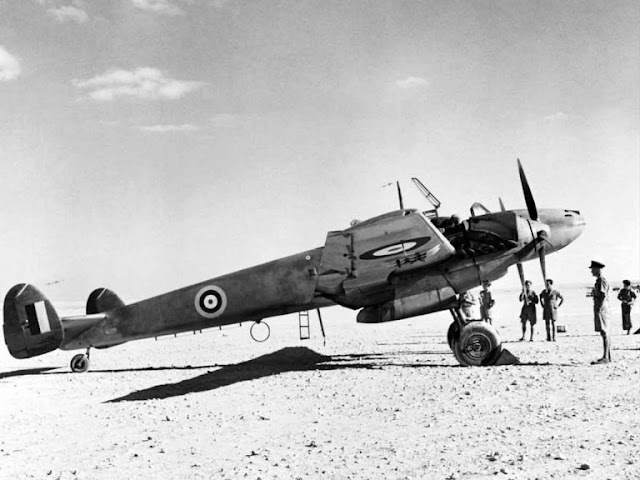
On 17 May 1941, recently arrived Special Force Junck (Sonderkommando Junck), under the command of Commander of Aviation Iraq (Fliegerführer Irak) Oberst Werner Junck, raids the advancing British relief column (Kingcol) with three Bf 110s. The RAF sends two recently arrived Hawker Hurricanes (flown in from Egypt) and six Bristol Blenheim bombers of No. 84 Squadron to attack Junck’s own airfield at Mosul. While the RAF loses one precious Hurricane, the Luftwaffe loses two planes and has four more damaged. In a separate action, two RAF Gloster Gladiators from Habbaniya Airfield catch two Bf 110s taking off from Rashid Airfield at Baghdad and shoot them down. One of these Bf 110s crashlands and will be repaired and placed in RAF service. While Junck still has a sizeable and effective force, it is suffering rapid attrition, and Iraqi/Luftwaffe ground support services are virtually nonexistent.
On the ground, the scratch British garrison at Habbaniya Airfield continues its unexpectedly stout defense against the Iraqi military with great success. The British relief column, Kingcol, reaches Habbaniya late in the evening, but the Habbaniya garrison was in no need of rescue. The newly arrived British forces then continue their advance east to within ten miles of Fallujah on the road to Baghdad.
The Soviet TASS News Agency announces that the USSR and Rashid Ali government in Iraq have reached an agreement for diplomatic, trad and consular arrangements.
General Wavell announced: “On Thursday the RAF bombed the three Syrian airfields at Palmyra, Damascus and Rayak. Three German Junkers and two other unidentified German aircraft, as well as an Italian Caproni 42, were sighted at Palmyra airfield. We succeeded in seriously crippling three of these machines; a fourth was demolished with incendiary bombs. Regarding General Dentz’s communiqué, Wavell Headquarters has learned that one morning, 17 German aircraft landed at one Syrian airfield, and 5 at another field, and flew on in the direction of Iraq after refueling. There is no question of the machines having been forced to make an emergency landing because the German aircraft were in impeccable condition. It is remarkable that General Dentz’s communiqué makes no mention of the results of the British raid on the airfield at Palmyra.”
The British Middle East Air Force in Cairo, Egypt announced: “German aircraft have been fired on by machine guns at Mosul (Iraq). One German plane went up in flames, the others were damaged. We have set oil warehouses on fire at Al Amarah (Iraq). The RAF base of Habbaniyah has been attacked by German aircraft, but damage was insignificant and the toll of victims was low. Our operations in Abyssinia were confined to reconnaissance flights and the bombardment of fortified positions.”
Viceroy of Italian East Africa Duke of Aosta surrendered Amba Alagi, Abyssinia to the British at 1730 hours. At Amba Alagi, surrender negotiations are concluded between the Duke of Aosta and the British (Indian and South African troops). An agreement for the Italians to surrender is reached at 17:30. It is to be a “surrender with honor,” and the Italians will be permitted to march out with their rifles (to be surrendered later) but leave behind their other equipment and stores. The ceremony of surrender is to take place on 19 May. The Italians are forced to surrender due to lack of supplies, a situation exacerbated when a British artillery shell damaged the oil tank they were using to store their potable water.
The Sudan Defense Force, accompanied by Abyssinian guerilla forces, attack Italian positions at Chilga west of Gondar.
The prisoner in the Tower of London today is Rudolf Hess, brought by train from Scotland after his “peace flight” from Germany. he is kept in a room neat the White Tower and spends much of his time watching guardsmen drilling. he will remain in the Tower until a Hampshire country house has been fortified for his detention. Hess has been examined by army psychiatrists who say that they believe that he sane, but his condition is deteriorating. He claims that attempts are being made to poison him. He dresses in his Luftwaffe uniform and insists that he should be given diplomatic status. In Germany, Hitler has ordered the arrest of Willi Messerschmitt; Hess took off from the company airfield at Augsburg, but the aircraft chief knew nothing of his plan. Hess’s aides have also been arrested. Everybody, British and German alike, remains baffled by Hess’s flight to Scotland.
Hess can idle his days away by watching guardsmen drill through his window. A “special place” is being prepared for him near London. Hess is treated well but is not allowed visitors, not allowed to learn any war/political news and not told that his peace initiative is being treated as a joke. Army psychiatrists conclude that he is sane, but his disposition darkens as days go by without any meeting with Winston Churchill and no movement on his peace offer.
Winston Churchill, in a memo to First Lord of the Admiralty A.V. Alexander and First Sea Lord and Chief of Naval Staff Admiral Dudley Pound, requests that ten of the Royal Navy’s 40 large armed merchant cruisers (AMCs) be converted into troop transports.
The Reuters News Agency reports from London: “As was made clear in a report on foreigners in the British armed services, approximately 10,000 US citizens are fighting under the British flag. Most of them are attached to the RAF as pilots, observers and aerial gunners, or assigned to the training camps. Some US citizens have joined the ranks of General de Gaulle’s Free French.”
In Albania, King Victor Emmanuel III of Italy and Albanian Prime Minister Shefqet Vërlaci survived an assassination attempt when 19-year old Albanian nationalist Vasil Laçi fired four shots at a car they were riding in. Laçi was arrested immediately and executed ten days later.
The Egyptian Government today sought the arrest of a former Chief of Staff of the Egyptian Army, General Aziz el Masri Pasha, known for his pro-Axis sympathies, after the general and two Egyptian Air Force members had attempted unsuccessfully to flee Cairo in an Egyptian military plane.
The Luftwaffe is moving the bulk of its aircraft from the western front to the East in preparation for Operation BARBAROSSA. Thus, the Blitz is over and the pace of operations along the Channel front slows markedly. The Luftwaffe mounts a small raid on Birmingham that hits Alum Rock Road (a continuation of High Street).
RAF Bomber Command, Day of 17 May 1941
5 Blenheims on an uneventful sweep off Cherbourg..
RAF Bomber Command, Night of 17/18 May 1941
Cologne
95 aircraft — 44 Wellingtons, 28 Whitleys, 23 Hampdens. 1 Hampden and 1 Whitley lost. Lack of moonlight and intense searchlights made identification of targets difficult but 82 aircraft claimed good bombing results. Cologne reports scattered bombing over a wide area but with some concentration in the southern districts of the city. 1 industrial building was destroyed and 22 damaged. 30 private houses were destroyed and 100 damaged. In the city center, the Rathaus, a hospital, a department store and a well-known café, Café Bauer, were all damaged. 20 people were killed and 24 injured.
Minor Operations: 15 Wellingtons and Whitleys to Boulogne, 14 Blenheims to Rotterdam. No losses.
The Soviet TASS News Agency stated: “Foreign reports that the Soviet Union has authorized the recruitment of volunteer pilots for the Iraqi army, are completely false.”
The first American, Pilot Officer Stanley Michel “Mike” Kolendorski, is killed in action while flying a Hawker Hurricane in service with the RAF. He is with RAF No. 71 (some sources say 121) “Eagle” Squadron. Kolendorski is of Polish heritage, was born in 1915 in Jersey City, New Jersey, and was living in California with his wife Charlotte May when he enlisted with the RAF in Canada. Kolendorski, shot down over Holland, is buried at Rockanje (Zeeweg) General Cemetery Rockanje, Westvoorne Municipality, Zuid-Holland, Netherlands, Memorial ID 18834392.
Sonderkommando Junck, a special formation of German Luftwaffe fighters, bombers and transports which had been hastily painted with Iraqi markings, commenced (with a dozen Bf 110 aircraft of 4./ZG 76) air attacks on British positions, especially those at Habbaniyahh, Iraq; or the next ten days the Bf 110 aircraft attacked, losing several aircraft in the process. Late in the evening, the British force from Palestine arrived at Habbaniyahh. After sundown, British and colonial troops crossed the Euphrates River toward Fallujah.
British bombers attacked Bramsfeld, 12 kilometers northwest of Köln, Germany; the Atlantik rubber plant was hit with 2 high explosive and 44 incendiary bombs.
The British Ministry of Home Security announces that 6,065 people were killed and 6,926 injured during Luftwaffe attacks in April 1941. Among the dead, 2,912 were men and 2,418 were women, and 680 were children under the age of 16. An additional 61 people remain missing and are presumed dead. The figures are an increase from the 4,259 killed and 5,557 injured in April 1941.
The RAF (Beaufighters of No. 252 Squadron based on Malta) raids Athens airfield and destroys the second — and last — Junkers G.38 (the “Generalfeldmarschall von Hindenburg”) being operated by the Luftwaffe (after long service with Lufthansa) on the ground. The G.38 is an obsolete 1929 design but has an advanced design that foreshadows the “Blended Wing Body” design that offers aerodynamic advantages and will experience a resurgence of popularity by Boeing and NASA in the 21st Century. It also is one of the few four-engine designs ever used by the Wehrmacht and features unique seats in the wings for passengers with forward-facing windows.
The Luftwaffe continues its attack on British installations on Crete in preparation for Operation MERCURY, the invasion of Crete. At Suda Bay, the German planes sink 10,694-ton British tanker Eleonora Maersk (20 killed, 7 later become POWs, 17 rescued) and 5719 ton Greek freighter Themoni. The Eleonora Maersk will stay sunk throughout the war but will be raised and repaired thereafter. Quiet day on most of Crete, with the Luftwaffe only performing minimal reconnaissance.
The Luftwaffe attacks 7938-ton hospital ship Aba about fifty miles south of Crete. Some Royal Navy ships of Force C come to the hospital ship’s aid, and one, anti-aircraft cruiser HMS Coventry, is strafed by the Luftwaffe planes. Attacking hospital ships, which are plainly marked, is a war crime, but it is fair to say that both sides have been guilty (under some interpretations) of violations of such commonly accepted rules of war.
The Luftwaffe drops mines in the Suez Canal.
U-107, commanded by Kapitänleutnant Günter Hessler, sank Dutch tanker Marisa (8029grt) in 6-10N, 18-09W. At 0036 hours on 17 May 1941 the unescorted Marisa (Master J.C. Landman) was hit in the engine room by one torpedo from U-107, killing the fourth engineer and one crew member. The U-boat had followed the tanker since 1249 hours the day before. The tanker stopped and was hit in the stern by a coup de grâce at 0115 hours, after the crew abandoned ship in three lifeboats. 15 minutes later the U-boat surfaced, opened fire with the deck gun and hit the ship with 20 rounds, but the next grenade burst in the barrel and made the deck gun useless. The burning tanker settled by the stern, but the bow remained afloat. At 0217 hours, the 20mm AA gun was used to open holes in the empty tanks until the weapon was damaged too by a round that exploded in the barrel. A part of the barrel hit a man standing on the conning tower, but fell off without wounding him. Hessler wrote in the KTB: What kind of weapons and munitions do we have, we must be afraid of them. On 20 May, one lifeboat was found by HMS Columbine (K 94) (T/Lt S.J. Lavis, RNR) and a second by the British patrol yacht HMS Surprise. The third lifeboat with the master landed at the coast of French-Guinea on 23 May. The 8,029 ton Marisa was carrying ballast and was bound for Curaçao, England.
Battleship HMS Rodney departed Scapa Flow escorted by destroyers HMS Somali, HMS Bedouin, and HMS Eskimo for the Clyde, arriving on the 18th.
Destroyer HMS Blankney arrived at Scapa Flow at 1930 after assisting sunken ship Archangel.
Destroyer HMS Lance arrived at Scapa Flow for working up exercises.
Ocean boarding vessel HMS Registan intercepted Vichy French auxiliary schooner Izarra (488grt) and sent her to St John’s, Newfoundland, under armed guard. The schooner arrived on the 27th.
Lt H. G. Hunt, flying a Battle of RAF No.1 Flying Training School at Netheravon, was killed when his aircraft crashed at Pepperbox Hill Bombing Range.
P/T/A/Sub Lt (A) J. N. W. Parish RNVR, was killed when his Hurricane of 759 Squadron crashed in the River Parrett.
British steamer Statesman (7939grt) was sunk by German bombing in 56-44N, 13-45W. One crewman was lost on the steamer.
British steamer Arthur Wright (1091grt) was damaged by German bombing five miles south of Shoreham.
Norwegian steamer Ala (933grt) was damaged by German bombing five miles south of Shoreham. One crewman was killed on the steamer. The steamer was beached about one and a half cables west of entrance pier, Shoreham. The steamer was refloated on the 19th and eventually towed to Southampton for repairs.
Hospital ship ABA (7938grt), on passage to Haifa, was attacked fifty miles south of Crete south of Kaso Strait by German bombers. Force C cruisers HMS Dido and HMS Coventry came to the hospital ship’s assistance. Anti-aircraft cruiser Coventry suffered some casualties to strafing.
British Forces C and D were recalled to Alexandria. Force C with light cruisers HMS Naiad and HMAS Perth and destroyers HMS Greyhound and HMS Hasty arrived at Alexandria at 0800/18th. Force D with light cruiser HMS Dido, anti-aircraft cruiser HMS Coventry, and destroyers HMS Kandahar, HMS Kingston, HMS Juno, and HMS Nubian arrived at Alexandria on the 18th.
British tanker Eleonora Maersk (10,694grt) was sunk by German bombing at Suda Bay. Twenty crewmen were missing and seven were made prisoners of war. Seventeen crew members were rescued.
Greek steamer Themoni (5719grt) was sunk by German bombing at Suda Bay.
Submarine HMS Regent arrived at Gibraltar from Malta.
Submarine HMS Pandora arrived at Gibraltar from patrol in the Tyrrhennian Sea.
Petty Officer J. F. Bray was killed when his Vega Gull crashed at Aboukir. He had been appointed to battleship HMS Warspite.
Convoy OB.323 departed Liverpool by corvette HMS Sunflower. On the 18th, destroyer HMS Veteran, catapult ship HMS Springbank, and corvette HMS Heather joined the escort. Destroyer HMS Venomous, HMS Keppel, HMS Lincoln, and HMS Sabre, corvettes HMS Dianella, HMS Kingcup, and HMS Petunia, and anti-submarine trawlers HMS Lady Elsa, HMS Man O’ War, and HMS Wellard joined on the 19th. Destroyers Venomous and Veteran and corvettes Dianella, Kingcup, and Sunflower were detached on the 22nd. On the 22nd, destroyers HMS Mansfield and HMS Wolverine and corvettes HMS Begonia, and HMS Larkspur joined. On the 23rd, destroyer Keppel and Sabre, corvettes Heather, Petunia, and Sunflower, and trawlers Lady Elsa, Man O’ War, and Wellard were detached. The remainder of the escort was detached on the 25th when the convoy was dispersed.
Convoy SL.75 departed Freetown escorted by armed merchant cruiser HMS Cathay to 12 June and corvettes HMS Crocus, HMS Cyclamen, and HMS Marguerite to 25 May. Battleship HMS Nelson joined the convoy on 1 June to 5 June. Corvette HMS Arabis joined on 8 June to 12 June. On 9 June, destroyers HMS Roxborough, HMS Salisbury, and HMS Skate, and corvettes HMS Anemone, HMS Clarkia, and HMS Veronica joined; all to 12 June. On 12 June anti-submarine trawler HMS Vizalma joined to 13 June. The convoy arrived at Liverpool on 13 June.
President Roosevelt, asserting international trade in a world “dominated by totalitarianism” would be merely a weapon for aggression, declared tonight the United States must defend democratic principles and “continue its leadership in the preservation and promotion of liberal economic policies.” “Only through that leadership,” the chief executive said in a statement on National Foreign Trade week, “can this country fulfill its responsibility in the rebuilding of a world economy from the chaos into which it has been plunged by destructive trade restrictions, born largely of greed and unreasoning fear, and by ruthless aggression.”
Four Democrats on the Senate Foreign Relations Committee, Clark of Missouri, Reynolds of North Carolina, Pepper of Florida and Murray of Montana, suggested today the United States take over French island possessions in this hemisphere. While differing widely on other foreign policies, the four agreed, in separate interviews with reporters, that this country should assume control of the French possessions in view of Marshal Petain’s talk of collaboration with Berlin.
Secretary of State Hull struck out sharply at France today in a sarcastic reference during his press conference to the Vichy explanations of the Franco-German “collaboration” agreement. Those explanations have sought to minimize the significance of the arrangements now being made by the two governments.
California Governor Culbert Olson announced after a three-hour conference with strike leaders today that “we are making progress” toward settlement of the eight-day walkout of A.F.L. and C.I.O. machinists which has tied up work on $500,000,000 defense contracts at 11 shipyards. Admiral John Wills Greenslade, commandant of the Twelfth naval headquarters, in commenting on reports from Washington that the navy may assign marines to ship yards to protect workers willing to return to their jobs, said such action might occur only if local and state police were unable to “function adequately.”
A new tie-up threatened in the Appalachian soft coal mines was put off indefinitely last night. In Washington, meanwhile, the defense mediation board settled its sixth dispute in 36 hours, bringing C.I.O. unionists and the Allis-Chalmers plant at La Porte, Indiana, together on a new contract. Its terms were not disclosed, but the workers had sought a union shop. The firm makes gun mounts.
As evidence of their willingness to make “any reasonable sacrifice” in the interest of national defense, C.I.O. members employed at the Ford Instrument Company plant in Long Island City have notified the management that they are ready to work sixty hours a week to relieve a shortage of skilled precision mechanics, it became known yesterday.
Chairman Dies, Texas Democrat, said tonight the house committee investigating un-American activities would hold public hearings next week to put into evidence “the extent to which Communist and Communist sympathizers have been able to obtain employment In the federal government.” In a statement, Dies asserted the committee had obtained “full membership lists of five Communist front organizations operating in the District of Columbia” and a “complete list of the federal government employees who own Soviet government bonds and regularly receive interest payments from the Soviet government.” Dies said, “The American public will, I believe, be shocked to learn that they have public servants who have their savings invested in ‘Stalin’s brutal totalitarianism at the very time the American government has embarked on a campaign to sell bonds to meet our enormous emergency expenditures.”
A nationwide roundup of aliens known to be in this country illegally was launched suddenly tonight by the Justice Department. The campaign centered in eight seacoast cities and was aimed principally at Nazi seamen who have overstayed their leave. Lemuel B. Schofield, special assistant attorney-general in charge of the immigration division, said immigration agents and police were seeking a number of aliens shown by files to have entered the country irregularly or to have remained illegally.
The Office of Production Management has informed Congress that the reserve stockpile program for strategic materials is destined to fail because it was not started soon enough and because of the world shipping shortage.
Arthur Compton and the United States National Academy of Sciences published a report noting the success rate of developing an atomic weapon was favorable.
Vannevar Bush created the Office of Scientific Research and Development (OSRD).
Major League Baseball:
Bob Feller was not his usual self today, but he didn’t have to be, as the Indians let loose with four homers, two by Jeff Heath, to give their pitching ace his seventh victory of the campaign, a 12–9 Cleveland Indians triumph over the Boston Red Sox. Feller’s erratic performance — he allowed ten hits in the six innings he worked and walked seven batters — was in line with the rest of a topsy-turvy contest, which dragged on for more than four hours and was called after eight innings. Rain halted play in the first half of the ninth. In making a clean sweep of the three-game series, the American League leading Indians ran to five their string of consecutive victories and made it five in a row over Boston this season.
The New York Giants’ Cliff Melton shut out the Chicago Cubs, 9–0, holding them to five hits. For a moment in the sixth, Melton was threatened with the loss of his shut-out when Dom Dallessandro followed Novikoff’s third single with a double. But there already were two out and Melton quickly snuffed out Clyde McCullough, who conveniently had provided the third out in the fourth by fanning with the bases full. The Giants, meanwhile, collected thirteen hits, including a triple by Burgess Whitehead and two doubles for Mel Ott.
The Phillies’ Johnny Podgajny outduels the Reds Bucky Walters to win, 2–1. The Reds lost their sixth straight game today as the last-place Phillies triumphed, behind the six-hit pitching of Podgajny, 21-year-old rookie. John permitted the world champions to get at least one man on base in every inning but the ninth, but they were unable to bat in a single run. The Reds’ one tally came in the third when Rookie Third Baseman Chuck Aleno tripled and got home on a passed ball. His slide, sending Umpire Jorda head over heels, was the feature of the game. Walters, co-ace of the Cincinnati staff, gave the Phillies only six hits himself, but in the second Nick Etten walked .and stole second, Emmett Mueller singled and Bob Bragan doubled for all the winners needed.
Myril Hoag’s clutch hitting paces the White Sox to a 3–2 win over the Yankees, as Chicago wins the rubber game in the 3-game series. Johnny Rigney hurls a five-hitter. Two cast-off Yankees, Hoag
and Bill Knickerbocker, played conspicuous roles in this latest setback for the Yankees, which provided the second victory of the year for Johnny Rigney. Hoag, who was balked by the strategy of Joe McCarthy when the Yanks visited Chicago recently, got a measure of vengeance by hammering Chandler for three of his clubs’ nine hits and blasting in two runs. With the Yanks only a run behind entering the ninth, Knickerbocker so amazed Gordon with an accidental dribbler through the infield that Gordon fumbled, Knickerbocker got a life on the error and, eventually, the Sox scored a run that proved unassailable despite a Yankee ninth-inning rally.
The city of Philadelphia and the state of Pennsylvania declare a legal holiday to honor the A’s manager on Connie Mack Day at Shibe Park on the occasion of the 40th anniversary of his managerial tenure. Connie declines to agree to a name change for Shibe Park to Connie Mack Stadium, though a small black sign “Connie Mack Stadium” is put in place (as noted by Bruce Kuklich). George M. Cohan sings a new baseball song and then the Tigers put a damper on the day’s festivities with a 6–5 come-from-behind win. Frank Croucher has three hits, including a triple, for Detroit.
The New York Yankees let a good first baseman go when they shipped Babe Dahlgren to the Braves. Dahlgren batted the Braves to a 6–3 victory over the Cardinals today, driving in one run with a single and then smashing a homer with two men on base in the twelfth inning to win the game. The defeat put St. Louis two games back of the idle Dodgers. Always a Fancy Dan in the field. Dahlgren handled twenty-one putouts, thirteen in succession. Al Javery and Art Johnson shared honors with Dahlgren. Javery, making his first start of the season, matched the veteran Lon Warneke in a pitchers’ duel until he weakened in the tenth inning. Johnson, rookie left-hander, pitched two and two-thirds innings of hitless ball in winding up the game.
Washington hammered four St. Louis Browns pitchers for thirteen hits today to register a 12–7 victory, producing six runs in a hectic sixth inning to take the lead for the first time. The Browns mauled a quartet of Washington pitchers for fourteen hits.
The scheduled game between the Brooklyn Dodgers and the Pirates at Pittsburgh was postponed due to wet grounds. The game will be made up as part of a doubleheader on July 27.
Cleveland Indians 12, Boston Red Sox 9
New York Giants 9, Chicago Cubs 0
Philadelphia Phillies 2, Cincinnati Reds 1
Chicago White Sox 3, New York Yankees 2
Detroit Tigers 8, Philadelphia Athletics 5
Boston Braves 6, St. Louis Cardinals 3
St. Louis Browns 7, Washington Senators 12
Bitter fighting continues between Chinese regulars and guerrillas and Japanese forces in the Chungtiao Mountains in Honan, north of the Yellow River. The Chinese are strengthening their defenses on the south bank of the river and are carrying out extensive evacuations of civilians from cities on the LungHai railway. Nonessential government departments have left Loyang.
Japanese quarters claimed new triumphs today in their “May offensive.” Domei news agency dispatches from Hankow reported that after two days of fighting in which 1,700 of 30,000 Chinese defenders were killed, the Japanese had occupied Tsaoyang, Northern Hupeh Province, previously a strategic Chinese base.
Chinese troops were said tonight in an official communiqué to have recaptured Tsaoyang, strategic base in Northern Hupeh Province, yesterday. The Chinese also claimed the capture of Suchi, in Chekiang Province, and said they had heavily bombarded Foochow. A “puppet” police unit at Tsingtao was said to have deserted, destroyed Japanese depots and barracks and wrecked the Yintao salt tax office near the city.
About 100 Japanese planes, in six raids between dawn and dusk yesterday, dropped 500 bombs on Loyang, Honan Province. “causing slight casualties,” the Chinese Central News Agency reported.
Brigadier General Henry B. Clagett, commander of the air force in the Philippines, arrived in Chungking today accompanied by his aides, Colonel Harold H. George of the United States Army Air Corps and Commander Edward McDonnell of the United States Navy Air Force.
Sources close to the Netherlands Indies Government disclosed today that economic negotiations between the Netherlands Indies and Japan have entered a critical stage, with the exchange of final memoranda. The Dutch are reluctant still to sell large quantities of materials to Japan, lest they be transshipped to Germany.
The first shipment of P-40’s arrives in the Philippines at Manila. A load of 31 P-40B fighters arrives by ship and is transported to Nichols Field, the only paved airfield capable of handling fighters. The shipment does not include the Prestone antifreeze which is necessary for their operation — so the planes are unusable until the coolant arrives. This will not be until early July, and training is critical because P-40s are considered tough to fly, especially by inexperienced pilots.
Dow Jones Industrial Average: 116.11 (+0.25)
Born:
Ben Nelson [Earl Benjamin Nelson], American Democratic politician, 37th governor of Nebraska and U.S. senator (2001-13), in McCook, Nebraska.
Grace Zabriskie, American actress (“Twin Peaks”, “Wild at Heart”), in New Orleans, Louisiana.
Malcolm Hale, American pop musician (Spanky and Our Gang, “Sunday Will Never Be the Same,” “Lazy Day”), in Butte, Montana (d. 1968, of carbon monoxide poisoning suffered when using a faulty space heater).
David Cope, American composer known his pioneering work using artificial intelligence to create music, in San Francisco, California (d. 2025).
Naval Construction:
The Royal Navy salvage vessel HMS King Salvor (W 191), lead ship of her class of 11, is laid down as HMS Allegiance by William Simons & Co. Ltd. (Renfrew, Scotland). She is transferred to the Royal Fleet Auxiliary for commissioning, entering service as RFA King Salvor.
The U.S. Navy YMS-1-class auxiliary motor minesweeper USS YMS-35 is laid down by the Hiltebrant Dry Dock Co. (Kingston, New York, U.S.A.).
The U.S. Navy SC-497-class (110-foot wooden hull) submarine chasers USS PC-538 and USS PC-539 (later SC-538 and SC-539) are laid down by the Peterson Boat Works (Sturgeon Bay, Wisconsin, U.S.A.).
The U.S. Navy 77-foot Elco patrol motor torpedo boat USS PT-44 is laid down by the Electric Launch Company Ltd. (Elco), (Bayonne, New Jersey, U.S.A.).
The Kriegsmarine (German Navy) Type VIIC U-boat U-212 is laid down by F. Krupp Germaniawerft AG, Kiel (werk 641).
The Kriegsmarine (German Navy) Type VIIC U-boat U-261 is laid down by Bremer Vulkan-Vegesacker Werft, Bremen-Vegesack (werk 26).
The Kriegsmarine (German Navy) Type VIIC U-boat U-465 is laid down by Deutsche Werke AG, Kiel (werk 296).
The U.S. Navy Accentor-class coastal minesweeper USS Courier (AMc-72) is launched by the Herreshoff Manufacturing Co. (Bristol, Rhode Island, U.S.A.).
The Kriegsmarine (German Navy) Type VIIC U-boat U-134 is launched by Bremer Vulkan-Vegesacker Werft, Bremen-Vegesack (werk 13).
The Royal Navy Fairmile B-class motor launch HMS ML 219 is commissioned.
The U.S. Navy submarine tender USS Antaeus (AS-21) [former SS Saint John] is commissioned. Her first commanding officer is Commander Richard Swift Morse, USN. In 1945 she is converted to a hospital ship and becomes USS Rescue (AH-18).
The Kriegsmarine (German Navy) Type VIIC U-boat U-206 is commissioned. Her first commanding officer is Oberleutnant zur See Herbert Opitz.
The Royal Canadian Navy Flower-class corvette HMCS Dauphin (K 157) is commissioned. Her first commanding officer is T/Lieutenant Commander Robert Aubern Stuart MacNeil, RCNR.

