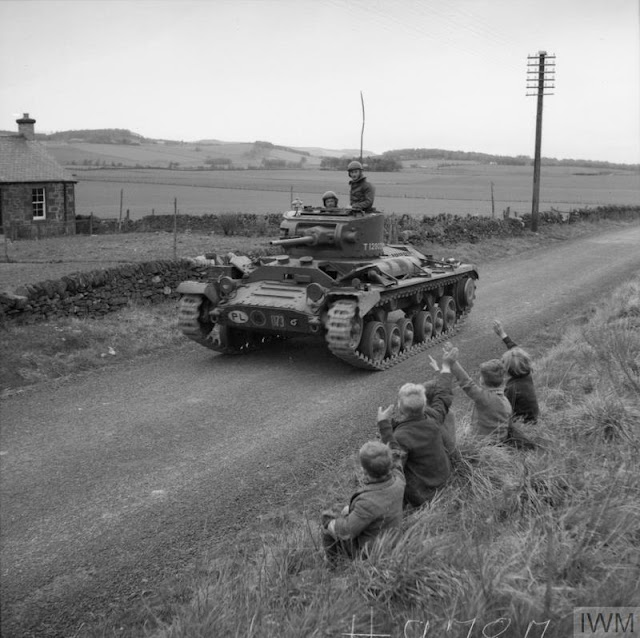
Operation BREVITY lives up to its codename as the British attack on Axis forces on the Egyptian/Libyan border, begun on the 15th and aimed at Sollum, stalls out. Operation BREVITY ended inconclusively. The British withdraw from gains achieved yesterday near Halfaya Pass on the border of Egypt and Cyrenaica. Brigadier Gott withdrew British tanks and infantry from the desert around Sollum and Fort Capuzzo, Libya to consolidate a hold on Halfaya Pass on the Egyptian-Libyan border. German Lieutenant Colonel Hans Cramer launched a surprise attack and captured the important British position of Sidi Azeiz. Without pausing he also overran Capuzzo. The British Army forms a new line running from Sidi Omar to Sidi Suleiman to Sollum. This gives up all of the British gains from Operation BREVITY aside from Halfaya Pass itself. The British are forced to retire because they have sustained heavy tank losses following the rapid Wehrmacht response to the attack.
Berlin orders General Rommel — back in undisputed command of Afrika Korps following the departure of his General Staff “minder” General Friedrich Paulus on 8 May — to leave his Italian forces to guard Tobruk and block the British advance further south with his panzers of the 5th Panzer Regiment and 8th Panzer Regiment. Italian sappers cleared barbed wires and mines. The subsequent attack on Tobruk saw Italian troops capturing several bunkers.
Clearly worried about the staunch Axis defense on the Libyan frontier, Winston Churchill cables Middle East Commander General Archibald Wavell and asks if it would be okay to repeat the recent Tiger Convoy, which sent hundreds of tanks directly through the Mediterranean to Alexandria. Churchill notes, “in view of the heavy loss of I tanks on 15th May, victory may depend upon the last hundred.”
In a message to South African leader Jan Smuts, Churchill notes that “President Roosevelt is pushing United States supplies towards Suez to the utmost.” Churchill also states “I have good hopes that we shall win the campaign in the Eastern Mediterranean this summer.”
Light cruisers HMS Fiji and Gloucester land troops at Heraklion, Crete and then join the Royal Navy forces operating in large numbers near Crete. The Luftwaffe continues its attacks on the British base at Suda Bay, damaging 5993-ton freighter Logician and 6397-ton Greek freighter Nicolaou Ourania (beached and repaired by the Germans) and sinking 1070-ton Greek freighter Kythera. The RAF loses two Hurricanes of No. 33 Squadron based at Maleme.
Winston Churchill sends Malta Governor Dobbie a message saying that he is sending Donald Parker Stevenson, DSO, to be his new air commander because “He embodies the offensive spirit.” The Luftwaffe raids continue against the island, and today they damage destroyer HMS Encounter and sink freighter Araybank.
A minesweeper, HMS Gloxinia, is damaged by a mine near Malta, and minesweeper Widnes is damaged by a bombing near-miss in the eastern Mediterranean, adding to the numerous minesweepers in the Mediterranean that have been put out of action. The island’s government releases figures today providing data on the effects of the air attacks to date:
2087 houses destroyed;
11,679 homeless.
The damage extends throughout the island, with areas populated by refugees also suffering along with Valetta. Wing Commander J. Warfield is named commanding officer of RAF Station Takali in Malta.
In Baghdad, Iraqi Headquarters announced: “No change on the western front. on the southern front, three British aircraft released several bombs over an Iraqi city. The ground defenses succeeded in shooting down one Wellington bomber. The Iraqi air force undertook reconnaissance flights over enemy bases and all aircraft returned undamaged. Our aircraft overflew the area around Ar Rutbah and successfully bombed enemy armored vehicles. British aircraft attacked our military barracks but no major damage was done. One enemy aircraft was probably shot down. Our troops in the desert fought throughout the day and are continuing to keep the situation under control.”
Special Force Junck (Sonderkommando Junck) on 16 May 1941 has assembled a squadron (Fliegerführer Irak) in Mosul composed of 12 Messerschmitt Bf 110s, 5 Heinkel He 111s, a communications flight equipped with light aircraft, a section of anti-aircraft guns, and 3 Junkers Ju 52s. The RAF No. 203 Squadron opens hostilities in the early morning hours by raiding Sonderkommando Junck’s airfield at Mosul. They destroy a Heinkel bomber and 2 Bf 110s. Already, Sonderkommando Junck is being whittled down.
The Germans respond by sending three Heinkel He 111 bombers and six Bf 110s against the main British airfield at Habbaniya. The Germans kill numerous British ground personnel and destroy a Hawker Audax fighter-bomber and shoot down a Gloster Gladiator fighter, both obsolete biplanes but still useful in the theater. Debris from the exploding Gladiator disables one of the Heinkels’ engines, causing it to crash-land on the way back to Mosul.
Oberst Werner Junck, leader of the German forces (Fliegerführer Irak), flies to Baghdad from Mosul in place of the deceased Major Axel von Blomberg, recently shot in his transport while approaching Baghdad. He meets with Rashid Ali, German representative Dr. Grobba, and other top Iraqi leaders. The group decides to interdict Kingcol, the British relief column currently at Fort Rutbah, and prevent it from relieving RAF Habbaniya. Sonderkommando Junck also is to assist Iraqi ground forces in taking Habbaniya.
Several German ships anchored at Bandari Shahpur are ordered to scuttle themselves in the Shatt al-Arab. The hope is that they will block the entrance to the refinery there.
The Soviet Union recognizes the Rashid Ali government in Iraq via an exchange of diplomatic notes in Ankara, Turkey.
With drinking water fouled in the Italian stronghold of Amba Alagi, Abyssinia, the Italian Viceroy Duke of Aosta requested the British to send in fresh water. When the British refused, he called for a ceasefire in order to begin surrender negotiations. By this point, his forces had suffered incurring 289,000 casualties. Following a renewed attack on his defenses at Amba Alagi, the Duke of Aosta has had enough. His troops are giving ground and his supplies are running out, a situation exacerbated by an artillery hit on an oil tank that contains the Italians’ only supply of fresh water. In addition, British promises of self-determination for Eritrea have induced the Italians’ Eritrean troops to desert and motivated partisans (Arbegnoch), who are said to be committing atrocities against Italians. The Duke sues for peace and institutes a ceasefire.
German envoys in Stockholm overhear the Russian envoy claiming that at no time in Russian history have more powerful troop contingents been massed in the west. This jibes with other warnings being received in Berlin from Antonescu in Romania that Soviet troops are massing around Kiev (Kyiv). In fact, the Soviets are indeed moving two armies to the area around Kiev pursuant to the Zhukov Plan of 15 May.
Winston Churchill, in his message today to Jan Smuts, notes that “It looks as if Hitler is massing against Russia.” He continues regarding Operation Barbarossa, still a full month away:
“A ceaseless movement of troops, armoured forces and aircraft northwards from the Balkans and eastward from France and Germany is in progress. I should myself suppose his [Hitler’s] best chance was to attack the Ukraine and Caucasus thus making sure of corn and oil.”
Whatever his sources, most likely Ultra decrypts, Churchill is deadly accurate in this summary to Smuts. His strategic analysis also jibes closely with Hitler’s own views, which are opposed by many generals and the OKW, who favor focusing on Moscow.
British Prime Minister Winston Churchill sends a memo to Sir Kingsley Wood, Chancellor of the Exchequer, arguing that the survivors of soldiers killed while on leave should receive the same compensation as those actually killed in action. Heretofore, survivors have been given much smaller amounts. He writes that soldiers:
“… have a right to be considered when on leave as enjoying the same privileges in regard to pensions for their widows etc. as when they are with their Units.”
Wood has resisted making the change because of cost, so Churchill asks for the figures.
Churchill authorizes the movement of Rudolf Hess, still in a Glasgow military hospital, to the Tower of London “by tonight pending his place of confinement being prepared at Aldershot.” Once again, Churchill emphasizes that “he must be kept in the strictest seclusion.”
The Gestapo arrests Karl Haushofer, a friend (former employer) of Rudolf Hess. Haushofer is one of many German philosophers who have argued that Germany should expand. As a former major general from World War I, he enjoys some status within the Reich and respect by Hitler. Haushofer’s wife is Jewish, or rather a “half-Jew” according to Reich racial laws, and to date, Hess has protected her — but that protection now is gone. While paternity of the word “Lebensraum” and its significance within the Third Reich generally is assigned to Hitler in “Mein Kampf,” some attribute the concept as used by the Reich as belonging to Haushofer.
The damaged port side crane aboard Bismarck was repaired. Issues to the port-side crane of battleship Bismarck are resolved to Captain Lindemann’s satisfaction. Admiral Lütjens reports the ship ready for action. Admiral Doenitz authorizes Operation RHEINÜBUNG, the planned sortie to the North Atlantic by Bismarck and cruiser Prinz Eugen, to begin on the evening of 19 May.
German submarine U-109 stumbled upon an American fleet containing a battleship and several destroyers. She dove and avoided attack.
Nazis forbid Dutch Organization of Actors (NOT).
Churchill inquires to General Ismay about the status of Martinique and says that “I have it in mind that the United States might take over Martinique to safeguard it from being used as a base for U-boats in view of Vichy collaboration.” Great Britain, of course, has no control over either Vichy France or the United States, so Churchill cannot compel anything to happen regarding the government of the island, but, of course, Churchill has an opinion on everything and a lot of influence with President Roosevelt.
The Althing (Icelandic Parliament) adopts four constitutional amendments intended to complete de facto independence from Denmark, which is effectively occupied by the Reich even if its government has been allowed to remain in place and theoretically retains freedom of decision. However, the Icelandic-Danish Act of Union remains in place for the time being (until February 1944). The Danish ambassador in Washington, D.C., who is not encumbered by coercion by the Reich, has been making decisions and representations on behalf of Iceland favorable to the Allies whose legality is questionable, and this action by the Althing does nothing to resolve that. Iceland itself is occupied by British troops, which the Icelandic government has protested against without result.
It is fair to say that the status of Iceland remains a giant unfinished puzzle, though its territory without question is greatly aiding the Allies. In any event, Iceland is going its own way regardless of legalities.
Vsevolod Merkulov reported to Joseph Stalin regarding the final deportation plan for the Baltic States, which targeted political leaders, land owners, officers, and others, plus their families. He recommended 8-year imprisonment in labor camps for them, and the exile to faraway lands in the Soviet Union for their families.
Goebbels writes in his diary, “Things are due to roll in the East on May 22, dependent on the weather.”
The Luftwaffe conducted the last great night air attack on Great Britain with 111 Luftwaffe aircraft striking Birmingham and West Midlands.
There are two separate commonly discussed periods of war activity between the Reich and Great Britain that overlap: the Battle of Britain and the Blitz. It is easy to confuse them and think of the Blitz and the Battle of Britain as one period of time, but they are separate actions that involve different characteristics. While the Battle of Britain is said to have ended at the end of October 1940, the Blitz continues until 16 May 1941. It finally ends today — or, at least the first and most destructive part of the Blitz.
The Luftwaffe sends 111 aircraft to raid RAF airfields in Birmingham and the West Midlands. The Germans lose three planes. While not apparent at the moment, this is the final Luftwaffe night bomber raid on England during the May Blitz. The Luftwaffe is shifting massive forces east in preparation for Operation Barbarossa.
The Luftwaffe sends fighter-bombers (Jabo) to raid southeast England. While Jabos carry a small payload, they are more accurate than level bombers and incur fewer losses. They also engage in strafing missions and can battle defending RAF fighters on an equal basis.
RAF Bomber Command, Day of 16 May 1941
8 Blenheims on coastal sweeps off Norway. 1 ship was claimed as sunk near Bergen. 1 aircraft lost.
RAF Bomber Command, Night of 16/17 May 1941
Köln (Cologne)
93 aircraft — 48 Wellingtons, 24 Hampdens, 20 Whitleys, 1 Stirling. 1 Whitley lost. Bombing conditions were poor and Cologne reports only 7 high-explosive bombs in the city with 11 houses damaged and 1 person injured.
Minor Operations: 11 Wellingtons to Boulogne, 8 Blenheims on shipping searches — 1 ship claimed hit, 2 Hampdens minelaying in the Frisians, 4 O.T.U. sorties. No losses.
German bombers damaged British destroyer HMS Encounter in drydock at Malta.
Wing Commander J. Warfield was named the commanding officer of RAF Station Takali on Malta.
The British passenger ship Archangel was bombed and heavily damaged in the North Sea by Luftwaffe aircraft, killing 52 of the 475 aboard. The following day she was beached south of Newburgh, Aberdeenshire.
U-105, commanded by Kapitänleutnant Georg Schewe, sank steamer Rodney Star (11,803grt) in 5-03N, 19-02W. At 0548 hours on 16 May 1941 the unescorted Rodney Star (Master Samuel John Clement Phillips) was hit in the stern by one of two torpedoes from U-105 about 420 miles west-southwest of Freetown. The ship was hit in the bow and amidships by two coups de grâce at 0620 and 0746 hours, but remained afloat. The U-boat surfaced and fired 91 high explosive rounds and 22 incendiary rounds from the deck gun into the waterline. Shortly before the ship sank by the stern in 05°08N/19°15W at 0930 hours, a shell exploded in the barrel which was tore apart and wounded six men of the gun crew. The survivors were picked up after six days by HMS Boreas (H 77) (Lt Cdr D.H. Maitland-Makgill Crichton) and Batna and landed at Takoradi on 23 May. The 11,803-ton Rodney Star was carrying refrigerated and general cargo and was bound for Glasgow, Scotland.
Light cruisers HMS Edinburgh, HMS Galatea, and HMS Aurora departed Scapa Flow to investigate a large warship reported by aircraft to the north. Battlecruiser HMS Hood, light cruiser HMS Birmingham, and destroyers HMS Achates, HMS Icarus, and HMS Active came to half hour’s notice which was cancelled at 1600. The cruisers returned to Scapa Flow on the 17th after an unsuccessful search.
Sloop HMS Black Swan arrived at Scapa Flow at 1930 from Rosyth after major repairs for working up.
Anti-aircraft ship HMS Alynbank departed Scapa Flow at 1300 to escort convoy WN.27 to the south. On the 17th off Tod Head, the ship transferred to convoy EC.20. In the Pentland Firth, she was detached and arrived at Scapa Flow at 0900/18th.
Minelayers HMS Teviotbank and HMS Plover, escorted by destroyer HMS Cattistock, laid minefield BS.56 off the east coast of England. Paddle minesweepers HMS Snaefell and HMS Thames Queen accompanied them.
Steamer Archangel (2448grt) was sunk by German bombing 57-55N, 2-03W, ten miles northeast of Aberdeen. Forty of a crew of seventy five and twelve of four hundred troops on board were lost. The survivors were rescued by destroyer HMS Blankney which landed them at Aberdeen. She attempted to take the steamer in tow, but she was beached off Black Dog, five miles south of Newburgh, and broke in four pieces.
Steamer Ethel Radcliffe (5673grt) had been damaged by a German S boat on 17 April. She was sunk by German bombing at Great Yarmouth on the 16 May.
Steamer Joffre Rose (715grt) was damaged by German bombing off St David’s Head, beached in Dale Bay on the 16th, and damaged again on the 18th in Dale Bay. She was refloated and drydocked.
Steamer Obsidian (811grt) was damaged by German bombing in 52-06N, 5-25W.
Minelayer HMS Latona, which had completed construction on the 4th, departed Portsmouth for Alexandria, via the Cape. She arrived at Gibraltar on the 20th and Alexandria on 21 June.
Light cruisers HMS Gloucester and HMS Fiji, after landing the troops at Heraklion, were able to sail at 0545/16th. They met destroyers HMS Havock and HMS Hotspur and then joined Force A and Force D. Destroyer HMS Ilex joined these forces on the 16th. During the day, the ten destroyers of Forces A, B, and D refueled from the two battleships of Force A.
Anti-aircraft cruiser HMS Dido and destroyer HMS Juno departed Alexandria during the morning of 16 May to join Force C.
During the night of 16/17 May, the British cruiser forces swept off the north coast of Crete. No contact was made.
Heavy cruiser HMS York was damaged by a near miss of German bombing at Suda Bay.
Troopship Glengyle departed Alexandria for Port Said, escorted by destroyer HMS Decoy to embark new landing craft. She departed Port Said on the 17th, escorted by destroyers HMAS Voyager and HMAS Waterhen and sloop HMS Auckland. Anti-aircraft cruiser HMS Coventry from Force C was detached to join this group at daylight on the 18th. During the night of 18th/19th, Glengyle landed 700 Argyle and Sutherland Highlanders at Tymbaki, then withdrew to Alexandria with Coventry, Voyager, Waterhen and Auckland, arriving on the 20th.
Australian destroyer HMAS Vampire carried troops to Tobruk during the night of 16/17 May.
Submarine HMS Unbeaten unsuccessfully attacked escorted two transports near Tripoli.
Lt A. H. M. Ash and Lt H. J. C. Richardson of 805 Squadron, attached to the RAF 33 Squadron at Maleme, were killed when their Hurricanes were shot down on the 16th.
In air raids on Malta, destroyer HMS Encounter was damaged again in the dockyard. She had already been damaged during raids on 29 and 30 April.
Corvette HMS Gloxinia, minesweeping at Malta, was damaged by the explosion of a mine close aboard. She remained in service.
Minesweeper HMS Widnes was damaged by the near miss of German bombing and machine gunning in the eastern Mediterranean.
Steamer Logician (5993grt) was badly damaged by German bombing at Suda Bay. She was bombed again on the 25th and sank two miles and two cables, bearing 303° from Kalani Prism. Five crewmen were killed and one was missing. Twenty five Australian troops were killed.
Greek steamer Kythera (1070grt) was sunk by German bombing at Suda Bay.
Greek steamer Nicolaou Ourania (6397grt) was badly damaged by German bombing at Suda Bay, beached, later refloated and towed to Piraeus. She was used under the name of Nikolaus for German use.
Aircraft carrier HMS Ark Royal, battlecruiser HMS Renown, light cruiser HMS Sheffield, and destroyers HMS Wrestler, HMS Fearless, HMS Forester, and HMS Fury sailed from Gibraltar for exercises, returning on the 17th.
Destroyers HMS Havelock, HMS Hesperus, and HMS Harvester departed Gibraltar to join aircraft carrier HMS Furious, heavy cruiser HMS London, dummy battleship Anson (old battleship HMS Centurion with wooden guns), and destroyer HMS Brilliant arriving from the Clyde and escorted them to Gibraltar, arriving on the 18th. On the 19th, “Anson” departed Gibraltar for Freetown, escorted by destroyer HMS Wrestler and corvettes HMS Jonquil and HMS Geranium as local escort.
Ocean boarding vessel HMS Maron arrived at Gibraltar from Western Patrol.
Convoy HX.127 departed Halifax, escorted by battleship HMS Ramillies, destroyer HMCS St Croix, and corvettes HMCS Agassiz and HMCS Wetaskiwin. The corvettes detached on the 18th.
Convoy BHX.127 departed Bermuda on the 13th escorted by armed merchant cruiser HMS Chitral as ocean escort. The convoy rendezvoused with HX.127 on the 20th and Chitral detached.
Destroyer HMS Lincoln and corvette HMS Sunflower joined on the 23rd and detached on the 27th. Destroyer HMS Salisbury joined on the 27th. On the 28th, destroyers HMCS Ottawa and HMCS Restigouche, sloop HMS Stork, corvette HMS Begonia, anti-submarine trawler HMS St Kenan, and anti-submarine yacht HMS Philante joined the escort. Destroyer HMS Skate and corvette HMS Larkspur joined on the 29th. Destroyer Ottawa and the yacht were detached on the 29th. Destroyers HMS Farndale and HMS Hambledon were with the convoy on the 30th. Sloop HMIS Sutlej was with the convoy in Home Waters. On 1 June Restigouche, Skate and Stork detached. The convoy arrived at Liverpool on 2 June.
Churchill sends President Roosevelt a lengthy cable. This message summarizes what has been learned from Rudolf Hess. The gist of the cable is that the Hess flight has brought valuable intelligence, but otherwise cannot be taken seriously.
Churchill writes that Hess has made “proposals for settlement.” Churchill continues:
“Hess said that the Führer had never entertained any designs against the British Empire, which would be left intact save for the return of former German colonies, in exchange for a free hand for him in Europe. But condition was attached that Hitler would not negotiate with present Government in England.”
Churchill notes that Hess has denied that Germany is making plans to attack Russia, but that the Reich does have plans in Asia. These include the removal of British forces from Iraq. Hess also makes “rather disparaging remarks” about the United States and its “aircraft types and production.”
Churchill concludes that if Hess “is honest and if he is sane this is an encouraging sign of ineptitude of German Intelligence service” for thinking that there is a strong peace faction in Great Britain which he hoped to stimulate. Regarding that last point, Churchill later notes that “Hess seems in good health and not excited and no ordinary signs of insanity can be detected.”
In Washington, President Roosevelt said at his press conference that freedom of the seas was an historic American policy, and indicated that it would be maintained against any efforts of other nations to infringe upon it. He conferred separately with Secretary Hull and Vice President Wallace. He sent to Congress a request for $60,000,000 for new ships and facilities for the Coast Guard.
The Senate passed bills amending the Reconstruction Finance Act and extending the priorities and rationing program for national defense, and adjourned at 4:19 PM until noon on Monday.
The House received the May bill for deferment of selective service registrants by ages, heard criticism of John L. Lewis, and adjourned at 12:28 PM until noon on Monday. The Ways and Means Committee heard further testimony on proposed tax legislation.
President Roosevelt hinted today the navy might be used to protect American shipping against any axis molestation in the Red Sea. He did so by pointing out the fleet was sent against Barbary pirates early last century and advising reporters to follow up that lead. “Do you know of any modern counterparts of the Barbary pirates,” a reporter inquired. The president chuckled for a moment at the aptness of the thrust and drawlingly suggested the correspondents use their heads.
Without a dissenting vote, the Senate approved today a measure giving the Office of Production Management broad statutory authority to channel United States resources into the defense program and to fix the sequence in which armaments orders may be filled. Before passing the bill on a voice vote, the chamber struck out a section which would have established a separate priorities division outside the O.P.M. and under the munitions control board. Defense officials had opposed this provision and Senator Hill, Alabama Democrat, floor sponsor for the measure, produced a letter from Secretary of War Stimson declaring it would “cause confusion and slow up” the production program. Leaders hoped the house, which inserted the proviso as a last-minute amendment when it passed the bill several days ago, would accept the senate changes early next week and rush the measure to the White House.
President Roosevelt declared today that it was the responsibility of the Senate and House to decide where cuts in non-defense expenditures should be made in order to save the $1,000,000,000 in this field desired by Secretary Morgenthau. Coincidentally, however, the President, who outlined his views in a press conference, said that reduction in the sums appropriated for the National Youth Administration and the Civilian Conservation Corps probably would have to be made up in some other defense brackets since both agencies were doing, or were going to do, work closely connected with defense. He thus opposed a cut in the outlays for them. Mr. Roosevelt made clear his belief, however, that Congress could have saved money on the legislation for crop loans of 85 percent of parity, which is now before him after action by both houses. He indicated that he might either veto the bill, or have administrative action taken to nullify its effects, if the increased government payments provided for farmers raised their income upon corn, wheat, cotton, tobacco and rice above parity, the level established by 1909-14 prices.
Attorney General Jackson stated today that machinery had been set up for cooperation of the Department of Justice with the Office of Price Administration and Civilian Supply to prevent price inflation and consumer exploitation as a result of the defense program.
Wage increases of more than $6,000,000 a year have been given to hourly rated workers in the Rouge Plant of the Ford Motor Company during the past three weeks, it was announced today by Harry H. Bennett, Ford personnel director. This, he added, was in addition to $7,000,000 of increases given the plant since the first of the year. The announcement came five days before the scheduled National Labor Relations Board election at the Ford Rouge and Lincoln plants and several hours after announcement of a settlement in the General Motors dispute by which the company granted a wage increase of 10 cents an hour. The NLRB election at the two Ford plants here is set for Wednesday. The rival United Automobile Workers unions, affiliated with the C.I.O. and the A.F. of L., will compete on the ballot for the right to act as bargaining agent. The General Motors settlement, which averted a strike at sixty-one plants affecting more than 165,000 workers, was brought about in Washington early this morning through the intervention of the National Defense Mediation Board.
France apparently has abandoned efforts to exist as a State independent of Nazi Germany, Secretary Knox said at Newport, Rhode Island today. Colonel Knox spoke extemporaneously on the Vichy government’s capitulation after delivering a prepared address before the graduating class of the Naval War College.
While the rising cost of living is attributed by dealers in food commodities in part to the Federal Government’s purchase of foodstuffs under the lease-lend law to feed Great Britain, the effects of the law are the subject of a study that the New York City Department of Markets now has under way.
Bolivian Finance Minister Joaquin Espada announced today that Bolivia had contracted to sell the country’s entire production of wolframite to the United States at $21.85 per unit of twenty pounds. The agreement automatically spikes Japanese bids to monopolize the Bolivian wolframite market. Wolframite, a source of tungsten, is important in defense production.
The special Senate Committee Investigating the National Defense Program today called upon San Francisco Bay area shipbuilders and 1,700 striking A.F.L. and C.I.O. machinists to settle their dispute. They announced that the committee would conduct a hearing on the case next Thursday if the strike is not ended by Tuesday night.
Walter D. Fuller, president of the National Association of Manufacturers and of the Curtis Publishing Company, said in an interview today: “I have been consistently an isolationist. So has The Saturday Evening Post — although that policy will change next week. “But we are in war now. We are like a man who has jumped off a springboard and has not yet touched the water. He isn’t wet, but he hasn’t a chance of getting back on the springboard again.”
Under plans announced three weeks ago for augmenting shortwave radio programs being broadcast to Europe and South America, the National Broadcasting Company yesterday began a twenty-four-hour service on short-wave foreign language programs. NBC officials said the major part of the time would be devoted to broadcasting American news to Europe. Up until yesterday, NBC started its short-wave foreign programs at 7 AM and continued its broadcasts to Europe until 4 PM, when the South American programs were broadcast until 2 AM the following morning, a total of nineteen hours. The new schedule is temporary, but will be made permanent if the demand increases. On the South American broadcasts, NBC is cooperating with the Committee on Cultural Relations with South America, headed by Nelson Rockefeller.
The first Republic P-43 Lancer fighter delivery was made to the United States Army Air Corps. The P-43 would soon become a footnote as production at Republic moved to the superior P-47 Thunderbolt.
General Walter Krueger takes command of the U.S. Third Army.
First U.S. radio performance of Robert Russell Bennett’s “Symphony in D for the Dodgers”
Major League Baseball:
The Cleveland Indians scored their second straight victory over the Boston Red Sox today, getting fourteen hits while Jim Bagby held his former Boston teammates to seven, three of them by Manager Joe Cronin. The score was 9–3. Gerald Walker led the Cleveland attack on three pitchers with a single, double and home run, Clarence Campbell hit three singles. It was a tight game until the seventh inning. Then Hal Trosky doubled to center. Jeff Heath sacrificed and Walker hit his second homer of the season, to the left-field screen, making the score 5–1. In the eighth, with Tom Judd pitching, Bagby singled, Lou Boudreau walked and Campbell got an infield single to fill the bases. Ken Keltner’s double to right scored two runs. Campbell came in on an outfield fly by Trosky and a double to right by Walker brought in another run.
Overcoming a number of annoying obstacles, including a raw blast of wind from Lake Michigan and intermittent rain, the Giants polished off Jimmy Wilson’s Cubs for their second straight triumph today. The score was 4–2. A ladies’ day gathering of 7,481 drew no satisfaction from the polishing. It was chiefly a case of the newly reconditioned Cubs finding themselves no match for the wiles of Colonel Bill Terry, who, given any sort of talent to manipulate, is renowned for the mileage he can get out of his machine. For seven innings Chicago struggled to make up a deficit into which Bill Lee fell when Mel Ott exploded his eighth homer of the season in the second. inning and Babe Young chased Burgess Whitehead home with a two-bagger in the fifth.
The Yankees bench Phil Rizzuto and Jerry Priddy, putting Joe Gordon back at second and Frankie Crosetti at short. New York then rallies in the 9th to beat the White Sox, 5–4. Successive triples by Gordon and Joe DiMaggio, a pair of purposeful passes that served no purpose at all and a ringing line single by Pinch-hitter Charley Ruffing all figured in a tremendous ninth-inning rally that brought the Yankees the victory. The Yankees got back the hard way, too. Off to a four-run lead, the Yanks blew that advantage when Marvin Breuer faltered in the sixth and Chicago scored all its runs. Fordham Johnny Murphy rushed to Breuer’s rescue, put out the fire and proceeded to hurl hitless, run-less ball for three and a third innings. One visitor reached base against Murphy on an infield error. Thus Murphy received credit for his second triumph of the campaign.
Substitute outfielder Pat Mullin’s home run inside Shibe Park, first in the arena in several years, carried the Tigers to a 5–4 triumph over the Athletics today. It was Detroit’s second victory in a row over Philadelphia. Mullin, who replaced the injured Barney McCosky, drove the ball against the scoreboard in the sixth inning and it caromed over centerfielder Sam Chapman’s head. Ned Harris, Hank Greenberg’s understudy, who had singled, scored ahead of Mullin. Dizzy Trout, who relieved Schoolboy Rowe after Benny McCoy had doubled the fourth Philadelphia run across in the fifth, kept the Athletics in check the remainder of the way, although the losers placed the tying and winning runs on base in the ninth.
Nine days ago Mace Brown pitched to three Cardinals in the ninth inning and won his first game for Brooklyn. Today he pitched to only one Pirate in the eleventh and lost. Elbie Fletcher, who beat the Dodgers with a homer on May 4, when they suffered their last defeat, and who has hit more round-trippers against Brooklyn pitchers than they care to recall, met a three-and-two pitch from Brown today and dynamited the ball high into the upper right-field stands to give Frankie Frisch’s Pirates a 3–2 victory. Fletcher’s wallop shattered the latest Brooklyn winning streak, which had been extended to seven games and which had. started against the Pirates on May 6, in Brooklyn.
Harry Gumbert, late of the New York Giants, made an auspicious pitching start with the Cardinals today by shutting out Boston, 4–0, on six hits. The lanky hurler shared honors with Frank Crespi, second baseman. In handling fifteen chances flawlessly Crespi came within one of tying the modern National League record. I Gumbert joined the Cards two days ago and his victory again proved the wisdom of the St. Louis front office trading ventures. Gumbert did not issue a walk. Only one of the Braves reached second.
The Senators staged a two-run ninth-inning rally to defeat the Browns, 7–6, today. The victory gave Washington an even break in the series. Mickey Vernon led off in the ninth with a double, his fourth hit of the game. He scored the tying run after Buddy Lewis hit a roller and Cecil Travis singled. Jimmy Bloodworth’s fourth blow of the day, a single, sent Travis to third, and a pinch hitter, Johnny Welaj, drove in the winning counter with a one-base blow to left. The Senators pounded Elden Auker, who pitched the full route for St. Louis, for eighteen hits.
Cleveland Indians 9, Boston Red Sox 3
New York Giants 4, Chicago Cubs 2
Chicago White Sox 5, New York Yankees 6
Detroit Tigers 5, Philadelphia Athletics 4
Brooklyn Dodgers 2, Pittsburgh Pirates 3
Boston Braves 0, St. Louis Cardinals 4
St. Louis Browns 6, Washington Senators 7
U.S. President Franklin D. Roosevelt declared the defense of China to be vital to the United States.
Three developments in the Far East are alarming Chungking government leaders who see the possibility of a far-reaching Soviet-Japanese understanding that may not only end Russian aid to China but also bring about cooperation between the Japanese and the Chinese Communist armies.
Japanese bombers raid the wartime Nationalist capital of Chungking. Fifty-four Japanese planes carried out a huge bombing raid on the capital this morning, causing extensive damage in the western and northern sections. An American-owned ice factory, official buildings and residences and properties were destroyed. Normal telegraphic and radio communications were temporarily disrupted. The Japanese also dropped propaganda leaflets eulogizing textually and pictorially the Soviet-Japanese pact and reporting an anti-British movement in India. The casualties were estimated at 300, a record for recent raids.
A definite showdown between Japan and her puppet Wang Ching-wei regime in China is reported to have followed extensive conferences in Nanking involving high Japanese military and political leaders and high Chinese representatives of the Nanking government.
General Percival, who has recently arrived by plane from Great Britain, assumes his post as General Officer Commanding, Malaya.
Dow Jones Industrial Average: 115.86 (+0.13)
Born:
Michael Cooper, British photographer and album cover artist (The Beatles — “Sgt. Pepper’s Lonely Hearts Club Band”; The Rolling Stones — “Their Satanic Majesties Request”), in Huddersfield, England, United Kingdom (d. 1973).
Maurice Weddington, American composer (“Epiphany”), in Chicago, Illinois.
Naval Construction:
The U.S. Navy YMS-1-class auxiliary motor minesweeper USS YMS-78 is laid down by the Stadium Yacht Basin (Cleveland, Ohio, U.S.A.).
The U.S. Navy SC-497-class (110-foot wooden hull) submarine chaser USS PC-513 (later SC-513) is laid down by the Quincy Adams Yacht Yard Inc. (Quincy, Massachusetts, U.S.A.).
The Kriegsmarine (German Navy) Type VIIC U-boats U-385 and U-386 are laid down by Howaldtswerke AG, Kiel (werk 16 and 17).
The Royal Navy River-class frigate HMS Exe (K 92) is laid down by Fleming & Ferguson Ltd. (Paisley, Scotland).
The Royal Canadian Navy Flower-class corvette HMCS Shawinigan (K 136) is launched by George T. Davie & Sons Ltd. (Lauzon, Quebec, Canada).
The U.S. Navy ammunition ship USS Kilauea (AE-4) [acquired while building as SS Surprise] is commissioned. Her first commanding officer is Captain William Isiah Causey, Jr., USN. On 17 March 1943, she is renamed the USS Mount Baker (AE-4).
The Royal Navy Isles-class minesweeping trawler HMS Balta (T 50) is commissioned. Her first commanding officer is T/Lieutenant John Ambrose Hanson Pontin, RNR.
The Royal Navy Flower-class corvette HMS Jasmine (K 23) is commissioned. Her first commanding officer is Lieutenant Commander (retired) Cecil Dick Bluett Coventry, RNR.
The Royal Navy Flower-class corvette HMS Lavender (K 60) is commissioned. Her first commanding officer is Lieutenant Commander Jackson Whayman, RNR.
The Royal Canadian Navy Flower-class corvette HMCS Levis (K 115) is commissioned. Her first commanding officer is T/Lieutenant Charles Walter Gilding, RCNR.

