The British launched Operation BREVITY, a limited offensive in the Egyptian and Libyan border area. The British under the command of General Major General William Gott began Operation BREVITY at 0600 hours. In the Libyan-Egyptian border region, British forces advanced in three columns and captured Halfaya Pass and Fort Capuzzo before noon, capturing 347 Axis prisoners (mostly Italians), but the 22nd Guards Brigade was held up in heavy fighting at Capuzzo. Operation BREVITY was designed to capture Halfaya Pass and gain ground leading to the more open areas of the Cyrenaica Plateau. British Prime Minister Winston Churchill is convinced by analysis of intercepted German signals that the German forces were weak and overextended. A German Panzer battalion counterattacked, recapturing Fort Capuzzo by 1445 hours, taking 70 British prisoners.
At midnight, British cruisers HMS Gloucester and HMS Fiji completed the transfer of the 2nd Battalion Leicester Regiment from Alexandria, Egypt to Heraklion, Crete, Greece. The Royal Navy gets ready for the coming Luftwaffe attack on Crete by organizing its forces into Forces A, B, C, and D. Force A, led by battleships Barham and Queen Elizabeth, is the most powerful. During the night, the Royal Navy sends elements of the 2nd Battalion Leicester Regiment to Heraklion aboard cruisers HMS Fiji and Gloucester. During the day, German Luftwaffe aircraft attacked Salamis Navy Yard at Suda Bay, Crete, sinking Greek destroyer RHS Leon.
New Zealand Prime Minister Peter Fraser arrives in Cairo on an inspection tour of New Zealand forces.
The British government in London announced that German planes were arriving in Syria and using Syrian bases to move on to Iraq.
Anthony Eden informs Vichy Authorities that the RAF will attack Luftwaffe aircraft based in Syria.
Luftwaffe Oberst Werner Junck, in command of Special Force Junck (Sonderkommando Junck), arrives in Mosul, Iraq on 15 May 1941 with the balance of his command. He now has a dozen Bf 110s, 5 Heinkel He 111 bombers, some light aircraft for communications, 3 Junkers Ju 52 transport planes, and a unit of anti-aircraft guns.
Oberst Junck sends a Heinkel bomber to Fort Rutbah, which it finds under British command and bombs. While this does little to damage the fort, it confirms British intelligence that the Luftwaffe has arrived in Iraq. Some accounts state that Major Axel von Blomberg, head of the reconnaissance group that preceded Junck’s flight, is shot and killed by ground fire today while flying to Baghdad, other accounts state that this happened several days previously.
The RAF also continues conducting air attacks. The Iraqis get a rare success against the British airplanes today when they shoot down a Swordfish of 814 Squadron during a dive-bombing attack on some military barracks at Samawah, midway between Baghdad and Basra.
The air situation in Iraq is confused. The Iraqis have some Bristol Blenheims, and they use one today to attack Kingcol, the troop convoy coming from Palestine. However, the RAF basically has control of the air even despite recent Luftwaffe reinforcements. The French High Commissioner in Syria, General Dentz, protests to the British about the recent RAF air raids on his airfields at Palmyra and Aleppo which are being used by the Luftwaffe.
General William Slim assumes command of the Indian 10th Infantry Division at Basra.
Free French General Catroux issues a demand for Vichy Syria to surrender to British forces.
At Amba Alagi, the British attacks make progress against the Italians. The recently arrived South African troops link up with Indian troops at Triangle Hill. The British have the support of Abyssinian guerilla fighters who are loyal to Emperor Haile Selassie. The Italians, meanwhile, are running short of the most basic and essential supplies, a situation made direr by shell damage to an oil tank containing the Italians’ only source of drinking water.
Prime Minister Winston Churchill answers questions in the House of Commons. He inadvertently lets slip that Minister of Economic Warfare Hugh Dalton (who coincidentally marks his one-year anniversary in the post today) is part of the country’s propaganda efforts. Since Dalton presumably is providing real information regarding trade, this calls into question his ministry’s regular press releases.
Churchill rejects a request that representatives of all three major political parties be included in the War Cabinet — and not just Churchill’s cronies. Churchill’s reasoning is that the War Cabinet is composed of non-Departmental Ministers, and the leader of the Liberal Party is Air Minister.
Regarding Rudolf Hess, Churchill denies that his mission was intended to seek a separate peace for Scotland, stating, “Whatever delusions may exist, that is not among them.” He does not mention that Hess has proposed a complete peace, not just one with Scotland.
At the evening War Cabinet meeting, Churchill claims that the Japanese “always showed nervousness when either the United States or [Great Britain] took a strong line.” Reasoning that the Japanese would never attack the Dutch East Indies without the certainty of US neutrality, he denies an Admiralty request that naval forces be sent to the Far East to strengthen its defenses.
Labour Minister Ernest Bevin makes the first official government statement on the Rudolf Hess incident, stating:
“I do not believe that Hitler did not know that Hess was coming to England. From my point of view Hess is a murderer. He is no man I would ever negotiate with and I don’t change even for diplomatic reasons. I am not going to be deceived.”
Interestingly, he does not adopt the “Hess is crazy” line that Germany already is using and that the British themselves believe is the most convenient cover story.
The British Government announces that, in operations in Norway and France, there were 13,250 men killed and 41,000 captured out of a total of 437,000 soldiers deployed.
Goebbels issues “an order against occultism, clairvoyancy, etc.” in response to Hess’ flight to England. “This obscure rubbish will now be eliminated once and for all. The miracle men, Hess’ darlings, will now be put under lock and key, “he writes in his diary.
Admiral Darlan returned from meeting with Hitler and Ribbentrop; Vichy-French cabinet approved German concessions as well as French counter-concessions.
Marshal Petain addresses the public in a radio address. He states in part, “For you, the French people, it is simply a question of following me without mental reservation along the path of honor and national interest.”
Axel von Blomberg passed away.
In London, British intelligence officers interrogate Karel Richter, a German spy captured recently. Richter gives them valuable information about other German spies in the UK. This includes information about German cabaret singer Clara Bauerle, who is not a spy, but is the mistress of Josef Jakobs, who is a German spy and thus suspected of being a spy.
There is a report in the British press today that Dame Sibyl Mary Hathaway, DBE (née Collings), the Dame of Sark in the Channel Islands, has been arrested by the Germans and deported to a concentration camp. However, this appears to be erroneous, as the Dame (who survives the war) makes no mention of the incident in her autobiography and is known to be present on the island throughout the war. How the story originated is a mystery, since there was no communication of any kind permitted between the occupied Channel Islands and Great Britain during the war aside from rare Red Cross deliveries. It is unclear if the Dame was aware at this time that her son, Francis William Lionel Collings Beaumont, heir to the Seigneur of Sark, had recently been killed (on 4 May) in the Liverpool Blitz.
Croatian strongman Ante Pavelić visits Rome to meet with Pope Pius XII. The Pope offers de facto recognition of Pavelić and his government. This is controversial on many levels, including the massacre in Glina that just concluded, but there is disagreement about how much the Pope knows about what is happening in occupied Yugoslavia.
Nazi occupiers in Netherlands forbid Jewish music.
Sigmund Rascher, a doctor, Luftwaffe captain, and associate of Heinrich Himmler, requested permission to use Dachau prisoners as test subjects for his medical experiments. Rascher would become known especially for his hypothermia experiments, which would kill 300 test subjects.
In Russia a document from military planners was issued recommending a short strike against any assembling forces threatening Soviet territory.
Richard Sorge, a Soviet spy in Tokyo, warns Moscow that Germany plans to invade during the third week in June. Soviet sleeper agent Richard Sorge, posing as a newspaper reporter in Tokyo, uses his clandestine radio to report to Moscow. He apparently gives further warning of Operation Barbarossa, this time specifying the third week of June for the attack. Sources vary on exactly when Sorge makes these transmissions and exactly what he says in them. The Soviet “Korsikanets” and “Starshina” sources in Berlin and other sources also have been giving Stalin confirmation of the coming German invasion, but Stalin prefers to trust his personal instinct and Hitler’s secret reassurances that he considers the USSR to be a staunch ally.
Stalin, following his bellicose 5 May speech to graduating officers in Moscow, has had General Zhukov prepare a plan of attack against the Reich. In the Zhukov Plan of May 15, 1941, the Southwestern and Western Fronts (centered around Zhukov’s former command at Kyiv) will be the axis of advance. The objective of the invasion will be to destroy the opposing Wehrmacht defense and advance across Poland toward the Reich border. This, Zhukov believes, would force the Wehrmacht to abandon Greece and Yugoslavia and cut the Germans off from their essential Romanian, Hungarian and Bulgarian allies (Romania is important more for its oil fields than its military). Once the Red Army has broken through, it could turn north and northwest to encircle the northern wing of the German defenses. Furthermore, the Red Army would invade Finland and complete the unfinished business from the Winter War.
The plan, which has no start date, and of course is never executed, reflects the poor state of Soviet military intelligence at this time. Zhukov is under the impression that the main Wehrmacht forces are across the border from Kyiv rather than further north, and that defeating them would eliminate the Wehrmacht’s ability to resist. This is an easy mistake to make because Hitler also prefers to place more emphasis on this sector than the Baltic states and Moscow, which he thinks are pointless political objectives. The Wehrmacht generals, however, are of the opinion that taking Moscow is a top priority, and the OKW subtly has been orienting the main attack further north.
The Luftwaffe launches scattered night attacks against targets including Newcastle, Scarborough and Middlesbrough’s dock installations. Notably, the 39 bombers are accompanied by 14 night fighters, a sign of increasing Luftwaffe bomber vulnerability at night.
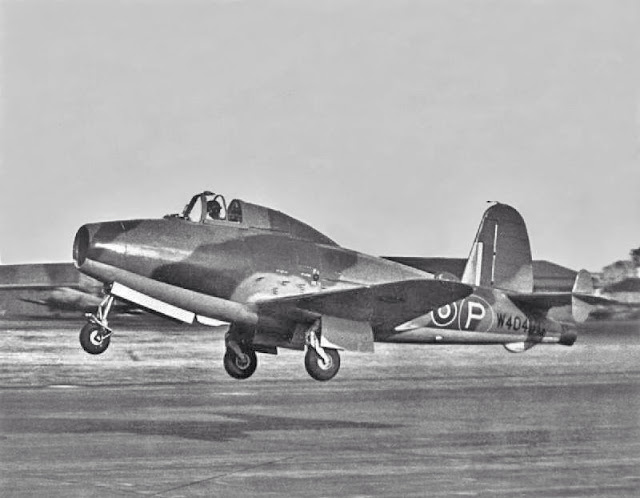
Gloster’s E.28/39 prototype jet fighter took its first flight over Cranwell, England. The Gloster E.28/39 (W 4041) is powered by a single 860-lb thrust Whittle W. 1 turbojet engine. This is the first flight by a British jet-propelled aircraft. At 7.40pm today piloted by Gloster Aircraft Company’s chief test pilot, Gerry Sayer, the aircraft flew for 17 minutes. Afterwards Wing-Cdr frank Whittle, Britain’s jet engine pioneer, said: “I was very tense, not so much because of any fears about the engine, but because this was a machine making its first flight.” Afterwards there was an impromptu celebration in the officers’ mess. Further test flights will now be made.
RAF Bomber Command, Day of 15 May 1941
20 Blenheims on coastal sweeps. Convoys were attacked off Rotterdam and near Heligoland and 3 ships were claimed as sunk. 1 aircraft was lost.
During the RAF Rhubarb attacks, the Junkers Ju 52 transport of Luftwaffe Generaloberst Ulrich Grauert, commander of the 1st Air Corps, is spotted flying near St. Omer, France. F/Lt Jerzy Jankiewicz, flying a Supermarine Spitfire, and Sgt Wacław Giermer, flying a Spitfire II, from the No. 303 Polish Fighter Squadron, combine to shoot the plane down and kill Grauert. This is a sign of increasing RAF penetrations over the Continent during daylight hours. There is the possibility that this interception is not a moment of serendipity, as the British are reading many Luftwaffe coded messages in the Ultra program.
RAF Bomber Command, Night of 15/16 May 1941
Hannover
101 aircraft — 55 Wellingtons, 27 Hampdens, 18 Whitleys, 1 Stirling — with the main post office and telephone exchange as the aiming point, signifying that this was mainly an area attack. 2 Wellingtons and 1 Hampden lost.
Minor Operations: 14 Manchesters and Stirlings to Berlin, 11 Wellingtons to Dieppe, 9 Whitleys to Boulogne. 1 Manchester lost on the Berlin raid.
The RAF has bombed Luftwaffe aircraft on the ground at three airfields in Vichy-French Syria: Damascus, Rayak, east of Beirut, and Palmyra. General Dentz, Petain’s High Commissioner in Syria, protested last night at the raids, which were a response to German efforts to ship aircraft, tanks, and other arms to Iraq to bolster Rashid Ali, the anti-British politician who seized power in Iraq last month.
RAF Headquarters in the Middle East announced: “On Monday, aircraft of the SAAF went into action in Cyrenaica for the first time when the RAF bombed enemy aircraft at Gambut airfield. On Monday night through to Tuesday morning, heavy English bombers overflew the Mediterranean and attacked the German airfield at Kattavia on the isle of Rhodes.”
The Luftwaffe raids Cyprus, perhaps as misdirection for Operation Mercury. The British, amply informed by Ultra, are not fooled.
Air raids continue on Malta. During the day, the airfields at Luqa and Hal Far are hit. The Luftwaffe continues using Bf 109 fighter-bombers (Jabos) with great success. While the Jabos can’t carry large bomb loads, they have great accuracy and incur few losses. During the night, there is a large raid centered on Grand Harbour and Luqa. Destroyer HMS Encounter is hit in a bomb that explodes in its boiler room, while MV Amerika suffers from a near-miss.
The Germans lay many mines at the entrance to Grand Harbour, a problem for the British magnified by the fact that so many minesweepers at Malta have been sunk recently. These include the new G mine.
An Iraqi Blenheim bomber attacked the British column moving from Palestine into Iraq, causing no damage. British Swordfish aircraft from HMS Hermes attacked the Al Qushla barracks in Samawah, Iraq; one aircraft was shot down. Meanwhile, British RAF bombers again attacked French airfields at Palmyra and Damascus, Syria.
Aircraft of the Fleet Air Arm took off to attack the Al Amarah military barracks in Iraq, 48 miles from the Persian Gulf. A factory in Al Musayyib, a fuel tank in Rashid and motorised transports were likewise bombed on Tuesday. The SAAF operated without a halt. In Abyssinia their targets were Fort Aba Maela and military positions at Ama Magiihr. In Lekemti aerial machine guns fired on a motorised transport column and aircraft on the ground. Three of General de Gaulle’s Free French aircraft raided Gondar airfield (Ethiopia).
The 488-ton French sailing ship Notre Dame du Châtelet, en route from St Malo to the Grand Banks, was sunk by gunfire by the U-43, commanded by Kapitänleutnant Wolfgang Lüth, in the eastern Atlantic Ocean. After 0415 hours on 15 May 1941 the three masted Notre Dame du Châtelet was sunk by U-43 with 45 rounds from the deck gun and AA gunfire about 400 miles east of Ouessant. Lüth suspected the vessel to report the position of U-boats to Allied forces, while some of the survivors thought they had been attacked by a British submarine. The day before, the sailing vessel had encountered the Italian submarine Cappellini in 47°42N/13°56W. The ten survivors abandoned ship in three dories: Two men were picked up by the Italian submarine Otaria on 23 May, three men were rescued by the French fishing trawler Petite Bernadette off Belle-Île on 24 May and the remaining five men reached the Berlengas archipelago off Portugal on 28 May, after sailing approx. 600 miles in their dory. The survivors reported that they were attacked without warning and that their dories were machine-gunned while they abandoned ship.
U-105, commanded by Kapitänleutnant Georg Schewe, sank steamer Benvenue (5920grt) in 4-27N, 18-25W. At 2029 hours on 15 May 1941 the Benvenue (Master James Struth), dispersed from convoy OB.314, was torpedoed and sunk by U-105 about 420 miles southwest by west of Freetown. One crew member and one gunner were lost. The master, 47 crew members, one gunner and six passengers (Army personnel) were picked up by the Empire Trader and landed at Freetown. The 5,920-ton Benvenue was carrying general cargo and six aircraft and was bound for Karachi, India.
Battlecruiser HMS Repulse, aircraft carrier HMS Argus, and liners Monarch of Bermuda (22,424grt) and Empress of Japan (26,032grt) arrived at the Clyde from Gibraltar.
Destroyer HMS Icarus arrived at Scapa Flow at 0915 for Home Fleet operations in the 3rd Destroyer Flotilla.
Destroyer HMS Punjabi departed Scapa Flow after night exercises to meet heavy cruiser HMS Berwick off Dunnet Head at 0730/16th and escort her to Rosyth. She was escorted as far as May Island, and Punjabi arrived back at Scapa Flow at 0230/16th.
Minelayers HMS Agamemnon, HMS Menestheus, and HMS Port Quebec of the 1st Minelaying Squadron laid minefield SN.9 B, escorted by destroyers HMS Anthony, HMS Electra, HMS Antelope, and HMS St Marys. Light cruiser HMS Hermione, which departed Scapa Flow on the 14th, covered the minelayers. Light cruisers HMS Nigeria and HMS Kenya, which departed the Iceland-Faroes Channel patrol on the 15th, provided support for the operation. Following the minelay, the cruisers returned to their patrol stations. Hermione arrived back at Scapa Flow on the 17th, and Antelope, Anthony, and Electra at 0730/18th.
P/T/Sub Lt (A) G. R. Cruickshank RNVR and P/T/Sub Lt (A) R. C. Brownie RNVR, were killed when their Skua of 801 Squadron crashed during a test flight near Winchester.
Swedish steamer Ossian (1564grt) was sunk by British aircraft in 54N, 7-16E. Two crewmen on the steamer were killed and another died later.
Italian submarine Barbarigo attacked steamer Manchester Port (5469grt) without success in 54N, 22W.
Mediterranean Fleet was divided at 1321 on the 15th into groups in anticipation of enemy action against Crete.
Force A: battleships HMS Queen Elizabeth, HMS Barham and destroyers HMS Jervis, HMS Jaguar, HMAS Nizam, HMS Defender, and HMS Imperial — was to be to the west of Crete by daylight on the 16th.
Force B: light cruisers HMS Gloucester and HMS Fiji embarked the Second Battalion, Leicester Regiment at Alexandria and departed forenoon on the 15th. The troops were landed at midnight of 15/16 May at Heraklion. This movement was covered by Force A.
Force C: anti-aircraft cruiser HMS Coventry and destroyers HMS Kandahar, HMS Nubian, HMS Kingston, and HMS Juno departed Alexandria at 2000 and proceeded towards the Kaso Straits. The force was to sweep Kaso Straits at dark and sweep north of Crete. Cruiser HMS Dido met the force on the 16th.
Force D: light cruisers HMS Naiad, HMAS Perth and destroyers HMS Greyhound and HMS Hasty patrolled between Antikithera and Piraeus.
Destroyers HMS Ilex, HMS Hotspur, and HMS Havock departed Alexandria at 1400/15th. Ilex joined Force A and Hotspur and Havock Force B after the disembarkation of the troops.
In Reserve: battleships HMS Warspite, HMS Valiant, aircraft carrier HMS Formidable, and light cruisers HMS Orion and HMS Ajax. Submarine HMS Rorqual was on patrol off Lemnos.
Minelayer HMS Abdiel departed Alexandria on the 17th for Haifa to embark mines for a minefield between Cephalonia and Levkos. She laid 150 mines east of Cape Dukato during the night of 19/20 May and returned to Alexandria, arriving on the 21st. Italian destroyer Mirabello, escorting steamers Annarella (5999grt) and Laura C (6181grt) and tankers Dora C (5843grt) and Strombo (5232grt) with armed merchant cruiser Brindisi from Brindisi for Patrasso, was sunk on this minefield off Cephalonia on the 21st. German steamers Kybfels (7764grt) and Marburg (7564grt) were lost on this minefield east of Cape Dukato on the 21st.
Greek destroyer RHS Leon, damaged by air attack on 22 April and towed to Suda Bay, was further damaged in bombing at Suda Bay. She was run aground a total loss.
Lt P. F. Scott of 806 Squadron was killed when the Gladiator he was ferrying between Maleme and Egypt crashed 100 miles south of Crete.
Italian steamer San Giusto (861grt) was sunk on a mine 15 miles 25° from Tripoli.
Destroyer HMS Velox departed Gibraltar for Freetown to join the South Atlantic command.
In a dive-bombing attack on the Sumawar barracks, Iraq, a Swordfish of 814 Squadron from aircraft carrier HMS Hermes, operating from Shaibah, was shot down. Sub Lt (A) G. R. Coy, Lt J. H. Dundas, and Leading Airman L. E. Lasson were rescued.
Convoy OG.62 departed Liverpool escorted by sloop HMS Bideford, and was joined on the 16th by destroyers HMS Boadicea and HMS St Francis, sloop HMS Egret, corvettes HMCS Arrowhead, HMS Aster, HMCS Hepatica, HMCS Snowberry, HMCS Spikenard, and HMS Woodruff, and anti-submarine trawlers HMS Arab, HMS Ayrshire, and HMS Stella Carina. Ayrshire detached later on the 16th, the two destroyers, Spikenard and Arab on the 19th, and Egret, Arrowhead, Hepatica, and Snowberry on the 20th. On the 22nd, Dutch submarine HNLMS O.24 joined the convoy escort. The convoy arrived at Gibraltar on the 29th, escorted by sloop Bideford, submarine O.24, corvettes Aster and Woodruff, and trawler Stella Carina. The sloop and the corvettes were temporarily assigned to the 13th Destroyer Flotilla.
Today in the U.S. capitol, President Roosevelt, after a conference with Secretary Hull and Under-Secretary Welles, issued a statement on the attitude of this government toward Franco-German relations. He received Enrique de Ruiz-Guinazu, the Argentine Foreign Minister.
The Senate passed the bill authorizing acquisition of foreign ships in United States ports, completed Congressional action on the War Department Civil Functions Appropriation Bill, passed a bill extending the export licensing program to territories and recessed at 3:43 PM until noon tomorrow. The Defense Investigation Committee heard further testimony on the aluminum situation, and the Appropriations Committee approved the $278,652,587 State-Commerce-Justice Appropriation Bill and the $174,299,630 Urgent Deficiency Bill.
The House approved the conference report on the War Department Civil Functions Bill, passed a bill to permit Canadian vessels to transport ore between Great Lakes ports in the United States, passed a bill extending the operations of the Federal Housing Administration, passed the $27,846,047 legislative appropriation bill and adjourned at 2:29 PM until noon tomorrow. The Ways and Means Committee continued hearings on proposed tax legislation.
In Washington, relations between Vichy France and the United States degenerated sharply today as the Senate passed a bill empowering the government to seize foreign shipping in US harbors. By a vote of nearly three to one, the senate today approved the administration ship seizure bill, empowering the president to requisition alien vessels now Idle in American harbors and use them in the national defense or British-aid programs. The measure already had been passed by the house, but before going on to the White House, it must go back to that body for routine action on minor senate amendments. The final vote found 59 senators supporting the bill and 20 opposing it, 15 of them Republicans, Ten Republicans, Including the minority floor leader, Senator McNary, Oregon, voted for the measure. Under the Ship Seizure Bill the US can take over vessels “by purchase, charter, requisition” or may take them “into protective custody.” Although not specifically aimed at Vichy, the measure is a response to Petain’s decision to collaborate more closely with Germany. Armed guards have already been placed on board all French ships in US ports, including the 83,423-ton liner ‘Normandie’. A score of French merchant ships will be put in “protective custody” as they arrive.
President Roosevelt addresses relations with France by issuing a statement:
“The policy of this government in its relations with the French Republic has been based upon the terms of the armistice between Germany and France and upon recognition of certain clear limitations imposed upon the French Government by this armistice.”
Roosevelt strongly disapproves of French collaboration:
“The people of the United States can hardly believe that the present Government of France could be brought to lend itself to a plan of voluntary alliance, implied or otherwise, which would apparently deliver up France and its colonial empire, including French African colonies and their Atlantic coasts, with the menace which that involves to the peace and safety of the Western Hemisphere.”
Armed Guards were put on board all 11 French ships in U.S. ports as U.S. President Franklin D. Roosevelt placed these vessels under U.S. jurisdiction due to Vichy France’s compliance with the Nazis.
Now that the bill has passed Congress, all that remains is for President Roosevelt to sign it for it to become law, which he promptly does. It is commonly believed that this bill is passed in retaliation for Vichy French collaboration with the Reich. French freighters are still coming into U.S. ports, and they now are liable to seizure as they arrive. The biggest prize of all is the 83,423-ton liner Normandie, berthed in New York City.
New York congressman Hamilton Fish has called the bill “the grossest breach of international law in history,” while Illinois congressman Leo Allen has warned of German and Italian retaliatory seizures of U.S. property. U.S. Air Force General Hoyt Vandenberg also thinks the move imprudent, terming it a “provocative step toward war.”
Senator Reynolds, North Carolina Democrat, was recommended for chairmanship of the important Senate Military Affairs Committee today after a closed session of the Senate Democratic steering committee. Senators said the vote was 12 to 3 with Senator Glass, Virginia Democrat, Guffey, Pennsylvania Democrat and Green, Rhode Island Democrat, asking that they be recorded as opposed to the elevation of Reynolds, who has opposed some administration foreign policies. The steering committee’s recommendations usually are followed but the senate must finally approve.
Under the assumption that the flight of Rudolf Hess to Scotland had shaken morale in Germany, Senator Burton K. Wheeler, Democrat, of Montana, and leader of the Senate non-interventionists, proposed today that President Roosevelt seize the opportunity to try to negotiate peace out of the European war.
W.L. Batt, deputy director of the Office of Production Management’s Production Division, said in a radio address tonight that “a radical change” of attitude on the part of “some people” in government, labor and industry must take place “if we are to make good our promises to the defenders of freedom.”
The defense mediation board worked into the early hours today to settle a threatened strike of General Motors Corp plants before the union’s deadline. William S. Knudsen, director of the office of production management, conferred at midnight with William H. Davis, chairman of the mediation panel, and when asked for his view of the situation, said shortly, “Damn serious.” An agreement by General Motors Corp. to grant demands of C.I.O.-United Automobile Workers for a 10-cents-an-hour wage increase, recommended by the national defense mediation board, then settled a labor dispute involving a strike threat at 60 G.M. plants. The action came several hours before the 4:10 a.m. strike deadline, and affected all 89 G.M. plants and an estimated 250,000 workers.
A navy pilot deliberately used the propeller of his plane to cut the trailing shrouds of a fouled parachute from another aircraft today and rescue Marine Lieutenant Walter S. Osipoff, 23, of Akron, Ohio, who had been dangling headfirst in mid-air for 30 minutes. The rescue, a real epic of precision flying, was made by Navy Lieut. W. W. Lowrey, 34, of Dallas, Texas, with the help of J. R. McCants, 31, aviation machinists mate, of Jordan, Montana. Risking a long shot against disaster, Lowrey drove his “Helldiver” type bomber to within 20 feet of the larger plane and held it there neatly while McCants seized Osipoff and pulled him as far into the cockpit as space would allow. Then Lowrey edged his craft to within two feet of the other plane, a marine transport, while the propeller slashed the shrouds.
American heavy cruisers USS Quincy and USS Vincennes and the 11th Destroyer Squadron (Captain M. L. Deyo in USS Sampson) joined the Bermuda based Central America Neutrality Patrol.
U.S. Navy Patrol Squadron Fifty Two (VP-52) deploys to Naval Air Station (NAS) Argentia, Newfoundland from NAS Quonset Point, Rhode Island with ten PBY-5A Catalinas. Support is provided by the seaplane tender USS Albemarle (AV-5). These aircraft will fly antisubmarine warfare (ASW) patrols over the North Atlantic.
The first Civilian Public Service camp opened for conscientious objectors in the United States near Baltimore, Maryland.
During paratroop training at Camp Kearney, California, Second Lieutenant Walter A. Osipoff, USMC, becomes fouled in static cable and ripcord lines and dangles 100 feet to the rear of the R2D from which he was to jump. Efforts to bring him into the plane are unsuccessful. Seeing his plight, Lieutenant W.W. Lowery and Naval Aviation Pilot J. R. McCants take off in an SOC and effect a daring mid-air rescue.
The motion picture “A Woman’s Face” opens in New York City. This thriller, directed by George Cukor and starring Joan Crawford, Melvyn Douglas, Conrad Veidt, Marjorie Main and Donald Meek, is about a blackmailer (Crawford) who despises everyone because of her facial scar. After a plastic surgeon (Douglas) performs an operation to correct her disfigurement, she is torn between returning to her old life or starting a new one with a new name.
Major League Baseball:
In a baseball game played against the Chicago White Sox before 9,040 fans in Yankee Stadium in New York City, the White Sox defeat the New York Yankees 13-1. This was New York’s fifth straight loss and nobody particularly cared that Yankee centerfielder Joe DiMaggio hit a single in the first inning and drove in the Yankees only run. This was the beginning of DiMaggio’s 56-game hitting streak, a record that is yet to be broken.
Rip Radcliff, one of the top American League batters in 1940 for the Browns, is waived to the Tigers as a result of a sudden batting decline. The Browns also trade pitcher Vern Kennedy to the Senators for vet Rick Ferrell. The Senators release vet pitcher Danny MacFayden.
The Indians captured the opening contest of a three-game series with the Red Sox by 6–4 today, but were forced to rush Bob Feller into action to quell a ninth-inning uprising. Lou Finney started Boston’s ninth by batting for Mike Ryba and belting a clean single to right field off Joe Heving. Dom DiMaggio drew a base on balls, and that was the signal for Feller’s entry. The Cleveland fireballer forced Stan Spence to pop up, but was lucky. Hal Trosky leaped high to snare a screaming liner by Ted Williams down the first-base alley. Trosky whipped the ball to Lou Boudreau at second base for a game-ending double play. Al Milnar, who was credited with the victory, started for the American-League leaders against Earl Johnson, youthful left-hander, who received slipshod support.
Feeling that Hal Schumacher, their prize hard-luck pitcher, had something coming to him in the light of recent misfortunes, the Giants today resorted to heroic measures. In a rousing rally they scored two runs and Schumacher made the two tallies stand up. Thus Claude Passeau and his fellow Chicagoans went down to defeat, 2–1, in the opening clash of a three-game series. Johnny Rucker was really the fair-haired boy today, coming up with three hits, one a two-bagger that sparked the Giants’ decisive thrust in the third inning. The Cubs had made off with a tally in the second, but Morrie Arnovich launched the Giant third with a single. There was a lull as Joe Orengo flied out and Schumacher struck out, but, under cover of the excitement attending his feat, Morrie stole second. A moment later he galloped home on Rucker’s two-bagger to left. Then Burgess Whitehead singled to center, scoring Rucker. That was all, but it proved just enough, as Schumacher went on to hold the Cubs to six hits.
The Reds blew up in the ninth inning tonight, giving the Phillies four runs and their third straight victory over the world champions this year. The score was 5–4. Young Bill Crouch of the Phillies kept the Reds fairly well in line for his eight innings of pitching, although they gained a 3–1 lead on him with the aid of Frank McCormick’s sixth home run of the year. In the ninth Junior Thompson, counted on as a twenty-game winner this year, yielded singles to Bob Bragan and Ben Warren. They moved up on Harry Marnie’s sacrifice. Tom Livingston batted for Crouch and singled in two runs to tie the score, then stole second. Merrill May and Danny Litwhiler got hits to send Livingston in. Joe Marty walked and May scored what proved to be the winning run on Nick Etten’s fly to right. Ernie Lombardi ended the nightmare by picking Litwhiler off third. With two out, the Reds made a try in their half. A pinch-hitter, Jimmy Ripple, doubled and scored on Lonnie Frey’s single, but Eddie Joost struck out and Thompson had his third straight defeat and the Reds their fifth.
Joe DiMaggio gets a single in 4 at bats against Ed Smith of the Chicago White Sox to start his 56-game hitting streak. Joe D’s hit goes unnoticed as the Yankees lose, 13–1. Taffy Wright homers and drives in 4 White Sox runs, the 8th straight game he’s driven in a run. Joe Kuhel and Billy Knickerbocker also homer for the White Sox. After this game, the experiment with Joe Gordon at first base will end and Johnny Sturm takes over at first. Yankees pitchers surrender 14 hits for 25 total bases.
Harold Newhouser pitched seven-hit ball today while each of his Tiger teammates except one hit safely to swamp the Athletics, 10–2. The victory ended a six-game losing streak for Detroit and marked the team’s first triumph of the year away from home. Outfielder Pat Mullin led the eighteen-hit attack with a triple, a double and two singles. The only Tiger who failed to get to two Philadelphia pitchers for a safety was Frank Croucher. Newhouser had a one-hit shutout until the sixth inning. Catcher Birdie Tebbetts of the victors hit a home run with one aboard in the ninth inning.
Ninety-degree temperature proved too torrid for the hurlers today, and after seven pitchers saw service, the Braves beat the Cardinals, 6–3. Four Cardinal pitchers gave four-teen hits while St. Louis was rapping twelve off three Boston moundsmen. A nose bleed forced Max West out in the second inning, and he was replaced in left field by Lloyd Waner, who made three straight hits. Clyde Shoun was the losing pitcher. Hank Gornicki, Sam Nahem and Ernie White also pitched for the Cards. Manuel Salvo started for Boston. Frank Lamanna received credit for the triumph.
A single by Jimmie Bloodworth in the 7th is the only hit for the Senators as they lose to the Browns’ Denny Galehouse, 7–0. Up until Bloodworth’s hit, Galehouse had surrendered just one walk and hit a batter.
The scheduled game between the Brooklyn Dodgers and the Pirates at Pittsburgh was postponed due to wet grounds. The game will be made up as part of a doubleheader on July 25.
Cleveland Indians 6, Boston Red Sox 4
New York Giants 2, Chicago Cubs 1
Philadelphia Phillies 5, Cincinnati Reds 4
Chicago White Sox 13, New York Yankees 1
Detroit Tigers 10, Philadelphia Athletics 2
Boston Braves 6, St. Louis Cardinals 3
St. Louis Browns 7, Washington Senators 0
At Suffield, Canada, artillery shells are tested containing metallic cadmium mixed with explosive RDX. This is intended to release smoke that damages the inhalers’ lungs. Chemical warfare, of course, is banned following the tragedies of World War I.
Elie Lescot becomes president of Haiti.
Chinese troops were reportedly doggedly hanging on today against powerful Japanese attacks in South Shansi in an effort to maintain their positions in the Chungtiao Mountains, where for three years they have withstood Japanese efforts to dislodge them. Reports reaching here indicated the attackers were closing in from all directions, with the defenders stubbornly balking the Japanese, especially in the northern fringe of the mountains. The Japanese operations were marked by unremitting aerial bombardments and strafing and a limited use of mechanized equipment. The Japanese now control a line on the north bank of the Yellow River, stretching for a hundred miles eastward from the elbow of the river, while pushing columns into the guerilla-infested Chungtiao range from this line and from a semi-circular line-up of bases linked to the two ends of the line and stretching northward of the range.
A preventive detention station for Japanese “thought offenders” who, after serving a prison sentence, remain unconverted has been established at the Toyotama Penitentiary under the revised peace law that came into effect today.
General Percival returns to Singapore from England by air.
Dow Jones Industrial Average: 115.73 (-1.28)
Born:
Robert Kowalski, logician and computer scientist, in Bridgeport, Connecticut.
K. T. Oslin, American country singer (80’s Ladies), in Crossett, Arkansas (d. 2020).
Richard Edward Wilson, American contemporary classical pianist, composer (Diablerie; The Cello Has Many Secrets; Æthelred the Unready), and educator (Vassar, 1966-2016), in Cleveland, Ohio.
Died:
Ulrich Grauert, 52, German Luftwaffe general (shot down near Saint-Omer).
Naval Construction:
The U.S. Navy YMS-1-class auxiliary motor minesweeper USS YMS-108 is laid down by the Burger Boat Co. (Manitowoc, Wisconsin, U.S.A.).
The U.S. Navy YMS-1-class auxiliary motor minesweepers USS YMS-121 and USS YMS-122 are laid down by the Kruse & Banks Shipbuilding Co. Inc. (North Bend, Oregon, U.S.A.).
The Royal Navy Bangor-class (Reciprocating-engined) minesweeper HMS Clydebank (J 200) is laid down by Lobnitz & Co. Ltd. (Renfrew, Scotland). Never commissioned in the Royal Navy. Transferred to the Royal Indian Navy before completion, commissioning as HMIS Orissa (J 200).
The U.S. Navy Gato-class submarine USS Amberjack (SS-219) is laid down by Electric Boat Co. (Groton, Connecticut, U.S.A.).
The U.S. Navy Gato-class submarine USS Halibut (SS-232) is laid down at the Portsmouth Navy Yard (Kittery, Maine, U.S.A.).
The Kriegsmarine (German Navy) Type IXC/40 U-boat U-169 is laid down by Deutsche Schiff und Maschinenbau AG, Bremen (werk 708).
The Kriegsmarine (German Navy) Type IXD1 U-boat U-195 is laid down by AG Weser, Bremen (werk 1041).
The U.S. Navy Bogue-class escort carrier USS Block Island (AVG-8) is laid down by the Ingalls Shipbuilding Corp. (Pascagoula, Mississippi, U.S.A.). Transferred to the Royal Navy under lend-lease, she commissions as the Royal Navy escort carrier HMS Hunter (D 80).
The Royal New Zealand Navy Kiwi-class minesweeping trawler HMNZS Moa (T 233) is laid down by Henry Robb Ltd. (Leith, U.K.); completed by G. Plenty Ltd. (Newbury, U.K.).
The U.S. Navy 77-foot Elco patrol motor torpedo boat USS PT-27 is launched by the Electric Launch Company Ltd. (Elco), (Bayonne, New Jersey, U.S.A.).
The Kriegsmarine (German Navy) Type VIIC U-boats U-577 and U-578 are launched by Blohm & Voss, Hamburg (werk 553 and 554).
The Royal Navy corvette HMS Coltsfoot (K 140) is launched by Alexander Hall & Co. Ltd. (Aberdeen, Scotland).
The Royal Canadian Navy corvette HMCS Sackville (K 181) is launched by the Saint John Dry Dock and Shipbuilding Co. Ltd. (Saint John, New Brunswick, Canada).
The Kriegsmarine (German Navy) Type 1936A (Mob) destroyer Z31 is launched by AG Weser (Deschimag), Bremen (werk 1001).
The Royal Navy Fairmile B-class motor launch HMS ML 191 is commissioned.
The U.S. Navy coastal minelayer USS Wassuc (CMc-3) [former SS Yale] is commissioned. Her first commanding officer is Lieutenant Commander Charles Russell Woodson.
The U.S. Navy minesweeper USS Goldcrest (AM-80) [former trawler M/V Shawmut] is commissioned. Her first commanding officer is Lieutenant Conrad H. Koopman.
The Kriegsmarine (German Navy) Type VIIC U-boat U-570 is commissioned. Her first commanding officer is Kptlt. Hans-Joachim Rahmlow. She will be captured by the British in August 1941 and enters service in September as HMS Graph.
Ten Royal Navy corvettes are transferred to the Royal Canadian Navy and retained the same names, becoming HMCS Arrowhead, HMCS Bittersweet, HMCS Eyebright, HMCS Fennel, HMCS Hepatica, HMCS Mayflower, HMCS Snowberry, HMCS Spikenard, HMCS Trillium and HMCS Windflower.
The Royal Canadian Navy corvette HMCS Galt (K 163) is commissioned. Her first commanding officer is Lieutenant Alexander Donald Landles, RCNR.
The Royal Navy Illustrious-class aircraft carrier HMS Victorious (R 38) is commissioned. Her first commanding officer is Captain Henry Cecil Bovell, RN.
The U.S. Navy North Carolina-class battleship USS Washington (BB-56) is commissioned. Her first commanding officer is Captain Howard Hartwell James Benson, USN.

