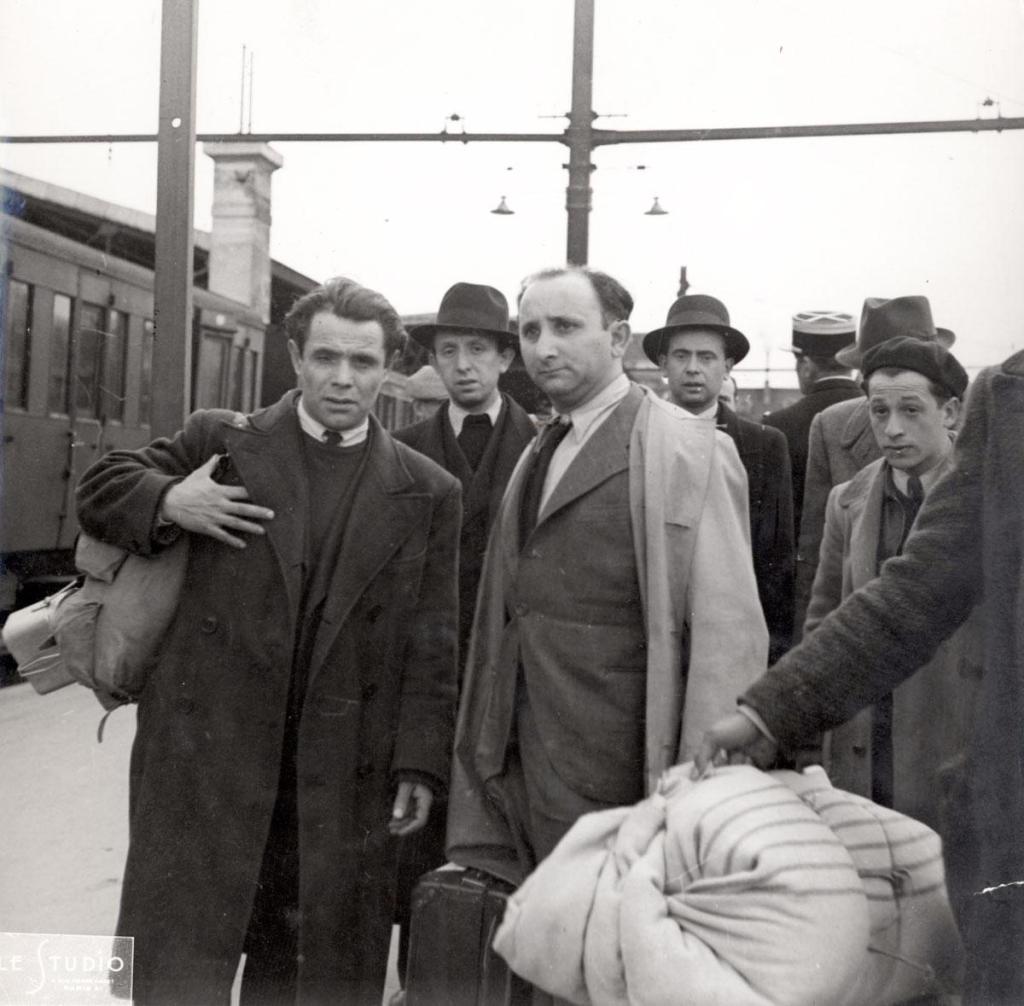
The first mass round-up of Jews in Paris took place. More than 3,700 foreign Jews were arrested when they reported to a gymnasium for police examination of their status. They were sent to the internment camps of Pithiviers and Beaune-la-Rolande. The “Green Ticket” Roundup is the first mass arrest of Jews in Paris, and it takes place on Wednesday May 14, 1941. These unsuspecting men, mainly foreigners from Eastern Europe are summoned on Wednesday morning by the Police Prefecture with a “green ticket” for a “status review” and asked to be accompanied by a relative or friend.
The men, most of them family men who were army volunteers at the beginning of the war and therefore fought for France, expect a verification of their status. Fleeing antisemitism and persecutions in their countries of origin – Poland, USSR, Romania, Czechoslovakia – and believing that they will find refuge in the land of freedom, they are arrested chiefly because they are Jewish and foreigners.
Several assembly points are indicated on the “green tickets”: the Caserne Napoléon (in the 4th arrondissement), the Caserne des Minimes (in the 3rd arrondissement), 52 rue Edouard Pailleron (in the 19th arrondissement), 33 rue de la Grange-aux-belles (in the 10th arrondissement) and the Japy gymnasium (in the 11th arrondissement) as well as other centers in the arrondissement police stations and Paris suburbs.
As far as the Japy gymnasium is concerned, 1,061 Jews are summoned at 7.00 am; 800 respond to the summons. When they arrive, they are checked and detained inside the gymnasium. The person accompanying them is asked to go to their home and return with a suitcase containing their personal belongings.
After that, the 3,700 arrested Jews are taken to the Paris-Austerlitz railway station in special buses, under the supervision of French police officers, and interned in the Pithiviers and Beaune-la-Rolande camps (in the Loiret). They spend more than a year there before being deported directly to the Auschwitz-Birkenau camp by Convoy #4 on June 25, 1942, #5 on June 28, 1942 and #6 on July 17, 1942. During the Vel’ d’Hiv’ Roundup of July 16 and 17, 1942, it is the families’ turn to be arrested and detained in these same camps before their deportation to the Auschwitz-Birkenau camp between July and September 1942.
Rumania passed laws which required all adult Jews to become forced laborers.
Axis aircraft attempted to locate British troop concentrations near the Libyan-Egyptian border as a British offensive was suspected; none were found.
General Wavell overnight launches operation ‘Brevity’ designed to counter-attack the German positions at Sollum and around Fort Capuzzo in an attempt to push Rommel back from the frontier and relieve Tobruk. The British front line forces, under Brigadier “Strafer” Gott, consisted of the Support Group of 7th Armoured, the 11th Hussars and the motorized 22nd Guards Brigade, together with some artillery, plus the 2nd Royal Tanks from the 7th Armoured Brigade, now equipped with the reconditioned A9 and A10 Cruiser tanks and the 4th RTR equipped with heavily armored Matildas. The 22 Guards Brigade and the 4th Tanks opened the offensive with an assault on the Halfaya Pass. Here they achieved complete surprise but were then held up by Italian gunners who fought well and knocked out 7 Matildas before being overrun. The fight alerted the Germans at Fort Capuzzo, who greeted the advancing tanks of A Squadron, 4 RTR, with a hail of shellfire. Although the fort fell, it was quickly recaptured. Gott’s forces continued to press forward during the night, but with more German tanks coming forward and the opposition steadily increasing, he decided to pull back and defend the Halfaya Pass above Sollum, which was held by a squadron of the 4th Tanks in Matildas, and 3rd Bn. the Coldstream Guards.
British cruiser HMS Dido departed Suda Bay, Crete, Greece and headed for Alexandria, Egypt with £7,000,000 worth of Greek gold aboard. She was escorted by destroyers HMS Stuart, HMS Vendetta, HMS Janus, and HMS Isis.
Wavell tells the UK Chiefs of Staff that occupation of Syria will require an entire corps including an armoured division. Fearing a concentrated Axis offensive against the Middle East from the Balkans via Syria, the Chiefs of Staff order Wavell to secure Syria as soon as possible.
Germany proclaimed the northern part of the Red Sea a zone of military operations.
Brigadier Dan Pienaar’s 1st South African Brigade advanced north from Addis Ababa and joined the fighting at Amba Alagi. Italian forces suffer from Allied attacks and by Ethiopian guerrilla attacks which are fierce and undisciplined.
The British Home Guard mounted guard at Buckingham Palace today in honour of its first birthday and was congratulated on its keenness by the King in an order of the day. Its strength is now 1,500,000 men, organized in 1,200 battalions. Their makeshift weapons have changed to regulation rifles and American Tommy guns.
Herbert Morrison, the Home Secretary, has announced the nationalization of the country’s fire services. The 1,450 local fire authorities in England and Wales will be replaced by a central command divided up into 12 Civil Defence regions. The Blitz has shown up the weakness of having a multiplicity of fire brigades, many of them very small, which refuse to amalgamate or co-operate. Some would not go to the help of others until payment was agreed. Their equipment, ranks and words of command all differ, causing confusion when two brigades are fighting the same fire side by side.
Karl Richter, a German spy, is arrested in East Anglia shortly after parachuting in.
Battleship Bismarck and light cruiser Leipzig conducted exercises; the port side crane was damaged during the exercises.
Lord Gort was appointed the Governor of Gibraltar.
France accepted the new German terms for economic collaboration. Darlan tells Petain that he will collaborate with Hitler to prevent France’s “Polandization”.
Bulgaria annexed part of Greek Macedonia and Greek Thrace.
The British RAF formed No. 121 Squadron, also known as the second Eagle Squadron. It was consisted of American volunteers.
A British Blenheim bomber flying reconnaissance over Syria spotted a German Ju 90 transport aircraft at the Vichy French airfield at Palmyra. The reconnaissance plane flew a second mission at noon and determined that several axis transport planes had landed there. Later that afternoon 3 British Blenheim bombers with 2 Curtiss Tomahawk fighters flying cover, made a low-level strafing attack on Palmyra without visible success. This was the first time that Curtiss Tomahawks were deployed in the war.
The 1st Free French Fighter Squadron leaves Libya and moves to Palestine.
Destroyer HMS Bulldog departed Scapa Flow at 0100 for Iceland.
Destroyers HMS Somali, HMS Bedouin, and HMS Eskimo departed Scapa Flow at 0500 for Rosyth to escort aircraft carrier HMS Victorious. The destroyers arrived at 1400/14th. Aircraft carrier Victorious departed Rosyth on the 15th, escorted by light cruiser HMS Aurora, and destroyers Somali, Bedouin, and Eskimo for Scapa Flow where she arrived the same day at 2200.
Destroyer HMS Blankney departed Scapa Flow at 1400 for Aberdeen to meet steamers Amsterdam and Archangel at 2100 off the harbor entrance. The destroyer escorted the steamers northward. Steamer Archangel was detached to Kirkwall. Steamer Amsterdam was escorted on to Lerwick. The destroyer and steamer Amsterdam arrived at Lerwick at 0945/15th and departed later at 2000 for Aberdeen. Destroyer Blankney arrived back at Scapa Flow on the 16th to escort steamer Archangel from Kirkwall to Aberdeen. The two departed at 1800.
Anti-aircraft ship HMS Alynbank departed Scapa Flow at 1045 and escorted convoy WN.26 from the Pentland Firth southwards. Early on the 15th, the ship transferred to convoy EC.Special 2 and provided cover until arrival in the Pentland Firth. Destroyer HMS Brocklesby departed Scapa Flow at 1845/15th to provide additional escort for convoy EC.Special 2. Ship Alynbank arrived back at Scapa Flow at 2000/15th. Destroyer Brocklesby after escort proceeded to Plymouth for duty.
Examination vessel HMS M. A. West (96grt) was sunk by German bombing one mile 105° from Great Yarmouth Harbour entrance. There were no casualties on the drifter.
Harbour defence patrol vessel HMS Minicoy (5grt, T/Lt E. F. Pegg RNVR) was sunk on a mine eleven cables 94° from St Ann’s Head. Pegg and some ratings were lost in the vessel.
Norwegian steamer Karlander (1843grt) was badly damaged by German bombing in 55-38N, 13-38W. The entire crew was rescued. The steamer was sunk by an escort vessel at 1020/14th in 55-36N, 13-24W.
At 2000/14th, battleships HMS Queen Elizabeth and HMS Barham, anti-aircraft cruisers HMS Naiad and HMS Phoebe, and destroyers HMS Jervis, HMS Jaguar, HMS Greyhound, HMS Hasty, HMAS Nizam, HMS Defender, and HMS Imperial. Cruiser Phoebe developed cracks in her hull plating aft and was forced to return to Alexandria, arriving on the 16th. Light cruiser HMAS Perth was detached from the 7th Cruiser Squadron as a replacement for cruiser Phoebe. After refueling, the cruiser joined the Queen Elizabeth group. These ships constituted Forces A and D for the defense of Crete.
Submarine HMS Unbeaten attacked two schooners in Khoms Roads. The submarine claimed sinking one with torpedo and the other with gunfire. Neither ship was lost.
British steamer Dalesman (6343grt) was badly damaged by German bombing in Suda Bay. The steamer went aground. She was later salved for use by the Germans.
British steamer Cape Horn (5643grt) was damaged by German bombing at Port Said.
Gunboat HMS Gnat bombarded a mobile enemy battery near the entrance of Tobruk Harbour.
Gunboat HMS Aphis rejoined the Inshore Squadron after repairs.
British steamer Rabaul (6809grt) was sunk by German raider Atlantis at 19-30S, 4-30E. The German commerce raider Atlantis, disguised as the Dutch motor-ship Brastagi, sank by gunfire the 5,144 ton British freighter Rabaul in the shipping lanes off the west coast of Africa. The Rabaul was bound for Capetown, South Africa from the United Kingdom with a cargo of coal. Seven of the crew died and the other 58 were taken prisoner. The prisoners would be transferred to the blockade-runner Dresden, which safely reached Bordeaux, France some weeks later.
Convoy AS.31 departed Suda Bay with merchant ships British Lossiebank (5627grt) and Dutch Nieuw Zeeland (11,069grt) escorted by light cruiser HMS Dido and destroyers HMAS Stuart, HMAS Vendetta, HMS Janus, and HMS Isis. Light cruiser Dido was carrying £7,000,000 sterling of Greek bullion. Steamer Lossiebank broke down and destroyer Stuart was sent ahead with steamer Nieuw Zeeland. The convoy was attacked by air on the 15th, but no damage was done. British Forces A and D joined the convoy for support. Cruiser Dido and anti-aircraft cruiser HMS Calcutta were detached from the convoy at dark on the 15th. They proceeded to Alexandria to refuel, arriving early on the 16th. Three Greek destroyers departed Alexandria on the 15th. They relieved destroyers Vendetta and Isis at daylight on the 16th. Destroyer Janus had already been detached and arrived at Alexandria on the 16th with damaged steamer Cape Horn (5643grt). Destroyers Stuart, Isis, and Vendetta arrived at Alexandria on the 16th. Convoy AS.31 arrived at Port Said escorted by the Greek destroyers on the 16th.
Convoy HG.62 departed Gibraltar escorted by sloop HMS Deptford, corvette HMS Fleur De Lys, and Dutch submarine HNLMS O.24. The submarine was detached that day and the corvette on the 21st. On the 26th, the convoy was joined by destroyers HMS Leamington and HMS Saladin, corvettes HMS Clarkia and HMS Gladiolus, and anti-submarine trawler HMS St Zeno. The convoy arrived at Liverpool on 2 June.
In Washington today, President Roosevelt’s callers were Sidney Hillman, associate director general of the OPM, and James V. Forrestal, Undersecretary of the Navy, who has just returned from a mission to Britain.
The Senate considered the bill for acquisition of foreign ships, completed Congressional action on the bill for increasing loans on agricultural commodities and recessed at 4:18 PM until noon tomorrow. The Appropriations Committee approved a deficiency bill with funds for defense housing; the Military Affairs Committee amended the Vinson priorities bill; the Defense Investigation Committee heard more testimony on the aluminum situation.
The House passed the Interior Department Appropriation Bill, received the Baldwin bill to provide military equipment to Eire under the Lend-Lease program, heard Representative Dirksen of Illinois call upon President Roosevelt to recommend economies and adjourned at 5:56 PM until noon tomorrow. The Coinage Committee rejected an amendment to curb the President’s monetary powers; the Dies committee announced a program of hearings on the American Peace Mobilization; the Ways and Means Committee continued hearings on proposed tax legislation.
A U.S. Senate fight on the convoy issue was postponed today. A group of senators favoring a ban on U. S. naval escorts for war supplies decided against trying to tack such a prohibition on the pending ship seizure bill. “This involves no element of retreat at all,” Senator Tobey, New Hampshire Republican, told reporters after a meeting at which the decision was reached. “The issue is still very much alive and will be presented to the senate. It’s just a matter of finding the best way to present it.” The anti-convoy senators reported a general feeling it would be better to wait until Mr. Roosevelt makes his speech of May 27. They would prefer, they said, that the issue be raised first by the administration.
President Roosevelt received an oral report today on the British position in the war and requirements for American aid, It was made to him by James V. Forrestal, Under-Secretary of the Navy, the highest ranking American official, except for Sumner Welles, who has been sent to Britain on a mission since the war started. Mr. Forrestal had luncheon with the President in his private quarters at the White House, and neither the Under-Secretary nor executive sources made any statement to the press. It was understood in Administration circles, however, that the Navy official told Mr. Roosevelt Britain’s prime immediate needs were enough heavy bombers to eliminate the convoy problem, heavy tanks to meet the assault of any mechanized forces which Germany may succeed in landing in Britain, and ships. Mr. Forrestal also was represented in these quarters as having advised the President that the morale of the British people was so high, despite persistent bombings, that there would be a revolution if any British Government tried to negotiate a peace, and that the position of Prime Minister Churchill was stronger than at any time.
United States Ambassador John G. Winant told the English-speaking Union in London today that “wise use of the navies of the world will decide the destinies of the world’s free peoples,” inferentially advocating immediate American convoys.
By a vote of 75 to 2 the Senate gave final approval today to legislation which would give to producers of wheat, corn, cotton, tobacco and rice government loans up to 85 per cent of parity prices. The conference report on the bill was approved, 275 to 63, by the House yesterday and the measure now goes to the President.
A unanimous decision to strike from the Vinson Priorities Bill the Cox amendment establishing an independent statutory priorities board was reached by the Senate Military Affairs Committee today after officials strongly opposed it. The amendment was added to the bill on the floor of the House, with the explanation from its sponsor, Representative Cox, Democrat, of Georgia, that one objective was to “freeze” Edward R. Stettinius Jr. in his status as director of priorities, and give him a $12,000 salary.. The amendment also would have authorized the director to exercise his authority with the assistance of industry committees, but only after approval by the Joint Army and Navy Munitions Board. With this section removed, the bill stands essentially in the form desired by the Administration. It extends the President’s power to impose priorities to include contracts or orders of any country the defense of which the President deems essential to the defense of this country, as set forth in the Lend-Lease act. The Chief Executive could exercise his powers through any government agency he might select, which probably would be the OPM.
The active intervention of Speaker Rayburn and Secretary Morgenthau served today to cause the House Committee on Coinage, Weights and Measures to reverse the action of yesterday in voting to recommend that the President’s power to devalue the dollar be “frozen” at the prevailing price of $35 an ounce of gold.
The threatened strike of General Motors Corporation employees, scheduled for 7 AM today, has been postponed for twenty-four hours, it was reported just before 3 AM, today. The postponement came at the end of a hectic day of negotiations over a peace formula proposed by the National Mediation Defense Board. The proposal was acceptable to the committee representing the United Automobile Workers, C.I.O., but was not acceptable to the corporation officials. The defense board’s proposal was presented to both sides yesterday afternoon and the union committee accepted it soon afterward. C. E. Wilson, president of General Motors, returned to his hotel last night and discussed it with his associates. They returned to the conference room at about 10 PM and announced their declination. However, they made a counter offer which was not approved by the union group, headed by President R. J. Thomas and Walter P. Reuther.
A two-day strike at Colt’s Patent Fire arms Manufacturing Co., largest American producer of machine-guns, was settled tonight and workers of the day shift were ordered to return to work at 7 a.m. tomorrow. Robert F. Mintz, organizer for the United Electrical, Radio & Machine Workers (C.I.O. ), representing the 5,600 strikers, announced that terms of the settlement would add $2,000,- 000 to the company’s annual payroll in increased wages, and liberalized vacation schedules.
President Roosevelt today proclaimed June 14 as Flag Day and, calling for public and private celebrations, declared that the principles of unity and freedom symbolized by Old Glory are under attack.
Former Governor Philip F. Lafollette of Wisconsin last night denounced Secretary Stimson and Secretary Knox as “two Republican jokers running wild in the New Deal” who were pushing the nation “to the brink of war.”
Twenty-one B-17 flying fortresses of the latest type joined the powerful garrison at Hawaii today after a secret mass flight from California last night. This powerful air group was assembled and led by Lieutenant General Delos C. Emmons, commanding general of the GHQ Air Force.
Pacific Fleet Exercise No. 1 commences off coast of California. The maneuvers involve a landing on San Clemente Island and a bombardment exercise in which heavy cruisers and destroyers bombard shore targets (see 18 June).
The comic book superhero “Plastic Man” made his first appearance in Police Comics issue #1 (cover date August).
Major League Baseball:
The Cubs finally give up on Dizzy Dean. Diz gets his release the same day that brother Paul is sent to the minors by the Giants. Diz will sign on as a coach.
The Giants sell Ernie Koy to the Reds and send pitcher Harry Gumbert to the Cardinals for pitcher “Fiddler Bill” McGee. Gumbert will go 11–5 for the Cards in 1941 and pitch another 10 years.
At Fenway, the Red Sox score 7 runs in the 7th, 4 on a grand slam by Joe Cronin, to whip the White Sox, 10–7. Jimmie Foxx has a pair of homers for Boston. Chicago enjoyed a 6–3 lead until
the seventh, when Bill Dietrich walked Johnny Peacock, first man up. Lou Finney batted for Dick Newsome, who had pitched the sixth and seventh for Boston, and was hit on the left arm by a pitched ball. After Dom DiMaggio had singled into the left field corner, scoring one run, Pete Appleton relieved Dietrich. Appleton walked Stan Spence and struck out Ted Williams, then Luke Appling booted what looked like a double play grounder off Jimmy Foxx’s bat and Finney tallied. With the count two and one, Cronin hit his fourth homer of the season back of the horns in left center field. Doerr walked, stole second and counted on Peacock’s double to left field.
John Whitlow Wyatt of the Dodgers wins his seventh in a row, leading Brooklyn to a 6–2 win over the Cincinnati Reds. All seven have been complete games; two of them shutouts. Cincy ace Paul Derringer took the loss. Joe Medwick started the Dodgers off with a two-run homer in the first inning. Two more Brooklyn runs came in the second. Dolph Camilli and Dixie Walker each singled and, after Mickey Owen had forced Dolph at third in trying to sacrifice, Wyatt drove a double over Jim Gleeson’s head to the scoreboard in left center. Medwick brought another counter across in the third, Derringer’s last inning, on his own single, an infield out and Camilli’s single. Elmer Riddle yielded the sixth marker in the eighth on Cookie Lavagetto’s looping triple to right, on which Ival Goodman missed a shoestring catch, and Walker’s long fly to Goodman. Wyatt hurled a shut-out for seven innings and wasn’t even threatened by the Reds, except in the seventh when Goodman and Cyrano Lombardi got singles. But in the eighth the locals broke through for their two tallies.
Distance made the difference. Both the Indians and the Yankees punched out six hits in another pitching duel at the Stadium yesterday before 10,406, but half of the Cleveland hits were home runs as the Tribe won, 4–1, to sweep the two-game series with the erstwhile Bronx Bombers. Those two veterans, Mel Harder and Red Ruffing, were locked in a terrific battle and a 1–1 deadlock until the redhead weakened in the eighth. Lou Boudreau singled and Clarence (Soup) Campbell splashed the first home run of his major league career well up in the right-field stands for the clincher. Gee Walker’s round-tripper in the ninth was just an unnecessary flourish. Thus it was that the Yanks went down to their fourth straight defeat.
St. Louis Browns hurlers walk 19 Philadelphia Athletics. Starter Bob Harris issues 8 of the passes, but the Browns win anyway 10–5. Johnny Lucadello, sent in at third base in an effort to improve the Browns’ hitting, did just that today, driving in three runs to help trounce the Athletics.
The veteran Bob Klinger pulled a ball game out of the fire today for Pittsburgh with a fine sample of relief hurling and a timely double, enabling the Pirates to beat Philadelphia, 12–7. Manager Frankie Frisch started his newest pitcher, Nicholas Strincevich, obtained from the Braves, but Nick Etten spoiled the big boy’s day with a three-run homer in the first frame. Danny Litwhiler connected for another Philly homer in the second off young Lloyd Dietz and Joe Marty made one off Russ Bauers. Klinger held the Phils to two hits in the last four innings and his double in the sixth scored Vince DiMaggio with the tying run. The Bucs turned the contest into a merry-go-round in the seventh and eighth when they bunched six hits with three walks for five runs. Arky Vaughan led the attack with four singles.
A sixteen-hit attack, plus some weird fielding feats by the Tigers, gave the Senators a 9–4 victory today for a sweep of the two-game series with Detroit. Steve Sundra, who went the route for Washington, yielded twelve blows in registering his fourth victory but stayed out of serious trouble after his mates had presented him with an 8–3 advantage by the end of the fifth. George Case and Jimmy Bloodworth contributed three hits each and Ben Chapman lifted a home run into the left-field bleachers.
The scheduled game between the New York Giants and the Cardinals at St. Louis was postponed due to rain. The game will be made up as part of a doubleheader on September 14.
The scheduled game between the Boston Braves and the Cubs at Chicago was postponed due to rain. The game will be made up as part of a doubleheader on June 22.
Chicago White Sox 7, Boston Red Sox 10
Brooklyn Dodgers 6, Cincinnati Reds 2
Cleveland Indians 4, New York Yankees 1
St. Louis Browns 10, Philadelphia Athletics 5
Philadelphia Phillies 7, Pittsburgh Pirates 12
Detroit Tigers 4, Washington Senators 9
New Zealand Division light cruiser HMS Leander arrived at Colombo.
Japanese and Chinese reports today indicated that fierce fighting was in progress in several parts of China. The official Japanese Domei news agency asserted that Japanese forces in Shansi Province had wiped out the Chinese Seventh, Twelfth and Thirty-fourth Divisions in the course of an encircling movement. Bloody fighting was reported to have been going on for three days in the vicinity of Chuki in Chekiang Province, as well as in Central Hupeh and Southern Shansi.
Ending thirty-four years of consular and diplomatic service in China, United States Ambassador Nelson T. Johnson left Chungking by plane today for Hong Kong. There he will board a Clipper plane for the United States next Wednesday.
For the first time since his return from Europe Foreign Minister Yosuke Matsuoka today received first United States Ambassador Joseph C. Grew and then British Ambassador Sir Robert Leslie Craigie at the Foreign Office in Tokyo for a discussion of the situation.
Britain has rejected Japanese complaints and has made a new protest to Tokyo over Japanese discrimination against British interests in China, Foreign Secretary Anthony Eden told the House of Commons today. He said the Japanese should expect no consideration as far as trade with Britain was concerned until this dispute was settled. The subject came up when the Foreign Secretary was asked whether the government had done anything to make the Japanese abide by their promises not to molest the trade of other powers in the occupied areas of China. Mr. Eden said that representations had been made to Tokyo. He added that they had yielded no satisfactory results. Now Whitehall has embarked on another line, which, it is believed, may bring results, he indicated. “We have replied to Japanese complaints of economic restrictions in British territories,” Mr. Eden declared, “by saying that, while our main objects are to conserve supplies for our war effort and to prevent these supplies from reaching our enemies, we are naturally influenced in deciding our economic policy by the attitude of the Japanese Government toward our interests in China.”
New Zealand Division auxiliary minesweeping trawler HMS Puriri (927grt) was sunk on a mine off Auckland. Light cruiser HMS Achilles rescued the survivors.
Dow Jones Industrial Average: 117.01 (-0.2)
Born:
Adelaïde Henriette “Ada” den Haan, Dutch woman swimmer (Olympics, 1960), in Eindhoven, German-occupied Netherlands (d. 2023).
Died:
Maurice Bavaud, 25, Swiss citizen who attempted to assassinate Adolf Hitler in 1938 (executed by guillotine).
Minnie Vautrin, 54, American missionary.
Naval Construction:
The Imperial Japanese Navy aircraft carrier HIJMS Kaga departed the drydocks at Sasebo, Japan.
The U.S. Navy oiler USS Chicopee (AO-34), lead ship of her class of 2, is laid down by the Sun Shipbuilding & Drydock Co. (Chester, Pennsylvania, U.S.A.).
The U.S. Navy SC-497-class (110-foot wooden hull) submarine chaser USS PC-522 (later SC-522) is laid down by the Annapolis Yacht Yard Inc. (Annapolis, Maryland, U.S.A.).
The U.S. Navy 80-foot Elco patrol motor torpedo boat USS PT-43 is laid down by the Electric Launch Company Ltd. (Elco), (Bayonne, New Jersey, U.S.A.).
The U.S. Navy Fletcher-class destroyers USS Aulick (DD-569) and USS Charles Ausburne (DD-570) are laid down by the Consolidated Steel Corp., Ltd. (Orange, Texas, U.S.A.).
The Royal Navy MMS I-class motor minesweeper HMS MMS 41 (J 541) is launched by Richards Ironworks Ltd. (Lowestoft, England, U.K.).
The Royal Navy MMS I-class motor minesweeper HMS MMS 47 (J 547) is launched by the J.W. & A. Upham Shipyard (Brixham, England, U.K.).
The U.S. Navy Accentor-class coastal minesweeper USS Roller (AMc-52) is launched by the Snow Shipyards Inc. (Rockland, Maine, U.S.A.).
The Royal Canadian Navy Bangor-class (Reciprocating-engined) minesweeper HMCS Goderich (J 260) is launched by the Dufferin Shipbuilding Co. (Toronto, Ontario, Canada).
The Royal Canadian Navy Flower-class corvette HMCS New Westminster (K 228) is launched by the Victoria Machinery Depot Co. Ltd. (Victoria. British Columbia, Canada).
The U.S. Navy transport USS Neville (AP-16; later APA-9) [former SS City of Norfolk] is commissioned. Her first commanding officer is Captain Carlos Augustus Bailey, USN.
The Kriegsmarine (German Navy) Type VIIC U-boat U-82 is commissioned. Her first commanding officer is Oberleutnant zur See Siegfried Rollmann.
The Royal Navy “T”-class (Second Group) submarine HMS Thrasher (N 37) is commissioned. Her first commanding officer is Lieutenant Patrick James Cowell, DSC, RN.

