OKW Chief Field Marshal Wilhelm Keitel, on behalf of the OKW and Adolf Hitler, issues the first in a stream of flagrantly illegal orders to the Wehrmacht concerning the upcoming Operation BARBAROSSA. The new Decree on wartime military jurisdiction was published, which removed crimes against civilians from the sphere of courts martial and suspended any obligation to punish offences against “hostile civilian persons” committed by soldiers. General Wilhelm Keitel issues the following directive on behalf of the Fuhrer: ‘Persons [Russian civilians] suspected of criminal action will be brought at once before an officer. This officer will decide whether they are to be shot. With regard to offenses committed against enemy civilians by members of the Wehrmacht, prosecution is not obligatory…’ Basically, the order suggests, “anything goes” and anything up to and including outright murder by Wehrmacht troops is not only permitted, but encouraged.
This broad order, under an interpretation, dispenses with due process completely and is contrary to every law of warfare regardless of specific treaties, and everyone within the Wehrmacht must realize this instantly — but it stands. Keitel will, on 27 June, order all copies of this infamous order destroyed, but the Soviets will obtain copies and retain them in the Kremlin.
British troops began gathering for the Operation BREVITY offensive in the Libyan-Egyptian border region. Axis aircraft discovered and bombed one tank concentration.
British gunboat HMS Gnat shelled the German airfield at Gazala, Libya 30 miles west of Tobruk after sundown in an attempt to disrupt the German aerial campaign against the besieged Tobruk.
Churchill is ecstatic about the safe conclusion of the TIGER convoy to Alexandria directly through the Mediterranean and sends a memo to David Margesson and General Sir John Dill noting that the success of the TIGER convoy “may well have transformed the situation in the [Middle East].” He reasons that:
“It is much better to provide ample forces in war so as to achieve a swift result, rather than to budget for a continued flow of wastage over a long period of months. I am therefore of the opinion that we should send all we can from [England] at the very earliest moment.”
Churchill says that he has asked the Admiralty to consider sending a repeat of the TIGER Convoy and also to return some convoy ships from Alexandria to England via the same direct route.
The exiled Mufti of Jerusalem broadcasted from Baghdad urging all Islamic countries to rise up against Britain.
A shipment of Vichy French weapons arrived in Mosul, Iraq from French Mandate of Syria, containing 15,500 rifles, 6 million rounds of ammunition, 200 machine guns, 4 75-mm field guns, and 10,000 shells. Meanwhile, a British mobile column from Palestine reached Rubah, Iraq, finding it already abandoned by Iraqi forces.
The remainder of Special Force Junck (Sonderkommando Junck), commanded by Luftwaffe Oberst Werner Junck, arrives in Aleppo, Syria on 13 May 1941. The squadron composed of Bf 110 Zerstörer heavy fighters (12 aircraft in total) from the 4. Staffel/ZG 76 Heinkel He 111 bombers (12 aircraft) is spotted by British agents. Sonderkommando Junck intends to fly on to Mosul, Iraq in order to aid Rashid Ali in his war against the British. Today, for the first time, the RAF encounters a Luftwaffe plane (flying under Iraqi colors) in the theater. This contributes to a growing British conclusion that they must invade Syria.
The Indian troops of the 5th Indian Division renew their attacks on the Italian stronghold of Amba Alagi. They attack the Twin Pyramids position. The newly arrived 1st South African Brigade prepares to join in the attacks on the 14th. The Italians continue to put up fierce resistance, but they have no source of supply and small stockpiles of essential goods such as food and water.
Homeless members of the House of Commons met today in Church House, Westminster, normally the assembly hall of the Church of England. Their own chamber is a heap of rubble. Only the scorched walls remain — the Speaker’s chair, the table and its despatch boxes all perished. A small bomb struck Big Ben, denting and blackening the clock face, but is it still chiming the hours. The hammerbeam roof of Westminster Hall (built c.1100) was saved, but the member’s lobby lost its roof. “Parliamentary business will not be interrupted by enemy action,” Churchill declared at Question Time in the substitute chamber.
Other London landmarks that are casualties of the great raid include Westminster Abbey, whose lantern roof collapsed in stream of molten lead — lack of water made the Abbey firewatch powerless.
The Deanery was destroyed. Lambeth Palace, Scotland Yard, the War Office, St James’s Palace, Victoria Station, the Law Courts, Gray’s Inn and Lincoln’s Inn were damaged. At the Royal College of Surgeons, pickled bodies were rescued from the debris. Fire destroyed 250,000 books at the British Museum. the Tower of London was hit by 100 incendiaries and Tower Pier was demolished, taking a naval vessel with it.
Having listened to Rudolf Hess drone on for two days in Glasgow about his (and presumably Adolf Hitler’s) peace proposal, military intelligence expert Ivone Kirkpatrick flies down to London and reports to Prime Minister Winston Churchill at 10 Downing Street. Churchill already knows the main outlines of the proposal, and nothing that Kirkpatrick tells him has any influence on his absolute refusal to consider any peace proposals.
Churchill’s main concern at this time is to prevent Hess from spreading his proposal to a wider audience. In a memo to Foreign Secretary Anthony Eden, Churchill calls Hess “potentially a war-criminal” and the other German leaders possibly “outlaws.” This is one of the first indications that this is how the Allies intend to treat the German leaders after the war.
Churchill further states:
In the meanwhile [Hess] should be strictly isolated in a convenient house not too far from London, fitted by “C” [head of the Secret Intelligence Services Stuart Menzies] with the necessary appliances, and every endeavour should be made to study his mentality and get anything worthwhile out of him.
Churchill emphasizes that Hess “should not have any contacts with the outer world or visitors except as prescribed by the Foreign Office.” However, Churchill specifies that Hess “should be treated with dignity as if he were an important General who had fallen into our hands.”
Churchill never meets with Hess despite the latter’s repeated requests to do so. The former deputy führer is kept in isolation and not informed of Churchill’s adamant refusal to consider his proposal, instead of being allowed to believe that the offer was being actively considered. For the time being, Hess is kept isolated from all news and sources of outside information.
Churchill decrees that Hess should be treated as a prisoner of war but, “…This man … is potentially a war criminal, and he … may well be declared outlaw at the close of the war…”
Churchill’s Tank Parliament meets at 10 Downing Street and reviews armored formation strategy for the defense of the British Isles, a German invasion still being considered an imminent threat. Churchill emphasizes the need for close cooperation between the RAF and tanks. In fact, he states that ground forces should have control over air operations and that “he would like a scheme prepared to equip as early as possible fourteen Army Co-operation Squadrons.” These, he adds, “would then be completely at the disposal of the Army.” Air Commodore Robert Goddard notes that equipping such squadrons, flying Blenheims, and Tomahawks, could only come at the expense of Bomber Command, but the decision is made and Lord Beaverbrook is instructed to begin the conversions.
The RAF refine their wireless navigation system known as Oboe. It is not ready for use yet. Oboe is a more sophisticated system of navigation than the current German systems that have proven effective, but easy to jam.
Following the delivery of a report of the court of inquiry into the conduct of military personnel on board the HMT Dunera in the summer of 1940, an order to court-martial the captain and other military personnel on the vessel is issued. The crew of Dunera is accused of malicious and predatory conduct of evacuees from England to Australia, including, inter alia, savage beatings, and theft.
German Chancellor Adolf Hitler flew to Berlin to address an emergency meeting of Reichsleiters and Gauleiters about the flight of Deputy Führer Rudolf Hess to England. He announces that Martin Bormann has taken office as NSDAP Party Chancellor. Bormann will control all appointments to the NSDAP and access to Adolf Hitler from this point forward. This enrages others within the German government whose own power depends upon their access to the Führer, but Hitler wants to free his hands for tighter control over military operations now that war with the Soviet Union is looming. This marks a major reorientation of German life from one in which the NSDAP is dominant to one in which the Wehrmacht becomes increasingly predominant.
German ambassador to Turkey Franz von Papen, former chancellor of Germany and Vice-Chancellor in 1933-34 under Hitler, reports from Ankara. He indicates that Turkey is increasingly favorably disposed to the Reich. Turkey, due to von Papen’s influence, is steadily increasing its trade with the Reich.
German Professor Karl Bömer, head of the Foreign Press Department, is at a diplomatic reception in the Bulgarian embassy in Berlin when he states in a drunken stupor to diplomats and journalists that he in line to be promoted to Gauleiter of the Crimea. Of course, the Crimea is a Soviet possession well behind the frontier, and this comment draws a lot of attention. Bömer is brought up on charges and sentenced by the People’s Court for “negligent treason” to three years in prison. Bömer later is sent to the army to serve in Russia, where he perishes in 1942.
German submarines U-98 and U-111 attacked Allied convoy SC.30 off Greenland in the morning, sinking British ship Somersby (entire crew of 43 survived and rescued by Greek ship Marika Protopapa) and armed merchant cruiser HMS Salopian (3 were killed, 287 survived). Also in the morning, U-105 sank British ship Benvrackie at 0748 hours 700 miles off Sierra Leone, British West Africa; 28 were killed, 55 survived.
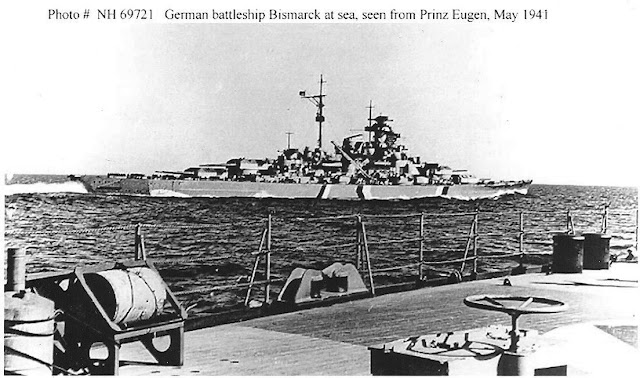
Battleship Bismarck and heavy cruiser Prinz Eugen conducted refueling exercises.
It is fair to say that Vichy France is caught between the millstones of the Reich and Great Britain at this time, and relations with both are murky at best. Both sides have been reaching separate agreements with Vichy, some public but many private. The Royal Navy is the flashpoint for many incidents, and one happens today which threatens to poison relations between the two powers. Royal Navy armed merchant cruiser (AMC) Bulolo seizes 4484-ton Vichy French freighter Bourbonnais several hundred miles southwest of Dakar. The Bourbonnais, however, have time to send out a distress call that is received in Dakar, and the French authorities there are tired of having their ships seized on the high seas. They send out destroyers Fantasque and Terrible to “assist” the Bourbonnais. More ships follow. However, they can’t find the Bulolo and Bourbonnais.
Trial against resistance fighter comte d’Estienne d’Orves begins.
Willy Lewis’ U.S. jazz band performs in Switzerland.
The Glina massacres in Serbia continue and come to a temporary conclusion. The Ustaše executes 100 Serb males in the nearby village of Prekopi. All told, roughly 260-300 Serbs have been killed in the previous few days (historians vary on their figures).
Yugoslav Army Colonel Dragoljub Mihailovic reached Ravna Gora on the western slopes of the Suvobor Mountains in Serbia where Mihailovic established his headquarters. Mihailovic issued an uprising call promising struggle against the occupiers and restoration of Monarchy. Mihailovic formed the first organized guerilla resistance movement not only in Yugoslavia and the Balkans, but in all of occupied Europe. This resistance movement was called the Ravna Gora Movement. This movement was comprised primarily of Serbs, but also Slovenes, Bosnians, and Croats who made the dangerous trek from Bosnia into central Serbia.
The Soviet Red Army commenced the movement of substantial forces to the western frontier, but out of the thirty-three divisions deployed only four or five were fully equipped by the outbreak of war. Soviet Chief of General Staff Georgi Zhukov has ordered four armies sent to the Western and Kyiv army groups. The Soviet armed forces sent west, however, are poorly equipped and understrength. The Soviet western border is roughly 2000 miles long, and four armies can only man isolated strong points.
Pursuant to Stalin’s expressed desire to attack the Reich, which he stated clearly on 5/6 May 1941, Soviet Defense Commissar Marshal Timoshenko and Zhukov submit a plan of operations. They project sending 152 divisions and over 3000 aircraft toward southern Poland. However, reviewing all the data of troop readiness and dispositions, Stalin decides against an attack at this time. He also rules against a general mobilization, though Soviet citizens are being called up in increasing numbers to serve in the armed forces.
The Luftwaffe again attacks London. One new characteristic of these night raids is that they now are accompanied by a fighter escort (day fighters that operate at night without radar are known in the Reich as “wild boar” fighters). This is an indication of growing RAF success at interdicting the nightly Luftwaffe bomber streams with Beaufort night fighters.
The damage to London is growing and alters daily life there. The chamber of the House of Commons is in ruins, so the MPs must meet in Church House, Westminster. Prime Minister Winston Churchill states there that “Parliamentary business will not be interrupted by enemy action.” Big Ben is damaged, but still functional. The historic hammer-beam roof of Westminster Hall is intact, but the lobby roof is destroyed. Westminster Abbey also has lost its lantern roof for lack of water to fight the fires — something that the Luftwaffe helped cause by timing its recent mass raid of 10-11 May to low tide in the Thames.
The list of damaged and destroyed architectural treasures goes on and on:
Tower of London;
British Museum;
Tower Pier;
Royal College of Surgeons;
Gray’s Inn and Lincoln’s Inn;
Law Courts;
Victoria Station;
War Office;
Scotland Yard;
Lambeth Palace;
The Deanery;
15 hospitals, including Charing Cross and St. Thomas’;
Numerous Christopher Wren churches.
The London Palladium Theatre has a lucky escape — a parachute mine of devastating power crashes through the roof but catches on the beams, remaining suspended above the stage. It later is removed and intentionally exploded elsewhere.
RAF Bomber Command, Day of 13 May 1941
44 Blenheims on coastal sweeps over a wide area. No ships were seen but docks at St-Nazaire and Heligoland were bombed. 2 aircraft were lost.
The Luftwaffe bombs Malta, sinking tug Cornflower at Mersa. The strange case of the “Miracle” bell happens when a church bell used to warn of impending air raids tolls at 14:00, sending residents of a home for the elderly and disabled in Qomi to shelters. Seconds later, the building is bombed and destroyed. However, the church had not been informed of an impending raid, and nobody admits to ringing the bell. The Spiritual Director of the building ascribes it to “truly miraculous deliverance.”
Armed merchant cruiser HMS Salopian (F 94, Captain Sir John M. Alleyne Bt DSO, DSC Rtd), which had been escorting convoy SC.30, was sunk by U-98, commanded by Kapitänleutnant Robert Gysae, in 59-04N, 38-15W. At 0400 hours on 13 May 1941, HMS Salopian (F 94) (Capt Sir John Meynell Alleyne, DSO, DSC, Rtd, RN) was spotted by U-98 while escorting the convoy SC.30 about 400 miles southeast of Cape Farewell and missed with a first spread of two torpedoes because the ship zigzagged every 7 to 12 minutes. The next two torpedoes at 0619 and 0622 hours also missed and Gysae had to reload two bow tubes at the surface while running at high speed to search the vessel in the fog. At 0720 hours, the heavy armed ship came in sight again and five minutes later both reloaded bow torpedoes were fired like in a motor torpedo boat on the surface. The torpedoes hit amidships and in the bow but the U-boat had to dive because the ship opened fire. At 0800 and 0850 hours, two torpedoes were fired that both hit in the engine room, but the ship remained afloat. The U-boat then reloaded the tubes and observed how more than ten boats were launched and a motor boat tried to cover the ship by laying a smoke screen. At 1043 hours, a coup de grâce was fired that struck amidships and caused the ship to break in two and sink in two minutes in 56°43N/38°57W. Early on 14 May, HMS Inglefield (D 02) (Capt P. Todd, DSO, RN), HMS Intrepid (D 10) (Cdr R.C. Gordon, RN), HMS Impulsive (D 11) (Lt Cdr W.S. Thomas, DSC, RN) and HMS Escapade (H 17) (Cdr E.N.V. Currey, DSC, RN) arrived in the area and unsuccessfully searched for the U-boat. The commander and 277 officers and ratings were picked up by HMS Impulsive (D 11) and taken to Hvalfjord. One officer and two ratings were lost. Impulsive departed Hvalfjord at 1500/17th for Scapa Flow. En route, she was diverted to Greenock where she arrived at 2030/18th. Destroyers HMS Inglefield, HMS Intrepid, and HMS Escapade arrived back at Hvalfjord after anti-submarine operations at 1730/18th.
U-105, commanded by Kapitänleutnant Georg Schewe, sank British steamer Benvrackie (6434grt) at 00-49N, 20-15W. At 0748 hours on 13 May 1941 the Benvrackie (Master William Edward Rawlings Eyton-Jones), dispersed from convoy OB.312, was hit aft by two G7e torpedoes from U-105 and sank after 4 minutes about 700 miles southwest of Freetown. On 9 May, the ship had picked up 25 survivors from the Lassell, which had been sunk by U-107 (Hessler) on 30 April. U-105 had spotted the zigzagging ship in the evening on 11 May, missed with one G7a and one G7e torpedo at 2030 and 2054 hours on 12 May and finally sank her after a chase of 34 hours. 13 crew members and 15 survivors were lost. The survivors were questioned by the Germans. The master, 40 crew members, four gunners and ten survivors were rescued after 13 days in lifeboats by the British hospital ship HMHS Oxfordshire and landed at Freetown. The master William Edward Rawlings Eyton-Jones was awarded the Lloyds War Medal for bravery at sea. The 6,434-ton Benvrackie was carrying general cargo, including silver and one Gypsy Moth aircraft and was bound for Beira, Mozambique.
U-111, commanded by Kapitänleutnant Wilhelm Kleinschmidt, sank British steamer Somersby (5170grt), which was a straggler from convoy SC.30, in 60-39N, 26-13W. At 1141 hours on 13 May 1941 the Somersby (Master John William Thompson), a straggler from convoy SC.30, was hit amidships by one of two torpedoes from U-111 southwest of Reykjavik. The ship capsized and sank after being hit in the bow by a coup de grâce at 1246 hours. The master, 38 crew members and four gunners were picked up by the Greek steam merchant Marika Protopapa and landed at Loch Ewe. The 5,170-ton Somersby was carrying grain and was bound for Hull, England.
Destroyers HMS Electra, HMS Anthony, and HMS Antelope departed Scapa Flow at 2215 for Loch Alsh. The destroyers arrived the next day at 0600.
Minesweeper HMS Franklin was damaged by the near miss of German bombing in the North Sea. The minesweeper spent no time out of service.
British hopper barge F (496grt) was sunk on a mine 350 yards south of Dingle Oil Jetty. Five crewmen of an eleven man crew were lost.
British trawler Fort Rona (203grt) was sunk by German bombing fifteen miles WSW of Bardsey Island. The entire crew was rescued.
British steamer Lottinge (2468grt) was damaged by German bombing three miles off the mouth of the Tyne. The steamer returned to the Tyne.
Spanish fishing smack Nueva Elisa was sunk on a mine in the Bay of Biscay.
Light cruisers HMS Orion and HMS Ajax and Australian light cruiser HMAS Perth with destroyers HMS Juno, HMS Kandahar, and HMS Kingston departed Alexandria in Operation MD.8 to bombard El Fateyah airdrome near Derna. The bombardment, scheduled for the night of 13/14 May was not carried out as a position could not be fixed accurately.
Gunboat HMS Gnat bombarded the Gazala airdrome during the night of 13/14 May.
MTB Depot ship trawler HMS Vulcan arrived at Suez to join the Mediterranean Fleet.
Tug Cornflower was sunk by German bombing at Mersa, Malta.
French steamer Bourbonnais (4484grt), which had departed Dakar without escort for Tamative on the 12th, was seized by armed merchant cruiser HMS Bulolo at 13-07N, 19-22W on the 13th. A distress signal from the steamer caused large destroyers Fantasque and Terrible to depart Dakar on the 13th to assist. Light cruisers Georges Leygues and Gloire departed Dakar on the 14th. On the 14th, light cruiser HMS Dragon relieved the armed merchant cruiser and both arrived at Freetown on the 16th. The French ships returned to Dakar without contacting the French steamer.
Indian sloop HMIS Clive and armed merchant cruiser HMS King Grufford proceeded to Dante, seventy miles south of Cape Guardafui. The ships arrived on the 16th and embarked Italian prisoners of war.
On this day in Washington, President Roosevelt sent to the Senate the nomination of Harry M. Durning for reappointment as Collector of Customs for New York City and Dr. Carl E. Rice to be Senior Surgeon of the Public Health Service, and signed a bill removing a statutory limitation upon further construction at Governors Island. His callers included Brigadier General Thomas M. Robins, Assistant Chief of Army Engineers; Harold Smith, Budget Director; Attorney General Jackson and Rear Admiral Ernest J. King.
The Senate approved the appointment of Dr. Joseph Rosier as Senator from West Virginia, confirmed the nomination of James C. Capt as Director of Census, received the White Resolution for a Senate investigation of Federal Communications Commission rules and recessed at 5:20 PM, until noon tomorrow. The Judiciary Committee heard William H. Davis and Edward F. McGrady testify on the Ball Strike Mediation bill. The Military Affairs Committee approved a bill for extending the export licensing control program to the territories.
The House considered the Interior Department Appropriation bill, approved the conference report on a bill raising wheat, corn and cotton parity loans and adjourned at 5:47 PM until noon tomorrow. The Coinage Committee reported the bill continuing the President’s monetary powers, while the Ways and Means Committee continued hearings on the new tax bill.
Prime Minister Robert G. Menzies of Australia told an audience at a Council on Foreign Relations dinner at the Ritz Carlton Hotel in New York that war was America’s business: “… for parliamentary liberty and the ordered rights of self-government are our joint and several heritage… it is essential for the world not only that tyranny should be defeated but that it should be defeated quickly before the scars made by it are too deep and too lasting.” Menzies soon will head west on his epic circumnavigation that includes meetings with virtually of the world’s Allied leaders.
A bill extending President Roosevelt’s emergency monetary powers for two years won approval of the House Coinage Committee so quickly today that an amendment designed to forestall further devaluation of the dollar slipped into the measure almost unnoticed. Acting Chairman Cochran, Missouri Democrat, said he would recall the members tomorrow and, in the hope the full Democratic strength would be present, would attempt to eliminate the amendment. “Some of the boys didn’t know what they were voting for,” Cochran said. “We’ll have the votes tomorrow to knock the amendment out. That proposition would certainly tie the president’s hands.” The bill would extend for two years from June 30 the treasury’s stabilization fund and the president’s devaluation power.
Indications that plans are under way for some further step by this government in turning the tide of the Battle of the Atlantic were seen here today when President Roosevelt conferred with Admiral Ernest J. King, Commander in Chief of the Atlantic Fleet, and officers directing the Neutrality Patrol operating off the East Coast.
President Roosevelt was out of bed today for the first time since the beginning of his illness a week ago today, according to Rear Admiral Ross T. McIntire, his personal physician. He received several visitors before returning to bed at 2:30 PM, but canceled his third successive press conference. Dr. McIntire said the President could go to his office tomorrow if he wished, but that he wanted his patient to do only essential work during the rest of this week, to take drives in the sunshine and to regain his strength. Mr. Roosevelt will remain at the White House over the week-end, he revealed. The President is on a full diet again, the admiral said, and is chafing under the curbs placed upon his activities, making him a difficult patient to control.
Possibility arose yesterday of a new shutdown in Appalachian soft coal mines, only recently reopened under a temporary wage agreement. John L. Lewis, president of the C.I.O. United Mine Workers, said in New York unless a permanent agreement could be reached with southern operators this week it might be “considered necessary” to call miners from their jobs in all Appalachian pits. Asserting he was not impressed with wage conference progress, Lewis said the union had “no desire to continue this uncertainty in the industry.” The miners in the eight-state area returned to work two weeks ago after being idle during a month of negotiations. A two-year contract expired April 1, and the mines were reopened with understanding work would go on pending negotiations for a new contract. The northern operators met a union demand for a $7 a day wage scale, a $1 a day increase over the previous two years, but the southern owners held out for continuance of a wage differential of 40 cents a day. The union asked a blanket increase to $7 a day for both northern and southern mines, which would have boosted the southern scale $1.40 a day from the previous $5.60 level. Under the temporary agreement, the southerners consented to a $1-a-day increase to $6.60, with the differential controversy to be adjusted later.
Support from officers of their international union was announced today by A.F. of L. machinists who are on strike against eleven shipbuilding plants in the San Francisco Bay area, the announcement coming as the San Francisco Chamber of Commerce telegraphed to President Roosevelt urging his personal intervention in the tie-up of more than $500,000,000 of naval and Maritime Commission construction.
A strike at the Colt’s Firearms Co., Hartford, Connecticut, slowed production of weapons for the army and for Great Britain. An undetermined number of employees walked out, but company officials said the plant was in operation and a “substantial number” of the 4,900 day employees were at work.
Colonel William J. (Wild Bill) Donovan will make his first public speech since his return from war scenes in Europe and Africa when he shares the platform Sunday with Mayor La Guardia and Secretary of the Interior Harold L. Ickes at the observance of I Am an American Day on the Central Park Mall.
The House Committee on Coinage, Weights and Measures voted today 9 to 7 for a provision limiting to $35 an ounce, the present value, the President’s powers to devalue the gold content of the dollar.
The House Ways and Means Committee announced today that the Treasury excess profits tax plan probably would be submitted on Friday, which indicated that the hearings on the defense tax bill might run to late in the next week.
The House of Representatives voted today, 275 to 63, to raise the crop loan rate from 75 to 85 percent of parity on cotton, wheat, corn, tobacco and rice.
Calling not only for delivery, “at whatever risk,” of United States war shipments to aid Britain, the Right Rev. William T. Manning, Protestant Episcopal Bishop of New York, declared yesterday that “we should now take our full and open part in this conflict.”
The intercoastal steamship trade has placed forty freighters, amounting to between 300,000 and 400,000 gross tons, at the disposal of the Maritime Commission as its contribution to the 2,000,000-ton ship pool called for by President Roosevelt, it was announced yesterday following a meeting of the operators to discuss the commission’s tonnage request.
“Dangerous Moonlight,” a typical wartime British propaganda drama directed by Desmond Horst, receives its US premiere via Republic Pictures under the title “Suicide Squadron.” Future star Michael Rennie appears in a small role. The film, not very well remembered, is notable for aerial scenes of actual combat featuring RAF No. 74 Squadron, its planes featuring the unit’s “ZD” marking. The film is a big success due less to its cinematic quality than its patriotic tale of a love story between a US female journalist (Sally Gray) and a Polish ace (Anton Walbrook) flying for the RAF.
Vic Ghezzi won the PGA Championship.
Major League Baseball:
John Duncan Rigney, who is expecting a call momentarily to join Uncle Sam’s fighting forces, held the Red Sox sluggers to four scattered hits today as the White Sox triumphed, 3–2, to vault into second place in the American League standings. Rigney hooked up with Charlie Wagner in a tight hurling duel at wind-swept Fenway Park, and it was the latter’s generosity which pushed the Chisox into an early two-run lead. Rigney started the fireworks himself by drawing a pass in the third and then, with two away, Luke Appling sent him to second with a blooper to center. Wagner slipped two strikes past Joe Kuhel, then lost him with a base on balls. Taft Wright scored Rigney and Appling with a slam to center, fast fielding holding the blow to a single. John Duncan accounted for the third and winning run by doubling and romping home on Bill Knickerbocker’s two-base wallop in the seventh.
The Cubs “walked” two flights up into fourth place today when Hank Leiber drew a pass with the bases loaded and the score tied in the seventh inning for a 4–3 homecoming victory over the Braves. Tom Earley, third Boston pitcher, walked Leiber, who earlier had hit a two-run homer. Jake Mooty, who succeeded Vern Olsen after the Braves tied the score at 3–3 with three runs in the fifth, was the winning pitcher. He shut out the Braves with three singles in the last four and two-thirds innings.
The Brooklyn Dodgers beat the Cincinnati Reds, 4–3, in the opener of their two-game series, and dropped the 1940 champions nine and one-half games off the pace. Hugh Casey went the distance to extend his personal winning streak to five games. He hasn’t lost one so far. Both the Reds’ Bucky Walters and Casey faced only three men in the first inning. but Bucky was greeted with a line single by Muscles Medwick to open the second. Cookie Lavagetto sizzled a double inside third base and shortly the Dodgers had a run. It didn’t come on Cookie’s two-bagger, Joe only reaching third. Medwick came home a moment later on Dolph Camilli’s fly to Harry Craft. Walters was personally responsible for the two Brooklyn runs that crossed in the third inning. Casey opened with a single through the box, Reese sacrificed, Herman walked and both men advanced on Jimmy Wasdell’s infield out. Then, with Medwick up, Bucky let loose a wild pitch and before Lombardi could retrieve the ball both runners had scored. The Reds got two runs back in the fourth without delay. Bill Werber belted the first pitch against the left-field wall above the leaping Medwick’s head for two bases and Lonnie Frey also leaned against an initial pitch for a single to right, scoring Werber. Lonnie went to third on a passed ball and, after Jimmy Ripple had popped to Wasdell in short right. came home as Herman took Frank McCormick’s slow hopper. Thereafter Casey was master until the ninth, when the Reds counted one more. Meanwhile the Dodgers put over the deciding run in the fifth. Reese singled, advanced on Herman’s infield out and tallied on Wasdell’s single.
George Selkirk had a good view of it. With his back pressed against a rightfield box, he watched Lou Boudreau’s fly ball float over his head for a home run that gave the Indians a dramatic 2–1 ten-inning victory over the Yankees at Yankee Stadium before 27,130 spectators yesterday. This was the final bit of evidence that Bobby Feller had outpitched Marlus Russo in a gripping struggle. The Boy Wonder unfolded a gaudy six-hitter and the Yankee left-hander was not much more generous, since he gave only eight. From start to finish this was a game in which pitching artistry predominated. Cleveland picked up a slightly tainted run in the second and New York an even more spotty tally in the sixth. Thus they stood until Boudreau’s fourth circuit smash of the campaign settled things.
Backing Jack Knott with a twelve-hit attack, the Philadelphia Athletics defeated the St. Louis Browns today, 7–3. It was the first victory of the year for Knott, who allowed seven hits, one of them a three-run homer by Rip Radcliff. Nine of the Athletics’ hits came off Vernon Kennedy and included Bob Johnson’s seventh home run of the year, a 400-foot drive that scored two runs in the first inning.
The Pirates and the Phillies staged a bargain basement baseball game today with the Pirates staggering home in front, 6–3. The victory ended a four-game famine for Pittsburgh and was the Phillies’ fifth straight reverse. Only 986 fans, one of the smallest crowds in years at Forbes Field, saw the contest. Each side had four errors and 10 hits but the Pirates combined their hitting with Philly misplays. After scoring twice in the second the Bucs settled things in the fourth when Frankie Gustine’s double scored two runners and Bobby Bragan’s wild throw to the plate on Lee Handley’s grounder permitted Gustine to tally. Bragan provided the only bright spark in a doleful Philly day with four hits, one a triple
Morton Cooper, the Cardinals’ Missouri-born righthander who doesn’t mind defying the elements of chance by wearing No. 13 on the back of his uniform, had a bit of luck on this thirteenth day of the month and most of it was good. As a consequence, he outhurled the combined efforts of Carl Hubbell and Walter Brown to down the Giants in the opening clash of a two-game series, 3–2, for a triumph that kept the Cardinals within a game and a half of the front running Dodgers. In the ninth, with the score deadlocked at 2–2, Walker Cooper, Morton’s catcher and brother, bounced a tantalizing grounder to Burgess Whitehead. To the consternation of every one in the New York entourage, Whitey played the big hop badly and then gummed up the play for an error. He went on to score the winning run on Jimmy Brown’s single.
Sid Hudson held the Tigers to three hits as the Senators connected for eight to defeat the American League champions, 5–4, today. Big Buck Newsom held Washington scoreless until the fifth, when singles by Ben Chapman, Jake Early and George Case and Mickey Vernon’s booming triple produced three runs. Newsom gave way to Al Benton in the sixth after walking Cecil Travis and allowing Jimmy Bloodworth a single. Benton walked Chapman to fill the sacks, Travis was thrown out at the plate on Early’s grounder, and two runs came over on a fielder’s choice and an outfield out. Benton was charged with the loss.
Chicago White Sox 3, Boston Red Sox 2
Boston Braves 3, Chicago Cubs 4
Brooklyn Dodgers 4, Cincinnati Reds 3
Cleveland Indians 2, New York Yankees 1
St. Louis Browns 3, Philadelphia Athletics 7
Philadelphia Phillies 3, Pittsburgh Pirates 6
New York Giants 2, St. Louis Cardinals 3
Detroit Tigers 4, Washington Senators 5
Dow Jones Industrial Average: 117.21 (+0.07)
The Battle of South Shanxi continues as the Japanese North China Front Army captures Tungfeng. The Japanese effectively have surrounded elements of the Chinese 1st War Area, which are ordered to break out to the north in any way possible. The Chinese begin to try to slip through Japanese lines in small groups.
Predicting that a new future Japanese offensive against Chinese government troops would assume even larger proportions than the offensive at present being staged, the Japanese military spokesman today reviewed the combat situation. In Southern Shansi, according to the Japanese spokesman, Japanese forces have successfully trapped approximately 200,000 Chinese troops in the vicinity of Yuanku, southwest of Tsechow. Japanese troops are also declared now to be in possession of six crossings of the Yellow River, fords in the section of the river running west to east. If Japanese troops should consolidate their positions at these fords they would be within striking distance of the Lung-Hai railway. Asked if the present Japanese drive in Southern Shansi was aimed to oust the troops of Generalissimo Chiang Kai-shek, as other drives have been announced to be, or was the first stage of a drive against Sian or other important Chinese military centers, the Japanese spokesman declined to answer. He declared that the question and answer constituted a “military secret,” but said, “Time will show.” In regard to Hupeh province the Japanese spokesman declared that 200,000 or 300,000 of General Li Tsung-jen’s troops were trapped between Hankow and Ichang along the valley of the Han River and its various tributaries. Further questioning as to whether the Japanese forces on the Han River and those in Shansi contemplated a junction for drives to the west also brought the answer, “Military secret.”
Expressions were heard in the U.S. House of Representatives today urging embargoes on shipments of oil to Japan and to other countries which might reship it to Germany. The demands came during consideration of the Interior Department 1942 appropriation bill carrying $177,019,078.
A German consul in Chunking, China has access to Soviet secret diplomatic circulars. He reports today, on May 7th, the Soviets had instructed all missions to ascertain the probable attitude of other countries in the event of a German-Soviet conflict. Since the Soviets are presumed not to know about Operation BARBAROSSA, this suggests to the Germans that the Soviets are planning an attack of their own. This jibes with military intelligence gained after the invasion which claims that Stalin had made many warlike statements to graduates of Moscow staff colleges on 5/6 May.
The flight of Rudolf Hess, third highest German leader, to Scotland — which the press here generally characterized as an “escape” from Germany and which came on the heels of the arrest of Friedrich Minoux, noted German industrialist in Berlin — created a sensation in Japan, and further reports are awaited here with some anxiety.
Ernest Hemingway leaves Manila for Hawaii via flying boat, and things begin to return to normal after the recent massive influx of new soldiers on USAT Washington (which sets off on its return voyage carrying departing soldiers and dependents). Major Kirtley Gregg, newly made commanding officer of the 4th Composite Group, prepares to move his quarters to Nichols Field, the only asphalt runway suitable for fighter squadrons (Clark Field is turf and only suitable for old bombers). This is a time of great upheaval in the Philippine Department, with many new officers and men and new positions for old hands.
Born:
Ritchie Valens, American singer, songwriter and guitarist (“Donna”, “La Bamba”), in Pacoima, Los Angeles, California (d. 1959).
Senta Berger, Austrian-German actress (“Cast a Giant Shadow”, “Cross of Iron”), in Vienna, Austria.
Jody Conradt, American women’s basketball coach and University of Texas at Austin athletic director, in Goldthwaite, Texas.
Naval Construction:
The U.S. Navy YMS-1-class auxiliary motor minesweeper USS YMS-34 is laid down by the Hiltebrant Dry Dock Co. (Kingston, New York, U.S.A.).
The U.S. Navy YMS-1-class auxiliary motor minesweeper USS YMS-105 is laid down by Frank L. Sample, Jr. (Boothbay Harbor, Maine, U.S.A.).
The U.S. Navy YMS-1-class auxiliary motor minesweeper USS YMS-107 is laid down by the Burger Boat Co. (Manitowoc, Wisconsin, U.S.A.).
The Royal Australian Navy Bathurst-class minesweeper-corvette HMAS Townsville (J 205) is launched by Evans Deakin Ltd. (Brisbane, Queensland, Australia).
The Royal Navy Dance-class ASW trawler HMS Valse (T 151) is commissioned. Her first commanding officer is T/Lieutenant Donald Swinborne Hutton, RNR.
The Royal Indian Navy Black Swan-class sloop HMIS Jumna (U 21) is commissioned. Her first commanding officer is Commander Walter Richard Shewring, RIN.
The Royal Navy Flower-class corvette HMS Clover (K 134) is commissioned. Her first commanding officer is Lieutenant Commander Frank Arthur Shaw, RNR.
The Royal Navy “L”-class destroyer HMS Lance (G 87) is commissioned. Her first commanding officer is Lieutenant Commander Ralph William Frank Northcott, RN.

