The ships from the Operation TIGER convoy reached Alexandria. All of the ships except for the Empire Song, which hit a mine and sank with a cargo of 57 tanks, 10 aircraft and several trucks, reached Egypt safely. Operation TIGER (Convoy WS 8A) completes its bold passage through the Mediterranean when it arrives at Alexandria. It brings some 238 precious tanks (including 135 Matildas, 82 of the new 2-pounder-gunned Mark VI Crusader cruiser tanks and 21 light tanks), vital for the defense of the Nile River Valley and Tobruk. Also included are 43 Hawker Hurricanes. With this desperate operation completed successfully, the Mediterranean Fleet returns to Alexandria and Force H returns to Gibraltar.
An Italian convoy of two freighters departs from Tripoli escorted by torpedo boats Clio, Orione, and Pegaso. The torpedo boats attack a submarine, which may be HMS Undaunted, which is lost around this date of unknown causes. There are 32 deaths on the Undaunted.
Royal Navy gunboat HMS Ladybird has given sterling service in support of British ground forces in North Africa. She is bombarding Tobruk during the night when her luck finally runs out. 47 Italian aircraft catch and sink the Ladybird (some sources say these are Luftwaffe Stukas). There are four deaths and 14 wounded. On the bright side for the British, the gunboat settles in only ten feet of water, meaning her guns remain above water level and can remain in operation with the assistance of another ship to provide power. Admiral Andrew Cunningham commends the ship’s captain, stating:
“Great fighting finish worthy of highest ideals and tradition of the Navy and an inspiration for all who fight on the seas.”
The Regia Aeronautica (Savoia-Marchetti SM.79 aircraft of 281 Squadron) bombs and sinks 4998-ton British freighter Rawnsley during an attack on Ierapetra Bay, southeast Crete. The wreck has become a very popular dive site.
Royal Navy submarine Rorqual is off Lemnos when it torpedoes and sinks 25 ton Greek freighter Aghios Paraskavi and accompanying schooner. These are transports carrying Wehrmacht troops to garrison Aegean islands.
The Royal Navy command structure in the Mediterranean experiences a shakeup. Among the changes:
Vice Admiral Pridham Wippell CB, CVO, former Vice Admiral Light Forces => Vice Admiral, 1st Battle Squadron with his flag on battleship Queen Elizabeth;
Rear Admiral E. L. S. King CB MVO => Rear Admiral, 15th Cruiser Squadron with his flag in anti-aircraft cruiser Naiad;
Rear Admiral H. B. Rawlings CBE => Rear Admiral, 7th Cruiser Squadron with his flag in light cruiser Orion;
Rear Admiral I. G. Glennie => Rear Admiral (D) the Mediterranean with his flag in anti-aircraft cruiser Dido or depot ship Woolwich, if Dido was required at sea as a private ship.
Cairo: RAF Headquarters in the Middle East announced: “In Iraq, our fliers continued their raids on rebel-occupied airfields and on other military targets. The military barracks and the airfield buildings and motor vehicle park at Mosul (northern Iraq) received more than twenty direct hits. The military barracks at Al Amarah, Ad Diwaniyah, An Nasiriyah, and Ad Daghgharah (all in Iraq) were also damaged. In Abyssinia, fighter planes and bombers of the South African Air Force supported our ground troops in their destruction of the Italian army in East Africa. Two British aircraft did not return from these missions.”
On 12 May 1941, having just secured permission from Vichy Vice Premier Admiral Darlan on 11 May for Reich use of Syria as a transit hub for the military supply of Iraq, the Luftwaffe flies six Heinkel He 111s (Special Force Junck (Sonderkommando Junck)) toward Damascus. Having flown from Greece via Rhodes under the command of Luftwaffe Oberst (Colonel) Werner Junck (Commander of Aviation Iraq. (Fliegerführer Irak)), these are the first major Reich attempt at interdiction in the Iraq war. Their ultimate destination is Mosul, Iraq.
British reconnaissance planes spot several German aircraft in Iraq.
The Soviet Union recognized the rebel pro-Nazi Government of Iraq. This action was taken to improve relations with Germany and avert German attack on Ukraine and Caucasus.
The East African 21st Infantry Brigade captures the Italian position at Alghe in Galla-Sidamo.
The British Indian troops at Amba Alagi prepare another battle to take the Italian stronghold.
Joseph Goebbels meets with Hitler at the Berghof to discuss the Hess affair. After a curiously long delay, the German government issues a formal statement concerning the flight of Deputy Führer Rudolf Hess to Scotland on 10 May. The release ascribes the incident to “hallucinations and a mental disease” in Hess. In addition, it states that all those who assisted Hess are to be arrested, but this is not done — though apparently astrologers, occultists, and clairvoyants are rounded up because Hess supposedly consulted them before making his flight.
Hitler abolishes the post of Deputy Führer and creates instead the new post of Chief of the Party Chancellery (Head of the Parteikanzlei). Martin Bormann, who has been Rudolf Hess’s party secretary since 4 July 1933 and has done personal tasks for Hitler such as overseeing renovations at the Berghof in 1935, takes the position. In his new role, Bormann controls access to Hitler in much the same manner that a US President’s Chief of Staff does, and in addition, he controls all NSDAP appointments. Due to his ability to restrict access to Hitler even by such Hitler confidantes as Albert Speer and Joseph Goebbels, Bormann instantly becomes one of the most hated figures within the hierarchy of the Third Reich.
In Glasgow, military intelligence officer Ivone Kirkpatrick continues listening to the injured Hess describing the terms of a fantastic peace offer. Hess basically offers peace on Great Britain’s terms so as to free the Reich’s rear for the real war in the offing in the East. In a carefully memorized statement, Hess claims that he has come “to save humanity.”
Ivone Kirkpatrick, interviewing Hess in Scotland, is keeping Whitehall informed of his findings. Churchill’s aide Sir Alexander Cadogan notes in his diary that Churchill has been informed about Hess’ announcement which claimed that he “had come here ‘in the name of humanity.’” Cadogan notes next, “This won’t do — looks like a peace offer, and we may want to run the line that he has quarreled with Hitler.” The last thing the Allies want to do is dangle the possibility of peace before a war-weary nation — why is open to debate. However, this has been Churchill’s consistent attitude throughout the war.
Daily Keynote from the Reich Press Chief: “I ask you to avoid any sort of cynicism, frivolousness and puerile or brazen expressions, in broadcast reports about air raids, which destroy immeasurable cultural, economic and human treasures. Things must be described in a manly, stern and serious way. This is how we can best live up to the mood in [bombed] cities like Hamburg and Bremen — For the rest, I am firmly convinced that we are fortunate that the bombing raids made on German territory are taking place in the northern part of the Reich and not in the south, and that these severe trials are being borne by hardy Ditmarshers [= people of Schleswig-Holstein] and other Nordic people.”
The Germans invite a select delegation of Vichy French officers to a meeting to discuss participation in Operation Barbarossa..
Admiral Günther Lütjens and other staff officers embarked battleship Bismarck.
Konrad Zuse presents the Z3, the world’s first working programmable, fully automatic computer, in Berlin.
Polish Lieutenant Mietek Chmiel and Lieutenant Miki Surmanowicz failed in their attempt to escape the Oflag IV-C prisoner of war camp at Colditz Castle, Germany. Chmiel and Surmanowicz contrive to be sent to solitary confinement — usually considered a punishment — and then pick the locks and then climb to the prison roof. This brings them to the attic of the German guardhouse. They then lower a rope and climb down the castle wall. However, while climbing down, their boots make noises against the wall which wake up the German duty officer inside the guardhouse. The German spots them immediately from his window and arrests the escapees in comical fashion, yelling “Hände Hoch” (“hands up”) while the two Poles are dangling from a rope dozens of feet above the ground.
British MPs met for the first time in their new temporary home, the House of Lords.
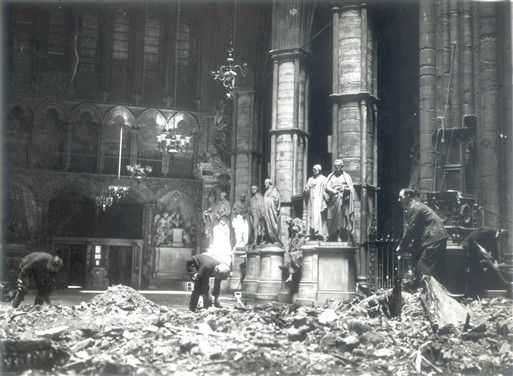
Queen Elizabeth sends a very rare note to Churchill from Windsor Castle to offer her “thanks… for his kindness in sending news of the progress and safe arrival of Tiger.” She adds, “Any risk was well worth taking,” and adds that she is “dreadfully sorry” about the destruction of the House of Commons and Westminster Abbey during the air raid of 10/11 May.
Abwehr agent Karel Richard Richter, a Czech sailor with a US girlfriend and son, is dropped by parachute north of London near London Colney. Richter, whose mission is to check on fellow agent Wulf Schmidt, hides in the forest, too afraid to go into London. The police will capture him when he is unable to give directions to a lorry driver.
At Erith, Kent, the Right Honorable the Earl of Suffolk and Berkshire (b. 1906), who had worked on many new and unknown devices, was killed with his assistants by an old bomb they were examining. The Earl of Sussex is working on a 250 kg (500 lb) bomb dropped some six months earlier in London which had been taken to a “bomb cemetery” in remote Erish marshland when it suddenly explodes. The bomb could have been detonated safely but was being worked on to retrieve its rare Type (17) and Type (50) fuzes for instructional purposes. A total of 13 people in the vicinity perish, including the Earl’s private secretary Eileen Beryl Morden and his chauffeur, Fred Hards. One theory is that the Earl’s attempt to disarm the bomb triggered a hidden Zus 40 booby trap. It is the 35th bomb the Earl has worked on, and he dies at age 35 and will receive the George Cross.
Winston Churchill will make special mention of this particular incident “as symbolic of the others” in volume 2 (“Their Finest Hour”) of his massive “The Second World War.” The BBC will televise a biographical series of the Earl’s life in 1973 called “The Dragon’s Opponent.” The Earl of Sussex earlier in the war was a key player in rescuing French nuclear scientists and the entire world stockpile of heavy water from France as it fell to the Wehrmacht in 1940.
Three former U.S. Coast Guard Cutters were commissioned into Royal Navy at New York, United States as HMS Sennen, HMS Walney, and HMS Totland. Like cutters commissioned shortly before them, they were manned by the crew of battleship HMS Malaya, which was currently under repair in the United States.
Atrocities in Yugoslavia continue as members of Pavelic’s Ustaše led by Mirko Puk kills 200-300 Serbs by burning them alive in the Orthodox church in Glina. There is an obvious edge of religious hatred involved in the symbolism of many of these killings.
Soviet Chief of Staff General Zhukov, wary of continuing reports from many sources warning of a brewing German attack on the USSR, orders four Soviet Armies to forward positions. The Soviet border is so long, however, that they can only provide a local defense.
During the day, the Luftwaffe launches standard anti-shipping sweeps by 125 planes in the English Channel. After dark, the Luftwaffe launches scattered attacks on Newcastle and Eshott in Northumberland, Billingham, Stockton, Darlington, North Hylton, Darlington, and Hartlepool in Co Durham and Middlesbrough, Northallerton, Thornaby and Hull in Yorkshire. Billingham, in particular, suffers from an attack on a chemical factory by 19 bombers.
RAF Bomber Command, Day of 12 May 1941
8 Blenheims on coastal operations in Skagerrak. 1 ship was attacked but not hit. No losses.
RAF Bomber Command, Night of 12/13 May 1941
Mannheim/Ludwigshafen
105 aircraft — 42 Wellingtons, 41 Hampdens, 18 Whitleys, 4 Manchesters. 65 of these aircraft were detailed for Mannheim and 40 for Ludwigshafen. Haze made identification of targets difficult. The local report suggests that no more than 10 aircraft succeeded in bombing the two targets. Damage was scattered and light. 5 people were killed and 3 injured. 26 aircraft reported that they had bombed alternative targets and there is an interesting report from Cologne where 16 aircraft reported bombing. Visibility must have been better at Cologne because direct hits were scored on several industrial premises and 1 bomb which hit the Hacketaner Barracks killed 92 soldiers in an air-raid shelter. 8 other people were killed in Cologne.
Minor Operations: 4 Hampdens minelaying in the Frisians, 2 O.T.U. sorties.
111 sorties were dispatched on this night without any loss.
In England, Air Marshal John Slessor takes over RAF No. 5 Group of Bomber Command.
At Malta, a second permanent fighter squadron is formed at Hal Far, No. 185. The Squadron Leader is Flight Lieutenant P W O Mould, DFC. The other fighter squadron on Malta remains No. 261 and is based at Ta Qali. By some accounts, RAF No. 261 Squadron is disbanded at this time and its equipment is given to No. 185. RAF No. 249 Squadron — composed of planes flown in from aircraft carrier Ark Royal — also participates in the island’s defense.
There is a major air raid over Malta around 22:00 and continuing almost to midnight. There is extensive damage to numerous points on the island, including Luqa, Kalafrana, Garden Reach and St. Georges Bay. The Bighi Royal Naval Hospital is badly damaged.
Luftwaffe bomber prisoners are interrogated at Malta and their morale is excellent. They exhibit great confidence in an early victory by the Reich and have great faith in Adolf Hitler.
U-boats captains typically are prone to zealously limiting their torpedo usage in order to preserve as many as possible for future operations. In fact, it is not unheard of for U-boats to surface and use their deck guns in questionable circumstances. Kptlt. Heinrich Liebe in U-38 has a very bad day with his torpedo management when he spots a freighter off Freetown in the mid-Atlantic, fires four torpedoes — and misses with all four. Fortunately for Liebe, the Kriegsmarine supply network in the Atlantic remains intact and he can be resupplied at sea. This allows U-38 to continue an extremely long patrol of almost three months.
Aircraft carrier HMS Furious, heavy cruiser HMS London, dummy battleship Anson (old battleship HMS Centurion), and destroyers HMS Tartar, HMS Mashona, HMS Legion, and HMS Brilliant departed the Clyde at 2030. The aircraft carrier was en route to Gibraltar. Destroyers Tartar and Mashona were detached at daylight on the 15th to act as an anti-submarine striking force for convoy OB.321 until noon on the 16th. The destroyers, less destroyer Brilliant, returned to the Clyde on the 18th. Aircraft carrier Furious, heavy cruiser London, dummy battleship Anson, and destroyer Brilliant arrived at Gibraltar on the 18th.
Heavy cruiser HMS Exeter departed Hvalfjord after being relieved in the Denmark Strait by heavy cruiser HMS Suffolk. Heavy cruiser HMS Norfolk departed Scapa Flow on the 17th to reinforce the patrol.
Heavy cruiser HMS Berwick departed Spithead escorted by destroyers HMS Wivern, HMS Wild Swan, HMS Berkeley, and HMS Blencathra. Destroyers Wivern and Wild Swan escorted the cruiser only until Smalls Light Vessel and then returned to Portsmouth. The two Hunt-class destroyers escorted the cruiser until dark on the 13th when they were relieved by destroyer HMAS Nestor off Dunnet Head. The heavy cruiser arrived at Rosyth on the 14th.
Destroyer HMS Ripley, which departed Londonderry on the 10th, was damaged by the near miss of German bombing. The destroyer spent no time out of service and returned to Londonderry on the 16th after her duties.
Indian sloop HMIS Sutlej arrived at Scapa Flow at 0800 to carry out working up exercises.
Destroyer HMS Bulldog arrived at Scapa Flow at 1800 to refuel.
Destroyer HMS Brighton arrived at Scapa Flow from Loch Alsh to carry out underwater repairs in dock.
A Walrus aircraft carrying Rear Admiral, destroyers Home Fleet, made a forced landing in the sea ten miles northwest of Dunnet Head while on passage to Scapa Flow. The passengers and crew of the aircraft were taken aboard British trawler St Ola (231grt). The aircraft was salved by destroyers HMS Blankney and HMS Brocklesby which departed Scapa Flow at 1900. The destroyers arrived back with the aircraft at 2330.
British steamer Fowberry Tower (4484grt) was sunk by German bombing one mile southwest by west of Humber Light Vessel. Six crewmen were lost on the steamer.
British steamer Richard de Larringa (5358grt) was sunk by German bombing four cables north of 20R Buoy, Tyne. No lives were lost on the steamer. She was towed until her back broke at Herd Sands.
Italian torpedo boats Clio, Orione, and Pegaso departed Tripoli escorting steamers Maddalena Odero (5479grt) and Nicolo Odero (6003grt). Torpedo boat Pegaso made an attack on a contact near the convoy that evening. Torpedo boat Pleiadi, escorting steamer Bosforo, also made an attack on a submarine contact off Tripoli.
These attacks may have claimed submarine HMS Undaunted. Otherwise the submarine may have been lost on a mine off Tripoli. Submarine Undaunted (Lt J. L. Livesay), which departed Malta on the 1st, was lost to unknown agent off Tripoli. Livesay, Lt H. R. D’Almaine, sub Lt J. W. Anthony, T/Sub Lt J. C. Bate RNR, and the twenty eight ratings of the crew were lost with the submarine.
Gunboat HMS Ladybird (Lt Cdr J. F. Blackburn Rtd) was sunk at Tobruk by Italian aircraft. Three ratings were killed and one rating died of wounds. Fourteen crewmen were wounded. Two bombers were shot down. Although she settled in 10 feet of water, her 6-inch gun was still above water, and thus she would remain useful as a stationary anti-aircraft gun platform while repairs were being done. Admiral Andrew Cunningham sent the message to her commanding officer “Great fighting finish worthy of highest ideals and tradition of the Navy and an inspiration for all who fight on the seas.”
The following changes were made in the Mediterranean Fleet command structure: Vice Admiral Pridham Wippell CB, CVO, former Vice Admiral Light Forces became Vice Admiral, 1st Battle Squadron with his flag on battleship HMS Queen Elizabeth. Rear Admiral E. L. S. King CB MVO, became Rear Admiral, 15th Cruiser Squadron with his flag in anti-aircraft cruiser HMS Naiad. Rear Admiral H. B. Rawlings CBE, became Rear Admiral, 7th Cruiser Squadron with his flag in light cruiser HMS Orion. Rear Admiral I. G. Glennie became Rear Admiral (D) Mediterranean with his flag in anti-aircraft cruiser HMS Dido or depot ship HMS Woolwich, if Dido was required at sea as a private ship.
Submarine HMS Rorqual sank Greek coastal steamer Aghios Paraskivi (25grt) and another small schooner, both carrying German troops, off Lemnos.
Submarine HMS Truant arrived at Gibraltar from Malta.
Convoy OB.322 departed Liverpool, escorted by destroyers HMS Ramsey and HMS Walker. On the 13th, destroyer HMS Caldwell, sloop HMS Enchantress, corvettes HMS Bluebell, HMS Candytuft, HMS Honeysuckle, HMS Hydrangea, and HMS Wallflower, minesweeper HMS Salamander, and anti-submarine trawlers HMS King Sol, HMS Northern Sun, and HMS Northern Wave joined. Corvette HMS Arabis joined on the 14th. Destroyers Caldwell, Ramsey, and Walker, sloop Enchantress, corvettes Bluebell, Candytuft, Honeysuckle, Hydrangea, and Wallflower, and trawler King Sol were detached on the 18th. Destroyer HMS Burnham, HMS Burwell, and HMS Scimitar and corvettes HMS Heliotrope and HMS Mallow joined on the 20th. The escort was detached when the convoy dispersed on the 20th.
Today in Washington, President Roosevelt’s callers were Secretary Hull and Robert Gordon Menzies, Prime Minister of Australia. It was announced that the Wednesday night Pan-American address by the President had been canceled, and that he would deliver a fireside chat to the nation on May 27.
The Senate considered the West Virginia seat dispute, passed a resolution granting Finland postponement of debt payments, and recessed at 4:33 PM until noon tomorrow. The Defense Investigation Committee heard testimony on the shortage of aluminum, and the Commerce Committee approved the ship seizure bill.
The House received the Hershey letter suggesting changes in the Selective Service Law, heard discussion on the need for convoys and adjourned at 6:03 PM until noon tomorrow. The Ways and Means Committee heard more recommendations on new taxes.
The bill empowering President Roosevelt to take over foreign ships in American ports and use them in the defense or aid-to-Britain program was approved without major changes today by the senate commerce committee. Meanwhile, as officials worked on other aspects of the defense and aid plans, it became apparent that many sacrifices by American consumers were in prospect. For one thing, William L. Batt of the office of production management forecast that the nation’s entire aluminum supply would be devoted to military needs by 1942. Other defense officials said that a second 20 percent cut in automobile production was a “distinct possibility” although “still in the pure speculation stage,” and that if a sharp upswing occurred in defense demands, the manufacture of furnaces, refrigerators and other household goods might also be curtailed. Before the senate committee okayed the house-approved ship- seizure bill, 11 to 4, it defeated, 10 to 6, a move by Senators Vandenberg, Michigan Republican, and Clark, Missouri Democrat, to prohibit the transfer of any axis ships to Britain, but its sponsors gave notice they would press for its adoption on the senate floor when the measure comes up for debate, probably late this week.
After conferring with President Roosevelt at the White House for more than an hour today, Robert Gordon Menzies, Prime Minister of Australia, made a moving appeal for increased American aid against the Axis.
President Roosevelt will make a “fireside chat” to the nation May 27, but will not make his scheduled speech before the Pan American Union Wednesday night, it was announced at the White House today. This change in plans was interpreted generally to mean that the President has in mind no important announcement on American foreign policy for two weeks and that, at least for this period, he does not contemplate any new type of aid for Britain. The Executive seldom makes fireside chats except upon important matters, however, and his talk on the 27th is generally expected to present an outline of the current position of the United States as he sees it and the future steps that should be taken.
One soldier and one Marine tonight broke up a line of eight pickets marching in front of the White House who represented the American Peace Mobilization. This organization has been charged with being a Communist Front group.
Further evidence that members of Congress are growing more concerned over the political effects of voting a 50 percent increase in taxes without at the same time slashing non-essential expenditures drastically came today as the House Ways and Means Committee continued to listen to arguments of witnesses against alleged “inequalities” of the proposed defense tax bill.
Henry Morgenthau Jr., Secretary of the Treasury, expressed the view at his press conference today that it was up to Congress, “which has been complaining about being a rubber stamp,” to take the initiative in paring $1,000,000,000 from non-defense expenditures during the coming fiscal year.
Direct legal authorization to defer from military service the older men registered under the Selective Service Act was requested of Congress today by Brigadier General Lewis B. Hershey, deputy director of Selective Service.
A.F.L. machinists, who joined with C.I.O. unionists in closing, by striking, 11 shipbuilding and repair plants holding contracts for $500,000,000 in warships, freighters and other defense work, today flatly rejected an office of production management request to return to work pending negotiation. The 11 plants in San Francisco, Oakland and Alameda, California, employing between 15,000 and 20,000 workmen, closed their gates when 1,700 A.F.L. and C.I.O. workers appeared in mass picket lines.
A strike of 925 American Federation of Labor skilled craftsmen today halted a $53,000,000 construction project at the big Navy drydock in South Boston.
Mediation conferences seeking a settlement of the dispute that threatens a strike affecting 165,000 employees of sixty-one General Motors Corporation plants will be resumed tomorrow.
Philip Murray, president of the Congress of Industrial Organizations, said today that the effect of strikes on national defense has been “infinitely small,” and declared that American labor would fight to protect and preserve democracy.
The bodies of Benjamin Brewster, New York investment broker, and his wife, the former Leonie de Bary Lyon, who disappeared Friday on a projected flight from Roosevelt Field to Warren, Ohio, were found last night in the charred wreckage of their plane on a rugged mountain top forty miles north of Harrisburg.
Southern bituminous coal operators, employing 150,000 miners, resumed negotiations yesterday with representatives of the United Mine Workers in another effort to reach a final agreement covering their portion of the industry. The conferees met at the Hotel Commodore in New York.
Ambassador Nomura Kichasaburo presents Secretary of State Cordell Hull with a Japanese proposal for establishment of a “just peace in the Pacific.”
The United Press News Agency reported from New York: “The American Institute of Petroleum has concluded an investigation showing that Germany must have enough oil to supply its land and air forces for an indefinite period.”
The nation’s armed forces will be using all available sources of aluminum in 1942 and there will be none for civilian or “indirect” military requirements, according to W.L. Batt, deputy director of the Production Division of the Office of Production Management.
Major League Baseball:
Love that home cooking. At Boston, its Lefty against Lefty as Grove stops the Yankees’ Gomez, 8–4 for the southpaw’s 20th straight win at Fenway Park. It is his 295th career victory. Jimmie Foxx helps with a 2-run homer. Boston scored all 8 runs in the first three innings off Gomez, then held on for the win. The Yankees outhit the Sox, 10 to 8, but Grove kept them scattered, with twelve Yankees left on base for the day.
Behind Bill Lee’s six-hit hurling, the Cubs again recorded a victory over the Reds today in the strangest exhibition of sandlot baseball the young season has produced. The score was 12–1. Stan Hack, first up in the first inning, walked, Lou Stringer tripled him home and the big parade was on, to continue for three innings. In all, three of the world champions’ hurlers allowed fourteen hits and two served up ten bases on balls. One of the Cincinnati pitchers, Jim Turner, contributed one of his team’s four miscues. Lee walked five batters, struck out two.
Veteran Lonnie Warneke, the Arkansas hillbilly with the bull-whip pitching arm, pitched a seven-hit game today and the Cardinals defeated the Pirates, 6–2, to sweep the two-game series. Only Vince DiMaggio gave lean Lonnie trouble as the wily right-hander sailed smoothly to his fourth triumph of the season. Vince robbed Warneke of a shut-out by blasting a curve out of the park in the fifth inning to score a runner ahead of him, and he singled later. But Warneke had his revenge when he struck out DiMaggio to end the game. While Warneke was mowing down the Pirates St. Louis laid down a persistent, thirteen-hit barrage. The Cards kept pecking away at Ken Heintzelman’s left-handed shoots, scoring single runs in the second, fourth, fifth and seventh innings. After Heintzelman had been removed for a pinch-hitter the Cards made their final two runs in the eighth off another southpaw, Dick Lanahan.
The Senators bunched eight hits effectively behind the six-hit hurling of Dutch Leonard today to defeat the Athletics, 5 to 1. It was the veteran knuckleballer’s third straight victory. Lester McCrabb, rookie right-hander, was invincible for the first three innings, but Washington exploded four runs in the fourth. In that inning Mickey Vernon homered over the right-field fence, Buddy Lewis and Ben Chapman singled, Cecil Travis doubled and Jimmy Bloodworth tripled.
New York Yankees 4, Boston Red Sox 8
Chicago Cubs 12, Cincinnati Reds 1
St. Louis Cardinals 6, Pittsburgh Pirates 2
Philadelphia Athletics 1, Washington Senators 5
The Battle of South Shanxi continues, with the Japanese North China Front Army capturing Kuangkou, Maotien, and Shaoyuan. The Japanese now have reached their first objective, the north bank of the Yellow River. Elsewhere, the Japanese also continue attacking Tungfeng.
The common character of the external menace facing China and the United States and the essentially united ideals for which the two nations are striving was the theme of the speech that Generalissimo Chiang Kai-shek delivered at the farewell dinner for Ambassador Nelson T. Johnson on Saturday night.
The question of further withdrawals of American defense forces from China has not recently been considered, Secretary of State Cordell Hull announced today in connection with a statement that extraterritoriality for Americans in China still existed.
In Tokyo, Ambassador Nomura and US Secretary of State Cordell Hull continue their discussions regarding a settlement of claims in the Pacific. Nomura presents Hull with a draft proposal.
Demands for sweeping reform of the entire administrative machinery as a concomitant of economic regimentation for the construction of a “high-degree defense state and the Greater East Asia co-prosperity sphere” were presented to the government today by representatives of the Japanese business world, who met in a round-table conference with Cabinet members headed by Prince Fumimaro Konoe, the Premier, to discuss the problem.
As indication that, despite an apparent lull, Japan’s diplomacy is continuing to work under high pressure, Foreign Minister Yosuke Matsuoka was received in audience by Emperor Hirohito this afternoon. He stayed at the palace for more than two hours.
Ernest Hemingway, on a stopover in Manila after a six-week tour of China, briefs the Philippine Department’s intelligence (Colonel Joseph O’Hare) and air officer (Colonel Richards) about the military situation in China. Hemingway is coy about the extent of his observations, claiming never to have gotten near any battlefields, but gives an extremely perceptive summary of ongoing and likely events in China. Among his conclusions is that the Chinese Nationalists and Communists soon will be fighting each other as much as they are fighting the Japanese and that Japan at some point will attack the United States. The 4th Composite Group CO, Major Kirley Gregg calls Hemingway “quite an interesting chap,” while the 3rd Pursuit Group CO, Major William Maverick, says Hemingway is “a marvelous fellow… a real genius” with a “striking personality.”
Dow Jones Industrial Average: 117.14 (-0.4)
Born:
Floyd Weaver, MLB pitcher (Cleveland Indians, Chicago White Sox, Milwaukee Brewers), in Ben Franklin, Texas (d. 2008).
Anthony Newman, American harpsichordist and organist (Bhajeb), in Los Angeles, California.
Ruud de Wolff, Dutch Indonesian singer and guitarist (The Blue Diamonds), in Batavia, Dutch East Indies (d. 2000).
Died:
Ruth Stonehouse, 48, American silent film actress and film director.
Naval Construction:
The Kriegsmarine (German Navy) Type IXC U-boat U-516 is laid down by Deutsche Werft AG, Hamburg (werk 312).
The Royal Navy “U”-class (Third Group) submarine HMS Unrivalled (P 45) is laid down by Vickers Armstrong (Barrow-in-Furness, U.K.).
The Royal Navy Isles-class minesweeping trawler HMS Bute (T 168) is launched by Goole Shipbuilding & Repairing Co. Ltd. (Goole, U.K.).
The U.S. Navy Accentor-class coastal minesweeper USS Bateleur (AMc-37) is launched by W.A. Robinson Inc. (Ipswich, Massachusetts, U.S.A.).
The Royal Navy Bangor-class (Reciprocating-engined) minesweeper HMS Fraserburgh (J 124) is launched by Lobnitz & Co. Ltd. (Renfrew, Scotland).
The Royal Australian Navy Bathurst-class minesweeper-corvette HMAS Whyalla (J 153) is launched by Broken Hill Pty. Ltd. (Whyalla, South Australia, Australia).
The Kriegsmarine (German Navy) Type IXC U-boat U-155 is launched by AG Weser, Bremen (werk 997).
The Royal Navy “U”-class (Third Group) submarine HMS Unbending (P 37) is launched by Vickers Armstrong (Barrow-in-Furness, U.K.).
The Royal Navy “T”-class (Second Group) submarine HMS Turbulent (N 98) is launched by Vickers Armstrong (Barrow-in-Furness, U.K.).
The U.S. Navy Gato-class submarine USS Drum (SS-228) is launched by the Portsmouth Navy Yard (Kittery, Maine, U.S.A.).
The Royal Navy Flower-class corvette HMS Stonecrop (K 142) is launched by Smiths Dock Co., Ltd. (South Bank-on-Tees, U.K.).
The Royal Navy Hunt-class (Type II) escort destroyer HMS Middleton (L 74) is launched by Vickers Armstrong (Newcastle-on-Tyne, U.K.); completed by Parsons.
The Sjøforsvaret (Royal Norwegian Navy) Thornycroft 75 foot-type motor torpedo boat HNoMS MTB 50 is commissioned.
Three “Lake”-class Coast Guard cutters, authorized for transfer on 10 April under Lend-Lease, are turned over to the Royal Navy and commissioned as Banff-class sloops. The USCGS Champlain became the HMS Sennen (Y 21), the USCGS Sebago became the HMS Walney (Y 04), and the USCGS Cayuga became the HMS Totland (Y 88) (see 20 and 30 May).
The Kriegsmarine (German Navy) Type IXC U-boat U-128 is commissioned. Her first commanding officer is Kapitänleutnant Ullrich Heyse.
The Royal Canadian Navy Flower-class corvette HMCS Napanee (K 118) is commissioned. Her first commanding officer is A/Lieutenant Commander Andrew Hedley Dobson, RCNR.
The Royal Canadian Navy Flower-class corvette HMCS Barrie (K 138) is commissioned. Her first commanding officer is T/Lieutenant Roy Milton Mosher, RCNR.
The Royal Canadian Navy Flower-class corvette HMCS Chicoutimi (K 156) is commissioned. Her first commanding officer is T/Lieutenant William Black, RCNR.
The Royal Navy Flower-class corvette HMS Bergamot (K 189) is commissioned. Her first commanding officer is T/A/Lieutenant Commander Richard Popkis Chapman, RNR.

