The Capture of U-110
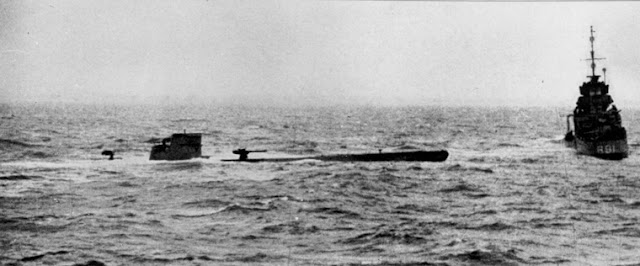
Events of 9 May 1941 are little remembered by the public after the fact, but they are of far-reaching consequence. They are so important that this almost could be considered a case of losing a battle but thereby winning a war.
The British recently captured German weather ship Munchen near Iceland, securing prized Kriegsmarine naval codes, and today they pull off an even greater intelligence coup. U-100 (Kptlt. Fritz-Julius Lemp), one of the top U-boat commanders (he sank the Athenia on 3 September 1939), is operating off of Cape Farewell, Greenland and shadowing Convoy OB-318 as part of Wolf Pack West. Lemp attacks the convoy, and all goes well at first as he sinks two ships:
4,976-ton British freighter Esmond (all survive);
2,609-ton British freighter Bengore Head (40 survivors, one dead).
However, the convoy escorts (HMS Bulldog, HMS Broadway, and HMS Aubretia) force the U-boat to the surface with depth charges. Lemp and his crew abandon ship (15 dead, 32 survivors) a little too quickly, and U-110 fails to sink. Lemp himself perishes during the incident under very murky and controversial circumstances.
Noticing the U-boat failing to sink, a boarding party from the Bulldog, led by 20-year-old Sub-Lt. David Balme, quickly rows over to the U-boat despite the ever-present fear that scuttling charges could go off at any moment. The capture was completed at 1245 hours. The Royal Navy sailors grab the extremely valuable Enigma coding machine along with its codebooks, rotor settings, and charts.
After everything of value has been removed from the U-boat (including the submarine’s chronometer), the British sink it (during a storm, so perhaps not intentionally) to maintain the secret of its capture. It is an astonishingly lucky find for the British Ultra operation at Bletchley Park, which has been in need of the equipment and information. Of immediate benefit, the documents aboard enable the British to break the German Reservehandverfahren code, a reserve German hand cipher. The capture also becomes is a key step on the road to British scientist Alan Turing’s first computer, Colossus. The capture of U-110 is so significant that it later is given the code name Operation PRIMROSE. Winston Churchill will not even tell President Roosevelt about it until January 1942.
The first four ships related to Operation TIGER (MW.7A and .7B out of Alexandria) reach Malta. They carry 30,000 tons of supplies. In addition, two tankers and a destroyer loaded with supplies, HMS Breconshire, also arrive. This is the largest convoy to arrive at Malta during the war and is aided by very cloudy weather. The main force of Operation TIGER coming from Gibraltar is still at sea.
One ship, however, fails to make it. British 9200-ton freighter Empire Song hits a mine during the night which sets off its ammunition cargo, causing it to explode. The Empire Song and its 57 tanks, 10 aircraft and several trucks quickly sink. There are 18 deaths and 130 survivors.
In addition, freighter New Zealand Star hits a mine but manages to make it to Malta.
At Tobruk, General Rommel’s men intercept a British wireless communication containing weather information that leads them to suspect that a major British offensive may be in the offing. Rommel orders defenses along the perimeter of Tobruk strengthened and orders Kampfgruppe von Herff to initiate offensive patrols.
The Royal Navy’s nightly shuttle to Tobruk continues as Australian destroyer HMAS Vendetta evacuates wounded and takes them to Alexandria.
At Malta, Governor Dobbie draws up a plan to replace soldiers with female auxiliaries. The jobs will include service as cooks, dining hall waitresses, messengers, and similar functions. Among other things, this involves an increase in pay for the women (subject to Whitehall approval).
Churchill to Wavell: “…danger of Syria being captured by … Germans. … In face of your lack of resources we can see no other course open that to furnish General Catroux with the necessary transport and let him and his Free French do their best… the RAF acting against German landings.”
German aircraft begin to stage through Syrian airfields to support Iraqi nationalists in revolt against British rule. As a result, Churchill instructs Wavell to allow Free French under General Catroux to invade Syria. Free French consist of only five battalions (mostly African) and some artillery. Wavell demurs – he has just dispatched his only (fully-equipped) cavalry brigade across the desert to Iraq, he is expecting the German assault on Crete to begin soon, and dealing with axis forces in the western desert, so cannot support such an operation.
In Brazzaville, de Gaulle receives a telegram from General Spears: “…it will be impossible to provide transport for the Free French troops (for an attack on Syria) for a month… [Wavell] sees no necessity for you coming to Cairo now or in the near future. There would in fact be some disadvantage in your doing so.”
Later that day de Gaulle receives a telegram from Churchill: “The question of Jibuti was discussed at a meeting of the defence Committee which we held this afternoon, when it was decided:
- That a strict blockade of Jibuti should be maintained.
- That you should be requested not to remove General Catroux from Palestine.
- That you go to Cairo…
Gratified at this sudden about face de Gaulle replies to Churchill in English: “1) Thank you. 2) Catroux remains in Palestine. 3) I shall go to Cairo soon. 4) You will win the war.
London: The Air Ministry announced: “Like all great powers, Great Britain formed a paratroop corps shortly after the outbreak of war. We now have a large number of paratroops who have completed their training and are ready for action. The paratroops consist exclusively of volunteers who are carefully selected and trained; most of them are aged between 23 and 27 years.” It is also announced that in last night’s raids on the east Midlands two cows and a few chickens had been killed.
At Sanski Most in Serbia, Yugolslavia, the Germans kill 27 Serb civilians as reprisals for the recent uprising. The troops force townspeople to hang the bodies in the town square for two days. This incident leads to bitter hatred between the Serbs and the Ustaše, who start contemplating how to wipe out (ethnically cleanse) the population of the entire region. A reign of terror against the Serbian locals commences. There remain many rebels in the nearby hills who will lay low until July. A memorial to the Sanski Most Revolt will be set up at Šušnjar in 1971 and designated a national monument of Bosnia and Herzegovina in 2003.
The Soviet Union declared that it would no longer recognize the diplomatic standing of Nazi-occupied Belgium, Norway and Yugoslavia. The Soviet Union withdraws diplomatic recognition of the Yugoslav government-in-exile. Led by King Peter, the exiles have been camping out in Jerusalem under British protection, along with remaining remnants of the Yugoslav Army, Navy and Air Force that managed to leave the country. Some army elements do remain in Yugoslavia, and they are in the process of regrouping as partisans and forming the primarily Serbian “Yugoslav Army of the Fatherland” (Jugoslovenska vojska u otadžbini, or JVUO, or Četniks) under Royalist General Draža Mihailović. However, communist partisans in the region also are stirring, and the Soviets may prefer to back them. The official reason for withdrawing recognition is that the German government now controls the country.
Bulgarian agents confirm other warnings, such as the one on 6 May from Richard Sorge in Tokyo, that the Germans are planning an attack on the Soviet Union. Stalin continues to essentially ignore the warnings.
The Luftwaffe attempted to hit the Rolls-Royce aero engine factory in the East Midlands, but their bombs only managed to kill a few farm animals.
At RAF Waddington in Waddington, Lincolnshire, England, United Kingdom, a direct hit by a German bomb on the Navy, Army and Air Force Institutes (NAAFI) station and a nearby air-raid shelter killed three airmen and seven women who worked in the NAAFI, including Mrs. Raven, the manageress.
Hull has been badly hit leaving 40,000 people homeless and 1,000 dead out of a population of 330,000. Dock warehouses burst open and thousands of tons of burning grain slid into the river Humber.
Berlin: Radio reports that last night German bombers had inflicted heavy damage in the towns of Derby and Nottingham, especially the Rolls-Royce aircraft-engine manufacturing plant.
RAF Bomber Command, Day of 9 May 1941
13 Blenheims on sweeps of French and Norwegian coasts. 1 ship was hit and seen to be abandoned by its crew. 1 aircraft was lost.
RAF Bomber Command, Night of 9/10 May 1941
Mannheim/Ludwigshafen
146 aircraft — 69 Wellingtons, 42 Whitleys, 24 Hampdens, 11 Manchester& 1 Wellington and 1 Whitley lost. Mannheim’s records show a successful raid on these two neighbouring cities. Totally destroyed buildings: military 1, war industry 4, other commerce 29, houses and shops 19. 11 railway wagons full of industrial fuel were burnt out. A large number of buildings of many kinds were damaged. 22 large and medium industrial plants suffered various production interruptions because of the damage. Casualties were: 64 killed, 122 injured and 3,533 bombed out (2,134 in Mannheim and 1,399 in Ludwigshafen). One third of the bombed out would return to their homes later.
Minor Operations: 5 aircraft to Berlin, 5 to Calais, 4 to Texel, 2 Hampdens minelaying in Frisians. No losses.
U-103, commanded by Korvettenkapitän Viktor Schütze, sank British steamer City of Winchester (7120grt) at 8-20N, 26-14W. At 2309 hours on 9 May 1941 the unescorted City of Winchester (Master William Samuel Coughlan), dispersed on 28 April from convoy OB.313, was hit by one of two torpedoes from U-103 and sank after being hit amidships by a coup de grâce at 2346 hours about 400 miles south-southwest of the Cape Verde Islands. Six crew members were lost. The master, 84 crew members and seven gunners were picked up by the Norwegian motor merchant Herma and landed at Takoradi. The 7,120-ton City of Winchester was carrying general cargo and was bound for Beira, Mozambique.
U-110, commanded by Kapitänleutnant Fritz-Julius Lemp, made attacks on convoy OB.318. British steamers Esmond (4976grt) and Bengore Head (2609grt) were sunk in 60-45N, 33-02W. At 1158 hours on 9 May 1941, U-110 attacked the convoy OB.318 east of Cape Farewell and sank Bengore Head and Esmond, but was then captured after being heavy damaged in the counterattack of the escort ships and foundered later.
The master, 44 crew members and five gunners from the Esmond (Master James Bernard McAulay Macaffert) were rescued. 22 survivors were picked up by the Norwegian merchant Borgfred, 27 survivors by the Aelybryn and landed at Sydney on 18 May. One survivor was picked up by the HMS Aubretia (K 96) (Lt Cdr V.F. Smith) and landed at Reykjavik. The 4,976-ton Esmond was carrying ballast and was bound for Sydney, Nova Scotia.
One crew member from Bengore Head (Master Maurice Kennedy) was lost. The master, 35 crew members and four gunners were rescued: 16 survivors by the Norwegian steam merchant Borgfred and landed at Sydney on 18 May and 24 survivors by HMS Aubretia (K 96) (Lt Cdr V.F. Smith, RNR) and landed at Reykjavik. The 2,609-ton Bengore Head was carrying coal and binder twine and was bound for Montreal, Canada.
U-110 was captured southwest of Ireland by convoy escorts destroyers HMS Bulldog, HMS Broadway, and HMS Amazon and corvette HMS Aubretia. The U-110 was damaged in action with the destroyers HMS Bulldog (H 91) and HMS Broadway (H 90) and the corvette HMS Aubretia (K 96). A boarding party from the HMS Bulldog recovered a veritable cryptanalysis windfall, including an intact enigma machine and important current codes. The HMS Broadway was damaged in the encounter by a collision with U-110. The U-boat was allowed to sink the following day to preserve the secret of the capture. Of the ship’s complement 15 died and 32 survived. The U-110’s commanding officer, Kapitänleutnant Fritz-Julius Lemp (who had been in command of the U-30 when she sank the British liner Athenia on September 3, 1939) was not among the survivors rescued. During its career under apitänleutnant Lemp the U-110 sank or damaged irreparably 3 merchant ships for a total of 10,149 tons, and damaged 2 merchant ships for a total of 8,675 tons. Kapitänleutnant Lemp was considered one of Germany’s top U-boat aces.
Destroyer HMS Broadway was damaged alongside the submarine when the submarine’s hydroplane pierced the destroyer’s engine room. Destroyer Broadway was repaired at Dundee in two months.
U-201, commanded by Oberleutnant zur See Adalbert Schnee, sank British steamer Gregalia (5802grt) in 60-24N, 32-37W and damaged steamer Empire Cloud (5969grt) in 61-00N, 32-30W. At 1426 and 1428 hours on 9 May 1941, U-201 (Schnee) attacked the convoy OB.318 east-northeast of Cape Farewell in grid AK 2181 (61°00N/32°30W), sank the Gregalia and badly damaged the Empire Cloud.
The master, 57 crew members and eight gunners from the Gregalia (Master Alexander Bankier) were picked up by HMS Daneman (FY 123) (T/Lt A.H. Ballard, RNR). Later the master and 51 survivors were transferred to the Aelybryn and 14 survivors to the Norwegian steam merchant Borgfred and landed at Sydney on 18 May. The 5,802-ton Gregalia was carrying ballast and was bound for Buenos Aires, Argentina.
The Empire Cloud (Master Charles Cottew Brown) was on her maiden voyage from Sunderland to Father Point via Loch Ewe in ballast. Developing a very heavy list she was abandoned by her crew, but HMS St. Apollo remained nearby to protect the drifting ship. Five crew members were lost. The master, 36 crew members and eight gunners were picked up by HMS Nigella (K 19) (T/Lt T.W. Coyne, RNR) and taken to Iceland. The Dutch tug Thames was sent out from Reykjavik, arriving on the 13 May and took the torpedoed ship in tow. With a speed of six knots they arrived at Greenock after seven days, where she was repaired and returned to service in November 1941
Italian submarine Tazzoli sank Norwegian tanker Alfred Olsen (8817grt) at 2-59N, 20-26W. The entire crew was rescued.
Mine destructor ship HMS Queenworth (3010grt, Lt Cdr R. W. Wainewright) was sunk by German bombing eight cables 85° from Outer Dowsing Light Buoy. No crew were killed in the loss.
Mine destructor ship HMS Corfield was damaged by near misses of German bombing in the Humber.
Armed merchant cruiser HMS Circassia arrived at Greenock on the 9th.
French steamer Criton (4564grt) was seized by armed merchant cruiser HMS Cilicia at 10-11N, 20-17W off Freetown. The steamer was taken to Freetown, arriving on the 11th. Steamer Criton joined convoy SL.78 on 19 June for passage to Belfast. The steamer fell out of the convoy and was returning to Freetown. She was intercepted on 21 June by auxiliary patrol vessel Air France IV and armed trawler Edith Germaine which ordered her to proceed to Konakri. After the steamer made a radio report, the French ships took off the crew and sank the steamer. Twenty four crewmen and the armed guard under the command of A/Sub Lt S. K. Stretten RNR, were interned at Konakri. Three crewmen of the steamer died during internment and a fourth later died of illness sustained.
British trawler Tankerton Towers (97grt) was sunk by German bombing off St Goven’s Light Vessel. The crew of eight was rescued.
British steamer Ostrevent (1737grt) was damaged by German bombing east of Helwick Light Vessel.
British sailing barge Whitaker’s No. 17 (64grt), British steamer Dan Y Bryn (5117grt), and steamer Castilian (3067grt) were damaged by German bombing at Hull. Two crewmen and two gunners were lost on steamer Castilian.
British steamer Fishpool (4950grt) was damaged by German bombing at Barrow.
During the night of 9/10 May, British tankers San Roberto (5890grt) and British Statesman (6991grt) were damaged by German bombing twenty two miles east by north of Spurn Point, 53-44N, 0-38E. Both tankers were towed to Immingham.
Australian destroyer HMAS Vendetta evacuated wounded from Tobruk during the night of 9/10 May to Alexandria.
Convoy AS.30 departed Suda Bay escorted by destroyers HMAS Vampire, HMAS Waterhen, and HMAS Voyager and sloops HMS Flamingo and HMS Auckland. Minesweeper HMS Derby and Greek destroyer RHS Sphendoni were involved in the escort. The convoy arrived at Alexandria on the 12th escorted by destroyers Vampire and Voyager and sloop Auckland.
Convoy SC.31 departed Halifax, escorted by armed merchant cruiser HMS Wolfe and corvettes HMCS Cobalt and HMCS Collingwood. The corvettes were detached the next day. Escort vessel HMS Lulworth joined on the 11th. The armed merchant cruiser was detached on the 21st. Destroyers HMS Amazon and HMS Bulldog, corvettes HMS Aubretia, HMS Hollyhock, and HMS Nigella, and anti-submarine trawler HMS Daneman joined on the 21st and were detached on the 24th. On the 24th, destroyers HMS Campbeltown, HMS Wanderer, and HMS Westcott, sloops HMS Fleetwood and HMS Rochester, and corvettes HMS Auricula, HMS Dianthus, HMS Marigold, HMS Nasturtium, and HMS Periwinkle joined. Sloop Rochester and corvette Primrose were detached on the 27th. All, but destroyer Campbeltown and corvette Periwinkle, were detached on the 29th. The remaining two escorts were detached when the convoy arrived at Liverpool on the 30th.
In Washington this day, President Roosevelt continued to have a slight temperature and remained in bed on orders of his physician.
The Senate considered the West Virginia Senate seat dispute, received the President’s request for additional funds for a CAA landing field program and recessed at 4:50 PM until noon Monday. The Naval Affairs Committee approved a bill shortening the Naval Academy course, and the Finance Committee approved a two-year postponement of Finnish debt payments.
The House passed a bill authorizing $150,000,000 for community facilities in defense areas and adjourned at 5:25 PM until noon Monday. The Ways and Means Committee heard further recommendations for new taxes.
Increasing emphasis within President Roosevelt’s Cabinet on the importance of assuring safe delivery of Lend-Lease aid to Britain heightened the belief at the capital today that a showdown is near on this important subject, known here by the word “convoys.” The suggestion was heard in various quarters that the President might use the occasion of next Wednesday night, when he addresses representatives of the Pan American Union, to clarify his own stand in the growing agitation over convoys. Washington regards it inevitable that Mr. Roosevelt will speak out soon, in one way or another, on the intra-Cabinet movement for additional measures to protect British-bound shipping. Already Secretaries Cordell Hull, Henry L. Stimson, Frank Knox, and Claude Wickard have advocated such measures. The President spent the fourth. straight day in bed today, suffering from a gastro-intestinal disorder which still has his temperature fluctuating over a range of a degree. Aides pointed out that during his enforced seclusion over the weekend he would have an excellent opportunity to make up his mind as to the next step toward implementing the American foreign policy. That implementation, the President’s chief advisers hold, includes more drastic measures to help Britain win the Battle of the Atlantic.
Australian Prime Minister Robert Menzies is in Washington, D.C. In the morning, he meets with Secretary of State Cordell Hull. Menzies notes that:
“I gather that the whole Cabinet would come into the war tomorrow if Roosevelt would say the word. But he hangs back, preferring an “incident” (e.g., as a result of the Atlantic patrol) to a formal declaration.”
Menzies notes that Dean Atcheson is “friendly but confused. Famous Harry Hopkins a great disappointment — a sort of gangling yokel.”
President Roosevelt’s Senate leaders began a campaign today to eliminate the Cox amendment to the Vinson bill setting up a statutory priorities division, independent of the Office of Production Management, and headed by a $12,000-a-year director whose decisions concerning rationing of industrial materials and parts would be subject to veto by the joint Army and Navy Munitions Board even when they concerned civilian supplies.
The Committee to Defend America by Aiding the Allies called on the American people tonight to urge President Roosevelt and congress to enact immediately six specific measures including approval of convoys and “declaration of a full state of national emergency.”
“Murder Inc.” organized crime head Louis Buchalter is arraigned in a New York state court for the 1936 Joseph Rosen murder along with three other murders, leading to his conviction and execution.
Lieutenant General John L. Dewitt, commanding the fourth army, today reviewed 45,000 troops and 5,000 mechanized units at Fort Lewis in the state of Washington. The Governors of Washington and Oregon, and Rear Admiral R. S. Freeman, commandant of the 13th Naval District, were present at the Pacific Northwest’s largest review of manpower and material since the world war.
The vanguard of a contingent of 800 or more Italian seamen took up quarters at Fort Missoula, Montana, today “for the duration.” Barracks once occupied by soldiers and now surrounded by a 10-foot fence about 2,000 feet long were turned over to 125 Italian officers and men of the seized luxury liner Biancamano. The men have been interned until the end of the European war.
Following Wednesday’s arrests of 151 German seamen in New York, immigration inspectors and the police began yesterday afternoon a round-up of about 100 Italian aliens also charged with violating the immigration laws by entering this country illegally or overstaying their permits.
TG 1, comprising carrier USS Ranger (CV-4) (VF 41, VS 41 and VS 42), heavy cruiser USS Vincennes (CA-44), and destroyers USS Sampson (DD-394) and USS Eberle (DD-430), sets out from Bermuda to begin a 4,675-mile neutrality patrol that will conclude at Bermuda on 23 May.
Singer Billie Holiday records “God Bless the Child” at the Okey Records studio on Seventh Avenue in New York City. It is the first recording of the jazz song written by Holiday and Arthur Herzog, Jr. “God Bless the Child” will not be released until 1942. The song will become one of Holiday’s signature songs and a major event in her eventual autobiography “Lady Sings the Blues.”
Major League Baseball:
The St. Louis Browns knocked Bob Feller off the mound on the way toa 9–6 triumph over the Cleveland Indians. The Indians, slapping singles with abandon, scored four times against Vernon Kennedy in the second inning and Feller seemed on an easy path to his sixth victory of the year. He wound up with his second defeat. In the third inning Harlond Clift singled, Alan Strange hit his second double and Chet Laabs walked to fill the bases for St. Louis. Roy Cullenbine, Brooklyn’s one-time $25,000 bust who is becoming a batting beauty with the Browns, then cleaned the sacks with a resounding triple. Feller was driven out in the next inning when the tail-enders of the batting order started the Browns on a four-run rally. Don Heffner walked, Frank Grube singled and Kennedy batted the tying run across with a single. Clift’s double counted two more runs and Laabs’s single scored another, sending Feller to the showers. The rest was anti-climax. Rip Radcliff hit a home run for the Browns in the fifth and tripled to score on an error in the seventh.
The scheduled game between the Boston Braves and the Giants at New York was postponed due to rain. The game will be made up as part of a doubleheader tomorrow.
The scheduled game between the Brooklyn Dodgers and the Phillies at Philadelphia was postponed due to rain. The game will be made up as part of a doubleheader on September 20.
The scheduled game between the Detroit Tigers and the White Sox at Chicago was postponed due to cold. The game will be made up as part of a doubleheader on August 14.
Cleveland Indians 6, St. Louis Browns 9
At the Battle of South Shanxi, the Japanese North China Front Army continues to attack the 9th Army of the Chinese 1st War Area at Fengmenkou and Lungwanwo. The Japanese also capture Wangyuan and attack Tungfeng. In addition, the Japanese Imperial Air Force raids the Nationalist capital of Chungking.
Japanese air raiders smashed at widely separated sections of Chungking in the second major attack of the year here today. There were relatively heavy casualties. They were estimated at 150 injured and fifty killed in the preliminary police computations. The property damaged ranged from the British Ambassador’s residence to the buildings of the American Methodist Mission’s Chiu Ching High School. Many old and newly built downtown shops were destroyed when several fires were started. The raid, carried out by a force estimated at about sixty planes, came at noon. The city’s only foreign style hotel was badly damaged. Many bombs fell into the river and within a few minutes after the explosions boatmen plunged into the water to grab the fish that were stunned or killed by the blasts. Three bombs fell in the compound of the Methodist school. One small building was almost demolished and the main building was badly damaged. The British Ambassador’s house, at which tomorrow evening there will be a farewell dinner for United States Ambassador Nelson T. Johnson, had all its windows and doors blown out and the ceiling knocked in.
A Japanese-imposed treaty between Vichy and Thailand was signed in Tokyo. The disputed territories of Laos, part of the Cambodian province of Siem Réap and the whole of Battambang were awarded to Thailand. The conflict had cost the French over 300 men and a further loss of prestige amongst its colonial subjects. The inconclusive border wall between Thailand and French forces in Indochina comes to an official end with the signing of a peace treaty in Tokyo. Thailand basically gets all the territory that it sought in the war. The Japanese, who have been serving as an “honest broker” in the affair (but actually strongly favor the Thais), guarantee the new borders. The Vichy French in Indochina are isolated and have been largely powerless to influence the one-sided negotiations.
The Foreign Office announced today that a general commission under the Triple Alliance of Japan, Germany and Italy had met for the first time in Tokyo this afternoon under the chairmanship of Foreign Minister Yosuke Matsuoka and had “fully discussed questions relating to cooperation among the three powers under the Tripartite Pact.”
Now that his staff has arrived on USAT Washington, Brigadier General Clagett, the newly arrived commander of the Philippines Department Air Corps, begins organizing his command. Ernest Hemingway, on his way back to the States from his six-week stay in Asia, is in Manila and parties with the enlisted men, at least one of whom he knows personally through a mutual female acquaintance. Hemingway, who claims never to have gotten anywhere near the war, makes eerily insightful comments about the situation in China. These include views that the Nationalists and Communists soon will be fighting each other in addition to the Japanese, and that Japan might well be at war with the United States soon.
The USAT Republic and USAT Washington depart Manila with American dependents.
Dow Jones Industrial Average: 116.46 (+0.12)
Born:
Danny Rapp, American pop singer (Danny & Juniors — “At The Hop”), in Philadelphia, Pennsylvania (d. 1983).
Pete Birrell, British rock bassist (Freddie and The Dreamers — “I’m Telling You Now”), in Wythenshawe, Cheshire, England, United Kingdom.
Dorothy Hyman, English athlete (Olympics, silver medal, 100m, bronze medal, 200m, 1960; bronze medal, 4×100m relay, 1964), in Cudworth, England, United Kingdom.
Howard Komives, American NBA star (New York Knicks, Buffalo Braves), in Toledo, Ohio (d. 2009).
Jan Dibbets, Dutch conceptual artist (Hommage to Arago, Paris), in Weert, Netherlands.
Died:
Fritz-Julius Lemp, 28, German U-boat commander (lost at sea during the capture of U-110).
Naval Construction:
The U.S. Navy Accentor-class coastal minesweeper USS Guide (AMc-83) is laid down by the Camden Shipbuilding and Marine Railway Co. (Camden, Maine, U.S.A.).
The U.S. Navy PC-461-class (173-foot steel hull) submarine chasers USS PC-490 and USS PC-491 are laid down by the Dravo Corp. (Pittsburgh, Pennsylvania, U.S.A.).
The Regia Marina (Royal Italian Navy) Animoso-class torpedo boat Fortunale is laid down by Cantieri Riuniti de l’Anreitico (Trieste, Italy).
The Royal Navy LCT (Mk 2)-class landing craft, tank HMS LCT 115 is launched by Henry Robb Ltd. (Leith, U.K.).
The Royal Navy harbor defence motor launch HMS HDML 1021 is commissioned.
The Royal Navy harbor defence motor launch HMS HDML 1027 is commissioned.
The Royal Navy Bangor-class (Turbine-engined) minesweeper HMS Polruan (J 97) is commissioned. Her first commanding officer is Lieutenant Commander John Spencer Landers, RNR.
The Royal Navy ASW Dance-class trawler HMS Tarantella (T 142) is commissioned. Her first commanding officer is T/Lieutenant Robert Arthur Balfour, RNVR.
The Royal Canadian Navy Flower-class corvette HMCS Matapedia (K 112) is commissioned. Her first commanding officer is T/Lieutenant Ronald James Herman, RCNVR.
 History Diaries