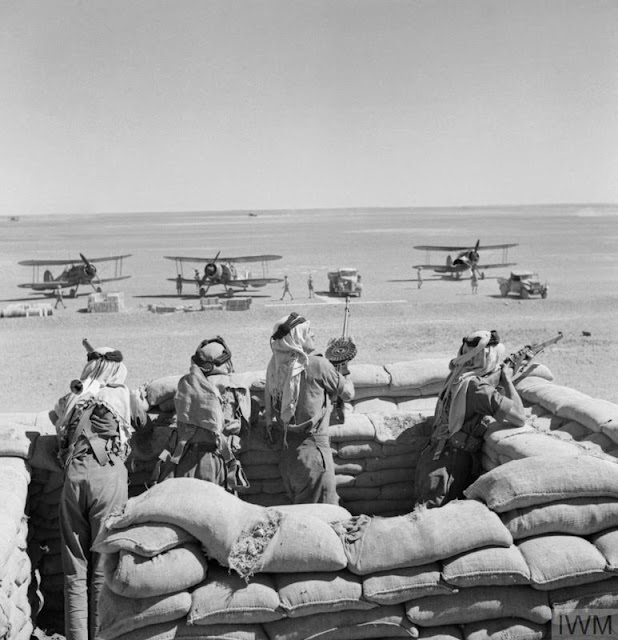
The war in Iraq itself is going well for the British, but Prime Minister Winston Churchill remains a troubled man. It is clear that the Germans have designs on the oil of the Middle East, and the Vichy French in Syria appear to hold the key. Churchill writes to General Ismay:
“I must have the advice of the Staffs upon the Syrian business available for Cabinet this morning. A supreme effort must be made to prevent the Germans getting a foothold in Syria with small forces and then using Syria as a jumping-off ground for the air domination of Iraq and Persia. … We ought to help in every way without minding what happens at Vichy.”
While it is not clear what Churchill means by “a supreme effort” against Syria, that is the subject of the evening’s War Cabinet meeting.
The British and Transjordanian forces crossing the desert from Palestine arrive at Rutbah Fort. They find it occupied by Iraqi forces under Rashid Ali, but the defenders are mostly just local policemen. The RAF sends four Blenheim bombers of No. 203 Squadron to bomb the fort while the British troops wait outside.
At the port of Basra, the Indian 10th Infantry Division continues fighting its way out of the port and consolidates its capture of Ashar.
The fighting at Amba Alagi continued. Indian forces took the the Falagi Pass and three small peaks south of Amba Alagi. Indian troops attacked Amba Alagi, Abyssinia at dawn, taking the Falagi Pass and three hills east and south of the city, respectively. Later in the morning, Italian troops counterattacked and recaptured two of the hills. After an opening attack by Indian troops at Amba Alagi that proved unsuccessful, fighting largely has died down at the Italian stronghold of Amba Alagi. An Indian 9th Infantry Brigade diversionary attack through the Falagi Pass to the east makes some progress and essentially clears the pass. However, the Italians counterattack and recover Centre and Khaki Hills. The British Army has reinforcements on the march only days away.
The TIGER Convoy comes under air attack, first by the Italian Air Force, then the Luftwaffe. Over the day, Ark Royal’s twelve Fairey Fulmars drove off over fifty aircraft, with the assistance of targeting information from HMS Sheffield’s radar and anti-aircraft fire from the escorts. During the initial waves, one Fulmar is lost, killing Flight Lieutenant Rupert Tillard and Lieutenant Mark Somerville, Admiral Somerville’s nephew; another is destroyed with the aircrew recovered, while others are damaged.
Tobruk is quiet, but the sea war in the Mediterranean is becoming ferocious. The Tiger Convoy bound from Gibraltar to Alexandria has come within the reach of the Regia Aeronautica and the Luftwaffe, and today the first attacks on the critical convoy occur. Italian planes based on Sardinia are the first to attack, but Royal Navy aircraft carrier HMS Ark Royal sends up its dozen Fairy Fulmars and they drive off the attacking 50+ aircraft at the cost of one of their own. The loss, however, is felt deeply, because the dead pilot is Admiral Somerville’s nephew. Another Fulmar also is lost, but the crew is picked up.
General Friedrich Paulus, who has been in North Africa on an “inspection tour” since being sent there on 24 April, flies to Rome for a meeting with Benito Mussolini. This leaves General Rommel in sole command of the Afrika Korps. Paulus is of the view, shared (perhaps not coincidentally) by his superiors at OKW, that Rommel is too headstrong and prone to over-extending his forces. However, neither Mussolini nor Hitler are dissatisfied with Rommel’s handling of the Afrika Korps, so they do not act on Paulus’ recommendations.
The Luftwaffe mines the Suez Canal, as it has in the past, during the night.
Royal Navy submarine Cachalot arrives in Malta from Alexandria. It carries badly needed supplies. The bombing has become so regular at the island that the government there decides to relocate facilities underground. There is only one problem: everyone is in the military and there aren’t enough miners to do the job. Governor Dobbie requests that miners be sent from Gibraltar for the job. Dobbie also bans the dissemination of all printed material, including newspapers such as the Government Gazette.
Winston Churchill keeps the pressure on his staff regarding the Takoradi route, which shuttles planes from the west coast of Africa to Cairo. He tells the War Cabinet that “greater efforts” are necessary, and that “It was evident that inadequate steps had been taken to secure American aid in erecting American aircraft.”
German Foreign Minister Ribbentrop signs an agreement with his Spanish counterpart by which Spanish workers will head north to work in German war plants.
The Sanski Most Revolt was suppressed on its third day. The Sanski Most revolt continues, and the Germans respond today with extreme force. General Rudolf Sintzenich sends the 3rd Battalion of the 436 Infantry Regiment by train from Banja Luka to Sanksi Most via Prijedor. Other troops arrive from Bosanski Novi and Prijedor. The German counterattack opens at 8 a.m., and by 11 a.m. the Serb revolt is crushed. The Wehrmacht troops sweep the area of revolt with the local Ustaše troops, with most of the rebels throwing down their weapons and surrendering but dozens perishing in the fighting. The Germans have difficulty distinguishing rebels from the rest of the population, so they wind up capturing many civilians who had nothing to do with the fighting. Reprisal executions are planned for the 9th.
The Italians have been given large swathes of Dalmatia to govern by the Germans (the thinking being that the Italian military at least will be a match for the partisan movement already developing there), and the issue of who is to govern Croatia has become a subject of debate. The Duke of Aosta is considered the best choice, but he is hunkered down in Abyssinia with no way to get out and, besides, the King doesn’t really like him. Essentially by a process of elimination of everyone the royal court can’t stand, the choice is made today. Benito Mussolini, Foreign Minister Count Ciano and Anton Pavelic’ meet at Monfalcone and confirm the lucky man: Prince Aimone, the trapped Duke of Aosta’s brother.
It is not a popular choice — Mussolini can’t stand the prince — but he is acceptable to the King and everyone else, so that is that. There’s only one problem: nobody can find the prince. The rest of the day is spent searching for the lucky 41-year-old to tell him he has just been made king of the independent State of Croatia. Prince Aimone, however, is hiding out with his mistress and, quite frankly, doesn’t want to be found. As Ciano writes in his diary:
“When we looked for him, to give him the news, we managed to find him, only after twenty-four hours, in a Milan Hotel, where he was hiding in the company of a young girl.”
When finally found, the prince laughs it off and says his proposed royal name, Tomislav II, sounds like “the name of a ruler in an operetta or that of a music-hall comedian.” Finally, the King himself has to announce the selection for Prince Aimone to realize it is a serious proposition and accept the decision.
Declaring a wish to impress upon American public opinion the “mutual understanding and close cooperation” existing between the governments and peoples of Sweden and Finland, the Swedish Legation today issued a formal statement by Christian Guenther, Sweden’s Minister of Foreign Affairs.
Soviet Russia is not concentrating her armed strength on her German frontier and has no intention of doing so, it was announced officially tonight. This denial of persistent foreign reports of a shifting of Russia’s land, sea and air striking power from east to west was emphatic and detailed.
In a long war, there are often small changes that some like to call “inflection points.” In one small area, May 8, 1941, could be called an inflection point in the air war. For the first week of May 1941, the Luftwaffe absolutely pounded several British cities. Liverpool, the critical gateway to North American supplies, has been reduced to 25% of capacity, and many other industrial cities in the north also have been ravaged. London, the most worthless target of the German air campaign, has been spared. In essence, the first week of May 1941 has shown what the Luftwaffe is capable of achieving given proper focus and target selection.
However, now it is the second week of May 1941, and things begin to change. The Luftwaffe gives up on Liverpool — right when the port is reeling — and shifts to the Rolls Royce works at Derby (which, of course, manufactures the all-important aircraft engines that some say are war-winning material). The British institute radio countermeasures that they have been refining for months, and this appears to have the desired effect of confusing the German navigators. Bombs fall all across the countryside in the Peak District, Nottingham, the agricultural Vale of Belvoir and nearby locations.
The Luftwaffe, which finally has figured out how to make its city raids pay real dividends by destroying port infrastructure, now shifts back to attacking 20 airfields during the night. While much damage is still being wrought in England, the air battle never again will be as one-sided in favor of the Luftwaffe as it was from 1-7 May 1941.
The Luftwaffe raids the Clyde, setting back construction of destroyer HMS Pakenham and monitor Roberts. An attack on the Tyne damages destroyers Vivacious and Whaddon, but nobody is aboard them because they are under repair.
The Luftwaffe raids Hull for the second consecutive (and last) night. The military helps with rescue work.
Portsmouth also receives attention. The Germans sink 99-ton tug Irishman and 83-ton dredger F.W. No. 20. There are 8 deaths total, five on the Irishman and three on the dredger.
Nottingham suffers extensive damage in what comes to be called, appropriately enough, the Nottingham Blitz. Fortunately, the city government has built numerous shelters. The British successfully jam the X-Gerät beams being used to guide the Luftwaffe bombers, and most of their bombs fall harmlessly in the moors. In addition, a Starfish decoy (fires lit intentionally in the countryside to misdirect Luftwaffe attackers) confuses some of the German planes, and they drop their bombs harmlessly near Cropwell Butler in the Vale of Belvoir. However, there are over 100 bombers in this raid, which is directed at the Rolls Royce works. Dropping incendiaries, they start 12 serious fires, 40 major fires, and 42 medium fires.
Kommodore Moelders of JG 51 claims a Spitfire from RAF No. 92 Squadron in his brand new Bf 109F. It is his third victory in the last few days in the new version of the Reich’s front-line fighter, a good omen for future use of the plane by the rest of the Luftwaffe.
RAF Bomber Command, Day of 8 May 1941
6 Blenheims on a sweep off Norway. 1 Flak ship was hit. 1 aircraft lost.
RAF Bomber Command, Night of 8/9 May 1941
364 bombers led the strongest mission yet against Germany.
Hamburg
188 aircraft — 100 Wellingtons, 78 Hampdens, 9 Manchesters, 1 Stirling — 119 aircraft to shipyard targets and 69 to the city 3 Wellingtons and 1 Hampden lost. Returning crews claimed good bombing results and this is borne out by the Hamburg reports. 83 fires were started of which 38 were classed as large. The source from which most of the Hamburg information comes, Hans Brunswig,* selects 2 incidents for description, a large fire at an oil depot — the Deutschen ErdOlwerken — from which many new lessons were learnt by the fire services (Brunswig was a fire officer), and the complete destruction by a 4,000-lb bomb of 10 substantial apartment buildings in the street named Tielch in a closely built-up area of the Barmbek district where 79 people were killed. These new bombs are described as causing many problems for the air-raid services. 185 people were killed in Hamburg on this night, 518 injured and 1,966 bombed out. It was the highest fatal casualty figure in Germany so far in the war.
Bremen
133 aircraft — 78 Whitleys, 55 Wellingtons — to shipyards and city targets. 3 Wellingtons and 2 Whitleys lost. Good bombing was claimed in clear weather conditions. Bremen reports widespread bombing in the town but no hits in the vital A.G.Weser submarine yards. The only casualties mentioned are 2 prisoners of war killed and 22 injured when a wooden camp in or near the harbour was hit by high-explosive bombs.
Kiel Canal, Bremerhaven
23 Blenheims, most in an unsuccessful attempt to seal the Kiel Canal by sinking ships in it. 4 of the Blenheims were sent to Bremerhaven to attack the liner Europa but only the general dock area was bombed. No aircraft losses.
Good bombing was reported in clear conditions. Hamburg reports 88 fires — 26 large, 11 people killed, 44 injured and 1,096 bombed out. This series of 3 raids in 4 nights made a big impression on Hamburg. Brunswig reports that there were 3,000 separate bombing incidents causing damage resulting in claims for 100 million Reichsmarks (E10 million). It may be significant, however, that there was no mention of industrial damage in any of the reports; this shows the continuing tendency to attack general city areas rather than the industrial targets, which were often so difficult to find. The morale of Hamburg was further affected when the Battleship Bismarck, built in Hamburg, was sunk in the Atlantic on 27 May.
Minor Operations: 5 aircraft to Rotterdam, 5 to Berlin, 4 to Flushing, 3 to Emden and 3 minelaying in the Frisian & 1 Wellington lost on the Berlin raid.
Total effort for the night: 364 sorties, 10 aircraft (23 percent) were lost. The effort on this night was a new record, the previous record being 265 sorties on 10/11 February 1941.
U-97, commanded by Udo Heilmann, sank British steamer Ramillies (4553grt) in 48-05N, 32-26W. At 0800 hours on 7 May 1941, U-97 spotted two merchants on west course southeast of Cape Farewell and four hours later two others that followed the first group. All ships had been dispersed from convoy OB.317 The U-boat chased the first ships and fired at 1704 hours a torpedo at the Ramillies (Master William Henry Macey), but missed and was not able to fire at the ships of the second group because they were too far away. So the U-boat had to overtake the first group again during the night and fired at 1214 hours on 8 May another torpedo at the same ship but again missed. At 1813 hours, a third torpedo was fired which hit the Ramillies and stopped her but did not sink. At 1848 hours, a coup de grâce was fired that malfunctioned, but the second at 1903 hours hit the ship in the stern and caused her to sink fast in the vertical. The master, 25 crew members and three gunners were lost. Eleven crew members and one gunner were picked up by the British steam merchant Geddington Court and landed at Halifax. The 4,553-ton Ramillies was carrying coke and was bound for Baltimore, Maryland.
Vice Admiral W. J. Whitworth CB, DSO, struck his flag of Vice Admiral Battle Cruiser Squadron on battlecruiser HMS Hood. Vice Admiral L. E. Holland CB, formerly Vice Admiral 18th Cruiser Squadron, was named to replace him and hoisted his flag on Hood on the 12th.
Captain C. M. Blackman DSO, Captain of the HMS Edinburgh was named a Commodore Second Class to temporarily command the 18th Cruiser Squadron.
Destroyers HMS Tartar, HMS Punjabi, and HMS Mashona at 1300 and HMS Inglefield, HMS Echo, and HMS Antelope at 1630 departed Scapa Flow to hunt for a reported by British aircraft six miles 110° from Sule Skerry. The destroyers HMS Intrepid and HMS Impulsive, returning from escort of the 1st Minelaying Squadron in SN.9A, joined the submarine hunt. The search was called off at 0800/9th and the destroyers arrived at Scapa Flow at 0840.
In a heavy German bombing raid on the Clyde caused disruption to the building schedule of destroyer HMS Pakenham and monitor HMS Roberts.
Anti-submarine yacht HMS Viva II (521grt, A/Captain M. A. Blomfield, OBE Rtd) was sunk by German bombing thirteen miles west of Trevose Head. Blomfield, T/Lt (E) A. McDougall RNVR, T/Sub Lt H. J. Nicklin RNVR, Lt G. H. Williams RNR Rtd, and eighteen ratings were lost. T/Sub Lt (E) H. C. Pollard RNVR, and Sub Lt J. A. Tuffin RNVR, were wounded on the yacht. Destroyer HMS Cleveland rescued ten survivors from the yacht.
Minesweeping trawler HMS Silicia (250grt, T/A/Lt Cdr F. A. Matson RNR) was mined 190° from Albert Dock entrance, Hull. Seven men were killed and three were wounded. The survivors were rescued by ML.211.
Naval drifter HMS Thistle V (79grt, P/T/Skipper C. Sanson RNR) was lost by mining off Lowestoft, in 52-28N, 1-47E. Sanson, T/Sub Lt T. S. Wedderburn-Ogilvy RNVR, and eight ratings were lost on the drifter. There was only one survivor.
British smack Thistle (16grt) was sunk on a mine in 51-45N, 1-09E. There were no casualties on the smack.
Naval drifter HMS Uberty (93grt, T/Skipper R. H. Alexander RNR) was sunk by German bombing at Lowestoft. Alexander and twelve ratings were lost on the drifter.
Destroyers HMS Whaddon and HMS Vivacious, both under repair in the Tyne, were damaged by German bombing.
Patrol sloop HMS Puffin, en route from Humber to Flamborough, was damaged by the explosion of two practice depth charges. The damage was repaired in two days.
In German air raids on Liverpool, British steamer Marton (4969grt), British steam barge Rose (143grt), British steamer Trentino (3079grt), British steam barge Burmah (127grt) at Canada Dock were sunk at Liverpool.
No crew members were on steamer Marton when bombed. The entire crew of steamer Trentino was rescued.
British steamer Royal Daffodil II (591grt), Finnish steamer Annenberg (2544grt), Belgian steamer Leopold II (2902grt), Norwegian steamer Stromboli (1376grt), and British crane Hercules (652grt) were damaged by German bombing at Liverpool. The crane was sunk, but was salved and repaired.
In German air raids on Alexandra Dock, Hull, British sailing barges Delite (89grt), Ladore (91grt), barge Whitakers No. II (48grt), and lighter Welcome Home (38grt) were sunk. There were no casualties on the four ships.
Tug Irishman (99grt) and dredger F. W. No. 20 (83grt) blew up off Sword Sands in Langston Harbour, Portsmouth. There were five killed on the tug and three lost on the dredger.
British ketch Welcome Home (38grt) was sunk by German bombing at Hull.
Submarine HMS Truant, which was proceeding from Malta to Gibraltar intercepted French steamer Gallium (1775grt), en route from Bone to Sete, and escorted her towards Gibraltar. On the 9th, Norwegian steamer Baalbeck (2160grt) reported that the French steamer was proceeding escorted by a Submarine east of Majorca. French destroyer Simoun departed Oran on the 9th to intercept. On the 10th, French torpedo boat La Bayonnaise and submarines Diane, Eurydice, Thetis, and Antiope departed Oran. On the 11th, the steamer was recaptured by the French ships. Steamer Gallium arrived at Marseilles on the 14th.
Battlecruiser HMS Repulse, aircraft carrier HMS Argus, and troopships Empress of Japan and Monarch of Bermuda departed Gibraltar for the UK, arriving on the 15th.
Submarine HMS Cachalot arrived at Malta with stores from Alexandria. The submarine departed on the 16th and arrived back at Alexandria on the 22nd.
Spanish fishing vessel Luis Puebla (106grt) was sunk on a mine during the night of 8/9 May 160 miles northeast of Gijon. Nine crewmen of a crew of twelve were lost.
Convoy OB.320 departed Liverpool, escorted by corvettes HMS Gladiolus and HMS Veronica and anti-submarine trawlers HMS St Kenan and HMS St Zeno. Destroyers HMS Leamington and HMS Roxborough and corvette HMS Abelia joined on the 9th. Corvette HMS Larkspur joined on the 13th. On the 13th, destroyers Leamington and Roxborough, corvettes Abelia and Veronica, and the trawlers were detached. The remainder of the escort was detached on the 14th when the convoy was dispersed.
President Roosevelt in Washington today remained in his private apartments, still suffering from a gastro-intestinal disorder. He signed the bill providing for Federal inspection of coal mines and conferred with Harry L. Hopkins on the aid-to-Britain program.
The Senate considered the West Virginia Senate seat dispute, heard Senator Harry F. Byrd reiterate demands for the resignation of Secretary of Labor Frances Perkins and recessed at 5:46 PM until noon tomorrow.
The House passed the Vinson priorities bill with an amendment giving the Priorities Division of the Office of Production Management statutory authority and adjourned at 3 PM until noon tomorrow.
Winston Churchill keeps a very close eye on political developments in the United States and is quick to react. He notices an article in the London Times quoting isolationist US Senator Vandenberg on 6 May that Churchill interprets as representing “efforts to belittle our losses.” He tells his staff to publish actual shipping losses. While this may provide useful information to the Germans, Churchill views “the present state of American opinion” as more important. By the evening War Cabinet meeting, Churchill has a telegram ready to send to Harry Hopkins containing the true figures, which goes out before midnight. The telegram states:
“Our shipping losses for April amount to just under 500,000 tons sunk and 285,000 damaged. Of tonnage lost, over 300,000 were incurred in the Atlantic and the rest in the Mediterranean fighting. Besides the loss in ships sunk and damaged at sea we are losing very heavily in the bombing of our western ports when cargoes are destroyed or damaged.”
Churchill adds that he will publish the figures on “this very bad month” on 15 May.
The British government and the U.S. Maritime Commission hastened to correct tonight any impression recent British shipping losses on the Atlantic had been minor, a disputed point suddenly important in the flaring congressional controversy over convoys. In high London quarters it was said tonnage lost in April was nearly as high as in any previous month, apparently close to 460,000 tons. The previous peak was 463,000 tons In June, 1940.
The German Government delivered a note to the United States today declaring that it could not consent to the requisition of its ships seized by the United States Coast Guard on March 30, and notifying the State Department that Germany was reserving all its rights under international law and the 1923 treaty of commerce between the United States and Germany.
[Ed: “Oh No!!! Anyway…” meme goes here.]
A warning that the economic life of the United States would be disrupted by a German victory was given yesterday morning by John Maynard Keynes, noted British economist, upon his arrival from Europe on the Atlantic Clipper. He asserted that this nation’s economy “could not function at all on the present basis” if the Axis were victorious, and that the effect on our financial position “doesn’t bear thinking about.”
The House threw somewhat of a bombshell into the defense set-up today when it approved unanimously a proposal to set up a separate priorities division as a creature of Congress, to be headed by a $12,000-a-year director appointed by the President with the advice and consent of the Senate.
The Interstate Commerce Commission said today “malicious tampering with the track” caused the derailment of a Pittsburgh-Cleveland passenger train of the Pennsylvania railroad near Baden, Pa., March 16. Five persons, including two passengers, were killed, and 121 others injured. The commission’s finding is in accordance with the railroad’s report. The railroad said the derailment was “definitely caused by sabotage.”
Captain James Roosevelt of the United States Marine Corps, son of the president, arrived at Cairo this afternoon by plane from Karachi, India, accompanied by Major Gerald Thomas, also of the marines. He came there to observe the war.
House Naval Committee recommended legislation today to authorize the Navy to acquire fifty-eight additional fleet auxiliary vessels at a cost of approximately $350,000,000. The bill represented an increase of thirty-three ships beyond what the Navy requested when the legislation was introduced early in March. Rear Admiral Samuel M. Robinson, chief of the Bureau of Ships, testified he had been instructed by Admiral Harold R. Stark, Chief of Naval Operations, to ask that the measure be amended to authorize acquisition of 550,000 tons of additional auxiliaries instead of the 200,000 tons originally requested. The admiral said rapid developments which could not be foreseen necessitated the increase.
Major League Baseball:
Cookie Lavagetto bounced a single off Jimmy Brown’s glove, the ball caromed just out of shortstop Marty Marion’s reach and Joe Medwick raced home from second base, to give the Brooklyn Dodgers a 5–4 victory over the Cardinals and put the Durocher team in undisputed possession of first place in the National League. The finish came in the twelfth inning of a thrilling battle watched by a ladies’ day crowd of 32,039, of whom 10,621 were women. Lavagetto’s winning blow, heartwarming to Kemp Wicker and the other Dodgers, was heartbreaking to Morton Cooper, who had shut out the Dodgers for nine straight innings, Brooklyn having scored twice each in the first and second frames.
Reliever Jawn Murphy saved the ball game as the New York Yankees won from the Indians, 5–4, to the undisguised disappointment of some 13,000 partisan Cleveland fans. Murphy came out of the bullpen in the sixth inning to check an Indian uprising. Charley Ruffing had outlived his usefulness for the day after giving a pretty good one-man show in which he struck his first homer, a double and single and hammered in three runs before weakening. Two Cleveland runs in the fifth and Ken Keltner’s third home run of the campaign with a mate aboard in the sixth gave Murphy the problem of protecting a one-run margin. This was all that remained of the four-run advantage the Yanks had gained as they pounded Lefty Al Smith and Joe Heving.
The Detroit Tigers called on Buck Newsom today to break the jinx held over them by Washington, but big Bobo was just another pitcher to the Senators, who scored their second triumph in a row, 7–1. Steve Sundra, former Yankee hurler, scattered six Detroit hits, five of them doubles, in hanging up his third triumph. Newsom, meanwhile, ran into all sorts of trouble in the three and two-thirds innings he worked. He gave up six hits and three walks, one forcing in a run, besides allowing another runner to score when he fumbled a throw from Rudy York.
Aided for the second day in a row by a home-run-hitting pitcher, the Chicago Cubs defeated the Phillies, 5–1, today to sweep a two-game series. Verne Olsen, who scattered ten hits, homered in the fourth inning with two on base. Yesterday Bill Lee hit two four-baggers to help beat the National League tail-enders. Stanley Hack’s single and Louis Stringer’s triple gave Chicago a 1–0 lead in the third. The Cubs got four more in the fourth on singles by Phil Cavarretta, Clyde McCullough and Billy Myers and Olsen’s round-tripper.
A four-run eighth-inning attack featured by Pete Suder’s homer, following a three-run splurge in the seventh, brought the Philadelphia Athletics a 9–6 victory over the Browns today. Bump Hadley was the winning pitcher in his first start for Philadelphia. Nelson Potter went to his rescue in the ninth after George McQuinn had hit his second home run for St. Louis.
The scheduled game between the Cincinnati Reds and the Giants at New York was postponed due to rain. The game will be made up as part of a doubleheader on June 1.
The scheduled game between the Pittsburgh Pirates and the Braves at Boston was postponed due to rain. The game will be made up as part of a doubleheader on July 16.
The scheduled game between the Boston Red Sox and the White Sox at Chicago was postponed due to rain. The game will be made up as part of a doubleheader on June 8.
St. Louis Cardinals 4, Brooklyn Dodgers 5
New York Yankees 5, Cleveland Indians 4
Washington Senators 7, Detroit Tigers 1
Chicago Cubs 5, Philadelphia Phillies 1
Philadelphia Athletics 9, St. Louis Browns 6
Having met with Malcolm Macdonald in the morning, Australian Prime Minister Robert Menzies boards a train from Ottawa to Toronto and then flies down to Washington. He notes in his diary that “the French Canadians… are OK,” an allusion to worries that they may choose to align with Vichy France rather than the Allies.
Action of 8 May 1941: The German commerce raider Pinguin was sunk by the British heavy cruiser HMS Cornwall in the Indian Ocean off the Seychelles. A Walrus seaplane from British cruiser HMS Cornwall (56, Captain Percival C. W. Manwaring) spotted German armed merchant cruiser Pinguin 400 miles off British Somaliland. The two ships fired on each other at 1714 hours; Pinguin was fatally damaged by Cornwall’s superior firepower, but Cornwall was also hit, killing 1 (Lt (E) G. C. Winslade) and wounding 3. Shortly after Pinguin’s commanding officer gave the abandon ship order, an eight-inch shell hit Pinguin, detonating her store of 130 naval mines and sinking her; 341 crew and 214 prisoners were killed. The cruiser rescued three officers, fifty seven ratings, and twenty two prisoners, ten from Clan Buchanan, one from Empire Light, and eleven from British Emperor. Eighteen officers, 323 ratings, and 200 prisoners, including ninety seven from Clan Buchanan, were lost on the German ship. German cruiser Pinguin had sunk 17 ships, plus 11 whalers captured, for a total of 136,551 tons. Cruiser HMS Cornwall proceeded to Durban for repair completing 10 June. The survivors from cruiser Pinguin departed the Seychilles on the 17th in steamer Khandalla and arrived at Mombasa on the 20th.
HMS Cornwall, which had been 500 nautical miles (930 km) to the south of Pinguin, heads north and intercepts the German raider 400 miles off Somaliland. The Pinguin spots the Royal Navy ship first and tries to run away to the southwest at flank speed, but the Cornwall’s Supermarine Walrus search plane spots the fleeing ship. The Cornwall is cautious: there are a lot of innocent ships in the vicinity, and Cmdr. Ernst-Felix Krüder of the Pinguin has disguised his ship carefully as Norwegian freighter Tamerlane. After returning to the Cornwall, the Walrus returns for a closer look. Once again the Walrus returns to the Cornwall, but then the decision is made to look over the suspicious ship a third time, and the captain of the Cornwall decides to take a look himself.
The Cornwall approaches and fires a warning shot, but the Pinguin attempts to flee. After numerous warning messages, the Pinguin finally runs up her battle flag and opens fire, straddling the Cornwall. It scores a hit in the cruiser’s stern, causing one sailor to perish and wounding three, and the Cornwall has to retire. However, the damage is quickly dealt with and the Cornwall returns to the attack and begins to score hits. Within 27 minutes, the Pinguin receives a direct hit that triggers the 130 high-explosive mines stored in its hold, blowing the Pinguin apart. Cornwall then heads to Durban for repairs which take about one month.
There are 60 survivors of the Pinguin (Krüder goes down with his ship), and 24 of 238 prisoners held on the ship survive. In total, 214 prisoners and 341 crew of the Pinguin perish in the encounter. In total, during its 59,000-mile cruise, the Pinguin sank or captured 28 ships for a total of 136,642 gross register tons, and it has laid mines that have sunk an additional four ships of 18,068 tons. The biggest prize of all was the Pinguin’s capture of the entire Norwegian Antarctic Whaling fleet, including two factory ships, eleven whalers, and a tanker. That is all over now, though, and the Pinguin has the additional distinction of becoming the first German raider to be sunk.
The Japanese offensive by the North China Front Army called the Battle of Southern Shansi (Chungyuan Operation) gathers steam. They attack Tungfeng and capture Tsiyuan, Menghsien, Fulochen, and Yuanchu. The Chinese Nationalist forces in the area are in trouble and call on nearby Communist forces for help, but the communists are slow to respond due to previous incidents with the Kuomintang.
The Franco-Thai Peace Conference, conducted under the auspices of Japan as mediator, came to a formal close this morning when the three countries concerned affixed their signatures to three documents that settle the conflict between Thailand and French-Indo China and further implement Japan’s leadership in East Asia.
The transport ship USAT Washington arrived in Manila with 39 more USAAF pilots. USAT Washington arrives at Pier 7 in Manila, carrying Philippine Department officers, including 39 Class 41-B graduates who are recent flying school graduates. The pilots will be divided between the 17th Pursuit Squadron and the 3rd Pursuit Squadron. Washington will spend six days in Manila, then head back to the States carrying officers’ wives and other dependents. Commanding Brig. Gen. Henry B. Clagett, who himself only arrived in the Philippines on 4 May along with his chief of staff Col. Harold Huston George, greets the pilots and several staff forces for his new command, including Captain Charles Sprague, who will serve as an operations officer.
Dow Jones Industrial Average: 116.34 (-0.53)
Born:
James A. Traficant Jr, American politician (Rep-D-Ohio, 1985-2002), in Youngstown, Ohio, (d. 2014).
Jim Mitchum, American actor (“Thunder Road”, “Blackout”), in Los Angeles, California (d. 2025).
John Fred [Gourrier], American pop singer (John Fred and His Playboy Band — “Judy in Disguise (With Glasses)”), in Baton Rouge, Louisiana (d. 2005)
Mahmoud Ahmed, Ethiopian singer, in Addis Ababa, Ethiopia.
Naval Construction:
The U.S. Navy YMS-1-class auxiliary motor minesweeper USS YMS-33 is laid down by the Hiltebrant Dry Dock Co. (Kingston, New York, U.S.A.).
The U.S. Navy YMS-1-class auxiliary motor minesweepers USS YMS-117 and USS YMS-118 are laid down by the Harbor Boat Building Co. (Terminal Island, California, U.S.A.).
The U.S. Navy Accentor-class coastal minesweeper USS Bulwark (AMc-66) is laid down by the Bristol Yacht Building Co. (South Bristol, Maine, U.S.A.). She will be renamed the USS Avenge before commissioning.
The U.S. Navy Accentor-class coastal minesweepers USS Conqueror (AMc-70) and USS Conquest (AMc-71) are laid down by the Warren Fish Co. (Pensacola, Florida, U.S.A.).
The U.S. Navy Accentor-class coastal minesweeper USS Loyalty (AMc-88) is laid down by the F. L. Fulton Shipyard (Antioch, California, U.S.A.) .
The Kriegsmarine (German Navy) Type IXC U-boat U-515 is laid down by Deutsche Werft AG, Hamburg (werk 311).
The Royal Navy “S”-class (Third Group) submarine HMS Sickle (P 224) is laid down by the Cammell Laird Shipyard (Birkenhead, U.K.).
The Royal Australian Navy Bathurst-class minesweeper-corvette HMAS Warrnambool (J 202) is launched by the Morts Dock & Enginering Co. Ltd. (Sydney, New South Wales, Australia).
The Royal Navy Fairmile B-class motor launch HMS ML 254 is commissioned.
The Royal Navy harbor defence motor launch HMS HDML 1052 is commissioned.
The Royal Navy harbor defence motor launch HMS HDML 1067 is commissioned.
The Kriegsmarine (German Navy) Type VIIC U-boat U-569 is commissioned. Her first commanding officer is Oberleutnant zur See Hans-Peter Hinsch.
 History Diaries