In a cable on 7 May 1941 to Middle East Commander General Archibald Wavell, British Prime Minister Winston Churchill noted that “It would seem that the Habbaniya show has greatly improved, and audacious action now against the Iraqis may crush the revolt before the Germans arrive.” Churchill sends Wavell the actual text of an Ultra decrypts of Wehrmacht wireless communications, something that very few people even within the highest levels of the military were privy to.
The British troops at Habbaniya continue pushing the Iraqi troops back toward Baghdad. Further south, the Indian 20th and 21st Brigades sortie out of the port of Basra and attack nearby port Ashar. Brigadier Slim arrives at Basra as chief of staff to General Edward Quinan.
The Italians have some planes in Iraq, and today they score a rare success when they damage 176-ton British tanker barge Safiyeh in the Persian Gulf. The barge is towed to Abadan for repairs.
Both sides are planning to send reinforcements – the Germans via Viche-held Syria – but the British have troops already on the march and already are having success on the ground in Iraq.
The Germans send Fritz Grobba to Iraq to become their official representative in Baghdad.
The siege at Tobruk has turned into normal patrols and artillery exchanges. The Royal Navy has begun a nightly supply shuttle from Alexandria, with fast destroyers dashing in, unloading and returning to port before dawn.Units of the Mediterranean fleet shell Benghazi during the night.
Operation TIGER, an attempt to get a British convoy to North Africa, begins.
Churchill allows General Freyberg, commander in Crete, to receive actual Ultra decrypts of German wireless transmissions using the Enigma code machine. These decrypts show in real-time that the Luftwaffe is planning an aerial assault by paratroopers. However, the Secret Intelligence Service cautions Freyberg not to act on the Ultra decrypts unless and until he received independent verification of their contents so that the Germans would not suspect a security breach. Freyberg dutifully complies, and thus does not rearrange his defenses from the beaches to prospective aerial landing zones at Maleme Airfield and elsewhere despite having a very clear picture of how the battle will develop.
During his speech to the House of Commons, Winston Churchill states that:
“The loss of the Nile Valley and the Suez Canal and the loss of our position in the Mediterranean, as well as the loss of Malta, would be among the heaviest blows which we could sustain. “
Basically, Churchill confirms the wisdom of German Admiral Raeder’s “peripheral strategy” which so far has worked well and still retains a lot of promise.
At Malta, there are several air raid alerts. The planes attack Luqa Airfield and some other military positions, and the RAF loses two Hurricanes when the planes collide (one pilot killed).
Lord Gort arrives at Gibraltar as the new Governor and Commander-in-Chief.
HMS Somali captured the German weather ship München off Iceland along with an Enigma cypher machine and code book.
Winston Churchill gives a speech, giving a nod to his erstwhile French allies by making kindly references to Napoleon (who British troops defeated, caught and exiled, of course):
“Some have compared Hitler’s conquests with those of Napoleon. It may be that Spain and Russia will shortly furnish new chapters to that theme. It must be remembered, however, that Napoleon’s armies carried with them the fierce, liberating and equalitarian winds of the French Revolution, whereas Hitler’s empire has nothing behind it but racial self-assertion, espionage, pillage, corruption and the Prussian boot.”
During his remarks, Churchill bashes Leslie Hore-Belisha, the former Secretary of War under Neville Chamberlain. He accuses Hore-Belisha at length and in great detail for not focusing sufficiently on tank development and production. Hore-Belisha, who is present, retorts that Churchill is “indulging in petty recriminations,” has not been in that position “for 20 months,” and that Churchill has “enjoyed unprecedented powers” since becoming Prime Minister and thus – presumably – should bear the blame for any current deficiencies. The exchange reflects deep worry among the British about the state of their tank forces as compared to the feared panzers.Napoleon’s armies carried with them the fierce, liberating and egalitarian winds of the French Revolution, whereas Hitler’s empire has nothing behind it but racial self-assertion, espionage, pillage, corruption and the Prussian boot.”
Adolf Hitler’s Voelkischer Beobachter, seemingly aroused by the declaration attributed to U. S. Secretary of War Henry L. Stimson that Nazism has retarded the clock at least five centuries, today branded the speech as a product of “mental disturbance” “even exceeding in historic misconstructions” President Roosevelt’s address of last Sunday. Secretary Stimson seldom displayed his “notorious and political ignorance” better than when he phrased this sentence, the paper said in a double-column of comment on the speech.
The first of the B-17 Flying Fortress bombers in Britain arrived at RAF Watton.
The British destroyer Hurricane was bombed and sunk during the Liverpool Blitz, but she would be repaired and returned to service in January 1942.
Hull Blitz: German aircraft bombed the port city of Kingston upon Hull for the first of two consecutive nights. German aircraft conducted the first of the two consecutive nightly raids on Hull, England, United Kingdom. Meanwhile, Liverpool, England was bombed for the seventh (and final) consecutive night, damaging destroyer HMS Hurricane; by this time, 75% of Liverpool’s port capacity had been destroyed. For the seventh successive night Liverpool and Merseyside are ablaze. The raids began on 1 May under cloudless moonlit skies and since then the fires, especially in the docks, have never gone out. In the city the Custom House, Corn Exchange, Museum and Central Station were destroyed. Lewis’s department store was gutted and a wing of Walton jail was demolished killing 22 prisoners. A Mersey Ferry, the Royal Daffodil, was sunk and a school shelter was hit, killing 160. Sixty patients and staff of a hospital died in a direct hit. One of the worst fires occurred at the Bryant and May match factory. Troops have been brought in to help clear the streets of wreckage. Cars have been banned from entering the center, and so many telephone cables and exchanges are out of action that people have been unable to get through. There have been 1,450 killed in this “May Week”.
Douglas Bader shot down a German Bf 109 aircraft and claimed another probable.
RAF Bomber Command, Day of 7 May 1941
16 Blenheims on coastal sweeps. 1 ship was attacked. 1 aircraft lost
RAF Bomber Command, Night of 7/8 May 1941
Brest
89 aircraft — 43 Wellingtons, 28 Whitleys, 18 Hampdens; hits were claimed on both German cruisers in clear visibility but the hits are not confirmed. No aircraft losses.
St. Nazaire
15 Wellingtons; 1 lost.
Minor Operations: 6 Blenheims on shipping strike off Ameland, 3 Stirlings to Bremen, 2 Hampdens minelaying in Frisians, 4 O.T.U. sorties. 1 Blenheim lost on the shipping operation.
U-94, commanded by Kapitänleutnant Herbert Kuppisch, attacked convoy OB.318. British steamer Ixion (10,263grt) and Norwegian steamer Eastern Star (5658grt) were sunk in 61-29N, 22-40W. Between 2310 and 2312 hours on 7 May 1941, U-94 fired four torpedoes at the convoy OB.318 about 200 miles southwest of Reykjavik and reported four ships sunk, but Kuppisch apparently interpreted depth charges dropped by HMS Bulldog (H 91) (Lt Cdr A.J.B. Cresswell, RN) and HMS Rochester (L 50) (Cdr C.B. Allen, RN) immediately after the torpedoes had detonated on Ixion and Eastern Star as hits on other ships. The both escorts dropped together 67 depth charges on the U-boat, damaging it slightly.
The Eastern Star (Master Olav Østervold) was hit on the starboard side near hold #5 by one torpedo, caught fire and sank some hours later in 61°25N/24°18W. All crew members abandoned ship in three lifeboats and were picked up by HMS Daneman (FY 123) (Lt A.H. Ballard, RNR) shortly thereafter and landed in Reykjavik on 12 May. The 5,658-ton Eastern Star was carrying general cargo, naphthalene, cresylic acid, and 16 aircraft in boxes and was bound for Halifax, Canada.
The Ixion (Master Walter Francis Dark) was hit on the port side at #7 hold by one torpedo and sank. The master and 18 crew members were picked up by HMS Marigold (K 87) (Lt W.S. MacDonald, RNVR) and landed at Greenock. 77 crew members and nine gunners were picked up by the British steam merchant Nailsea Moor and landed at Sydney, Nova Scotia. The 10,263-ton Ixion was carrying general cargo, including whisky, and bags of mail and was bound for Halifax, Canada.
Convoy escorts destroyer HMS Bulldog and sloop HMS Rochester dropped depth charges.
Light cruisers HMS Edinburgh, HMS Manchester, and HMS Birmingham after covering minelaying Operation SN.9 A met destroyers HMS Somali, HMAS Nestor, HMS Bedouin, and HMS Eskimo, which had just refueled at Skaalefjord, in 62-50N, 5-20W for Operation EB to search for a German weather vessel. On the 7th, German weather ship Munchen (306grt) was captured off Iceland. Destroyer Somali was able to recover important (Enigma code) documents from the ship. Destroyers Nestor arrived at Scapa Flow at 2100/8th. The cruisers and destroyer Somali arrived at Scapa Flow on the 10th. Destroyers Bedouin and Eskimo, which had been detached to search for a submarine sixty miles west of the Shetlands, arrived at Scapa Flow at 2145/10th. The German ship arrived at Thorshavn on the 9th. Destroyer HMS Farndale departed Scapa Flow at 1900/13th to escort the ship. The destroyer arrived at 0945 and departed at 1515. The destroyer and the trawler, disguised as Norwegian trawler Froyen, arrived at Scapa Flow at 2215/15th.
Destroyer HMS Walpole departed Scapa Flow at 1600 for Aberdeen to meet steamers Amsterdam and Archangel off the entrance at 2300 and escort them to Lerwick and Kirkwall, respectively. At 2050/8th, destroyer Walpole departed Lerwick escorting steamer Amsterdam back to Aberdeen. The steamer was delivered to Aberdeen on the 9th. The destroyer returned to Kirkwall, arriving at 1300 to escort steamer Archangel to Aberdeen. They departed at 1800 and arrived off Aberdeen at 0500/10th. Destroyer Walpole arrived back at Scapa Flow at 0930/10th after this escort duty.
Anti-aircraft ship HMS Alynbank departed Scapa Flow at 0600 to escort convoy WN.23. At 1400, she transferred to convoy EC.16. At 0400/8th, the ship transferred to convoy WN.24 which she escorted to Methil arriving at 0730/9th.
During the night of 7/8 May, destroyer HMS Hurricane was sunk by German air attack in shallow water at Liverpool. The destroyer was salved and returned to service in January 1942. Destroyer HMS Viscount was also damaged in this air raid. The destroyer was taken to Devonport and repair was completed in January 1942. CAM ship Maplin was hit by a bomb at Liverpool.
Minesweeping trawler HMS Susarion (260grt, T/Skipper P. Coull RNR) was sunk by German bombing three miles south by east of Humber Light Vessel.
Naval drifter HMS Gowan Hill (96grt) was sunk by German bombing at Greenock.
Italian submarine Tazzoli sank Norwegian steamer Ferlane (4310grt) at 10-02N, 20-17W. The entire crew was rescued.
British steamer Ril Ida (53grt) was sunk by German bombing at Victoria Dock, Hull.
British flat Ellesbasnk (43grt) was sunk by German bombing in Stanley Dock at Liverpool.
Tug Hornby (201grt) was sunk by German bombing at Liverpool. The tug was salved and repaired.
British steamer Bluestone (106grt) was sunk by German bombing at Greenock. The crew was rescued.
British steam barge Kineenan (72grt) was sunk on a mine at Liverpool. All five crewmen were killed on the barge.
British sailing barge Ida Burton (46grt) was sunk by German bombing at Liverpool.
British fishing vessel Waterlily (12grt) was sunk by German bombing in Bessom Creek, West Mersea.
British steamer Clan Macinnes (4672grt) was damaged by German bombing at Liverpool.
Minesweeper HMS Stoke (Cdr C. J. P. Hill Rtd) was sunk by German bombing at Tobruk. Commissioned Engineer G. L. Rose and Twenty ratings were lost on the minesweeper. Gunboat HMS Ladybird rescued the survivors. Minesweeping whaler HMS Svana was damaged by a near miss in the same attack.
Greek steamer Katina P. (1216grt) was sunk by German bombing at Astakos.
Greek steamer Tanais (1545grt) was damaged by German bombing at Suda Bay. The steamer sank, but was salved by the Germans for their use.
Destroyers HMS Velox and HMS Wrestler departed Gibraltar to meet light cruiser HMS Dunedin and troopships Monarch of Bermuda and Empress of Japan, coming from Freetown. The ships arrived at Gibraltar on the 8th. Light cruiser Dunedin was taken in hand for repairs to boiler tubes.
British tanker barge Safiyeh (176grt) was sunk by Italian bombing three miles from Qurnan. The barge was refloated and towed to Abadan for repair.
Italian steamer Pascoli (2939grt) was sunk off Saseno on a mine.
Convoy OB.319 departed Liverpool, escorted by corvettes HMS Anemone and HMS Clarkia. Destroyers HMS Burnham, HMS Eridge, and HMS Salisbury, catapult ship HMS Ariguani, and minesweeper HMS Hussar joined the escort. Minesweeper HMS Niger, and anti-submarine trawlers HMS St Elstan and HMS Vizalma joined on the 9th. Destroyers Burnham and Salisbury and the catapult ship were detached on the 12th. Destroyers HMS Mansfield and HMS Wolverine and corvette HMS Convolvulous joined on the 12th. The escort was detached on the 13th when the convoy was dispersed.
Today in Washington, President Roosevelt conferred with Mayor Fiorello H. La Guardia.
The Senate passed the Treasury-Post office Appropriation Bill after eliminating the subsidy for a new transatlantic air service; heard Senator Tobey oppose convoys, heard Senator Vandenberg urge publication of sea losses of lease-lend material for Britain and adjourned at 4:20 PM until noon tomorrow.
The House passed the bill providing for acquisition of foreign merchant vessels in United States ports; received and passed a $173,749,630 urgent deficiency bill, recelved the Vinson bill for a special force to protect naval shore establishments and adjourned at 3:54 PM until tomorrow. The Ways and Means Committee heard Leon Henderson and others testify on tax recommendations; the Judiciary Committee heard William Green, president of the American Federation of Labor, on the defense labor situation and the Naval Affairs Committee approved a bill for construction of bases for lighter-than-air craft.
In the face of an attack by Senate non-interventionists upon the advocacy by Secretary Stimson of the use of the American Navy to protect the delivery of munitions to Britain, the House again rallied impressively today to President Roosevelt’s program of all-out aid. It adopted by a vote of 266 to 120 the requisitioning bill which would authorize the President to seize foreign vessels now tied up in American harbors as a result of the war. The House’s action, if approved by the Senate, as Administration leaders believe it will be, would pave the way for the President to requisition nearly 1,000,000 tons of idle alien ships, and lump them into the 2,000,000-ton merchant shipping pool which he has ordered the Maritime Commission to assemble and operate in a manner to contribute most to a British victory in the battle of the Atlantic. Just before the final vote, the House again defeated, this time by a record vote of 220 to 160, an amendment which would have prevented the President from turning directly over to the British, or using in their military interest, the twenty-six Italian and two German vessels which are now in the protective custody of this government and are expected to be commandeered under the authority of the bill as soon as it becomes law. The amendment, as worded, would have prohibited the transfer to any belligerent of the ships requisitioned from another nation with whom it was at war.
President Roosevelt signed today the $3,415,521,750 Naval Appropriation Bill for 1942, which contains funds for carrying on construction of the projected two-ocean Navy. The bill provides $1,515,000,000 to speed construction of more than 300 new fighting ships which the Navy plans to complete between now and 1946. About $5,533,976,000 more will be needed in the intervening period to complete the program. The measure signed by Mr. Roosevelt also provides $434,000,000 to strengthen the Navy’s air arm and $142,000,000 to modernize existing warships in the light of European war experience.
Associate O.P.M. Director Sidney Hillman disclosed today that he is perfecting a plan, in cooperation with the A.F.L. and C.I.O., for a four-shift, 160-hour production week for some vital defense industries. He told a press conference that such a program would leave machines idle for only eight hours a week from 7 AM to 3 PM Sundays, and that this time would be used for repair and other essential maintenance work. It would substantially meet the 7-day, 24-hour-a-day production goal set by President Roosevelt.
Two advisers of President Roosevelt laid before the House Ways and Means Committee today identical plans for raising $3,600,000,000 in revenue for defense and at the same time opposed the Treasury’s plan as putting the wrong emphasis on our economy during the emergency period. The witnesses were Leon Henderson, Administrator of Price Control, and Marriner S. Eccles, chairman of the Federal Reserve Board. So closely did the two presentations parallel each other that several committee members expressed the private opinion that their plan represented the views of the Chief Executive regarding a method of raising additional revenue to help finance the defense program. The officials differed in several basic principles from the Treasury’s plan. The Henderson-Eccles plan stressed more moderate income and surtax rates on personal incomes of the lower brackets but with lowered exemptions; much greater excess profits taxes; substantially higher gift and inheritance levies and excise taxes levied only on goods which would compete with the defense program, such as automobiles, on which they advocated a tax of at least 20 percent.
Secretary of the Navy Knox said tonight that all American resources were dedicated to making certain that the British Navy, which he described as the Atlantic safeguard of the United States, is not destroyed.
President Roosevelt’s stomach condition was improved today and his fever has decreased. His physician, Rear-Admiral Ross T. Mclntire, preferred, however, that Mr. Roosevelt remain in White House residential quarters both today and tomorrow and keep a minimum of engagements.
Acting on oral orders issued by President Roosevelt last Thursday, the Navy is taking over the seagoing vessels and personnel of the Coast Guard, it became known today. The operations were described by Secretary Knox at a press conference at which he said he assumed that a formal Presidential order would be issued, validating the transfer, in the near future. By custom and law it is the usual thing for the Navy to absorb the Coast Guard in time of war. It was first indicated several weeks ago that this course would be followed to build up the Navy to meet the present emergency. The Coast Guard will retain its shore functions, such as life-saving. beach patrols and the rendering of assistance to vessels in distress near shore. Likewise, it will continue to operate the Great Lakes patrol.
Acting under direct orders from Attorney General Robert H. Jackson, Federal immigration officials, assisted by the local police in a dozen cities from coast to coast, began a round-up yesterday morning of more than 200 German sailors known to be in the United States illegally.
Wendell L. Willkie denounced last night the “doctrine of defeat and despair” that preaches that Nazi Germany is invincible and Britain cannot win even with American help and predicted Hitler’s defeat in 1942 or 1943 if American war materials are safely delivered to England.
Senator Gerald P. Nye declared tonight that “the Winchells, the Thompsons, the Stimsons, the Peppers and the Willkies” were “blitzkrieging the American people into this war” and urged a Mutual Broadcasting System audience to “make known to official Washington” that the persons he mentioned did not reflect “popular faith and popular belief.”
William Green, president of the American Federation of Labor, told Congress today that organized labor was not prepared to accept compulsory anti-strike legislation and accused the rival CIO union of responsibility for 90 per cent of the strikes in defense industries.
Government economists, forecasting a national income of $100,000,000,000 in 1942, estimated today that total military, British aid and civilian steel demands next year would run between 110,000,000 and 120,000,000 tons, which was taken to indicate a need for strict priorities control, drastic restrictions on civilian demands or a vast program of expansion to produce more than 20,000,000 additional tons of steel.
Glenn Miller records “Chattanooga Choo Choo” for RCA, it becomes 1st record to be designated “gold.”
Major League Baseball:
The Pirates send veteran Lloyd Waner to the Braves, where he will be reunited with his brother, in exchange for pitcher Nick Strincevich. Waner will play just a month in Boston before being swapped to the Reds for John Hutchings. Waner will play 77 games for 3 teams this year (April 24 — Sept. 16) and not strike out, a National League record.
Baseball star Hank Greenberg joined the U.S. Army.
At Ebbets Field, when Manager Bill Southworth thought his Cardinals had a ball game safely won, the Dodgers suddenly snatched it away from them in the ninth inning and moved half a game into the lead, although the percentages still give the Cards an 11-point edge. With Dixie Walker on third with the winning run, Peewee Reese drove a line single to left off Fiddler Bill McGee that gave Brooklyn a 4–3 decision in the first meeting of the clubs. A crowd of 22,787 deliriously happy Flatbush fans, largest weekday gathering save for opening day. went slightly mad at this finale. Dozens rushed on the field to slap Peewee’s back and thousands of others strewed a snowstorm of torn paper on the field
After both managers had been banished for protesting decisions, the Boston Braves put on a two-run rally in the ninth inning today to beat the Pittsburgh Pirates, 7–6, in a wild and woolly game. Manager Frankie Frisch of the Pirates was ejected in the third inning when he argued whether Bama Rowell had beaten Elbie Fletcher’s throw to Catcher Al Lopez at the plate. That run moved the Braves into a 2–1 lead. Casey Stengel was ordered off the diamond in the eighth after Umpire Bill Stewart called a balk against Jim Tobin which brought in Vince DiMaggio from third with the Pirates’ sixth tally. With one out in the ninth, Tobin started the Braves on their victory surge with a single. Clarence Bray ran for him. After Rowell flied out, Johnny Cooney got his fifth consecutive hit and his third two-bagger of the game. Johnny Lanning, relief pitcher, then filled the bases by passing Gene Moore, and Maxie West singled in Bray and Cooney with the tying and winning runs.
Ted Williams hit two homers today, his second coming in the eleventh inning to give Boston’s Red Sox a 4–3 victory over the Chicago White Sox and boost Boston into third place in the American League. The defeat, fourth in a row for the White Sox, dropped them to fifth place behind Detroit, but there still was some cheer in the Chicago camp. It was disclosed that pitcher Johnny Rigney, who went the full eleven innings and struck out eight in his first start of the season, would not be inducted into the Army until some time in June. Assignment of Cook County draft quotas today revealed a 65 percent reduction over April’s heavy induction and that Rigney’s local board, among others, had received no May quota. Rigney had expected to be called this month.
The Yankees waded through a couple of Roger Peckinpaugh’s left-handed pitchers at League Park in Cleveland today to snap out of their losing streak and vault back into second place, moving up from fourth. Under cover of a fifteen-hit attack which left its mark on Al Milnar and Harry Eisenstat, as well as the right-handed Clint Brown, the Yanks gave Marius Russo his fourth conquest of the campaign when they fought off an uprising in the ninth and came down to the wire in front of the Indians, 7–5. The contest, twenty-five minutes late in starting because of rain, kept the emotions of the fans at fever pitch most of the way. It ended when Joe DiMaggio raced to the distant centerfield fence, narrowly missing a crack-up, to pull down Hal Trosky’s long fly with the Tribe’s tying runs on the bases.
After winning their last five games, including a three-game series with the Yankees, the Detroit Tigers lost a 4–2 decision today to the sixth-place Washington Senators. The defeat dropped the Tigers into fourth place. Sid Hudson held the Tigers to six hits and also struck out six. Hank Greenberg, inducted into the Army today under the Selective Service Act, was replaced in left field by Ned Harris, who went hitless.
At the Polo Grounds, Reds shortstop Eddie Joost accepts a record 19 chances as Cincinnati edges New York, 1–0. In addition to his 10 assists and 9 putouts, Joost has a throwing error and the game’s only stolen base. Ernie Lombardi’s homer accounts for the only run as Bucky Walters is the winner over Prince Hal Schumacher in a battle of veterans. Both pitchers keep the ball down and each outfield accounts for a single fly out, tying the Major League mark for fewest chances by 2 teams: the two infields make a National League record 46 putouts as both combine for a record 78 assists.
At Philadelphia, Cubs pitcher Bill Lee cracks a pair of homers while pitching Chicago to an 11–2 win over the Phillies. Bill Crouch takes the loss. Lee pitched and batted the Cubs out of the National League cellar today at the expense of Philadelphia. He limited the Phils to five hits and garnered two home runs himself, while his teammates blasted four hurlers for 18 hits. A ladies’ day crowd of 3,517 saw Lee gain his initial victory of the season. It was the Cubs’ first triumph in five games and by virtue of it they pushed the Phillies back into last place.
Just before dusk today Roy Cullenbine singled to right field breaking up a fourteen-inning ball game and enabling the Browns to nose out the Athletics, 6–5. A handful of the St. Louis loyal had resigned themselves to a tie when this hit sent Chet Laabs scampering across the plate from third, After one out Chet had singled and advanced on Walt Judnich’s double. Frank Hayes’s thirteenth-inning homer for Philadelphia had appeared to be the victory blow, but the Browns tied the score in their half. Cullenbine’s homer in the fifth drove in three runs and erased a 4–1 Athletics’ lead built up at the expense of Johnny Allen, who was making his first start for the Browns.
St. Louis Cardinals 3, Brooklyn Dodgers 4
Pittsburgh Pirates 6, Boston Braves 7
Boston Red Sox 4, Chicago White Sox 3
New York Yankees 7, Cleveland Indians 5
Washington Senators 4, Detroit Tigers 2
Cincinnati Reds 1, New York Giants 0
Chicago Cubs 11, Philadelphia Phillies 2
Philadelphia Athletics 5, St. Louis Browns 6
After an exhausting trip across the Atlantic by flying boat from Portugal to New York, Australian Prime Minister Robert Menzies boards a Douglas bomber and flies up to Ottawa for talks with Canadian leader MacKenzie King. Australia and Canada have a tight relationship because many Australian pilots are being trained in Canada at Empire Air Training Schools in Canada. Menzies gives five speeches and shows films of bomb damage in England.
German armed merchant cruiser Pinguin stopped small British tanker British Emperor (3663grt) 400 miles off British Somaliland at 8-30N, 56-25E with gunfire. Forty five crewmen were lost on the tanker, between the lost of the tanker and the sinking of the German cruiser the next day. The tanker was able to radio an SOS. The tanker was scuttled with torpedoes from Pinguin. Meanwhile, British heavy cruiser HMS Cornwall sailed toward the location of the distress signal from Mombasa. Aircraft carrier HMS Eagle and heavy cruiser HMS Hawkins also put out from Mombasa.
New Zealand Division light cruiser HMS Leander, which had departed Colombo on the 6th with an ANZAC convoy, was ordered to turn her convoy over to Australian heavy cruiser HMAS Canberra and assist in the search. Light cruisers HMS Liverpool and HMS Glasgow and armed merchant cruiser HMS Hector also assisted in the search.
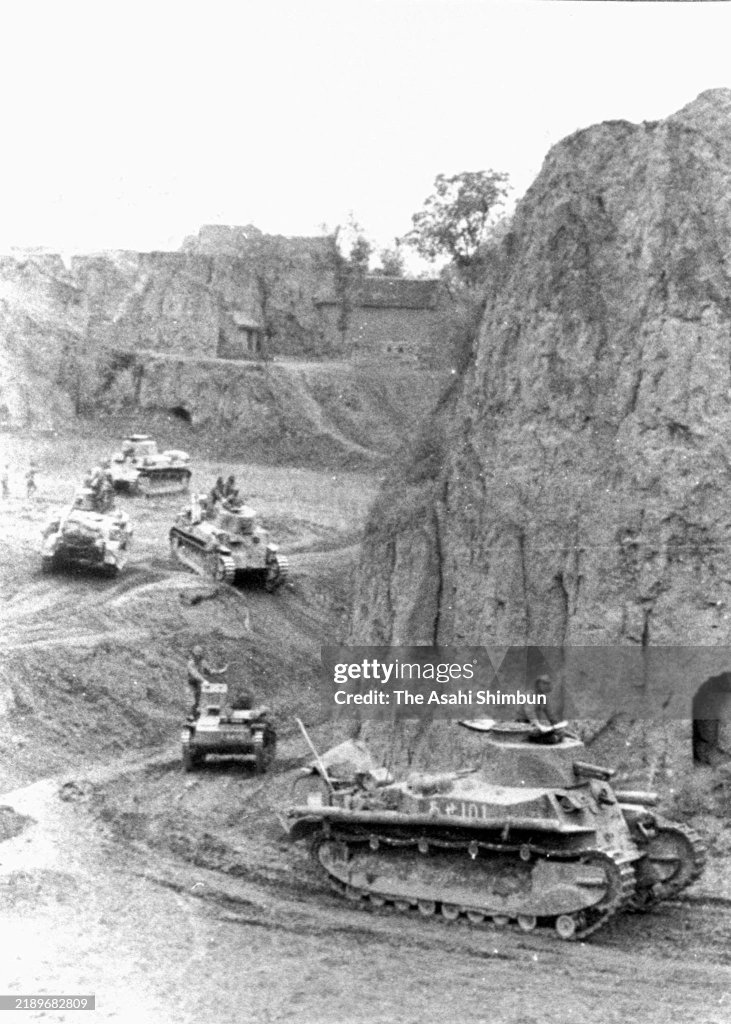
The Battle of South Shanxi, also known as the Battle of Jinnan (晉南战役) and Zhongtiao Mountains campaign (中條山會戰) by the Chinese and as the Chungyuan Operation by the Japanese began. In early 1941, the Japanese army in North China made plans to eliminate the Kuomintang presence in the Zhongtiao Mountains. In March of the same year, they launched attacks against the NRA 27th corps in Lingchuan and the NRA 15th corps south of Yicheng and east of Jiang County for a more favorable position before the Zhongtiao Mountains operation at a cost of 924 casualties. In mid-April 1941, the Chinese army detected the Japanese army amassing a large force of 200,000 troops in 4 divisions and 3 independent brigades for an offensive at Zhongtiao Mountain. The Southern Shanxi army thus deployed its troops accordingly for guerilla warfare while planning a counterattack with the support from parts of the Second, Fifth, and Eighth Military Fronts. However, due to lack of coordination between the military fronts, the Fifth and Eighth Military Fronts did not support the First Military Front in a timely manner. At the onset of the battle, KMT-CPC relations were at a low point following the still recent New Fourth Army incident in early 1941. As a result, the nearby 8th Route Army refused to assist the surrounded Nationalists. South Shanxi was later remembered in China as one of the worst defeats of the entire war. The battle of Zhongtiao Mountain resulted in tens of thousands of casualties for the Chinese army. Moreover, a large number of Chinese generals were killed or captured in the operation.
By the end of the Qinhe mopping-up campaign, corps commander Wu Shimin, divisional chief of staff Wang Ruqin (王儒钦), and more than 1,180 officers and soldiers had been killed in action. Divisional commander Wang Kejing (王克敬), deputy divisional commander Xue Rulan (薛如蘭), and more than 2,000 officers and soldiers were captured. Guo Jingtang (郭景唐), the commander of the 169th division, led the remaining hundreds to break out and cross the Yellow River towards friendly lines. The Japanese army claimed to have killed 2,862 soldiers and captured 4,311 from the 98th corps and Eighth Route Army, suffering 16 killed and 52 wounded in the process. In a few months, the Nationalists had lost its foothold in Southern Shanxi.
The Japanese show increasing uneasiness over their relations with the United States. Declines on the Tokyo Stock Exchange were attributed to reaction to Secretary of War Henry L. Stimson’s call for protection of shipments to Britain by United States naval forces.
Dow Jones Industrial Average: 116.87 (-0.23)
Born:
Kinichi Hagimoto, Japanese comedian, in Tokyo, Japan.
Died:
James George Frazer, 87, Scottish social anthropologist.
Naval Construction:
The U.S. Navy Vulcan-class repair ship USS Ajax (AR-6) is laid down by the Los Angeles Shipbuilding and Drydock Corp. (San Pedro, California, U.S.A.).
The U.S. Navy MMS I-class motor minesweeper USS YMS-32 is laid down by the Hiltebrant Dry Dock Co. (Kingston, New York, U.S.A.).
The Royal Navy Hill-class ASW trawler HMS Portsdown (T 221) is laid down by Cook, Welton & Gemmill (Beverley, U.K.); completed by Holmes.
The U.S. Navy SC-497-class (110-foot wooden hull) submarine chaser USS PC-516 (later SC-516) is laid down by the Elizabeth City Shipyard (Elizabeth City, North Carolina, U.S.A.).
The Вое́нно-морско́й флот СССР (ВМФ) (Soviet Navy) “M” (Malyutka)-class (3rd group, Type XII) submarines M-114, M-115, and M-116 are launched by Dalzavod (Vladivostok, U.S.S.R.) / Yard 202.
The Kriegsmarine (German Navy) Type VIIC U-boat U-260 is laid down by Bremer Vulkan-Vegesacker Werft, Bremen-Vegesack (werk 25).
The Kriegsmarine (German Navy) Type VIIC U-boat U-662 is laid down by Howaldtswerke Hamburg AG, Hamburg (werk 811).
The Kriegsmarine (German Navy) Type VIIC U-boat U-352 is launched by Flensburger Schiffsbau-Ges, Flensburg (werk 471).
The Royal Canadian Navy Flower-class corvette HMCS Summerside (K 141) is launched by the Morton Engineering and Dry Dock Co. (Quebec City, Quebec, Canada).
The Royal Navy Fairmile B-class motor launch HMS ML 215 is commissioned.
The Royal Navy harbor defence motor launch HMS HDML 1042 is commissioned.
The Royal Navy Flower-class corvette HMS Mignonette (K 38) is commissioned. Her first commanding officer is Lieutenant Harold Hinksman Brown, RNR.
The U.S. Navy Gleaves-class destroyer USS Woolsey (DD-437) is commissioned. Her first commanding officer is Lieutenant Commander William Henry von Dreele, USN.
 History Diaries