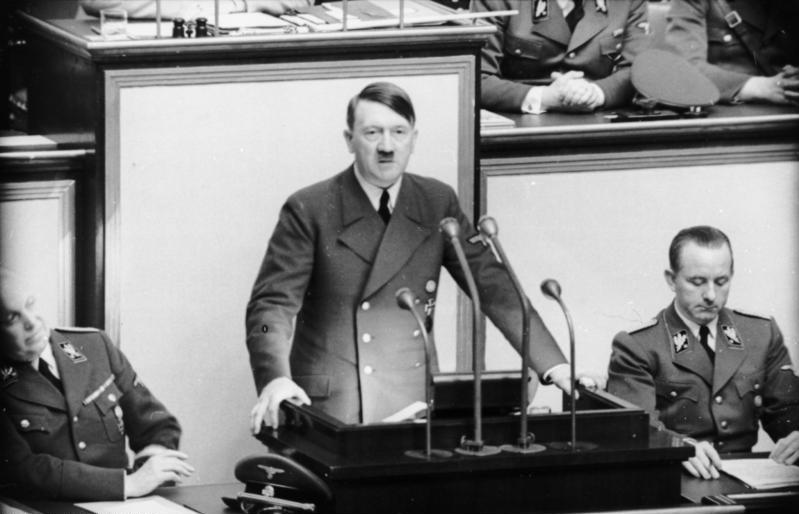
Adolf Hitler made an address to the Reichstag reviewing the Balkan campaign and declaring that the German Reich and its allies were superior to any conceivable coalition in the world. Flanked by Göring and Hess, the Fuhrer today strode into the Kroll Opera House — where Reichstag deputies have met since the fire of 1933 — to deliver a speech marking German victories in the Balkans. The speech covered the actions being taken against Germany by Great Britain, his thoughts on British Prime Minister Winston Churchill, Germany’s military campaigns in the Balkans, and details on the German attack of Yugoslavia. “For the sake of historical truth I must verify that only the Greeks, of all the adversaries who confronted us, fought with bold courage and highest disregard of death.”
Hitler also puts forth an economic argument for German policy in the Balkans — which obviously involves a lot of Wehrmacht military activity. He argues that reliance on money, or “worthless democratic money paper” as he puts it, is inherently unfair, and only mutual trade agreements such as those between the Reich and the Balkan states is fair. The wars that Germany has just won were the product of “filthy British politics” which had duped Romania, Yugoslavia, and Greece and had forced a defensive campaign by the Wehrmacht to protect its southeast flank.
“In this Jewish-capitalist age”, Hitler declared, “the National Socialist state stands out as a solid monument to common sense. It will last for a thousand years.” The greater part of the speech consisted of an attack on Churchill, who was portrayed as a blood-thirsty warmonger lacking the qualities needed to fight a war. “The gift Mr. Churchill possesses is the gift to lie with a pious expression on his face and to distort the truth until finally glorious victories are made of the most terrible defeats,” Hitler declared. Meanwhile Grand Admiral Raeder is urging Hitler to exploit the victories in Greece and Yugoslavia and launch a major offensive to capture Egypt and Suez. “This stroke”, Raeder says, “would be more deadly to the British Empire than the capture of London.” But Hitler is obsessed with Operation BARBAROSSA.
A cheering Reichstag heard Adolf Hitler pronounce Germany superior in power to “any conceivable coalition” and declare she will have only one answer to “democratic agitators” who “threaten to throttle” the Nazi state. Hitler’s only reference to the United States which, however, was not named, came near the end of his speech after he had sailed into British Prime Minister Churchill with vicious rhetoric and, in a review of the Balkan campaign, had put Germany’s losses in men killed at little more than 1,000. He said, choosing his words with great care: “When today democratic agitators of a country which the German people never harmed and whose statement that the German people intend to do so is an absurd lie, threaten to throttle the national socialist peoples’ state with the force of their capitalistic system, then there is only one answer: The German people will never again experience such a year as 1918.”
Hitler summarizes the Greek Campaign (Operation MARITA) by claiming that Churchill had committed “one of the greatest strategic blunders of this war” by trying to garrison and defend it. He credits the order to attack Yugoslavia to the coup there. He notes that “the Greek soldiers have fought with the greatest bravery and contempt of death,” and that the British force in Greece was there to attack the Reich and thus had to be removed. He gives figures of 57 officers and 1042 noncommissioned officers and men killed, 181 officers and 3571 noncommissioned officers and men wounded, and 13 officers and 372 noncommissioned officers and men wounded. Regarding future operations, he merely states that he views them with “perfect tranquillity and great confidence.”
Needless to say, the speech is pure propaganda. Churchill’s belated and inadequate military aid to Greece turned out to do nothing but offer Hitler a convenient excuse for why he attacked. No mention is made in the speech, of course, of Hitler’s intense preparations for invading Greece long before the first British boot set foot there.
While Adolf Hitler already has set the date for Operation Barbarossa as 22 June 1941, not everyone agrees with the decision. In fact, there is little enthusiasm for it within the uppermost reaches of the German government and military, including by Luftwaffe boss Hermann Göring. Admiral Raeder continues to press for his “peripheral strategy,” which focuses on cutting off Great Britain’s overseas possessions in the Mediterranean and elsewhere. That strategy to date has had great success, but the British remain entrenched in Egypt and at Gibraltar. The vast mass of the Wehrmacht, however, already is positioned in the East, and Hitler sticks with his plan to invade the Soviet Union.
As the Axis offensive on Tobruk, Libya began to stall, Paulus ordered Major General Erwin Rommel to besiege rather than eliminate Tobruk. Rommel halted his attack on Tobruk. German General Paulus, temporarily in command of the Afrika Korps, has seen enough of the abortive attack on Tobruk. He orders that no more attacks be made by Rommel’s forces unless there are signs of Allied retreat. Paulus already is looking toward his rear and orders that a new defensive line must be built in Gazala. In this sense, he is basically in agreement with the failed Italian strategy which began the campaign, believing in the value of fixed defensive positions in the defensive rather than Rommel’s faith in mobile operations. Rommel dutifully begins constructing defensive outposts facing the Tobruk perimeter. From this point forward for the next couple of months, the Germans and Australians will engage in only local actions, with the Germans holding their small three-mile wide incursion into Tobruk’s defenses.
The campaign evolves into competing supply buildups between Germany and Great Britain, with both sides holding unique advances in that struggle (the Royal Navy largely controls the sea and can be supplied from India, Australia, and New Zealand in addition to England, while the Axis has a short, though dangerous, supply route from Italy).
Churchill cables his Middle East commander General Archibald Wavell in Cairo. He states that is is “most important not to allow fighting around Tobruk to die down” due to the Germans’ over-extension following his “premature audacious advance.” He encourages counterattacks “at the earliest possible moment” to prevent the Afrika Korps from being able to “gather supplies and strength for a forward move.” Churchill and Paulus, thus, see the North Africa campaign developing the same way, and this is not a coincidence, as the British are reading the German codes via the Ultra decryption program.
Churchill also notes in his cable the “success of Demon.” This is a reference to Operation DEMON, a daring gamble of running disguised freighters directly through the Mediterranean to Egypt. In fact, one DEMON ship already has been sunk, though two have made it through.
Italian torpedo boat Giuseppe La Farina hits a mine and sinks off Kerkennah. The Italians are busy supplying the Afrika Korps in Tripoli and today send a convoy of seven troopships from Naples. The Italians provide a heavy escort three light cruisers and 8 destroyers, with some smaller torpedo boats also involved.
The Luftwaffe damages 7117-ton hospital ship Karapara in Tobruk Harbour. While accidents happen, hospital ships are clearly marked and there have been many incidents involving them. The Karapara makes it to Port Said for repairs. While there may seem little to gain by attacking hospital ships, driving them off or destroying them isolates the Australians holding out in Tobruk.
The British on 4 May 1941 continue their successful defense of Habbaniyah Airfield, Basra and their other fortified positions in Iraq. The RAF has complete control of the air. British reinforcements, called “Iraqforce,” are now on the march to Iraq from Palestine and Transjordan (Habforce and Kingcol), while men are trickling into Basra from India. The motley group of British ground forces in Habbaniyah already are having some success forcing the Iraqis back toward Baghdad, suggesting they will be able to hold out until the relief arrives.
The RAF raids the Iraqi forces, including Baghdad (where it drops leaflets) and other enemy areas. The Luftwaffe has a small presence at Mosul Airfield for receiving supplies via Vichy Syria, which the RAF also attacks.
There still is Iraqi resistance at Basra, where Iraqi gunboats and merchantmen remain outside of British control. Australian sloop HMAS Yarra arrives there today to help deal with the Iraqi shipping.
Iraq has stopped the flow of oil in the last pipeline to the Mediterranean from the little kingdom’s rich oil fields, British dispatches said tonight as fighting in the three-day-old war in Iraq showed no signs of abating. It is at Haifa, British-mandated Palestine, on the Mediterranean that the British fleet in the near east has received its chief oil supplies. While Iraq artillery shelled the British air base at Habbaniyah, 60 miles west of Baghdad, for the third straight day, the deposed regent of Iraq, Emir AbdulIlah, announced he was preparing to return to Iraq and called on Iraq troops to return peacefully to their stations and wait for his restoration of an independent Iraq constitutional government.
British troops occupied the airport and docks of Basra.
New Zealand Major-General Bernard Freyberg sent a message to the British commander in the Middle East, General Archibald Wavell, requesting the evacuation of about 10,000 personnel who did not have weapons and had “little or no employment other than getting into trouble with the civil population”. Few of these men had left Crete by the time the Germans invasion began on May 20.
The Germans occupy the Greek islands of Lesbos and Chios.
29th Brigade of the Indian 5th Division launched another attack at Amba Alagi, Abyssinia, capturing 3 hills between 0415 and 0730 hours. The 5th Indian Division, which has been advancing from the south, attacks the Italian positions at Amba Alagi. The Italians, though somewhat distracted by a separate attack coming up the Falaga Pass, are dug in and give little ground. The Gold Coast 24th Infantry Brigade attacks Italian positions at Wadara in Galla-Sidamo, while the Indian troops at Amba Alagi do capture a few foothills (Pyramid, Whale Back, and Elephant ). From here the going becomes steeper and more open to Italian fire.
Another British force is heading south toward the city, with a third force, the South Africans, also approaching. The Italians, meanwhile, are hiding out in caves which are very defensible, but also have no access to resupply and scant stores of even the most basic necessities such as food and water.
Churchill cables President Roosevelt and suggests that the Royal Navy is seriously considering occupying the Canary Islands (which he never actually names) and other Portuguese islands in the Atlantic in order to forestall a Wehrmacht occupation there. The U.S., he proposes, would serve as the “guarantor” that those islands would be returned to Portugal after the war. He also notes that “We are determined to fight to the last inch and ounce for Egypt, including its outposts of Tobruk and Crete.”
Perhaps coincidental to Churchill’s cable to President Roosevelt (but perhaps not), Australian Prime Minister Robert Menzies, on his way to New York, calls on Portuguese Prime Minister Dr. Salazar in Lisbon. Salazar, Menzies writes in his diary, is “very sincere and earnest” and tells Menzies that “The Portuguese won’t fight.” Of course, the Portuguese are in no danger so long as Spain remains neutral, though Hitler still dreams of drawing Franco into his collection of satellites and then occupying Portugal and its Atlantic islands.
The Prime Minister of Australia, Mr. Robert Menzies, paid a glowing tribute to British womanhood in a speech broadcast today. he praised “the courage, the action, the endurance of Britain’s women. Wherever I go I see them and I marvel at them. Is it possible to believe that not long ago we called them ‘the weaker sex’?”
HMS Edinburgh supported the raid on Lofoten Islands, Norway.
The Politburo appointed Joseph Stalin the Chairman of the Council of People’s Commissars, thus taking over as the actual head of the Soviet government, which position was previously held by Vyacheslav Molotov.
The May Blitz of Liverpool continued. The German bombing on Liverpool, England, United Kingdom that began on the previous date ended before dawn on this date, killing 850 people and destroying ammunition ship Malakand in the harbor. The May Blitz is notable for its ferocity and accuracy. The Germans have refined their techniques and finally are targeting port infrastructure and vulnerable shipping in the harbor with great success. The aftereffects of the devastating explosion of 7649-ton ammunition ship Malakand on the 3rd continue to be felt there, and 295-ton ship Pneumatic Elevator No. 11 sinks due to the blast effects, adding to the numerous ships sunk or damaged.
Some of the ships are repaired, but others are hit in subsequent raids and destroyed. The port is devastated and in chaos, with many ships on fire, others slowly sinking, and new ships still being docked and unloaded. There are separate attacks by 55 bombers targets Barrow-in-Furness, and 17 bombers on Hartlepool, with a small force hitting Middlesbrough. The Germans lose a couple of Junkers Ju 88s, one to engine failure, another to a night fighter.
The Luftwaffe also bombs Belfast with 204 aircraft. This is the third attack of the “Belfast Blitz,” the first two attacks occurring on 7 and 15 April 1941. In today’s attack, 150 people are killed by the many incendiaries dropped by the Germans. The Germans believe that this is one of England’s “hiding places” where it is hiding vast stocks of war material. Hitler, however, is beginning to have doubts about the wisdom of attacking Ireland, reasoning that the strong Irish influence in the United States might lead to U.S. entry into the war.
The British in Liverpool are reeling. They evacuate the Liverpool North End Unitarian Mission shelter, where Reverend Charles A Piper has been keeping a diary as he runs the shelter. The diary, which concludes with the 4 May 1941 entry, remains a valuable primary source on the May Blitz.
RAF Bomber Command, Day of 4 May 1941
12 Blenheims on coastal operations from France to Denmark. 1 fishing vessel was hit. No aircraft lost.
RAF Bomber Command, Night of 4/5 May 1941
Brest
97 aircraft — 54 Wellingtons, 21 Hampdens, 21 Whitleys, 1 Stirling. No aircraft lost. Direct hits were reported on the Scharnhorst and the Gneisenau but these are not confirmed.
Minor Operations: 10 Wellingtons to Le Havre, 9 Blenheims to Antwerp and Rotterdam. No losses.
The Luftwaffe continues to upgrade its equipment, with Bf 109F fighters beginning to appear. Kommodore Mölders of JG 51, the leading ace of the war to date, shoots down a Hawker Hurricane of RAF No. 601 Squadron in the new plane.
At Malta, the Luftwaffe remains active. Minesweeper HMS Fermoy, which was damaged earlier in the month and under repair, sinks from its damage.
The RAF targeted the airfield at Mosul, Iraq, which was being used by a small German force. The German force there was receiving supplies from and via Syria with the cooperation of the Vichy authorities.
Allied aircraft conducted a raid on Baghdad, Iraq.
U-38, commanded by Kapitänleutnant Heinrich Liebe, sank Swedish steamer Japan (5230grt) from dispersed convoy OB.310 at 249 miles northwest of Freetown. At 1829 hours on 4 May 1941 the unescorted and unarmed Japan (Master Lars Hugo Berggren), dispersed from convoy OB-310 on 18 April, was missed by two G7e torpedoes from U-38 249 miles northwest of Freetown. The U-boat then surfaced and began shelling the ship, setting the cargo in the forward holds on fire after three or four hits. The crew had stopped the engines when the U-boat surfaced nearby and immediately abandoned ship in two lifeboats when it opened fire. The barrel of the deck gun burst after the ninth round, slightly injuring some members of the gun crew. At 1915 hours, a coup de grâce was fired that hit aft and caused the ship to sink vertically by the stern after one hour, still burning. On 7 May, the crew and four passengers made landfall at the coast of French Guinea and were interned by the Vichy French authorities. They were later transferred to Marseilles and the 27 Swedish crew members were allowed to return to Sweden. The 5,230-ton Japan was carrying general cargo and coal and was bound for the Middle East.
Heavy cruiser HMS Norfolk departed Scapa Flow for docking at Rosyth to replace a damaged propeller. The cruiser departed Rosyth after repairs on the 11th. Departing, the cruiser was involved in a collision with Dutch skoot Sparta, but no damage was done to the cruiser.
Destroyers HMS Intrepid and HMS Impulsive departed Scapa Flow at 0715 for Loch Alsh to escort minelaying operation SN.9A. The destroyers arrived at 1640.
Destroyer HMS Punjabi departed Rosyth at 2350 escorting armed merchant cruiser HMS Moreton Bay to Cape Wrath. After this escort, the destroyer arrived at Scapa Flow at 2030/5th.
Minesweeping trawler HMS Ben Gairn (234grt, T/Lt R. H. Masurier RNVR) was sunk by a parachute mine Waveney Dock, Lowestoft. There were no casualties on the trawler.
Destroyer HMS Southdown, which departed Sheerness on the 3rd was damaged in the North Sea by the near miss of German bombing. The destroyer’s hull was leaking and her steering motors were temporarily out of action.
Minesweeper Selkirk was damaged by the near miss of a German bomb off Roughs Buoy. The ship was towed to port and was under repair in the Thames from 15 May to 31 July.
Patrol yacht HMS Franc Tireur was also damaged by a near miss.
British steamer Tregor (222grt) was sunk by German bombing six miles off Trevose Head. The crew of six was rescued.
Belgian steamer Marie Flore (545grt) was damaged by German bombing in 50-41N, 5-05W. The steamer was beached at Padstow on the 5th.
Pneumatic Elevator No. 11 (295grt) was sunk at Liverpool as a result of the explosion of steamer Malakand (7649grt).
Tug Bison (274grt), British steamer Talthybius (10,254grt), British steamer Baron Inchcape (7005grt), Tug Hornby (201grt), Tug Enid Blanche (99grt), British hopper barge No. 33 (718grt), barge Aid (209grt), flat John (67grt), and British steamer Roxburgh Castle (7801grt) were damaged by German bombing at Liverpool.
Steamer Baron Inchcape settled onto the seabed. She was bombed again on the 6th.
Steamer Talthybius was bombed again on the 8th.
Steamer Roxburgh Castle was repaired at Birkenhead.
During the night of 4/5 May, British sailing barge Bongo (46grt) was damaged by German bombing at Liverpool.
Australian sloop HMAS Yarra arrived to Basra to quell rebellion. A few days later, the sloop engaged Iraqi gunboats and captured them along with some Axis merchant ships.
Minesweeper HMS Fermoy was sunk in dock at Malta by German bombing.
Hospital ship Karapara (7117grt) was damaged by German bombing at Tobruk. The hospital ship arrived at Alexandria on the 6th and continued on to Port Said.
Submarine HMS Taku made an unsuccessful attack on a coastal steamer in the Messina Strait.
Italian torpedo boat Giuseppe La Farina, which had departed Tripoli on the 3rd for Trapani with tanker Luisiano (2552grt), was sunk by a mine off Kerkenah.
An Italian convoy with troopship Victoria (13,098grt), Andrea Gritti (6338grt), Sebastiano Venier (6311grt), Marco Foscarini (6342grt), Barbarigo (5293grt), Calitea (4013grt), and Ankara (4768grt) departed Naples escorted by destroyers Vivaldi, Da Noli and Malocello and torpedo boats Pegaso, Orione, and Cassiopea.
The convoy was covered by light cruisers Eugenio Di Savoia, Duca D’ Aosta, and Attendolo and destroyers Pigafetta, Zeno, De Recco, Da Mosta, and Verazzano. En route to Tripoli, destroyers Pigafetta and Zeno attacked a submarine contact. The convoy arrived without loss on the 5th.
On the convoy return, the distant force covered a German convoy to Italy of steamers Marburg (7564grt), Kybfels (7764grt), Reichenfels (7744grt), Marco Polo (12,272grt), and Rialto (6099grt) escorted by destroyers Euro and Fulmine and torpedo boats Procione, Orsa, Centauro, Cigno, and Perseo from Tripoli on the 5th. The convoy arrived at Palermo on the 7th.
Light cruisers HMS Fiji from convoy SL.72 and HMS Naiad from convoy WS.8A arrived at Gibraltar and embarked ammunition for the passage to the Eastern Mediterranean.
Administration leaders indicated today they would not oppose a showdown in the senate on the proposal of Senator Tobey, New Hampshire Republican to put congress on record against using the navy to convoy shipments to Britain. Although opponents succeeded in smothering Tobey’s resolution in the foreign relations committee last week, Democratic Leader Barkley of Kentucky said if the New Hampshire senator offered it as an amendment to other legislation as the latter has said he would do, no attempt would be made to curtail debate or prevent the bill coming to a vote. “It will just come up and we will vote it down,” Barkley told reporters.
President Roosevelt asserted today the American people had fought before and were “ever ready to fight again” for the existence of “democracy in the world.” . Speaking at the dedication of Woodrow Wilson’s birthplace as a national shrine, Mr. Roosevelt said the World war president had taught “that democracy could not survive in isolation.”
President James Bryant Conant of Harvard university, who returned recently from an official trip to England, said today that the United States should go to war against the axis powers immediately. Conant emphasized that he was expressing his views as a private citizen and was not talking as head of President Roosevelt’s scientific mission which spent six weeks in the British isles. There is no chance of a negotiated peace and the isolationists “are living in a world of wishful thinking when they imagine the struggle may soon be over,” Conant said in his C.B.S. radio address. The question is not “Shall America fight?” but “When shall America fight?” he declared. “I believe we should fight now,” he said.
Wendell L. Willkie predicted in Nashville today that “within ninety days, within six months at the latest, the United States, without even the assistance of British production, will be turning out more arms, armaments and airplanes than Germany,” but added that it was imperative to see that what was built for Britain was delivered to Britain.
Niles Trammell, president of the National Broadcasting: Co., charged tonight that the federal communications commission’s new regulations governing network broadcasting are “a definite step toward complete government control of radio.” He said that in order to meet the regulations N.B.C. may be forced to sacrifice several leading programs including “The National Farm and Home Hour,” the “Toscaninl Symphony Concerts,” and the “Town Meeting of the Air.” “Even a casual reading of the regulations set forth in the report adopted by a majority of the commission is enough to indicate that chaos, not further competition, would result from the blow aimed at the American system of broadcasting,” Trammell said.
A Lockheed aircraft P-38 interceptor which the company claims is the world’s fastest fighting craft traveled 458 miles an hour today, its pilot said, in an exhibition before more than 50,000 spectators at an air show. Test Pilot Milo Burcham made the announcement of the speed indicator’s reading over the show’s broadcasting system after landing the plane for its first public inspection. Before he set the twin-engined, all-metal ship down he whipped it through a series of rolls and dives that had had audience twisting necks in all directions.
Twenty thousand bus riders in cities from New York to St. Louis had to find alternative means f transportation yesterday when a protest walkout of 1,400 drivers, mechanics and terminal employes cut off all service on Pennsylvania Greyhound Lines buses. The company made no effort to operate, but it arranged to have its tickets honored by railroads and other bus lines to reduce the inconvenience to passengers. A conference looking toward settlement of the wage dispute between the company and the Amalgamated Association of Street, Electric Railway and Motor Coach Employees, A. F. of L., will be held in Washington today, with Dr. John R. Steelman, director of the United States Conciliation Service, presiding. The stoppage went into effect at 5 o’clock this morning, although union leaders announced Saturday night that they had rescinded the call for the walkout at Dr. Steelman’s request. The union officials said the telegram from the Federal conciliator had arrived “too late” for them to arrange an orderly deferment of the strike.
A German band played for the Deutsches Kriegshilfswerk [German war workers] at the California Hall in San Francisco, California. There is a strong German presence in San Francisco, where the Germans maintain a consulate.
Major League Baseball:
27,015 Dodger fans watched Frankie Frisch’s Pirates beat Brooklyn, 6-4, at Ebbets Field. Luke (Hot Patato) Hamlin, winner of three straight games in which he had allowed only three runs, chose a most inauspicious moment yesterday to serve his third home-run ball of the campaign. Luke tossed it to Elbie Fletcher with two Pirates aboard in the third inning and, although the Dodgers gathered four tallies later on, that blow really was the payoff. Debs Garms hit another for the circuit off Bill Swift in the seventh for the sixth Pirate run. Young Pete Reiser brought the fans to their feet and hope back to their hearts in the ninth when he dynamited one of Ken Heintzelman’s fast ones far into Bedford Avenue after Peewee Reese had walked with two out. But Cookie Lavagetto ended things with his easy fly to Vince DiMaggio in left center.
The Cardinals bunched five hits in the eighth inning against Manny Salvo today to gain their ninth straight victory. They beat the Braves, 3–1, before 18,197 fans. Salvo, armed with a 1–0 lead, appeared to have the game under control until the Cards staged their big inning. The Boston right-hander had kept St. Louis hitless until the sixth, when, with two out, Don Padgett got the first of his two hits. The Cards made six hits in all.
The Philadelphia Athletics scored five runs in the first inning and went on to register a 17–11 victory over the White Sox today before a disappointed Chicago crowd of 13,091. The Sox made four errors in the opening frame. These, coupled with two hits, gave Philadelphia its lead and sent the rookie hurler, Jack Hallett, to the showers. The A’s built their margin to 12–2 before Chicago began pecking away at Bill Beckman. The Sox finally knocked him out with a three-run splurge in the eighth, but they never seriously threatened to catch their rivals.
The Indians win their 10th in a row, 12–4, over Washington. Al Smith is the winner. Everybody in the Tribe’s line-up got a hit but Smith, who gained his third triumph, and Clint Brown, who relieved him in the eighth inning. Ray Mack was the only Indian who failed to score at least one run. There were 21,388 in the Stadium to see the Tribe take a cut at three Washington pitchers — Walter Masterson, who was charged with the loss; Arnold Anderson and the former Clevelander, Bill Zuber. Among them they gave up fifteen hits.
In Detroit, the Tigers jump on Yankee rookie George Washburn, in his lone Major League appearance, to win, 10–1. Billy Sullivan and Rudy York homer and Bobo Newsom has a hit and 2 RBI to help his cause. Bobo’s lone mistake is a pitch to Charlie Keller that Kong drives 450 feet off the centerfield screen for an inside-the-park homer in the second inning. The blow gave the Yanks a lead,
but not for long. In the Tiger second, after fanning York, Washburn walked Hank Greenberg, Bruce Campbell and Pinky Higgins in succession. He uncorked a wild pitch on which Greenberg scored with the tying run. After Sullivan walked, filling the bases again, Newsom bounded a single over Washburn’s head on which Campbell and Higgins tallied. Barney McCosky opened the third with a triple and, when Charley Gehringer walked, Washburn was yanked. Breuer fanned York and Greenberg and seemed out of danger until Phil Rizzuto booted Campbell’s rap, permitting McCosky to score. In the fourth Sullivan hit a homer into the upper right-field stand. With two down, McCosky singled and so did Gehringer, who also stole second. Then York wafted his sixth homer into the lower left-field stand. Two passes, two singles and errors by Dickey and Priddy gave the Tigers two more runs in the seventh.
The Giants downed the Cubs, 9–4. Thirteen hits, including Babe Young’s fourth homer of the campaign, whistled off the aroused Giant bats as Manager Wilson frantically sent half a dozen hurlers to the mound. In addition to his homer, Young helped himself to two singles. Mel Ott also came up with three blows, one a double, and Frank Demaree, performing in center field for the first time in place of Johnny Rucker, celebrated his season debut with two damaging singles. Behind this barrage, Cliff Melton, for another agreeable surprise, survived everything, including a ninth inning homer by Dominic Dallessandro, and pitched his first complete game of the year. It was his first victory.
Long Tom Hughes, 21-year-old rookie, turned in a masterful three-hit performance today to give the Phillies a 3–0 shutout victory over the world champion Reds before a crowd of 6,471. The slender right-hander struck out three and only two Reds — Frank McCormick in the seventh and Harry Craft in the eighth — reached third base. McCormick, who walked, gained the third sack when Bill Werber singled with two out, but Dick West flied out. Craft singled, reached second on an error and third on an infield out.
In St. Louis, Red Sox pitcher Lefty Grove wins his 294th victory, 11–4, over the Browns. The Red Sox back Lefty with 15 hits, including five doubles. The Red Sox continued their neck-and-neck race with Detroit for a first-division seat as they toppled the Browns back into the basement in a series opener today.
Pittsburgh Pirates 6, Brooklyn Dodgers 4
St. Louis Cardinals 3, Boston Braves 1
Philadelphia Athletics 17, Chicago White Sox 11
Washington Senators 4, Cleveland Indians 12
New York Yankees 1, Detroit Tigers 10
Chicago Cubs 4, New York Giants 9
Cincinnati Reds 0, Philadelphia Phillies 3
Boston Red Sox 11, St. Louis Browns 4
Squires’ Gate Aerodrome: The first mission of the North Atlantic Return Ferry Service flies from Montreal to Blackpool using the Consolidated LB-30A.
Coincident with the departure of Captain James Roosevelt from Chungking yesterday, authoritative reports that a United States military mission would arrive in Chungking in the next week or ten days were strengthened.
Winston Churchill asks General Ismay for a “report on the efficiency of the gunners and personnel” manning air defenses in Singapore.
Foreign Minister Yosuke Matsuoka flatly and brusquely denied today any intention of visiting the United States to ascertain its attitude toward the Far East and suggested it would be more plausible if President Roosevelt and Secretary of State Hull came to Tokyo to really learn about conditions in the Orient. “I have studied America and know the conditions,” he said. “I doubt, however, whether Mr. Roosevelt or Mr. Hull are able to grasp the true situation in the far east. I believe Japanese-United States problems could easily be solved if Roosevelt or Hull visited Japan rather than my going to the United States.”
U.S. Army Brigadier General Henry B. Clagett, with his chief of staff Colonel Harold Huston George, arrive at Manila in the Philippines to command the newly created Philippine Department Air Force. They arrive on a Boeing 314 Clipper (Pan-American Air Lines). Their mission is to expand the air defenses in the Philippines.
Born:
George Will, American columnist and political analyst (“Night Line”), in Champaign, Illinois.
Nickolas Ashford, R&B singer and one-half of Ashford & Simpson, in Fairfield, South Carolina (d. 2011).
David LaFlamme [Gary Posie], American electric rock violinist (It’s A Beautiful Day — “White Bird”), in New Britain, Connecticut (d. 2023).
Mike Fitzgerald, NFL defensive back (Minnesota Vikings, New York Giants, Atlanta Falcons), in Detroit, Michigan.
Died:
William A. Welch, 72, American engineer and environmentalist.
Naval Construction:
The U.S. Navy Accentor-Class coastal minesweeper USS Governor (AMc-82) is laid down by the Camden Shipbuilding and Marine Railway Co. (Camden, Maine, U.S.A.).
The Marina Regală Română (Royal Romanian Navy) submarine NMS Marsuinul (“Porpoise”) is launched by the Galați shipyard (Galați, Moldavia, Rumania).
The Royal Navy Abdiel-class minelayer HMS Latona (M 76) is commissioned. Her first commanding officer is Captain Stuart Latham Bateson, RN.
 History Diaries