With mainland Greece occupied by the Germans on 1 May 1941, the focus shifts to Crete. British Prime Minister Winston Churchill sends a lengthy cable to Admiral Sir Andrew Cunningham, chief of the Mediterranean Fleet, in which he congratulates the Royal Navy for the way it “succored the Army and brought off four-fifths of the entire force” from the mainland. He also notes:
“It is now necessary to fight hard for Crete, which seems soon to be attacked heavily, and for Malta as a base for flotilla actions against the enemy’s communications with Libya.”
Churchill sends a much briefer cable to his Middle East Commander, General Archibald Wavell, merely appending his cable to Cunningham and noting “Feel sure you are waiting to strike a blow.” An old sea dog, Churchill naturally favors the Royal Navy over the army, but it also is clear from his communications that he hates to lavish praise on Wavell (and his subordinates) for what are likely personal reasons.
Italian airborne troops continue occupying the Greek islands of Cephalonia, Ithaca, and Zante.
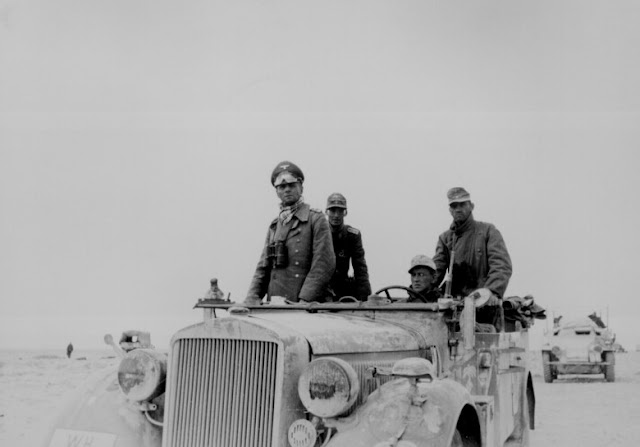
Major General Erwin Rommel’s attack on Tobruk continued. He attempted to widen and deepen the gap but the Australian forces fight fiercely and largely contained the attacks. German tanks attacked Tobruk, Libya at 0715 hours; slowed by a minefield, they were attacked by 2-pounder anti-tank guns and then by British tanks; the Germans lost 12 tanks in this engagement while the British lost 4. In the evening, Australian 2/48th Battalion conducted a counterattack but it was repulsed with heavy casualties. 300 kilometers to the west, RAF aircraft attacked Benghazi and sank an Italian freighter.
The German/Italian offensive against Tobruk continues, and makes some progress. The Germans reorient the axis of attack by the panzers from the southeast to the east but run into a minefield and antitank fire. Paulus, nominally in charge, already is ready to give up, but Major General Rommel tries to enlarge his small bridgehead with an attack to the southeast toward Bir el Medauar. The British respond by sending their own tanks to block them, and a major battle takes place. The British lose five tanks, but blunt the German attack, and the Australian infantry counterattacks. This attack also is repulsed, leaving the Germans within the Tobruk perimeter but unable to expand it as the day ends.
The following Italian infantry, meanwhile, which was supposed to follow the panzer in, is still dealing with isolated Australian outposts that have been overrun but still refuse to surrender. Overall, the battle is trending toward the British, but they have lost ground when they have very little to spare. Operations are hampered during the morning by fog. This combat operation, incidentally, is sometimes called the Battle of Ras el Medauar.
The British Reuters News Agency reported from the headquarters of General Wavell: “An extremely violent battle ignited Wednesday night around Tobruk. After a vigorous bombardment lasting several hours, German and Italian infantry attacked the Tobruk fortifications, deploying heavy tanks and flamethrowing tanks simultaneously. Early this morning another attack ensued by large numbers of German Stuka dive bombers which dropped heavy calibre bombs on the defence installations. Until 10:00 AM the British garrison succeeded in preventing any breach in the Tobruk defences. After that, a strong panzer force successfully penetrated the outer perimeter along a 2-mile front. British and Australian troops are at this moment engaged in hand-to-hand fighting in the defensive installations outside the city.” The flamethrower tanks were Italian flamethrower L3’s. These had already been in service for a couple of years by 1941, and the Italian Ariete armoured division was heavily involved in many of the Axis assaults on the Tobruk perimeter in April- early May ’41. The flamethrower L3 was a rather distinctive vehicle. The flame projector (maximum range about 100 meters) replaced the twin machineguns mounted in the left side of the hull, and flame fuel came directly from a special two-wheeled trailer which the tank pulled behind it when in action.
Winston Churchill orders another operation to run an aircraft carrier into the Mediterranean from Gibraltar and fly off some Hawker Hurricanes to Malta. Such operations have had mixed success to date, with losses of several planes that apparently ran out of fuel. This projected operation is tentatively slated for late May at the earliest.
The Italian Navy sends a large force, including three light cruisers, to lay mines north of Tripoli.
Viceroy of Italian East Africa Duke of Aosta and 7,000 troops were trapped at Amba Alagi, Abyssinia by Indian 5th division to the north and South African 1st Brigade in the south.
Fighting in western Ethiopia between the Italian and Belgian Congolese colonial forces was mostly halted for six weeks due to the rainy season. While there have been some small attacks recently in western Abyssinia on heavily defended Italian positions, the rainy season begins and halts the most further operations until mid-June. The Duke of Aosta, a favorite of the King of Italy, is trapped in Amba Alaga, Abyssinia with 7,000 troops, but has maximized his possibilities with prudent withdrawals into defensible positions. The East African 22nd Infantry Brigade, advances south from Addis Ababa, capturing Mount Fike in Galla-Sidamo.
Iraqi forces overlooking RAF Habbaniyah grew to 9,000 men, 50 artillery pieces, 12 armored cars, and a few light tanks. They demanded the airfield to cease flight operations, but the local RAF commander ignored the threat, a decision backed by Winston Churchill. Iraqi forces attack British forces at Rutba west of Baghdad.
The Iraqis have demanded that the British at Habbaniya Airfield west of Baghdad surrender. The British do not reply. The ultimatum will expire in the early morning hours of 2 May. The British prepare to sortie out of their airfield fortress against the Iraqis, who have set up 28 artillery pieces on a plateau overlooking the airfield to the south. There are small Iraqi attacks near the airfield at Rutba. Air Vice-Marshal Harry Smart is instructed personally by Churchill to defend his position: “If you have to strike, strike hard. Use all necessary force.”
At Pretzsch, in Saxony, special mobile killing squads, the Einsatzgruppen, are set up by the SS this month. Each of the squads has been assigned a particular area of the Soviet Union. Einsatzgruppe A, commanded by Walter Stahlecker, is to be responsible for the murder of Jews in the Baltic states of Latvia, Lithuania, and Estonia. Einsatzgruppe B, under Arthur Nebe, is assigned the area between the Baltic states and the Ukraine. Einsatzgruppe C, commanded by Otto Rasch, is to operate in the Ukraine south of Nebe’s group, and Einsatzgruppe D, commanded by Otto Ohlendorf, is assigned the remainder the Ukraine and Crimea. Heydrich told those at Pretzsch that all “Communists, Jews, Gypsies, saboteurs, and agents must basically be regarded as persons who by their very existence, endanger the security of the troops and are thereby to be executed without further ado.” (Note: The SS was convinced that by mass executions on the spot they could “solve” the “Jewish question” in Russia, by murdering all the Jews they could catch. No family was to be spared. No resources were to be wasted by setting up ghettos or deporting Jews to distant camps or murder sites. The killings were to be done in the towns and villages at the moment of military victory.)
Groß-Rosen Concentration Camp, formerly a satellite camp of Sachsenhausen Concentration Camp, became an independent camp. It was located in Groß-Rosen, Lower Silesia, Germany (now Rogoznica, Poland).
The first Croatian concentration camp is set up at Danica in May. It is quickly followed by four more camps at Jadovno, Gradiska, Loborgrad, and Dakovo.
In Paris this month, thousands of foreign-born Jews are seized and interned. At the same time, thousands of Polish and German-born Jews, who had fought against the Germans in the French Foreign Legion during 1940, are deported to the slave labor camps in the Sahara Dessert (see March 22).
There is a major shakeup within the British ministries. Lord Brabazon becomes the new Minister of Aircraft Production, and a new Ministry of War Transport is established that combines the old ministries of shipping and transport. Industrialist Frederick Leathers, who gets a peerage for his effort, will preside over the new Transport ministry. Lord Beaverbrook becomes Minister of State.
Visiting Australian Prime Minister Robert Menzies confides in his diary that he is “desperately afraid of the future in Great Britain.” Menzies is scheduled to return home on 3 May, but notes that Lord Beaverbrook “thinks [it] absurd that I should go back to Australia!” There is definite sentiment among those opposed to Churchill’s conduct of the war that Menzies would be a good replacement for Churchill as Prime Minister of Great Britain.
Generalleutnant August Krakau succeeded Robert Martinek as the commanding officer of the German 7th Mountain Division.
Frederick Leathers, an industrialist who started work as an office boy in the coal trade, was tonight appointed head of a new ministry of wartime communications by Mr Churchill. He will amalgamate the ministries of shipping and transport, and gets a peerage on joining the government. Another change is the move of Lord Beaverbrook to be Minister of State — a rank without precedent. Lord Brabazon now takes over a Minister of Aircraft Production.
Premier Benito Mussolini’s newspaper announced today that Germany and Italy have decided to regard the United States as “a 100 percent enemy” and warned of the danger of axis attacks on the U.S. fleet and air force. Italy’s leading political commentator, Mario Appelius, Issued the warning in II Duce’s Milan newspaper, Popolo d’ltalia, describing President Roosevelt’s Atlantic patrol project as a “hypocritical attempt to provoke war.”
Joseph Broz “Tito” issues a call for armed resistance to the Germans and Italian occupiers. He is an avowed communist. This is partly in response to mass killings being undertaken at this time by the Pavelic Ustashi government.
Soviet Russia today sounded a strong May Day appeal for world peace “the sooner the better” amid a bristling background of massed fighting strength and warnings that any nation daring to attack Soviet territory will be annihilated. Particular emphasis was laid on the Red army’s mechanized equipment. Hundreds of armored cars, heavy and light artillery pieces, whippet tanks and “land battleships” raced in formation across the vast expanse of the central square where 2,000,000 soldiers and civilians participated in or watched the largest military demonstration in years. Formation after formation of new twin-motored bombers, new pursuit planes of great speed and dive-bombers roared overhead. Foreign observers pointed out the particular emphasis laid on anti-tank and antiaircraft guns.
Soviet Premier Joseph Stalin gives a routine May Day speech which reflects growing rumblings beneath the placid peacetime surface. Stalin’s remarks probably are not directed at his current ally Germany, but, in retrospect, they seem to fit what he has in store for them:
“The Red Army is ready, in the interests of the socialist state, to ward off every blow struck by the imperialists. The international situation is full of unexpected events. In such a situation the Red Army must step up its defensive readiness.”
The German military attaché in Moscow notes that the Red Army has begun calling up recruits in the lowest age cohort six months earlier than usual. The Soviets also orders that foreign diplomats may no longer travel freely, but must be escorted.
The May Blitz of Liverpool began. The Luftwaffe begins a major campaign against Liverpool, which is the main port through which Great Britain communicates with the outside world. This will continue for the next seven nights and wound or kill 3,000 people. The Germans also accomplish their true goal of strangling tonnage going into the port, at least temporarily. At 2215 hours, German bombers began attacking Liverpool, England. The Luftwaffe raids the city and continues for the next 7 nights. 76,000 people are made homeless and 3,000 killed or injured. 69 out of 144 berths are put out of action, and for a while the tonnage landed was down 75%.
Churchill’s secretary, John Colville, notes in his diary after a tour of the area that “Plymouth has been cruelly laid waste in the last fortnight.” The Luftwaffe has attacked Plymouth for five nights running, but at least the attacks had lessened in severity as they continued. Now, it is Liverpool’s turn. The War Cabinet minutes note that it is “disturbing” that “the Press had drawn attention to an unofficial nightly exodus from Plymouth into surrounding districts.” The same pattern is likely to occur in Liverpool.
The Luftwaffe combines the day and night fighter commands into a unified command structure, but FLAK units remain independently controlled by local air headquarters (Luftgaukommandos). Colonel Josef Kammhuber is in charge of coordinating FLAK, searchlight and radar units and is a genius at creating an organization (though a bit shakier on overall military strategy). Kammhuber is in the process of coordinating Reich air defenses into a unified structure later known as the Kammhuber Line. This works fairly well under the circumstances that prevail during the early part of the war.
The “Blitz,” the German bombing attacks on British cities, will come to an end this month when most of the Luftwaffe planes are withdrawn to prepare for the German invasion of the Soviet Union.
Luftwaffe day and night fighter interceptor controls are united under a single command post. German flak units remain under the control of the individual air district headquarters (Luftgaukommandos), but in other respects German air defense now makes up a single unified military organization.
RAF Bomber Command, Day of 1 May 1941
22 Blenheims on coastal operations to Holland. Bombs were dropped on the naval base at Den Helder and on ships at sea. 1 aircraft lost 3 Hampdens on cloud-cover raid to Emmerich turned back.
Hans-Joachim Marseille shot down his 10th and 11th kills, two British Hurricane fighters, while escorting German Stuka dive bombers to Tobruk, Libya.
Ofw. Erich Rudorffer of I./JG 2, with nineteen aerial victories, is awarded the Ritterkreuz.
At Malta, the Luftwaffe attacks continue, and the attacks include bombings and minelaying. The Germans sink 1373-ton freighter Polinice, but the ship is later raised for salvage. There is one civilian death. HMS Jersey hits a mine in Valetta Harbor and later sinks during a raid.
U-552, commanded by Oberleutnant zur See Erich Topp, sank British steamer Nerissa (5583grt) in 57-57N, 10-08W. A straggler from Convoy HX-121, the British steam passenger ship Nerissa was torpedoed and sunk by the U-552 southeast of Rockall in the northern Atlantic Ocean. Of the ship’s complement and passengers, eighty three crewmen and one hundred and twenty four passengers were lost on the steamer. Among the passengers lost were Lt Cdr R. A. F. Nicholl-Cadell Rtd, Paymaster Cdr F. R. W. Nixon RCN, sub Lt B. Harvey RCN, and Sub Lt E. G. Robbins RCN, en route to Canada. Twenty three crew members and fifty one passengers were rescued and picked up by the destroyer HMS Veteran (D 72). The 5,583-ton Nerissa was carrying passengers and general cargo, including aluminum, motor trucks, and shells and was bound for Liverpool, England.
U-103, commanded by Kapitänleutnant Viktor Schütze, sank British steamer Samsø (1494grt) at 8-35N, 16-17W. At 1834 hours on 1 May 1941 the unescorted Samsø (Master Hefarn Madsorn) was hit near the aft mast by one torpedo from U-103 southwest of Freetown and sank slowly in 50 minutes. One crew member was lost. The master and 18 crew members in three lifeboats landed at Los Island, French Guinea on 3 May, were taken to Conakry and thence to Freetown on 16 May. The 1,494-ton Samsø was carrying groundnuts and was bound for the United Kingdom.
Kapitän zur See Friedrich Hüffmeier took command of German cruiser Köln.
Heavy cruiser HMS London arrived at Scapa Flow after escorting convoy SL.71.
Destroyers HMS Bedouin and HMS Antelope departed Scapa Flow at 2345 to investigate a submarine contact reported in Preswick Bay. No contact was made and the destroyers arrived back at Scapa Flow at 0800/2nd.
Destroyer HMS Maori departed Scapa Flow at 1900 to join the Plymouth Command. Destroyer HMS Sikh departed at 2200/11th. The 4th Destroyer Flotilla ships were replaced in the Home Fleet by the destroyers of the 20th Destroyer Flotilla.
Destroyer HMS Impulsive, escorting steamer Amsterdam, departed Aberdeen for Lerwick at 0200 and arrived at 1520. At 0035/3rd, the destroyer and steamer departed Lerwick for the return to Aberdeen. At 0500, steamer Archangel from Kirkwall join company off Duncansby Head. Off Aberdeen, the destroyer parted company and returned to Scapa Flow, arriving at 1830.
Australian destroyer HMAS Nestor departed Greenock at 1330 to rejoin the 7th Destroyer Flotilla operating with the Home Fleet, and arrived at Scapa Flow at 0900/2nd.
P/T/Midshipman (A) J. A. David RNVR, was killed when his Albacore of 767 Squadron from Arbroath crashed near Glen Cova.
Minesweeping trawler HMS Jean Frederic (329grt) with a Dutch crew, and escorting a convoy, was sunk by German bombing off Start Point. T/Sub Lt R. G. Madders RNVR was lost.
Balloon barrage vessel Saturnus (200grt) with a Dutch crew was declared a constructive total loss after damage.
British steamer Sea Fisher (2950grt) was damaged on a mine in 55-34N, 1-28W. The steamer was beached by tugs. She was refloated and arrived at Middlesborough on the 5th.
Destroyer HMS Faulknor with Dutch submarine HNLMS O.21 departed Gibraltar for exercises.
Former Italian steamer Polinice (1373grt) under Control was sunk by German bombing at Malta. The steamer was later salved.
Anti-submarine trawler HMS Loch Oskaig (534grt) captured French steamer Cap Cantin (3317grt). At 0430/2nd, Battlecruiser HMS Renown and destroyers HMS Faulknor, HMS Foresight, HMS Fury, HMS Forester, and HMS Fortune departed Gibraltar to ensure the French would not attempt to recapture the steamer. Destroyer Foresight took over escort of the steamer and the anti-submarine trawler returned to patrol.
Destroyers HMS Jaguar and HMS Juno attacked a submarine contact in 32-59N, 27-52E. A premature explosion of a depth charge on destroyer Juno killed Gunner (T) S. C. Parker, which died of wounds on the 2nd, and four ratings and eleven men were wounded. The ship sustained minor damage only.
Submarine HMS Truant arrived at Malta from patrol. Owing to the danger from night minelaying, she was sailed at 2000 for Gibraltar.
Sub Lt R. D. B. Hopkins, on loan to the RAF in a Beaufighter of 525 Squadron, was taken prisoner by the French after the aircraft crashed between Speval and Gibraltar.
Italian light cruisers Eugenio Di Savoia, Duca D’aosta, and Attendolo and destroyers Pigafetta, Zeno, Da Mosto, Da Verazzano, Da Recco, and Pessagno laid mines north of Tripoli.
German steamer Larrisa (1819grt) was sunk on a mine in the Gulf of Volos.
Italian steamer Serdica (1533grt) was sunk by British bombing at Benghazi.
When a direction finding bearing indicated an Italian submarine in 35-00N, 15-30W, Corvettes HMS Fleur de Lys, HMS Spirae, and HMS Coreopsis departed Gibraltar to search. On the 4th, the corvettes attacked a firm contact 110 miles 280° Cape Spartel. Corvettes HMS Jonquil, HMS Geranium, and HMS Azalea were ordered to join in the search.
Ocean boarding vessel HMS Cavina captured Italian tanker Sangro (6466grt), which departed Teneriffe on 21 April for France, on the 1st in 44-36N, 30-20W. The vessel turned the tanker over to ocean boarding vessel HMS Camito for the voyage to Gibraltar. Corvettes HMS Heather and HMS Orchis were ordered to meet and escort the two ships to Gibraltar. U-97 sank ocean boarding vessel HMS Camito (6833grt, A/Cdr A. A. Barnet RNR) and the tanker on the 6th in 50-42N, 21-20W. A/Sub Lt (E) R. H. Barclay RNVR, Lt D. M. Brown RNR, T/Sub Lt C. B. Fisher RNVR, A/Sub Lt (E) R. H. Lewis RNVR, T/Sub Lt G. V. Townley RNR, T/Sub Lt (E) E. Williams RNR, and twenty two ratings were lost on the ocean boarding vessel. Camito’s prize crew on Sangro and all but four of Sangro’s crew were lost. Only two of Camito’s ship’s company were lost. The rest were picked up by corvette HMS Orchis.
Ocean boarding vessel HMS Corinthian captured French three masted schooner Martin Pecheur (350grt). The ship sank as a result of a fire on the 10th in 37-07N, 8-34W. The prise crew made their way to Gibraltar in one of the ship’s boats.
Aircraft carrier HMS Eagle was ordered to sail for Durban, South Africa.
In Washington this day, President Roosevelt asked Congress to finance two-thirds of the cost of constructing the Central American section of the Inter-American highway. He conferred with Thomas Lamont and other visitors.
The Senate completed Congressional action on the $3,415,521,751 naval supply bill for 1942, approved an investigation of available mineral resources on public lands, heard discussion of the convoy issue and adjourned out of respect to the late Representative Alonzo D. Folger at 1:43 PM until noon on Monday.
The House adjourned out of respect to Mr. Folger at 12:13 PM until noon tomorrow. The Ways and Means Committee continued hearings on proposed tax legislation.
The U.S. Joint Army-Navy Board completes Warplan Rainbow-5 calling for abandonment of the Philippines upon the outbreak of war and the sacrifice of the garrison. It calls for a defensive strategy that entails the surrender of the Philippines. Admiral Hart in the Philippines, acting on optimistic advice from the Navy Department, tells his staff that they will have at least two days of warning prior to the outbreak of hostilities. Commander H D Linder, Royal Netherlands Navy, arrives in Manila to serve as Hart’s liaison with the powerful Dutch naval forces in the East Indies (Indonesia).
The general belief in Washington is that the United States will be in the war within 60 days, John Thomas Taylor, legislative director of the American Legion, told the Legion committee at its semi-annual meeting today. Taylor, reporting on the Legion’s legislative program said, “It is not a question in Washington now as to whether we will get into war, it is only a question of when.” He asserted that the question of giving all aid to Britain “short of war” now is forgotten in the nation’s capital and he added that some persons think the nation will be engaged in the conflict within 30 days. “But I have not talked to anyone who believes it will be more than 60 days,” he added.
Acting quickly upon instructions from President Roosevelt to amass immediately 2,000,000 tons of existing domestic and foreign shipping for use in helping Britain and her allies turn the tide of the battle of the Atlantic, the Maritime Commission began arrangements today for the early diversion to the service of Great Britain of up to fifty American-owned oil tankers.
The defense mediation board began hearings in Washington yesterday on the contract dispute between the United Automobile Workers (C.I.O.) and General Motors Corp. The question of wages was understood to be the top issue as federal officials sat down with management and labor representatives in an effort to avert a threatened strike in 61 G.M. plants employing about 160,000. The union is asking 10 cents an hour increase. The management in reply, offered 2 cents for hourly employees and larger raises for some groups of skilled workers, though C. E. Wilson, General Motors president, contended no raise was justified.
Returning from a brief mission in London aboard the Pan American Airways Yankee Clipper yesterday, Major General Henry H. Arnold, chief of the Army Air Corps, lauded the morale of the English people and the quality of their leadership and asserted that there was no sentiment in England for peace at this time.
Wendell L. Willkie, in an article entitled “Americans, Stop Being Afraid!” appearing in Collier’s Weekly today, urged the United States to give Britain “the ships in our docks, the ships in our coastwise trade — until it hurts, the impounded ships of other nations, the ships we are building,” and demanded that this nation “if necessary see that those ships, loaded with the ever-increasing production of American factories and farms, deliver their cargoes safely.”
Installment prepayment of taxes, endorsed in principle by the treasury, and compulsory purchasing of defense securities were recommended to congress by a group of about 170 economists today as speedy revenue raisers and safeguards against currency inflation. The economists’ views were presented to the house ways and means committee by two spokesmen a short time after Secretary Morgenthau had disclosed his tax experts were at work on a plan which would, in effect, enable taxpayers to pay the forthcoming higher taxes on an advance installment basis and thus avoid the necessity for borrowing at tax time.
The “Mad Dog” trial ended after twenty days when the jury found the Esposito brothers guilty of two counts of murder after just one minute of deliberation. The “mad dog” Esposito brothers, who gibbered and drooled in imitation of imbeciles through their 20-day murder trial, were convicted of murder today in one minute by a blue ribbon jury in New York which decided they had overacted the part. The brothers, Anthony, 35, and William, 28, were convicted of murdering Alfred J. Klausman during a payroll holdup on January 14, in which Patrolman Edward F. Maher also was killed. The holdup and gun-fight occurred on Fifth Avenue, terrorizing the shopping district and causing the Berlin Lokalanzeiger to publish an editorial on “America with its contemporary plutocratic mode of life.” The Espositos came to be known as “mad dogs” and proceeded to act the part in the courtroom throughout the trial.
The U.S. Navy Office of Public Relations is established as an independent office directly under the Secretary of the Navy, “to serve as liaison between the people and their Navy and, within the limits of military security, to keep the public informed of the activities of the Navy.”
U.S. Asiatic Fleet commander Admiral Thomas Hart is advised by Navy Department that he would be given at least four days’ notice prior to the start of hostilities. Hart instructs his staff to base all plans on a two days’ warning.
U.S. Navy Admiral Ernest J. King takes command of the Atlantic Fleet.
Commander H. D. Linder, Royal Netherlands Navy, joins Hart in Manila as a liaison officer.
The Marine Barracks of New River, North Carolina, United States was established with Lieutenant Colonel William P. T. Hill in command.
U.S. savings bonds go on sale to help finance the war effort.
A new breakfast cereal by General Mills named Cheerioats was introduced. Its name would be changed to Cheerios in 1945.
The motion picture “Citizen Kane” is released in the U.S. Directed by Orson Welles, this drama stars Welles, Joseph Cotten, Everett Sloane, Agnes Moorehead and a bit part by Alan Ladd. The movie premieres at the Palace Theater in New York City. The film has been rank Number 1 on the American Film Institute’s list of Top 100 films. The plot centers on the rise of a William Randolph Heart-like newspaper publisher and was Welles first and best film. It was nominated for nine Academy Awards and won the award for original screenplay, crediting Welles and Herman Mankiewitz. The making of “Citizen Kane” is an oft-retold saga all of its own, with William Randolph Hearst repeatedly trying to quash its release to no avail. “Citizen Kane” is widely regarded as one of the best films ever made, and can fairly be said to the high point of Welles’ long and inventive career. Audience reception upon its release, however, is muted.
Major League Baseball:
Reds pitcher Bucky Walters stops the Dodgers, 2–1 in 11 innings. Walters not only waged a great pitching duel with Curt Davis but delivered a ringing double to left center in the eleventh with two out and then carried the winning run across on Eddie Joost’s solid single to left. In recording his third triumph of the season Walters did some courageous hurling in the ninth, tenth and eleventh frames. In the final inning, singles by Muscles Medwick and Dolph Camilli and a pass to Jimmy Wasdell filled the bases with one out. Walters proceeded to strike out young Pete Reiser, who batted for Pete Coscarart, and Blimp Phelps, up for Mickey Owen.
Cecil Travis raises his average to .571 with a homer and 2 doubles to pace the Senators to a 7–0 win over the White Sox. Knuckleballer Dutch Leonard twirls the shutout. Leonard, who has lost three games, allowed eight hits today and only one walk to beat Bill Dletrich, who retired after allowing five hits in seven innings. It was Dietrich’s first setback in four starts.
In Cleveland, Indian Bob Johnson hits a 9th inning grand slam for the A’s, but it only makes the score more respectable, as the Cleveland Indians prevail, 13–8. The Indians flashed power at the plate as well as on the mound today, with Bobby Feller gaining the honors in both respects, as he set down the Athletics. Feller had four RBIs, one on a home run.
The Red Sox today salvaged one game from the set of three with the Tigers with a heavy attack on three pitchers, including Tommy Bridges, for a 15–9 decision. Bridges, winner of his two previous starts, lasted one inning, giving up five runs in the first, and Boston pounded his two successors, Dizzy Trout and Hal White. Jim Tabor’s three-run double in the first was the telling blow against Bridges.
St. Louis hurler Lon Warneke shut out the Giants, 5–0, at the Polo Grounds, the first whitewash the Clan Stoneham has had this season. In fact, this was the first game in which the Giants failed to score at least three runs. And they had no one to blame but themselves. The home forces made five hits in the first three innings and got nothing in the run column. The Cards made two hits off Carl Hubbell in that same length of time and got two runs.
The cellar-dwelling Pirates gave the Phillies an overdose of their own medicine today when they blasted three pitchers for 23 hits and a 15–2 triumph, their first in four games. Frankie Frisch sent seven left-handed batters into the Pittsburgh line-up against Si Johnson, who withdrew in the third inning. The Bucs got six runs in that frame off Johnson and Ike Pearson and added four more in the fourth off Pearson and Roy Bruner. Russ Bauers went the route for Pittsburgh and allowed only five hits, three of them in the fifth, when the Phillies got both their runs.
At Sportsman’s Park, the Yankees unload 17 hits to down the Browns, 14–5. Charlie Keller drives in 7 runs with a triple and home run. Joe Gordon had four hits, one
a double. Red Rolfe and Bill Dickey hit three singles apiece. George Selkirk chimed in with a couple of doubles and Joe DiMaggio managed to bounce a double over Alan Strange’s head in the ninth after the Browns’ line-up had been changed almost beyond recognition. Tiny Bonham coasts to his third win.
The scheduled game between the Chicago Cubs and the Braves at Boston was postponed due to rain. The game will be made up as part of a doubleheader on June 8.
Cincinnati Reds 2, Brooklyn Dodgers 1
Washington Senators 7, Chicago White Sox 0
Philadelphia Athletics 8, Cleveland Indians 13
Boston Red Sox 15, Detroit Tigers 9
St. Louis Cardinals 5, New York Giants 0
Pittsburgh Pirates 15, Philadelphia Phillies 2
New York Yankees 14, St. Louis Browns 5
New Japanese Army forces have been landed in South China as part of increasing Japanese efforts to halt the smuggling of military supplies to Chinese Generalissimo Chiang Kai-shek’s forces, Japanese-military quarters said today. The announcement said the new landing had been made at Kiatze, east of Lufkung on the southeastern coast of Kwangtun Province. Dispatches from Chungking said a Chinese military spokesman there had predicted new drives by Japanese troops in Central China soon. The Chinese were reported preparing to meet any new Japanese offensive.
The United States, Great Britain and China must pool their economic and natural resources in a powerful, democratic combination if the threat of a totalitarian-controlled world is to be defeated, Dr. Quo Tai-chi, newly appointed Chinese Foreign Minister, declared tonight at a dinner in his honor at the Waldorf-Astoria Hotel in New York.
Dow Jones Industrial Average: 115.3 (-0.24)
Born:
Brian Glencross, Australian field hockey defender (Olympics, bronze medal, 1964, silver medal, 1968) and coach (Australia women’s Olympic gold, 1988), in Narrogin, W.A., Australia (d. 2022).
Magne Thomassen, speed skater (Olympics, silver medal, 500m, 1968), in Melhus, Norway.
George Lehmann, NBA and ABA spoint guard and shooting guard (NBA: St. Louis-Atlanta Hawks; ABA: Los Angeles Stars, New York Nets, Miaimi Floridians, Carolina Cougers, Memphis Pros-Tams), in Riverside, New Jersey.
Barbara Barendrecht, Dutch actress (“Memory of the Unknown”), in Wassenaar, Netherlands.
Juraj Hatrík, Slovak composer (Monumento malinconico; Dispute Over a Plastered Dwarf), and educator, in Orkucany, Czecho-Slovakia (d. 2021).
Died:
Howard Johnson, 53, American lyricist (“When the Moon Comes over the Mountain”, “M-O-T-H-E-R”).
Naval Construction:
The Nihon Kaigun (Imperial Japanese Navy) aircraft carrier HIJMS Kaga (加賀) entered the drydocks at Sasebo, Japan for a refit.
The U.S. Navy PC-461-Class (173-foot steel hull) submarine chaser USS PC-485 is laid down by the Consolidated Shipbuilding Corp. (Morris Heights, New York, U.S.A.).
The U.S. Navy PC-461-Class (173-foot steel hull) submarine chaser USS PC-549 is laid down by the Defoe Shipbuilding Co. (Bay City, Michigan, U.S.A.).
The Royal Navy Hunt-class (Type III) escort destroyer HMS Border (L 67) is laid down by Swan Hunter and Wigham Richardson Ltd. (Wallsend-on-Tyne, U.K.); completed by Wallsend. She will be transferred to the Royal Hellenic (Greek) Navy before completion and enters service as RHS Adrias (L 67).
The Royal Navy Hunt-class (Type III) escort destroyer HMS Haydon (L 75) is laid down by Vickers Armstrong (Newcastle-on-Tyne, U.K.); completed by Parsons.
The U.S. Navy Gleaves-class destroyers USS Endicott (DD-495) and USS McCook (DD-495) are laid down by the Seattle-Tacoma Shipbuilding Corp. (Seattle, Washington, U.S.A.).
The U.S. Navy Benson-class destroyer USS Bancroft (DD-598) is laid down by the Bethlehem Shipbuilding Corp. (Quincy, Massachusetts, U.S.A.).
The U.S. Navy Benson-class destroyers USS Kendrick (DD-612) and (DD-613) USS Laub are laid down by the Bethlehem Steel Corp. (San Pedro, California, U.S.A.).
The U.S. Navy Gleaves-class destroyers USS Beatty (DD-640) and USS Tillman (DD-641) are laid down by the Charleston Navy Yard (Charleston, South Carolina, U.S.A.).
The U.S. Navy Cleveland-class light cruiser USS Amsterdam (CL-59) is laid down by the New York Shipbuilding Corp. (Camden, New Jersey, U.S.A.). After the Pearl Harbor raid, she will begin conversion while still under construction, commissioning in January 1943 as the light fleet aircraft carrier USS Independence (CVL-22), lead ship of her class of 9.
The Kriegsmarine (German Navy) Type IXC U-boats U-163 and U-164 are launched by Deutsche Schiff und Maschinenbau AG, Bremen (werk 702 and 703).
The Nihon Kaigun (Imperial Japanese Navy) B1 type (I-15-class) submarine HIJMS I-41 is launched by Mitsubishi (Kobe, Japan). She is renumbered as I-33 before commissioning.
The Nippon Yusen (NYK) lines ocean liner Kasuga Maru (春日丸) began conversion into an escort carrier at the Sasabo Naval Arsenal (Sasebo, Japan). She will enter service in September 1941 as the Imperial Japanese Navy escort carrier HIJMS Taiyo (大鷹; “Big Eagle”).
The Royal Canadian Navy auxiliary examination vessel HMCS Shulamite (Z 39) is commissioned. Her first commander is Chief/Skipper Alfred John Sinclair, RCNR.
The Royal Canadian Navy auxiliary examination vessel HMCS Marvita (Z 44) is commissioned. Her first commander is Chief/Skipper Michael Dermot MacDonald, RCNR.
The Royal Australian Navy auxiliary minesweeper HMAS Paterson (FY 109) is commissioned. Her first commanding officer is Lieutenant Percy G. Collins, RANR(S).
The Kriegsmarine (German Navy) Type VIIC U-boat U-568 is commissioned. Her first commanding officer is Kapitänleutnant Joachim Preuss.
The U.S. Navy Gar-class submarine USS Grenadier (SS-210) is commissioned. Her first commanding officer is Lieutenant Commander Allen Raymond Joyce, USN.
 History Diaries