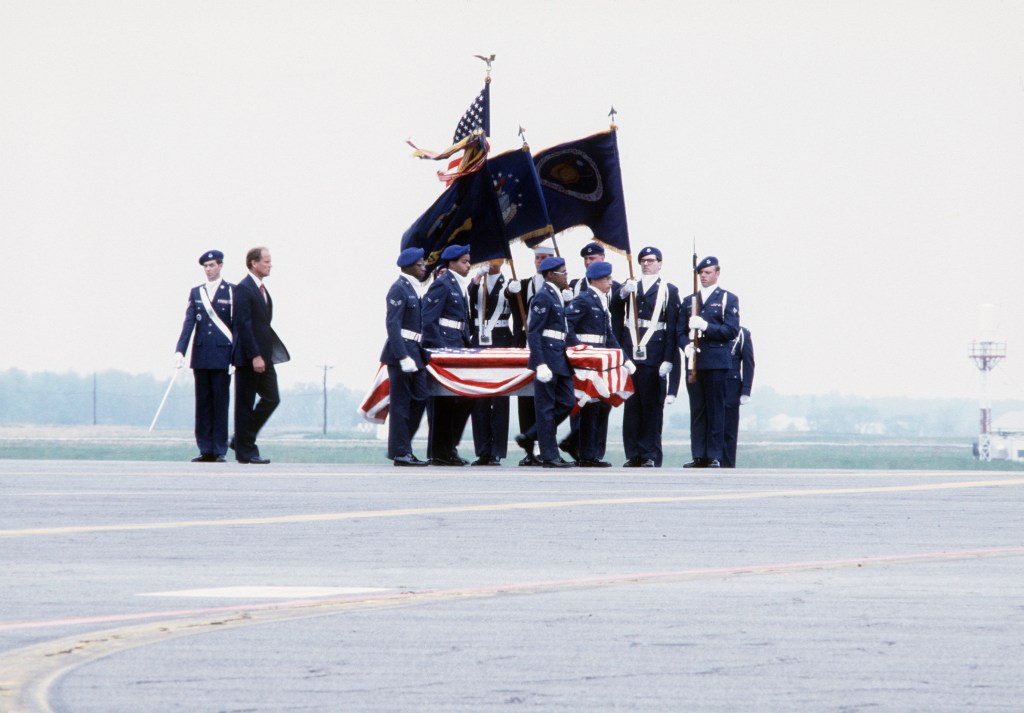
The Kremlin made urgent appeals to West Germany and Sweden for aid in handling a fire in a nuclear reactor core. Officials in Bonn and Stockholm reported the appeals amid signs that a reactor accident near Kiev that the Soviet Union acknowledged Monday was a major disaster, perhaps the worst in nuclear power history. The developments came as the Soviet Government issued its second official statement on the accident in the Chernobyl nuclear power station at Pripyat, saying that the “radiation situation has now been stabilized.” The four-paragraph statement disclosed for the first time that the accident at the four-reactor plant had occurred in the No. 4 reactor, which went into service in 1983, and that the three others were in operating order, but had been shut down. Each of the four reactors had an electrical generating capacity of 1,000 megawatts. At one point, according to Reuters, the Moscow radio referred to the accident as “a disaster,” but later dropped the word. United Press International quoted the radio as having said, “The disaster was the first one at a Soviet nuclear power plant in more than 30 years.” There was a nuclear accident in the Urals in 1957 that the Soviet Government has never acknowledged.
United States intelligence sources said today that the nuclear disaster in the Soviet Union started as long as four or five days ago and was continuing to spread radioactive material into the atmosphere. Most experts agreed that the graphite core of the Chernobyl reactor, at Pripyat in the Ukraine, had caught fire and was burning fiercely. Details of the accident remained scarce today, the day after the Russians announced that an accident had taken place at the reactor. Without such details, experts found it difficult to speculate about the short- and long-term dangers the disaster posed to health and the environment. But they faulted Soviet technology, which uses graphite, a form of carbon, to moderate nuclear reactions. In the United States, water is used as a moderator. They also said the stricken reactor was not encased in a protective concrete containment dome, as is customary in the United States. The external shell could cut down on the radioactive material spewed into the atmosphere. The experts warned that such graphite fires can be very difficult to extinguish, and that an unextinguished fire continues to release more radioactivity over the Soviet Union and other countries downwind of the reactor. “The graphite is burning and will continue to burn for a good number of days,” said Kenneth L. Adelman, the United States arms control administrator. He told Congress that, because the reactor is on a river, “there is concern over water contamination.”
American experts said yesterday that deaths and injuries from the reactor accident in the Soviet Union may continue to mount for several weeks in the vicinity of the disaster if severe radiation has been released. These experts on health and radiation said there appeared to be no danger for the Western Hemisphere and probably little in the Scandinavian countries, on the basis of what has been reported thus far. When the Soviet Union announced that two people had been killed in the accident at the Chernobyl power plant in the Ukraine, there was no indication if the cause of death was radiation, fire or other nonnuclear effects. There was an unconfirmed report from the area that many more may have died. If that report is confirmed, said Dr. Kenneth Mossman of Georgetown University Medical School, it would suggest extremely high levels of gamma radiation.
Two types of radiation exposure are likely to be involved in the damage at and near the reactor site. The first and most immediately dangerous is external gamma radiation, which is similar to X-rays and equally penetrating. Gamma radiation can damage cells, genes and vital tissues, such as the bone marrow and digestive tract. If radiation deaths are occurring, they are probably the result of severe gamma exposure. The other major hazard is beta radiation from radioactive forms of iodine and other elements that may enter the body through contaminated air, water, milk or solid food, and do damage internally. The effects could include immediate harm to the thyroid gland as well as cancers that may appear only decades afterward.
Swedish scientists said today that they were convinced that the radioactive core of a Soviet power-generating reactor melted after an accident at the weekend, making it the worst nuclear power plant disaster in history. They said their conclusion was based partly on discussions with Soviet experts, who sought advice from the Swedes today on handling the accident. In addition, the scientists said, their own analysis of atmospheric samples from Sweden’s east coast, more than 700 miles from the Chernobyl station in the Ukraine, supported the view that a meltdown had occurred at the plant.
The Soviet Government, never forthcoming about domestic disasters, has kept tight control on information about the accident at a nuclear station in the Ukraine. More than 36 hours after a still-unclear sequence of events that produced the accident at the Chernobyl plant, spreading radioactive debris as far as Scandinavia, Government information has consisted of two statements totaling less than 250 words. While reporting that there had been an accident that left a reactor damaged and two people dead, and forced the evacuation of four population centers, the statements have not explained what happened or how extensive the danger of contamination may be.
European officials today bitterly denounced Soviet delays in announcing the nuclear accident and reluctance to supply information to neighboring countries. Denmark’s Prime Minister, Poul Schlueter, said at a news conference that it was “quite unacceptable that the Soviet Union did not unhesitatingly inform other countries.” Officials said they expected the accident to spur already strong opposition to the use of nuclear energy in Europe. West German and Swedish officials reported today that the Soviet Union had made urgent appeals for technical advice and assistance in handling what were said to be uncontrolled graphite fires and the meltdown of the radioactive core at the Chernobyl nuclear power station. Officials here agreed that, based on available information, the accident was the worst nuclear-power disaster in history. The reported appeals came as officials in the United States and European countries declared their willingness to supply assistance if requested. Experts said the reported Soviet requests seemed to reveal critical shortcomings both in safety mechanisms and the know-how needed to deal with serious reactor accidents.
The United States formally offered humanitarian and technical assistance to the Soviet Union today to help it deal with the nuclear accident near Kiev. A State Department spokesman, Charles E. Redman, said the offer was extended by Rozanne L. Ridgway, Assistant Secretary of State for European and Canadian Affairs, in a meeting with Oleg M. Sokolov, the charge d’affaires of the Soviet Embassy. Mr. Redman said she also urged the Soviet Union to make available more information about the incident. The meeting preceded a Soviet Government statement that said two people had died and that the “radiation situation” had been “stabilized.” The White House decided overnight to set up an interagency task force headed by the Environmental Protection Agency to coordinate the American response to the disaster at the Chernobyl station.
Direct flights resumed between the Soviet Union and the United States. Pan American World Airways Flight 74, carrying 57 passengers, landed in Moscow, renewing service halted by the U.S. flag carrier in 1978 for financial reasons. In turn, an Aeroflot plane from Moscow arrived in Washington, ending an embargo imposed by the United States in December, 1981, to protest the imposition of martial law in Poland. President Reagan and Soviet leader Mikhail S. Gorbachev decided at last November’s Geneva summit meeting to renew commercial flights.
The United States will spend $1.8 million this year to rent apartments for 45 members of the United States mission, Michael E. Coughlin, the mission’s administrative officer, said today. Among the highest rentals is a three-bedroom apartment in the River Tower, a luxury high-rise at 420 East 54th Street where Herbert S. Okun, a deputy chief delegate, lives. The cost: $10,961 a month. Like the others who get Government-paid apartments, Mr. Okun contributes 5 percent of his salary for rent, which comes to less than $300 a month. The building, which one leading New York real estate agent describes as “one of the fanciest luxury towers in New York,” advertises “a wine cellar, direct-dialing to the concierge, valet, housekeeper, florist, vintner, fine restaurants, two levels of underground parking.” Three-bedroom apartments start at $4,300 a month. “It’s a function of the real estate market, not a function of luxury,” said Richard C. Hottelet, the mission’s chief spokesman. However, another member of the mission said of the apartment, “It’s a run-of-the mill apartment and the price just seems phenomenal.”
Prime Minister Kaare Willoch’s minority Government collapsed early today after losing a vote of confidence, 79 to 78, in Parliament. After a 13-hour debate in the 157-seat Parliament, the major opposition Labor Party and the Socialist Left Party joined with the tiny Progress Party against Mr. Willoch and his coalition Government. The 57-year-old Prime Minister said he would recommend King Olav V ask the main opposition leader, Gro Harlem Brundtland, 47, to form a new government. She leads the Labor Party and was toppled as Prime Minister by Mr. Willoch in 1981. His coalition was re-elected last September.
Israel captured a gang believed responsible for four shootings in Arab East Jerusalem in the last eight weeks. The suspects’ names were not published on court order, but police spokesman Rafi Levi said they are members of the Abu Moussa Palestinian faction. Security sources said six people have been arrested and that more arrests are expected. The suspects are accused of killing, among others, British tourist Paul Appleby. The disclosure threw doubt on the claim by the Abu Nidal group that it killed Appleby in reprisal for British support of the U.S. Libya attack. On Monday, the Abu Nidal organization in Beirut said its members were responsible for the killing of the British tourist.
Legislation to require five U.S. oil companies to stop doing business in Libya was introduced in the House by members who said that money from their operations is fueling “the murderous foreign policy” of Colonel Muammar Qaddafi. The five companies-Occidental Petroleum, Marathon Oil, W.R. Grace & Co., Conoco and Amerada Hess-pump about 100 million barrels of Libyan oil a year, producing about $2 billion in revenue.
Iraq said it bombed the Iranian city of Kermanshah, inflicting heavy losses before returning to base. Kermanshah, which Iran has renamed Bakhtaran, is 250 miles west of Tehran and 70 miles east of the Iraqi border. Iran, meanwhile, said that its forces killed or wounded 4,000 Iraqis on the southern front of the 52-year war. Iran said that several Iraqi army units were overrun in a one-mile advance.
Twenty-seven Tamil guerrillas were killed today in a battle between rival rebel groups in northern Jaffna district, Sri Lankan security sources said. They said the fighting started after two district leaders of the Liberation Tigers of Tamil Eelam were abducted by the rival Tamil Eelam Liberation Organization. The Liberation Tigers, the most powerful of the five main guerrilla groups fighting for an independent state for Sri Lanka’s minority Tamils, attacked and killed 26 members of the other group for the loss of one fighter, the sources said.
President Reagan arrives in Bali and welcomed by President Suharto. President Reagan arrived today on the Indonesian island on the first major stop of his trip to the Far East, but the occasion was marred, White House officials said, when the Indonesian Government detained two Australian journalists in the President’s party and barred them from the country. In a separate incident, Indonesian authorities detained and expelled Barbara Crossette, a correspondent for The New York Times who was seeking to report on the Reagan visit. Moments before Mr. Reagan was greeted at the island’s airport by President Suharto, the Indonesian leader, and colorfully clad Balinese dancers, Indonesian authorities removed the two Australians from the White House press plane.
The Government of Indonesia also detained and then expelled a correspondent for The New York Times who was seeking authorization to report on President Reagan’s visit. The correspondent, Barbara Crossette, who is based in Bangkok, Thailand, was taken into custody by the Indonesian immigration police and ordered to board a flight out of the country. Miss Crossette had been given permission to enter Indonesia on a two-month tourist visa and was told by American officials before her arrival there that she would be given a journalist’s visa, which Government regulations require of working reporters. The Indonesian authorities gave her no explanation for her deportation. She was refused permission to speak with American or Indonesian officials after her detention and was also prevented from returning to her hotel room to gather her belongings and notebooks.
Riot policemen in Seoul, South Korea fired tear gas to break up anti-Government and anti-American demonstrations on two Seoul university campuses today. Witnesses said about 500 policemen stormed the Presbyterian Yonsei University to disperse more than 1,000 students shouting “Down with military dictatorship!” and “Go away U.S. imperialists!” Nearly 1,000 students also demonstrated at Korea University, witnesses said. Meanwhile, the opposition moved to distance itself from violent student protests. A leading dissident, Kim Dae Jung, told reporters today that the opposition did not approve of the “radicalism and extremism of some militant students.” “On the other hand,” he said, “we have to warn the Government that all these undesirable events are happening because of the lack of democracy in our country.”
The U.S. State Department has given approval for a private anti-Communist organization to send a UH-1B Huey helicopter to help Nicaraguan rebels evacuate injured and sick from the war zones, Reagan Administration officials said today. Faced with an inability to secure funds from Congress quickly for helicopters and other military equipment, the Administration last week decided to grant a license so that the rebels, known as contras, will have the use of a large helicopter for the first time, officials said. The license was issued by the State Department last Friday to the United States Council for World Freedom, headed by the retired Maj. Gen. John K. Singlaub, which has Federal tax-exempt status, on the basis of a request submitted four days earlier, the officials said. Marta Wintering, a spokesman for the group, which is situated in Phoenix, confirmed that it had received permission and said the helicopter was on its way to Honduras.
Salvadoran Government and leftist rebel officials held talks on Saturday for the first time in more than a year, rebel and Government officials announced. Neither side was willing to give details of the unpublicized meeting, which took place in Lima, Peru. But it appeared to have been a low-key attempt to explore the possiblility of renewing negotiations to end the six-year civil war that has taken more than 50,000 lives in El Salvador. The indications here, however, are that there is little chance that the deadlocked talks will be reopened soon. The news of efforts to meet again comes at a moment of apparent shifts within the rebel front and cautious maneuvers by some members of the rebel alliance who have sent representatives to El Salvador to explore the prospects for political activity in San Salvador.
The Peruvian Government, campaigning to end police corruption, has dismissed the chief of the Republican Guard, its third biggest police force, and 10 of his subordinates. The police chief, General Julio Nins Rios, was ordered into early retirement three days after two kidnapping suspects escaped from the law court jails in central Lima, Deputy Interior Minister Agustin Mantilla said Monday night. The Republican Guard is primarily a prison guard force. The jailbreak last Friday involved payoffs, the Supreme Court president, Hector Beltran, said. The police opened an investigation of 10 of the dismissed subordinates and another 10 guarding the courts at the time of the escape for possible criminal responsibility.
Chilean guerrillas fighting the military Government set off 13 bombs today and shot and wounded four guards at an army officers’ housing development, the police reported. One of the bombs shattered a concrete wall at the United States Embassy compound. The incidents today, combined with the deaths of a policeman and three guerrilla suspects, made it the most violent two-day period in Chile this year. Chilean troops made dozens of arrests in Santiago after bombs struck at least 13 targets, including a wall near the residence of U.S. Ambassador Harry G. Barnes Jr. He was not injured in the blast, which cracked two windows. Suspected guerrillas also wounded four soldiers in a gun battle at a military housing complex in south Santiago. Residents of that slum district, La Legua, said soldiers surrounded the area and conducted searches after the shootings.
Angolan guerrilla leader Jonas Savimbi said U.S. aid has begun arriving for his forces, who are fighting Angola’s Marxist government. Savimbi said the aid includes trucks, uniforms and medicine and that it would help repulse an expected May offensive by government forces and their Cuban allies. He refused to say whether he has also received Stinger anti-aircraft missiles reportedly promised him when he visited President Reagan in February.
Five South African army troop carriers were involved in a chain collision today, injuring 15 soldiers, the army information office said. Three soldiers were taken by helicopter to a Johannesburg hospital from the accident site in Roodeport, about 15 miles to the west. The others were treated and released.
New and unpublished test results show that a failure of a safety seal on the space shuttle Challenger was virtually inevitable because of a combination of cold weather on the morning of the launching and serious design flaws. The test results, conducted for the Presidential panel studying the accident and summarized for The New York Times, also determined that the joint would sometimes begin to fail at temperatures as high as 50 degrees Fahrenheit. In the past, officials of the National Aeronautics and Space Administration have testified that they felt confident the shuttle could be launched at far lower temperatures without undue risk to the crew. The Challenger was launched January 28 in 36-degree weather, but investigators estimate that the temperature of the joint that contained the failed seal was about 28 degrees, a temperature at which failure is more likely than not, the tests show. The analysis of the accident, in which the seven crew members died, is expected to serve as the centerpiece of the Presidential commission’s report, due in early June. On Monday panel members received a summary of the results, based on tests conducted in recent weeks primarily by NASA engineers and outside aerospace experts working for the commission’s working group analyzing data and design.
House Democrats have a budget plan that would cut military and domestic programs equally and would provide no “significant new revenues,” according to Representative Jim Wright of Texas, the Democratic leader. He said the House would not wait indefinitely for action in the Senate, which has been fitfully debating a budget plan.
The Pentagon has dismissed a senior official who was charged with providing secret information for a newspaper article on an American covert intelligence operation, according to Government officials. They said the action was taken against Michael E. Pillsbury, Assistant Under Secretary for policy planning, who they said had failed to pass a polygraph, or lie detector, test about published reports that Stinger missiles were being supplied to insurgents in Afghanistan and Angola.
The House approved a four-year extension of the Head Start program, launched at President Lyndon B. Johnson’s urging in the 1960s to help the children of poor families. The bill to continue Head Start and related programs was approved on a 377–33 vote and sent to the Senate. The preschool Head Start program is intended to help children of low-income families develop skills that enable them to enter school on an even footing with other children. The program now serves about 452,000 children and operates on a $1.2-billion budget.
A Russian emigre testified today that her lover, Richard W. Miller, then an agent of the Federal Bureau of Investigation, told her he was playing “a political game” and wanted the Russians to think he was working for them. At Mr. Miller’s espionage trial, the witness, Svetlana Ogorodnikov, who last week retracted a confession that she and Mr. Miller had spied on the United States, gave her most extensive testimony about their relationship. “I told him I couldn’t understand why F.B.I. wanted to meet with Russians,” she said, recalling that he had pressed her constantly to introduce him to Soviet officials. “He answered me that’s a political game that I would not understand anyway.” Mr. Miller, the first F.B.I. agent to be charged with espionage, was later dismissed from the bureau. He is accused of giving Mrs. Ogorodnikov classified documents for the Soviet Union in exchange for promises of $65,000 in gold and cash.
John A. Walker Jr., confessed leader of a Soviet spy ring, testified today that he attempted to recruit family members into espionage because he was a “good-hearted guy” seeking to help his relatives “out of the pits.” Testifying at the espionage trial of his former Navy colleague, Jerry A. Whitworth, Mr. Walker offered the first detailed explanation of his decision to bring family members into an operation that supplied military secrets to the Soviet Union. Mr. Whitworth, a retired Navy radioman who had top-secret security clearance in his military career, has pleaded not guilty. Mr. Walker, the Government’s star witness at the trial, said in his second day of testimony in Federal District Court that Soviet agents were highly impressed with the communications secrets provided by Mr. Whitworth.
Members of two Congressional subcommittees today expressed concern that the Department of Agriculture had placed the public and the environment at risk by failing to oversee field-testing in the development of genetically altered products. The lawmakers voiced their fears after learning that almost two years ago scientists in Texas inoculated 1,350 pigs on a farm in Lometa with a genetically engineered virus without the prior approval of any scientific committee sanctioned by the Government to review research on gene-altered organisms. Two major Texas universities today completed investigations of the matter and one, Texas A&M University, concluded that the researchers had violated Federal guidelines for releasing living gene-altered agents into the environment. The Baylor College of Medicine is expected to announce its findings Wednesday. An official with the National Institutes of Health, which oversees genetic engineering research at universities, said the agency was likely to conduct its own investigation of the 1984 field test.
Differences over acid rain again divide the White House and Congress. High officials in the Reagan Administration today emphatically opposed legislation to control acid rain that was recently introduced in the House with broad bipartisan support. Both Lee M. Thomas, Administrator of the Environmental Protection Agency, and John S. Herrington, Secretary of Energy, told a House subcommittee that the cost of the proposed legislation would be too high in view of what they said were the continuing uncertainties about the causes and effects of acid rain and of any program to control it. In view of the apparent economic and social costs of the legislation, Mr. Thomas said, “the Administration would strongly oppose its passage.”
A year ago this month, with the price of oil about $28 a barrel, a small independent oil company in the oil-rich Permian Basin of West Texas started selling interests in a limited partnership to drill high-risk wells. Today, with West Texas crude fetching less than half what it did then, the 114 investors around the country who put up a total of $2.1 million have reason to worry about their money. And the company, the Spectrum 7 Energy Corporation of Midland, like hundreds of other comparatively new oil companies in the Southwest, is facing a struggle to survive. The chairman of Spectrum 7 is 40-year-old George W. Bush, eldest son of the Vice President of the United States. About 575 miles to the north, in Denver, another oil company that operates out of a modest downtown office with only two partners and a secretary is also struggling against plunging world oil prices. It is the J.N.B. Exploration Company, and its financial managing partner is Neil M. Bush, the 31-year-old son of the Vice President.
The Administration’s plan to sell Conrail to Norfolk Southern Corp. for $1.2 billion is “mired in a hopeless swamp” and must be abandoned in the public interest, the chairman of the House Energy and Commerce Committee demanded. Rep. John D. Dingell (D-Michigan) ripped into the proposal after weeks of study, issuing a surprise statement that called for a new transaction to preserve the government-owned freight rail carrier as an independent entity.
Exactly three years after he became Mayor of Chicago, Harold Washington today won what he called “a working majority” in the City Council. Two Council candidates who were supported by Mr. Washington in today’s runoff elections defeated their opponents, meaning that alderman loyal to him now hold 25 of the Council’s 50 seats. The opposition now also has 25, down from 29. In case of ties, the Mayor could cast the deciding vote.
A new survey found that teachers earn more than other people with comparable education, and that they are highly satisfied as a group. The findings, released by the National Center for Education Information, incensed the National Education Association, but Secretary of Education William J. Bennett praised the report. It said that teachers earn an average of $136 a day, while people with equal education in other fields average $129 a day. Because most other occupations involve working 250 days a year, however, the average nonteacher’s salary is more than $32,000 annually, compared with almost $25,000 for teachers, who usually work 180 days a year.
Cards and letters poured into the U.S. Bankruptcy Court in Richmond, Virginia, from women trying to beat today’s deadline for submitting claims that they were injured by the Dalkon Shield contraceptive made by A.H. Robins. About 300,000 claims relating to the IUD are expected to be filed with the court, which is receiving about 10,000 notices daily. Before a litigation crunch forced the pharmaceutical giant to seek Chapter 11 bankruptcy reorganization, Robins or its insurers had paid $378 million to settle 9,230 claims.
A precious metals dealer charged with operating a tax shelter scheme was sentenced in Miami to 62 years in prison, the longest sentence ever for such a crime, according to the Internal Revenue Service. William T. Irwin, 53, also must pay a $67,000 fine. According to testimony and documents presented during the trial, Irwin concocted a fraudulent tax shelter scheme by which investors were swindled out of more than $7 million. The government also charged the investors fraudulently deducted about $42 million as part of the tax shelter scheme.
A voluntary muster of inactive Army reservists early this year uncovered problems that provide fresh evidence of the need for mandatory annual call-ups to improve readiness, a top Pentagon spokesman said. The musters, conducted in January in 13 cities, highlighted problems with the medical fitness of inactive reservists and the lack of current addresses of the men and women, the spokesman said.
A federal judge in New York sentenced a self-styled revolutionary to 45 years in prison for bombing buildings as a member of the underground United Freedom Front, which opposes apartheid and U.S. policy in Central America. U.S. District Judge Leo Glasser ordered Ray Luc Levasseur, 38, to serve 40 consecutive years for four bombings and one attempted bombing and five more years for his role in the conspiracy.
Methodist opposition to nuclear arms was reflected in a pastoral letter approved by their bishops. The Council of Bishops of the United Methodist Church, the third-largest church in the country, voted unanimously to declare their opposition to any use of nuclear arms.
A university laboratory technician in Pullman, Washington who collapsed after taking two Extra-Strength Tylenol capsules died of cyanide poisoning, a coroner said today. Detectives said they have not ruled out the possibility that the technician, Sandie Lynn Gregory, 21 years old, committed suicide Sunday. They noted that she had had access to cyanide at the veterinarian laboratory at Washington State University where she had worked. The authorities advised residents of the Palouse area of southeastern Washington not to take Tylenol capsules, which were withdrawn from the market in February after a New York woman died after taking capsules laced with cyanide. Police Chief Ted Weatherly said some people might have kept capsules purchased before the withdrawal. Sgt. Don Witt of the police said the young woman moved here from San Diego in January and was known to be depressed.
The United States Patent and Trademark Office has decided to allow formal proceedings to determine whether French or American scientists were the first to invent the AIDS antibody test, spokesmen for the French researchers reported yesterday. However, American officials said they were unable to confirm the report. The test is widely used by American blood banks to screen out contaminated blood and sometimes by doctors as an aid in diagnosing acquired immune deficiency syndrome.
Ryan White is sometimes “pretty scared. Sometimes I just sit with mom and we talk.” The 14-year-old AIDS victim, who was interviewed on ABC’s Good Morning America, was also scheduled to attend a star-studded AIDS fund-raiser hosted by designer Calvin Klein and Elizabeth Taylor. Since his return April 10 to his seventh-grade classes, Ryan said, pupils have “treated me really good. They treated me just like anybody else.” Ryan resumed studies at Western Middle School near Kokomo, Indiana, after a judge dissolved an injunction that kept him from class. The injunction was obtained by parents who were afraid their children might contract acquired immune deficiency syndrome from Ryan. Ryan contracted AIDS, which destroys the immune system, through a blood transfusion during treatment for his hemophilia. Experts say it cannot be transmitted by casual contact. Jeanne White said that when Ryan first was diagnosed in December, 1984, “I thought the same thing these parents thought. You know it’s fatal; it’s scary. But the medical profession has reassured me and my daughter that we don’t have anything to worry about, and I don’t worry any more at all.” Said Mrs. White about her son: “He doesn’t give up. He has been through a lot of painful things, but he always keeps smiling and just keeps charging through.”
800,000 books are destroyed by fire in Los Angeles Central Library. More than 250 firefighters battled a stubborn, smoky fire that swept through the Central Los Angeles Library today, injuring 22 firefighters and destroying thousands of books in the downtown landmark building. Neither Mayor Tom Bradley nor Fire Chief Donald Manning could say what caused the fire, which broke out shortly before 11 A.M. in the book stacks. It was declared under control six hours later, after 49 fire companies from across the city fought the blaze. The 60-year-old library, which had 2.3 million volumes, was listed on the National Register of Historic Places and was declared a historic cultural monument by the Los Angeles Cultural Heritage Board in 1967.
1986 NFL Draft: Auburn running back Bo Jackson is the first pick, by the Tampa Bay Buccaneers.
Major League Baseball:
In the aftermath of a 10–5 New York Mets win over the Atlanta Braves, the players gorged on postgame hamburgers, watched television, swigged beer. When they spoke, it was with a keen sense that everything would happen as it did: timely pitching, clutch hitting, another victory. “We felt we would come back and win, and we did,” said Darryl Strawberry. “That’s the way our offense thinks.” It was Strawberry’s towering three-run homer in the sixth inning that brought the Mets back. And the bullpen — Bruce Berenyi, Terry Leach, Roger McDowell — combined to throw five and one-third innings of shutout ball, allowing just one hit, and keep them marching forward. The Braves suffered a more significant loss in the third inning when Dale Murphy, their center fielder, suffered a cut on the palm of his right hand making a catch of a Keith Hernandez fly ball at the fence. Murphy left the game and later took nine stitches to close the wound. He is expected to be out at least one week. The Mets, owning baseball’s best record at 12–3, are within one victory of tying the club record for consecutive wins set in 1969 and tied in 1972.
Twenty-three-year-old Red Sox pitcher Roger Clemens strikes out 20 batters in a 3–1 win over Seattle, breaking the Major League record of 19 shared by Nolan Ryan, Steve Carlton, and Tom Seaver. Clemens doesn’t walk a batter, allows just 3 hits, and ties the American League record (Ryan and Davis) with 8 consecutive strikeouts in the middle innings. Clemens, a right-hander, broke the nine-inning record of 19 strikeouts set by Steve Carlton for the St. Louis Cardinals in 1969, and equaled by Tom Seaver for the Mets in 1970 and Nolan Ryan for the California Angels in 1974. Tom Cheney of the Washington Senators struck out 21 batters in 16 innings against Baltimore in 1962. “I was trying to keep it close, trying to battle a guy that’s throwing a good game against us,” Clemens said, referring to Mike Moore, the Mariners’ pitcher. “The strikeouts just kept on coming. I knew something was happening because of the way the fans were reacting.”
Cal Ripken’s two-run homer following Lee Lacy’s two-run double in the seventh inning boosted Baltimore to an 8–1 triumph over the Chicago White Sox. McGregor, 2–2, limited the White Sox to four hits. He did not allow a runner to reach third base, struck out four and walked none. He retired 11 consecutive batters at one stretch starting with one out in third inning.
Reds pitcher Mario Soto ties the Major League record by surrendering home runs to Andre Dawson, Hubie Brooks, Tim Wallach, and Mike Fitzgerald in the 4th inning of a loss to the Expos. Andre Dawson’s sixth home run launched a four-homer barrage in the fourth inning against the Reds’ Mario Soto that lifted Montreal to a 7–4 win in Cincinnati. Dawson, Hubie Brooks and Tim Wallach hit solo homers to mount the long-ball assault, and Mike Fitzgerald’s two-run homer completed the binge that tied the Montreal club record for homers in an inning. Fitzgerald also had an RBI single for Montreal’s sixth run in the fifth. Soto, 2–2, became the 11th pitcher in baseball history to surrender four homers in an inning and the first in the majors since Milwaukee’s Mike Caldwell gave up four in 1980. The last National Leaguer was Benjamin Wade, pitching for Brooklyn in 1954.
Mike Laga’s seventh-inning home run was the difference in a pitcher’s duel between Detroit’s Frank Tanana and Dennis Leonard of Kansas City, lifting the Tigers past the Royals, 2–1. Laga’s two-out bases-empty homer — his third of the season — into the second deck in right field was only the second hit off Leonard, 2–2. Leonard set down 17 consecutive Tigers after walking Laga to start the Detroit second. It was the only walk by Leonard, who struck out three over eight innings.
The Los Angeles Dodgers edged the Pittsburgh Pirates, 5–4. Pinch-hitter Cesar Cedeno tripled home the tiebreaking run and then scored on Dave Anderson’s single in the sixth inning. With the score tied 3–3, Mike Scioscia singled with one out in the sixth off reliever Bob Patterson, 0–1. Cedeno, hitting for the slumping Franklin Stubbs, followed with a sinking line drive to center field.
Billy Jo Robidoux’s bases-loaded single off Oakland reliever Jay Howell with none out in the bottom of the ninth inning lifted Milwaukee over Oakland, 5–4. With the score tied 4–4 in the ninth the Brewers loaded the bases off Howell, 0–2, on a single by Ernest Riles, a double by Cecil Cooper and an intentional walk to Robin Yount. With the outfield playing shallow, Robidoux then lined a shot to center field to score Riles with the winning run. Bob McClure, 2–0, was the winner.
In a hit parade in the Bronx, the New York Yankees downed the Minnesota Twins, 14–11, connecting for three homers. Rickey Henderson has a single, double and home run to drive in 4 runs for the Yankees, while Billy Beane is Money for the Twins in his 4th game with them, collecting 5 hits and driving in 4 runs. Billy will collect his next five hits over the next three months. The latest Yankee Stadium ritual received its first serious test and worked — at least for a while. The ritual involves the Yankee fans chanting, “Eddie, Eddie, Eddie,” when Ed Whitson pitches. They chanted frequently last night, and Whitson responded by pitching three good innings in relief of Ron Guidry, who was battered by the Twins for six runs and 10 hits, including two home runs and three doubles, in five innings. Whitson weakened in the ninth, giving up a three-run home run to Billy Beane, the former Mets’ minor leaguer, who had five hits. But the Yankees’ big inning, which was climaxed by Rickey Henderson’s three-run home run, was enough to get the beleaguered pitcher the victory.
The Phillies crushed the Houston Astros, 12–4, as Mike Schmidt’s three-run homer and a two-run shot by Luis Aguayo highlighted a six-run first inning. Shane Rawley, who went 6 ⅓ innings and was tagged for 12 hits, gained his third victory against one loss. Loser Nolan Ryan, 3–3, lasted only one inning. Kent Tekulve pitched the final 2 ⅔ innings for the Phillies. Milt Thompson opened the first inning with a walk and stole second. After Rick Schu walked, Thompson moved to third on a wild pitch and scored on Von Hayes’ grounder. Schmidt followed with his fifth homer of the season, a towering blast to left field. After Darren Daulton walked, Aguayo hit a 3–2 pitch for his first home run of the year.
The Padres nipped the Cubs, 5–4, as Terry Kennedy slammed a three-run homer with one out in the bottom of the ninth inning. Kennedy drove a 2–1 pitch off reliever Ray Fontenot into the right field bleachers to cap a four-run Padres rally in the final inning. The game-winning hit was Kennedy’s second homer of the year. Rick Sutcliffe took a three-hitter and a 4-1 lead into the ninth, but he was replaced by Fontenot with one out after Marvell Wynne and Steve Garvey singled. Pinch-hitter Jerry Royster singled in a run off Fontenot before Kennedy’s game-winner.
Manager Roger Craig went to the San Francisco Giants’ bullpen early Tuesday night, giving Mike LaCoss his first major-league start in two years, and he was rewarded with 7 ⅓ innings of three-hit, shutout pitching. Greg Minton finished off the 2–0 shutout victory over the St. Louis Cardinals with perfect pitching in relief of LaCoss, who was doing relief pitching himself as recently as Sunday. LaCoss left the game very reluctantly. “He told me before the game that I shouldn’t ask him how he felt because he wasn’t going to tell me. I asked him anyway after the seventh inning, and he just walked away from me.” Craig said.
Julio Franco doubled home Andy Allanson in the ninth inning as Cleveland rallied from a three-run deficit in the final two innings to beat the Rangers, 6–5. Indians reliever Jim Kern, 1–1, pitched 1 ⅔ innings and got relief help from Ernie Camacho, who earned his fifth save. Greg Harris, 2–3, allowed five hits and four runs in 2 ⅓ innings. The Indians tied the game in the eighth when Mel Hall hitting for Carmen Castillo, hit a two-out three-run home run to right field.
Rick Burleson raced home from second on a fielder’s choice ground out in the ninth inning to give California a 4–3 victory over the Blue Jays. With one out, Burleson singled to center and moved to second when Ruppert Jones was awarded first base after being interfered with by Toronto catcher Jeff Hearron. Wally Joyner then bounced into what appeared to be an inning-ending double play, but was ruled safe at first after pitcher Mark Eichhorn had taken the relay throw. While Eichhorn, 2–1, stared in disbelief at umpire Al Clark, Burleson raced home and Eichhorn’s late throw sailed over Hearron’s head.
New York Mets 10, Atlanta Braves 5
Seattle Mariners 1, Boston Red Sox 3
Baltimore Orioles 8, Chicago White Sox 1
Montreal Expos 7, Cincinnati Reds 4
Kansas City Royals 1, Detroit Tigers 2
Pittsburgh Pirates 4, Los Angeles Dodgers 5
Oakland Athletics 4, Milwaukee Brewers 5
Minnesota Twins 11, New York Yankees 14
Houston Astros 4, Philadelphia Phillies 12
Chicago Cubs 4, San Diego Padres 5
St. Louis Cardinals 0, San Francisco Giants 2
Cleveland Indians 6, Texas Rangers 5
California Angels 4, Toronto Blue Jays 3
After remaining in a holding pattern for several sessions, stock prices fell sharply yesterday. The decline was attributed to a variety of factors, ranging from the nuclear accident in the Soviet Union to the price of stock index futures. The nuclear plant accident near Kiev caused investors to shun electric utilities, like Long Island Lighting. But it gave a boost to certain agriculture stocks.
Dow Jones Industrial Average: 1825.89 (-17.86)
Born:
Brandon Dubinsky, NHL centre (New York Rangers, Columbus Blue Jackets), in Anchorage, Alaska.
Amy Heidemann (Noonan), American rapper, and singer-songwriter (Karmin — “Brokenhearted”; Qveen Herby), in Seward, Nebraska.
Died:
Séamus McElwaine, 25, Irish IRA volunteer, killed by British special forces during “The Troubles.”

