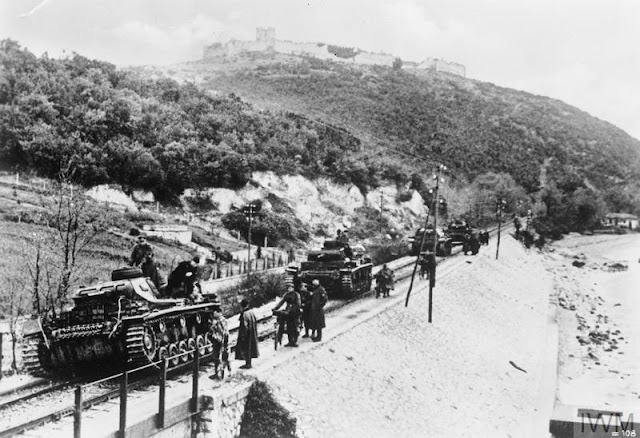
Hitler issued Directive No. 28, Invasion of Crete, to be codenamed Operation MERKUR.
The Führer and Supreme Commander of the Armed Forces
Führer Headquarters, 25th April 1941.
10 copies
Directive No. 28
Operation MERKUR (“Mercury”)
As a base for air warfare against Great Britain in the Eastern Mediterranean we must prepare to occupy the island of Crete (Operation MERKUR). For the purpose of planning, it will be assumed that the whole Greek mainland including the Peloponnese is in the hands of the Axis Powers.
Command of this operation is entrusted to Commander-in-Chief Air Force who will employ for the purpose, primarily, the airborne forces and the air forces stationed in the Mediterranean area.
The Army, in co-operation with Commander-in-Chief Air Force, will make available in Greece suitable reinforcements for the airborne troops, including a mixed armored detachment, which can be moved to Crete by sea.
The Navy will take steps to ensure sea communications, which must be secured as soon as the occupation of the island begins. For protection of these communications and, as far as is necessary, for the provision of troopships, Commander-in-Chief Navy will make the necessary arrangements with the Italian Navy.
All means will be employed to move the airborne troops and 22nd Division, which is under the command of Commander-in-Chief Air Force, to the assembly area which he will designate. The necessary space for freight lorries will be put at the disposal of the Chief of Armed Forces Transport by the High Commands of the Army and Air Force. These transport movements must not entail any delay in the mounting of Operation BARBAROSSA.
For anti-aircraft protection in Greece and Crete, Commander-in-Chief Air Force may bring up anti-aircraft units of 12th Army. Commander-in-Chief Air Force and Commander-in-Chief Army will make the necessary arrangements for their relief and replacement.
After the occupation of the island, all or part of the airborne forces must be made ready for new tasks. Arrangements will therefore be made for their replacement by Army units.
In preparing coastal defenses Commander-in-Chief Navy may if necessary draw upon guns captured by the Army.
I request Commanders-in-Chief to inform me of their plans and Commander-in-Chief Air Force to inform me when his preparations will be completed. The order for the execution of the operation will be given by me only.
[signed] Adolf Hitler
Today, 25 April 1941, is Anzac Day, and it marks another failed expedition in the Mediterranean. Allied troops ride south through Athens, having covered 100 miles in 12 hours. The British evacuation from mainland Greece, Operation DEMON, switches into high gear today. Transports from several Greek ports take thousands of British and Commonwealth soldiers to Crete and Egypt. Some 10,200 troops depart through the ports of Nafplio and Megara.
Troopships Thurland Castle and Pennland (once White Star Liner Pittsburgh) depart from Megara, escorted by anti-aircraft cruiser HMS Coventry and several destroyers. The 16,322-ton Red Star Liner Pennland is attacked by the Luftwaffe and badly damaged near San Giorgio Island. There are four deaths, while roughly 350 men are taken off by escorting destroyer Griffin. The Griffin then scuttles Pennland. Thurland Castle also is damaged. Australian destroyers HMAS Waterhen and Vendetta also take off troops. The Luftwaffe bombs and sinks Royal Navy troopship Pittsburgh in the Gulf of Athens, while troopship Ulster Prince sinks in the Aegean.
Out at sea, German aircraft sank 6 merchant ships and 1 yacht; 6 Greek destroyers and 5 submarines were able to escape toward Alexandria, Egypt.
The Battle of Thermopylae ended in German victory, although the Allies fought a successful delaying action. The Pass of Thermopylae is completely in German hands after a bitter battle of nearly two days, it was announced officially tonight, and informed Germans hinted at a strategic plan for triumphal Nazi entry into an unresisting Athens. Athens, said one spokesman, is “a ripe apple,” ready for the Germans to pluck, and it was understood here both army and air force have the strictest of orders to refrain from bombardment of the capital.
Allied rearguard forces from Thermopylae, Greece traveled 100 miles within 12 hours and reached the Greek capital of Athens around noon time; while crowds welcomed their arrival, diplomats of various countries burned papers as Axis capture was imminent.
Far to the west, the 1st SS Panzer Division Leibstandarte SS Adolf Hitler (LSSAH, still of brigade-size) races southward toward the Gulf of Patras. The battle in the west has become a race to the ports of the Peloponnesos which the British are using for Operation Demon (also ports in east Attica). The LSSAH moves along the western foothills of the Pindus Mountains, moving from Arta to Missolonghi. British Commonwealth troops are on the way to the Peloponnesos as well. The Germans drop Fallschirmjäger (paratroopers) to seize bridges over the Corinth Canal so that the following Wehrmacht ground troops can use them to continue their pursuit, but British artillery destroys the bridge. This places additional pressure on the LSSAH advance toward Patras.
The RAF has been in retreat for the past week, and today it leaves the mainland entirely. Air Commodore John D’Albiac establishes new headquarters on Crete at Heraklion. King George II of Greece also establishes new headquarters on Crete along with the rest of his government.
King George II and his government left the Greek mainland for Crete.
Some 10,200 Australian troops were evacuated from Nauplion and Megara.
Athens Radio made the following announcement: “You are listening to the voice of Greece. Greeks, stand firm, proud, and dignified. You must prove yourselves worthy of your history. The valor and victory of our army has already been recognized. The righteousness of our cause will also be recognized. We did our duty honestly. Friends! Have Greece in your hearts, live inspired with the fire of her latest triumph and the glory of our army. Greece will live again and will be great, because she fought honestly for a just cause and for freedom. Brothers! Have courage and patience. Be stouthearted. We will overcome these hardships. Greeks! With Greece in your minds you must be proud and dignified. We have been an honest nation and brave soldiers.”
The British submarine HMS Usk was lost in the Mediterranean, probably to a naval mine, on or sometime after this date.
Luftwaffe General Gerhard is made air commander of a force of transport aircraft which is to include 493 Ju 52/3ms and over 80 DFS 230 gliders.
An indication that the Germans were considering Crete, Greece as a target for major parachute assault was discovered by the code-breakers at the Government Code and Cypher School at Bletchley Park in Britain through an interception of the German Luftwaffe’s lax cypher discipline. The British codebreakers at Bletchley Park in Operation Ultra learn about the German plans for Operation HERCULES, the airborne assault on Crete, from Luftwaffe transmissions. Of the three German services, the Luftwaffe is the newest and has the worst security in its radio transmissions. Throughout the war, Luftwaffe intercepts are a major source of British intelligence information, and that includes switching around evacuation beaches in Greece.
The Axis offensive on the Libyan-Egyptian border resumed despite the lack of progress at Tobruk, Libya; German troops engaged British patrols near Fort Capuzzo. The 2 remaining Hurricane fighters in Tobruk were withdrawn to Egypt to join the mere 13 Hurricane fighters there, leaving Tobruk with only Lysander aircraft to perform artillery spotting duties and no aircraft capable of air defense. Out at sea, British submarine HMS Upholder sank Italian ship Antonietta Lauro off the Tunisian island of Kerkenah.
The Germans need some breathing room around Tobruk, and the British are determined not to let them have it. The Allies launch attacks all along the Tobruk perimeter that are repulsed, including one in the south at 03:00, a tank sortie at 12:30, an attack against the Italian Brescia Division at 15:15, and another attack in the south at 22:30. British artillery is proving to be quite effective, directed at times by an artillery spotter Lysander plane and outranges some of the Italian artillery.
The Luftwaffe attacks British armor south of Capuzzo, destroying some armored cars. At noon, Gruppe Herff attacks southeast of Capuzzo to try to give the southern German forces more of a cushion between the two Allied lines. The Germans make some progress through Halfaya Pass to Buq Buq at the cost of 7 dead and 10 wounded. British Middle East Commander General Archibald Wavell later claims that he allows his forces to withdraw in hopes of inducing the Afrika Korps to become over-extended.
Wavell admits to Churchill that the decision to let the Armoured Division withdraw gradually from Rommel so as to maintain force until the enemy had been stretched too far and then counterattack, was a mistake. The 3rd Armoured Brigade melted away through mechanical and administrative breakdowns, without much fighting. 2nd Armoured Division’s unpractised HQ lost control. This was partly due to inexperience of signal personnel.
Lieutenant General Erwin Rommel has been intending to launch a push all along the Tobruk perimeter. However, the “bad experience of the last days” with Italian troops (some recently have surrendered) forces the Germans to focus their attacks using the 5th Light Division and the 15th Panzer Division. The Luftwaffe Fliegerkorps X in Naples is ordered by Reichsmarschall Hermann Göring’s headquarters to use air transport to bring 15th Panzer units from Naples to Derna.
The German 8th Panzer Regiment departed Italy in three convoys for North Africa.
Hitler telephones Foreign Minister Ribbentrop and has him come to his command train Amerika near Graz, Austria. Ribbentrop later recalls:
“He said that all the military Intelligence reaching him confirmed that the Soviet Union was preparing in a big way along the entire front from the Baltic to the Black Sea. He was not willing to be taken by surprise once he had recognized a danger. Moscow’s pact with the Serbian putschist government was a downright provocation to Germany and a clear departure from the German-Russian treaty of friendship. In this conversation I recommended that he listen first to our ambassador [to Moscow], Count [Werner von der] Schulenburg…. I wanted to try a diplomatic settlement with Moscow first. But Hitler refused any such attempt and forbade me to discuss the matter with anybody; no amount of diplomacy could change the Russian attitude, as he now recognized it, but it might cheat him of the important tactical element of surprise when he attacked. He requested me to put on a show of complete support for his view, and explained that one day the West would understand why he had rejected the Soviet demands and attacked the East.”
Hitler also talks to one of his aides, Colonel Walter Scherff, asking him, “What can you, a war historian, tell me about preventative wars?” Scherff recalls later that he tells Hitler:
“Only somebody with the deepest sense of responsibility can take such a decision, and then only after looking at it from every possible angle. Because he will be risking immense dangers in starting such a war.”
Scherff recalls that Hitler states:
“Britain will just have to climb down, once we have defeated her last ally on the continent. If she does not, we shall destroy her, with all the means that we shall have when all Europe as far as the Urals is at our feet.”
These sentiments echo those expressed by Hungarian leader Admiral Horthy during his visit on the 24th — that defeating the Soviet Union is the way to defeat Great Britain and end the war in the West.
The Germans inform General Heinrichs of the Finnish high command about Operation BARBAROSSA.
Hitler has instructed Konteradmiral Karl Dönitz to avoid all provocations with the U.S. Navy. Doenitz duly communicates this to his subordinates today.
Churchill visits Liverpool to see bomb damage.
There are reports of 2500 German troops prowling the streets of Madrid posing as tourists. This has been a precursor to some German invasions. It’s a false alarm.
The German government has been critical of alcohol abuse, so German brewers consider making “light beer.” The government also is critical of tobacco use, not for health reasons, but for its effect on morale and discipline.
Germany and Italy undertake to give financial and military aid to Rashid Ali in Iraq. The Germans are bemused by the situation in Iraq. The Germans and Italy agree to provide financial assistance to Iraq’s pro-Axis Rashid Ali government but have no other way of assisting them. The Iraqis have assembled troops around the British enclaves such as Habbaniyah airfield and the port of Basra, but show no signs of attacking. The British have occupied Mosul airfield and taken up defensive positions there.
Reuters News Agency reports from Basra, Iraq: “Strong British and Imperial troops have arrived in the area of the Mosul airfields and, with the consent of Iraqi military authorities, have occupied positions of strategic importance. Precautions have been taken against possible military surprise raids, and both land and aerial forces have been considerably strengthened. British troop movements are still continuing.”
German armed merchant cruiser Pinguin attacked British ship Empire Light, stopping the ship. After the 70 crew members were taken off, Pinguin scuttled Empire Light.
The Luftwaffe raids Sunderland with 57 bombers.
British Prime Minister Winston Churchill visited Liverpool to view the damage done by recent Luftwaffe raids.
James Lacey, flying a Spitfire fighter, damaged a German Fw 190 aircraft.
RAF Bomber Command: Day of 25 April 1941
27 Blenheims on sweeps of German and Danish coasts. Several attacks were made and at least 2 ships were hit. 1 aircraft lost.
RAF Bomber Command: Night of 25/26 April 1941
Kiel
62 aircraft — 38 Wellingtons, 14 Whitleys, 10 Hampdens. 1 Wellington lost. Kiel reports a scattered raid; places hit are listed: private housing, an old folks’ home, a coal-yard, a Catholic church, a mental home. 7 people were killed, all at one place, and 8 were injured.
Minor Operations: 5 aircraft to Bremerhaven, 4 each to Emden and Rotterdam, 3 to Berlin; 7 Hampdens minelaying off Aalborg, Denmark, and in the East Frisians. No losses.
Visiting Australian Prime Minister Robert Menzies — who plans on returning to Australia in about a week — visits air raid shelters at King’s Cross and Old Street. He writes in his diary:
“Indescribably pathetic. Malodorous, or rather stuffy. Bunks of wire arranged in tiers of 2 or 3 along the platforms and in the recesses. Canteen arranged. Little children staggering in beneath bundles of bed-clothes. Old women & men, going down to their nightly burial, for this happens every night, and not just when the alert blows. These people are “deep shelter conscious.” They are drab, dreary, and look infinitely sad — standing in the queues for their places, for which they have tickets. Squatting on the metal treads of narrow stairs, there to hunch up asleep all night. Stretched out in a bunk, with electric trains swishing and roaring past every few minutes.”
The RAF bombs Derna airfield and town. The last two remaining Hurricanes operating out of Tobruk fly out to Alexandria, where there are only 13 Hurricane fighters. The only RAF plane remaining in Tobruk is a Lysander for artillery spotting.
The Luftwaffe builds a new runway at Comiso, Sicily.
Destroyer HMS Brocklesby departed Scapa Flow at 1630 escorting steamers Amsterdam from Kirkwall and Archangel from Duncansby Head to Aberdeen. Following the escort, the destroyer arrived back at Scapa Flow at 0720/26th.
Submarine HMS Urge unsuccessfully attacked shipping in 41-36N, 8-46W.
U-103, commanded by Korvettenkapitän Viktor Schütze, sank Norwegian steamer Polyana (2267grt) from dispersed convoy OG.58 at 24N, 27W. At 0038 hours on 25 April 1941 the Polyana (Master Karl Jacobsen) was hit near the bridge by one torpedo from U-103, capsized fast and sank within one minute. The ship was last seen when detached from the convoy OG-58 in 44°41N/22°43W and was reported missing when she did not arrive in Freetown on 30 April. The U-boat had missed the freighter with a first torpedo at 2357 hours on 24 April. All crew members 19 Norwegians, two British, one Danish, one Tunisian, one Spanish and one Maltese were lost. The 2,267 ton Polyana was carrying coal and was bound for Freetown, Sierra Leone.
Norwegian tanker Polarsol (10,022grt) was damaged by German bombing 180 miles 130° from Myrdals Jokull Light, Iceland. The tanker arrived in tow at Kames Bay on the 30th.
Destroyer HMS Nubian and sloop HMS Flamingo after repairs departed Alexandria to join the Vice Admiral, Light Forces on light cruiser HMS Orion. Destroyer Nubian arrived at Suda Bay at 0400/26th. At 1700, Sloop Flamingo arrived in Suda Bay on the 26th.
Light cruiser HMS Orion and destroyers HMS Decoy, HMS Hasty, HMS Havock, and HMS Defender arrived at Suda Bay at 1800. Destroyers Decoy, Hasty, and Havock were sent to Nauphalia to investigate the situation and discover the fate of troopship Ulster Prince.
Submarine HMS Upholder sank German troopship Antoniette Lauro (5428grt) 2½ miles 125° from Kerkenah in 34-57N, 11-44E. The troopship was badly damaged and stranded on Kerkenah Bay.
Greek destroyers RHS Koudouriotis and RHS Spetsai from Athens, RHS Panther, RHS Ierax, RHS Spehndoni, and RHS Aetos arrived at Alexandria. Greek submarines RHS Glaucos, RHS Katsonis, RHS Nereus, RHS Papanicolis, and RHS Triton also escaped to Alexandria. Submarine Glaucos had been under repair at Salamis. Greek torpedo boats RHS Aphis and RHS Niki also escaped to Alexandria.
During the night of 25/26 April DEMON continued. From Megara came anti-aircraft cruiser HMS Coventry, destroyers HMS Diamond, HMS Griffin, and HMS Wryneck, and troopships Thurland Castle and Pennland. Troopship Pennland was badly damaged en route by German bombing off Bela Pouli, near San Giorgio Island. Four crewmen were lost. Two hundred and forty seven crewmen and about a hundred troops were rescued by destroyer Griffin which took them to Suda Bay. Destroyer Griffin scuttled the troopship. Troopship Thurland Castle was also bombed, but was not seriously damaged. Australian destroyers HMAS Waterhen and HMAS Vendetta from convoy AN.29 were sent to support the Megara force. Both these destroyers embarked troops at Megara. In addition, destroyers HMS Hasty, HMS Havock, and HMS Decoy were sent to Megara to carry troops for the lost steamer Pennland. Lighter A19 embarked troops from the beaches and carried them to the ships. The lighter was later abandoned and was lost when she broke down. Hutton returned to Crete in Anti-aircraft ship Coventry. Destroyer Diamond did not embark troops during this lift. Some 5500 troops were evacuated. Light cruisers HMS Orion, HMS Phoebe, and HMAS Perth and destroyer HMS Defender covered these operations.
Greek yacht Thraki was sunk by German bombing at Myli.
Greek steamer Sofia (1722grt) was sunk by German bombing at Megara.
Greek steamers Anna Maria (128grt) and Marious (602grt) were sunk by German bombing at Vostizza.
Greek steamer George A. Dracoulis (1570grt) was sunk by German bombing at Chalkis. Date of loss is also given as 20 April.
Greek steamer Thraki (982grt) was sunk by German bombing at Port Kheli.
Greek steamer Dimitrios Nomikos (1171grt) was sunk by German bombing at Karystos, Euboea. The steamer was raised by the Germans and repaired for their use.
Force H departed Gibraltar on Operations SALIENT and DUNLOP with battlecruiser HMS Renown, aircraft carrier HMS Ark Royal, light cruiser HMS Sheffield, and destroyers HMS Faulknor, HMS Fearless, HMS Foresight, HMS Fury, and HMS Fortune. Accompanying was Force S of light cruiser HMS Dido, minelayer HMS Abdiel, and destroyers HMS Kelly, HMS Kashmir, HMS Kelvin, HMS Kipling, HMS Jersey, and HMS Jackal being sent to Malta. This movement was the transfer of ships to the Mediterranean Fleet in Operation SALIENT and a flyoff of aircraft from HMS Ark Royal to Malta in Operation DUNLOP. The flyoff was delayed due to bad weather until 27 April. The ships arrived at Malta on the 28th.
Light cruiser HMS Dido, minelayer HMS Abdiel, and destroyers HMS Jervis, HMS Juno, HMS Jaguar, and HMS Imperial (which had just completed her October 1940 mine damage repair) departed Malta on the 28th escorting Breconshire to Alexandria. Destroyer HMS Janus remained at Malta for repairs. Destroyers HMS Kelly, HMS Kashmir, HMS Kelvin, HMS Kipling, HMS Jersey, and HMS Jackal remained at Malta to operate as a striking force with light cruiser HMS Gloucester. The Dido force arrived at Alexandria on the 30th.
Light cruiser HMS Mauritius arrived at Gibraltar after being relieved by heavy cruiser HMS London of the escort of convoy SL.71. The light cruiser had on board the crew of a Wellington bomber which had forced landed at sea in 36-19N, 7-06W. The crew had been rescued by Spanish steamer Norte (2825grt) and transferred to the cruiser.
Ocean boarding vessel HMS Maron captured French fishing vessel Joseph Elise, which had departed Casablanca for fishing at 27-16N, 14-29W. A fifteen man armed guard, under the command of A/Sub Lt P. G. Martin RNR, was placed aboard the vessel which was sent off towards Gibraltar. The French crew overpowered the British guard on the 26th and the vessel arrived back at Casablanca on the 27th. The guards were interned.
Light cruiser HMS Diomede departed Bermuda to intercept Spanish steamer Marques de Commillas (9922grt), which had departed New York on the 24th, carrying the Italian Naval Attache to Washington. The ship was intercepted and both arrived at Bermuda on the 30th. The steamer was released on 4 May.
British steamer Empire Light (6828grt) was sunk by German raider Pinguin north of the Seychilles.
Convoy HX.123 departed Halifax, escorted by armed merchant cruiser HMS Derbyshire and corvettes HMCS Cobalt and HMCS Collingwood. The corvettes were detached later that day. Battleship HMS Ramillies joined the convoy on the 30th and remained until 4 May. On 6 May, destroyer HMS Wolverine and corvette HMS Begonia joined the convoy. Destroyer HMS Verity joined on 8 May. Destroyers HMS Campbeltown, HMS Chelsea, HMS Mansfield, HMS Newmarket, and HMS Westcott, sloop HMS Rochester, and corvettes HMS Auricula, HMS Dianthus, HMS Marigold, HMS Nasturtium, and HMS Primrose joined on 9 May. On 9 May, the armed merchant cruiser, destroyers Chelsea, Mansfield, Newmarket, Verity, and Wolverine and corvette Begonia departed the escort. The remaining escorts were detached when the convoy arrived at Liverpool on 12 May.
President Roosevelt, at a press conference in Washington today, denied that the Administration was considering naval escorts for convoys at this time, and said that the danger of attack upon the Western Hemisphere was greater now than at the beginning of the war, and that the majority of the American people were willing to fight for democracy. He told a delegation from the Order of Ahepa that aid to Greece would continue.
The Senate approved the conference report on a bill granting the Maritime Commission authority to negotiate contracts, approved the conference report on the Federal Mine Inspection Bill, heard Senator Byrd of Virginia demand the resignation of Frances Perkins, Secretary of Labor; held memorial services for deceased members and recessed at 3:31 PM, until noon on Tuesday.
The House received the Vinson bill to authorize broad priorities and a rationing program for defense industries and other measures and adjourned at 1:15 PM until noon on Monday. The Ways and Means Committee considered. tax proposals and the Merchant Marine Committee approved a bill authorizing the acquisition of foreign-owned ships held in protective custody in American ports.
Asserting it was dumb to consider a Nazi victory inevitable, President Franklin D. Roosevelt today classified Colonel Charles A. Lindbergh with appeasers who urged peace during the Revolutionary and Civil wars on the ground those wars could not be won. During a press conference, President Roosevelt seemed to compare Charles Lindbergh to Clement Vallandigham and the Copperheads of the American Civil War. Without using Lindbergh’s name, Roosevelt said, “There are people in this country … [who] say out of one side of the mouth, ‘No, I don’t like it, I don’t like dictatorship,’ and then out of the other side of the mouth, ‘Well, it’s going to beat democracy, it’s going to defeat democracy, therefore I might just as well accept it.’ Now, I don’t call that good Americanism … Well, Vallandigham, as you know, was an appeaser. He wanted to make peace from 1863 on because the North ‘couldn’t win.’ Once upon a time there was a place called Valley Forge and there were an awful lot of appeasers that pleaded with Washington to quit, because he ‘couldn’t win.’ Just because he ‘couldn’t win.’ See what Tom Paine said at that time in favor of Washington keeping on fighting!.”
The President appears to be comparing supporters of the America First Committee with the Copperheads who opposed the U.S. Civil War. It is a thinly veiled attack on Charles Lindbergh, the leading voice of the America First Committee. Lindbergh reads this and decides to resign his commission in the U.S. Army Air Corps Reserve.
In a statement today, President Roosevelt promises all possible aid will be sent to Greece from the United States. Greek resistance has collapsed too quickly for the United States to send any aid, but today President Roosevelt issues a statement saying that the U.S. still intends to send some. The situation in the Balkans has changed extremely rapidly, and it is difficult to keep track of the course of events. In fact, it is an empty promise as Greece has run out of time.
Wendell L. Willkie called upon the national administration today to tell the American people the full truth about the sinking of ships carrying war material to Great Britain, and urged immediate steps to stop the sinkings.
Britain’s ability to checkmate Germany in the Battle of the Atlantic — a principal, “if not the greatest” danger point at the present moment — is conditional upon the Commonwealth having United States’ aid to the fullest possible measure and in every direction “quickly enough,” Viscount Halifax, British Ambassador, warned members of the Atlanta Bar Association tonight. Chancellor Hitler of Germany is “straining every nerve to cut the jugular vein of British resistance” -merchant shipping-Lord Halifax said, “but there is no reason to think that, if you can help us quickly enough, we shall not be able to checkmate his effort.”
British Prime Minister Winston Churchill sends President Roosevelt a telegram expressing appreciation for the extended Neutrality Patrols ordered in “Navy Western Hemisphere Defence Plan No. 2.” He informs the President of the routes of British convoys currently at sea. He also says that he is “not at all discontented with Libya” because Tobruk “is exercising its powerful attractive influence.”
One of the commonest beliefs in American minds today — as Adolf Hitler mops up after his Balkan Blitzkrieg — is that sooner or later the United States will be in the war. The latest Gallup Poll shows 82% of respondents now believe the U.S. will enter the war, “before it is over.”
The National Defense Mediation Board spent today acquainting itself with the viewpoints of the United Mine Workers of America and the bituminous coal operators in an endeavor to lay the basis for a compromise proposal to end the strike of 400,000 coal miners that began on April 1.
The House Ways and Means Committee made public today taxes suggested by its own experts which differed in major respects from the Treasury’s suggestions as to income and surtax rates on individual incomes and as to excise and “consumption” taxes.
Selective service officials today favored June 14, Flag Day, as the date for the next registration of men for compulsory military service. President Roosevelt will make the final decision. An executive order designating another registration day the second since enactment of the selective service act is not far off, officials said. Only those men who have reached the age of 21 since the original registration on October 16 last will be obliged to register this year. The registration last October was for men 21 to 35, inclusive.
A radical change in policy of the Air Corps is reflected in the bill, approved by the Senate Military Affairs Committee today, to provide for the training of enlisted men of the Regular Army as aviation pilots. The measure, which was recommended to Congress by the War Department, has been favorably reported by the House Military Affairs Committee and early passage through both Houses is predicted.
The Federal program designed to assure ample food supplies for the United States, Great Britain and other nations resisting the Axis powers was endorsed yesterday by 150 State agricultural officials and northeastern farm representatives at the closing sessions of the two-day conference of regional farm leaders at the Barbizon-Plaza Hotel.
U.S. Coast Guard cutter USCGC Ingham relieves cutter USCGC Campbell at Lisbon, Portugal.
The motion picture “The Flame of New Orleans” is released in the U.S. Directed by Rene Clair, the film stars Marlene Dietrich, Bruce Cabot, Mischa Auer and Andy Devine. This period comedy set in 1840 New Orleans, has Dietrich trying to convince her fiancé that she is two different women while being chased by another man. The film was nominated for one technical Academy Award.
Major League Baseball:
Heber (Dick) Newsome, 26-year-old Red Sox rookie, gave a glittering five-hit performance today in his first start of the season to beat the Athletics, 3-1, and snap a four-game Boston losing streak. A surprise starter when a sudden cold snap forced abandonment of plans to send the aging Lefty Grove against Philadelphia, Newsome held his hard-hitting opponents to a pair of widely spaced singles until the final frame.
The Dodgers’ Kirby Higbe shut out the Boston Bees with four hits, all singles, before a half-frozen ladies’ day crowd of 10,520 while the Dodgers were collecting seven blows for a 5-0 triumph. For a time it appeared as if Higbe’s luck was all bad, what with a Giant cast-off, Manuel Salvo, hurling four hitless innings and permitting only one Dodger to reach first base. But Dolph Camilli changed all that in the fifth. He met Salvo’s first pitch squarely and sent the ball far across Bedford Avenue for his fifth homer of the season, his fourth in five games. With two out in the same inning, Mickey Owen doubled to left center and Higbe scored him with a single to right center.
The Indians scored three runs after two were out in the ninth inning today to defeat the White Sox, 5 to 3, and nullify a protest they had made on a play in the fourth inning. Manager Roger Peckinpaugh said he was playing the game under protest when Ray Mack was called out on a fly ball to Julius Solters, Chicago left fielder. Solters caught the ball, but dropped it in what appeared to be an attempt to throw.
The champion Tigers and the Browns played a typical picnic ball game today, Detroit winning the three-hour struggle, 12–11, for its third straight victory. Rudy York, soon to occupy the Tigers’ slugging throne because Hank Greenberg is to march off to the Army, put an end to the marathon with a bases-full single in the ninth for two runs after St. Louis had gone ahead in its half of the inning. Johnny Allen, fifth Browns pitcher, was on the mound in relief of Fritz Ostermueller, to whom the loss was charged, when York struck.
Holding Washington to three scattered hits, two of them scratches, Ernie Bonham shut out Bucky Harris’s clan, 6–0. Yankee swingers clubbed Dutch Leonard and Arnold Anderson for eleven blows, to give Bonham appropriate encouragement for his second victory of the campaign and bring the Yankees the satisfaction of turning the Senators back scoreless for the second time.
Though the bases were full and one Cy Blanton had just been forced to vacate for Vito Tamulis, the Phillies were still leading, 4–2, at home, and no one in the gathering of 1,000 shivering onlookers apparently entertained any fears that Morrie Arnovich, pinch hitter, would do anything to alter the outlook. But the one-time Philly fly-chaser seemingly is not one to be sneered or snickered into submission. Neither was he to be fooled by a nice, juicy slow ball that the wily Vito tossed his way, for Morrie just up and stroked a magnificent triple to right field to sweep the sacks. The Giants then added two more runs, and won, 7–4.
After being held to four hits, one of them a home run by Billy Myers, in eight innings, the Cubs cut loose in the ninth inning today with a four-run rally and beat Pittsburgh, 8–7. A squeeze play with Rookie Catcher Clyde McCullough laying down a perfect bunt scored the tying run. Then Augie Galan, Pinch-hitting for Myers, singled to send across the winning marker. The Pirates drove Dizzy Dean to cover in the first inning when both Debs Garms and Bob Elliott got triples, the latter coming with two mates on base. It was Dizzy’s first start of the year.
Scoring in bursts of two and clicking off five double plays, the Cardinals defeated the Reds today, 8 to 4, breaking the world champions’ five-game winning streak. St. Louis now has won four of its five encounters with the Reds. Lon Warneke received credit for his second victory over Cincinnati, although he didn’t finish. Junior Thompson, Elmer Riddle and Johnny Hutchings pitched for the Reds, yielding thirteen hits.
Philadelphia Athletics 1, Boston Red Sox 3
Boston Bees 0, Brooklyn Dodgers 5
Cleveland Indians 5, Chicago White Sox 3
St. Louis Browns 11, Detroit Tigers 12
Washington Senators 0, New York Yankees 6
New York Giants 7, Philadelphia Phillies 4
Chicago Cubs 8, Pittsburgh Pirates 7
Cincinnati Reds 4, St. Louis Cardinals 8
The United States and China, working through the Treasury Department and the Central Bank of China, today completed negotiations for the setting up of a $50,000,000 fund to stabilize Chinese currency.
American, British, and Dutch military officials continued to meet in Singapore to develop a strategic plan for combined operations against Japan in the event the Japanese attacked the United States.
The new king of Cambodia is Prince Norodom Sihanouk.
Although the existence of a formal pact for the pooling of the military and naval resources of the United States, the British Empire, the Netherlands Indies and China to check Japan’s southward advance has been denied by all the countries concerned, including Japan, the Japanese newspapers continue to publish reports purporting to show that the alleged provisions of such a pact are already being put into effect.
The government of Tahiti allies itself with the Free French.
Dow Jones Industrial Average: 116.58 (-0.77)
Born:
Lawrence J. Smith, American politician, U.S. House of Representatives from Florida (1983-1993), in Brooklyn, New York, New York.
Princess Muna al-Hussein, mother of King Abdullah II of Jordan, in Chelmondiston, Suffolk, England, United Kingdom.
Chuck Harrison, MLB first baseman (Houston Astros, Kansas City Royals), in Abilene, Texas (d. 2023).
Bertrand Tavernier, French film director (“Round Midnight”, “A Sunday in the Country”), in Lyon, France (d. 2021).
Naval Construction:
The U.S. Navy YMS-1-class auxiliary motor minesweeper USS YMS-76 is laid down by the Stadium Yacht Basin (Cleveland, Ohio, U.S.A.).
The U.S. Navy Accentor-class coastal minesweeper USS Trident (AMc-107) is laid down by the Snow Shipyards Inc. (Rockland, Maine, U.S.A.).
The U.S. Navy 80-foot Elco patrol motor torpedo boat USS PT-40 is laid down by the Electric Launch Company Ltd. (Elco), (Bayonne, New Jersey, U.S.A.).
The Kriegsmarine (German Navy) Type VIIC U-boat U-413 is laid down by Danziger Werft AG, Danzig (werk 114).
The Royal Navy “T”-class (Third Group) submarine HMS P-311 is laid down by Vickers Armstrong (Barrow-in-Furness, U.K.). he was due to have been named Tutankhamen but was lost before she could be renamed.
The Вое́нно-морско́й флот СССР (ВМФ) (Soviet Navy) “S” (Stalinec)-class (3rd group, Type IX-modified-2) submarine S-21 is launched by Sudomekh (Leningrad, U.S.S.R.) / Yard 196.
The Royal Navy Fairmile B-class motor launch HMS ML 225 is commissioned.
The U.S. Navy coastal minesweeper USS Cockatoo (AMc-8) [ex-fishing boat Vashon] is commissioned.
The Imperial Japanese Navy Kagerō-class destroyer HIJMS Tanikaze (谷風; “Valley Wind”) is commissioned into service. Her first commanding officer is Commander Katsumi Motoi.

