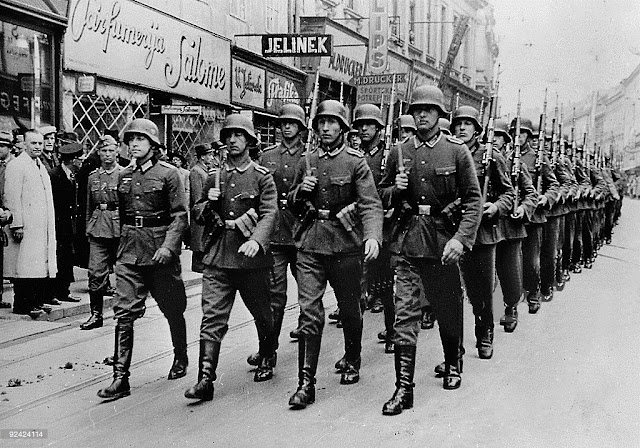
The Battle of Thermopylae began. As German paratroopers capture the islands of Samothrace, Limnos and Thasos, the Allies start to evacuate their troops from the mainland. The troops at Thermopylae are soon withdrawn and themselves evacuated from Megara, Rafina and Porto Rafti near Athens. To lift the troops there were 6 cruisers, 24 destroyers and escort vessels, 2 Landing Ships Infantry, 14 troopships and a number of landing craft. The Germans attacked the Thermopylae line which was held by the 6th New Zealand Brigade on the east and the 19th Australian Brigade on the west. German tanks tried to break through the New Zealanders while mountain troops attacked the high pass held by the Australians. The New Zealanders destroyed twelve tanks and together with the Australians held their ground. The 5th NZ Brigade and 6000 corps and base troops embarked on the night of 24/25 April. The 19th Australian Brigade embarked from the Peloponnese beaches the following night.
The Battle of Thermopylae takes place on 24 April 1941 after some initial skirmishes. The Allied ANZAC Corps holds the pass with rearguards, but the orders already have been issued for the complete evacuation of all Operation LUSTRE forces. General Blamey, the Australian general in charge of the Commonwealth troops, flies to Alexandria.
The British maintain a blocking detachment on the road from Larissa to Athens at the pass composed of the 4th New Zealand Brigade. The 6th New Zealand Brigade holds the east portion of the pass line and the 19th Australian Brigade holds the western sector. The German 6th Mountain Division (Generalmajor Ferdinand Schörner) attacks at 11:30 and attempts to break through the defensive line. The 5th Panzer Division also sends a battlegroup into the pass. New Zealand and Australian troops repulse these attacks, the Wehrmacht losing about 12-15 panzers. After the dark, the ANZAC troops withdraw from the pass toward Thebes, having delayed the panzers for over 24 vital hours.
There are no Greek troops involved in the Battle of Thermopylae despite the fact that the nation of Greece officially has not surrendered, only the army group in the north. This becomes a controversial issue in Greece which echoes down through the years.
Operation DEMON, the evacuation of British and Commonwealth troops from mainland Greece, begins. Many ships depart from Suda Bay, Crete bound for ports on mainland Greece. On the first day, about 5200 men, mostly from the 5th New Zealand Brigade, are evacuated from Porto Rafti in East Attica, and another 8000 from Nauplia on the Peloponnese. Other ports being used for evacuations include Megara and Rafina.
The Germans continue pressing against the British line anchored at Thermopylae, but they also are making an end-around run toward the Gulf of Patras. The Greek Army was supposed to protect this sector, but it in effect no longer exists, having surrendered on the 23rd. The 1st SS Panzer Division Leibstandarte SS Adolf Hitler (“LSSAH,” still of brigade-size) is racing to the southwest from Ioannina, with its ultimate objective seizing ports on the Peloponnesus which the British need for their evacuation.
The Germans also are using the port of Salonika (Thessaloniki) to occupy the islands in the Aegean. These include Samothrace, Lemnos (occupied today by elements of the 164th Division) and Thasos. The Greek garrison on Lemnos puts up a brief fight, then surrenders.
Somewhat belatedly, Bulgaria, under Tsar Boris III, declares war on Yugoslavia and Greece. The Bulgarian Army is in the process of occupying Western Thrace, and much of Macedonia.
At the War Cabinet meeting held in London, visiting Australian Prime Minister Robert Menzies “said that he was uneasy as to whether our forces in Greece… would be given sufficient protection from the air.” Prime Minister Winston Churchill decides to send a telegram to Middle East Air Marshal Longmore, ordering him “to spare all the aircraft he could for Greece during the immediately critical days.” Menzies himself notes darkly in his diary that “I am afraid of a disaster… Better Dunkirk than Poland or Czechoslovakia.” He also wonders how anyone could have thought that the Greek expedition had “military merits,” something he always argued against.
[Ed: The entire episode has been a complete disaster. Churchill tried to do too much with too little — holding Cyrenaica in Libya and Greece. He ended up falling between two stools: The British have lost both. Now even the British possession of Egypt and the absolutely vital Suez Canal are at risk. And the debacle of Crete is still to come…]
German aircraft sank hospital ship Andros and 11 freighters off the coast and damaged British cruiser HMS York and submarine HMS Rover at Suda Bay, Crete; Greek torpedo boats Aigli, Alkyoni, and Arethousa were scuttled to prevent capture. British troops held off German attacks through the afternoon at Thermopylae, destroying 15 German tanks, before withdrawing after sundown. The British rear guards withdrew to Thebes. At 1900 hours, Greek luxury yacht Hellas was bombed at Piraeus while boarding 500 British civilians and 400 wounded Allied soldiers, killing 500. 5,200 Commonwealth soldiers were evacuated from Porto Rafti, East Attica.
The German Naval Attaché in Moscow, Russia reported back to German Navy headquarters that it had been learned that the British had deduced the German invasion of the Soviet Union to take place around 26 June 1941, and the British had shared this information with the Soviet Union.
Italian infantry attacked two points of the Tobruk, Libya defenses at 0700 hours; the attacks were halted within an hour with heavy casualties and 107 captured.
Both sides launch attacks on the Tobruk perimeter without major results, but there are some ominous omens for the Axis. The Germans mount a series of coordinated assaults on the Tobruk perimeter, but the daily D.A.K. staff report notes that “Italian troops cannot be relied upon.” This is a brewing problem for the Germans, and one of Lieutenant General Erwin Rommel’s major tasks is figuring out a way to get effective use out of the Italians. In their defense, the Italians are taking heavy casualties and holding large portions of the perimeter, but they do show an inclination to surrender.
A secret cablegram dated 24 April 1941 reports:
“…there are about 145,000 prisoners in the Middle East excluding Abyssinia and Eritrea and figures (are) still growing.” ((National Archives of Australia NAA: A 433, 1945/2/6098, 1941-1943) ).
While this sounds like a positive, taking care of the vast hordes of Italian prisoners is becoming a major issue for the Allies. Many of these prisoners will wind up in Australia, causing a strain on transport and that country’s resources.
At Ras el Medauuar, an Italian battalion attacks at 07:00 and manages to make its way in the perimeter wire, but after a hail of artillery fire, it surrenders. A British report notes sardonically that white flags “appeared to have become standard battle equipment of the Italian infantry at Tobruk.” The British take 107 mainly Italian POWs, with the Italians losing about 40 dead. The German 15th Panzer Division then makes an attack in the same area around midday that is supported by about 18 Junkers Ju 87 Stukas, but this also is beaten off. In repelling the Axis attacks, the Australian defenders follow their typical pattern and allow the panzers to approach closely to their positions, then open fire as if in an ambush and send the attackers packing.
The British Army launches its own attack in the Gazala area which is quickly broken off but causes genuine alarm. The Royal Navy assists by bombarding the Capuzzo/Bardia area during the night, with the RAF joining in. The British obviously are building up large tank forces near Bardia and Sollum, with the German high command realizing that loss of those areas “would lead… also to the abandonment of the fight for Tobruk.”
The German summary notes that the battle is developing into a “crisis-like situation” that requires “immediate reinforcement” — which the OKH (Army High Command in Berlin) notes is “currently not possible.” The Tobruk battle is developing into a classic stalemate.
Churchill sends a telegram in which he continues his veiled attacks on Middle East Commander General Archibald Wavell. After making some elementary tactical suggestions — using smoke screens in Tobruk Harbor to protect shipping — he turns to his usual theme of Wavell providing insufficient information about the situation. “We still await news” of recent battles in Libya, he writes, noting “Evidently there was a severe defeat.” He continues:
“Surely the reports of the survivors should have made it possible to give us a coherent story of this key action. I cannot help you if you do not tell me…. While I recognize the difficulties of giving information of the fighting in Greece set out in your telegram, I cannot feel that the explanation is complete.”
He demands that General Henry Maitland Wilson, the commander in Greece, send a “short report” every night setting forth the positions of the troops. Of course, the troops are heading for embarkation ships now and won’t be on mainland Greece much longer.
German Colonel Lahousen of the Abwehr (German military intelligence) meets with Croatian War Minister General Kvaternik. Kvaternik expresses open hatred for the Italians, reflecting a general sentiment within Croatia, but agrees to Italian annexation of the Dalmatian coastal area. Already, reports are surfacing of insensitive Italian actions in the region.
Operation Dunlop, a supply effort to Malta, begins when Force H departs from Gibraltar. HMS Ark Royal carries 22 Hurricane fighters for delivery to Malta. There also is a supply component from Alexandria, led by three battleships escorting fast transport Breconshire. Convoy ME 7 departs from Malta bound for Alexandria.
The Luftwaffe bombs and sinks 2068 ton Greek hospital ship Andros off Loutraki, Gulf of Corinth. This is another in a series of Luftwaffe attacks on hospital ships operating off the Greek mainland.
The Indian 29th Infantry Brigade moves toward the Italian redoubt at Amba Alagi in East Africa.
Churchill decides to hold regular meetings to discuss issues of the Army’s tank and anti-tank weaponry. He characterizes these meetings as a “tank parliament.” Among the topics covered will be the organization of Armoured Divisions.
Churchill meets with U.S. Admiral Ghormley to discuss joint activities in the Atlantic, and the risk of German bases being set-up in the Canaries or Cape Verde Islands.
Late in the day, Churchill sets out on a tour of Liverpool and Manchester.
Dutch Prince Bernhard becomes an RAF pilot.
Swedish poet/novelist Karin Maria Boye, age 40, passes away in an apparent suicide on or about this date. She chooses a spot next to a boulder on a hill with a view near Alingsås, near Bolltorpsvägen. The boulder is made into a memorial dedicated to her.
The Germans seal off the Lublin ghetto. There are 30,000 people inside, all prohibited from leaving without special work passes.
An accountant in Warsaw, Chaim Hasenfus, recalls in his diary walking innocently along Walicowa Street in the Warsaw Ghetto today when a German soldier hits him on the head with a rubber nightstick and orders him and several other Jews to load gravel on a truck. The diary entries stop soon after this and his fate is unknown.
The German Naval Attaché in Moscow reports to Berlin that the British know about the plans for Operation BARBAROSSA. The only thing they don’t know is the exact date of the invasion — which is not surprising since the Germans have not yet set a date. Hitler, meanwhile, still has not made his “final, final” decision to mount Operation BARBAROSSA, but his meeting today with Admiral Horthy goes a long way in that direction.
Admiral Horthy, Regent of the Kingdom of Hungary, lunches with Adolf Hitler at the Führer’s command train Amerika near Graz, Austria. This is their first meeting since 1938 when Horthy in effect agreed to participate in the dismemberment of Czechoslovakia. Horthy, as he has in previous correspondence, warns against attempting to invade Great Britain, but enthusiastically argues that by seizing “Russia’s inexhaustible riches,” Germany can “hold out forever.” Walther Hewel writes in his diary that Horthy “talked and talked” during the luncheon, which is unusual because Hitler usually launches into extended monologues with other leaders.
This meeting seems to clarify Hitler’s own mind about invading the Soviet Union, or at least allay any of his underlying concerns about Germany’s ability to prevail. After today, Operation BARBAROSSA becomes much more likely to happen. It may be that Hitler’ feels that Hungarian military might would seal the deal, but Horthy’s influence may be much more subtle: Hitler always has a great deal of respect for foreign leaders of stature and their assessments.
The Admiral tries to work a deal in which Hungary is granted large territorial concessions at Rumanian expense — the whole of Transylvania — in exchange for its participation in upcoming Operation BARBAROSSA (which Horthy fervently advocates). Hitler knows that Hungarian / Rumanian relations are a potentially explosive issue, refuses to commit to Hungary taking the whole of Transylvania at Rumania’s expense. Horthy takes this in stride. As a result of the meeting, Hitler and Horthy maintain their collaborative relationship, with Hungary benefiting directly from Hitler’s conquests while trying to keep its own hands as clean as possible. The issue of Hungarian military participation in the Soviet Union remains up in the air, but relations between the two leaders remain excellent.
RAF Bomber Command: Day of 24 April 1941
24 Blenheims on coastal sweeps from Norway to the Channel Islands. A tanker was bombed and hit off Norway; a fishing vessel was sunk and a radio station ashore was bombed. No losses.
RAF Bomber Command: Night of 24/25 April 1941
Kiel
69 aircraft — 39 Wellingtons, 19 Whitleys, 10 Hampdens, 1 Stirling. 1 Whitley lost. Kiel reports a very scattered attack with no serious damage and 1 person killed and 3 injured.
Minor Operations: 12 aircraft to Le Havre, 10 to Ostend, 9 to Wilhelmshaven (where several houses were hit and a woman and 2 children killed), 8 Hampdens minelaying in Frisians and off Copenhagen, 4 O.T.U. sorties. No losses.
The Luftwaffe sends scattered raiders over the Channel after dark.
The Luftwaffe continues its heavy raids on Malta. About 30 planes spend an hour over the dockyard area and the airfields at Luqa and Hal Far. Valetta is hammered, and four auxiliary antiaircraft gunners of the 4th Battalion perish when a bomb hits their position. St. Frederic Street takes the most damage, but everyone in the shelters survives after temporarily being trapped under the rubble.
Destroyers HMS Inglefield and HMS Maori departed Hvalfjord at 0200 and joined convoy HX.120 as an anti-submarine striking force. The destroyers were to diverted to join convoy OB.312. They remained with this convoy until departing this convoy at daybreak on the 25th to join convoy HX.121. The destroyers parted company with convoy HX.121 at longitude 8 at 2130/29th and arrived back at Scapa Flow at 0945/30th.
Anti-aircraft ship HMS Pozarica departed Scapa Flow at 0500 to join convoy WN.18. The ship then proceeded to Chatham for alterations.
British steamer Dolius (5507grt) was damaged by German bombing in 56-35N, 2-11W. The steamer was able to proceed to Leith.
Yugoslav submarine Nebojsca arrived at Suda Bay. The submarine was found to be unserviceable and was never used operationally.
British steamer Cavallo (2269grt) was badly damaged by German bombing at Nauplia. The steamer had been attacked on the 23rd, but not hit. However, the crew had abandoned the steamer. The steamer sank on the 25th.
Armed yacht HMS Calanthe (370grt) was sunk by German bombing off Milos. Four crewmen and a gunner were killed on the yacht.
Aircraft carrier HMS Argus, light cruiser HMS Sheffield, and destroyers HMS Faulknor, HMS Fortune, and HMS Wrestler arrived at Gibraltar.
Anti-aircraft cruiser HMS Dido, minelaying cruiser HMS Abdiel, and destroyers HMS Kelly, HMS Kipling, HMS Kelvin, and HMS Jersey arrived at Gibraltar from the UK.
Submarine HMS Rover, alongside heavy cruiser HMS York supplying power to the cruiser, was badly damaged by German bombing in Suda Bay. The submarine was beached. The cruiser was damaged by the near misses. The submarine was towed by destroyer HMS Griffin and escorted by netlayer HMS Protector and minesweeping trawler HMS Muroto to Alexandria arriving on the 29th. The submarine was temporarily repaired at Port Said completing on 6 July. The submarine departed Port Said on 10 July. She was towed to Singapore for refitting arriving on 31 July. Submarine Rover was towed from Singapore on 29 January 1942 to Batavia by destroyer HMS Express. She was towed from Batavia on 14 February by steamer City of Pretoria (8049grt) to Trincomalee, arriving on 21 February. The submarine was taken to Bombay for repairs. The submarine arrived at Bombay on 4 March.
Italian torpedo boat Simone Schiaffino was sunk on an Italian mine off Cape Bon.
Naval tanker RFA Brambleleaf, escorted by destroyers HMS Isis, HMS Hero, HMS Hereward, and HMS Hotspur departed Alexandria on the 24th and arrived at Suda Bay, arrived very early in the morning on the 26th. The destroyers joined the Vice Admiral, Light Forces on cruiser HMS Orion.
Light cruiser HMS Orion and destroyers HMS Decoy, HMS Hasty, and HMS Havock departed Alexandria for Suda Bay. Destroyer HMS Defender from Tobruk joined early on the 25th. The ships arrived at 1800/25th at Suda Bay.
Light cruiser HMAS Perth joined light cruiser HMS Phoebe at Suda Bay to patrol Kithera Straits to cover convoy AG13.
Submarine HMS Otus was under repair at Gibraltar from 24 April to 12 July for the removed of her main motor armature.
Greek torpedo boat RHS Pergamos was sunk by German bombing at Salamis.
Greek hospital ship Andros (2068grt) was sunk by German bombing off Loutraki, Gulf of Corinth.
Greek steamer Hellas (2295grt) was sunk by German bombing at Piraeus.
Greek steamer Kehrea (1968grt) was sunk by German bombing in the anchorage, Bay of Frangolimano.
Greek steamer Kyriaki (5528grt) was sunk by German bombing at Suda Bay. There were no casualties.
Greek steamer Manna (238grt) was sunk by German bombing at Aedipsos.
Greek steamer Petros (634grt) was sunk by German bombing at Porto Heli. The steamer was refloated by the Germans and broken up at Piraeus.
Greek steamer Popi S. (2083grt) was sunk by German bombing at Milos Island.
Greek steamer Pylaros (932grt) was sunk by German bombing at Galaxeidion.
Greek steamer Spetsai (379grt) was sunk by German bombing at Psathopyrgos, Gulf of Corinth.
Greek steamer Point Judith (4810grt) was sunk by German bombing at Kythnos Island. The entire crew was rescued. Date of loss also given as 26 April.
Convoy HG.60 departed Gibraltar escorted by destroyer HMS Firedrake, sloop HMS Wellington, corvettes HMS Coreopsis, HMS Fleur de Lys, and HMS Spiraea, and Dutch submarine HNLMS O.23. Destroyer Firedrake was detached on the 28th, the corvettes on the 30th, and the submarine on 2 May. On 7 May, the convoy was joined by destroyer HMS Boadicea, sloop HMS Egret, corvettes HMS Snowflower, HMS Trillium, and HMS Windflower, and anti-submarine trawlers HMS Arab, HMS Ayrshire, and HMS Lady Madeleine. Destroyer HMS Niagara joined on 9 May, and arrived at Liverpool on 12 May.
Convoy AG.14 of troopships Dutch Costa Rica (8672grt), British City of Lincoln (8039grt), British Dilwara (11,080grt), British Salween (7093grt), Egyptian Khedive Ismael (7290grt), and Dutch Slamat (11,636grt) departed Alexandria escorted by anti-aircraft cruiser HMS Carlisle and destroyers HMS Kandahar and HMS Kingston. At 0700/26th, convoy AG.14 arrived in the Aegean. The convoy did not go into Suda Bay.
Convoy AG.15 departed Alexandria escorted by destroyers HMS Kimberley and HMAS Vampire. Sloop HMS Auckland, after being relieved of the tow of tanker British Lord, refueled at Suda Bay and joined the convoy. Convoy AG.15 arrived at Suda Bay at 1300/26th with troopships Greek Ionia (1936grt), Greek Corinthia (3701grt), British Itria (6854grt), British Comliebank (5149grt), British Belray (2888grt), and Dutch Eleonora Maersk (10,694grt). The convoy was escorted by destroyer Kimberley and sloop Auckland. The escort ships joined Vice Admiral, Light Forces on cruiser HMS Orion. Destroyer Vampire of this convoy had been detached en route to aid British steamer Scottish Prince (4917grt), bombed on the 26th. Destroyer Vampire relieved destroyer HMS Hasty which had been standing by. Sloop HMS Grimsby also later joined. Destroyer Vampire, sloop Grimsby, and bomb damaged Scottish Prince arrived at 0610/27th at Suda Bay.
During the night of 24/25 April in Operation DEMON evacuations of British troops from Greece began. The ships involved departed Suda Bay on the 24th. From Raphtis sailed anti-aircraft cruiser HMS Calcutta, commando ship Glengyle, and corvette HMS Salvia. Australian light cruiser HMAS Perth was at Raphtis in a support role and did not embark any troops. From Nauplia joined light cruiser HMS Phoebe, commando ship Glenearn (damaged en route on the 24th by German bombing, but able to continue), troopship Ulster Prince (grounded at Nauplia. Corvette HMS Hyacinth and lighter A 5 attempted to tow her clear without success. The troopship was bombed and set afire on the 25th), destroyers HMAS Stuart and HMAS Voyager, and corvette HMS Hyacinth. A total of 13,500 troops were brought off from Raphtis and Nauplia.
Today in the U.S. capital, President Roosevelt conferred with Adolf A. Berle Jr., Assistant Secretary of State, and Leland Olds, chairman of the Federal Power Commission, on the St. Lawrence power project; discussed the coal situation with Secretary Ickes and R. R. Sayres of the Bureau of Mines, and the defense and aid to Britain program with Secretaries Hull, Stimson and Knox, and Harry L. Hopkins. He announced that Mr. Hopkins would receive a salary of $10,000 a year as Lend-Lease supervisor and appointed Wayne Coy. Assistant Federal Security Administrator, a special assistant to the President to act as a liaison agent between Mr. Roosevelt and the Office of Emergency Management.
With the Senate in recess, its Defense Investigation Committee continued questioning War Department officials; the Privileges and Elections Committee voted to recommend the seating of Joseph Rosier as Senator from West Virginia, and the Appropriations Committee approved the $228,251,828 War Department Civil Functions Appropriations Bill.
The House completed Congressional action on the $150,000,000 Defense Housing Bill and adjourned at 2:36 PM until noon tomorrow. The Ways and Means Committee heard Secretary Morgenthau and John L. Sullivan, Assistant Secretary of the Treasury, on the Administration’s defense tax proposals.
President Roosevelt extends Neutrality Patrols to 26W longitude (the vicinity of Iceland) and as far south as Rio de Janeiro and orders the U.S. Navy to report any movement of German ships west of Iceland. US Rear Admiral Robert Ghormley, President Roosevelt’s Special Naval Observer in England, meets with Churchill to discuss joint operations in the Atlantic. Among the topics is the possibility of German bases on the island groups in the Atlantic, including the Canary and Cape Verde Islands. U.S. Navy ships simply transport their sightings in the clear, and the signals invariably are picked up by Royal Navy listeners who can vector in British ships or aircraft.
Churchill sends a telegram to President Roosevelt summarizing the war situation. He notes that the U-boats have moved further west, from 22 degrees West to about 30 degrees West, and they seem to be heading even further west. He asks for US aerial reconnaissance in this area. He also asks for a US Navy carrier to conduct aerial patrols in the vicinity of the Cape Verde Island, which Churchill characterizes as “Another area in which we are having considerable trouble.” Churchill also says that, should Spain declare war, the Royal Navy immediately will occupy the Azores and the Cape Verde Islands, but requests that US Navy ships conduct a “friendly cruise in the region” in order to scare off any German raiders.
Roosevelt is in agreement with Churchill’s requests. US Navy Secretary Frank Knox issues a statement:
“We can no longer occupy the immoral and craven position of asking others to make all the sacrifices for this victory which we recognize as so essential to us.”
That, however, is U.S. doctrine at the moment, amplified by Lend Lease. He will divert the ships of Task Force 3, which sails today from Newport, Rhode Island bound for the Caribbean, to the Cape Verde Island group.
Two key figures in President Roosevelt’s” cabinet called tonight for more active steps to aid Britain, one declaring that “we cannot allow our goods to be sunk in the Atlantic” and the other demanding “resistance wherever resistance will be most effective.” Secretary of State Cordell Hull said in an address here that “ways must be found” to insure that aid reaches its destination “in the shortest of time and in maximum quantity.” In an even stronger pronouncement in New York, Secretary of the Navy Frank Knox declared “this is our fight,” that “we must see the job through” and that “we can no longer occupy the immoral and craven position of asking others to make all the sacrifice for this victory which we recognize as so essential to us.”
The U.S. Treasury presented its new defense tax schedules to the House Ways and Means Committee today and through Assistant Secretary John L. Sullivan argued emphatically against substitution of a payroll tax or a sales tax for the proposed heavy imposts on incomes. Sullivan faced the committee after Morgenthau, flanked by 17 assistants, had urged the prospective $3,500,000,000 increase in tax revenues be accompanied by a billion dollar reduction in non-defense expenditures. He thought such a cut not only highly desirable but clearly possible.
Mrs. Eleanor Roosevelt tonight commented that Colonel Charles A. Lindbergh “seems to have a strange lack of confidence in his own people” on the basis of remarks he made at an America First rally in New York last night. The first lady said she had not read accounts of Lindbergh’s statements in which he said England could not win the war regardless of how much assistance the United States extends. Mrs. Roosevelt made her statement after hearing a summarized account of Lindbergh’s speech. “Colonel Lindbergh seems to underestimate our courage and our resources,” she said.
Colonel Lindbergh’s belief that Britain cannot win the war and that she should try to arrange a negotiated peace with Germany now is not shared by the majority of American voters polled in a nation-wide survey by the American Institute of Public Opinion.
The House Rules Committee postponed today until Tuesday a decision on whether it would grant a rule permitting House consideration next week of the Vinson Labor Mediation Bill. This action followed discussion of the measure by several members.
Organizers in the aircraft division of the United Automobile Workers of America (C.I.O.) voted tonight to call a general strike of C.I.O. workers at the Glenn L. Martin Company, where planes are being made for the United States and Great Britain.
U.S. Navy Task Force 3 (Rear Admiral Jones H. Ingram) with American light cruisers USS Memphis (Ingram), USS Cincinnati, USS Omaha, and USS Milwaukee and destroyers USS Somers (Destroyer Squadron 9: Captain T. A. Symington), USS Jouett, USS Davis, USS Winslow, and USS Moffett sailed from Newport, R. I. , to patrol Trinidad, Cape San Roque, and Cape Verde Island.
The first M3 tank constructed at the Detroit Arsenal Tank Plant in Michigan, United States was delivered to the U.S. Army. The M3 has a 75mm main gun in a sponson mount, not an optimal arrangement because American manufacturers are not at this time capable of creating turrets large enough to handle the gun. The Germans at this time are up-gunning their Panzer IIIs and IVs to handle similar guns at Hitler’s personal insistence but in normal turrets. The M3 continues the American pattern of tall and roomy tanks which the crews like — until they have to go into battle in such an exposed target. It is fair to argue that the M3 already is outclassed by tanks in Europe, but this is a controversial topic and, on the other hand, American engineering is very solid and the tanks reliable. Many of these M3s will be sent to Great Britain with different turrets and be called Grants, serving capably in the major battles in North Africa.
There is another major air defense drill in New York City. Air defense officials maintain a plotting board in Manhattan that directs interceptors based at Mitchell Field, Long Island.
Painter George de Forest Brush passes away.
Columbia Pictures releases “Penny Serenade.” Produced and directed by George Stevens and starring Cary Grant and Irene Dunne, “Penny Serenade” is another in a series of 1941 Hollywood films exploring issues within marriages — a theme which seems to reflect the troubled international situation and the divisions that it is causing within the United States. The film begins with Dunne’s character stating that her marriage is over, and the remainder of the film addresses how that issue resolves. Cary Grant is nominated for an Academy Award, but Gary Cooper wins it for “Sergeant York.” The film strikes a chord, and radio dramatizations are produced throughout the war, with a television adaptation broadcast in January 1955.
Major League Baseball:
The Brooklyn Dodgers downed the Philadelphia Phillies, 6–1. Luke (Hot Potato) Hamlin, making his second start, yesterday hurled his second complete game, and now has permitted only one run in eighteen innings. The Phillies gathered only four hits, including two doubles by Nick Etten and one by Danny Litwhiler, but only the first of Etten’s two-baggers, coming in the seventh, figured in the scoring.
Thornton Lee of the White Sox allowed only six hits today for a 2–1 victory over Pitcher Al Smith and the Indians. Dario Lodigiani’s triple with two runners on base in the seventh gave Chicago its runs. Lodigiani’s hit was the third off Smith, who was removed for a pinch-hitter in the eighth. In all, the Sox made only five hits off Smith and Clint Brown.
Frankie Croucher, promoted from the Tigers’ bench, celebrated today by tripling in the sixth to drive in two runs, beat the Browns, 4–2, and reward Tommy Bridges for a good pitching job. The drive by Croucher, who replaced Dick Bartell at shortstop yesterday in Detroit’s efforts to get more hitting, gave the Tigers the lead, and Rudy York insured the victory by walloping his third home run in the seventh.
Don’t look now, but the Yankees are in first place. It almost seemed like old times at the Stadium yesterday, with the Bronx Bombers riding to victory over the Red Sex, principally on the wings of a three-run homer by Charlie Keller. They unleashed a ten-hit assault on a trio of Boston hurlers and won, 6–3. Marius Russo struggled with wildness, walking six, but got the win for New York.
An infield hit by Rip Collins with the bases full gave the Pirates a 2–1 victory in eleven innings today, breaking a four-game losing streak. A bloop double by Vince DiMaggio had tied the game a moment earlier after the Cubs had scored to take a 1–0 lead in the top of the 11th..
The world champion Reds turned the tables on the Cardinals today, scoring a run on Lonnie Frey’s ninth-inning double to win, 3–2. Three times in a row at the start of the season St. Louis stopped the Reds, and twice victory came in the ninth. Fiddler Bill McGee pitched no-hit ball for five innings, but Ival Goodman broke the spell with a single in the sixth. Cincinnati combined two hits, a walk and a stolen base in the seventh to tie the count at 2–2.
The scheduled game between the Washington Senators and the Athletics at Philadelphia was postponed due to wet grounds. The game will be made up as part of a doubleheader on May 24.
The scheduled game between the New York Giants and the Bees at Boston was postponed due to wet grounds. The game will be made up as part of a doubleheader on July 2.
Philadelphia Phillies 1, Brooklyn Dodgers 6
Cleveland Indians 1, Chicago White Sox 2
St. Louis Browns 2, Detroit Tigers 4
Boston Red Sox 3, New York Yankees 6
Chicago Cubs 1, Pittsburgh Pirates 2
Cincinnati Reds 3, St. Louis Cardinals 2
The recent reports that the Soviet had refused to grant visas for foreign travel on the Transsiberian Railway because troops were being withdrawn from Siberia to Europe are, generally speaking, said to be untrue. The Soviet General Staff long since formulated plans for two armies, one in Europe and one in the Far East.
Ratification of the Russo-Japanese neutrality pact was assured tonight when the Privy Council, meeting in plenary session in the presence of the Emperor, approved it unanimously. The pact now will be submitted for imperial sanction tomorrow, which will complete the ratification formalities and will make the pact effective immediately, even before the exchange of ratification documents.
American, British, and Dutch military officials continued to meet in Singapore to develop a strategic plan for combined operations against Japan in the event the Japanese attacked the United States. Formidable new reinforcements of men and machines landed at this British Far Eastern stronghold today, strengthening the defense of Singapore and the Malay Peninsula against a surprise thrust by land or sea.
Dow Jones Industrial Average: 117.35 (+0.76)
Born:
Richard Holbrooke, American diplomat (U.S. Ambassador to the United Nations, 1999-2001), in New York, New York (d. 2010).
Daryl Sanders, NFL tackle (Detroit Lions), in Canton, Ohio.
John Williams, Australian classical guitarist, in Melbourne, Victoria, Australia.
Died:
Karin Boye, 40, Swedish poet and novelist, committed suicide.
Cambodian King Sisowath Monivong (27 December 1875 to 24 April 1941).
Naval Construction:
The U.S. Navy SC-497-class (110-foot wooden hull) submarine chaser USS PC-515 (later SC-515) is laid down by the Elizabeth City Shipyard (Elizabeth City, North Carolina, U.S.A.).
The U.S. Navy PC-461-class (173-foot steel hull) submarine chaser USS PC-496 is laid down by the Leatham D. Smith Shipbuilding Co. (Sturgeon Bay, Wisconsin, U.S.A.).
The Royal Australian Navy Bathurst-class minesweeper-corvette HMAS Wallaroos (J 222) is laid down by Poole & Steel Pty. Ltd. (Sydney, New South Wales, Australia).
The Royal Navy “S”-class (Third Group) submarine HMS Sirdar (P 226) is laid down by the Scotts Shipbuilding & Engineering Co. (Greenock, Scotland).
The U.S. Navy 77′ Elco patrol motor torpedo boat USS PT-23 is launched by the Electric Launch Company Ltd. (Elco), (Bayonne, New Jersey, U.S.A.).
The U.S. Navy coastal minesweeper USS Ruff (AMc-59) [converted fishing boat; ex-Speaker] is launched by the Martinolich Shipbuilding Co. (San Diego, California, U.S.A.).
The Kriegsmarine (German Navy) Type VIIC U-boat U-207 is launched by F. Krupp Germaniawerft AG, Kiel (werk 636).
The Kriegsmarine (German Navy) Type IXC U-boat U-504 is launched by Deutsche Werft AG, Hamburg (werk 294).
The Kriegsmarine (German Navy) Type IXC U-boat U-127 is commissioned. Her first commanding officer is Kapitänleutnant Bruno Hansmann.
The Kriegsmarine (German Navy) Type VIIC U-boat U-567 is commissioned. Her first commanding officer is Kapitänleutnant Theodor Fahr.
The Royal Navy Flower-class corvette HMS Polyanthus (K 47) is commissioned. Her first commanding officer is Lieutenant Arthur Hague, RNR.

