At Mussolini’s insistence, a second Greek surrender document was signed up in Thessaloniki that included the Italians.
With Adolf Hitler having placated Benito Mussolini by agreeing to modifications of various Greek surrender terms, Germany, Italy and Greece sign documents by which the Greek Epirus Army surrenders. The ceremony takes place at 14:45 on 23 April 1941 at Salonika (Thessaloniki), and Hitler wants the news announced then — but Mussolini has his Rome news service broadcast the news at 10:00:
“The enemy armies of Epirus and Macedonia have laid down their arms. The surrender was tendered by a Greek military delegation yesterday at 9:04 P.M. to the commander of the Italian Eleventh Army on the Epirus front. The details of the surrender will now be worked out in complete agreement with our German allies.”
Among other things, Hitler agrees to grant Italy dominion over the new “Independent State of Croatia” despite vociferous opposition from the locals there. However, Hitler retains German control over Serbia, and Foreign Minister Ribbentrop appoints Luftwaffe General Helmut Forster as the new military governor there.
Greek General Papagos, who now has virtually no troops left under his command, resigns.
The Germans have concentrated forces in the vicinity of Ioannina, placed there to prevent any escape by the Greek Epirus Army. With that no longer an issue, the Wehrmacht troops (led by the 1st SS Panzer Division Leibstandarte SS Adolf Hitler, currently of brigade strength) head toward the Ionian coast. Their plan is to block any British evacuation attempts from the Peloponnese, with landings near Corinth by fallschirmjäger (paratroopers). The Bulgarian 2nd Army moves into Thrace.
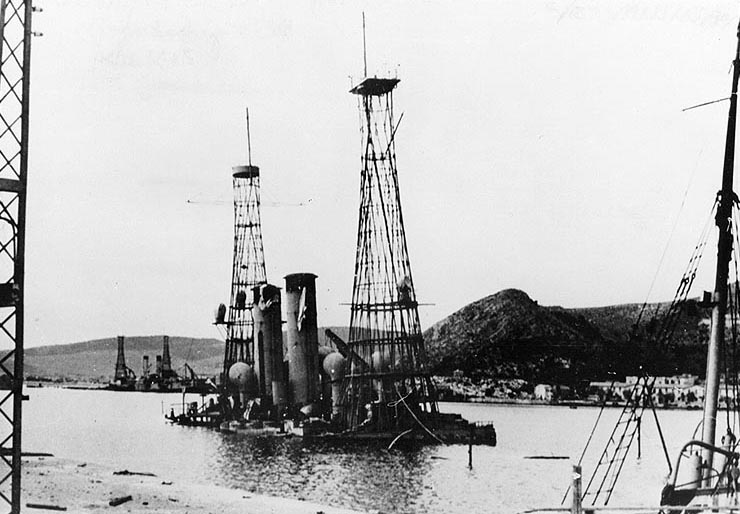
German troops attacked westward in Greece from Ioannina. Meanwhile, German paratroopers landed on Aegean Islands. On the same day, German bombers destroyed 13 British Hurricane fighters on the ground at Argoes (forcing the survivors to evacuate to Crete) and sank Greek torpedo boat RHS Kios, minelayer RHS Nestos, hospital ship Policos, battleship RHS Kilkis (ex-USS Mississippi BB-23), battleship RHS Lemnos (ex-USS Idaho, BB-24), 12 freighters, and 1 tanker; damaged Greek torpedo boat RHS Doris was scuttled to prevent capture.
The Wehrmacht High Command announced: “The movements of the German army in Greece are unfolding as scheduled. German forces have advanced through Lamia toward the south and have joined battle with British rearguard forces in the historic pass of Thermopylae.”
King George II of Greece, Crown Prince Paul, Prime Minister Emmanuel Tsouderos and other important figures of the Greek government were evacuated by the RAF to Crete, where an attempt to evacuate personnel from Crete to Egypt had begun. Departing King George II, now in Crete, orders that his wine cellar be opened and the bottles given to Allied soldiers. Each enlisted man will receive one bottle, and each officer two.
The British are gearing up for Operation Demon, the evacuation of British troops from the Greek mainland. Some A-lighters arrive off the coast, and the Luftwaffe promptly bombs and damages lighter A.1 off the coast at Megara, causing the crew to scuttle it. Another lighter, A-6, is damaged off Raphtis.
Greece severs diplomatic relations with Bulgaria.
Germany agrees to transfer captured French tanks to the Bulgarian army.
The Italians occupy the island of Vis, Yugoslavia.
The British 11 Hussars mount a tank raid against German transport in the Fort Capuzzo region. While not resulting in much, the raid reinforces jitters at the Afrika Korps headquarters regarding British attempts to relieve the Australians trapped in Tobruk. The Italian Brescia Division arrives in the operational zone around Tobruk to reinforce the besiegers.
At the OKH headquarters at Zossen, worries about the course of operations in Libya are mounting. Lieutenant General Erwin Rommel has shown a propensity to “dash about” contrary to any orders, and now is requesting additional troops and air cover. OKH Chief-of-Staff General Franz Halder decides to send one of his staff officers, General Friedrich Paulus, to Libya to “correct matters which had got out of hand.” General von Manstein turns down the assignment, calling Rommel a “lunatic” and noting that Paulus has a personal friendship with Rommel. Paulus later recalls that he is offered command of the Afrika Korps at this time, but he turns it down because, as his wife counsels, it would be impossible for a general to earn a reputation in North Africa. Instead, he prefers to wait for a command in Operation BARBAROSSA.
An Axis convoy was spotted by British aircraft in the Mediterranean Sea sailing toward Tripoli, Libya. British destroyers HMS Jervis, HMS Jaguar, HMS Janus, and HMS Juno failed to intercept. Overnight, however, destroyer HMS Juno was able to find and sink empty Italian troopship Egeo off the Libyan coast.
Following urgings by Australian Prime Minister Robert Menzies, Middle East Commander General Archibald Wavell appoints Australian General Thomas Blamey the Deputy Commander-in-chief, Middle East.
Churchill to the Secretary of State for War: “All the lessons of this war emphasise the necessity of good anti-tank weapons and plenty of them. The number of anti-tank guns that can be produced is necessarily limited; all the more need therefore to press forward with whatever substitutes can do the trick. There are persistent rumours that the Germans are constructing tanks with very thick armour — figures of four to six inches are mentioned. Such armour would be impervious to any existing anti-tank gun, or indeed and mobile gun; the tracks and other vulnerable parts are very small targets. Tests have shown that plastic explosive applied to armour plate, as, for instance, in the bombard developed by Colonel Blacker and Colonel Jefferies, has very great cutting power, and this may be a solution to the problem. In any event, we must not be caught napping.”
Tensions in Iraq remain high. Iraqi leader Rashid Ali again asks Germany to send aid, which can only come by air. However, there are immense logistical problems that must be overcome before the Luftwaffe can even attempt a mission to Iraq, not least of which is that the British control the major airfields.
The War Cabinet, Battle of the Atlantic Committee reviews the Royal Navy’s progress in fitting out merchant ships with catapult aircraft. These ships are known at first as Fighter Catapult Ships (FCS), and later as Catapult Aircraft Merchant Ships (CAM ships). They typically launch a converted Hawker Hurricane (Sea Hurricane) from a catapult at the bow. The Admiralty finds that one such ship will be completed by the end of the month, with another 8 during May, 11 in June and 6 in July. The first 10 such ships will be assigned to continuous patrolling within the “danger area” to the west of the British Isles.
Prime Minister Robert Menzies, still visiting in London, notes in his diary that he makes a broadcast today to Australia to “stop the rot.” There is a loud minority in Australia who are dissatisfied with Australian involvement in the war, or at least with the state of the country’s readiness for the conflict.
Princess Elizabeth — future Queen Elizabeth II — thanks Churchill “for the lovely roses you sent me on my birthday.” If there is one thing that Churchill knows how to do better than anyone else, it is to schmooze with the royals.
German heavy cruiser Prinz Eugen is passing through the Fehmarn Belt en route to Kiel when it detonates a magnetic mine dropped by the RAF. This causes damage to the stern of the ship, including the fuel tank, fire control equipment, and propeller shaft couplings. Prinze Eugen is scheduled for a sortie into the Atlantic with battleship Bismarck, but this incident forces a delay in that operation while repairs to the cruiser are completed. The repairs will take until 11 May 1941.
German raider Thor arrives back at Hamburg, Germany after its 322-day raiding mission. During that mission, Thor sank 11 merchant ships and a British armed merchant cruiser. It also confounded the Royal Navy and kept it searching fruitlessly throughout the South Atlantic without success.
The Kriegsmarine overseas supply network remains intact. Today, German tanker Nordmark supplies Italian submarine Perla, which has been making an arduous journey from Eritrea to France. The Perla is not built for such lengthy cruises, and its sailors have been suffering from lack of supplies for some time.
Alexander Löhr was mentioned in the Wehrmachtbericht daily radio report.
Adolf Wagner, Gauleiter and Minister of Education and Religious Affairs in Bavaria, issues an order prohibiting the opening of the school day with a prayer and suggests the gradual removal of all crucifixes (See August 28, 1941).
At Auschwitz, the Germans decide to punish the inmates for an escape attempt. They select 10 prisoners to starve to death in retaliation.
The “Lucy” spy ring centered in Prague sends Soviet leader Joseph Stalin more warnings about an imminent German attack. As with all the other previous warnings, Stalin discounts this as British propaganda.
German bombers again attacked Plymouth, England, United Kingdom. Tonight, it sends 109 bombers to continue their attacks on the heart of the city.
Luftwaffe ace Hermann-Friedrich Joppien of JG 51, who recently scored his 40th victory against the RAF (and was mentioned in the Wehrmachtbericht), becomes the 11th officer or soldier of the Wehrmacht honored with the Knight’s Cross of the Iron Cross with Oak Leaves (Ritterkreuz des Eisernen Kreuzes mit Eichenlaub). He travels to Adolf Hitler’s command train Amerika in Austria to receive the medal at the hand of the Führer.
RAF Bomber Command: Day of 23 April 1941
31 Blenheims and 6 Hampdens on sweeps of Belgian, Dutch and German coasts. Ships and land targets bombed. 1 Blenheim lost.
RAF Bomber Command: Night of 23/24 April 1941
Brest
67 aircraft — 30 Wellingtons, 25 Whitleys, 10 Hampdens, 2 Stirlings. No losses. Hits were claimed on the Scharnhorst and Gneisenau but there is no confirmation of this.
14 Hampdens minelaying — 7 off Lorient, 7 off the East Frisians. No losses.
The RAF is taking a beating in Greece. A Luftwaffe attack on Argos destroys numerous Hurricane fighters on the ground (some sources say up to 13 planes).
At Malta, the Luftwaffe raids continue. The RAF loses a Hurricane during a dogfight off Dellmara, with the pilot making a safe landing in the ocean. A rescue launch is not sent out immediately due to continued enemy air action, and by the time it reaches the vicinity, it cannot find Canadian Flying Officer Henri F Auger, who disappears.
Hans-Joachim Marseille scored his 8th kill, a British Hurricane II fighter, over Tobruk, Libya during the morning sortie. In the afternoon sortie, he was shot down and safely landed in German territory.
German Luftwaffe bombers attacked Tobruk harbor in Libya, sinking several ships at the cost of 6 German aircraft. The war in the air over Tobruk is intense, and the Luftwaffe gradually is achieving complete air superiority. Today, German pilots shoot down a Blenheim bomber that is attacking Gazala airfield. The Luftwaffe attacks Tobruk twice, losing two fighters. The RAF force there is not being reinforced, and each loss causes a permanent diminution in its capabilities over the port. RAF losses today are unclear, with different sources placing them at somewhere between 1-7 planes.
The Luftwaffe also is in action off the Tripoli coast. It bombs corvette HMS Gloxinia, causing some damage from near misses.
The Luftwaffe attacks on hospital ships in the Aegean continue. Today, the Germans bomb and sink 875-ton Greek hospital ship Policos at Methana.
Battleship HMS Rodney arrived at Scapa Flow after having been detached on escort duties since 9 March.
Destroyer HMS Eskimo departed Scapa Flow to rendezvous with steamers Amsterdam and Archangel and escort them to Kirkwall and Scapa Flow, respectively. The destroyer arrived back at Scapa Flow at 0745/24th after the escort duty.
Destroyer HMS Saladin and Polish destroyers ORP Piorun and ORP Garland departed Scapa Flow at 0600. The Royal navy destroyer was bound for Londonderry and the Polish destroyers for Greenock.
Anti-aircraft ship HMS Alynbank departed Scapa Flow at 0600 and joined convoy WN17 in the Pentland Firth. The ship later transferred to convoy EC.10 off Buchan Ness. Ship Alynbank transferred to convoy WN18 at 0500/24th. The convoy with ship Alynbank arrived at Methil at 0800/25th.
German heavy cruiser Prinz Eugen was mined in the Baltic during preparations for a sortie with battleship Bismarck into the Atlantic.
At Tripoli, corvette HMS Gloxinia, minesweeper HMS Fareham, and anti-submarine whaler HMS Southern Sea were near missed by German bombing. Corvette Gloxinia sustained damage from the near misses.
British A lighters arrived off the Greek coast. A1 (T/Sub Lt L. D. Peters RNVR) and A19 (T/Skipper R. S. Cooper RNR, Lt Cdr P. C. Hutton DSC, (emergency), Commander of the 1st TLC Flotilla aboard) were attacked off Megara by German bombing. A1 was badly damaged and later scuttled. A 6 (T/Sub Lt J. D. Sutton RNVR) off Raphtis was bombed and strafed, but escaped serious damage.
Greek battleships RHS Kilkis (ex-USS Mississippi BB-23), and RHS Lemnos (ex-USS Idaho, BB-24) were sunk by German bombing at Salamis.
British steamer Santa Clara Valley (4665grt) was sunk by German bombing in Nauplia Bay. One crewman, one military personnel, and five muleteers were lost on the steamer.
Greek steamer Assimi (722grt) was sunk by German bombing at Krioneri.
Greek steamer Elvira (372grt) was sunk by German bombing at Chalkis.
Greek tanker Katerina (2398grt) was sunk by German bombing at Methana.
Greek steamer Kerkyra (1461grt) was sunk by German bombing off Punta gun emplacement on Salamis.
Greek steamer Kyma (223grt) was sunk by German bombing at Patras.
Greek steamers Macedonia (1839grt) and Nicolaos Nomicos (625grt) were sunk by German bombing at Trisonia — Spilia, seven miles north of Patras. Steamer Nicolaos Nomicos was refloated and towed to Piraeus for drydocking. She was scrapped by the Germans.
Greek steamer Nicolaou Georgios (4108grt) was sunk by German bombing at Nauplia.
Greek hospital ship Policos (875grt) was sunk by German bombing at Methana.
Greek steamers Stathis A. (385grt) and Hydra (231grt) were sunk by German bombing at Megara. Greek steamer Athina S. (273grt) was sunk by German bombing at Psathopirgos. The steamer was subsequently raised.
Greek steamer Kriti (1028grt) was sunk by German bombing at Antirion. The steamer was later raised and taken to Italy.
Submarine HMS Torbay departed Gibraltar for patrol in the Tyrrhenian Sea.
Submarine HMS Unbeaten departed Gibraltar for Malta.
Convoy OB.314 departed Liverpool, escorted by destroyers HMS Douglas, HMS Leamington, and HMS Roxborough, corvettes HMS Abelia, HMS Gladiolus, and HMS Veronica, minesweeper HMS Nigella, and anti-submarine trawlers HMS Notts County, HMS St Elstan, HMS St Kenan, HMS St Zeno, and HMS Vizalma. On the 27th, destroyers HMS Amazon and HMS Chesterfield joined the convoy and on the 28th, corvettes HMS Hollyhock and HMS Nigella joined. The escorts, except destroyers Amazon and Chesterfield and corvettes Hollyhock and Nigella, were detached on the 28th. The remainder of the escort was detached on the 30th when the convoy dispersed.
Today in Washington, President Roosevelt deferred his visit to Warm Springs because of the gravity of the soft coal strike, conferred with Sidney Hillman, associate director of the OPM; issued an executive order putting most remaining federal employees under the merit system and signed a bill increasing the enlisted personnel of the Navy to a regular level of 232,000 and an emergency level of 300,000.
The Senate was in recess; its Defense Investigation Committee heard Lieutenant Colonel A. B. Wilson and Brigadier General Harry L. Twaddle on Army preparations and conferees reached agreement on the bill to permit the Maritime Commission to negotiate shipbuilding contracts.
The House approved a bill for filling the Presidency in the event of delay in induction of regularly elected officials and adjourned at 4:40 PM until noon tomorrow. Its Ways and Means Committee received more recommendations for new taxes, the Rules Committee held hearings on a proposed rule for the Vinson Strike Mediation Bill and the Military Affairs Committee approved a bill authorizing training of enlisted men as Army fliers.
At the America First Committee meeting in New York City, New York, Colonel Charles A. Lindbergh publicly called for the United States to stay out of the war. Charles Lindbergh addresses 30,000 people at the first mass meeting of the America First Committee in New York City. Lindbergh told the rally tonight the United States “cannot win this war for England, regardless of how much assistance we extend.” Branding American interventionists as “the real defeatists, for their policy has led to the defeat of every country that followed their advice,” Lindbergh said the British “hope they may be able to persuade us to send another expeditionary force to Europe, and to share with England militarily, as well as financially, the fiasco of this war.” He condemned England for having ‘encouraged the smaller nations of Europe to fight against hopeless odds.’
As with all of Lindbergh’s speeches, this one receives a great deal of publicity and stirs debate throughout the country. The Gallup organization releases a poll today which gives survey results to the following question:
“If it appears certain that Britain will be defeated unless we use part of our navy to protect ships going to Britain, would you favor or oppose such convoys?”
The results show that 71% approve, 21% are opposed and 8 have no opinion. However, other recent surveys have shown similar majorities as opposed to direct U.S. military involvement.
Plans of the Canada-United States Permanent Joint Defense Board provide for defense by Canada and the United States of the waters within 1,000 miles of their coasts on both the Atlantic and Pacific Oceans, Mayor Fiorello La Guardia of New York told a cheering luncheon audience today. The full possible significance of the statement was not immediately apparent, but in some quarters, because of a remark Mayor La Guardia had made earlier to reporters, it was believed to forecast use of United States naval craft in convoy duty half way across the Atlantic. Mayor La Guardia is the American chairman of the defense board. He flew to Ottawa this morning, after a meeting in Washington with President Roosevelt yesterday. In his address before a St. George’s Day luncheon gathering of the Canadian Club and the Canadian Federation of Mayors and Municipalities, Mayor La Guardia said: “As we talk about common defense we naturally have in mind. the defense of our coasts. Lest anybody get the idea that we stop at the coastline let it be known that, in keeping with warfare as it is today, we are most realistic and when we talk about defense of Canada and the United States we mean not only defense of the coast but off-shore defense as well.
“And when we talk of off-shore defense we are most realistic. We have taken time and distance into consideration and the off-shore defense, as we understand it, is to defend our shores at three hours’ distance from the farthest point of either the Canadian or the United States coast. And when I say three hours I mean three hours by airplane doing 333 miles an hour. That is our St. George’s Day message to the people of England.” Questioned by reporters as he left for the airport after the luncheon to return to New York, the Mayor would not amplify the statement, but emphasized that the “333 miles an hour” mentioned in his speech was “very important.” He said that the Atlantic Coast limit would be fixed from “the most eastern point at which we have bases.” When asked if this meant Newfoundland, Mayor La Guardia smiled but made no reply.
The tie-up of the nation’s soft coal mines was certified to the national defense mediation board for settlement early today after southern operators bolted the Appalachian wage conference in New York for the second time. Secretary Perkins acted little more than an hour later with the statement that “every opportunity had been afforded the disputants to reach an accord by the usual conciliation methods” but that “the southern operators have withdrawn from negotiations and declined to agree to the president’s proposal to reopen the mines.” Northern operators and the C.I.O. United Mine Workers’ union accepted President Roosevelt’s proposal for reopening the vital mines but the southern operators were reluctant to agree to the plan, which called for resumption of work in their mines immediately and for any agreement subsequently reached to be made retroactive to the reopening date.
The failure of Secretary Perkins to certify the soft-coal strike to the National Defense Mediation Board was cited today by Representative Vinson, author of a bill to provide a cooling off period before a strike can take effect, as a “fatal” weakness of President Roosevelt’s methods of reducing stoppages of arms plants.
The Truman Committee, of the U.S. Senate, holds a hearing at Camp Meade in Maryland. They are investigating waste and fraud in the military build-up of the U.S. Armed Forces. This is the first of 9 camps that will be visited by the committee in the coming weeks. “Cost Plus” contracts, “fantastically poor judgment” by the Army in selecting camp sites (Camp Meade is a primary example) and the rental of equipment instead of outright purchase are cited as wasteful. Senator Truman’s intent is to find the waste before it can continue, rather than to investigate and make headlines “after the fact.”
Proposals calling for less drastic tax increases for low and middle incomes than those suggested by the Treasury Department were put before the House Ways and Means Committee today by Congressional tax experts. Colin B. Stam, chief tax consultant of the Joint Committee on Internal Revenue Taxation, an agency maintained by Congress to advise on revenue questions, submitted a proposal to ease the load on moderate incomes and make up from other sources the deficiency which would be caused in the total of $3,500,000,000 sought to help finance the defense program. Mr. Stam did not name all the sources of new revenue which should be tapped to make up the deficiency, except to appreciably raise the gift and inheritance tax rates. He is expected to give his ideas later on increases. in the present excise levies and possibly new taxes of this kind. Mr. Stam was understood to have proposed that present exemptions on income taxes be retained, as well as the present normal rates. But as an added revenue producer, he proposed that a graduated surtax starting at 6 percent be imposed after the taxpayer took a $2,000 surtax exemption.
Peace rallies and “strikes” sponsored by various groups were held in many colleges throughout the country yesterday, often more than one to a college, with the convoy issue paramount at most. While the American Youth Congress declared that the demonstration enabled thousands of students to express dramatically “their opposition to convoys and to an A. E. F.,” the Student Defenders of Democracy countered with a campaign for signatures by persons under 35 urging the immediate convoying of supplies to Britain by American ships.
At North American Aviation’s Inglewood, California factory, test pilot Louis S. Wait takes the very first production Mustang Mk. I, AG345, (c/n 73-3098) for its first flight. The Royal Air Force had contracted with NAA to design and build a new fighter with an Allison V-1710 supercharged 12-cylinder engine producing 1,200 horsepower. The first order from the British Purchasing Commission was for 320 airplanes, and a second order for another 300 soon followed.
In a PCL game, Hollywood’s Babe Herman pinch hits in the 9th with 2 out and hits a grand slam to beat Los Angeles, 10–6. It’s the Babe’s 2nd pinch hit homer this year.
Major League Baseball:
Hank Greenberg, baseball’s highest paid star, is ordered to report to his draft board on May 7th.
Another bean-ball disaster struck the Dodgers yesterday at Ebbets Field as they won their sixth game in their last seven starts, with Whit Wyatt shutting out the Phillies, 4–0, on four hits. Phillies sidearmer Ike Pearson beans Brooklyn’s Pete Reiser on the cheek.
The blistering hot New York Giants score four runs in the sixth inning to down the Boston Bees, 5–4. Bob Bowman recorded the win and Bill Lohrman got the save in relief. Joe Orengo singled home the last two Giants’ runs.
Manager Jimmy Wilson of the Cubs was the victim today of his own celebrated talent as a sound baseball teacher. The Cub pilot stood on the third-base coaching line and watched Bucky Walters — a mediocre third-baseman before Wilson turned him into a pitcher — hurl the Cincinnati Reds to a 5–0 victory. It was the Reds’ second straight shut-out over the Cubs. Wilson converted Walters into a pitcher when both played for the Phillies, Bucky since has become one of the league’s top hurlers. Only two Cubs reached third base, one on a wild pitch and the other on a passed ball.
The Cleveland Indians produced a four-run inning for Bob Feller today and the Iowa fireballer came through with an eight-hit, 5–2 triumph over the Browns for his second victory in three starts. A three-run stanza was the biggest for the light-hitting Tribesmen in their seven previous starts, but the quartet of runs which was scored in a batting rally against Johnny Niggeling gave the Indians an even break in the rain-abbreviated, two-game series.
The Chicago White Sox tried new pitching talent today and the champion Detroit Tigers, storming out of a hitting slump, hammered the ball for a 13–5 victory, their second in six games. Six Tigers crossed the plate in the fourth inning against young Jack Hallett, 6-foot 4-inch righthander from Shreveport, and Orval Grove, Oklahoma City rookie. Pinky Higgins capped a parade of five hits and two walks with a bases-full triple off Grove.
With Ted Williams on the bench, having reinjured his ankle yesterday, the Red Sox fall to the Yankees, 4–2, in 11 innings. Joe DiMaggio is hitless, but Phil Rizzuto provides the offense by hitting his first Major League homer, a 2-run shot off Charlie Wagner in the 11th, to win the contest. Phil Rizzuto lost his cap yesterday and he didn’t mind it a bit. He was pounded and pummeled, but he enjoyed it. For the little Yankee freshman had just hit his first major league home run at the Stadium. He could not have chosen a more auspicious moment because his 400-foot shot came in the eleventh inning and gave the Yanks the victory over the Red Sox.
Catcher Frank Hayes hit a homer with three aboard as the Philadelphia Athletics staged a nine-run uprising in the sixth inning today to trounce Washington’s Senators, 11–7. The winning rally came at the expense of Pitcher Ken Chase, who was enjoying a comfortable 6–1 margin in runs until the Athletics’ war clubs spoke. Sam Chapman collected his third home run of the year and a single in the same stanza, while Pete Suder helped matters with a double and a single. With the exception of Chapman’s circuit clout, all the sixth-inning runs came with two out.
Sam Nahem, bespectacled lawyer-pitcher who came to the Cardinals in the Joe Medwick deal, turned in the Redbirds’ best hurling performance of the season today in holding the Pirates to three scattered hits for a 3–1 victory.
Philadelphia Phillies 0, Brooklyn Dodgers 4
New York Giants 5, Boston Bees 4
Cincinnati Reds 5, Chicago Cubs 0
St. Louis Browns 2, Cleveland Indians 5
Chicago White Sox 5, Detroit Tigers 13
Boston Red Sox 2, New York Yankees 4
Washington Senators 7, Philadelphia Athletics 11
Pittsburgh Pirates 1, St. Louis Cardinals 3
New Zealand Division light cruiser HMS Leander departed Basra to Colombo. En route, the cruiser operated in Raider Hunting Group V of aircraft carrier HMS Eagle and heavy cruisers HMS Cornwall and HMS Hawkins. On the 26th, a Swordfish from Eagle of 813 Squadron ditched during a search operation. A/Sub Lt (A) J. L. Cullen, P/A/Sub Lt (A) J. D. Rowland RNVR, and Leading Airman B. K. J. Willis were picked up by British steamer Mathura and taken to Aden. Leander arrived at Colombo on the 29th.
A Japanese Army spokesman said today that the conquest of Chekiang Province had been completed and that the campaign had cost the Japanese landing forces, which occupied six major cities, only fifty casualties.
Ratification of the Russian-Japanese neutrality pact probably will be decided upon tomorrow when the Cabinet and Privy Council will meet in special sessions to consider it and to hear Foreign Minister Yosuke Matsuoka’s report on its significance and implications.
American, British, and Dutch military officials continued to meet in Singapore to develop a strategic plan for combined operations against Japan in the event the Japanese attacked the United States.
Dow Jones Industrial Average: 116.59 (+0.81)
Born:
Paavo Lipponen, Finnish politician, Prime Minister of Finland (1995-2003), in Turtola, Finland.
Hal Daub, American lawyer and politician, (U.S. Representative from Nebraska, 1981-1989; Mayor of Omaha, 1995-2001), in Fort Bragg, North Carolina.
Jacqueline Boyer [Eliane Ducos], French pop singer (“Tom Pillibi”), in Paris, France.
Michael Lynne, American film producer (“The Mortal Instruments: City of Bones”), in Brooklyn, New York, New York.
Ray Tomlinson, American computer programmer (invented email and the @ sign), in Amsterdam, New York (d. 2016).
Ed Stewart, English broadcaster, in Exmouth, Devon, England, United Kingdom (d. 2016).
Naval Construction:
The U.S. Navy Kennebec-class oiler USS Winooski (AO-38) is laid down by the Bethlehem Steel Corp. (Sparrows Point, Maryland, U.S.A.).
The Royal Canadian Navy Bangor-class (VTE Reciprocating-engined) minesweeper HMCS Ganonoque (J 259) is launched by the Dufferin Shipbuilding Co. (Toronto, Ontario, Canada).
The Nihon Kaigun (Imperial Japanese Navy) No. 13-class submarine chaser Ch-18 is launched by Nippon Kokan K. K., Tsurumi, Kanagawa Prefecture, Japan.
The Royal Indian Navy Black Swan-class sloop HMIS Sutlej (U 95) is commissioned. Her first commanding officer is Commander Philip Armitage Mare, RIN.

