The Pancevo Massacre
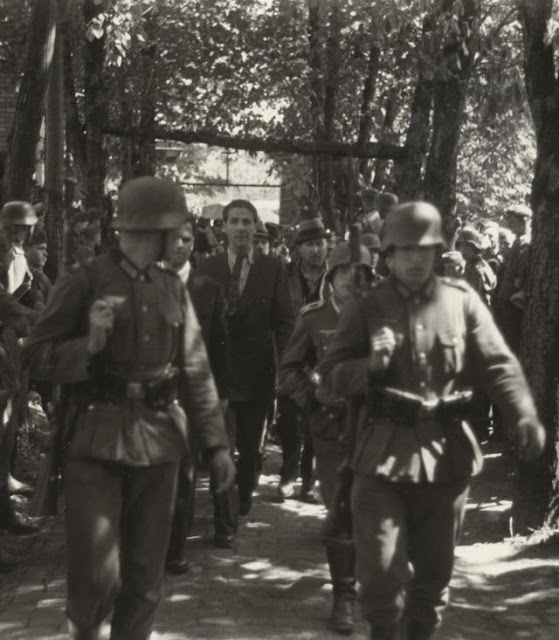
The Pancevo executions are carried out. Soldiers of the German Wehrmacht had rounded up 36 Serbian civilians at random in the Yugoslav city of Pancevo, in Vojvodina. These were now executed in public, as supposed reprisal for the killing of two SS officers by partisans. The killings were photographed by German Wehrmacht photographer Gerhard Gronefeld. He called it the “most terrible scene, which I photographed ever. Those eyes, those eyes. They will never give me peace” Suspecting that his photos of the killings would likely be destroyed, Gronefeld never turned them over to his superiors. Nor was he asked for the photos. Gronefeld says he kept the pictures because he wanted to someday tell the world what happened at Pancevo. After 18 died on the gallows, the remainder were taken to the cemetery wall and executed by firing squad. Gronefeld photographed a soldier who drew his pistol and finished off a wounded victim. “They were completely innocent of any wrongdoing,” he said in an interview in 1997. The Pancevo executions were the first in a series of German and Axis massacres of civilians that would occur in Axis-occupied Yugoslavia during World War II.
What happened at Pancevo, Serbia today is extremely murky and controversial. A few facts seem ascertainable:
18 people were shot, apparently at the Orthodox Cemetery
18 people were hanged, allegedly by ethnic German civilians
Why exactly half were hung and the others shot is unclear.
The names of those hung: Milanović Milan, Milivojevic Milutin, Cadik Jacob, Koceš Franja, Caran Milorad, Azick Pera, Mirđić George, Žestić Vladimir, Maxine Jovan, Topolovački Alexander, Skovran Mirko Ristic, Ljubomir Jeftic Milenko, Adamović Jovan Stojkov Dusan, Radak Kosta, Cosic Taja, Šiškulović Darinka (all from Pancevo, except for Milivojevic, who was from Omoljica near Pancevo).
The names of those shot: Humanović Tihomir, Grobanović Ivan, Tešanović Gojko, Pantelić Sava, Hadžić Dušan, Grujuć Đura, Haker Šandor, Markov Toma, Perić Steva, Crni Đura, Novak Marijan, Milenković Dragutin, Nedić Pera, Dimković Tihomir, Atanacković Draga, Atanacković Radivoj, Avramov Vasa, Pinter Stevan (All from Pancevo).
Beyond that, historians disagree. The incident was meticulously documented by filmmaker Gottfried Kessel of the Grossdeutschland Division and photographer Gerhard Gronefeld.
Some claim that it was pure butchery by the Germans.
Others claim that the Germans executed armed partisans after a lawful (if extremely brief) trial presided over by an SS man, SS-Sturmbannführer Rudolf Hoffmann of the SS Das Reich Division. Allegedly, the partisans had been firing on the Wehrmacht soldiers and were executed according to the norms of international law.
Drawing any firm conclusions as to guilt or legality is impossible. Going beyond these sketchy facts is dangerous and involves assumptions. The only firm conclusion is that the incident happened, and about 36 people died by hanging or firing squad.
There are streets named after two of the people killed, Vladimir Žestić and Jovan Maksin. Otherwise, the massacre has received little notice, then or now. A perfunctory German investigation after the war by state attorneys in Munich and Darmstadt allegedly was closed without any charges being brought. Beyond that, everything is speculation or disputed evidence. But… something bad happened in Pancevo.
The Greek government, including King George, departs from Greece on 22 April 1941 aboard Greek destroyer Vasilissa Olga, bound for Suda Bay. The Germans begin absorbing their conquests in the Balkans by creating the Territory of the Military Commander in Serbia.
The Italians remain violently upset that they have been excluded from the surrender of Greek forces in Albania. In fact, they open an offensive on the Epirus front, where the Greeks fight back and, following the established pattern, give little ground and inflict heavy casualties on the Italian attackers.
Hitler — conflicted between his roles of military warlord and statesman — tries to placate Mussolini. He has his military headquarters (OKW) rush a draft of the surrender terms to Rome to “keep Italy in the loop.” Mussolini, however, loudly proclaims that Italy could have defeated Greece by itself and demands to be included in the setting of any surrender terms. After looking over the OKW agreement, he objects to provisions allowing Greek officers to keep their sidearms because they have humiliated the Italian troops. The Germans — meaning Hitler — reject Mussolini’s quibbles on that one score, but basically give him everything else that he wants. This includes handing over the entire Yugoslav and Greek navies to Italy (which admittedly are not that large).
A surrender conference begins late in the day at Salonika (Thessaloniki). The Germans agree to an Italian demand that Axis troops stage a ceremonial entry into Athens with German and Italian troops marching side-by-side. The Italians — meaning Mussolini — also demand that the Greeks offer to surrender to them on the Epirus front before they will sign any surrender documents. The Germans are uncertain how to respond to this — Hitler briefly considers letting the Italians fight on — but the Greeks agree to surrender to Mussolini’s generals as well as the German ones.
The New Zealand 4th Infantry Brigade begins the withdrawals from the Thermopylae Line. The British 1st Armoured Brigade also heads south towards Athens. The RAF withdraws its last fighters from Athens to a base at Argos further south. German forces reach the Thermopylae position in Greece.
German aircraft attacked British-controlled airfields near Athens, Greece, forcing remaining British fighters in the region to be withdrawn to Argos in southern Greece. In the Saronic Gulf, German dive bombers sank Greek minelayer Aliakmon, hospital ship Sokratis, 11 freighters, and 1 tanker. At 1800 hours, 35 German dive bombers sank Greek destroyer Hydra at Piraeus; 41 were killed, 115 survived. Further south, German aircraft damaged cruiser HMS York at Suda Bay, Crete with near misses. Finally, on the same day, Yugoslavian torpedo boats Kajmakcalan and Durmitor arrived at Suda Bay and joined the Allied fleet.
The evacuation of Allied troops from Greece begins. The evacuation marked the end of the ill-conceived Greek campaign which lasted only three weeks and saw the Allies retreat ever southwards in the face of the German advance until they were evacuated at the end of April.
British Prime Minister Winston Churchill sends a message to Middle East Commander General Archibald Wavell telling him, regarding the evacuation from Greece:
“In the execution of this policy you will no doubt not worry about vehicles or stores, but get the men away. We can re-arm them later.”
The main problem for the Allied troops in Greece is that their left flank was supposed to be defended by Greek troops, but the Greek Army for all intents and purposes has been prevented from doing that. The campaign is turning into a race for the ports that the British can use to evacuate their troops, with the Germans hurrying toward the Gulf of Patras in order to cross over to the Peloponnese and shut off escape routes there.
Skirmishing continues on the Tobruk perimeter, with the Allied troops focusing on the Italian troops. At dawn, the British send armored vehicles against the 5th Light Division. Australian soldiers of the 2/48th Battalion, including three tanks and 25-pounder artillery, mount a raid southwest of Ras el Medauar. The Fabris detachment holding a hillock there loses 370 men as prisoners and 2-4 guns. A company of the 2/23rd Battalion advance toward Derna and takes about 100 prisoners of the Italian 27th Infantry Division “Brescia.” The German war units note, “The Italians are surrendering.” 27 Australians were killed and 28 were wounded in this action.
British warships bombarded Tripoli, Libya. On the return trip, battleship HMS Valiant hit a mine and was lightly damaged.
Churchill sends a message to Middle East Commander General Archibald Wavell in which he confirms that the Royal Navy will deliver “307 of our best tanks through the Mediterranean… around May 10.” This is Operation Tiger. Churchill notes that “99 are cruisers Mark IV and Mark VI… and 180 I tanks.” He asks for a “plan for bringing these vehicles into action at the very earliest moment” and adds, hopefully:
“If this consignment gets through the hazards of the passage, which, of course, cannot be guaranteed, the boot will be on the other leg and no German should remain in Cyrenaica by the end of the month of June.”
Of course, the Germans continue to reinforce their troops in Libya, too, with elements of several units of Infantry Regiment 19 arriving. An arms race is developing in North Africa with a very uncertain outcome.
Churchill also memos CIGS Sir John Dill, stating that it is the War Office’s estimation that the British/Australian Tobruk defenders “are four or five times as strong as the besiegers,” adding somewhat characteristically that “some of them are Italians.” The War Office estimates that there are 4500 Axis troops besieging Tobruk.
Visiting Australian Prime Minister Menzies notes in his diary that “Bombardment of Tripoli not, I think, a great success, but some damage done.”
Lieutenant General Erwin Rommel (who is awarded the Gold Medal of Military Valor in Silver today) drives to Acroma to assess the situation. He orders the Italian Trento Division to take over for the mauled Fabris detachment. The report notes (apparently based on Rommel’s inspection) that the Italian troops simply abandoned their guns and other equipment “undamaged” when surrendering and did not even take out their breechblocks. It is standard procedure in all armies to disable artillery when abandoning it to take out the breechblocks.
Rommel continues to assemble his forces for a massive set-piece battle to take Tobruk. The 15th Panzer Division continues to assemble in Tripoli, and the Allied attempts to break out of Tobruk give him a sense of urgency to move his troops across Libya for that purpose.
Australian Private Ron Daniels, the gunner on a Bren-gun carrier, continues firing after his commander, Sergeant Len Batty, is wounded during one of the morning skirmishes. Daniels himself also is wounded and receives the Military Medal for his heroism.
British 1st South African Brigade captured Camboicia Pass, Abyssinia and 1,200 Italian prisoners of war. This is a major step on the road to Dessie, one of the main Italian strongholds in the country.
Tensions are simmering in Iraq. The British hold several bases, including the port of Basra and the airfield at Habbaniyah, while the pro-Axis government of Rashid Ali controls the rest of the country. The Iraqis surround the British base at Habbaniyah. They also cut some oil pipelines. As yet, despite demands from both sides to the other to abandon their positions, there has been no fighting.
Erich Raeder reported to Adolf Hitler regarding American belligerency despite of neutrality pledges.
Erwin Rommel received the Gold Medal of Military Valor in Silver.
British tank regiments armed with Cruiser-type tanks have been re-organized as more effective fighting units. In future they will have their own support arms in the front-line, including motorized infantry, combat engineers, artillery, anti-aircraft and anti-tank units. It is the sort of mixture which has given such strength to the German Panzer divisions. The government believes that Cruisers — Crusaders, Cavaliers or Cromwells — are as good as anything that the Germans or Italians can put into the field.
The Soviet Union protested to Germany regarding border violations by German troops and aircraft. Among the evidence presented was a downed German aircraft in Soviet territory which contained maps of the Soviet Union, aerial photographic equipment, and rolls exposed film. The Soviets, however, remained generally friendly toward Germany.
In the Plymouth Blitz, the communal air-raid shelter at Portland Square took a direct hit which killed 72 people. The Plymouth Blitz continues with another classic Luftwaffe all-night raid. This continues the devastation of the center of town. A direct hit on a communal air-raid shelter at Portland Square kills 72 people inside. The raid damages three Royal Navy ships in drydock at the Devonport facility:
cruiser HMS Kent;
destroyer HMS Lewes;
destroyer HMS Leeds.
RAF Bomber Command: Day of 22 April 1941
14 Blenheims on coastal sweeps off Norway. 3 aircraft bombed a cargo ship, scoring one hit. No losses.
RAF Bomber Command: Night of 22/23 April 1941
Brest
24 Wellingtons and 2 Stirlings; the warships were not located because of intense Flak and searchlights. 1 Wellington lost 6 Hampdens minelaying off Brest; no losses.
The Luftwaffe engages in major raids throughout the Aegean against Allied shipping and sinks numerous ships throughout the region, almost all Greek ships. With the Wehrmacht grinding forward on the mainland, the Luftwaffe aims to cut off the British escape route to Crete and Alexandria.
The Luftwaffe bombards Tobruk with about 30 Junkers Ju 87 Stukas.
The Luftwaffe (Junkers Ju 87 Stukas) bombs and holes British hospital ship Vita off Tobruk. The ship sinks after destroyer HMAS Waterhen takes off 486 people (including 6 nurses). The Luftwaffe also bombs and sinks 1134 ton Greek hospital ship Sokratis off Antikyra, Gulf of Corinth.
Around 20:30, the Luftwaffe sends a very large air raid after dark on Valletta, the surrounding area, and RAF airfields. The attack destroys 40 homes and kills about six people. The attack is very professional, with pathfinders dropping flares on a moonless night. The Luftwaffe escapes without loss.
Light cruiser HMS Birmingham arrived at Scapa Flow at 0602 after being away on escort duties since 8 February.
The flag of CS 10 was transferred from base ship HMS Dunluce Castle to light cruiser HMS Nigeria at Scapa Flow.
Convoy OB.313 departed Liverpool, escorted by corvette HMS Alisma. On the 23rd, destroyers HMS Keppel, HMS Lincoln, HMS Sabre, and HMS Sherwood, sloop HMS Fleetwood, corvettes HMS Dianella, HMS Kingcup, and HMS Sunflower, and anti-submarine trawlers HMS Lady Elsie, HMS Northern Dawn, and HMS Wellard. On the 27th, the escort, except destroyers Lincoln and Sherwood and corvettes Alisma and Sunflower, were detached. The remaining escort was detached on the 28th when the convoy dispersed.
Destroyers HMS Walpole and HMS St Albans departed Sheerness at 0950 to work up at Scapa Flow. The destroyers arrived at 1500/23rd.
Destroyers HMS Achates and HMS Anthony departed Scapa Flow at 1600 for Loch Alsh, arriving at 2200. At 0930/23rd, minelayers HMS Southern Prince, HMS Menetheus, and HMS Port Quebec, escorted by destroyers HMS Achates, HMS Anthony, HMS Brighton, and HMS St Marys departed Loch Alsh for minelaying mission SN.71. The operation was covered by light cruisers HMS Kenya and HMS Edinburgh from the Iceland — Faroes patrol. Destroyers HMS Cossack and HMS Zulu departed Hvalfjord at 0100/25th to carry out an anti-submarine sweep in the line of advance of the minelayers. On completion of the sweep, destroyers Cossack and Zulu relieved destroyers Anthony and Achates at 1300 which proceeded to Reykjavik. British minefield SN.71 was laid on the 26th. The cruisers, after the minelay, they proceeded to Scapa Flow arriving on the 29th. Destroyers Cossack and Zulu arrived at Scapa Flow at 2130/29th after the duty.
Anti-aircraft ship HMS Alynbank departed Scapa Flow at 1500 to join convoy WN17 in the Pentland Firth. Fog delayed the arrival of the convoy and the ship arrived back at Scapa Flow at 1830. Destroyer HMS Lewes was damaged by bombing at Devonport. The destroyer was not restored to service until February 1942.
British steam barge Coronation of Leeds (87grt) was lost on a mine off Thames Haven. The crew of three were all lost. The afterpart of the barge was raised on 5 September 1941.
British steamer Antonio (5225grt) was damaged by German bombing off T2 Buoy, Tyne. The steamer arrived at Shields on the 23rd in tow.
British steamer Croham (391grt) was damaged by German bombing at Peterhead.
Salvage vessel Miss Elaine (364grt) was sunk by German bombing at Plymouth. The vessel raised on 14 May and repaired at Southampton.
German steamer Obra (551grt) was sunk on a mine off Greifswald.
Battleship HMS Nelson was docked for refitting at Durban.
British hospital ship Vita was badly damaged by German Stuka bombers off Tobruk. Australian destroyer HMAS Waterhen attempted to tow the ship without success. The destroyer took off 437 patients, six doctors, six nurses, and 47 sick berth ratings to Alexandria.
Greek destroyer RHS Hydra, which had recently departed Piraeus as escort for an Alexandria convoy, was sunk by German bombing off the Island of Aegina. Greek destroyer RHS Leon was badly damaged by German bombing at Suda Bay.
Greek torpedo boat RHS Thyella was sunk in Vouliagmeni Bay and torpedo boat RHS Kios was sunk by German bombing the Gulf of Athens.
From 22 to 25 April, Greek torpedo boats RHS Aigli, RHS Alkyone, RHS Arethousa, and RHS Doris were sunk in the Gulf of Athens by German bombing.
Convoy AG13 with troopship Ulster Prince and commanding landing ships Glengyle and Glenearn departed Alexandria at noon for Suda Bay escorted by Australian destroyers HMAS Stuart and HMAS Voyager. Convoy AG13 proceeded directly to the beaches at Raphtis and Nauplia for Operation DEMON.
Minesweepers HMS Aberdare, HMS Harrow, and HMS Widnes, from the East Indies Station, arrived at Alexandria for duty with the Mediterranean Fleet.
Greek steamer Athinai (968grt) was sunk by German bombing in Itea Harbour.
Greek steamer Avlis (223grt) was sunk by German bombing at Raphina.
Greek steamer Aghios Markos (4514grt) was sunk by German bombing at Peristeri (Salamis Island).
Greek steamer Frinton (1361grt) was sunk by German bombing at Megalo Lefko.
Greek steamer Ioannis Nomicos (637grt) was sunk by German bombing near Rhion, Gulf of Corinth.
Greek steamer Pancration (2171grt) was sunk by German bombing at Milos.
Greek hospital ship Sokratis (1134grt) was sunk by German bombing at Antikyra, Gulf of Corinth.
Greek tanker Thedol 2 (657grt) was sunk by German bombing at Antikyra, Gulf of Corinth.
Greek tanker Theodora (1054grt) was near missed by a German bomb at Antikyra, Gulf of Corinth. This near miss killed the Master and twelve crewmen. The remainder of the crew attempted to move the tanker away from burning Thedol 2. However, Theodora also caught fire and was lost.
Greek steamer Thraki (1511grt) was sunk by German bombing near Sombraina, Gulf of Corinth.
Greek steamer Thassos (1565grt) was sunk by German bombing at Megara.
Greek steamer Teti (2747grt) was badly damaged by German bombing in Greek waters. The steamer was grounded to avoid sinking.
Greek steamer Messarya Nomikou (985grt) was sunk by German bombing at Nafpactos. The steamer was salved by the Germans for their use.
Greek steamer Sifnos (315grt) was sunk by German bombing at Suda Bay. The steamer was salved by the Germans for their use.
Greek destroyer RHS Vasilissa Olga departed Greece with the King of Greece and the government. The destroyer safely arrived at Suda Bay.
Yugoslav torpedo boats Kajmakcalan and Durmitor arrived at Suda Bay after escaping from Yugoslavia, via Navarino Bay.
Heavy cruiser HMS York and netlayer HMS Protector, assisting damaged heavy cruiser York, was damaged by near misses of German air bombs at Suda Bay. A lighter A16 (T/Boatswain E. J. Boisell) alongside the cruiser was also damaged. The lighter was scuttled on 2 June.
Convoy ANF.29 departed Alexandria for Suda Bay with Dutch steamer Pennland (16,082grt) and British steamers Thurland Castle (6372grt) and Delane (6054grt). The convoy was escorted by anti-aircraft cruiser HMS Coventry and destroyers HMS Wryneck and HMS Diamond. Landing ship Glenroy had run aground leaving Alexandria in Boghas Pass on the 20th. Her beach party was transferred to steamer Thurland Castle. Destroyer HMS Griffin joined the convoy at sea. Convoy ANF.29 arrived at Suda Bay on the 25th. Two A lighters departed Alexandria for Suda Bay escorted by two anti-submarine trawlers.
Submarine HMS Regent departed Malta on the 17th for Kotor in hopes of effecting a rescue of the British Minister to Yugoslavian and British civilians. Lt D. Lambert was sent ashore to contact the British Minister, but taken prisoner. He was later exchanged on 11 December for the Italian officer taken on board Regent when Lambert had been sent ashore. Departing the area, submarine Regent was damaged by a near miss of an air bomb. Lt E. T. Stanley was seriously wounded. The commanding officer, Lt Cdr H. C. Browne, and a rating were seriously wounded by machine gun fire from the shore. The submarine arrived back at Malta on the 27th.
Yugoslavian steamer Serafin Topic (4294grt) was interned by Algerian authorities at Oran. The steamer was renamed Cosalla for Italian use.
French submarines Orphee, Meduse, and Antiope departed Casablanca, escorted by minesweeper La Boudeuse. The ships passed Gibraltar on the 23rd and arrived at Oran on the 24th. Submarines Orphee and Meduse were placed in caretaker status at Oran. They relieved submarines Diane and Eurydice which departed Oran, with submarine Antiope on 10 May and arrived Toulon on 14 May.
In Washington, President Roosevelt conferred with Mayor La Guardia of New York, Henry Kaiser, Pacific Coast steel manufacturer; Senator Murdock, Utah Democrat; Wayne Coy, assistant Federal security administrator; Harold D. Smith, Director of the Budget; Secretary Stimson; Sumner Welles, Undersecretary of State, and Bernard M. Baruch. He sent to the Senate the nomination of James C. Capt to be Director of the Census.
The Senate received the Taft bill for creation of a War Resources Administration and the McCarran resolution for vocational training of Civilian Conservation Corps enrollees in subjects bearing on national defense and adjourned at 12:24 PM until 11 AM Friday. The Defense. Investigation Committee heard General George C. Marshall, Chief of Staff, on the Army expansion Program.
The House heard discussion of the coal strike situation and adjourned at 1:30 PM until noon tomorrow. The Ways and Means Committee received Treasury recommendations for the new tax program.
U.S. Army officials were reported today to be considering a plan to induce thousands of selective service trainees to remain in uniform voluntarily for two years beyond the compulsory one-year period. The proposal, army men said, might involve increasing the total land forces beyond the present goal of 1,418,000 men by mid-1941. Some senators said they had heard unconfirmed reports that the army might seek legislation to keep the trainees in training “for the duration of the emergency.”
A system of greatly increased income taxes, providing an effective levy of 16.5 percent on the lowest tax bracket, was disclosed today to be part of a treasury program for raising $3,600,000,000 in new revenue The present effective rate is 4.4 percent, including a defense “supertax” amounting to 10 per cent of the normal levy of 4 per cent of taxable income. The new system, built around steeply increasing surtaxes and estimated to produce $1,517,100,000, would boost to $72 the income levy of a childless married couple with an earned net income of $2,500. Such a couple now pays $11. The treasury summary, as made public today, would continue the 4 percent normal tax but would add to it surtaxes starting at 11 per cent on the first $2,000 of taxable income. To the sum of the normal taxes and surtaxes would be added the 10 percent supertax. In other words, to this 15 percent total would be added a 1.5 supertax, making a grand total of 16.5 percent. At present the surtax is applicable only to income above $4,000, and the first surtax bracket from $4,000 to $6,000 of taxable income is only 4 percent plus the supertax. Taxable income is income remaining after deduction of contributions to church and charity, tax and interest payments and the fixed exemption of $800 for single persons, $2,000 for married persons and $400 for each dependent. These exemptions would continue as at present, under the department’s outline.
Gravely confident in the face of allied reverses in the Balkans, President Roosevelt said today the war would not be won by any single battle, but by maintaining England as the defender of democracy abroad. In the light of history, he said at a press conference, the American people should not go to a pinnacle one day because of a British victory in the Mediterranean, and then sink to the depths of despair the next on word of a Nazi victory.
President Roosevelt conferred on the national home defense program and other undisclosed matters with Mayor La Guardia of New York today. The Mayor canceled an appointment in Ottawa to fly to Washington at President Roosevelt’s request.
While American Institute of Public Opinion surveys show that 50 percent of the voters think the navy should not be used to convoy, 41 percent are for convoys, and 9 percent are undecided, the surveys have revealed also that 71 percent would favor convoys if British defeat seemed certain without them.
Colonel Charles A. Lindbergh will address a rally tomorrow night at Manhattan Center, 311 West Thirty-fourth Street, in New York for the declared purpose of arousing public sentiment against the possible use of naval convoys for British supplies and the sending of another expeditionary force abroad.
Leon Henderson, making his first public speech last night since his appointment April 16 as Federal Price Administrator, said that the defense program, of which he is one of the chief executives, was far too small in fighting planes, pilots, shipping and ordnance.
The Vinson bill to “freeze” labor at the status quo during the emergency and provide a twenty-five-day “cooling off” period before defense strikes, will be brought to the House floor on Monday, Representative McCormack, majority leader, said today. His announcement was made after Speaker Rayburn told reporters that he expected the proponents to be “practical” and not let the measure stand or fall on its provisions outlawing new closed shops in defense plants during the emergency.
Completion within six weeks of the first test unit of an experimental in-line, liquid-cooled aircraft engine which may break four bottlenecks in the mass output of American airplane engines is forecast by engineers of the Ford Motor Company.
Colonel Gerald Brower, United States military and air observer with the Royal Air Force in the Middle East, was killed on Sunday at El Obeid, 250 miles Southwest of Khartum, according to a report received by the State Department today from Alexander Kirk, the United States Minister in Cairo. No details were given.
Thomas H. Beck, Chairman of the Board of Crowell-Collier Publishing Company, submits to President Roosevelt a proposal for the organization of a private air force. Beck’s submission advocates a course of pre-flight instruction for men interested in the air force. This is a key step in the formation of the Civil Air Patrol (CAP), which is designed to be an Auxiliary of the US Army Air Corps.
The U.S. Congress passed an act that would increase the authorized enlisted strength of the US Navy and the US Marine Corps; the latter’s active list was to be 20% of the former. The authorized enlisted strength of the U.S. regular Navy was increased to 232,000 men.
Major League Baseball:
The Phillies, with the aid of exceptional pitching, broke their six-game losing streak the hard way today by topping the Boston Bees, 6–4, in a fourteen-inning battle. Tom Hughes got the win in relief and also scored the winning run.
Johnny Vander Meer of Cincinnati, showing his best form since his dazzling no-hit triumphs of 1938, struck out twelve Cubs today and yielded only four hits to blank them, 1–0. The Reds get their lone run on an infield single by Bill Werber, two wild pitches, and an RBI single by Ival Goodman.
Left on bases: St. Louis 2, Cleveland 7. That was the story of Elden Auker’s 8–3 triumph over the Indians today for his second straight success of the season. The Browns’ submarine ball hurler was aided by timely hits against Lefty Al Milnar as he exerted his usual mastery over Cleveland.
Bill Dietrich, 31-year-old White Sox pitcher, stood at the door of baseball’s Hall of Fame a second time today only to have Hank Greenberg and Rudy York of the Tigers slam it shut in his face and force him to settle for a 6–3 victory.
The Brooklyn Dodgers beat the New York Giants, 7–4, to take the rubber match of the three-game series. Hugh Casey holds the Giants to one hit over the first five innings, leading 5–0, before New York closes to within 5–4. Dolf Camilli singles in two insurance runs for Brooklyn in the ninth.
The Yankees got homers by Bill Dickey, Tommy Heinrich, and Charley Keller, but the Philadelphia Athletics got the win, 6–5, scoring five runs in the sixth to tie it, and one in the ninth to decide the contest.
The Cardinals refused to give up today and after coming from three runs behind to tie the score in the ninth inning went on to defeat the Pirates, 9–8, in the twelfth. Bill Moore doubled in a run to tie it in the 12th, then Enos Slaughter singled him home to win it.
The Senators, playing the role of giant killers for the second time in a row, unleashed a 15-blow attack to defeat Boston, 12–5, today, while young Walter Masterson held the league-leaders in check after a shaky start.
Philadelphia Phillies 6, Boston Bees 4
Cincinnati Reds 1, Chicago Cubs 0
St. Louis Browns 6, Cleveland Indians 3
Chicago White Sox 6, Detroit Tigers 3
Brooklyn Dodgers 7, New York Giants 4
New York Yankees 5, Philadelphia Athletics 6
Pittsburgh Pirates 8, St. Louis Cardinals 9
Boston Red Sox 5, Washington Senators 12
Japanese forces occupy Foochow (Fuzhou), China. United States Consul Robert S. Ward radioed the United States Embassy in Chungking from Foochow yesterday that the Japanese had entered that city and that all of about fifty Americans there were safe.
Yugoslavian steamer Tomislav (5387grt) was seized by Italian Marines at Shanghai. The ship was renamed Venezia Giula for Italian use and was later transferred to Japan as Teian Maru.
Japanese Foreign Minister Yosuke Matsuoka returns from Europe and says, “We should not confuse deliberation with procrastination just as the Tripartite Pact does not affect the relations of the Three Powers vis the Soviets so that the Soviet-Japanese Neutrality Pact and the declaration do not affect in the least the Tripartite Pact which remains the immutable basis of our foreign policy.” Welcomed home like a victor entitled to the thanks of the nation, Foreign Minister Yosuke Matsuoka returned to Tokyo by air this afternoon. He enjoyed a rousing reception by the government, the army, the people and the press.
The ABD Conference continues in Singapore to develop a coordinated plan in case of Japanese attacks. Participating are military officials from Great Britain, the Netherlands (who control powerful naval forces in the Dutch East Indies) and the United States. The British are nonplussed by the low-level participants that the United States has sent.
2,000 American troops arrive to reinforce the U.S. Army’s Philippine Department.
In his diary entry for 22 April 1941, Australian PM Menzies refers cryptically to “malcontents” back home in Australia. Churchill calls Menzies and remonstrates with him about negative press commentary about the war situation emanating from Australia. Some politicians there in Menzies’ own party are upset that he is spending so much time in Britain.
Dow Jones Industrial Average: 115.78 (-0.28)
Born:
Steve Jones, MLB pitcher (Chicago White Sox, Washington Senators, Kansas City Royals), in Huntington Park, California.
Died:
(Arthur) “Dooley” Briscoe MC, 30, South African cricket batsman (2 Tests; Transvaal) and soldier (Military Cross, 1941), dies in action in Ethiopia
Naval Construction:
The Royal Navy M 1-class minelayer HMS M 6 (M 94) is laid down by George Philip & Sons Ltd. (Dartmouth, U.K.).
The U.S. Navy 77′ Elco patrol motor torpedo boat USS PT-39 is laid down by the Electric Launch Company Ltd. (Elco), (Bayonne, New Jersey, U.S.A.).
The Kriegsmarine (German Navy) Type VIIC U-boat U-611 is laid down by Blohm & Voss, Hamburg (werk 587).
The Royal Australian Navy Bathurst-class minesweeper-corvette HMAS Geelong (J 201) is launched by the Williamstown Dockyard (Williamstown, Victoria, Australia).
The Royal Navy Dance-class ASW trawler HMS Tango (T 146) is commissioned. Her first commanding officer is T/Lieutenant John Hunter, RNR.
The U.S. Navy Gleaves-class destroyer USS Wilkes (DD-441) is commissioned. Her first commanding officer is Lieutenant Commander John Donald Kelsey, USN.
 History Diaries