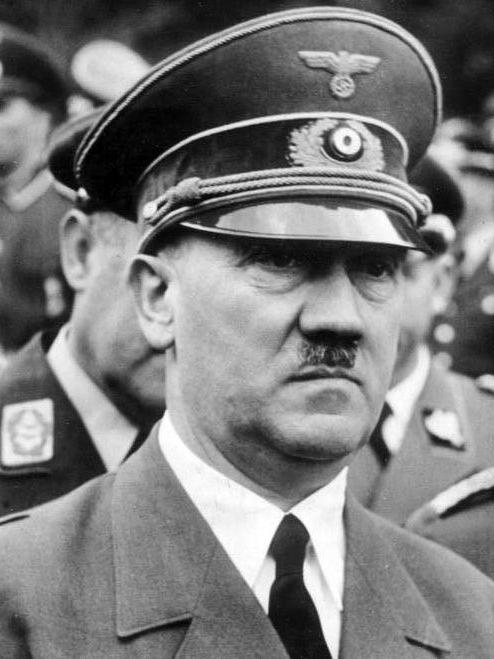
Today is Adolf Hitler’s 52nd birthday. Adolf Hitler celebrated his birthday at the temporary headquarters Frühlingssturm in eastern Austria. Looking over his long, strange life, this marks the one where he is at the peak of his success, the only real contender being 20 April 1939 when he presided over a nation still not engaged in a perpetual shooting war. As of today, Germany has conquered France, Hitler’s dream since his days in the trenches during World War I, and he has the British on the run both in North Africa and Greece. There are no issues in any campaign, as there will be on subsequent birthdays, no worries about his forces being outmatched by the forces arrayed against him. Indeed, he receives a welcome birthday present with the surrender today of the main Greek army. Hitler can pick and choose his enemies and battles like a medieval warlord — and therein lies the danger.
Not everything is rosy. Two strategically vital nations on the periphery of his empire — Turkey, and Spain — refuse to join in his coalition, and they present too much danger along with too little potential benefit to invade. England may be reeling on land and at sea, but in the air, it remains supreme despite the nightly Luftwaffe bombardments of English cities. The RAF is starting to become annoying, too, as evidenced by the recent destruction of the Berlin Opera House. Any invasion of England is completely off the table.
However, as of 20 April 1941, Adolf Hitler is the master of continental Western Europe. The decisions that Adolf Hitler makes over the course of the next year will determine his — and Germany’s — fate.
Italian Foreign Minister Count Galeazzo Ciano meets with Hitler at the temporary Fuehrer headquarters Frühlingssturm in eastern Austria, no doubt to convey birthday greetings. Of course, they also have serious business to discuss regarding the situations in Greece and North Africa.
The commander of the Greek forces in Albania, General Georgios Tsolakoglou, realized the hopelessness of the situation and offered to surrender his Greek Epirus Army, which then consisted of fourteen divisions. Tsolakoglou was so determined to deny the Italians the satisfaction of a victory he felt they had not earned that he opened an unauthorized parley with the commander of the German Leibstandarte SS Adolf Hitler Regiment opposite him, SS Obergruppenführer Josef “Sepp” Dietrich, to arrange a surrender to the Germans alone. On strict orders from Hitler negotiations were kept secret from the Italians, and the surrender was accepted. Outraged by this decision Mussolini ordered counterattacks against the Greek forces, which were repulsed. It took personal representation from Mussolini to Hitler to bring together an armistice in which Italy was included on April 23.
The events leading to the surrender involve feats of great daring. Sturmbannfuehrer Kurt “Panzer” Meyer leads his LSSAH men in a surprise attack on the headquarters of the 3rd Greek Army Corps, and 12,000 Greek soldiers surrender to him. Sepp Dietrich personally drives to the Greek headquarters near Ioannina and negotiates terms with the Greek General Tsolakoglu. Dietrich consents to Tsolakoglu’s request that the Greek officers be allowed to retain their sidearms and return home — a mark of respect previously offered by the Germans to officers in Norway, too. Dietrich later recalls the capitulation as marking the greatest day of his life. Tsolakoglu, for his part, wants to surrender to the Germans rather than the Italians as a subtle mark of contempt for Mussolini’s unsuccessful troops. The surrender is a bit suspect because it purports to apply to all Greek forces on the mainland — including those behind British lines, at least theoretically.
The Greek high command in Athens is against this surrender and orders him not to sign the papers, an act scheduled for the 21st. Somewhat surprisingly, so is Benito Mussolini, who demands that the Greeks surrender to an Italian general. Out of spite or some other emotion, Mussolini orders his troops to accelerate their attacks against the Greeks — which achieves little. Many military incidents of World War II are like this, stemming from the bent emotions of some of the leaders.
The British digging in far to the south watch this with some bemusement. The British column passing through Thermopylae is ten miles long and being strafed by the Luftwaffe and Regia Aeronautica. The Italians have joined the pursuit, with the 4th Bersaglieri Regiment using flamethrowers to incinerate Greek bunkers — and those in them. An Italian war correspondent claims that the Greeks lose two entire regiments of Evzones (Greek soldiers), though such figures are often exaggerated in the heat of war.
General Freyberg’s 2nd New Zealand Division forms up at the historic pass of Thermopylae, while General Mackay’s 6th Australian Division focuses inland at the village of Brallos. Today, the British line encompasses Kalamata, Monemvasia, and Nauplia.
The air battle over Athens known as the Battle of Athens occurred. There is a major air battle over Athens that is so intense that it becomes known as the Battle of Athens. A very large formation of Bf 109s and 110s (accounts vary, estimates range up to 200) from 5,/ZG 26 and JG 27 escorting Junkers Ju 87 Stukas jumps about fifteen Hawker Hurricanes. The RAF loses five pilots and a total of 6-10 planes. The Luftwaffe losses are tremendous, some estimates place them over 20 planes. Author Roald Dahl and South African Squadron Leader ace Marmaduke “Pat” Pattle participate in this battle, with Pattle perishing. The RAF loses a dozen Blenheims on the ground at Menidi.
By some accounts, Pattle is the top-scoring British Commonwealth (and western ally) ace of the entire war, with 51 claims. He generally is acknowledged as having at least 24-40 kills and likely more, with 26 Italians and 15 achieved in Gloster Gladiators. Pattle is the top ace in victories achieved in Gladiator and Hurricane fighters (at least 35 in the Hurricane).
Luftwaffe aircraft bombed and sank the Greek passenger ship Ithaki in Souda Bay and the Greek destroyer Psara in the Saronic Gulf.
The Greek destroyer Vasilefs Georgios was scuttled in the Salamis Naval Base to prevent capture. The Germans later raised it and put it into service as Hermes.
General Kurt Student, leader of the new XI. Fliegerkorps of the Luftwaffe which took under its control all air transport units, suggests to Göring that an attempt be made to invade Crete from the air. Looking far ahead, Lieutenant General Kurt Student, commander of the XI. Fliegerkorps (German Airborne troops), approaches Reichsmarschall Hermann Göring with a proposition. So far, General Student’s Fallschirmjäger (paratroopers) has had a mixed record. They successfully completed the capture of the Belgian fortress of Eben Emael in May 1940 but had great difficulties near Rotterdam (where Student had been shot in the head). General Student is eager to prove the worth of his airborne troops (which include glider forces), so he points to the map at an objective not yet contemplated by the Oberkommando der Wehrmacht (OKW): the island of Crete. He proposes to take it via aerial assault.
Göring is interested because he wants to embellish his own prestige, which has slipped somewhat following the lost Battle of Britain. He brings General Student in to meet Hitler, who essentially approves the concept. This idea eventually will blossom into Unternehmen Merkur — Operation MERCURY.
The Germans in their daily summary of operations that the British attempt to land troops at Bardia during the night failed miserably, and that they took 56 soldiers and four officers prisoner. There are a few other minor skirmishes along the Tobruk perimeter, along with heavy bombing. The Germans are preparing a “decisive attack” against the port.
Churchill, having received a pessimistic appraisal from Middle East Commander General Archibald Wavell, is extremely concerned about the German advantage in tanks in Libya, so in a memo that he reads to General Ismay in person, he makes a daring proposal: send at least 250 tanks on fast transports directly through the Straits of Gibraltar to the British forces in Egypt. Many of these tanks already are loaded on ships and designated for convoy WS (Winston Special) 7 (Churchill adds another ship). This would be much quicker than using the normal route around the Cape of Good Hope — but also much more dangerous due to Axis attacks. General Ismay immediately gathers his staff together and later recalls that, while the Chiefs of Staff initially opposed the idea due to safety concerns, “opposition petered out” after “a very long meeting.” The plan immediately acquires the code Operation TIGER.
The South African 1st Infantry Brigade continue up the road to Dessie. The Indian 29th Infantry Brigade advances south toward Amba Alagi to meet them. The Italians under the General Frusci group in Cambolcia Pass as a blocking point.
Grand Admiral Erich Raeder attempted to convince Adolf Hitler to allow German submarines to attack American ships; Hitler rejected the request, citing his unwillingness to provoke the Americans to fully enter the war. The issue of unrestricted U-boat warfare remains a hot topic in Berlin. During World War I, the same arguments were made that the submarine fleet could strangle Great Britain if only allowed to torpedo U.S. ships as well. Admiral Raeder presses Hitler to allow his U-boats to sink U.S. ships. Hitler, however, demurs — he does not want to add the U.S. to Germany’s list of enemies, at least until the Japanese are in the conflict as well as a counterweight.
In one of those daring epics at which the British excel, SOE Captain Peter Morland Churchill (no relation) leads a group of three other men on a secret mission to the Bay of Antibes. Landing in folboats (kayaks), they rendezvous with François d’Astier de La Vigerie (Baron d′Astier de la Vigerie), aka “Bernard,” a stranded French general. Churchill and his men successfully rescue Bernard and take him aboard Royal Navy submarine HMS Unbroken.
Churchill memos Foreign Secretary Anthony Eden recommending that the government recognize the Czech government-in-exile in the same fashion as the British recognize the Polish government-in-exile. He pointedly cautions that “In neither case should we be committed to territorial frontiers.”
Irish Prime Minister Eamon De Valera gives a speech denouncing recent Luftwaffe raids on Belfast, stating among other things:
“…they are our people. We are one and the same people, and their sorrows in the present instance are also our sorrows.”
Of course, he is not upset enough to join the Allied war effort.
The British cargo liner Empire Endurance was torpedoed and sunk west of Rockall by the German submarine U-73.
British Prime Minister Winston Churchill memos Foreign Secretary Anthony Eden about the Iraq situation. He notes that, while the recent landings at Basra were made pursuant to the treaty:
“Our position at Basra… does not rest solely on the Treaty, but also on a new event arising out of the war.”
He notes that the British government does not owe any “undertakings” regarding troop movements to “a Government which has in itself usurped power by a coup d’etat.”
The bombing of London, England, United Kingdom which began on the previous date ended before dawn; 449 were killed. Via a speech made in Ireland, Irish Prime Minister Eamon De Valera protested the German bombing of Belfast, Northern Ireland, United Kingdom; “they are our people”, he said, “we are one and the same people, and their sorrows in the present instance are also our sorrows.” In honor of Hitler’s birthday, the Luftwaffe attacks London. They send 712 sorties (some planes make multiple sorties) which drop 1000 tons of bombs. The center of the attack is the London docks. Firefighters take a beating in this raid, losing 13 firefighters in London and 21 in Beckenham. The bomb that kills the firefighters hits a school at 01:53, which fortunately has no students in it at the time. Included in the deaths are two firewomen. This is the largest single loss of firefighters in British history. Council housing will be built on the spot in 1955, with each block of flats named after one of the Beckenham victims — one is called Vick House, another Beadle House, etc.
Heavy air raids wipe out an area of 600 yards radius around the Guildhall in Plymouth; medieval buildings simply vanished. In all 1,000 people have died, with 30,000 made homeless as 18,000 houses have been destroyed. However, Devonport dockyard — the bombers’ target — is still working. The Royal Navy is clearing the wreckage and the lord mayor and lady mayoress, Lord and Lady Astor have been raising morale. A band is playing on Plymouth Hoe for open-air dancing. At night 50,000 people leave Plymouth to shelter on the moors, in barns, in churches, even cow-sheds.
RAF Bomber Command: Day of 20 April 1941
22 Blenheims on coastal operations; 3 ships hit. No aircraft lost
RAF Bomber Command: Night of 20/21 April 1941
Cologne
61 aircraft — 37 Wellingtons, 12 Whitleys, 11 Hampdens, 1 Stirling. Weather conditions were unfavorable and it was a poor raid. 2 Hampdens and 1 Wellington lost.
Rotterdam
17 Wellingtons and 7 Whitleys attacked the oil-storage depot without loss.
9 Hampdens minelaying off Brest without loss.
At Malta, the Regia Aeronautica bombs Fort San Rocco around noontime. They lose three CR 42 fighters, maybe four, to defending Hawker Hurricane fighters, with all the Italian pilots perishing. Another raid overnight on Grand Harbour destroys several houses, killing a civilian.
U-73, commanded by Kapitänleutnant Helmut Rosenbaum, sank British steamer Empire Endurance (8570grt) in 53-05N, 23-14W. At 0332 hours on 20 April 1941 the unescorted Empire Endurance (Master William Willis Torkington) was hit amidships by one G7e torpedo from U-73 southwest of Rockall. The ship had been missed with one G7a stern torpedo 7 minutes earlier. She broke in two and sank after being hit underneath the bridge by a coup de grâce at 0357 hours. The motor launches HMS ML-1003 and HMS ML-1037 were lost with the ship. 39 crew members, two gunners and one passenger were lost. 18 crew members, two gunners and four passengers were picked up on 21 April by HMCS Trillium (K 172) (LtCdr R.F. Harris, RCNR) in position 52°50N/22°50W and landed at Greenock on 26 April. The corvette had searched in vain for the lifeboat in charge of the master with 28 occupants. On 9 May this boat was found by the British motor passenger ship Highland Brigade. However, the most survivors including the master had died of exposure and only seven crew members were still alive. Two of them died shortly after being picked up and another died in a hospital at Liverpool where the men were landed on 11 May. The 8,570-ton Empire Endurance was carrying general cargo, military stores, and two motor launches as deck cargo and was bound for Alexandria, Egypt.
Battleship HMS Rodney, arriving with convoy TC.10, rammed and sank anti-submarine trawler HMS Topaze (608grt, Chief Skipper G. R. Gale RNR) in an accidental collision off the Clyde. Gale, Skipper J. More RNR, and sixteen ratings were lost on the trawler.
During the night of 20/21 April, destroyers HMS Intrepid and HMS Icarus laid minefield HB in the English Channel.
Armed boarding vessel HMS Northern Sky attacked a submarine contact in 58-47N, 7-02W. Destroyer HMS Bedouin, HMS Arrow, and HMS Eskimo were sent to investigate a submarine contact reported by aircraft in 58-30N, 5-55W. However, before arriving, they were sent to assist armed boarding vessel HMS Northern Sky. The search was abandoned on the 21st when contact was lost.
British spritsail R. S. Jackson (60grt) was sunk by German bombing at London.
British barges Harry and Percy were sunk by German bombing at Nash and Miller Moorings, Shadwell, London. Both barges were raised and broken up.
On 20 and 21 April, a German tanker replenished Italian submarine Perla, supply ship Alsterufer, and armed merchant cruisers Atlantis and Kormoran at sea.
Greek destroyer RHS Psara was sunk by Italian air attack off Megara.
Greek destroyer RHS Vasilevs Georgios I was unsuccessfully scuttled in the floating drydock at Salamis. Intentions to sink the destroyer and drydock in deep water were cancelled when the dock was damaged in a bombing raid and could not be moved from its berth.
Minesweeper HMS Stoke, en route to Alexandria, was damaged by a near miss of German bombing. The damage required two weeks to repair.
British troopship Glenroy ran aground in Boghas Pass when leaving harbor and could not be refloated until 25 April.
Greek steamer Assimina Baika (1344grt) was sunk by German bombing at Politika, north of Chalkis.
Greek steamer Pteroti (176grt) was sunk by German bombing at Chalkis.
Greek steamer Moschanthi (311grt) was sunk by German bombing near Vostizza.
Greek tanker Chryssoroi (379grt) was sunk by German bombing at Phleva.
Greek steamer Ithaki (675grt) was sunk by German bombing in Suda Bay.
Light cruiser HMS Sheffield and destroyers HMS Faulknor, HMS Fortune, and HMS Wrestler departed Gibraltar to join aircraft carrier HMS Argus and heavy cruiser HMS London. The light cruiser and destroyers relieved the heavy cruiser and proceeded with aircraft carrier Argus to Gibraltar.
Corvette HMS Amaranthus departed Gibraltar for Freetown.
Convoy AS.26 of fourteen British and eleven Greek ships departed Athens early on the 20th escorted by anti-aircraft cruiser HMS Carlisle and destroyers HMS Isis and HMS Vampire, and arrived at Alexandria on the 23rd.
Convoy HX.122 departed Halifax, escorted by battleship HMS Ramillies, armed merchant cruiser HMS Alaunia, and corvettes HMCS Chambly and HMCS Orillia. The corvettes were detached later that day and the battleship on the 23rd. Destroyers HMS Broadway and HMS Bulldog., corvettes HMS Aubretia, HMS Hollyhock, HMS Nigella, and HMS Picotee, and anti-submarine trawlers HMS Daneman and HMS St Apollo. This group, less Picotee, was detached on the 4th. On the 4th, destroyers HMS Caldwell, HMS Chesterfield, HMS Electra, HMS Escapade, HMS Ramsey, and HMS Walker, corvettes HMS Candytuft, HMS Honeysuckle, and HMS Hydrangea joined. The escort was detached when the convoy arrived at Liverpool on 8 May.
President Roosevelt and Canadian leader Mackenzie King, who have been meeting together for the past four days, issue the Hyde Park Declaration. President Roosevelt and Canada’s Prime Minister, W. L. Mackenzie King, declared tonight in a joint statement that they had discussed the “most prompt and effective utilization” of North America’s productive facilities, both for assistance to Britain and other democracies and for hemisphere defense. It was agreed as a general principle, that in mobilizing the resources of this continent, each country should provide the other with a defense article which it is best able to produce, and, above all, produce quickly, and that production programs should be coordinated to this end. This establishes a common military construction program for the two countries. In practical terms, what this means is that the U.S. pays Canada to make Lend-Lease equipment for shipment to Great Britain. This enables the Canadians to produce equipment specifically for Great Britain that the U.S. does not already make for its own armed forces, such as the Bren gun (.303-caliber) and the 25-pounder artillery piece. In other words, it gives the British the unique non-American equipment they prefer without the U.S. having to retool its own factories to make it, because the Canadians — as part of the Commonwealth — already have factories set up to make it.
Preliminary consideration of the record-breaking $3,500,000,000 defense tax measure seemed likely today to be the most important matter to come before Congress in the coming week. With routine appropriation bills well advanced and no other important new proposals coming forward immediately, both houses were expected to take things easy for the next five days.
President Roosevelt urged young American doctors tonight to volunteer for service in military and civilian hospitals of “our British friends.” He said in a statement that the British Red Cross had appealed through the American Red Cross for as many as 1,000 young American doctors to help it meet “an acute shortage” of physicians in British hospitals. “As president of the American Red Cross,” Mr. Roosevelt said, “I heartily approve this request.” He said his views were shared by the surgeons-general of the army, navy and public health service and that the doctors whom Britain “so desperately needs can do much to heal the wounds inflicted alike upon civilians and military in this cruel war.”
The George Gallup American Institute of Public Opinion releases another in its continuing series of polls gauging the U.S. appetite for entering the war. Today’s results find that 67% of the public opposes sending US-manned warships to help the British, and 79% oppose sending part of the U.S. Army.
Lowering the minimum age for selective service to 18 years would add 3,645,267 men to the total of possible draftees, the U.S. Census Bureau estimated today. Suggestions that this be done have been advanced informally in congress, but members of the House Military Committee have indicated opposition.
Congressional advocates of a compulsory “cooling off” period before strikes could be called in defense industries suffered s setback today when the War Department declared opposition to legislation of that nature.
With the bituminous-coal strike pinching harder on steel companies working on defense orders, the government within the next twenty-four hours will move to settle the strike or to get the mines reopened pending further negotiations, it was believed here tonight.
This country’s economic system needs higher wages to preserve the health, morale and efficiency of its workers in the present total defense program, Dr. Robert B.B. Brooks, a faculty member of Williams College, asserts in a pamphlet issued by the American Council on Public Affairs.
A crowd of 75,000 persons of Polish ancestry braved a blustery rain this afternoon to greet General Wladyslaw Sikorski at a civic reception on Soldier Field in Chicago.
Reuters News Agency in New York announced: “Undersecretary-of-State Robert P. Patterson of the U.S. War Department, and other American and Canadian leaders, have seen a demonstration of the first 28-ton tanks built for the US Army. The new tanks have a 400-hp airplane engine, a maximum speed of 24 mph and are equipped with several heavy machine-guns and one 37-mm cannon.” These tanks are an interim step between the Light Tank M2, which the army is gradually realizing from events in Europe to be obsolete already, and the 28-ton M3 Grant. Chrysler engineers also attend, as chair of the National Defense Advisory Council William S. Knudsen is interested in having the company build the tanks for the army.
USS Yorktown (CV-5) and four destroyers are transferred from Pacific to Atlantic Fleets. (By the summer, three battleships, one aircraft carrier, four light cruisers, seventeen destroyers and 16 auxiliaries had been transferred.) The aircraft carrier USS Yorktown (CV-5) departs from Pearl Harbor in company with USS Warrington (DD-383), USS Somers (DD-381), and USS Jouett (DD-396). This is part of the redeployment of US naval forces to meet the growing German threat. The ships are heading for Bermuda via the Panama Canal. The sailors on the ships operate on a wartime footing, not knowing if the Kriegsmarine will respect their neutrality.
Forest fires in long-rainless areas of New Jersey, Massachusetts, Maryland, New York, West Virginia and Pennsylvania burned over thousands of acres yesterday and caused huge damage.
The motion picture “That Uncertain Feeling” is released in the U.S. The film, directed by Ernst Lubitsch, stars Merle Oberon, Melvyn Douglas, Burgess Meredith, Alan Mowbray and Eve Arden. This romantic comedy is about a married couple (Oberon and Douglas) who have problems and get involved with an absurd pianist (Meredith). The film was nominated for an Academy Award in the Best Music category.
President Roosevelt announces an exchange of defence articles with Canada.
Major League Baseball:
A syndicate of 12 Bostonians buys 73 percent of the Boston Bees, for $350,000 from the Charles F. Adams estate.
The Boston Bees beat the Phillies today when Babe Dahlgren blasted his third homer of the seven-games-old season, with Eddie Miller on base, in the tenth inning. Just before Dahlgren, who had a perfect day at bat with a double, two singles and a pass, cleared the center-field wall, Miller had bounced a two-bagger off the left-center barrier.
Veterans Mel Harder and Joe Heving teamed today to enable the Cleveland Indians to rap out a 4–2 victory over the Tigers before 19,437 in the final game of their series in Detroit. Harder held the American League champions to four hits and one unearned run in eight innings, but had to give way in the ninth to Heving when Detroit threatened. The triumph gave Cleveland the series, two games to one.
At the Polo Grounds, the Giants draw 56,314 to date the biggest crowd ever to view a single game. They get their money’s worth as the Dodgers shade the Giants, 10–9. Mel Ott has 2 of the 5 homers hit in the game. The Dodgers score the winning run in the 9th when Dolph Camilli scores from second base after Babe Young’s throw hits Kampouris, running from first, in the head. Reiser has 4 hits for Brooklyn and Hugh Casey wins in relief.
At the direction of Larry MacPhail, the Dodgers start to wear liners designed by Dr. Walter Dandy in their caps. This is in response to the numerous beanball wars of 1940 that hospitalized Joe Medwick, Billy Jurges, and others, and the cap will “save” Pete Reiser when he is beaned by the Phil’s Ike Pearson. In August, Dr. Dandy will apply for a patent on the cap but will turned down because the Patent Office has already granted one to MacPhail. An accommodation will be reached between the two granting Dandy the patent with royalties going to the Majors. The Dandy cap will get only occasional use until 1949, when it is discarded.
At Shibe Park, the Yankees bombard the A’s, 19–5, with Joe DiMaggio driving in 6 runs, 4 on a 9th-inning grand slam. DiMaggio is hitting a blistering .484 this season. Red Ruffing is down, 4–2, to Chubby Dean after 4 innings, but the New Yorkers notch 8 runs in the 5th. Joe Gordon has 2 home runs good for 5 RBIs.
Robust hitting at timely intervals and nifty relief twirling by Junior Thompson gave the Cincinnati Reds a 7–3 victory, their second straight, over the Pirates today. Cincinnati clouted three Pittsburgh pitchers for 13 hits. Linus Frey drove in four runs with a four-bagger and two singles. Harry Craft also hit for the circuit and Billy Werber had a triple, two singles and two walks in six appearances before 19,060 fans.
The Cubs defeated the Cardinals, 11–10, in ten innings today after St. Louis had bounded off to a five-run lead in three innings. Chicago tallied five times in the fourth, tied the count in the eighth, then put over the deciding run on Bill Nicholson’s walk, Glen Russell’s single and Clyde McCullough’s long fly to center field.
In Washington, Doc Cramer hits an 8th inning inside-the-park grand slam for the Senators but it is too little, too late as the Red Sox win, 14-8. Boston scores 4 in the top of the 8th and 3 in the 9th. Boston, undefeated so far in the 1941 campaign, landed on young Sid Hudson for 7 runs and 11 hits in the first six innings and continued the assault against Arnold Anderson, Danny MacFayden and Jim Dean. It was the Senators’ fifth loss in six games.
The scheduled game between the St. Louis Browns and the White Sox in Chicago is postponed due to cold. The game will be made up as part of a doubleheader on August 11.
Philadelphia Phillies 5, Boston Bees 7
Cleveland Indians 4, Detroit Tigers 2
Brooklyn Dodgers 10, New York Giants 9
New York Yankees 19, Philadelphia Athletics 5
Cincinnati Reds 7, Pittsburgh Pirates 3
Chicago Cubs 11, St. Louis Cardinals 10
Boston Red Sox 14, Washington Senators 8
Indian Nationalist Leader M. K. Gandhi declared today his seven-month-old “individual civil disobedience” program must “continue at all odds.” His statement was in reply to a London Times appeal to call off the movement in view of European war developments and a widening breach in India between Hindus and Muslims. Hindu-Muslim riots at Ahmendabad caused at least 56 deaths and injury to 318 persons, it was reported yesterday. Strife broke out Friday and police fired on crowds twice.
Japan captures Ningbo in China. The Japanese land at several points on the Fukien and Chekiang coast and take Ningbo in northeast Zhejiang province (just south of Shanghai). Ningbo is a notorious city in World War II lore. In 1940, in one of the most notorious incidents of World War II, the Japanese bombed Ningbo with ceramic bombs full of fleas carrying bubonic plague. The Japanese also occupy Wenchow.
A new Japanese “peace offensive” in China is expected by high Chungking officials after the return of Foreign Minister Yosuke Matsuoka to Tokyo. It is believed here that Japan will make use of the pact with the Soviets by attempting to settle the China war and that the initial efforts to this end may be along the lines or a peace drive rather than military action.
A portion of the Japanese press declared today, “It no longer is a crazy dream to expect a great war with Japan, Germany, Italy and Soviet Russia on one side, and the United States, Britain and China on the other.” The newspaper Miyako, which was joined in this line of thought by other papers, said possible war between Germany and the United States would necessarily lead to “war between Japan and the United States” and this war might come before June. At the same time Japan and the Soviet appeared to be accepting their neutrality pact of a week ago at face value. It was learned there have been recent removals of Japanese troops in Manchoukuo toward the south, in a direction indicating they were not bound for China.
Born:
Ryan O’Neal, American actor (“Love Story”; “Paper Moon”; “What’s Up, Doc?”), in Los Angeles, California (d. 2023).
Priscilla Coolidge, American singer (Booker T. & Priscilla; Walela), in Lafayette, Tennessee (d 2014).
David Richmond, American civil rights activist (Greensboro Four lunch counter sit-in, 1960), in Greensboro, North Carolina (d. 1990).
Grace Coddington, Welsh born fashion editor and model (American Vogue), on Anglesey, Wales, United Kingdom.
Joni Evans, American publisher (Simon & Schuster, Random House), in New York, New York.
Died:
Pat Pattle, 26, South African fighter ace (killed in the Battle of Athens).
Naval Construction:
The Royal Navy Fairmile B-class motor launch HMS ML 222 is commissioned.

