The Germans take Olympus and Larisa, the SS ‘Adolf Hitler’ Regiment cutting off the Greek retreat. General Wavell arrives in Athens to meet Generals Wilson and Blamey. By dawn all units except parts of battalion in the Pinios Gap were south of Larisa and the Anzac Corps was deploying in the Thermopylae positions. German troops captured Larisa, Greece, and the airfield there, theoretically allowing them to move south along the eastern coast of Greece, though this movement was to be hampered by roads and bridges that were destroyed by retreating Allied troops. The British had left their supply dumps intact and the seizure of ten truckloads of rations and fuel enabled the spearhead units to continue their drive without ceasing. Elsewhere, troops of German Leibstandarte SS Adolf Hitler Regiment captured Ioannina 50 miles from the western coast of Greece, further frustrating the southward retreat of Greek Epirus Army from Albania. British General Wavell flew to Athens, Greece for a meeting with King George II where the king agreed that the Allies could not hold Greece, and preparations should begin immediately to evacuate troops to Crete to prevent further destruction of the country. General Wilson was ordered to prepare for a stand at Thermopylae with a small rearguard force to protect the southward evacuation of British troops.
The amphibious landing of British Commandos at Bardia known as the Bardia raid began. 450 British commandos conducted an amphibious raid against Axis forces in Bardia, Libya. An Italian supply dump and a coastal artillery battery were destroyed. While most men were successfully evacuated after the raid, 1 was killed by friendly fire and 67 were captured after getting lost and going to the wrong beach.
Erwin Rommel personally inspected the front lines in the Libyan-Egyptian border area.
British Headquarters in Egypt announced: “Violent attacks by German armoured formations and infantry units, aimed along the entire front, have been repulsed. The enemy has suffered heavy losses and we have taken many prisoners. Despite the heavy attacks, our lines have not been broken at any point. Our patrols around Tobruk have launched several bold attacks.”
Indian 5th Division (marching south from Amara, Eritrea, Italian East Africa) and British 1st South African Brigade (marching north from Addis Ababa, Abyssinia) attacked toward the 7,000-strong Italian garrison at Amba Alagi, Abyssinia.
Labour exchanges across Britain were filled today with 20 and 21 year old women signing up for war work under the new Employment Order. Under the order, brought in by the Minister of Labour, Ernest Bevin, women with young children will not be compelled to work for the war effort, but they must all register so that their cases can be considered. Subsidized childcare is being made available. The government has also issued an Essential Work Order compelling reluctant companies to employ women to do war work.
Youngest Mitford sister Deborah Mitford marries Andrew Cavendish, son of the Duke of Devonshire in London.
Milk is rationed in Holland.
British Prime Minister Winston Churchill warned Soviet Marshal Josef Stalin that Germany was moving armored divisions from Romania to Poland.
The first Imperial troops arrive in Iraq when the British 20th Indian Brigade come ashore at Basra. Although Rashid Ali’s new government objects, these movements are covered by a 1930 treaty and with no German support available, the objections are just words.
The Bertolt Brecht play “Mother Courage and Her Children” had its world premiere at the Schauspielhaus Zürich in Switzerland.
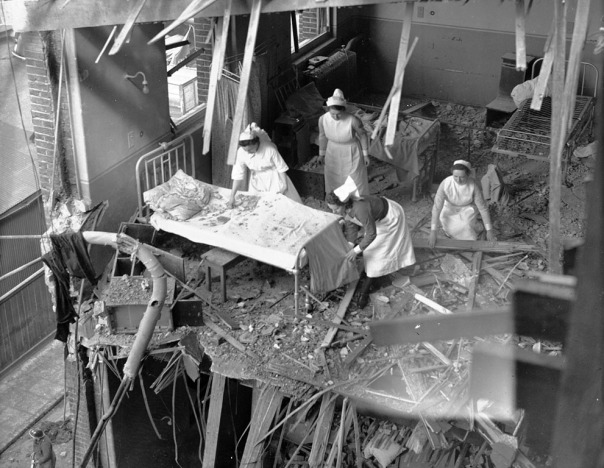
A nighttime German air-raid on London killed 13 firefighters, the largest single loss of firefighters in British history. 712 German bombers conducted a heavy raid on London, England, United Kingdom starting in the evening hours. Although the primary target was the London docks, the Old Place School in Poplar, East London, which was being used as a sub-fire station, was struck by a stray bomb, killing 13 London firefighters of both genders and 21 male Beckenham firemen; it was the largest single loss of firefighters in British history. The bombing continued past midnight. London experiences its heaviest air raid since the “Great Fire” of December 29. The attack lasted until the early hours. 712 aircraft dropped 153,096 incendiaries, which started a record 1,500 fires followed by a rain of 1,026 tons of high explosive and parachute mines. These are as large as pillar-boxes and weigh over two tons. They drift down on the wind, exploding on impact with the surface with the maximum blast effect. Two can completely obliterate a street. One mine failed to explode and lodged on the railway bridge leading to Charing Cross, where it was disarmed on the spot by a naval squad. Eight London Hospitals including Guy’s were hit. Christie’s auction rooms, Maples’ furniture store and the Shaftesbury theatre were destroyed, parts of Selfridge’s set on fire, the Speaker’s House at Westminster, the Royal Hospital, Chelsea, the Law Courts and Wellington Barracks badly damaged. St. Paul’s is closed after a 500-pound bomb crashed through the north transept, strewing the crypt below with wreckage. Fortunately the St Paul’s Watch, whose rest room is beneath, were all on the roof dealing with incendiaries. All the remaining windows were shattered, but the dome was not shaken by the blast. Other churches destroyed or burnt out included St Andrew’s, Holborn (Wren’s largest after St Paul’s), the City Temple, St Clement Danes and Chelsea Old Church.
RAF Bomber Command: Day of 19 April 1941
34 Blenheims and 2 Hampdens on coastal operations. Many attacks on ships were made; 2 large merchant ships were hit and believed sunk; a tug was definitely sunk. No aircraft lost.
RAF Bomber Command: Night of 19/20 April 1941
5 Hampdens minelaying off Brest. No losses.
British intelligence reported that the German battleship Bismarck, two cruisers, and three destroyers had passed the Skaw. The Admiralty reported this movement at 0117. Battlecruiser HMS Hood, light cruiser HMS Kenya, and destroyers HMS Cossack, HMS Zulu, and HMS Maori had departed Scapa Flow at 1700/18th to relieve battleship HMS King George V on Biscay Patrol. They were diverted to support the cruiser patrol in the Iceland Faroes passage. Heavy cruiser HMS Norfolk and light cruisers HMS Galatea and HMS Arethusa departed Icelandic waters. The heavy cruiser had arrived at Hvalfjord on the 17th after convoy HX.119 escort. Heavy cruisers HMS Suffolk and HMS Exeter, light cruiser HMS Edinburgh, and destroyers HMS Tartar, HMS Achates, HMS Inglefield, HMS Echo, and HMS Anthony at Scapa Flow raised steam and departed Scapa Flow at 0606. Battleship HMS King George V and light cruiser HMS Nigeria turned north, but returned to their patrol area when it was realized they could not be in position in time. Battleship King George V and light cruiser Nigeria met destroyers HMS Electra, HMS Escapade, and HMS Mashona at 0900/20th in 50N, 21W. Destroyers HMS Bedouin, HMS Arrow, and HMS Eskimo departed Scapa Flow at 1600/20th to join battleship King George V. They were to refuel at Londonderry, but they diverted to hunt a submarine in 58-30N, 5-55W. When it was decided the contact was a whale, they were sent to assist armed boarding vessel HMS Northern Sky attacking a submarine in 58-47N, 7-02W. The search was discontinued on the 21st and the destroyers arrived at Scapa Flow at 2100 that evening.
Battleship HMS Rodney and destroyers ORP Piorun, ORP Garland, and HMS Saladin departed the Clyde. Battlecruiser HMS Repulse departed Gibraltar on the 21st and was ordered to the Clyde with all dispatch. On the 21st, battleship HMS Rodney and her escorts were ordered to the Clyde. En route, they were diverted to Scapa Flow where they arrived on the 23rd at 0115. Destroyer HMS Inglefield joined the battlecruiser HMS Hood force at sea. Battlecruiser Hood and destroyers HMS Cossack, HMS Inglefield, HMS Maori, and HMS Zulu arrived at Hvalfjord at 0730/21st to remain at two hours’ notice. Heavy cruisers HMS Suffolk and HMS Exeter and destroyers HMS Tartar, HMS Achates, HMS Echo, and HMS Anthony were ordered to return and arrived at Scapa Flow on the 21st. Destroyer Anthony escorting heavy cruiser Exeter arrived at 1405. Destroyer Tartar arrived independently at 1900. Destroyers Echo and Achates escorting heavy cruiser Suffolk arrived at 2000.Battleship King George V and destroyers Electra, Escapade, and Mashona arrived at Scapa Flow at 1600/22nd.
Destroyer HMS Bedouin departed Rosyth at 0940 after boiler repairs. The destroyer arrived at Scapa Flow at 2000.
Anti-aircraft ship HMS Alynbank departed Scapa Flow at 0600 to cover convoy EC.8 to Pentland Firth. The ship arrived back at 0900/20th after this duty.
Destroyer HMS Wild Swan, in drydock at London, was damaged by the near miss of German bombing during the night of 19/20 April. The destroyer sustained no additional time out of service, completing repairs on the 26th. Destroyer HMS Winchester, also under repair at London, was damaged by near misses.
Submarine HMS Sunfish, which had departed Portsmouth, collided with netlayer HMS Minster (707grt) in convoy in 51-06N, 01-21E. The damage was not severe, but opportunity was taken to conduct a refit while the ship was in port for the repair. The submarine was in dockyard hands at Tyneside from 24 April to 27 September.
Free French submarine Minerve sank German auxiliary minesweeper M1101 in 58-40N, 4-55E. German tanker Tiger, being escorted by the minesweeper, was missed.
Minesweeping trawler HMS Kopanes (351grt, T/Lt J. M. Anderson RNVR) was sunk by German bombing near 20.G Buoy, Coquet Island. There were no casualties on the trawler.
Armed merchant cruiser HMS Laconia arrived at Greenock.
British dredger Fravis (133grt) was lost on a mine at Langstone Harbour.
British tanker Desmoulea (8120grt) departed Suda Bay, in tow of armed boarding vessel HMS Chakla and escorted by anti-submarine trawlers HMS Lydiard and HMS Amber. The tanker and the armed boarding vessel safely arrived at Port Said.
Panamanian ship Margit (3257grt) was sunk by German bombing at Kalkara Creek, Malta.
Greek steamer Teti Nomikou (1822grt) was sunk by German bombing at Chalkis.
Destroyers HMS Fearless and HMS Kashmir departed Gibraltar to rendezvous with battlecruiser HMS Repulse and escort her to Gibraltar.
Sloop HMS Aberdeen departed Gibraltar for Halifax with twenty six officers and thirty one ratings for Coast Guard cutters being commissioned.
The Italian 7th Cruiser Division of light cruisers Eugenio De Savoia, Duca D’aosta, Montecuccoli, and Attendolo and destroyers Pigafetta, Zeno, Da Mosta, Da Verazzano, Da Recco, and Pessagno laid 321 mines and 492 explosive floats east of Cape Bon in barrages S11, S12, and S13 from 19 to 23 April. The second half of the minefield with 740 mines were laid on 23/24 April.
The German commerce raider Atlantis rendezvoused with the supply ships Dresden and Alsterufer and transferred the crew and passengers of the Egyptian passenger liner ZamZam sunk on April 17. Captain Bernhard Rogge instructed the captains of the Dresden and Alsterufer that these people were to be treated with generosity and kindness as two of the captives were American newspaper correspondents and Rogge wanted to limit the inevitably unfavorable news coverage. The Atlantis also took on three new, crated, Arado Ar-196 seaplanes.
Convoy SC.29 departed Halifax, escorted by armed merchant cruiser HMS Ranpura, corvettes HMCS Cobalt and HMCS Collingwood, and submarine HMS Porpoise. The corvettes were detached that day. Submarine Porpoise was detached on the 29th. On the 30th, destroyers HMS Burwell and HMS Scimitar and corvette HMS Mallow joined the convoy. On 1 May, destroyers HMS Malcolm and HMS Watchman, corvette HMS Violet, and anti-submarine trawler HMS Northern Wave joined. The armed merchant cruisers and the escorts joined on the 30th and 1 May were detached. Destroyers HMS Saladin, HMS Skate, HMS Veteran, and HMS Watchman, corvette HMS Wallflower, and minesweepers HMS Harrier, HMS Seagull, and HMS Sharpshooter joined the convoy. The escort was detached when the convoy arrived at Liverpool on 8 May.
Although concentrating upon getting action on the Tobey anti-convoy resolution, U.S. Senate foes of the administration’s foreign policy have not lost sight of another measure which several of them introduced jointly. It is a resolution requiring approval in a national referendum before any American air, naval or land forces could be sent outside the western hemisphere and American possessions. Like the anti-convoy resolution introduced by Senator Tobey, New Hampshire Republican, it is languishing in the Senate Foreign Relations Committee. Interested senators said today they planned an active campaign to get it before the senate as soon as the convoy legislation has been disposed of. They reported, too, the receipt of much mail urging the adoption of the referendum measure. As the convoy resolution is now worded, it would prohibit use of American naval units as escorts for ships carrying war supplies. Some of its backers, conceding there was little chance for its adoption in that form, devised an alternative today under which convoys could be ordered only with the approval of congress.
Talk of an 8 percent basic income tax rate coupled with a general sales levy developed in congress today as the house ways and means committee arranged to start consideration of new revenue legislation Monday. The treasury has fixed $3,500,000,000 as the amount of new money to be raised in the forthcoming tax bill, and congressional authorities generally agreed this would mean sharply increased burdens on all groups of taxpayers. The basic income tax Is now 4 percent, but taxpayers, after figuring their tax by the normal method, must add 10 per cent as a special defense levy. Thus the rate becomes in actuality 4.4 percent.
President Roosevelt and Secretary of Labor Frances Perkins intervened respectively yesterday in labor relations problems of the shipbuilding and coal mining industries, both vital to national defense. Miss Perkins was rebuffed in a request for resumption of soft coal production from northern mines next Tuesday. There was no immediate reaction to Mr. Roosevelt’s move. The chief executive, at his Hyde Park, New York home, urged Pacific Coast shipyard managers and workers to ratify a coast-wide master contract for wages. Such an agreement would be effective for duration of the national emergency.
Appealing to the tradition of Thomas Jefferson as the great exponent of pure democracy, Paul V. McNutt, Federal Security Administrator, told the annual Jefferson dinner of the National Democratic Club at the Hotel Commodore last night that “more democracy” and not less is essential to our defense program if we are to help conquer Hitlerism in a “death struggle with the forces of evil.”
Senator Gerald P. Nye, North Dakota Republican, predicted at a press conference today that the British Empire faced disintegration but added that this should cause no undue alarm in this country. Britain, he said, had always been the United States’ strongest economic competitor, “fighting for every red penny of trade at every crossroads” and “creating jealousies and rivalries.” The United States could not fare worse economically, he added, than in the face of British competition, although this country would face a “very unpleasant foreign trade experience” in event of a Nazi victory. But, he said “it can’t be very material because our foreign trade involves only 3 percent of our total economic dependence, and we ought to more than make that up in our own hemisphere.”
The Committee to Defend America by Aiding the Allies issued yesterday a statement asserting that Colonel Charles A. Lindbergh, a leading opponent of aid to Britain, was ignorant of history and “has a blind spot which prevents him from seeing the value of moral imponderables.”
Officials said today an executive order at the White House was ready for President Roosevelt’s signature. Its task would be to deal with the changes in every day American life occasioned by the war abroad and the defense program here. It is expected to look after such things as air raid precautions, civilian morale, recreational facilities in the vicinity of military camps, and to coordinate efforts of states and municipalities in connection with the defense program. The armament effort already has made its Impact felt in the daily lives of almost all Americans.
Captain James Roosevelt, son of the president, left for Honolulu aboard the China Clipper tonight to report to Admiral Husband E. Kimmel, Commander-in-Chief of the U. S. Fleet, and take over his assignment to the Marine Corps. Roosevelt, who was accompanied by Major Gerald Thomas, said he didn’t know what his final destination would be. He anticipated he might receive specific orders aboard the plane before he reaches Honolulu.
The first M3 medium tank for the U.S. Army to come off the production line of a private industrial plant emerged with ceremony from the American Locomotive Company works in Schenectady, New York today, eight months ahead of schedule.
Naval Aircraft Factory initiated development of a Glomb (glider bomb), to be towed long distances by powered aircraft and released over target and guided by radio control and target-viewing television.
Les Pawson won the Boston Marathon.
Steve Stanko posted the World’s first official 1000 pound total at the Mid-Atlantic Championships in York Pennsylvania. He achieved this by posting a 310-pound clean and Press, a 310-pound snatch, and a 380-pound Clean and Jerk.
Major League Baseball:
In the annual Patriot’s Day doubleheader in Boston, the Brooklyn Dodgers sting the Boston Bees twice, winning 8–0 in each game. Luke Hamlin and Whit Wyatt apply the whitewashings. George Barnicle starts and loses the nightcap, his last appearance in the majors. Peewee Reese and Joe Medwick hit home runs in the opener.
Bob Feller of the Indians mastered the Tigers today, 2–1, to rack up his first victory of the young season, even though his swift one seemed slowed down. Still, Feller allowed just six hits. The only Tiger run came on a solo homer by George Stainbeck.
Harry Danning hits a 4th inning grand slam and Hal Schumacher shuts out the Phillies on five hits as the Giants win, 7–0. Babe Young hit another home run in the first. New York is now 5–0.
Red Sox power at the plate and Athletic miscues afield gave Boston a 7–2 verdict and a sweep of their two-game series today before 8,604 fans. It was the fourth straight victory for the Red Sox. Joe Cronin hit a three-run home run in addition to a double and a single.
The world-champion Reds, beaten their first four times out this season, crashed into the victory column today with an eighth-inning rally that scored three runs — enough to nose out the Pirates, 5–3. The Reds broke a 2–2 tie with five straight singles after two men were out in the eighth.
The New York Yankees beat the Washington Senators in ten innings, 5–2. The Yankees rallied for three runs in the extra frame, two of them coming on Joe DiMaggio’s home run, after Phil Rizzuto tripled and scored on Robert Rolfe’s single.
Brooklyn Dodgers 8, Boston Bees 0
Brooklyn Dodgers 8, Boston Bees 0
Cleveland Indians 2, Detroit Tigers 1
Philadelphia Phillies 0, New York Giants 7
Boston Red Sox 7, Philadelphia Athletics 2
Cincinnati Reds 5, Pittsburgh Pirates 3
New York Yankees 5, Washington Senators 2
The Soviet Union, through the newspaper Pravda, official organ of the Communist party, today bluntly described the new Soviet-Japanese neutrality pact as a bewildering blow to the plans of United States and British interests whom it accused of having conspired to draw Russia into war against Japan or Germany.
In preparation for the “positive foreign policy” that is expected to be inaugurated following the return of Foreign Minister Yosuke Matsuoka on Tuesday, Japanese Premier Prince Fumimaro Konoe and his economic ministers emphasized anew today the urgent need for the construction of a “high degree defense State” to expand the production of war materials.
Dow Jones Industrial Average: 116.15 (-0.13)
Born:
Gene Heeter, AFL tight end (New York Jets), in Windber, Pennsylvania.
Michel Roux, French chef and restaurateur (Le Gavroche, 1st Michelin three-starred restaurant in Britain), in Charolles, Saône-et-Loire, Vichy France (d. 2020).
Roberto Carlos [Braga], Brazilian singer and songwriter (“Se Você Pensa”, “Esse Cara Sou Eu”), in Cachoeiro de Itapemirim, Brazil.
Naval Construction:
The Royal Navy Bangor-class (Reciprocating-engined) minesweeper HMS Shippigan (J 212) is laid down by the Dufferin Shipbuilding Co. (Toronto, Ontario, Canada) : Montreal-Loco.
The U.S. Navy SC-497 Class Submarine Chaser USS PC-532 (later SC-532) is laid down by the Luders Marine Construction Co. (Stamford, Connecticut, U.S.A.).
The Regia Marina (Royal Italian Navy) Soldati-class (Second Group) destroyer Velite is laid down by Cantieri Odero Terni Orlando (O.T.O.), (Livorno, Italy).
The U.S. Navy oiler USS Kennebec (AO 36), lead ship of her class of 6, is launched by the Bethlehem Steel Corp. (Sparrows Point, Maryland, U.S.A.).
The U.S. Navy Accentor-class coastal minesweeper USS Lorikeet (AMc-49) is launched by the Greenport Basin and Construction Co. (Greenport, Long Island, New York, U.S.A.).
The Royal Navy MMS I-class motor minesweeper HMS MMS 2 (J 502) is commissioned.
The Royal New Zealand Navy minesweeper HMNZS Puriri (T02) [requisitioned coastal cargo ship] is commissioned.
The Royal Navy Fisher 58′-class motor torpedo boat HMS MTB 273 is commissioned.
The Royal Navy Fisher 58′-class motor torpedo boat HMS MTB 274 is commissioned.
The Kriegsmarine (German Navy) Type VIIC U-boat U-372 is commissioned. Her first commanding officer is Kapitänleutnant Heinz-Joachim Neumann.

