Yugoslavia Capitulates
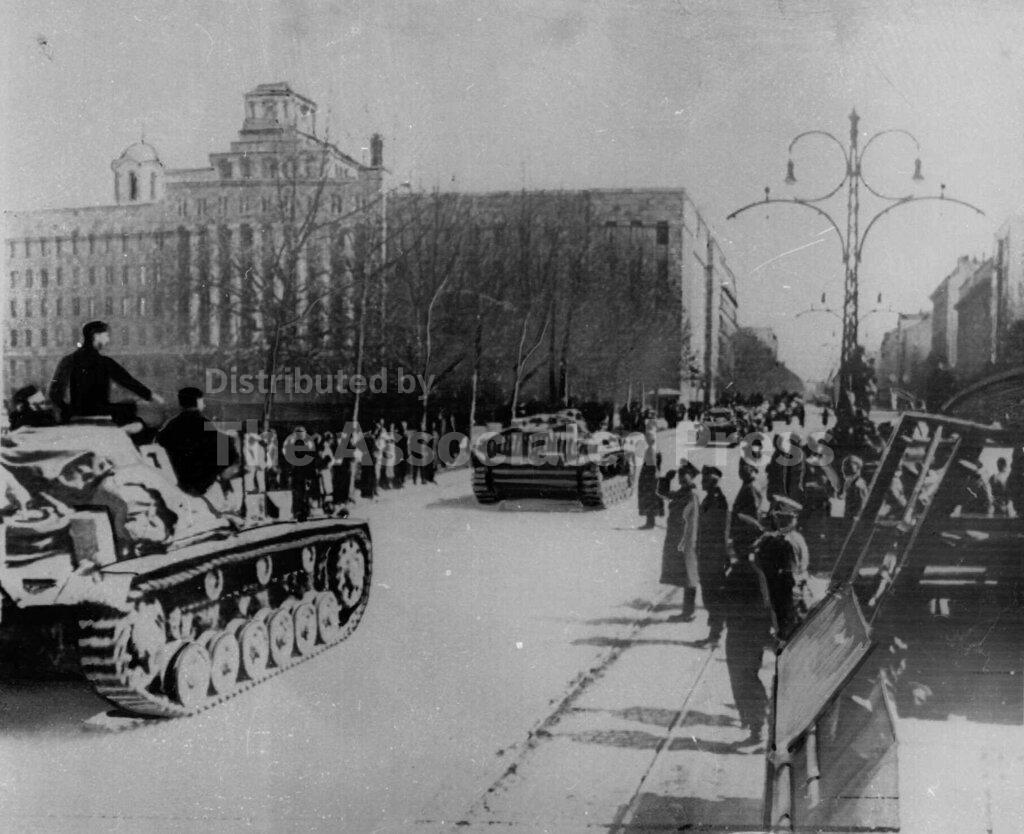
Yugoslavia formally surrendered to the Axis. Yugoslavia unconditionally surrenders to Germany and Italy on 17 April 1941. Or, rather, the Yugoslav Army surrenders, effective at noon on 18 April, which amounts in practice to the same thing. In addition, Yugoslav Foreign Minister Cincar-Marcovic signs surrender documents to Italy and Germany on behalf of the Yugoslav government — but he does not have the authority to do so. While Hungary has invaded Yugoslavia, it decides that it is not “at war” with Yugoslavia and thus does not have to sign any peace treaties with it. And what about Bulgaria? And the new Independent State of Croatia? In fact, it’s not clear what the heck actually happened today.
The situation may be legally muddled, but the inescapable conclusion is that Yugoslavia is now out of the war.
Yugoslav assistant to Commander General Danil Kalafatovic, Lieutenant General Mihailo Bodi, and German Colonel General Maximilian Freiherr von Weichs sign an armistice in the building of the Czechoslovak ministry in Belgrade. Separately, the Ban and National Assembly of Slovenia surrender to the Italians. The Yugoslavs resisted for twelve days.
Virtually the entire Yugoslav government, including King Peter II, already has fled to Athens via RAF Flying boat flying from the island of Kotor. The military situation clearly is hopeless for the Yugoslavs and has been for several days. All that remains is for them to see how the Axis powers will divide up the country. The Germans have very definite ideas on that, and they revolve around a complete abnegation of the treaties signed after World War I.
Others in Yugoslavia are not so fortunate as King Peter and Prime Minister Simovic. Around 6,000 Yugoslav officers and 335,000 troops are put in POW camps. The dispersal of Yugoslav units along the frontier and in remote areas where they have not been captured, though, provide the seeds for a partisan campaign.
Germany announced early today the unconditional capitulation of the remaining fighting units of the Yugoslav army and declared fighting had stopped on all Yugoslav fronts. The capitulation is effective at noon Friday, it was stated in a DNB, official German news agency, dispatch. Weapons then will be formally surrendered, it was said. Negotiations for the Yugoslavs to lay down their arms were made exclusively with Serb military authorities.
German forces captured the supreme command of the Royal Yugoslav Army at Sarajevo and Yugoslavia formally surrendered to Axis forces. Germany, Italy, Hungary, Bulgaria, and Albania annexed or occupied parts of the country. Yugoslavia formally surrendered to Germany as Foreign Minister Cincar-Marcovic signed the armistice with German and Italian representatives in Belgrade. Germans captured Yugoslavian destroyers Beograd and Dubrovnik at Kotor, but destroyer Zagreb was scuttled by her crew (2 killed in the process). After 12 days of resistance the Yugoslav government signed the act of surrender to the triumphant Germans today. In Sarajevo remnants of the army gave themselves up; around 6,000 officers and 335,000 men were marched off to PoW camps. King Peter and Prime Minister, General Simovich have escaped to Greece. From the outset the Yugoslav General Staff was committed to fighting an unwinnable campaign. The bitter divisions between the country’s many nationalities — especially between Croats and Serbs — meant that an attempt had to be made to defend the whole country. The Yugoslav forces were thus strung out along the frontier without depth or necessary reserves. The Germans jumping off from Hungary, Romania and Bulgaria plunged into Yugoslavia along the mountain passes accompanied by dive-bombers. Within a week German forces were in Belgrade. Many Yugoslav units never saw battle and they remain in remote areas still with their weapons, where some intend to fight on as partisans.
King Peter II of Yugoslavia arrived at London, England, United Kingdom via Athens, Greece.
Croatia soon becomes an independent state, ruled by the pro-Nazi “Ustashi.” Persecution of Croatian Jews begins immediately.
The Yugoslav destroyer Zagreb was scuttled in Cattaro Harbor to prevent capture. The Germans, however, capture largely intact destroyers Beograd and Dubrovnik and damaged destroyer Ljubjana.
The remaining 18 planes of the Yugoslav Air Force fly to Greece, ending their operations in Yugoslavia.
Greece is still fighting alongside their British allies. However, it is plain to see how things are going. Prime Minister Winston Churchill reads the contents of a telegram from Middle East Commander General Archibald Wavell. In it, Wavell recounts discussions held in Athens between local British commander General Henry Maitland Wilson and Greek Commander in Chief General Alexander Papagos. While agreeing to the British withdrawal down the waist of Greece, Papagos noted (according to Wavell’s message):
“as things might become critical in future, he [Wilson] should re-embark British troops and save Greece devastation.”
Churchill agrees to a secret appeal from General Papagos, the Greek C-in-C for British and Empire forces to evacuate mainland Greece in order to save it from further destruction, but insists that Crete must be held with force. British Prime Minister Churchill agreed to the proposal for the evacuation of Allied troops from mainland Greece to the island of Crete, should it become necessary; this plan was then communicated to the government of Greece shortly after.
The War Cabinet minutes note that “arrangements to this end [the British evacuation from the mainland] were being made.”
In the field, British troops in Greece continue moving back to the line Thermopylae-Corinth that Papagos has approved. This requires a retrograde move of at least 100 miles for most units. The New Zealand 21st Battalion, which delayed the panzers at the Platamon railway tunnel yesterday, continue performing delaying maneuvers at the Tempe and Pinios Gorges, allowing other Allied troops to withdraw to new defenses on the Thermopylae line.
By midnight the Anzac Corps’ four forward brigades had left their positions, embussed and driven south, leaving the 6th NZ and the 16th and 17th Australian Brigades astride the 3 main roads converging on Larisa.
Savige Force withdraws from the Kalabake area during the night.
A group from the Joint Planning Staff in Cairo, including British Rear Admiral Harold T. Baillie-Grohman, arrive to plan the evacuation of ‘LUSTRE’, the Allied expeditionary force.
The War Office in London announced: “No confirmation has been received from the Greek or British high commands in Greece of the German-spread rumour that the enemy has broken through Allied lines at the Mount Olympus sector of the front [northeastern Greece] and that German troops are already advancing into the Larissa area.”
Italian infantry and tanks attacked Tobruk, Libya in the early afternoon, but it was repulsed. After dark, 12 Axis tanks engaged Allied counterparts along the line; 3 Axis tanks were destroyed.
The British in Libya mount an attempt to retake Fort Capuzzo in the morning, losing four tanks. The German troops in Gruppe Schwerin also launch an attack against the northeast section of the Tobruk perimeter but also are repulsed.
Lieutenant General Erwin Rommel personally supervises an attack on Tobruk by two companies of motorcycle troops, reinforced by artillery, at Ras Mdaauar. This attack makes progress close to the barbed wire, which is held as a jump-off point for future operations. Rommel decides to wait for reinforcements — which were supposed to arrive on the recent convoy that the Royal Navy destroyed off Tripoli — before launching a set-piece attack on Tobruk. Both sides use their planes to harass the other. The Luftwaffe sends 41 Junkers Ju 87 Stukas against key points within the Tobruk perimeter, while the RAF bombs the investing German and Italian troops.
The South African 1st Infantry Brigade skirmishes with Italian forces near Cambolcia Pass in Abyssinia.
German motor torpedo boats S41 S42 S43 S55, S104 attacked Allied convoy FS.464 off Great Yarmouth, England, United Kingdom, sinking 2 small freighters and damaging a large steamer. The German S-boats were engaged by British motor gun boats MGB.60, MGB59, and MGB.64, without success.
Jacques Chartier, Vichy French Consul-General, is expelled from Britain.
Popular singer Al Bowlly, who reached his peak in the late 1920s and early 1930s but since has faded badly in popularity, is killed during the Luftwaffe raid on London that lasts throughout the night of 16-17 April 1941. Bowlly had taken the last train home the night before from a performance at the Rex Cinema in Oxford Street, High Wycombe, despite being offered a place to stay there overnight. A Luftwaffe parachute mine explodes just outside his flat at 32 Duke Street, Duke’s Court, St James, London, at 03:10 and blows the bedroom door off its hinges — it strikes Bowlly in the head, killing him instantly. There is a blue commemorative plaque in his honor at Charing Cross Mansion, 26 Charing Cross Road, a previous residence which the plaque describes as “his home at the pinnacle of his career.”
SS-Untersturmfuehrer Maximilian Grabner at Auschwitz Concentration Camp announced that urns containing the ashes of Polish political prisoners who died at Auschwitz no longer needed to be sent to their families.
Rashid Ali al-Gaylani’s 16-day old Iraqi government submitted a request to Germany for military assistance in its attempt to remove British forces from Iraq. Meanwhile, Iraqi forces surrounded the RAF airbase at Habbaniya while British 1st Battalion King’s Own Royal Regiment, originally based in Karachi, India, arrived at RAF Shaibah near Basra. Iraqi forces surround the British airbase but make no provocative moves at this time.
The bombing of London, England, United Kingdom which began on the previous date ended before dawn. 1,179 were killed. Great tongues of flame and smoke coiled over London at dawn today and great sprawling areas of blackened masonry entombed uncounted victims of the German air force’s most savage attack of the war. Casualties were heavy and considerable damage was done, an air ministry communique acknowledged this morning. This was the worst ever, veterans said. The ancient capital was a stricken witness to what Berlin had promised that the R.A.F. attack on the Nazi capital April 9 would be repaid a “hundred-fold.” Wave upon wave of German bombers, some zooming low over the city, dropped tons of heavy explosive and fire bombs to surpass the great December 29 fire raids which gutted so much of London. Observers estimated that more than 400 raiders participated in the overnight attack. Only daylight will tell the full tragic toll of casualties and damage. A choking smoke pall overhung the city, and London never really had a protecting darkness from the moment the first Nazi avalanche of fire and explosive hit the city.
The Wehrmacht High Command announced: “In retaliation for the British air raid on the residential and cultural center of the German capital on the night of 9th-10th April, the German Luftwaffe last night carried out a grand assault on the British capital. A great number of German bomber wings released countless high-explosive bombs of all calibers, and incendiary bombs, uninterruptedly throughout the entire night. Ground visibility was good and the bomb detonations and their effects could be observed with absolute clarity. Large fires had sprung up in the harbor districts, a well as in other city areas, by the time the first German formations flew away; some of the fires joined together to form wide-scale conflagrations. The glow from these huge fires was visible as far away as the Channel and some of them even from the Belgian coast. In future, any British air raid on residential quarters of Germany will be answered by increased retaliation.”
Visiting Australian Prime Minister Robert Menzies must drive through the London devastation to reach 10 Downing Street. He notes in his diary:
“It takes a long time to reach Downing Street. All round Victoria there is damage and confusion. The Admiralty has a great chunk cut out of it. Charing Cross Station is ablaze, and the Halifax Building in the Strand also. Shell-Mex building has a great unexploded bomb, and is evacuated. Two bombs fell on either side of the street from Australia House. In Middle London, every street shows the marks. There are at least 1000 dead and 2000 seriously injured.”
Among many, many others, Lord and Lady Stamp are killed. Lord Stamp was the Government adviser on Economic Coordination.
Lieutenant Ernest Oliver Gidden (1910-61), RNVR, spent six hours chiseling molten metal from the highly sensitive fuse of a bomb on Hungerford Bridge in London, and putting in a gag to stop the mechanism. Hungerford Bridge carries an electrified railway line with the live current on a third rail. This had caused the bomb to weld itself to the rail. For this, he was awarded the George Cross.
RAF Bomber Command: Day of 17 April 1941
35 Blenheims on coastal operations bombed ships — claiming 1 probably sunk — and Cherbourg docks. 1 aircraft lost.
RAF Bomber Command: Night of 17/18 April 1941
Berlin
118 aircraft — 50 Wellingtons, 39 Hampdens, 28 Whitleys, 1 Stirling — to two aiming points but haze prevented concentrated bombing. 8 aircraft — 5 Whitleys, 2 Hampdens, 1 Wellington — lost.
Minor Operations: 13 Wellingtons and Whitleys to Rotterdam, 10 Wellingtons to Cologne, 3 Wellingtons to Mannheim, 6 Hampdens minelaying off Brest and the Frisians, 1 O.T.U. sortie. 3 Wellingtons were lost from the Cologne raid. The 11 aircraft lost this night represent the largest total lost in night operations so far (not counting aircraft crashed in the United Kingdom).
The Luftwaffe also is active after dark. It raids one of its favorite targets, Portsmouth. The raid, however, is very unusual. The large force of Luftwaffe bombers drops their 170 tons of high explosives and 5400 incendiaries on a brightly lit target that they assume to be the city of Portsmouth. In fact, it is a “Q” decoy site set up in Farlington Marshes on Hayling Island just to the south of Portsmouth in Hampshire. The decoy involves a number of decoy fires that burn for four hours, attracting the bomber navigators away from the city. The bombs destroy a Heavy Anti-aircraft Artillery battery at Southwest Hayling, killing the soldiers there, along with some pillboxes and other military installations. Portsmouth itself largely is spared. The residents of Hayling Island, though, are not, and they are somewhat annoyed at having the decoy site set up in their own backyards.
Churchill sends Air Chief Marshal Sir Charles Portal a strongly worded “Action this Day” memorandum criticizing the RAF’s failure to “hit the enemy cruiser in Brest.” In fact, the RAF has hit Gneisenau, but apparently the British do not know this yet. Churchill chastises the Air Ministry for “neglecting the dive-bomber type of aircraft,” which of course is exemplified by the Luftwaffe’s Junkers Ju 87 Stuka.
The Luftwaffe bombs Malta with 15 aircraft at 20:47. They hit the St. Paul’s Bay area.
U-123, commanded by Kapitänleutnant Karl-Heinz Moehle, sank Swedish steamer Venezuela (6991grt) in 53N, 18W. At 1550 hours on 17 April 1941, U-123 fired a single G7a stern torpedo at the unescorted and neutral Venezuela and hit her amidships south-southwest of Rockall. The U-boat had spotted the modern and fast ship at 0430 hours and decided to attack it because she was not following the routes for neutral vessels, the mistake was only noticed after the attack. After it was observed that the crew abandoned ship in lifeboats, the U-boat fired at 1600 hours a coup de grâce which was a dud and at 1603 and 1626 hours two torpedoes that hit in a hold and the engine room and settled slowly. Because the ship remained afloat another torpedo was fired at 1727 hours, which also was a dud but when the U-boat surfaced two hours later after reloading the torpedo tubes the ship was no longer visible. Aboard the Venezuela were eight passengers from the Finnish motor merchant Caroline Thordén, which had been sunk by German He115 aircraft of KFlGr 706 near the Faroe Islands on 26 March. The 6,991-ton Venezuela was carrying paper pulp and was bound for Buenos Aires, Argentina.
Destroyer HMS Eclipse departed Scapa Flow at 1700 to refit at Devonport, arriving at 0900/19th.
Anti-aircraft ship HMS Alynbank departed Scapa Flow at 1200 to join convoy WN.15 and escort it to Methil. They arrived at Methil at 1400/18th.
Heavy cruiser HMS London and aircraft carrier HMS Argus departed the Clyde for Gibraltar. The aircraft carrier carried aircraft for Operation DUNLOP. Aircraft carrier Argus was joined on the 22nd by light cruiser HMS Sheffield and destroyers HMS Faulknor and HMS Wrestler, which had departed Gibraltar on the 20th. The heavy cruiser then joined convoy SL.71 and arrived back at Scapa Flow on 1 May.
The German 2nd MTB Flotilla with S41, S42, S43, S55, and S104 made a sortie against Convoy FS 464 off Great Yarmouth. British steamer Effra (1446grt) was sunk by a German S-boat near Cross Sand Light Vessel in 52-44N, 1-58E. Two crewmen were missing. Dutch steamer Nereus (1298grt) was sunk by a German S-boat two miles south of No. 5 Buoy, Great Yarmouth. The crew was rescued.
British steamer Ethel Radcliffe (5673grt) was damaged by German S-boat near No. 6 Buoy off Great Yarmouth. There were no casualties on the steamer. The steamer was towed to Yarmouth by anti-submarine trawler HMS Sapphire (421grt). The steamer was sunk on 16 May by German bombing.
The German S-boats were later engaged by British MGB.60, MGB59, and MGB.64 which had sailed in Operation QE at 1915/16th.
British steamer Montalto (623grt) was sunk by German bombing at Rochester. The entire crew was rescued.
Destroyer HMS Kingston, the last of the three K destroyers from the Red Sea, arrived at Alexandria to reinforce the Mediterranean Fleet.
Destroyer HMS Greyhound and Australian destroyer HMAS Voyager carried out a sweep westwards from Tolmeita. Italian barque Romagna (195grt), carrying bombs and fuel for Derna was sunk.
Submarine HMS Truant, on a reconnaissance mission off the Cyrenaican coast, sank Italian ammunition barque Vanna (279grt) with bombs and fuel for Derna with gunfire off Appolonia.
Submarine HMS Truant attacked German steamer Samos (2576grt) one mile west of Benghazi. The attack was unsuccessful, but the steamer was sunk on a magnetic mine on the 19th.
Five British A lighters A1, A5, A.6, A16, and A19 of the 1st Tank Landing Craft Flotilla, escorted by sloop HMS Auckland and anti-submarine whaler HMS Southern Maid departed Alexandria on the 17th and arrived at Tobruk on the 18th. The A lighters departed Tobruk that evening for Suda Bay, led by anti-submarine whaler HMS Skud V. A1, A.6, A16, and A19 arrived on the 21st. A5 was detached to Nauplia independently. A sixth lighter A15 was delayed at Alexandria with mechanical problems, but later proceeded directly to Suda Bay.
Yugoslav destroyer Zagreb was scuttled in Cattaro Harbor at the loss of two of her officers, Porucnik bojnog broda (Lt Cdr) Milan Spasic and Porucnik bojnog broda (Lt Cdr) Sergej Masera. German troops captured the damaged destroyer Beograd and undamaged destroyer Dubrovnik at Cattaro. German troops also captured the damaged destroyer Ljubjana in dock at Sebenico Harbor. The destroyer had been wrecked in a grounding at Split on 24 January 1940.
Greek steamer Damaskini (1196grt) was sunk by German bombing in Oreos Channel, north of Euboea Island.
Greek steamer Petrakis Nomikos (7020grt) was badly damaged by German bombing at Piraeus. The steamer was beached and bombed again on the 23rd. Steamer Petrakis Nomikos was later salved by the Germans for their use.
Egyptian steamer ZamZam (8299grt) was sunk by German raider Atlantis at 27-41S, 8-08W. The crew and passengers, including 138 Americans, were transferred to German supply ship Dresden and landed at St Jean de Ruz. The German commerce raider Atlantis, disguised as the Norwegian freighter Tamesis, fired upon, stopped and sank the 5,144 ton Egyptian passenger liner ZamZam in the mid-Atlantic Ocean. The ZamZam was bound for Cape Town from New York with a cargo of lubricating oil, tin plate, ambulances, trucks, steel bars, radios, batteries, typewriters, cosmetics, girdles and Coca-Cola, 202 passengers, and a crew of 129. Among the passengers were Charles J.V. Murphy, editor of Fortune Magazine, and a major contributor to TIME and LIFE magazines, as well as LIFE magazine photographer, David E. Sherman. Accordingly, Captain Bernhard Rogge instructed his officers and crew that these people were to be treated with generosity and kindness, so that they might at least limit the inevitably unfavorable news coverage. Unknown to Rogge, Sherman had taken a full-length photograph of the raider ‘Tamesis’ from one of the ZamZam’s lifeboats, a photograph which would ultimately play a significant role in the Atlantis’ destruction. He puts the film in tubes of toothpaste and shaving cream and smuggles it out for publication in his magazine in the 23 June 1941 issue.
Submarine HMS Pandora arrived at Gibraltar escorting British oiler RFA Cairndale.
Destroyers HMS Kashmir and HMS Jackal and corvette HMS Spirae arrived at Gibraltar escorting the 3rd Motor Launch Flotilla of ML121, ML129, ML130, ML132, ML134, ML135, and ML168. These ships had departed the UK on the 12th.
Convoy SL.72 departed Freetown escorted by light cruiser HMS Dragon to 19 April, destroyers HMS Vidette and HMS Wishart for the day only, and corvettes HMS Asphodel and HMS Calendula for the day only. On the 19th, light cruiser HMS Fiji relieved light cruiser Dragon. Light cruiser Fiji continued with the convoy to 1 May. On the 20th, armed merchant cruiser HMS Dunnottar Castle joined to 11 May. Destroyers HMS Columbia to 13 May, HMS Keppel to 13 May, HMS Lincoln to 13 May, and HMS Sabre to 12 May, sloop HMS Fleetwood to 13 May, corvettes HMS Alisma to 13 May, HMS Dianella to 13 May, and HMS Kingcup to 13 May, and anti-submarine trawlers HMS Man O’ War to 13 May, HMS St Loman to 13 May, and HMS Wellard to 13 May joined the convoy, and arrived at Liverpool on 13 May.
President Roosevelt conferred with Daniel J. Tobin, head of the teamsters’ union, and other callers. Letters from the President were read at the Convention of the American Society of Newspaper Editors and the Defense Morale Conference under auspices of the United Service Organizations.
The Senate was not in session. Its special defense investigation committee heard Frank Knox, Secretary of the Navy, and William S. Knudsen, Director of the Office of Production Management.
The House rejected parity payment increases added by the Senate to the Agriculture Appropriation Bill and sent the measure to conference, heard speeches on the national defense situation and other matters, and adjourned at 2:08 PM, until noon tomorrow. The Naval Affairs Committee approved the Vinson Anti-Strike Bill, and the Merchant Marine Committee began hearings on legislation for the acquisition by the United States of foreign vessels seized in American ports.
A tremendous new U.S. tax program designed to add $3,500,000,000 to the government’s annual income, perhaps by increasing virtually all present tax rates and assessing new levies as well, was proposed by the administration today with both Republican and Democratic leaders approving. Under the program, the total tax yield sought by the federal government would be $12,667,000,000. This compares with estimated expenditures of approximately $17,000,000,000, leaving a deficit of about $4,000,000,000 probably to be raised by borrowing. Details of the program remained to be worked out, but Secretary of the Treasury Morgenthau was authoritatively reported to have advocated raising all present tax rates income, excess profits, excise, etc. from 25 to 50 per cent higher than existing levels. The present individual income tax rate is 4.4 per cent; the corporation income tax is 24 per cent. In addition to boosts “all along the line,” the treasury plan was said also to include several additional excise taxes, such as levies on washing machines, radios and other so-called luxury objects not now taxed.
Charles Lindbergh at 20:00 speaks to an overflow crowd of 10,000 at the Chicago Arena, with an additional 4,000 outside the arena, on behalf of the America First Committee. By one count, he is interrupted by applause 31 times while giving an address of only about 2,000 words. His main points:
— The US is being led into war by a minority of war-mongers;
— That 80% of the public opposes joining the war;
— The U.S. is unable at this time to defeat Germany.
Among issues favored by the America First Committee is an anti-convoy bill. Isolationists believe that participating in convoys inevitably would lead to war.
William S. Knudsen, director of the Office of Production Management (OPM), announces that automakers and motor truck manufacturers agree to cut production by 20% beginning on 1 August 1941. He states that this is expected to cut the production of such civilian vehicles by about 1 million over the first year. The purpose is to switch resources to war production. The automakers agree to the cuts for a variety of reasons, not least of which is the likelihood that cut would be imposed upon them if they did not do so voluntarily.
OPM also is in discussions with manufacturers of tin cans to reduce the amount of tin being used. They are arguing with the manufacturers about the percentage, 10% less tin versus 17%. The savings are expected to amount to 5000-7500 tons of tin for a 10% cut.
The policy committee of the United Mine Workers of America (C.I.O.) voted early tonight not to send miners back into the nation’s soft coal mines until wage disputes with southern Appalachian coal operators could be settled, Although the committee approved a contract negotiated yesterday and ready for signature by the union and northern Appalachian operators, John L. Lewis, union president, said the committee “deemed it inadvisable for the mine workers to divide their forces and expose our membership in the south to economic sanctions that would be imposed upon them by the coal operators in the southern districts.”
The House Naval Affairs Committee today approved the Vinson compulsory mediation bill as the first major step toward legislation to prevent labor disputes from interfering with defense production. As originally drafted the measure would have applied only to plants working on navy contracts but the committee amended it to embrace all defense industries. The bill calls for a 30-day “cooling off” period before defense project workers may go out on strike. During this time conciliation and mediation agencies would attempt to settle the disputes and thus avert a work stoppage. Employers would be barred from closing their plants or reducing wages.
The country’s shortage of modern anti-aircraft guns is still a serious one almost a year after the German blitzkrieg began. The U.S. Navy has not sufficient modern guns of the desired types to equip all its combatant ships, much less the American merchant vessels, and the Army, admittedly, has not enough equipment to protect half the principal cities of the eastern seaboard or to provide mobile equipment for our field armies.
President Roosevelt declared today that free speech and a free press are still in the possession of the American people and gave a pledge that these liberties would remain sacrosanct. “As far as I am concerned there will be no government control of news unless it be of vital military information,” Mr. Roosevelt said in a letter read before the American Society of Newspaper Editors holding its annual convention.
The latest nation-wide survey by the American Institute of Public Opinion shows that President Roosevelt’s personal popularity has climbed to a record high of 73% since the Presidential popularity index was started seven years ago, Dr. George Gallup, the institute’s director, reports.
The latest nation-wide survey by the American Institute of Public Opinion shows that President Roosevelt’s personal popularity has climbed to a record high since the Presidential popularity index was started seven years ago, Dr. George Gallup, the institute’s director, reports.
Canadian leader Mackenzie King continues his meetings with President Roosevelt. Among other things, they discuss defense production cooperation.
The completion of plans for the military and naval defense of the Eastern and Western coasts of Canada and the United States was announced today by the Canada-United States Joint Permanent Defense Board.
R.J. Thomas, international president of the United Automobile Workers (C.I.O.), announced today that he would file with the State Labor Mediation Board a five-day notice of intention to strike in plants of the General Motors Corporation.
Igor Sikorsky lifts his VS-300 helicopter off the water for the first time near the plant in Sikorsky plant in Stratford, Connecticut. By lifting the helicopter, thus equipped, above the water near his Stratford, Connecticut plant, Sikorsky sets another first. He lands the helicopter both on land and water, making it a truly amphibious aircraft.
American actress Doris Day (19) weds trombonist Albert Jorden.
Major League Baseball:
The Giants made it three straight victories over the pennant-conscious Dodgers to sweep the opening series. The score was 7–5. It looked for a time as if fortune might smile on the Durocher band, especially when Dolph Camilli made his first hit of the season a first-pitch home run off Bump Hadley into the lower left-field seats with Joe Medwick on base in the third inning. This blow gave the Dodgers a 4–3 lead. But the Giants came back to win it with one run in the fifth, two in the seventh, and the last in the eighth.
At Wrigley Field, Vince DiMaggio cracks a first-inning grand slam off Vern Olson and that is all Rip Sewell needs as he spins a two-hitter and the Pirates top Chicago, 7–2.
Junior Thompson is staked to a 4-run lead over the visiting Cardinals, but the when he tires in the 7th and Elmer Riddle relieves, the Birds scratch back. Johnny Riddle, subbing for a hurt Ernie Lombardi, is behind the plate as brother Elmer walks Terry Moore and serves up a homer to Johnny Mize, the only 2 batters he faces. The Cards plate another 2 runs in the 9th to win, 7–6. For the Riddle brothers, it is the first time that 36-year-old Johnny and 27-year-old Elmer are batterymates in the majors (they were at Indianapolis). They’ll reprise their act in 1948 in Pittsburgh with Johnny calling gopher balls on the only two batters Elmer and he face together.
The Indians’ southpaw strategy worked effectively again today as Al Smith handed the White Sox their second consecutive shut-out, 2–0.
The Yankees downed the Athletics, 9–4, behind a complete game by Lefty Gomez. Charley Keller had a homer, a double, and two singles for New York.
Babe Dahlgren and Pitcher Wes Ferrell clubbed the Phillies into submission today with a home run apiece as the Bees came from behind to win, 7–5.
The scheduled game between the Detroit Tigers and Browns in St. Louis was postponed due to rain. The game will be made up as part of a doubleheader on August 17.
The scheduled game between the Washington Senators and the Red Sox in Boston was postponed due to wet grounds.The game will be made up as part of a doubleheader on August 10.
New York Giants 7, Brooklyn Dodgers 5
Pittsburgh Pirates 7, Chicago Cubs 2
St. Louis Cardinals 7, Cincinnati Reds 6
Chicago White Sox 0, Cleveland Indians 2
Philadelphia Athletics 4, New York Yankees 9
Boston Bees 7, Philadelphia Phillies 5
The reoccupation of Swabue in Northern Kwangtung by Chinese forces is announced. It marks the withdrawal of the Japanese from the last of the small Kwangtung coastal points occupied in recent weeks. The Chinese military spokesman announces that 10.000 Japanese attempting to clean up Chinese forces entrenched in the Tahung Mountains in Northwestern Hupeh have failed. Columns advancing from Chunghsiang and Suihsien are said to have been checked and in some cases driven back with the Chinese positions intact. Spirited fighting is reported continuing.
Immediately after Foreign Minister Yosuke Matsuoka’s return, expected next Tuesday, the Japanese Government intends to hold important conferences to determine what is termed here “the new foreign policy,” which, according to press indications, will be both strong and dynamic and will involve a diplomatic offensive amounting to “positive diplomatic warfare.”
Dow Jones Industrial Average: 118.16 (-0.44)
Born:
Adolphus Hailstork, American composer (“EarthRise (A Song of Healing)”; “Ghosts in Grey and Blue”), and educator, in Rochester, New York.
Max Stafford-Clark, English artistic director (Royal Court Theatre), in Cambridge, England, United Kingdom.
Died:
Sergej Mašera, 28, Yugoslav Navy officer.
Milan Spasić, 31, Yugoslav Navy officer.
Al Bowlly, 43, famed British musician. Killed by a Luftwaffe parachute mine that detonated outside his flat.
Naval Construction:
The U.S. Navy Accentor-class coastal minesweeper USS Combat (AMc-69) is laid down as Comrade by Hodgdon Brothers, Goudy and Stevens (East Boothbay, Maine, U.S.A.).
The Royal Navy Bangor-class (Reciprocating-engined) minesweeper HMS Tadoussac (J 220) is laid down by the Dufferin Shipbuilding Co. (Toronto, Ontario, Canada); completed by Montreal-Loco.
The U.S. Navy 77′ Elco motor torpedo boat PT-38 is laid down by the Electric Launch Company Ltd. (Elco), (Bayonne, New Jersey, U.S.A.).
The Nihon Kaigun (Imperial Japanese Navy) Kaidai type (KD7 sub-class) (I-176 class) submarine HIJMS I-180 is laid down by the Yokosuka Naval Arsenal, Kanagawa Prefecture, Japan.
The merchant ship Steel Artisan, under a Maritime Commission contract (hull number 171) is laid down by the Western Pipe & Steel Corporation, San Francisco, California. She is acquired before launching by the U.S. Navy for conversion to an escort carrier and renamed USS Barnes (AVG-7, then ACV-7). She is transferred to the Royal Navy under Lend-Lease and commissions as the escort aircraft carrier HMS Attacker (D 02) in 1942.
The U.S. Navy Aloe-class net tender USS Holly (YN-14; later AN-19) is launched by the Marietta Manufacturing Co. (Point Pleasant, West Virginia).
The Kriegsmarine (German Navy) Type VIIC U-boat U-573 is launched by Blohm & Voss, Hamburg (werk 549).
The Royal Navy corvette HMS Monkshood (K 207) is launched by Fleming & Ferguson Ltd. (Paisley, Scotland).
The Royal Navy “N”-class destroyer HMS Noble (G 84) is launched by William Denny & Brothers (Dumbarton, Scotland). She is transferred to the Royal Netherlands Navy on completion and commissions as the HNLMS Van Galen (G 84).
The Kriegsmarine (German Navy) Type VIIC U-boat U-566 is commissioned. Her first commanding officer is Kapitänleutnant Dietrich Borchert.

