Things are going poorly for the Allies in the Balkans on 16 April 1941. The Yugoslav government — what there is left of it in the country, most of it already having fled to Greece — sues for peace. The two sides arrange a meeting to discuss terms, but the Yugoslav representative is considered by the Germans to have insufficient authority to sign such a document. They send him back to Belgrade with a draft and continue their operations.
The Wehrmacht High Command reports: “The remains of the Serbian army are disintegrating. German motorized troops have advanced to Sarajevo and occupied the city. Thousands of Serbians have laid down their arms. The toll of prisoners and captured material is growing by the hour.”
German troops enter Sarajevo and demolish the main Jewish synagogue. A few Jews escape over the mountains into Italian occupied territory, but the majority of Bosnian Jews are soon deported to concentration camps controlled by the Fascist Croatian “Ustashi.” Nearly all will die.
In Zagreb, Croatian leader Ante Pavelic formally came into power as the head of the Independent State of Croatia.
A Yugoslavian submarine, the Nebojsa, and two torpedo boats, the Kajmakcalan and Durmitor, leave port to escape the advancing Germans.
In Greece, German troops attacked the Platamon Pass between Mount Olympus and the Aegean Sea, forcing New Zealand troops to withdraw across the river at the bottom of the Tempe Gorge, a move that greatly alarmed Allied leadership. The New Zealand Anzacs battle the German 5th Panzer Division in a stopping action at the Platamon Ridge in Greece. The Germans have problems getting the panzers over the ridge. The cliffs jut out past the beach so that cliffs drop straight into the sea. The railway tunnel running through at the base of the cliffs in this area was sabotaged by the British but the explosion did not close the tunnel. The Germans sent a Panzer through the tunnel where on the other end it met the Anzacs who promptly disabled it at the tunnel exit. They were forced to fight for the narrow elevated pass which at that time was the only way past this area. Meanwhile, German 6th Mountain Division attacked across Mount Olympus using goat paths, taking heavy casualties.
General Henry Maitland Wilson, commander of the British forces in Greece, meets with Greek Commander-in-chief Papagos at Lamia. He tells Papagos that the British are retreating to Thermopylae. This effectively cedes all of northern and central Greece to the Wehrmacht.
The British retrograde move to the south is complicated. Australian Lieutenant General Thomas Blamey, in charge of the ANZAC units which comprise the bulk of the British forces, has only a few good north/south roads at his disposal. General Freyberg commands the New Zealand Division which holds the center of the withdrawal, while Australian General Mackey’s troops guard the flanks. The first switch position is a line running through the city of Larissa, the main communications center in the region. The Australians and New Zealanders have to get to this new line in good order — and before the Germans do.
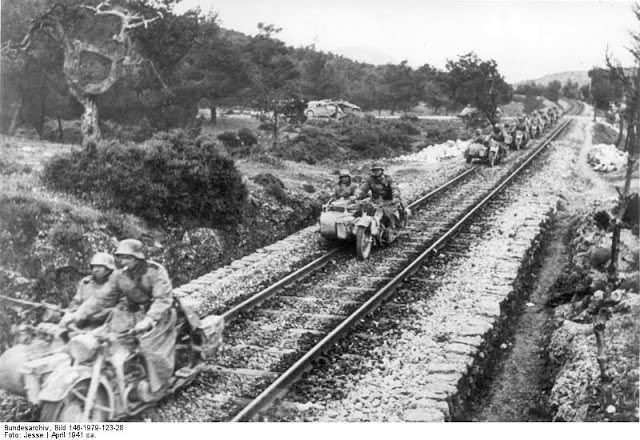
The Germans of Kampfgruppe (Hermann) Balck are not giving Blamey much time. They are heading south at lightning speed. It is Blitzkrieg at its ultimate, motorcyclists leading the way, followed by the panzers. They are following an open, undefended road — but actually, it’s not a road at all, but a single-track coastal railway.
The coast railway line, however, is interrupted at Platamon, north of Larissa, by a large ridge on which sits Platamonas Castle. Under the ridge is a convenient tunnel (there are new, larger tunnels nearby, but this is a one-track tunnel). Wehrmacht motorcyclists have been using the railway tracks on the drive south from Katerini like a road, and, once past the Platamon ridge, the railway and nearby roads lead south all the way to Athens. The Germans intend to roll through the tunnel to continue the journey south on the tracks.
Unfortunately for the Germans, however, the New Zealand 21st Battalion has been in position there since the end of March and is blocking the tunnel. The Germans halted before the New Zealanders late on the 15th after making a perfunctory attack, but today the Germans make a determined effort.
Basically, the Germans are trying to seize a shortcut that would give them a quick route to Larissa and the main roads south that the city controls. Without it, they would have to make a circuitous journey through a gorge to the west between two mountains (Ossa Oros and Olympus Oros) or surmount the coastal mountain that the tunnel cuts through. The tunnel is critical for the bulk of the division’s panzers to continue on this route in any timely fashion. If the Germans can take the tunnel, the short road to Larissa and Athens lies open, with the prospect of trapping huge Allied formations still evacuating from the north.
At dawn, the German Kradschützen Truppen-Bataillon 2 (Motorcycle Battalion 2) of the 3rd Panzer Division attacks, preceded by mortar fire. The Germans make good progress, and around 09:00 about 50 panzers (PzKpfw IIs) arrive and start pounding the New Zealand positions. Some of the New Zealanders on the flanks withdraw, while others on the main hill hold firm.
The New Zealanders are overwhelmed by 10:15, when Lieutenant Colonel N. Macky, in charge of the 21st Battalion, issues the order to retreat. They block the tunnel — it is not completely destroyed, but demolished enough to prevent a quick pursuit. In one version of the battle, they blow explosive charges to seal it; in another, they disable a panzer in the tunnel, blocking it. Either way, the Germans can’t use the tunnel quickly enough for it to be practical. Their German motorcyclists suffer 25% casualties during the attack and their unit is pulled out of the line.
Without the Platamon tunnel, the men of the I,/Panzer Regiment 3 have a decision to make: go west, or try to get over the ridge. By mid-day, they begin across the ridge on a narrow mule track. However, it is very rough going. The Panzer IIs are narrower than Panzer IIIs and would make it over the ridge easier, but the Panzer IIs were all disabled during the morning attack. The Panzer IIIs start across but begin losing their tracks on the uneven and rocky surface or experience other issues with the slope and narrow path. Every time a panzer is disabled, it stops the entire column. Frustrated, the tankers try to go off-road — two get stuck in a swamp and a third runs into a minefield. After losing several tanks, the Germans late in the day finally clear the mule track, sweep it for mines, and get their tanks across — a process that would have taken fifteen minutes through the tunnel.
The New Zealand troops, meanwhile, use a ferry to cross a nearby river in a gorge. They then sink the ferry and take up defensive positions in the gorge.
Elsewhere, the Italians advancing down the Yugoslav coast occupy Split. They also make small gains in Albania as the Greeks pull out. The German 6th Mountain Division, taking the slow route, advances along mountain paths on Mount Olympos.
The Italian High Command reports: “In Yugoslavia, motorized columns of the Italian 2nd Army, after overcoming enemy resistance, have occupied Split 240 miles from their original positions. On the Greek front our troops have advanced from the Lake District to Vijosa. After violent fighting we occupied and overran Erseka (Albania). In North Africa we are continuing operations at Sollum and the encirclement of the fortress of Tobruk, where the enemy, supported by naval forces, is resisting tenaciously.”
Troops of the Italian 62nd “Trento” Regiment attacked Tobruk, Libya in the late afternoon; the attack was personally observed by Erwin Rommel. The attack was driven back by heavy artillery fire, and the entire 1st Battalion of the Italian 62nd Regiment, 775 men and 25 officers, was captured. Rommel “personally, from the most forward lines” leads an attack on the Tobruk perimeter (quotes are from the Afrika Korps War Diary). This is at Ras Mdaauar. He uses his Italian forces, specifically the armored battalion of the Ariete Division and infantry from the Trento Division. The attack fails “because of the hesitant advance of the armored battalion” of the Ariete Division. The War Diary notes sourly that two Italian companies surrendered without putting up any fight.
Wavell stops the Polish Brigade and 7th Australian Division sailing for Greece. He also orders those ships on the way to Greece to turn back, those in Greek ports not yet unloaded should return with their cargoes and those still loading to stop and unload. General Wavell hurriedly stops further convoys of Operation Lustre bringing troops from Egypt to Greece. From now on, the convoys will move in the other direction, evacuating the expeditionary forces from Greece.
The British attempt a commando-style raid on Bardia, but the ships embarking the troops are recalled due to poor weather. The operation is rescheduled for when the skies clear. Another such raid is attempted on Marakeb, Libya, but destroyer HMS Decoy runs aground and the operation cannot be completed.
The Battle of the Tarigo Convoy was fought off the Kerkennah Islands near Tunisia. The British destroyer HMS Mohawk was sunk but the Italians lost two destroyers and five cargo ships. British destroyers HMS Jervis, HMS Janus, HMS Nubian, and HMS Mohawk, aided by Ultra intercepts of German communications, ambushed an Axis convoy on the Tunisian coast after sundown. 4 German troopships and 1 Italian ammunition ship (carrying German 15th Panzer Division less its tanks) as well as Italian destroyers Luca Tarigo, Baleno, and Lampo; 1,800 were killed, 1,200 survived. Luca Tarigo was able to fire two torpedoes at HMS Mohawk, which hit and killed 43 men; HMS Mohawk would soon be scuttled in a hurry, leaving behind secret documents outlining Alexandria, Egypt defenses for Italian divers to capture shortly after.
The British have come to the realization that the battle for North Africa will be decided at sea. Specifically, the key area is the convoy route from Naples to Tripoli. Accordingly, they are positioning submarines in this area, and also sending surface patrols there at night.
Captain P.J. Mack is leading the 14th Destroyer Flotilla, composed of HMS Janus, Jervis, Mohawk, and Nubian and based in Malta, on a more-or-less routine patrol off Tunisia. His lookouts spot an Italian/German convoy commanded by Commander Pietro de Cristofaro. It is composed of five freighters and escorted by three Italian destroyers. Mack attacks the convoy (called the “Tarigo Convoy” after the lead escort destroyer) and sinks not only all five freighters/transports but also all three of the destroyers. Mack accomplishes this at the price of the Mohawk, which is scuttled off the Kerkenneh Islands. There are 168 survivors of the Mohawk and 43 deaths.
On the German side, there are 384 deaths of men who had been en route to the Afrika Korps, mainly from the 15th Panzer Division. The Italian navy puts to sea and eventually rescues 1248 out of about 3000 men who had been on the sunk ships.
An American calling himself “Paul Revere” soon will begin a daily news broadcast to the United States over the German radio, it was learned tonight. “Paul Revere” will be the American counterpart of the famous English “Lord Haw Haw,” who has identified himself as William Joyce, a British expatriate. “Paul Revere” is claimed to be a descendant of a Pilgrim family and a resident of Europe for 10 years.
Premier General Ion Antonescu announced today the discovery of an alleged Iron Guard plot to murder him and members of his cabinet. Antonescu, it was disclosed, told his cabinet yesterday that the murders were planned to take place during church services in the Easter holidays of the Orthodox Church this coming week-end. The premier said that Rumanian authorities were now rounding up the plotters. Antonescu declined to disclose the names of the suspects until a court martial convenes, but he said they were members of the “death squad” of the outlawed Iron Guard.
The last remaining tower of the Crystal Palace in London is demolished. Around this date, the British demolish with explosives the north water tower of the old Crystal Palace. This is simply done — there is no reason given or fuss made about it. The Crystal Palace grounds are being used to manufacture radar equipment, and the reason may be to make more room for this. Another conjecture is that the tower provides a navigational aid to Luftwaffe crews. In any event, it is the final and definitive end to the 1851 Hyde Park structure.
The first U.S. Lend-Lease food shipment arrived in Britain.
British Minister of Labour, Ernest Bevin, announced a National Registration of Women for war work. The first registrations, for women in the age group 20 and 21, were to commence on 19 April 1941.
German armed merchant cruiser Thor stopped Swedish ship Sir Ernest Cassell with two warning shots 500 miles southwest of Cape Verde Islands. The crew of Sir Ernest Cassell was taken aboard, and the ship was scuttled with demolition charges.
The German embassy in Moscow, Russia continued to report unexpectedly friendliness from the Soviets toward Germany.
At Suresnes, outside Paris, the first executions of Jews in the resistance take place. During 1941, a total of 133 Jews are shot for resistance in France, according to Gestapo records.
At 0500 hours, the German air raid on Belfast, Northern Ireland, United Kingdom which began at 2300 hours on the previous date ended; the 203 tons of high explosive bombs, 80 parachute mines, and 800 incendiary bombs dropped killed 758, wounded 1,500, and destroyed 56,000 homes; 100,000 residents were made homeless. Approximately 200 bombers from the Luftwaffe dropped bombs on Belfast in Northern Ireland during the raid.
The British aircraft carrier HMS Furious was slightly damaged in another day of German bombing during the Belfast Blitz. The damage does not interfere with operations.
The Luftwaffe on the Channel Front has entered one of its active phases again. So far in 1941, it has had long spells of inactivity, followed by bursts of heavy raids. Last night, the main target was Belfast (that raid only ends at 05:00 today), and tonight it is London.
There is another reason for the ferocity, indeed savagery, of tonight’s raid, and it has nothing to do with London specifically. Adolf Hitler and Hermann Goering send in the bombers in seemingly endless waves because of the Opera House in Berlin. One of the favored forms of amusement for the Third Reich’s leaders is in the opera — it is not only their preferred form of music but a major form of socializing outside of the work environment. However, the RAF threw a spanner in the works with their raid on Berlin of 9 April which devastated the Opera House. Hitler has ordered the building rebuilt and London flattened in reprisal.
About 300 bombers participate, and they each fly multiple sorties. This is one of the biggest raids of the entire Blitz, rivaling the one at the end of December and some of the others from 1940. The bombers make two and even sometimes three sorties, for a total of 685 payloads dropped over the city. The East End takes tremendous damage. This is probably not coincidental, as it plays to Hitler’s pet theory that he can stir up class resentment against the “Plutocrats” by targeting certain districts. British night air defenses are getting better, and the Luftwaffe loses half a dozen bombers. There is no question that tonight’s raid is one of the climaxes of the Blitz, perhaps not a turning point but with subtle hints of change in the air.
In a sense, Hitler achieves his aim of revenge in one grisly respect. Among the casualties of the night’s raid is Al Bowlly, a Mozambican-born South African/British music hall performer. Thus, both sides are deprived of musical entertainment as a result of the initial RAF raid.
Visiting Australian Prime Minister Robert Menzies is in London during the attack. He hears the bombers overhead but believes at first that they are heading further west. He notes that “a dozen large bombs fell within 100 yards” of his hotel. The room he is in is damaged, with the windows and door blown in. He notes that “The sky beyond the Palace was red with fire and smoke, the sky was flashing like lightning.” At 05:00 on the 17th, he surveys the damage, and finds that “buildings were blazing” on Brook Street and that “gas mains blazed in Piccadilly.” He wonders: “How can it go on for years?”
RAF Bomber Command: Day of 16 April 1941
30 Blenheims on coastal raids. 11 aircraft bombed various targets. No losses.
RAF Bomber Command: Night of 16/17 April 1941
Bremen
107 aircraft — 62 Wellingtons, 24 Whitleys, 21 Hampdens; mist and cloud prevented accurate bombing,. Only 74 aircraft claimed to have bombed in the Bremen area. 1 Whitley and a Photographic Reconnaissance Unit Wellington accompanying the raid were lost.
Minor Operations: 9 Hampdens minelaying, of which 1 was shot down in England by an Intruder, 3 Wellingtons to Calais and Dunkirk, 1 O.T.U. sortie.
Kommodore Werner Mölders of Stab./JG 51 shoots down two Hurricanes of RAF No. 601 Squadron in a Bf 109F. This gives him 65 claims and opens some ground between him and No. 2 Adolf Galland.
Light cruiser HMS Naiad arrived at Scapa Flow after refitting in the Tyne.
Aircraft carrier HMS Furious, under repair at Belfast, was damaged by German bombing.
Destroyer HMS Somali departed Scapa Flow to join steamers Amsterdam and Archangel off Aberdeen at 2130 and escort them to Lerwick and Scapa Flow, respectively. The destroyer and steamer Amsterdam arrived at Lerwick at 1050/17th. They departed again at 2000 for Aberdeen. Destroyer HMS Anthony departed Scapa Flow at 0030/18th to relieve destroyer Somali. Destroyer Somali arrived back at Scapa Flow at 1500/18th. Destroyer Anthony parted company with the steamer off Aberdeen at 0730 and arrived back at Scapa Flow at 1500. Destroyer HMS Arrow departed Scapa Flow at 2000/18th to escort steamer Archangel to Aberdeen. The steamer was detached off Aberdeen and destroyer Arrow arrived back at Scapa Flow at 1200/19th.
Anti-aircraft ship HMS Alynbank departed Methil and joined convoy EC.7 off May Island. The ship arrived at Scapa Flow at 0500/17th after this duty.
British steamer Swedru (5379grt) was badly damaged by German bombing in 55-21N, 12-50W. Seventeen crewmen and seven passengers were lost. The steamer was sunk by HM ship on the 19th.
British steamers Angelesea Rose (1151grt) and Amiens (1548grt) and Norwegian steamer Bolette (1167grt) were sunk by German bombing in 50-25N, 5-35W. There were no casualties on either British steamer. Eight crewmen were missing on the Norwegian steamer.
Norwegian steamer Favorit (2826grt) was sunk by German bombing in 60-06N, 8-31W. The entire crew were rescued.
British trawler King Athelstan (159grt) was damaged by German bombing three miles off Ballinskelligs. The trawler was beached with hull damage. She was temporarily repaired and was able to proceed under her own steam.
German tanker Nordmark replenished Italian submarines Archimede, Gugliemotti, and Ferraris at sea on 16 and 17 April
A German Afrika Korps supply convoy of German steamers Andana (4205grt), Aegina (2447grt), Arta (2452grt), and Iserlohn (3704grt) and Italian steamer Sabaudia (1590grt) departed Naples escorted by destroyers Lampo, Tarigo, and Baleno on the 13th. The British 14th Destroyer Flotilla sighted this convoy off Kerkenah at 0158 on the 16th and attacked at 0210. The entire convoy and all three destroyers were sunk in 34-53N, 9-50E. Destroyer HMS Mohawk was torpedoed by Italian destroyer Tarigo. Lt Cdr (E) J. R. de M. Warren, sub Lt P. J. Hartcup, and thirty nine ratings were lost on destroyer Mohawk. Cdr Eaton and one hundred and sixty crew members were rescued. Destroyer HMS Nubian picked up survivors from the water. Destroyer HMS Jervis took two men from destroyer Mohawk’s fo’c’sle. Destroyer was scuttled by destroyer HMS Janus with gunfire. Italian destroyers Vivaldi and Da Noli arrived and picked up survivors. When the threat of continued attack by British units arose, light cruiser Bande Nere and other units (Barbiano and Di Guissano ??) departed Palermo to cover rescue operations. Over the next seven days, destroyers Vivaldi, Da Noli, Malocello, and Dardo, torpedo boats Cigno, Clio, Centauro, Missori, Papa, Perseo, and Partenope, hospital ships Arno and Giuseppe Orlando, and rescue aircraft rescued 1248 troops (3000 had been aboard the ships).
British troopships Glengyle and Glenearn departed Alexandria at 0300/16th escorted by anti-aircraft cruiser HMS Carlisle and destroyers HMAS Stuart, HMS Wryneck, and HMAS Voyager for a raid by special troops on Bardia. Submarine HMS Triumph had sailed on the 15th to act as a beacon for the operation. After dark, Anti-aircraft cruiser Carlisle departed this force to join convoy AN.27. Anti-aircraft cruiser HMS Coventry departed Alexandria on the 16th to join the force at daylight on the 17th. This operation was to be conducted during the night of 16/17 April, but was cancelled due to bad weather. During the night of 19/20 April, British commandoes raided Bardia. The raid was successful, but sixty seven men lost their way and were left behind. The remainder of the force were embarked and returned to Alexandria.
Destroyer HMS Decoy and gunboat HMS Ladybird departed Tobruk at 1630 for a raid by special troops on Marakeb. The raid was carried out during the night of 16/17, but was unsuccessful. Destroyer Decoy ran aground, but was gotten off without serious damage. Both ships returned to Alexandria.
Destroyer HMS Hero, operating in the Piraeus — Suda Bay area, was ordered to Kotor to embark the Yugoslavian King and Government and the British Minister. However, the sailing was cancelled since it was unknown if Kotor was still in allied hands.
Battlecruiser HMS Renown and aircraft carrier HMS Ark Royal arrived at Gibraltar from Bay of Biscay patrol. Escorting destroyer HMS Fearless was fired upon from Algeciras, but was not damaged.
Swedish steamer Sir Ernest Cassell (7739grt) was sunk by German raider Thor in 32N, 35W. The entire crew was taken as prisoners of war.
Armed boarding vessel HMS Chakla was grounded in a storm at Suda Bay. She was towed off by netlayer HMS Protector.
Greek steamer Memas (4359grt) was sunk by German bombing at Chalkis.
Convoy OB.311 departed Liverpool, escorted by anti-submarine trawler HMS Northern Spray. The convoy was joined on the 17th by corvette HMS Mallow and on the 18th by corvette HMS Violet and minesweepers HMS Niger and HMS Speedwell. Destroyers HMS Malcolm, HMS Scimitar, and HMS Watchman joined on the 19th. Corvette Mallow and the trawler were detached on the 20th. On the 22nd, destroyer Scimitar and the minesweepers were detached. The remainder of the escort was detached on the 25th when the convoy dispersed.
Convoy HX.121 departed Halifax, escorted by armed merchant cruiser HMS California and corvettes HMCS Chambly, HMCS Collingwood, and HMCS Orillia. The corvettes were detached later that day. Battleship HMS Revenge joined the convoy on the 19th and was detached on the 23rd. Destroyers HMS Inglefield, HMS Malcolm, HMS Maori, and HMS Watchman and corvette HMS Violet joined the convoy on the 25th. Destroyers Maori and Watchman and corvette Violet were detached later that day. Destroyers Inglefield and Malcolm were detached on the 28th. The armed merchant cruiser was detached on the 27th. Destroyers HMS Douglas, HMS Leamington, and HMS Roxborough, corvettes HMS Gladiolus, HMS Lobelia, and HMS Veronica, and anti-submarine trawlers HMS St Elstan, HMS St Kenan, HMS St Zeno, and HMS Vizalma joined on the 28th. Corvette HMS Abelia joined on the 29th. On the 30th, destroyers Douglas, Leamington, and Roxborough, corvette Veronica, and the anti-submarine trawlers were detached. Corvette Gladiolus was detached on 1 May and corvette Abelia on 2 May. The convoy arrived at Liverpool on 3 May.
In Washington this day, President Roosevelt conferred with Mackenzie King, Prime Minister of Canada, and with other callers.
With the Senate in recess, its Foreign Relations Committee postponed action on the Tobey anti-convoy resolution, and the committee investigating the defense program questioned Robert P. Patterson, Under Secretary of War.
The House heard discussion of the strike situation in defense industries and adjourned at 2:06 PM until noon tomorrow. The Naval Affairs Committee concluded hearings on the Vinson antistrike bill, and the Military Affairs Committee discussed proposals for changing age limits under the Selective Service Act.
An authorized spokesman for the House Military Affairs Committee said tonight that it was predominantly opposed to lowering draft ages below the present 21 to 35 range. The committee considered such proposals during executive session this afternoon. Representative Faddis, Pennsylvania Democrat, delegated to state the group’s views, said “there was not one (member) who spoke in favor” of lowering the age range, and that “practically every man expressed his opposition.” President Roosevelt said yesterday that officials were studying proposals to lower the draft ages. He said 18 was being considered as the minimum age, and that the plans studied contemplated a considerable lowering of the top age. Faddis said he was “satisfied the committee will not approve this proposal unless some pressure is brought to bear.” He personally felt that the average 18-year-old boy “has not reached the proper physical development to be able to make as desirable a soldier as he should.”
Canadian Prime Minister Mackenzie King visits with President Roosevelt. They will spend the next four days conferring in Washington, Virginia Beach and Roosevelt’s home at Hyde Park. At some point during these meetings, they sign a defense production agreement.
With dramatic suddenness Leon Henderson, administrator of the Office of Price Administration and Civilian Supply, issued a schedule tonight freezing steel prices at the levels which prevailed during the first quarter of 1941.
In his most outspoken statement on the labor problem since he became a government official, William S. Knudsen, director of the Office of Production Management, last night denounced strikes called to take advantage of the defense situation as “criminal,” and jurisdictional strikes as “plain stupid.”
A new two-year wage agreement between soft-coal operators of the Northern Appalachian area and the United Mine Workers was finally negotiated yesterday, it was announced by Dr. John R. Steelman, director of the United States Conciliation Service, who has been participating in the negotiations for the past three weeks.
Wendell L. Willkie announced tonight that he is returning to law practice and has become senior partner in the 60-year-old firm of Miller, Owen, Otis & Bailly, hereafter to be known as Willkie, Owen, Otis & Bailly. He will continue to write and speak on political questions of principle but his chief work is to be the practice of law, in which he intends to devote himself to advocacy and trial work. Willkie intends to take a vacation at his Indiana farm early next week, returning to New York about the beginning of May. His personal offices in the Commodore hotel, from which he has answered 280,000 pieces of mail since the November election, are to be closed about the end of the month.
Secretary of the Navy Frank Knox said today that the Navy was preparing to send a force of one officer and thirty-five United States Marines to London to guard the American Embassy. The Secretary said that only a formal request from Ambassador John G. Winant was awaited before the guard was sent. He described the move as a “minor” matter and said the guard was “an ordinary embassy guard.”
Repair of British combatant ships in American navy yards has received priority over all other work, Secretary Knox stated today. A considerable number of British ships have arrived in American waters and the repairing of them, as well as others expected, will be rushed so as to get the craft back into the fighting line.
Secretary Wickard and a group of Agricultural Department aides from Washington disclosed to Corn Belt farm leaders today the large program which the United States has undertaken to feed Great Britain and the other democracies.
Two witnesses who said that they were former members of the Communist party testified today at the deportation hearing of Harry Bridges that they saw the West Coast labor leader and C.I.O. official at Communist party meetings in 1934 soon after or during the general strike which Mr. Bridges led in San Francisco that year.
The heavy cruiser USS Vincennes (CA-44) arrived at New York, having transported a cargo of British gold for deposit in the United States from Simonstown, South Africa, pursuant to Operation FISH.
MacDill Air Force Base, operational since 16 April 1940, receives its name today. It is named after World War I veteran Colonel Leslie MacDill.
Major League Baseball:
The Red Sox waged another uphill struggle today to beat the Senators, 8–7, in twelve innings, Pete Fox singling home the deciding run in Boston’s second straight victory. The Red Sox scored three runs in the ninth inning on homers by Bobby Doerr and Jim Tabor to send the game into extra innings.
Kirby Higbe, pitching for the Dodgers, allows the Giants just five hits, but four Brooklyn errors — two by young Pee Wee Reese, and two by Cookie Lavagetto — result in a 3–1 Giants win. Harry Gumbert gets the win.
Morton Cooper pitched five-hit ball today, fanned seven and led the Cardinals to their second straight victory over the world champion Reds, 4–2.
Southpaw Al Milnar limited the White Sox to two singles today as Hal Trosky and Roy Weatherly lined homers over League Park’s short right field wall in Cleveland to give the Indians a 6–0 triumph.
The Philadelphia Athletics score five runs in the sixth inning to beat the New York Yankees, 10–7. Joe DiMaggio hammers out four hits, including his first home run of the year, in a losing effort. Dick Siebert hits two homers for the A’s, and Bob Johnson adds another.
The Philadelphia Phillies’ offense bogged down before Manuel Salvo’s three-hit pitching today as the Boston Bees evened their series at 1-all with a 4–1 victory.
The champion Detroit Tigers and pitcher Buck Newsom made their delayed start in the American League race today by losing, 8–1, to the St. Louis Browns, just as they had on opening day a year ago. Rudy York homered for the Tigers.
Washington Senators 7, Boston Red Sox 8
New York Giants 3, Brooklyn Dodgers 1
St. Louis Cardinals 4, Cincinnati Reds 2
Chicago White Sox 0, Cleveland Indians 6
Philadelphia Athletics 10, New York Yankees 7
Boston Bees 4, Philadelphia Phillies 1
Detroit Tigers 1, St. Louis Browns 8
Mexican Government authorities reported 174 known dead and at least 175 injured in a wide area affected yesterday by an earthquake that crumbled hundreds of homes, brought a tidal wave smashing on coastal villages, and caused eruption of the Colima volcano.
China has received formal assurances from Moscow that the new Russo-Japanese neutrality pact means no change in the Soviet policy toward China, official sources revealed here today.
Chinese reports reaching Hong Kong indicate large scale Japanese withdrawals from the southeastern part of Kwangtung Province with the subsequent Chinese reoccupation of Haifung, Lukfung, Swabue and other coastal points. The Chinese assert that the withdrawal follows attacks by Chinese reinforcements. There is reason to believe, however, that the Japanese are again concentrating on Formosa and Hainan and are also strengthening the garrison at Canton. The Japanese are reported to have mined the waters off the coastal areas that have been evacuated. Chinese sources here also report that the garrisons near the Hong Kong border have been increased, mainly by Chinese troops from the Canton area, who are in the Japanese pay. This is ostensibly to tighten the blockade of the routes from Hong Kong to Free China.
An Associated Press dispatch from Tokyo quotes Ko Ishii (the spokesman for the cabinet board of information) as denying absolutely and flatly that “Japan intended to send an army or navy force against Singapore.” Ishii added: “Premier Prince Konoye already stated that Japan’s southward intentions are clearly and entirely peaceful and economic. This report (about Singapore) is entirely groundless and the propaganda of war mongers.”
In the Philippines, Elizalde writes MacArthur that war is “60 to 90 days away.”
Dow Jones Industrial Average: 118.6 (+0.01)
Born:
Cliff Stearns, American businessman and politician (Rep-R-Florida, 1989–2013), in Washington, District of Columbia.
Died:
Josiah Stamp, 1st Baron Stamp, 60, English industrialist, economist and civil servant.
Naval Construction:
The Royal Navy Isles-class minesweeping trawlers HMS Tiree (T 180) and HMS Trondra (T 181) are laid down by the Goole Shipbuilding & Repairing Co. Ltd. (Goole, U.K.).
The Royal Canadian Navy Bangor-class (VTE Reciprocating-engined) minesweeper HMCS Bellechasse (J 170) is laid down by the Burrard Dry Dock Co. Ltd. (Vancouver, British Columbia, Canada).
The Royal Australian Navy Bathurst-class minesweeper-corvette HMAS Cessnock (J 175) is laid down by the Cockatoo Docks and Engineering Co. Ltd. (Sydney, New South Wales, Australia).
The Royal Navy Flower-class corvette HMS Balsam (K 72) is laid down as HMS Chelmer by George Brown & Co. (Greenock, Scotland); completed by Clark.
The Royal Navy “R”-class destroyer HMS Raider (H 15) is laid down by the Cammell Laird Shipyard (Birkenhead, U.K.).
The Royal Navy Isles-class minesweeping trawler HMS Pladda (T 144) is launched by Cook, Welton & Gemmill (Beverley, U.K.); completed by Holmes.
The Royal Navy MMS I-class motor minesweeper HMS MMS 38 (J 538) is launched by P.K. Harris & Sons (Appledore, England, U.K.).
The Royal Australian Navy Bathurst-class minesweeper-corvette HMAS Katoomba (J 204) is launched by Poole & Steel Pty. Ltd. (Sydney, New South Wales, Australia).
The Kriegsmarine (German Navy) Type VIIC U-boat U-701 is launched by H C Stülcken Sohn, Hamburg (werk 760).
The Regia Marina (Royal Italian Navy) Soldati-class (Second Group) destroyer Legionario is launched by Cantieri Odero Terni Orlando (O.T.O.), (Livorno, Italy).
The SS Rainbow, a Maritime Commission type (C2-T Cargo) hull, under Maritime Commission contract (MC hull 124), fitting out at Tampa Shipbuilding Corp., Tampa, FL, is acquired by the U.S. Navy for conversion to an ammunition ship. She will commission as the USS Rainier (AE-5).
A second unnamed Maritime Commission type (C2 Cargo) hull, under Maritime Commission contract (MC hull 125) under construction at Tampa Shipbuilding Corp., Tampa, FL, is acquired by the U.S. Navy for conversion to an ammunition ship. She will commission as the USS Shasta (AE-6).
The SS Raven, a Maritime Commission type (C2) hull, under Maritime Commission contract (MC hull 126) under construction at Tampa Shipbuilding and Drydock Co. Tampa FL, is acquired by the U.S. Navy for conversion to a naval cargo ship. She will commission as the USS Bellatrix (AK-20).
The MV Meteor, a Maritime Commission type (C2-T) hull, under Maritime Commission contract (MC hull 127) under construction at Tampa Shipbuilding and Drydock Co. Tampa, FL, is acquired by the U.S. Navy for conversion to a naval cargo ship. She will commission as the USS Electra (AK-21).
The SS Cape Lookout a Maritime Commission type (C1-A) under Maritime Commission contract (MC hull 138) under construction at Pennsylvania Shipyards, Inc., Beaumont, TX, is acquired by the U.S. Navy for conversion to a naval cargo ship. She will commission as the USS Fomalhaut (AK-22).

