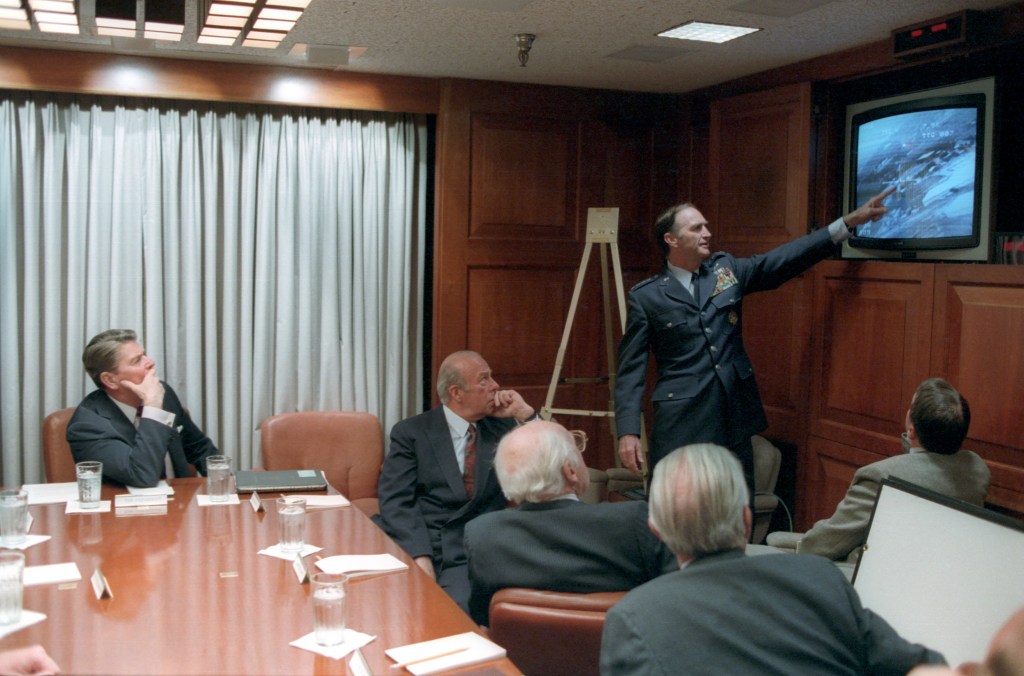
The bombing raid on Libya damaged Colonel Muammar el-Qaddafi’s ability “to direct and control the export of international terrorism,” according to the Reagan Administration. It warned the Libyan leader that he would face further American military retaliation unless he stopped sponsoring violence against Americans. President Reagan said the air strikes on Monday night near Tripoli and Benghazi were “a single engagement in a long battle against terrorism.” “We would prefer not to have to repeat the events of last night,” Mr. Reagan told a business group here today. “What is required is for Libya to end its pursuit of terror for political goals. The choice is theirs.”
The American planes that attacked early today struck a number of military targets, including the headquarters compound of the Libyan leader, Colonel Muammar el-Qaddafi, a naval academy and air bases here and in Benghazi. There was also damage in a residential neighborhood in the capital. Libyans tried to assess the damage, but there was no publicly available estimate of casualties. After the raids, at least 15 people were reported dead and 60 wounded in the Bin Ashur residential neighborhood, hospital workers said. To add to the tension in the capital, antiaircraft flak and missiles suddenly filled the night sky again tonight, although it was not clear that there were any American planes about. In Washington, American officials said there had been no United States attacks Tuesday.
The youngest Qaddafi child, a 15-month-old adopted daughter named Hana, died in the American air strike, the family pediatrician said. He said two other children of the Libyan leader were wounded in the attack. The Libyan leader maintained a public silence and his whereabouts was not immediately known. His daughter, Hana, died two and a half hours after suffering a concussion and internal injuries from an explosion next to the colonel’s home. In keeping with custom, she was buried before sunset. The two injured sons of Colonel Qaddafi’s seven surviving children were listed in serious condition in a pediatric hospital from percussion wounds. Doctors said the children were Camis, 3, and Sef al-Arab, 4. Libyans retaliated for the United States bombing by firing two missiles at an American-manned radar installation on the Italian island of Lampedusa between Libya and Sicily. But the tiny, isolated island emerged unscathed.
The Soviet Union responded today to the American military attack on Libya by canceling a planned meeting between Secretary of State George P. Shultz and Foreign Minister Eduard A. Shevardnadze in mid-May. The United States Ambassador, Arthur A. Hartman, was summoned to the Foreign Ministry late in the afternoon to receive a formal protest from the Soviet Government and was informed that the meeting had been called off, Western diplomats said. The White House criticized the Soviet Union for canceling the meeting. The White House spokesman, Larry Speakes, said the move cast doubt on the Kremlin’s position on terrorism and on its intent to take part in a summit meeting this year. A Soviet Government statement said Washington’s “criminal action” had made it impossible to hold high-level discussions and warned that continued American military action against Libya would force Moscow to draw “more far-reaching conclusions.”
The United States Army in Europe today ordered a curfew from midnight to 5 A.M. on 225,000 soldiers. The Air Force sent 200 more security policemen to Europe. Marines carrying submachine guns patrolled the American Embassy grounds in Mexico City. In Peking, American Embassy officials urged Americans to “exercise special caution.” Egyptian police patrolled the streets around the American Embassy in Cairo and in a suburb where many Americans live. And an international school in St. Germain-en-Laye outside Paris has taken down the sign outside its American section. Around the world, American citizens, embassies and military bases sought to secure themselves against retaliation for the American bombing raid into Libya. In Washington, the State Department urged Americans traveling abroad to be careful. The Federal Aviation Administration directed American air lines to be “extra-vigilant” when flying to foreign airports and said extra sky marshals would be sent on more flights. Despite the flurry of security measures, there seemed to be no master plan. The degrees of alert differed for each military service while reports from correspondents of The New York Times showed wide differences in precautions at embassies and among private citizens. Security was tightened especially in Western Europe, where access from Libya was easier. In addition to the curfew, more American guards in West Germany ringed military headquarters, erected barricades and used mirrors on long handles to check under cars for bombs.
Administration officials said today that President Reagan would decide on further use of force against Libya on a case-by-case basis and that he had not adopted a strategy of automatic military retaliation to terrorist incidents. The officials said this definition of Administration strategy was intended to quell fears that the fighting might get out of hand, without at the same time removing the threat of additional American strikes in response to terrorism by the Government of Colonel Muammar el-Qaddafi. The officials said this was the policy even though they said that Mr. Reagan had given advance orders to American forces attacking Libya Monday to step up their efforts “immediately” if they met Libyan military opposition. “If Qaddafi hits our forces or continues terrorist acts and we can prove it, the President will maintain and sustain military options on a case-by-case basis,” a senior Administration official stated.
Most of the allies in Western Europe criticized the attack on Libya today, and France defended its decision not to allow American planes to fly over its territory, saying that the European countries themselves should respond to the Libyan terrorist threat in Europe. Prime Minister Bettino Craxi of Italy said the American attack could cause “a further explosion of fanaticism and extremism.” Greece called for an early meeting of the European Community’s foreign ministers. Britain stood alone in supporting the United States. The West German Chancellor, Helmut Kohl, in a delicately balanced statement, was critical of the “use of force,” but said he understood the American response to “continuous aggression” by Libya.
Despite signs of discord between the United States and its European allies, Administration officials and others in Washington played down the notion today that the American attack on Libya on Monday had caused a rupture in the Atlantic alliance. France and, in a less direct way, Spain refused to allow United States Air Force bombers based in England to use their airspace, forcing the planes to make a long detour on the way to their targets. Defense Secretary Caspar W. Weinberger said that that subjected the pilots to increased fatigue and heightened the chance of detection. In addition, most Western European governments, except that of Prime Minister Margaret Thatcher in Britain, criticized the attack on Libya.
An air and sea search for two downed Air Force crewmen — a pilot and radar-weapons officer — missing after the bombing of Libya on Monday continued after dark tonight in the Mediterranean. Late today, a Pentagon spokesman said, “We have no evidence of survivors.” Meanwhile, clouds over Libya today seriously hampered bomb damage assessment by United States reconnaissance satellites, the Pentagon said. Despite that, the Assistant Secretary of Defense for Public Affairs, Robert Sims, said the American raids on Tripoli and Benghazi had damaged three to five medium Soviet-built bombers and 5 to 12 MIG-23 fighter planes and destroyed three hangars filled with MIG spare parts.
Vernon A. Walters, the chief American delegate to the United Nations, today defended the American air strikes against Libya at a meeting of the Security Council, calling them an act of self-defense. The Libyan delegate, Rajab Azzarouk, urged the Council to condemn the air raids as state terrorism, calling them “barbaric and savage” and an “unprovoked” raid on civilian targets. The chief Soviet delegate, Yuri Dubinin, called on the Council “firmly to condemn the act of armed aggression against Libya perpetrated by the United States” and to “demand that the United States immediately cease its armed attacks on Libya and not allow for such actions in the future.”
The foreign ministers of 21 nations espousing nonalignment joined today with Prime Minister Rajiv Gandhi, chairman of the nonaligned movement, in sharply condemning the American bombings in Libya and likening them to acts of terrorism. Mr. Gandhi said the nonaligned movement “extends its firm support and solidarity to Libya in this critical hour.” Meeting in a special session this evening, the ministers expressed “deep shock and profound indignation” over what they termed an “act of aggression” violating international law.
Arab countries reacted today with almost universal condemnation of the American air strikes against Libya, but there were discernable differences between moderate governments that have long looked askance at Colonel Muammar el-Qaddafi and radical groups who vowed immediate vengeance. The Abu Nidal terrorist group, believed supported by Libya and held responsible by Western nations for, among other terrorist attacks, those at the Rome and Vienna airports last December, threatened to strike at American interests around the world in reprisal. “Faced with this American imperialist aggression, we will fiercely strike American institutions and interests in our country and around the world,” the organization, known as the Fatah Revolutionary Council, said in a two-page typewritten statement delivered to Western news agencies in Beirut. The statement warned Arabs and “friendly nations to keep away from bases of the American interests which will be targets for our attacks.”
President Reagan is to meet Wednesday with Cabinet members and senior arms-control advisers to take up the issue of whether the United States should continue to abide by the second agreement limiting nuclear arms. The issue, potentially the most important arms-control decision to be made in the second term of the Reagan Administration, has divided State Department and civilian Defense Department officials. It has also emerged as a potentially divisive issue for the United States and its Western allies, who support continued adherence to the agreement. Administration officials said they expect a tentative decision to be made within days. Then, Paul H. Nitze and Edward L. Rowny, two arms control advisers, will consult with United States allies. Upon their return, a final decision will be made, officials said.
The United States has signed the 1979 agreement but the Senate did not approve it. But after Mr. Reagan took office, his Administration announced that it would not “undercut” the agreement as long as the Soviet Union adopted a similar policy. A decision is required soon because of Navy plans to launch the USS Nevada. Unless the United States dismantles some multiple warhead missile launchers, it will exceed provisions that limit each side to 1,200 multiple warhead missiles when the Nevada begins her sea trials in late May. To stay within the agreement limits the Administration is considering whether to dismantle two Poseidon submarines. Last year, President Reagan decided to dismantle one Poseidon submarine, when the Navy’s seventh Trident submarine began sea trials. The Administration has been under pressure from conservatives to take a hard line on alleged Soviet arms control violations by taking steps that run counter to the accord. Moreover, Defense Secretary Caspar W. Weinberger and other officials have all along opposed abiding by the agreement.
A 35-nation conference seeking freer movement of people between Eastern and Western Europe began hours late after the Soviet Union refused to permit the meetings to be held in public. American and other Western officials said they would counter Moscow’s insistence on closed proceedings at the conference in Bern, Switzerland, by circulating all their statements to the news media.
A recent test of the latest Soviet land-based missile failed and the rocket may have exploded, an Administration source said. U.S. officials believe the Soviets will correct whatever problems led to the failure of the missile, which is designed to succeed the SS-18 According to one report, the missile exploded on liftoff and damaged the test area; in another, it malfunctioned on the launching pad.
A Communist Party newspaper published an article by the poet Yevgeny Yevtushenko today in which he criticized censorship and dogmatism in Soviet life and said “public silence is a hidden form of anarchy.” “The archaic dinosaurs of so-called security are still trying to put their personal opinions above all others, doing everything to prevent writers, film directors, artists, scientists and workers from saying what is on their mind,” Mr. Yevtushenko said. The article also made a rare disapproving reference to Stalin’s persecution of Anna Akhmatova, the poet, and Dmitri Shostakovich, the composer.
Roman Catholic leaders in the United States believe that Pope John Paul II’s weekend visit to a Rome synagogue will foster important changes in Catholic attitudes about Jews and undermine lingering anti-Semitism. Joseph Cardinal Bernardin of Chicago, one of the American Catholic Church’s most respected figures, said the embrace between the Pope and Elio Toaff, the Chief Rabbi of Rome, “was a symbolic gesture indicating on the church’s part a clear end to centuries of discrimination and persecution of the Jews and a deeper appreciation and affection for our Jewish brothers and sisters.” Dr. Eugene J. Fisher, director of Catholic-Jewish relations for the National Conference of Catholic Bishops, said the Pope’s visit demonstrated that a Jewish house of worship “is a place the Pope would visit and honor and respect, so it should have a rather deep impact on slowing down anti-Semitism and any ideas Christians might have of viewing Judaism from a posture of superiority rather than of respect and dialogue.”
Andrija Artukovic, the Croat accused of being a war criminal, said today that when he was Interior Minister in the Nazi puppet regime he never knew that Serbs, Jews and Gypsies were being killed, and he denied he ever visited any of the death camps established by the Government he served. On the second day of his trial in Zagreb, Yugoslavia, the defendant, 86 years old, who was extradited to Yugoslavia from California, showed none of the senility ascribed to him by his defense lawyers. In fact, Mr. Artukovic seemed alert and mentally spry, dodging potentially difficult questions as he said he could not remember certain meetings or visits, though he recalled seemingly innocuous episodes in abundant detail. The charges arise from a four-year period beginning in 1941 when Mr. Artukovic was Interior Minister and then Justice and Religion Minister in the Ustasha Government that ruled Croatia under the patronage of Nazi Germany and Fascist Italy.
The Swiss Government has notified Haiti that it has frozen the Swiss bank assets of former President Jean-Claude Duvalier, Haiti’s Minister of Justice said today. The Justice Minister, Francois Latortue, said the freeze affected assets held in banks in Geneva, Lausanne and Zurich. In an interview today, Mr. Latortue said that he had just been notified of the move but had not been informed of the amount of money that might be involved. “We are very pleased,” Mr. Latortue said as he reached for a telephone to discuss the matter with Haiti’s Foreign Minister, “but we still do not know how much money there may be.”
The American granddaughter of Stalin returned to Britain today after 18 months in the Soviet Union, saying she was glad for the experience but happy to be back in the West. Her mother, Svetlana Alliluyeva, was not with her. “I’m not sorry that I went,” said the smiling girl, Olga Peters, who was born in the United States, as reporters surrounded her on her arrival at Heathrow Airport on an Aeroflot flight from Moscow. “It was a really great experience for anybody,”
The United Nations faces its most serious financial crisis ever, with debts projected to reach $275 million by the end of the year, a sum greater than the organization’s combined reserves, Secretary General Javier Perez de Cuellar said. Contributing to the group’s financial difficulties were a U.S. decision to withhold funding in compliance with congressional budget-cutting bills and the failure of several other members to pay substantial arrears. The secretary general proposed sharp cuts in U.N. activities, including a three-week reduction in the duration of the annual session of the General Assembly.
Israel has quietly moved hundreds of Jewish Ethiopian immigrants into the West Bank despite U.S. opposition to settling them in Israeli-occupied Arab land. About 400 Ethiopian Jews live in government housing in Kiryat Arba and make up about 8% of the settlement, according to an official at a Hebrew language school in which many of the immigrants study. “American aid is not supposed to help in Jewish settlement of the West Bank, which the United States opposes,” a U.S. Embassy official in Tel Aviv said.
The State Department and the Israeli Embassy said today that an Arab-American was mistreated after his arrest in southern Lebanon by an Israeli-backed militia in February. The man, identified as Ghazi Dabaja of Dearborn, Michigan, said he had been tortured with electric shocks and lighted cigarettes. The State Department expressed “strong concerns” to Israel about the incident, a spokesman said. Although Mr. Dabaja was reported to have sworn in an affidavit that an Israeli had supervised his torture, the Israeli Embassy in Washington said the abuses had been halted by an Israeli officer who was assigned to monitor the interrogation after the prisoner’s American citizenship became known. The embassy spokesman, Yossi Gal, also provided unusually detailed intelligence reports to support an accusation that Mr. Dabaja had acted as an agent of a Shiite Muslim guerrilla movement and, at the time of his arrest, was plotting to kill four officers of the Israeli-backed militia.
Hundreds reportedly were killed, wounded or captured during heavy fighting between Soviet and Afghan troops and Islamic guerrillas in southeastern Afghanistan after a major attack was launched earlier this month in three border provinces to stop the return of guerrillas who had spent the winter in Pakistan. Radio Kabul, the Afghan government radio, said in a broadcast Sunday that government soldiers killed about 700 guerrillas. And, in the capital of Kabul, authorities dramatically tightened security after a wave of bombings and after about 20 bombs were found in a Soviet complex, Western diplomats said.
Two Democratic Senators today compared South Korea with the Philippines before Ferdinand E. Marcos was overthrown and said the United States should do more to promote democracy in Seoul’s Government. “That yearning for freedom that was present in the Philippines is present in your country,” Senator Paul Simon of Illinois told members of the New Korea Democratic Party who are visiting the United States. The party is the chief opposition one in South Korea. Senator John Kerry of Massachusetts said the 1988 summer Olympic games in Seoul presented a good opportunity to focus world press attention on South Korea and its problems. Senators Kerry and Simon are sponsoring a resolution urging South Korea to restore full rights to the South Korean opposition leader Kim Dae Jung.
Prime Minister Yasuhiro Nakasone seems increasingly likely to dissolve the Japanese Parliament soon and hold national elections in late June, members of his ruling Liberal Democratic Party say. Mr. Nakasone, who returned tonight from Washington after two days of talks with President Reagan, has said several times that he has no such plan. But fellow politicians say they assume an election is imminent, and some have already put up wall posters and returned to home districts to campaign. They say they believe the Prime Minister, seeking to take advantage of uncommon popular support, will dissolve the decision-making lower chamber of Parliament, the House of Representatives, and call an election. They said this would be done to coincide with a vote that must be held for the less significant upper chamber, the House of Councilors.
A truck exploded and burned in what was believed to be an attempt by suspected radicals to fire homemade rockets at the U.S. Yokota Air Base, the headquarters for American forces in Japan, officials said. There were no immediate reports of casualties or damage in the incident, which occurred about 25 miles west of Tokyo. Police who extinguished the flames found five pipes believed to have been used as crude rocket launchers and a timer rigged to the vehicle.
More than 4,000 supporters of Ferdinand E. Marcos marched to the U.S. Embassy in Manila and demanded the return of their leader, who urged them on from exile in Hawaii. Demonstrators burned an American flag and shouted obscenities at two U.S. officials entering the embassy. “The flame you have started shall spread,” Marcos said in an interview with a Manila radio station. He exhorted loyalists to continue protests against President Corazon Aquino’s government.
Mexico has agreed to permit the United States to monitor the Mexican antinarcotics program more closely, a State Department official said here today. “They have agreed to a major increase in the exchange of intelligence and information and to permit much more access to the eradication program in terms of our observers verifying destruction of crops,” the State Department official said, referring to marijuana and opium poppy crops.
The House of Representatives, opening its second round of debate on military aid to the rebels in Nicaragua, approved a debating procedure today that supporters of the aid said was designed to kill or delay it. The procedure, devised by the Democratic leadership, was approved on votes of 221 to 202 and 212 to 208. The margins reflected the narrow partisan support for the tactics of the Democratic leaders and the sentiment of members on aid to the rebels. Under the procedure, the aid measure will be attached to a $1.7 billion catchall spending bill that is opposed by the Administration. Today, Representative Robert H. Michel of Illinois, the House minority leader, called the bill a “great rancid barrel of pork.”
A force of several hundred rebels raided the remote northern village of El Delirio on Wednesday, burning a state-owned coffee warehouse and several homes and capturing two Sandinista militiamen and a public health worker. Although the raid was relatively small in scale and had no great military significance, the guerrillas used tactics that have led many American politicians to criticize their movement. Yet they killed no civilians and inflicted no damage on the nearby Santa Rosa ranch, which is privately owned. Rebel leaders have said they attack state farms to prevent the Government from earning hard currency to finance the war effort.
An American communications specialist at the United States Embassy in the Sudan was shot in the head today by an unknown assailant while driving his car, the State Department said tonight. A spokesman on the department’s special Libyan task force said the wounded American was “in serious condition” in a Khartoum hospital, where he was being treated. His identity was not made known immediately, pending notification of his family. The State Department said that the “security situation in Khartoum is currently under review” and that no decisions had been made on evacuating Americans from the Sudanese capital. There are about 200 American diplomatic personnel and 200 dependents in Khartoum, as well as a far smaller number of American relief workers attached to private organizations.
Congressional leaders from both parties asserted today that the Administration had failed to consider their views adequately before ordering the air raid against Libya on Monday and that Congress should be consulted more closely before any future counterterrorist actions. While there was widespread support on Capitol Hill today for the Libya attack, many lawmakers said the spread of terrorism had created a new global situation that required new procedures for Congressional participation in the shaping of critical foreign policy decisions. Representative Robert H. Michel of Illinois, the Republican leader, summed up this theme when he said: “We’re in a war. It’s a new kind of war. It’s a terrorist war. We’re going over the threshhold, we’re ploughing new ground, and we have to think what comes next.”
Bomb threats to offices of government agencies and news organizations briefly disrupted activities around the capital today. The police said the telephoned threats had apparently been the work of cranks rather than terrorists. The authorities in the Washington area said there were reports of seven telephone calls from people making bomb threats. Two of the calls mentioned or alluded to the United States’ bombing of targets in Libya’s capital, the police said. However, the authorities said the number of bomb threats today was not unusual for Washington.
Security at airports, diplomatic offices and government buildings in the New York metropolitan area was stiffened yesterday against possible retaliation for the United States attacks on Libya, law-enforcement officials said. Police officers, some of them armed with special tactical weapons, were put on “ready alert” at Kennedy International, Newark International and La Guardia Airports, according to the Superintendent of the Port Authority police, Henry I. DeGeneste.
The International Air Line Pilots Association has authorized boycotts of countries that promote terrorist acts against civil aviation or fail to provide adequate airport security, the 60-nation group announced yesterday. The action was taken at the pilots’ annual meeting in London, which just ended, and was disclosed at a news conference by the group’s president, Reg Smith of Air Canada.
The Senate confirmed the nomination of Robert M. Gates as deputy director of the Central Intelligence Agency. Gates was approved by the Senate on a voice vote, without dissent, to succeed CIA veteran John N. McMahon, who is retiring. Gates was described as an “extremely professional member of our intelligence community” by Sen. Patrick J. Leahy (D-Vermont), vice chairman of the Senate Intelligence Committee. In his career, Gates has been an analyst and administrator, with no experience in covert operations.
The Army and Navy have begun advertising special college tuition benefits that are tied to a veterans’ assistance law that President Reagan is seeking to eliminate. The law, the New G.I. Bill, which provides tuition payments of $300 a month for 36 months to veterans with two years of service who have contributed $1,200 of their own money to the tuition, was approved by Congress in 1984. As a further inducement to recruits, the Army and Navy have added benefits that could raise to $17,000 the total amount that soldiers and sailors could get for college.
The Supreme Court has not retreated drastically from protection of constitutional rights despite strong dissents by William J. Brennan Jr. from many rulings over the last decade, the Associate Justice said. Justice Brennan, in an interview, also said he “strongly favored televising and radio broadcasts of our arguments.”
The judge in the espionage trial of Jerry A. Whitworth ruled today that the defense could present evidence that the Government’s chief witness failed part of a polygraph examination. The purpose of the defense is to raise questions about the witness’s truthfulness. While courts normally refuse to allow the results of polygraph, or lie-detector tests, as evidence, Federal District Judge John P. Vukasin Jr. noted that judges have wide discretion in allowing their use for the purpose of impeaching the credibility of a witness.
A court-martial opened today for an Air Force clerk accused of trying to give classified information to Soviet agents, with the defense urging the Government to pay for a psychiatrist to help prepare an insanity defense. The airman, Bruce D. Ott, an administrative clerk in a squadron that flies the SR-71 spy planes, was arrested January 22 in Davis, California about 40 miles south of Beale Air Force Base.
Kicking, cursing and fighting with five Death Row guards, ski mask killer Daniel Morris Thomas was strapped into Florida’s electric chair in Starke and executed for the 1976 murder of a man and the rape of the wife as her husband lay dying. Observers said the struggle was the first to take place in Florida State Prison’s death room within memory. Cursing and screaming “Get off me! Get off me!” Thomas, 37, was subdued after a seven-minute struggle during which he kicked one guard in the groin and tried to bite another on the arm.
Union meatpackers refused to admit today that they had disobeyed an order by their parent union to end their eight-month strike against the Geo. A. Hormel & Company plant in Austin, Minnesota. “We haven’t admitted anything,” said Lynn Huston, vice president of Local P-9 of the United Food and Commercial Workers Union. “We haven’t even admitted we are on strike.” About two dozen local and international union officers attended the second day of a closed hearing called by the parent union to determine whether Local P-9 obeyed an order March 14 to end the strike. The hearing will resume Wednesday.
Despite a rally and march by 250 students, parents and school patrons outside a school board meeting, students in Purdy, Missouri, still cannot dance at school events. The rally climaxed when dozens of Purdy youths rushed in front of the crowd to dance to the theme song from “Footloose” — a movie about a fictitious small town where dancing was forbidden. The school board, however, declined to discuss the issue in the town of 930 people.
The Illinois Supreme Court upheld a ruling that would let a supporter of Mayor Harold Washington be certified as victor in an aldermanic election, giving the mayor control of the City Council for the first time in his three-year tenure. The high court upheld a lower court ruling in favor of Washington ally Luis Gutierrez. His apparent victory had been challenged by Manuel Torres, ally of Washington’s chief political foe, Alderman Edward R. Vrdolyak.
A man who lost his home in the fire after the police confrontation May 13 with the radical group Move shot and wounded his lawyer. then threatened an official in a city office building today, the police said. The 42-year-old suspect, Ernest Bostic, owned one of the 61 homes destroyed in a fire after the police bombed the radicals’ house, Police Capt. Richard DeLise said. Another police official said Mr. Bostic was distraught over delays in compensation for the loss. Mr. Bostic, who threatened an official in the City Solicitor’s office who was trying to settle a claim, was still at large last night. The victim, David Novitsky, 27, was listed in critical condition at a hospital.
The boycott-plagued school system in Indianola, Mississippi has been ordered shut down indefinitely, beginning today. “It was the decision of the board that it is in the best interest of the majority of the children enrolled in this district that all schools be closed indefinitely,” Walter Gregory, chairman of the five-member school board and one of two black members, said Monday. He said only 643 students, mostly white, attended classes in the system’s five schools Monday. The predominantly black district has an enrollment of 3,029 students. Parents began a second boycott of the schools a week ago to increase pressure on the school board to withdraw its offer of the vacant superintendent’s job to W. A. Grissom, a white assistant superintendent in Bolivar County.
While Californians have begun to do more to prepare for a major earthquake than previously, public safety officials say much remains to be done and that the state is in a race against time to reduce the casualties in an inevitable disaster. As Chief Emmet Condon of the San Francisco Fire Department told a conference on emergency planning the other day, “We are not prepared for a major earthquake.” His warning came as the city prepared to commemorate the 80th anniversary of the earthquake that all but destroyed it on April 18, 1906. And, as if to remind people here that they still live on shaky ground, the earth has been wobbling and trembling in a spate of small earthquakes.
The Los Angeles Times has suspended the comic strip Doonesbury for its criticism of Reagan Administration appointees accused of misconduct. In place of the strip, The Times published a brief notice that the episodes scheduled for this week would not appear on the ground that they contained “damaging material we know to be overdrawn and unfair.” “We feel this week’s ‘Doonesbury’ grossly exaggerates the real and alleged transgressions of many Reagan Administration appointees,” the newspaper said in the notice, which appeared Monday and today.
A wintry storm dusted the Midwest with April snow showers, and gusty winds blew frigid Canadian air into the northern Plains, breaking record lows in at least five cities. The spring storm spread swirls of huge snowflakes from South Dakota to Michigan, but accumulation was light in most areas and caused few problems, the National Weather Service said. At least one traffic death was blamed on the storm. Light snow and rain fell from South Dakota and Nebraska across Iowa, Minnesota and Illinois into Michigan. Less than an inch of snow fell in Chicago.
Thousands of homes across the United States will be checked next year for indoor levels of radon, a radioactive gas linked to lung cancer, federal scientists said. The random sample will be designed to give a national profile. The Environmental Protection Agency study will include most if not all states, said Richard Guimond, director of the criteria and standards division of the EPA’s office of radiation programs. The study, to begin by mid-1987, will run for two years. Radon is a colorless, odorless gas emitted by radium in the earth. It deteriorates into tiny radioactive particles that can settle in lung tissue and lead to lung cancer.
The government approved the use of low-level radiation to kill insects on fresh fruits and vegetables but said consumers must be told that the process was used. Health and Human Services Secretary Otis R. Bowen said he had signed final regulations authorizing the expanded use of radiation, which he called “a new technology that can produce benefits to consumers.” He said irradiation could reduce the use of pesticides and inhibit maturation and spoilage.
The future of the 120 national forests is being laid out in a process that has attracted criticism both from people who want more economic development of them and those who want less. The plans being prepared are the first long-range, forest-by-forest management blueprints required under the National Forest Management Act of 1976. In the big Flathead National Forest in northern Montana, those issues are drawn as clearly as anywhere. People who believe the forests should produce timber and minerals for local jobs are opposing those who want the forest to be managed more like a national park, as a place for recreation and wildlife. At stake, say the proponents of development, are thousands of jobs and the well-being of hundreds of small towns across the West whose workers rely on the timber and minerals of the national forest system. Conservationists say that unless their point of view is heard the vistas that many of them moved West to enjoy may be threatened, species like the grizzly bear and the wolf may be diminished, and a tourist industry that may one day replace today’s struggling sawmills as a source of jobs will never grow.
The New York Rangers, defying all the logic and all the numbers that cast them plainly as the underdog, pulled off the hockey upset of the season, this team’s most magnificent moment in years. They stunned the Philadelphia Flyers tonight, beating them, 5-2, to win their opening round Stanley Cup playoff series, three games to two. The Rangers, a club that barely qualified for the playoffs, that lost more times than it won in the regular season, defeated a team that won 53 times, accumulated 110 points, and was considered one of the powerhouses in the sport. And they did it at the Spectrum, where 17,211 fans screamed and stomped, urging and cajoling their Flyers in the last minutes to restore everything back to what seemed to be its proper order. This was just not supposed to happen. No one really could believe it, most of all the Rangers.
Major League Baseball:
The Cincinnati Reds downed the Atlanta Braves, 5–3. Dave Parker hit a three-run homer in the eighth inning and made a running catch of a drive to right field to end the game. Parker’s homer over the left-center-field fence off Jeff Dedmon, was his fourth of the season. His running backhanded catch on the warning track robbed Ted Simmons of an extra-base hit that would have driven in Atlanta’s fourth run.
The Mariners rough up Don Sutton, scoring 8 runs in the 1st inning off the former ace to send him to the showers, as they whip the Angels, 9–4. Danny Tartabull, in his second at bat in the inning, hits a grand slam. Tartabull, who has homered in four straight games, finished off Don Sutton’s bid to win his 296th career game. Tartabull is batting .353 and leading the majors with ties for the major-league lead with Cincinnati’s Dave Parker. Tartabull opened the game by grounding out, but Phil Bradley doubled and Ivan Calderon followed with his first homer of the season.
Playing in near-freezing weather and a near-empty canyon of a stadium, the Yankees added another victory tonight to their most torrid start in nearly 30 years. The Yankees, ignoring the elements and the emptiness of Cleveland Stadium, defeated the Cleveland Indians, 6–2, for their sixth victory in seven games. That record represents their best start since 1958, when they won seven of the first eight games. The latest victory, gained largely on the strength of Joe Niekro’s pitching, came before an announced crowd of 3,223, who sat frigidly and sparsely throughout the 74,208-seat stadium. This was the smallest crowd to see the Yankees play since 1,807 fans watched their game against the Senators in Washington April 23, 1970. The Yankees hitter were not bothered by the cold: they rang up thirteen hits.
Oakland’s combination of veteran pitcher Moose Haas and rookie catcher Bill Bathe proved too much for the Minnesota Twins as the Athletics pounded out an 8-2 victory Tuesday night. “I thought we could get to him,” said Twins manager Ray Miller of Haas, who pitched a five-hitter and beat the Twins for the second time this season. “I thought he was starting to tire. But you give a 10-year veteran a five-run lead, and he’s going to get hungry.” Haas, acquired from Milwaukee shortly before the season started, struck out five and walked one as Oakland won its third straight game and handed Minnesota its fourth consecutive loss. “I think it’s a case of coming out and wanting to do well for a new team,” Haas said. He said the move to Oakland “definitely helped my attitude.”
Mitch Webster drew a bases-loaded walk with none out in the bottom of the 11th inning to score Dan Schatzeder and give the Montreal Expos a 4–3 victory over the Chicago Cubs. Schatzeder, a pitcher, pinch-hit for Jeff Reardon, a relief pitcher, and drew a walk off Lee Smith (0–2). A passed ball by Jody Davis moved Schatzeder to second, and Hubie Brooks reached first on an error by Leon Durham at first base. Tim Wallach was intentionally walked to load the bases. Smith went to a 3–2 count on Webster before throwing ball four on a high, outside pitch to the right-handed hitter.
Garry Templeton lined a bases-loaded single with two outs in the 12th inning to lift San Diego to a 2–1 victory over the Los Angeles Dodgers. Templeton was suffering from the flu and did not enter the game until the sixth inning. His third hit of the night gave the Padres their third extra-inning victory of the season without a loss. It was the ninth consecutive one-run game for both the Dodgers and Padres.
Phil Garner drove in Houston’s first four runs with two homers and Glenn Davis hit a three-run homer as the Astros routed San Francisco, 8–3, in the Giants’ home opener. There were six homers in the game, including a two-run shot in the fifth inning that earned Will Clark, the Giants’ rookie first baseman, a standing ovation from the Candlestick Park crowd of 46,638. Clark had singled off Bob Knepper (2–0) in his first two times at bat.
The scheduled game between the Detroit Tigers and the White Sox in Chicago was postponed due to snow. The game is rescheduled for Thursday, April 17.
Cincinnati Reds 5, Atlanta Braves 3
Seattle Mariners 9, California Angels 4
New York Yankees 6, Cleveland Indians 2
Oakland Athletics 8, Minnesota Twins 2
Chicago Cubs 3, Montreal Expos 4
Los Angeles Dodgers 1, San Diego Padres 2
Houston Astros 8, San Francisco Giants 3
The Dow Jones industrial average closed at 1,809.65, up 4.34 points, and moved closer to its record close of 1,821.72, set on March 27. The Libyan situation caused prices to decline somewhat on Wall Street at the beginning of trading yesterday, but when the price of oil did not rise the stock market managed to finish with a modest gain. Investors at first were worried, analysts said, that the bombing of Libya by the United States on Monday would intensify hostilities in the Middle East and drive up oil prices. “In the early part of the session there was some very real concern,” said Jack Conlon, the head trader at E.F. Hutton & Company. Later, he said, “the consensus was that it was a successful strike and it was a one-time thing.”
Dow Jones Industrial Average: 1809.65 (+4.34)
Born:
Phil Trautwein, NFL tackle (St. Louis Rams), in Voorhees, New Jersey.
Rudy Carpenter, NFL quarterback (Tampa Bay Buccaneers), in Westlake Village, California.
Died:
Sergei Anokhin, 76, Soviet test pilot who set world records for gliding flights.
Tim McIntire, 41, American actor (“Brubaker”; “Stand By Your Man”), singer-songwriter, and musician (Funzone), son of actors John McIntire and Jeanette Nolan, of congestive heart failure.
Jean Genet, 75, French novelist (“The Thief’s Journal”, “Our Lady of the Flowers”) and playwright (“The Balcony”, “The Maids”), of throat cancer.

