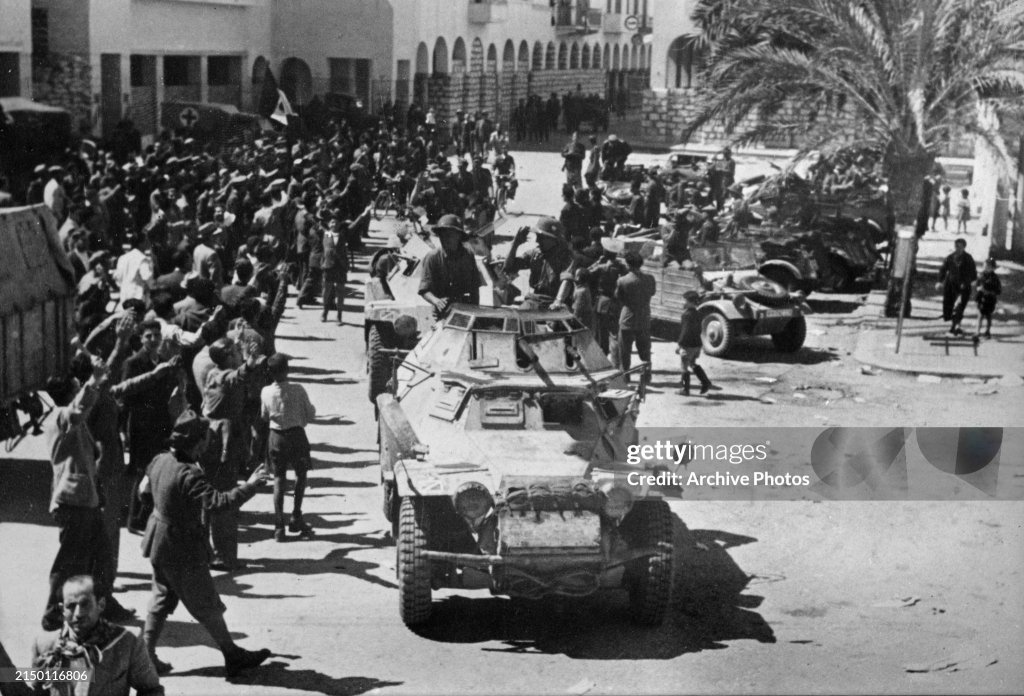
Rommel takes Benghazi
Hitler issued Directive No. 27, Plan of Attack on Greece:
The Führer And Supreme Commander Of The Armed Forces.
The Führer’s Headquarters.4th April, 1941.17 copies
Directive No. 27
- The Yugoslav forces are in process of disintegration. This, with the elimination of the Greek Army in Thrace, and the occupation of the Salonika Basin and of the area around Florina, creates conditions which, after sufficient forces have been concentrated, will permit an attack on Greece with the aim of annihilating the Anglo-Greek forces there, occupying Greece, and thus finally driving the British from the Balkans.
- I therefore give the following orders for the prosecution of operations in the Balkans:
(a) Yugoslavia:
The aim of the operation is to destroy the remaining Yugoslav forces and to clean up and occupy the country.
Formations of the German Army will be employed to occupy Old Serbia and the Banat. The protective area between the Morava River and Danube River, with its valuable copper mines, will be secured as swiftly as possible. The use for these purposes of formations not hitherto employed in Yugoslavia will be limited to the smallest possible extent.
The Air force is to destroy what remains of the Yugoslav Air force and will support ground operations so that any serious resistance which may still be encountered will be quickly overcome. If circumstances allow, air and antiaircraft units not required for action in Greece may, with the agreement of the High Command Of The Armed Forces, be withdrawn for employment elsewhere.
Any arrangements with the Italian Air force which may be necessary as a result of the boundary between 2nd German Army and 2nd Italian Army are the responsibility of Commander In Chief Air force.
The Italian 2nd Army is to clean up and occupy the area southwest of the road Karlovac-Bos Novi-Banja Luka-Sarajevo. It may, on occasion, be necessary for German mobile forces to thrust forward across this line in support of the Italian advance.
The Hungarian 3rd Army will clean up and occupy Yugoslav territory west of the Tisza as far as the Danube River and the Drave River. The participation of the two Hungarian motorized brigades in the further operations of the German 2nd Army has been requested and granted.
(b) Greece:
As soon as adequate forces have been concentrated in the area of Florina and the Salonika Basin, the decisive attack against Anglo-Greek forces in northern Greece will be launched. The object of this operation will be, by a quick breakthrough in the direction of Larissa, to encircle and annihilate the enemy forces there, and to prevent the establishment of a new defensive front.
At the same time the Italian breakthrough on the Greek front in Albania will be supported by a thrust in a southwesterly direction.
Operations will continue with a quick advance of mobile forces thrusting towards Athens with the aim of occupying the rest of the Greek mainland including the Peloponnese. At the same time the Italian Army Group in Albania will advance west of the line from Lake Prespansko to the crest of the Pindus Mountains in the direction of the Gulf Of Patras. If time and the state of the roads permit, any opportunity of blocking a withdrawal of the main Greek forces west of the Pindus must be exploited.
It will be the duty of the Air force, apart from engaging the Greek and British Air forces, to support the new ground operations in all possible strength and to carry the German troops constantly forward. Later operations aimed at the occupation of the Cyclades will also be supported.
Operational boundaries between the German and Italian Air forces will be arranged through Commander In Chief Airforce.
The Army and Air force will employ all means available to prevent a possible evacuation of the British forces. In particular an evacuation across the Mediterranean will be prevented, as far as possible, by constant air attack on Greek ports and particularly on concentrations of shipping, as also by mining approaches to ports.
- Orders to carry out the proposed parachute operation against Lemnos and to occupy Thasos and Samothrace will be issued by me alone. They will be issued at the latest forty eight hours before the beginning of operations.
For this purpose the Army will leave one Division in Thrace, while the occupation of the rest of Thrace will be undertaken by the Bulgarians at a time which I shall determine.
- After the conclusion of operations, most of the Army formations engaged will be withdrawn for new tasks. It is planned to leave:
one or two Divisions in Greece,
one further Division in Salonika,
two to three Divisions in Serbia.
For the Air force (X Air Corps) the chief task at the conclusion of the operation will be to support the Afrika Corps. In the immediate future the laying of mines in the Suez Canal is of great importance in order to prevent, or at least to impede, the arrival of enemy reinforcements from East Africa.
Arrangements will be made for the air defense of conquered territory.
Coastal defense will, for the present, be organized on the assumption that the north coast of the Aegean Sea, including Salonika, will be taken over by the Bulgarians, the east coast of the Aegean Sea, from there to the Gulf Of Saros inclusive, will be taken over by us, and the remainder of the Greek coast will be in Italian hands.
Boundaries can only be finally laid down after the end of operations in the Balkans.
- I expect Commanders In Chief to submit detailed reports of their plans.
Any requests by branches of the Armed Forces to our allies will be made in accordance with the principles laid down in Directive 26 of 3rd April, 1941.
(signed) Adolf Hitler.
The Athens radio reported tonight that British bombing planes had set fire to Berat, Italy’s key base in central Albania and outpost guarding the approach to Tirana, the capital. It said the Greeks carried out an attack in the Voyusa valley, capturing several soldiers and one officer.
The Yugoslav government early today designated Belgrade, Zagreb and Ljubljana as open cities in the event of a war which departing German diplomats freely predicted would begin, barring the most unexpected- developments, with air attacks in the next few days. Although thus hoping to escape a rain of Nazi bombs, Belgrade just before midnight blacked out for the first time in a half-hour emergency air raid drill.
Deputy Prime Minister Vladko Maček, leader of the Croatian Peasant Party, had been in Zagreb on 27 March. At that time, he had counseled Prince Paul to fight to retain his regency. However, under the new Simović government, his fate had been unclear. Today, Maček decides to accept Simović’s request that he continue on as Deputy Prime Minister and arrives in Belgrade. He requires, among other things, that the new government respects the Cvetković–Maček Agreement and affirm the Tripartite Agreement. This all apparently is satisfactory to Simović.
Separately, exiled Croatian politician and Ustaše leader Ante Pavelić, broadcasting from Florence, Italy, uses his Radio Velebit program to call for an uprising against the Yugoslavian government by the pro-German Croatian people.
Thousands of troops from the classes of 1910 and 1911 rushed from Istanbul tonight to bolster the Turkish army drawn up near the Bulgarian and Greek frontiers as British experts in mechanical warfare laid plans for defense of European Turkey. Well informed sources believed Turkey would adhere to her policy of fighting only if attacked, but military preparations were being rushed amid hints in the authoritative press that the ticklish Balkan situation may explode in a manner not anticipated by Germany.
Churchill appealed to Simovich, the Yugoslav Minister President, saying that he could not understand his argument about playing for time. The German army and air force were concentrating for an attack on Yugoslavia, and what was wanted was a decisive forestalling thrust by the Yugoslavs into Albania.
The Germans and Italians took Benghazi. The 3rd Reconnaissance Unit of the Afrika Korps reached Benghazi, Libya before daylight. Visiting in person, Major General Erwin Rommel ordered that when the Brescia Division arrived the 3rd Reconnaissance Unit should head for Mechili. The German 5th Light and the Italian Ariete Divisions advance toward Mechili, Libya, is going well. German and Italian spearheads reach Benghazi and occupy the city. Axis troops captured Benghazi, Libya, which was evacuated by British forces on the previous day. They pushed further east to the Green Mountain, where they were held by 3 companies of the Australian 9th Division. In the desert to the south, while German 5th Light Division was held in place waiting for a resupply of fuel, the British did not realize the German offensive through the desert had paused and continued to fall back. From the air, German Luftwaffe aircraft destroyed a convoy of 21 trucks, destroying 1,600 gallons of gasoline.
Lieutenant General Erwin Rommel’s headquarters radios Lt. Colonel Graf Schwerin of the 3rd Recon Battalion to:
“push to the coast and carry out Operation Tmimi… prevent move of English to the east. Push forward to Tobruk with forward detachment.”
The fast and unexpected pace of the offensive also is causing the Germans logistical problems. In addition, the Germans follow numerous British vehicle tracks into the desert which only cause their vehicles to bog down in the sand. In addition, sand often drifts across the roads during times of heavy winds, completely obscuring them and causing German vehicles to drive off of them and get bogged down. The 5th Light Division requests that all further supplies be sent only by 4-wheel-drive trucks.
The Wehrmacht High Command announced: “As we already reported in a special announcement, on April 2, German and Italian troops continued their pursuit of British troops whom they defeated at Mersa-el-Brega in North Africa. We have captured Agedabia and reached Zuctina. The enemy is retreating northward in haste.”
The British 2nd Armoured Division is abandoned without supplies at Msus because the British garrison there had prematurely blown up the all the fuel store, thinking to save them from the German tanks.
From Cairo, the Reuters News Agency announced: An official British government spokesman has said that Great Britain is allowing the enemy to penetrate farther east in Cyrenaica, until a point is reached where he can be fought with the greatest prospect of victory.
An incident takes place in Malta that shows the mixed feelings on the island about the war. Some conscripts from the local population are refusing service because they claim that their enlistment notices are out of date and thus unenforceable. Governor Dobbie requests instructions from Whitehall on how to proceed.
Italian forces quit Addis Ababa. After securing Asmara, Eritrea, Italian East Africa, Indian 5th Division moved east toward Massawa while Indian 4th Division was withdrawn from the region to reinforce Libya where a renewed Axis offensive was underway. 6 German and 7 Italian freighters were scuttled at Massawa to prevent Allied capture, while British RAF aircraft sank Italian torpedo boat Acerbi in the harbor. In Abyssinia, Italian troops were evacuated out of Addis Ababa as British 11th African Division advanced.
Lieutenant General Alan Cunningham’s forces approach Addis Ababa after an advance averaging 35 miles a day over a thousand miles. The Italians hurriedly evacuate the city. The British take 50,000 prisoners around the city at a cost of only 135 men killed. Taking the capital gives British control over 360,000 square miles of jungle and mountains. Italian commander the Duke of Aosta withdraws with his remaining forces. Aosta’s forces are suffering from malaria and other maladies, and he himself has tuberculosis.
The game is almost up at Massawa. The Indian 5th Infantry Division arrives at the outskirts of the city to see the Italians and Germans in the harbor furiously at work scuttling their ships.
Roosevelt had expressed concern for the Italian civil population in Abyssinia. Churchill telegrams to re-assure him that all efforts would be made to provide for civilians once the fighting has stopped. In the meantime though, all efforts were going towards keeping the armies supplied.
Aktion 14 F 13 began; it was the first documented proof that the Nazi German regime conducted mass extermination of the handicapped in concentration camps. Action 14 F 13, also called “Sonderbehandlung (“special treatment”) 14 F 13″, was a campaign of the Third Reich to murder Nazi concentration camp prisoners. Also called “invalid” or “prisoner euthanasia”, the campaign culled the sick, elderly and those deemed no longer fit for work from the rest of the prisoners in a selection process, after which they were killed. The Nazi campaign was in operation from 1941–1944 and later covered other groups of concentration camp prisoners, as well. Between 15,000 and 20,000 people were murdered in this operation.
The British Government issues a new regulation regarding the official time in the country. This regulation provides for double summer time, during which period the time is two hours in advance of Greenwich Mean Time (GMT), starting on the day after the first Saturday in May (4 May 1941) and ending on the day after the second Saturday in August (10 August 1941), both at 0100 hours GMT (rather than the previously used 0200 hours). The time for the rest of the year remained one hour in advance of GMT. The order provided savings for certain contracts with agricultural workers and concerning the production of milk: for those purposes, the time was to be taken to be one hour in advance of GMT throughout the year, unless the parties to the contract agreed otherwise.
Visiting Australian Prime Minister Menzie visits Dublin and notes, “In Dublin life goes on and there is no blackout — it seems queer!”
German raider Thor and British armed merchant cruiser Voltaire engaged in a 55-minute gun duel 900 miles west of the Cape Verde Islands at the distance of 9 kilometers. Voltaire was sunk, killing 74; Thor picked up 195 survivors.
The Greek torpedo boat Proussa was sunk by Italian aircraft off Corfu.
Professor Georges Claude informs the French Academy of Sciences at Paris of a new low cost, synthetic motor fuel called “acetylated ammonia”, 40% acetylene and 60% ammonia. It should put France’s cars back on the road as it can run a car 300 miles on a single tank.
Japanese Foreign Minister Matsuoka wrangles a meeting with Adolf Hitler and German Foreign Minister Ribbentrop. Hitler obviously places great priority on Germany’s relationship with Japan to schedule the meeting at this time, with preparations for Operation Marita revving into high gear. Germany would “strike without delay” if a Japanese attack on British Asian possessions should cause the United States to declare war on Japan. Note that Hitler continues the Ribbentrop line of urging an attack on Great Britain, but not on the United States.
Matsuoka, for his part, asks that Germany provide Japan, via the Technical Military Commission of the Tripartite Pact, with submarine blueprints and cutting edge U-boat technology. This, Matsuoka says, would be necessary for an attack on Singapore, which is music to Hitler’s ears. In addition, Matsuoka adds that Japan would be at war with the United States at some point and that the Japanese intent to attack Singapore should be kept quiet and not mentioned in cables to Tokyo lest it leak out to the Allies, suggesting that the Japanese are beginning to worry that at least some of their communications are being intercepted. Ambassador Oshima is to serve as the conduit of the technical information.
The anti-British propaganda film ‘Omh Kruger’ [Uncle Kruger], which depicts British atrocities against the South Africans in the Boer War, is released.
German submarines continued their attack on Allied convoy SC.26 250 miles southwest of Iceland, which was initially intercepted two days prior. Between 0000 and 0344 hours, U-94 and U-98 sank three ships; 36 were killed and 70 survived. At 1956 hours, U-76 sank Athenic; the entire crew of 40 were rescued. Destroyer HMS Wolverine and sloop HMS Scarborough were able to locate U-76 and launched depth charges, damaging the submarine.
In an article in the German scientific magazine ‘Die Naturwissenschaften’ it is announced that Professors Clusius and Dickel of the University of Munich can now separate Uranium 235 from Uranium 238.
Polish General Anders was taken from his cell in a Moscow prison and led to a luxuriously furnished study. Upon reaching this room, Anders was informed that in accordance with a recently signed Polish-Soviet agreement, he was promoted to Lieutenant General and appointed the commander of all Polish troops in the Soviet Union. The stunned Anders was then taken by limousine to a Moscow apartment which had been furnished for his personal use.
Commander-in-chief General Olof Thörnell issues a memorandum recommending participation in a war against the Soviet Union in order, among other reasons, to aid sister nation Finland. This is an interesting position to take, seeing as how Sweden did not help Finland during the Winter War despite repeated pleas from the Finnish government. The real reason is buried in the text, “so that the land war can be held at a distance from our borders.”
The Luftwaffe returns to Bristol and Avonmouth during the night with 83 planes from KG 77, KG 27, KG 54 and KGr 806, led by pathfinders from KG 26 and KGr 100. There are ten Heinkel He 111s equipped with X-Verfahren radio direction finders and a Y-Verfahren-equipped Heinkel from III,/KG 26 which crashes near Hewish, Somerset. The attack lasts from 21:00 to 01:30. The Germans attack Falmouth and sink Free French sloops Suippe and Conquerant.
The British try a new tactic to disrupt the Luftwaffe attacks. The civil defense authorities use Haslar Smoke Generators at Newcastle to obscure the city. This is the beginning of a ten-day period in which Newcastle and nearby towns are protected by this method. The Luftwaffe does not attack the towns while they are obscured by smoke, but there is no indication that they intended to do so in the first place.
RAF Bomber Command: Day of 4 April 1941
14 Blenheims to French and Danish coasts; shipping attacked and 1 trawler hit. 1 aircraft lost.
RAF Bomber Command: Night of 4/5 April 1941
Brest
54 aircraft — 39 Wellingtons, 11 Hampdens, 4 Manchesters; 1 Hampden was lost. A direct hit was claimed on one of the German cruisers. German records show that one bomb fell in the dry dock in which the Gneisenau was lying. The bomb remained in the water left in the bottom of the dock alongside the cruiser. Further bombs hit the Continental Hotel in Brest just as the evening meal was being served. Several German naval officers, including, some from the Scharnhorst and Gneisenau, were believed to have been killed. Next day the captain of the Gneisenau decided it would be safer to move his ship and he did so, mooring, at a buoy out in Brest harbour. While there, Gneisenau was attacked by a Coastal Command Beaufort daylight torpedo bomber which scored a direct hit and inflicted serious damage that required six months to repair. The Beaufort was shot down and its crew all killed; its pilot, Flying Officer K. Campbell, was awarded a posthumous Victoria Cross.*
Minor Operations: 16 aircraft to Cologne, Rotterdam and Dunkirk but thick cloud prevented good bombing. 6 Hampdens minelaying off Brest. 2 O.T.U. sorties. No losses.
U-76, commanded by Oberleutnant zur See Friedrich von Hippel, torpedoed British steamer Athenic (5351grt), which was straggling behind convoy SC.26 with damage, in 58-32N, 20-13W. The entire crew was rescued. The steamer sank on the 5th. At 1956 hours on 4 April 1941 the unescorted Athenic (Master Ernest William Agnes), dispersed from convoy SC.26, was hit on the starboard side in #2 hold by one stern torpedo from U-76 about 340 miles south of Reykjavik. The explosion opened a large hole, blew the hatch covers off and damaged the bridge, injuring the chief officer on watch. About 28 hours earlier, the ship picked up eleven survivors from Liguria which had been sunk by U-46 (Endrass) on 29 March, but one of them died of exposure. The master, 35 crew members, two gunners (the ship was armed with one 4in, one 12pdr and two machine guns) and the ten survivors immediately abandoned ship in the lifeboats in very rough seas when she developed a list to starboard. At 2035 hours, the ship was struck on the port side in #4 hold just abaft the engine room by a coup de grâce and after 17 minutes she rolled over to starboard and sank. U-76 left the area without questioning the survivors because the Athenic had sent distress signals and the Germans correctly assumed that escort ships from the dispersed convoy were heading for the scene. At dawn the next morning, the U-boat was located by the warships, forced to surface after several depth charge attacks and sank after the crew abandoned ship. The Germans were taken prisoner by HMS Arbutus (K 86) (Lt A.L.W. Warren, RNR), which subsequently searched for the lifeboats and picked up the survivors at 1415 hours, landing them at Liverpool on 8 April. The 5,351-ton Athenic was carrying wheat and was bound for London, England.
U-94 sank British steamer Harbledown (5414grt) from convoy SC.26 in 58-30N, 23W. At 0340 hours on 4 April 1941 the unescorted Harbledown (Master Griffith Jones), dispersed from convoy SC.26, was torpedoed and sunk by U-94 south-southwest of Iceland. 13 crew members, two gunners and two passengers were lost. The master, 22 crew members and one passenger (naval officer) were picked up by HMS Veteran (D 72) (Cdr W.T. Couchman, OB.E, RN) and landed at Liverpool. The 5,414-ton Harbledown was carrying wheat and was bound for London, England.
U-97, commanded by Kapitänleutnant Udo Heilmann, sank British tanker Conus (8132grt) in 56-14N, 31-19W. At 1819 hours on 4 April 1941 the Conus (Master Charles Asquith), dispersed from convoy OB.304, was hit in the foreship by one G7e torpedo from U-97 and stopped southeast of Cape Farewell. The U-boat then fired its last two torpedoes at 1908 and 2006 hours. The tanker capsized and sank within 10 minutes after the third torpedo hit. The master and 56 crew members and two gunners were lost. The 8,132-ton Conus was carrying ballast and was bound for Curaçao, the Netherlands Antilles.
U-98, commanded by Kapitänleutnant Robert Gysae, sank Norwegian steamer Helle (2467grt), a straggler from convoy SC.26, in 59N, 24-30W. At 0029 hours on 4 April 1941 the Helle (Master Karl Jørgensen), dispersed from convoy SC.26, was torpedoed and sunk by U-98. The 24 crew members abandoned ship in one lifeboat and were picked up in the morning by the British destroyer HMS Havelock, which had been notified by the radio station at Resolution Island after the distress signals from Helle had been received. The 2,467-ton Helle was carrying pulp and steel.
U-98 also sank British steamer Welcombe (5122grt) from convoy SC.26 in 59-09N, 22W. At 0344 hours on 4 April 1941, U-98 fired a G7e torpedo at Welcombe (Master Richard Edgar Johnson) in a group of ships from the recently dispersed convoy SC.26 south of Iceland. She was hit underneath the stack and sank after 15 minutes. The ship had been missed by a first G7e torpedo at 0315 hours. The master and 19 crew members were lost. 19 crew members and two gunners were picked up by HMS Havelock (H 88) (Cdr C.H. Thomas, DSC) and landed at Liverpool. The 5,122-ton Welcombe was grain and was bound for Loch Ewe, Scotland.
U-124, commanded by Kapitänleutnant Georg-Wilhelm Schulz, sank British steamer Marlene (6507grt) at 8-15N, 14-19W. At 2302 hours on 4 April 1941 the unescorted Marlene (Master Henry Ellison Lascelles) was struck under the bridge by one torpedo from U-124 southwest of Freetown. The zigzagging ship had been spotted at 1608 hours and missed by a first torpedo at 2059 hours. 22 minutes after the first hit, she was struck by a coup de grâce and remained afloat, but the crew began to abandon ship. At 2344 hours, the U-boat began to shell the ship, but had to stop after 12 rounds of incendiary rounds were fired because the light for the gunsight failed. The Marlene sank by the bow five minutes after being hit by a second coup de grâce at 0005 hours on 5 April. 13 crew members were lost. The master and 46 crew members landed at False Cape, Sierra Leone. The 6,507-ton Marlene was carrying general cargo and pig iron and was bound for the United Kingdom.
Light cruisers HMS Arethusa and HMS Galatea arrived at Scapa Flow at 0044.
Free French sloops Suippe and Conquerant were sunk by German bombing at Falmouth.
British steamer Salvus (4815grt) was sunk by German bombing in 53-05N, 1-27E. Four crewmen were lost on the steamer.
British trawler Whitby (164grt) was sunk by German bombing three miles south, southeast of Blackwater Light Vessel. The entire crew was rescued.
British steamer Cape Verde (6914grt) was damaged by German bombing in 52-12N, 5-42W.
Battlecruiser HMS Repulse, aircraft carrier HMS Argus, and troopship Narkunda with destroyers HMS Highlander, HMS Fury, and HMS Velox departed Gibraltar for England. Aircraft carrier HMS Furious departed later, escorted by destroyers HMS Faulknor and HMS Fortune, and joined at sea. The destroyers returned to Gibraltar.
Battlecruiser HMS Renown, aircraft carriers HMS Ark Royal and HMS Furious, light cruiser HMS Sheffield, and destroyers HMS Faulknor, HMS Fearless, HMS Fortune, and HMS Foresight departed Gibraltar on Operation PRINCIPAL, an attack on French battleship Dunkerque. Submarines HMS Olympus and HMS Otus had already put to sea from Gibraltar on the 3rd for this operation. On the 5th, operation PRINCIPAL was cancelled when it was found that the French battleship was not preparing to leave port. Submarines Olympus and Otus departed their patrols off Oran and proceeded to Malta and Gibraltar, respectively.
Submarine HMS Rorqual arrived at Malta after minelaying operations off western Sicily.
Destroyer HMS Nubian and corvette HMS Hyacinth of convoy ANF.24 attacked a submarine contact off Phleva Island.
Destroyer HMS Janus departed Alexandria for Port Said for escort duty in convoy AN.25.
Submarine HMS Parthian departed Alexandria for Port Said for docking and repairs.
Australian destroyers HMAS Vendetta and HMAS Waterhen departed Alexandria to reinforce the Inshore Squadron.
Italian torpedo boat Acerbi was sunk at Massawa.
German and Italian steamers were scuttled at Massawa.
German steamer Crefeld (8045grt) was scuttled at Massawa.
German steamer Frauenfels (7487grt) was scuttled at Massawa. The steamer was salved as Empire Niger.
German steamer Gera (5155grt) was scuttled at Massawa. The steamer was salved as Empire Indus.
German steamer Lichtenfels (7566grt) was scuttled at Massawa.
German steamer Liebenfels (6318grt) was scuttled at Massawa. The steamer was salved at Empire Nile.
German steamer Oliva (7885grt) was scuttled at Massawa.
Italian steamer Adua (3564grt) was scuttled at Massawa.
Italian steamer Brenta (5400grt) was scuttled at Massawa.
Italian steamer Arabia (5943grt) was scuttled at Massawa.
Italian steamer Romolo Gessi (5148grt) was scuttled at Massawa.
Italian coastal steamer Impero (488grt) was scuttled at Massawa.
Italian steamer Vesuvio (5430grt) was scuttled at Massawa. The steamer was later salved.
Italian steamer XXIII Marzo (5006grt) was scuttled at Massawa.
Armed merchant cruiser HMS Voltaire (A/Captain J. A. P. Blackburn DSC) engaged German raider Thor. Cruiser Thor was hit once by Voltaire, but the British ship was sunk at 14-30N, 40-30W. Blackburn, A/Cdr J. T. Templar Rtd, Lt Cdr R. Mercer RNR, T/Lt W. R. Bevin RNR, T/Cdr (E) J. V. Thompson RNR, T/Lt Cdr (E) J. M. Muir RNR, T/Sub Lt (E) N. A. Burgoyne RNR, T/Sub Lt (E) E. Costelloe RNR, A/Sub Lt (E) H. S. Cross RNVR, T/Paymaster Lt Cdr J. E. Duckett RNR, T/Paymaster Lt N. Edwards RNR, Paymaster Sub Lt F. H. Price RNR, P/Lt J. H. E. Evans RNR, A/Surgeon Lt C. M. Fisher, MD.RCNVR, sub Lt J. W. Hoggard RNR, P/Midshipman G. O. Mackenzie RNR, Sixteen officers and one hundred and thirty eight ratings were taken prisoner of war. T/Lt W. B. Jackson RNR, died of wounds on 5 May. Lt Cdr H. W. Taggart RNR, T/Lt Cdr W. Davies RNR, A/Sub Lt P. L. Howard RNR, Midshipman B. B. J. Roberts RNR, T/Sub Lt (E) A. E. Downs RNR, P/A/Sub Lt (E) J. F. McLaughlin RNVR, Gunner F. W. Sutton Rtd and sixty two ratings were lost.
Canadian armed merchant cruiser HMCS Prince Henry reported oil and wreckage on 7 and 9 April at this location, but there was no information on the armed merchant cruiser. HMS Voltaire was reported missing on 3 May.
Greek torpedo boat Prousa and Greek steamer Sussanna (932grt) was sunk by German bombing at Corfu.
Convoy ASF.23 of two British and one Greek ship departed Piraeus escorted by anti-aircraft cruiser HMS Coventry, destroyers HMS Decoy, HMS Hero, and corvette HMS Salvia. Netlayer HMS Protector sailed in the convoy to repair the boom defences at Suda Bay and transport motor generators for damaged cruiser HMS YORK. The convoy arrived at Alexandria on the 7th.
Convoy GA.10 of British steamer Cameronia (16,297grt) and Dutch steamer Pennland (16,381grt) escorted by anti-aircraft cruiser HMS Carlisle, destroyers HMS Ilex, HMS Nubian, and HMS Hereward, arrived at Alexandria on the 6th.
The United States has flatly rejected German and Italian protests against the seizure of 30 merchant vessels in American harbors, it was learned authoritatively today, and refused axis demands for release of the ships and 875 crew members now in custody. The state department notes dismissing the allegations made in protests from Dr. Hans Thomsen, the German charge d’affaires, and Prince Colonna, the Italian ambassador, were drafted late yesterday, and are understood to have been dispatched during the night. In rejecting the axis protests, Secretary Hull was reported to have reaffirmed vigorously the right of the United States to take the axis vessels into “protective custody” after discovery that at least 26 vessels had been seriously damaged in what officials believe was a concerted sabotage plot.
President Roosevelt assigned another $1,000,000,000 chunk out of the lend-lease appropriation today, half to go for 212 new merchant ships and from 50 to 60 new shipways and the other half for helping Britain and her allies with war supplies now on hand. At the same time he indicated that if the Red sea and Gulf of Aden waters off east Africa remain free of fighting he might remove them from combat zone restrictions, thus permitting American vessels to carry supplies around the southern tip of Africa to Egypt or points nearby. Thence, the British and their allies could transfer the supplies to the Balkans. A crowded White House press conference, heard this progress report of the $7,000,000,000 aid program from the chief executive, who also disclosed the United States is studying ways to meet a request from Yugoslavia for certain defense materials, even though that Balkan country is not yet at war.
The Roosevelt Administration orders that all Bulgarian assets in the United States be frozen.
Prime Minister Winston Churchill sends President Roosevelt a telegram giving an update on the Battle of the Atlantic. He notes that, because the Royal Navy has been able to “strengthen our escorts” — presumably as a result of the destroyers-for-bases agreement of September 1940 — the U-boats “have now moved further west.” He requests “ten cutters” for operations out of Iceland because “our losses are increasingly serious.”
Separately, President Roosevelt agrees to Churchill’s request that British warships can be repaired in US shipyards. He goes further and orders that Royal Navy warships on combat missions can be refueled there, too. Naturally, the same courtesies are not extended to German warships.
Well-informed persons said today that U. S. army troops at Camp Custer, Battle Creek, 116 miles west of Detroit, had been ordered to “stand by” for possible call to quell strike disorder at the Ford Motor Co. The troops were reported to have their duffle bags packed and ready for quick movement. Brigadier-General Cummings, commandant, when asked by the United Press for comment said, “we’re confirming nor denying nothing. Our orders must come from the president. We have been getting ready for maneuvers in June and all leaves of over 10 days have been refused since last September.”
The government today demanded that the nation’s soft coal mines, idle since Monday midnight because of a wage dispute, be reopened by next Monday. The demand was made by Dr. John R. Steelman, director of the United States conciliation service, who said: “It is imperative that the mines be reopened. The public cannot condone quibbling while 400,000 men and 85 per cent of the nation’s bituminous mines stand idle.” Steelman’s demand was made after the United Mine Workers of America (C.I.O.) and operators in the eight-state Appalachian area failed to break their deadlock even after a 48-hour period of extended negotiations had expired at midnight Thursday. Last Tuesday night, President Roosevelt urged the joint conference to continue negotiations in order to prevent a stoppage in the industry and lessen any danger to the country’s defense effort. With the deadlock and the stoppage still in effect, Steelman, emerged from the weary group of conferees and announced that while “much progress was made, full agreement has not been reached.” Steelman said that because’ the weekend is approaching and miners do not work Saturday and Sunday, the mines could not be reopened sooner than Monday anyway. Therefore, he continued, the negotiators would resume their efforts to break the deadlock during the next 24 hour.
There is a major America First Committee meeting at the Manhattan Center. The featured speakers are Colonel Charles Lindbergh, author Kathleen Norris, and isolationist Massachusetts Senator David Walsh. Walsh supported James Farley for President in 1940 and runs the key Naval Affairs Committee. The affair is extremely well attended.
As will become a matter of some controversy in the future, it is alleged by some that Walsh at around this time is patronizing a “house of degradation” (male prostitution) in Brooklyn during this time. This “house” in question also is patronized by three foreign agents. However, these charges are never proven and Walsh may, in fact, have nothing to do with it. It is true, though, that many fear Walsh’s political views and are looking for any dirt they can find to smear and discredit him. The “homosexual” label is considered extremely toxic during this time and is a favorite weapon used to destroy political careers (as we will see with Sumner Welles). The charges are usually composed of extremely flimsy evidence. They are worth mentioning, however, to illustrate the polarized political climate developing in the United States, of which these America’s First rallies are both a beneficiary and a cause.
George Patton was promoted to the temporary rank of major general.
American Pacific Fleet units were ordered to the Atlantic on the 4th. Units involved were battleships USS Idaho, USS Mississippi, and USS New Mexico, aircraft carrier USS Yorktown, light cruisers USS Philadelphia, USS Brooklyn, USS Savannah, and USS Nashville, and destroyers USS Lang, USS Sterett, USS Wilson, USS Winslow, USS Wainwright, USS Stack, USS Morris, USS Buck, and USS Roe of the 8th Destroyer Squadron and the 9th Destroyer Squadron.
Destroyer USS Warrington departed Pearl Harbor on the 18th.
Aircraft carrier USS Yorktown departed Pearl Harbor on the 20th with destroyers USS Mayrant, USS Trippe, USS Rhind, USS Mustin, USS Russell, and USS Jouett. The carrier arrived at Bermuda on 12 May.
Battleship USS Mississippi, light cruiser USS Savannah, and destroyers USS Wilson, USS Sterett, and USS Lang departed Pearl Harbor on 19 May and arrived at Guantanamo on 5 June.
Battleship USS New Mexico and light cruiser USS Nashville departed Pearl Harbor on 20 May and arrived at Norfolk on 16 June.
Battleship USS Idaho and light cruisers USS Philadelphia and USS Brooklyn departed Pearl Harbor on 22 May for Norfolk, arriving on 16 June.
Light cruiser USS Savannah later arrived at Boston on 17 June.
Light cruiser USS Nashville later arrived at Boston on 19 June.
Light cruiser USS Philadelphia later arrived at Boston on 18 June.
From San Diego, destroyers USS Sims, USS Anderson, USS Hughes, and USS Hammann departed on 29 May for the Atlantic.
Australian heavy cruiser HMAS Canberra departed Mauritius escorting British steamer Talamba, carrying 910 troops. The cruiser escorted the steamer to the Seychilles where 500 more personnel were embarked. Light cruiser HMS Glasgow escorted the steamer from the Seychilles until rendezvousing with convoy WS.6. The steamer continued on to the Middle East arriving on the 29th.
Japanese Chief Cabinet Secretary Naoki Hoshino, chief of the “Project Department” inside the Finance Ministry, is elevated to the House of Peers. He is replaced by Lieutenant General Teiichi Suzuki, who is named President of the Planning Board and Minister without Portfolio. This is a subtle preparation for war; while it appears that Hoshino is being promoted, in fact, he is being removed at the behest of the military. Hoshino has been warning that, while there is sufficient oil in Japanese storage tanks to tide the military over until the Netherlands East Indies can be seized, that will only be the case if those stocks are carefully managed. Imperial Headquarters now wants someone it trusts — one might say “controls” — in charge of those stocks. Essentially, the Japanese economy now is going on a war footing.
Mooring vessel HMS Buffalo (750grt) departed Singapore on the 5th to salvage a Blenheim aircraft of 27 Squadron which had crashed south of Siglap Obelisk. She carried a dockyard party of nineteen, an officer and a signalman from light cruiser HMS Dauntless, and twenty five RAF personnel of RAF 151 Maintenance Unit. The vessel struck a mine in Minefield 3, laid by destroyer HMS Stronghold in March, and was sunk. Cdr R. R. Airey of light cruiser Dauntless, Lt Cdr M. B. Thomas of HMS Sultan, two RAF officers, including Wing Commander Geoffrey Farnhill, six dockyard officers, six RAF ordinary ratings, and fourteen crewmen were missing in the blast. Two ratings died of wounds. One RAF officer, one RN signalman rating from Dauntless, 10 RAF ordinary ratings, and thirteen crewmen were wounded.
“The Power and the Glory” opens today at the Mayfair Theater in Sydney, Australia. It is an Australian film, written and directed by Noel Monkman, about a Czech scientist who escapes from Occupied Europe to live in Australia. The scientist, Professor Marnelle, has developed a deadly nerve gas that must not be allowed to fall into German hands. Katrin Rosselle, the female lead, is an Austrian who emigrates to the United States around this time. The 9700-ton freighter Turakina seen in the film was sunk for real in August 1940 by a German raider.
Dow Jones Industrial Average: 124.64 (-0.01)
Born:
Eddie Watt, MLB pitcher (World Series Champions-Orioles, 1970; Baltimore Orioles, Philadelphia Phillies, Chicago Cubs), in Lamoni, Iowa.
John Maczuzak, AFL defensive tackle (Kansas City Chiefs), in Ellsworth, Pennsylvania (d. 2013).
Bill Tarmey, England actor (“Coronation Street”), singer and author, in Ardwick, Manchester, England, United Kingdom (d. 2012).
Naval Construction:
The Kriegsmarine (German Navy) Type VIIC U-boat U-338 is laid down by Nordseewerke, Emden (werk 210).
The Royal Navy Flower-class corvette HMS Sweetbriar (K 209) is laid down by the Smiths Dock Co., Ltd. (South Bank-on-Tees, U.K.).
The U.S. Navy Accentor-class coastal minesweeper USS Courlan (AMc-44) is launched by the Gibbs Gas Engine Co. (Jacksonville, Florida, U.S.A.).
The Kriegsmarine (German Navy) Type VIIC U-boat U-206is launched by F. Krupp Germaniawerft AG, Kiel (werk 635).
The Kriegsmarine (German Navy) Type VIIC U-boat U-571 is launched by Blohm & Voss, Hamburg (werk 547).
The Royal Navy harbor defence motor launch HMS HDML 1006 is commissioned.
The Royal Navy harbor defence motor launch HMS HDML 1016 is commissioned.
The U.S. Navy Aldebaran-Class stores ship USS Polaris (AF-11) is commissioned. Her first commanding officer is Commander Edwin Darius Graves, Jr., USN.
The Royal Navy LCT (Mk 1)-class landing craft, tank HMS LCT 28 is commissioned.
The Royal Navy LCT (Mk 1)-class landing craft, tank HMS LCT 29 is commissioned.
The Royal Navy LCT (Mk 1)-class landing craft, tank HMS LCT 30 is commissioned.
The Royal Navy Elco 70 foot-type motor gun boat HMS MGB 86 is commissioned.
The Royal Navy Elco 70 foot-type motor gun boat HMS MGB 87 is commissioned.
The Royal Navy Elco 70 foot-type motor gun boat HMS MGB 88 is commissioned.
The Royal Navy Elco 70 foot-type motor gun boat HMS MGB 89 is commissioned.
The Royal Navy Elco 70 foot-type motor gun boat HMS MGB 90 is commissioned.
The Royal Navy Elco 70 foot-type motor gun boat HMS MGB 91 is commissioned.
The Royal Navy Elco 70 foot-type motor gun boat HMS MGB 92 is commissioned.
The Royal Navy Elco 70 foot-type motor gun boat HMS MGB 93 is commissioned.
The Royal Navy Bangor-class (Reciprocating-engined) minesweeper HMS Cromer (J 128) is commissioned. Her first commanding officer is Lieutenant Commander Arthur Edward Coles, RNR.
 History Diaries