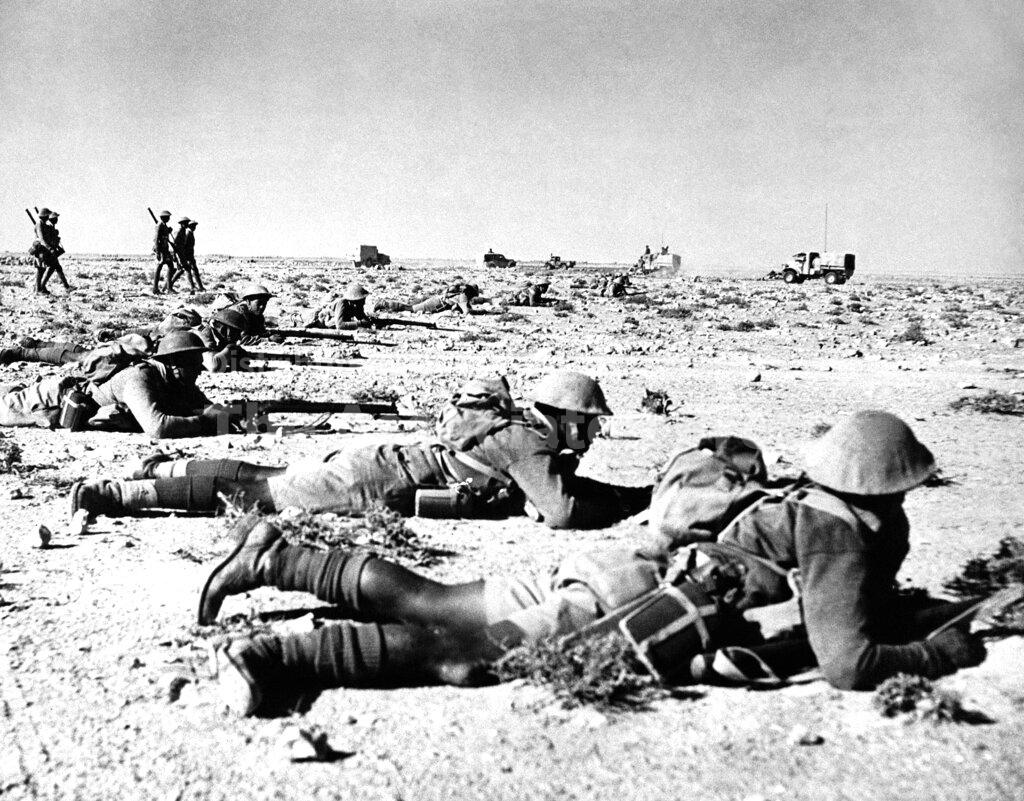
The German Luftwaffe has begun to operate on the Libyan front. The attacking planes, which raided an advanced British position in Libya, could not be identified with certainty, but observers were convinced that they were German because of the style of the attack. Also, the planes did not appear to carry the standard Italian markings.
The Australian forces have already advanced well to the west of Derna on the coast and are discovering that the Italians are withdrawing. General Richard O’Connor received the authorization from General Archibald Wavell to use tanks of British 7th Armoured Division to flank the Italian retreat. Wavell, Commander in Chief Middle East Command, agrees with O’Connor, General Officer Commanding Western Desert Force, that 7th Armoured Division should be sent hurrying across the center of Cyrenaica in an attempt to cut the Italians off. Supplies are being assembled to support this move but because the Italian retreat is so rapid the advance will have to start before the preparations are complete. The Australian 6th Division continues pursuing the Italians west of Derna. While not in wild flight, the Italians are moving with some alacrity back toward Benghazi — which itself is being evacuated. They also are engaging in skillful minelaying and combat destruction. This is slowing down the Australian infantry, as each minefield requires a methodical clearing before the advance can continue.
With Middle East Commander Archibald Wavell’s permission in hand, General O’Connor of XIII Corps is preparing to send his armored forces south of the mountain (Jebel Akhdar, or Green Mountain) that bifurcates northeast Libyan operations. This requires supplies that must be shipped to Tobruk — not in perfect working order after the recent battles there — and then transport north toward Derna. O’Connor is torn between getting his supplies in order and then sending his troops (Combe Force) out fully prepared, or sending what he has available out quickly in order to increase the likelihood of blocking the Italian retreat.
O’Connor adopts the latter course. He orders Lieutenant Colonel J.F.B. Combe, commanding 11th Hussars, 2nd Rifle Brigade and assorted field, antitank and antiaircraft artillery) to set out first thing in the morning of the 3rd. The 7th Armoured Division will follow shortly thereafter. The basic plan is for the Australians to herd the Italians westward north of the mountain, while Combe Force moves directly westward and cuts them off further west. This unit becomes known as Combe Force.
Elsewhere, the Royal Navy is active. Operation PICKET by Force H is launched from the aircraft carrier HMS Ark Royal. This is an attack by eight Skuas of RAF No. 810 Squadron on a strategically important San Chiara Ulla Dam at Lake Tirso, Sardinia. This attack, which aims to destroy hydroelectric facilities as well using torpedoes, is executed but does not damage the targets due to low clouds, hail, rain, antiaircraft fire, barking dogs and the whole lot. Four torpedoes are released, but apparently, they hit a sandbar or other obstruction. The British lose a Skua, with the three crewmen rescued by the Italians and taken prisoner. It is an interesting operation in the abstract, full of derring-do and the like, but results only in quite a bit of profitless effort on both ends of the Mediterranean.
Admiral Somerville still plans to carry off companion Operation GROG (formerly RESULT) (the bombardment of Genoa). However, he decides against it on this sortie due to the weather. Force H then retires to Gibraltar. Many lessons are learned from this somewhat embarrassing affair which is put to good use eventually in the famous “Dambusters” raid later in the war.
A diversionary operation for the disappointing Operation PICKET and abortive Operation Result is underway in the eastern Mediterranean. In Operation MC 7, a large force of Royal Navy ships essentially simulates a typical convoy from Alexandria to Malta.
In Malta, the government decides to set up a new department, the Food and Distributions Office. This office, under Marquis Barbaro of St George, will implement a rationing scheme. As part of this process, households will be issued rationing cards.
Greek soldiers fighting what their official spokesman called a “really heroic” action captured a large and important mountain range north of Klisura in Albania today, it was reported tonight. The spokesman said that 270 Italian prisoners, belonging mostly to units which arrived in Albania last month, were seized along with large quantities of machine-guns, automatic rifles and other materials not yet counted. “The Italians,” the spokesman said, “having been convinced that counterattacks are ineffective and are costing heavy losses, renounced any further attempts.” The Greeks (Cretan 5th Division of II Corps) on 2 February 1941 finally take full possession of the Trebeshina (Trebeshinë) massif. The nearby Greek 15th Division also makes small gains, completing the capture of the village of Bubeshi.
Italian forces in the area, however, remain unusually feisty for Italian troops of World War II. Thus, little profit appears likely from this commanding position in the area achieved by the Greek troops. Further progress may depend upon British troops, which remain in Egypt and Libya pending the completion of operations there and Greek approval to accept them. The RAF is busy in support of the Greeks. The Greeks are trying to take the strategically decisive port of Valona (Vlorë) quickly, and capture of the Trebeshinë heights is necessary to accomplish that. However, Klisura Pass is just the gateway toward Valona, not on its doorstep, and much work remains to be done (such as the capture of Tepelenë) before the port is even threatened, much less overcome.
With the benefit of hindsight and in light of later events (Operation MARITA), the protracted defense of the Trebeshinë heights by two battalions of the Italian Blackshirts may be seen as having secured Valona and, thus, the entire Italian position in Albania for the duration of World War II. It salvages a tiny bit of Italian military honor. With the benefit of even more hindsight and perhaps a bit of arguable interpretation, the use of crack Cretan troops in Albania rather than keeping them in Crete may have contributed to future Allied defeats there as well.
Spinning things out a bit further…. perhaps beyond the breaking point… the successful Italian defense of the Trebeshinë heights may have played an even larger role in the outcome of World War II. If the Italians in Albania had folded completely in a short period of time, Hitler might not have authorized Operation MARITA (at least partly intended to rescue the Italians). In that case, he might have had those troops available at the start of Operation BARBAROSSA. Many historians theorize that, had those troops been used in the Soviet Union right from the opening of hostilities, Moscow might have been captured before the winter snows and the entire course of world history altered. But, that is sheer speculation.
Indian 5th Division captured Italian fortifications defended by 8,000 troops and 32 field guns at Barentu, Eritrea, Italian East Africa. To the east in the Indian Ocean, British aircraft carrier HMS Formidable launched aircraft in the Indian Ocean to mine the harbor of Mogadishu, Italian Somaliland. The British aircraft carrier HMS Formidable replaced the damaged Illustrious in the Mediterranean. The Illustrious was sent to the United States for repairs. Gazelle Force and 4th Indian Division press on into the mountains of Ethiopia, despite blown bridges and heavily mined stretches of road, but they cannot pass through the narrow Dongolaas Gorge, where a huge tumble of rocks lay across the road.
The Italian collapse in Eritrea continues. The 5th Indian Infantry Division takes Barentu, with the Italians retreating at first down a small road that turns into a mule track. The reported prisoner haul is 8000, but this figure seems high. Ultimately, the Italians abandon the road altogether and simply hike overland toward the coast. While this prevents the pursuing British from catching up to them, it also forces them to abandon every single vehicle, including guns, trucks, and tanks. The Italian troops (largely colonial) from both the Cochen Mountain and Barentu fronts head for Keren on the Keren Plateau, which has fewer natural defensive advantages than the positions the British already have overcome. However, it is located at 4300 feet above sea level, which forces the British to attack essentially while going uphill.
Preliminary operations against Keren already are underway. Gazelle Force crosses the Baraka River with some difficulty (the Italians have blown the Ponte Mussolini bridge) and ascends toward the plateau. The British troops make it all the way to within about 6 km of Keren, where it is stopped at the Donglolaas Gorge. Normally, the area can be traversed without difficulty, but the Italians have dynamited the overhanging escarpments, filling the gorge with boulders and debris. The Italians also rather unhelpfully have mined the approaches.
In Abyssinia, the advancing South African troops capture Hobok.
Torpedo bombers from British carrier HMS Ark Royal attacked the hydroelectric plant at the Santa Chiara Dam on the Tirso River on Sardinia, Italy. The attack failed to damage the facilities. One Swordfish aircraft was shot down, with its crew of 3 taken prisoner.
Benito Mussolini declared the southern portion of Italy to be a war zone and put it under martial law.
General Alan Brooke, commander of United Kingdom Home Forces and in charge of anti-invasion preparations, records in his diary that he had dinner at Chequers and then gave a presentation to Prime Minister Churchill, Foreign Secretary Anthony Eden and various others in Churchill’s coterie. Everybody is complimentary, he says, but Churchill “would not acknowledge that an invasion … was possible in the face of partial sea-control and local air-control.”
Winding up his rapid tour of England amid the joyful shouts of crowds that resembled campaign gatherings in the United States, Wendell L. Willkie visited the wrecked city of Coventry and the severely bombed industrial center of Birmingham today and then, after reaffirming his sympathy for the British cause, spent the rest of the day with the Earl of Derby, War Secretary in the World War Cabinet.
The seven-weeks-old crisis in French and German relations neared Its climax early today when Admiral Francois Darlan, chief confidant of Marshal Henri Philippe Petain, left for Paris aboard a special train for a showdown on Adolf Hitler’s’ “collaboration” demands. Hitler’s foremost demand, upon which Paris Nazis say there can be no compromise, is for the restoration to power of pro-German Pierre Laval. In Paris, it was said, Darlan will receive a German note formally setting forth Hitler’s demands.
It is estimated that some 2.5 million prisoners of war are currently being held in camps across Germany and German-occupied territory. The vast majority, nearly two million are French; hundreds of thousands are Polish; tens of thousands are Belgian, Dutch and Norwegian, and about 44,000 are British. Red Cross delegates are allowed into camps to report on conditions. Although these vary considerably, they are generally found to be satisfactory. Inmates of Oflags, camps in which officers are held, are usually better-fed and more comfortable than those in stalags, where privates and NCOs are confined. Dulags are transfer camps where the prisoners are sent first. A Red Cross delegate, Dr. Marti, wrote in his report on Dulag Luft: “Rooms with one to three beds; tables, easy chairs; exceptional comfort; dining-room; whisky every evening; papers; various games; walks outside camp …” The prisoners’ main complaint is boredom, brought on by the routine and, perhaps most of all, by the diet of soup and potatoes that is standard camp fare. In several camps visited recently by the Red Cross the lack of winter clothing was also a problem. The situation was not helped by the Germans selling extra garments at vastly inflated prices. But compared with the treatment of “dissidents” and, in particular, Jews, in Nazi camps, conditions for prisoners of war seem positively humane.
According to Hitler’s army adjutant, Gerhard Engel, Hitler tells a small group of intimates that he had been thinking of sending a couple million Jews to Madagascar but the war had prevented this; he was now thinking of something else, which “was not exactly friendlier.”
The British Legation in Sofia, Bulgaria, reports that German troops are entering Dobruja and that schools had been closed, possibly to provide accommodation for them. There was evidence to show that a German military mission had arrived and that German infiltration was proceeding at a faster rate. ‘It is therefore possible, though not yet certain, that Germans have already begun establishing themselves militarily in this country and are no longer waiting to begin a formal invasion until the Danube is free of ice.’
Fierce rioting between soldiers and civilians suspected of anti-British sympathies broke out in Johannesburg, capital of Transvaal province, Friday and peace was not fully re stored until this morning. The wildest scenes occurred last night and today when thousands of police and street fighters were involved, Police resorted to tear gas bombs and baton charges to break up the fighting in the heart of the city and about 140 persons, mostly soldiers were sent to hospitals. Johannesburg, an important mining center, is quiet now and the flareup, apparently only an emotional outburst, was said not to have spread beyond the city.
More than 100 Spitfire and Hurricane fighters and a large number of bombers crossed the English channel today in a new daylight aerial offensive against the coast from which the Nazis are expected to try to invade Britain in the spring. To one observer on the coast the sky seemed to be “full of planes” and the bombers, protected by clouds of fighting planes, soared over the channel in brilliant sunshine, carrying high explosives to smash the German preparations. Three German fighting planes, encountered by the British, were shot down, while one British plane failed to return home, an air ministry communique said. Among the targeted ports today are Berck, Le Havre, and Ostend. After dark, the RAF bombs Brest.
The Circus Operations continue. As opposed to Rhubarb missions, which are fighters only, the Circus missions include a token force of bombers to make their interception by the Luftwaffe more potentially profitable. This attack in the daylight is by five Blenheims against Boulogne. The British claim three fighters destroyed.
The Luftwaffe remains dormant. There are scattered raids over eastern England, with a few bombs dropped here and there.
RAF Bomber Command: Attacks continue on the invasion ports from the next 9 days and nights. Le Havre and Ostend are especially targeted.
RAF Bomber Command dispatches 5 Blenheims during daylight with a large fighter escort in a Circus operation. 4 aircraft bombed Boulogne docks. No losses to Blenheims.
RAF Bomber Command dispatches 12 Hampdens overnight to Brest to attack warships but cloud prevented accurate bombing. 2 Hampdens minelaying off Lorient. No losses.
Wellingtons based on Malta attack Castel Benito, a Libyan airfield that the Italians enlarged in the late 1930s. This is but the latest in many air attacks on the field.
German battlecruisers Scharnhorst and Gneisenau, which have been in the far North Atlantic near Bear Island for several days waiting for the weather to improve, finally manage to complete refueling from tanker Adria. They each receive about 3400 tons of fuel and then quickly head to the southwest. Rather than head south of Iceland, as they did during their abortive breakout attempt in late January, the two ships head north of Iceland. Their objective is a passage through the Denmark Strait between Iceland and Greenland. Around this time, one of the Gneisenau’s crewmen, named Liske, is lost overboard in the heavy seas and not recovered.
Light cruisers HMS Arethusa and HMS Aurora and destroyers HMS Matabele, HMS Tartar, HMS Intrepid, and HMS Impulsive departed Scapa Flow at 0830 for minelaying operation EA. Mines were to be laid at Fro Havet, but bad weather prevented the operation. The ships, less light cruiser Aurora, arrived back at Scapa Flow at 1000/3rd. Light cruiser Aurora arrived at 1100. The operation was cancelled and destroyers Intrepid and Impulsive departed Scapa Flow for Immingham on the 4th.
Light cruiser HMS Dido, refitting in the Tyne since 17 December, arrived at Scapa Flow for operations. Light cruiser HMS Naiad departed Scapa Flow for refitting in the Tyne.
Destroyers HMS Brighton and HMS Lancaster departed Scapa Flow independently during the evening after practices for Loch Alsh. The destroyers arrived at 0900 and 1300, respectively.
Anti-aircraft ship HMS Curacoa departed Scapa Flow at 1430 to cover convoy WN.78 as far as the latitude of Buchan Ness. The ship returned to Scapa Flow at 2300.
Anti-aircraft ship HMS Alynbank was docked at Leith for collision damages.
Submarine HMS Sunfish unsuccessfully attacked a German steamer off Kristiansand.
Naval trawler HMS Almond (505grt, T/Skipper A. E. Johnson RNR) was sunk on a mine off Falmouth. Johnson, T/Skipper J. C. Cutter RNR, seventeen ratings were lost in the trawler.
British steamer The Sultan (824grt) was sunk by German bombing in 51-43N, 1-26E. One crewman and one gunner were lost. Trawler Lord St Vincent rescued twelve survivors.
British steamer Waziristan (5135grt) was damaged by a near miss of German bombing in 61-21N, 11-12W. Anti-submarine trawler HMS Lord Middleton stood by the steamer. Destroyer HMS Douglas departed Scapa Flow at 1215/3rd to assist the steamer. The steamer was damaged by a near miss. She was taken in tow by tug Bandit on the 6th, escorted by destroyer Douglas. The destroyer was ordered to proceed to Skaalefjord for refueling. She arrived at daylight on the 7th and departed after refueling at 1440 to return to her escort duty. The steamer arrived at Kirkwall on the 10th. The destroyer arrived at Scapa Flow at 0900. At 1330/10th, destroyer Douglas departed Scapa Flow for Londonderry to operate in the Western Approaches.
Aircraft carrier HMS Ark Royal launched eight torpedo planes against the hydroelectric San Chiara Ula Dam on Lake Tirso in Sardinia, Operation PICKET. No success was obtained in destroying the dam or the facilities. One Swordfish of 810 Squadron was shot down and its crew of Lt M. J. A. O’Sullivan, Sub Lt (A) R. B. Knight, Petty Officer L. C. Eccleshall made prisoners of war. A Skua of 800 Squadron force landed in the sea. Sub Lt A. M. Tritton and his crewman were rescued.
Operation RESULT, bombardment of Genoa, was cancelled due to bad weather. Force H returned to Gibraltar on the 4th.
Anti-aircraft cruiser HMS Carlisle, operating in the Red Sea, was found to have half of her starboard bracket bush missing. The cruiser could operate on only one propeller shaft. A replacement was sent from Malta on anti-aircraft cruiser HMS Bonaventure in March.
Netlayer HMS Protector departed Alexandria with the second half of the anti-torpedo boom for Suda Bay. The netlayer was to pass the Kithera Straits during the night of 3/4 February.
Submarines HMS Tetrarch and HMS Rover departed Alexandria and Malta, respectively, for patrols off Tripoli.
Force K, with aircraft carrier HMS Formidable and heavy cruiser HMS Hawkins was operating off Italian Somaliland in the area of German armed merchant cruiser Atlantis. Aircraft from aircraft carrier Formidable dropped mines in Mogadishu harbor. After the mining, nine Albacore aircraft attacked shore installations at Mogadishu in Operation BREACH. Heavy cruiser HMS Shropshire and light cruisers HMS Ceres and HMS Colombo were blockading the port of Kismayu.
During the night of 2/3 February, Italian destroyers Pantera, Tigre, and Leon from Massawa made an unsuccessful attack on a Convoy in the Red Sea.
Convoy BS.14 departed Suez. The convoy was joined by light cruiser HMS Caledon and sloops HMS Flamingo and HMIS Indus. The convoy was dispersed on the 8th.
Convoy FN.398 departed Southend, escorted by destroyers HMS Pytchley, HMS Westminster, and HMS Wolfhound, and arrived at Methil on the 4th.
Convoy FS.402 departed Methil, and arrived at Southend on the 4th.
Administration strategists said today they hoped to obtain House approval of the aid-to-Britain bill by next weekend without major amendment and then grant any necessary concessions to assure Senate passage by a substantial majority. The House leadership scheduled three days of general debate on the measure, beginning tomorrow, and supporters were confident it would sail through the chamber with votes to spare. A determined fight was in the making, however, in the Senate. Its Foreign Relations Committee arranged another week of hearings. Opposition witnesses, including Norman Thomas, Colonel Charles A. Lindbergh and Philip La Follette, the former Wisconsin governor, were on the list.
Dean Acheson is made Assistant Secretary of State.
President William Green said tonight the American Federation of Labor had organized “a majority” of the approximately 60,000 production employees in the Ford Motor Co.’s Lincoln and River Rouge plants in Michigan. Officials said the A.F.L. had conducted a “quiet” organization drive, and that all details had been completed and charters issued. The locals, simply given numbers, are what the A.F.L. designates as “federal labor unions,” chartered directly by the A.F.L. rather than by its affiliated United Automobile Workers. “The next step to be taken,” Green said in a statement, “will be to establish collective bargaining and the recognition of these American Federation of Labor unions as collective bargaining agencies.”
Early returns from a nation-wide survey conducted by the National Industrial Council, an affiliate of the National Association of Manufacturers, disclosed yesterday that there is a vast amount of idle plant space and partly used machinery and equipment available for defense production.
Representatives Joe Starnes of Alabama, acting chairman of the House Special Committee on Un-American Activities, declared tonight that the American Youth Congress stood “fully exposed as an un-American and subversive group working solely in the interests of the Communist dictator.”
The strike of 3,400 workers in the two plants of the Alabama Drydocks and Shipbuilding Company was ended today by ratification of a new contract by unanimous vote of members of the C.I.O. Marine and Shipbuilders Workers of America.
One thousand striking employees of the Phelps Dodge Copper Products Corporation voted today to return to work at 7 AM tomorrow, thus ending a tie-up that threatened to delay $230,000,000 in national defense orders.
Rear Admiral Harris Laning, 67, U.S. Navy retired, recognized as one of the navy s foremost tacticians, died In the U.S. naval hospital today.
Prime Minister W.L. Mackenzie King announced tonight the virtual doubling of the Canadian Army overseas, the Commonwealth Air Training Plan, and the Canadian Navy. The following is a statement by Canadian Prime Minister Mackenzie King in a radio broadcast: “Total war means an indiscriminate attack on every front, by every means, however fiendish. Practiced by the Nazis, as we have seen, it is war against homes, hospitals, schools and churches. It is war on men, women and children.”
The Gneisenau and Scharnhorst aren’t the only German heavy ships operating in the Atlantic; battlecruisers Admiral Scheer and Admiral Hipper also are on the loose. There also are many other German ships of various purposes roaming the high seas which can help them fulfill their commerce-raiding missions. One of them operating in the western Indian Ocean, north of Madagascar, is German raider Atlantis. Today, Norwegian tanker Ketty Brovig (7031grt) was captured by German armed merchant cruiser Atlantis north of Madagascar. The German commerce raider Atlantis, disguised as the Norwegian freighter Tamesis, fired upon, stopped and captured the 7,031-ton Norwegian tanker Ketty Brøvig in the tanker lanes off the Persian Gulf. The Ketty Brøvig was bound for from Bahrain to Lourenco Marques, Mozambique with a cargo of fuel and diesel oil. A prize crew was put aboard the Ketty Brøvig and sent to a rendezvous point to meet with the previously captured Mandasor. On 4 March, the tanker was intercepted by British warships off Italian Somaliland and scuttled herself.
German battlecruiser Admiral Scheer transits from the Atlantic to the Indian Ocean.
Prime Minister Robert Menzies continues his epic journey from Melbourne to London, recorded in his voluminous diary (these entries most likely written on the plane). Today, he stops at Baghdad. He meets the Regent, who he describes as “clear-headed but only 25, afraid of his advisers.” Menzies describes the new Iraqi Prime Minister as “a stop-gap, being a little better [than his predecessor] but not much.” He then continues on to Jerusalem for the night.
The indeterminate fighting in Southern Honan (Henan) continues. The Japanese 11th Army evacuates Wuyang. Japanese columns mopping up Chinese forces in Honan Province today captured the fortified city of Siangcheng, fifty miles southeast of Yencheng on the Peiping-Hankow railway, Domei, the Japanese news agency, reported.
The Moscow radio said today that Chinese forces were offering stiff resistance to Japanese troops attempting to advance along the Peiping-Hankow railway, the British Broadcasting Corporation reported tonight. “In Southern Honan, where yesterday the Chinese claimed to have broken a Japanese offensive, fierce fighting is still going on,” the Moscow radio said.
“Terrorists” shot and killed Ching Wo-ting, reporter of the American-owned pro-Chinese Shanghai newspaper Shun Pao, early today as he left a dance hall with a party of friends.
Unconfirmed Chinese reports from Hong Kong today said that Indo-China had sent representatives to Singapore to discuss British cooperation against any effort by Japan to “seize South Indo-China.” Following the armistice agreement between Thailand and Indo-China, according to the reports, French forces are being withdrawn to Cochin China to strengthen the defenses of Saigon. Japanese warships are active off the Japanese-controlled Spratly and Paracel islands, off Indo-China, the reports stated.
Japan plans to strengthen her position in Indo-China as a result of her success in arranging an armistice ending the Thailand-Indo-China border conflict, a neutral diplomatic informant said tonight. The informant believed this French colony would be used as a springboard for Japanese action “either against the Netherland Indies or Singapore, I am unable to say which.” Details of the Japanese plans, the informant said, probably will be made known to Indo-China during the forthcoming Thailand-Indo-China peace conference in Tokyo. An official statement tonight said that the Indo-Chinese delegation to the Tokyo peace conference would leave for Tokyo during the middle of this week. The Director of the Cabinet, Georges Gautier, will head the Indo-Chinese delegation.
Broadening the base of its extensive although secret preparations to defend the Philippines, the United States Army announced today that it would take in 5,000 Philippine Army reservists for a year of additional training.
Australian light cruiser HMAS Sydney arrived in Australian waters.
Born:
Serge Tcherepnin, French American composer (Serge Modular synthesizer), in Issy-les-Moulineaux, France.
Harry Butsko, NFL linebacker (Washington Redskins), in Pottsville, Pennsylvania.
Died:
Harris Laning, 67, American admiral.
Yanko Sakazov, 80, Bulgarian socialist politician.
Naval Construction:
The Kriegsmarine (German Navy) Type VIIC U-boat U-431 is launched by F Schichau GmbH, Danzig (werk 1472).

