In Hitler’s New Year’s Order of the Day, he promised the Wehrmacht the completion of the “greatest victory in our history” on the Western Front.
Negotiations began between Germany and Bulgaria to use Bulgarian territory as a staging area for Operation MARITA, the German invasion of Greece.
Hitler advises Antonescu to “liquidate” the Rumanian Legionary Movement in early January and German forces are soon ordered to help crush the Legionaries.
439 old and sick Jews from the Old Peoples Home in Kalisz, Poland, are gassed with exhaust fumes in the nearby woods.
More than 2,000 Jews die of starvation in the Warsaw ghetto this month. Between January and June 1941, 13,000 Jews will die of starvation in the Warsaw ghetto and another 5,000 in the ghetto at Lodz.
Himmler meets with twelve high-ranking SS generals at Wewelsburg castle in January.
Himmler claims that the purpose of the coming war with Russia is to reduce the indigenous population by thirty million, presumably to provide living space for German settlers.
General O’Connor’s Western Desert Force gets the official designation XIII Corps. It is scheduled to attack Bardia on 3 January with troops of the 6th Australian Division. In preparation for that attack, the RAF drops 20,000 pounds of ordnance on Bardia during the night. Wellingtons based on Malta chip in with a raid on Tripoli.
The Indian 7th Infantry Brigade arrives at Port Sudan from Egypt.
Fighting continues on 1 January 1941 in the Klisura Pass between Greek II Corps and the Italian Julia Division. The Italians are hurriedly throwing up fortifications across central Albania.
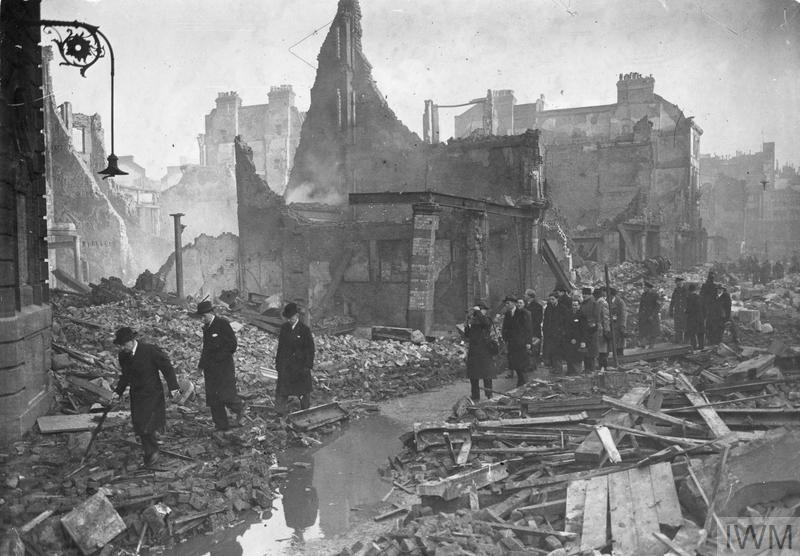
In the unrelenting darkness of the blackout but with the crash German bombs missing, New Year revelers gathered today in the shadow of- St. Paul’s cathedral and greeted 1941 with cries of “To hell with Hitler.” The merrymakers clambered over hose lines and, surrounded by the charred structures of buildings set on fire in the terrific Nazi assault Sunday night, sang “Auld Lang Syne” with smoke-blackened firemen still on duty. Londoners in the fashionable West end cheered and sang as the old year passed on. The great ring in Piccadilly its blazing lights of former years extinguished for the war had its revelers but most of the bomb-wearied residents remained indoors to toast the New Year. Through the night, searchlights and anti-aircraft guns were idle in the peace which every Briton knew was only temporary. Big Ben’s 12 calm notes tolling the hour echoed through the city’s streets. The New Year began without a sign of German activity over Britain, apparently because of a continuation of bad weather which grounded bombers Monday night.
Due to the effectiveness of the German U-boat offensive in the Battle of the Atlantic and the dire straits of the British military situation, the British government exhausted $6.5 billion in credit offered by the U.S. government in 1940. As a result, British purchases had to be cut back, even though Britain had become increasingly dependent on American arms, food, and raw materials.
The United Kingdom suppressed the Daily Worker, a Communist publication. The government announces the “suppression” of the communist Daily Worker and a related journal “The Week” pursuant to Regulation 2D of the Defence (General) Regulations. The government claims this is due to “systematic publication of matter calculated to foment opposition to the prosecution of the war to a successful issue.” The means of suppression is that:
“The effect of the Orders (the announcement continues) is that if any person prints, publishes, or distributes, or is in any way concerned in printing, publishing, or distributing either of these papers, he will be committing an offence.”
The rest of the media is supportive of this measure, as even the most sympathetic outlets consider the Daily Worker “dishonest” in its supposed support of the working man.
The BBC aired the Brains Trust for the first time. This radio program which had five men discussing such diverse subjects as philosophy, art and science was surprisingly a great success, frequently having a regular audience of ten million listeners.
George Giffard was made a Knight Commander of the Order of the Bath.
Arthur Coningham was Mentioned in Despatches.
Tension noticeably increased in official Vichy circles tonight with the rumors of ruptured negotiations, and Adolf Hitler’s reply to the proposals of Chief of State Petain for limited French- German collaboration.
The chief of the Free French naval forces, Vice-Admiral Muselier is arrested on suspicion of treason. The Intelligence Service had acquired four documents, allegedly emanating from the Vichy French Consulate in London, one of which proved that Muselier had betrayed the plans of the Dakar expedition and sent them to Vichy through the intermediary of the Brazilian Embassy. Another document showed that Muselier was plotting to hand over the submarine ‘Surcouf’ to Vichy, and yet another showed that he had received £2000 for sabotaging the recruiting of sailors for the Free French naval forces. The evidence is brought before Churchill who reacts in characteristic fashion. Sir Alexander Cadogan notes in his diary: “PM of course wants to hang him at once. I pointed out possible effect on de G. movement… For good measure, Churchill wanted to declare war on Brazil…”
As it turns out, the letters supposedly incriminating Muselier have been forged. The culprit is the former head of security of the Free French headquarters in London who recently has been fired due to internal intrigue there. Right-wingers (known as “Cagoulards”) and supporters of the leftist Popular Front have been fighting for priority and the usual favoritism. This security man, known as “Howard” but apparently a Captain Collins, has used a forger named “Colin” to craft the documents in order to discredit Muselier. Howard and Colin both confess, and Admiral Muselier is released within about a week.
The whole affair further roils the Free French cause because Muselier suspects that de Gaulle set him up, while de Gaulle suspects the British intelligence service, MI5, of setting him up. Meanwhile, Muselier may not be a traitor, but he is a serious piece of work who seems determined to embarrass everyone who comes in contact with him at some point or another.
In actuality, neither MI5 nor de Gaulle was involved in this, Muselier was simply being used as a pawn in a continuing battle between people within the Free French movement but at opposite ends of the political spectrum. The so-called Cagoulards, who may somewhat simplistically be thought of as Monarchists, generally have the upper hand with de Gaulle, and this is an attempt to disrupt that influence. This internal battle against the communists — and them firing back — has been waging throughout the war and takes many twists and turns.
The entire affair is a tremendous embarrassment for everyone. The British Foreign Secretary is forced to write a contrite letter of apology:
Dear Admiral Muselier,
I have been charged to convey to you an expression of the deep regret of His Majesty’s Government that you should have been detained by the British authorities on suspicions which have now been proved to be unsubstantiated.
His Majesty’s Government have satisfied themselves that the documents, which at first appeared to cast suspicions on you, are spurious. As soon as this conclusion was reached, instructions were given for your immediate release.
His Majesty’s Government look forward to continuing their collaboration with yourself and with the Free French Naval Forces under your command, which are rendering such signal services to the Allied cause.
I would beg at the same time to convey the regrets of His Majesty’s
Government to Lieutenant Villers.
With renewed and deep regrets, believe me,
Yours sincerely,
Anthony Eden
Léon Degrelle, the leader of the Belgian fascist Rexist movement, calls for greater collaboration with Germany. Léon Degrelle, a journalist who founded the fringe Rexist party in 1935, declares his support for Germany. This is not a surprise, and Degrelle will make several speeches in the coming days and months declaring his support for Hitlerism.
The Dutch occupational government imposes a levy (luisterbijdrage) on owners of radio receivers. During the month, the occupation authorities clamp down on people’s ability to listen to anything related to the Allies, such as BBC and Radio Orange from the Dutch government-in-exile. These Allied broadcasts already are forbidden, but now even broadcasts based in the Netherlands are heavily restricted. Broadcasting of English and American songs is forbidden, and radio stations are ordered to play approved German shows such as “Wunschkonzert” (a call-in song request show) and “Gruss aus der Heimat” (“Greetings from the Fatherland”).
Ezra Pound, an admirer of Mussolini, begins recording talks this month for broadcast over Rome Radio. He makes more than 300 broadcasts for the Fascists.
Bulgarian Premier Bogdan Philoff, with a powerful German army steadily expanding in neighboring Rumania, dashed off to Vienna today “for his health,” leaving the pro-Nazi minister of the interior to act as premier in his absence.
Soviet General Georgy Zhukov was appointed Chief of General Staff of the Red Army over several senior generals. Zhukov prepares to command “Western” or “Blue” forces in a war games exercise that simulates a German invasion. His opponent is Colonel General D. G. Pavlov, the commander of the “Eastern” or “Red” forces. The exercises are to begin on 2 January 1940.
E.A. Schadenko, Soviet vice-commissar for defense, has been relieved of his duties, it was announced today. Schadenko is one of many who is purged in 1941. The Great Terror of the Purges of 1937-39 has ended, but all Soviet failures and shortcomings still require the sacrifice of scapegoats.
The Luftwaffe, meanwhile, resumes night bombing after taking the previous two nights off. However, they go off course and bomb Dublin and four other Irish counties (Counties Meath, Carlow, Kildare, Wicklow, Wexford and Dublin). Three people perish in Darlow, and there are injuries there and in the other counties. German aircraft dropped bombs on Duleek and Julianstown in Ireland. It is thought that the bombings might be intended to intimidate the Irish into remaining neutral in spite of Anglo-American pressure for the use of Irish bases to protect convoys.
As of the first of the year, the two Luftflotten facing England, 2 and 3, have a total of 1214 aircraft. This is down from 1291 in September when the area bombing campaign against England began. However, front-line strength only tells part of the story: many of those bombers are in the shop awaiting repair or overhaul (such as engine replacement). Whereas in September about 20% of the planes were in the shops, as of early January the number is almost 50%. The cause is not so much RAF defenses as the almost daily use of the equipment in difficult weather.
Generalmajor Theo Osterkamp becomes Jagdfliegerführer 2 (commander of the fighter aircraft in Luftflotte 2).
Lt. Rudolf Stradner of 1,/NJG 2 shoots down his first victim, a Wellington I of RAF No. 301 Squadron near Digby at 22:25.
Spitfire production rises again this month after having been decreased by the bombardments of Woolton and Itchen.
RAF Bomber Command dispatches 9 Blenheims to Germany during daylight which turned back.
RAF Bomber Command dispatches 141 aircraft overnight to Bremen and in smaller raids to ports in Holland, Belgium and France. Bomber Command sends 95 bombers against the port of Bremen, which has an important Focke-Wulf aircraft factory. Another 46 bombers attack other various other targets. Many fires seen in target area. Bremen reports accurate bombing, particularly by the first wave of aircraft, which hit the Focke-Wulf factory in the southern suburb of Hemelingen. 2 other industrial firms received serious damage and several others light damage. A large fire was started in stacks of straw and hay at an army depot. Fire units from outside Bremen were called in to help and the firemen had a difficult time in the prolonged bombing raid in a temperature of — 12° Celsius. The bombing spread to the town center where 14 housing units (blocks of flats) were destroyed and 313 damaged, though much of the damage consisted only of broken windows. 11 people were killed (including 3 firemen) and 30 people injured. No aircraft were lost but 4 crashed in England.
The Luftwaffe continues transferring units to the Mediterranean. III,/ZG 26 begins the journey today, flying to the Treviso coast. The ultimate destination is Tripoli.
The Luftwaffe now has around 150 bombers and fighters in Sicily compared with the RAF’s 15 Hurricanes in Malta.
In Libya, RAF aircraft continued to bomb the port of Bardia and the airfields at Tobruk, Derna, and Benina.
The Southern Rhodesia Air Force (SRAF) bombs Italian positions at Keru, east of Kassala.
British naval officers were encouraged to search all captured ships for encoding machines and related paperwork.
Destroyers HMS Duncan, HMS Firedrake, HMS Foxhound, HMS Jaguar, and HMS Hero departed Gibraltar on 31 December on a RATION operation. Anti-aircraft cruiser HMS Bonaventure departed Gibraltar on the 1st to support. On the 1st, the destroyers intercepted French convoy K.5 of four ships, French steamer Chantilly (9986grt), French tankers Octane (1950grt) and Suroit (554grt), and Danish steamer Sally Maersk (3252grt), escorted by armed trawler La Toulonaise, in the Gibraltar Straits, coming from Casablanca, having departed on 30 December, for Oran. Destroyer Jaguar fired on steamer Chantilly. Two on the steamer were killed and four were wounded. The convoy was taken towards Gibraltar. A storm caused dispersal of the convoy. Steamer Chantilly arrived at Gibraltar on the 2nd and tankers Octane with an armed guard from destroyer Hero and Suroit with an armed guard arrived on the 3rd. The Danish ship with an armed guard from destroyer Firedrake also arrived at Gibraltar.
Aircraft carrier HMS Ark Royal, light cruiser HMS Sheffield, and destroyers HMS Faulknor, HMS Fortune, and HMS Fury departed Gibraltar to support this operation and sweep in the western Mediterranean. The Ark Royal force arrived back at Gibraltar on the 4th. Steamer Chantilly and tanker Octane proceeded to England in convoy HG.57 on 24 March.
Italian submarine Bagnolini attacked armed boarding vessel HMS Northern Pride in 54N, 14W without success.
Light cruisers HMS Arethusa and HMS Aurora and destroyers HMS Bedouin, HMS Mashona, HMS Matabele, and HMS Tartar departed Scapa Flow at 0830 to cover destroyers HMS Intrepid and HMS Icarus departing to lay mines off Jaederens Point and Obrestad in Operation DZ. Destroyer Icarus damaged her mine rails casting off from depot ship HMS Maidstone. The ships returned to port at 1109 while destroyer Icarus was repaired. The force departed again at 0800/2nd for the operations. During the morning, destroyers Bedouin and Mashona were detached for forty five minutes to search for a submarine reported by a trawler in 58-57N, 2-12W. The mines were laid and all ships arrived back at 1415/3rd.
Light cruisers HMS Manchester and HMS Nigeria arrived at Scapa Flow from patrol. Light cruiser Nigeria had serious engine room defects.
Anti-aircraft ship HMS Curacoa departed Scapa Flow at 0930 to carry out exercises, then join convoy WN.62 until dark. The ship arrived back at Scapa Flow at 2330.
Destroyer HMS Meynell arrived at Scapa Flow from Rosyth for working up.
Destroyer HMS Whitshed arrived at Scapa Flow from the Nore for working up.
British steamer Attendant (1016grt) was damaged on a mine one cable east of 9 Buoy, Sheerness. The steamer was beached, was later refloated and towed to Gravesend for drydocking.
Dutch coaster Catharina collides with Norwegian freighter Madrono in the English Channel south of the Lizard in Cornwall. The Catharina sinks, but everybody survives.
A Fulmar of 803 Squadron from aircraft carrier HMS Formidable failed to return from a reconnaissance flight. Petty Officer H A Glover and Petty Officer R F Hurford were both killed.
Convoy OB.268 departed Liverpool, escorted by destroyers HMS Veteran and HMS Wolverine, sloop HMS Deptford, and corvettes HMS Arbutus, HMS Delphinium, and HMS Erica. The escort was detached when the convoy dispersed on the 4th.
Convoy FN.373 departed Southend, escorted by destroyer HMS Vimiera and sloop HMS Weston, and arrived at Methil on the 3rd.
Convoy FS.377 departed Methil, escorted by destroyer HMS Wolfhound and sloop HMS Egret, and arrived at Southend on the 3rd.
Convoy SL.61 departed Freetown escorted by armed merchant cruiser HMS Bulolo to 18 January and anti-submarine trawlers HMS Kelt and HMS Turcoman to 3 January. On the 18th, destroyer HMS Veteran and corvette HMS Delphinium joined the convoy. On the 19th, corvette HMS Arbutus joined and on the 20th, corvette HMS Camellia joined. These four were detached on the 21st. On the 22nd, destroyer HMS Wolverine joined and on the 23rd, anti-submarine trawler HMS Leeds United joined. These escorted the convoy to arrival at Liverpool on the 24th.
Convoy SLS.61 departed Freetown escorted by anti-submarine trawlers HMS Bengali and HMS Spaniard to 7 January, and arrived at Liverpool on the 26th.
Convoy HX.100 departed Halifax, escorted by armed merchant cruiser HMS Comoran, corvette HMS Collingwood, and escort vessel HMS Otter. The corvette and the patrol vessel were detached the next day. The armed merchant cruiser was detached on the 12th.
Convoy BHX.100 departed Bermuda on 30 December escorted by ocean escort armed merchant cruiser HMS Montclare. The convoy rendezvoused with convoy HX.100/4th and the armed merchant cruiser was detached. On the 13th, destroyers HMS Vanquisher, HMS Viscount, HMS Whitehall, and HMS Winchelsea and corvettes HMS Gentian and HMS Rhododendron joined the convoy. Destroyer Whitehall was with the convoy on the 13th. Destroyers Vanquisher and Winchelsea and corvette Rhododendron were detached on the 16th and destroyer Viscount and corvette Gentian the next day, and arrived at Liverpool on the 18th.
With President Roosevelt’s plan for lending war equipment to England and the whole question of American policy toward the European conflict providing a seething controversy, the Seventy-seventh Congress will convene formally on Friday. Mr. Roosevelt will address Congress in person Monday from the rostrum of the House. His “fireside chat” of last Sunday outlined his views on aid to England in general terms, and many expect his speech to the national Legislature to go into the details on which he did not touch at that time, especially where the Lend-Lease plan for helping Britain is concerned. Although technically a new session, the one beginning Friday will be a continuation of the one which began a year ago, approved the beginnings of a huge defense program, enacted a “Conscription Law” and quarreled over the Roosevelt foreign policy and then refused to adjourn.
Friday’s program will be brief and formal. As usual on the opening day, it will consist of the administration of the oath of office to new members, election of officers and the formality of notifying the President that the session has begun. While defense will be the central topic of the session, the question of Federal finances, taxes and appropriations has already taken on large stature. There is to be a new tax bill, and disagreement is keen as to what it should contain. Probably all hard work upon it will be postponed until the March 15 income tax returns can be inspected. House committees, however, will make a start upon the appropriations at once. Some leaders have indicated that the general objective would be to pare non-defense expenditures and increase tax rates and revenues to a point at which they will bring in enough money to pay for everything except the defense and aid-to-Britain program. The latter, it is expected, will be costly. Some, in a position to know, have estimated that it will require $2,000,000,000 to $2,500,000,000 over and above the cost of America’s own defense plan.
In an unprecedented move to forestall any possible inflation of the nation’s money, the Federal Reserve System today proposed removal of the president’s power to de value the dollar, repeal of “greenback” legislation, an eventual balanced budget, and restrictions on bank lending. System officials said it was not presented as an administration proposal, and neither the White House nor other official quarters would express an opinion on the plan which would require congressional action to make it effective. First reaction among the few members of congress in town was generally favorable.
Senator Vandenberg of Michigan, one of the leading isolationists in Congress, would have the United States guarantee a negotiated European peace, provided it met the approval of American public opinion as just and durable, or he would have the United States go to war against Germany if Chancellor Hitler refused to negotiate such a peace, according to an interview published in today’s issue of Foreign Correspondence.
The bodies of three trainmen who perished in derailment of a Santa Fe freight train south of Del Mar, California last night were extricated today from the wreckage. The engine and three cars of the freight, en route from San Diego to Los Angeles, plunged over a 150-foot embankment and onto the beach. Four other cars were telescoped and went off the rails, one, carrying lumber, plunging into the ocean. Santa Fe officials said that water seepage apparently had undermined the roadbed for about 100 feet along the bluff, creating a “mushy” track for the heavy train.
At least 200 persons died violent deaths as the nation celebrated the beginning of a new year. Traffic accidents took a toll of at least 142 lives. Slayings, suicides, fires and a variety of accidents accounted for the rest. A late Associated Press survey of traffic deaths by states showed: California 17; Illinois and Ohio 12 each; New York 11; Michigan and New Jersey 10 each; Pennsylvania 9; Connecticut and Texas 6 each; Virginia, West Virginia and Wisconsin 5 each; Florida, Iowa, Massachusetts and Missouri 4 each; Ore gon 3; Louisiana, Maryland, North Carolina and Washington 2 each; Indiana, Kansas, Maine, Minnesota, Montana, South Carolina and Tennessee, one each.
A major snowstorm develops in the Midwest. It will lead to immense snowfall in Minnesota, Iowa, and nearby states. Snow, which began last night, becomes a major blizzard today, burying Des Moines, Iowa, under 19.8 inches (50,3 centimeters) of snow in 24 hours, an all-time record for that location.
RCA this month proposed to NDRC design and development of rocket-propelled, radio-controlled aerial torpedo with TV nose, which was given code name “Dragon.” The National Bureau of Standards was assigned the task of developing a suitable airframe.
The first production Bell P-39C Airacobra flies this month.
ASCAP boycott: Music licensed by the American Society of Composers, Authors and Publishers disappeared from American airwaves over a licensing fee dispute. The boycott would last ten months.
Bette Davis in a seven-line message to newspapers tonight announced her New Year’s eve elopement with Arthur Farnsworth of Boston. The noted screen star said she and Farnsworth, an old childhood friend, were married at the Justin Dart ranch near Rimrock, Ariz. The announcement, typical of Miss Davis who makes it a habit to inform the press directly of events in her life that might prove of interest to the public, caught the movie colony flatfooted. Even her studio’s corps of press agents was unaware of the marriage and most of them were unavailable to give the marriage the usual rousing Hollywood sendoff. The telegram from Miss Davis said: “Arthur Farnsworth and I were married at 8 o’clock Tuesday evening at the ranch of Mr. and Mrs. Justin Dart in Arizona.” Miss Davis then reported that she was attended by her mother, her sister, Mrs. Robert Pelgram, and Miss Ruth Garland. The actress said Farnsworth was attended by her brother-in-law, Robert Pelgram. Friends of Miss Davis reported that she had known Farnsworth since her childhood days in Lowell, Mass.
A crowd of 1,500,000 persons jammed Colorado street in Pasadena today to view a patriotic story of “America in Flowers” as portrayed in the fifty-second annual Tournament of Roses. Thousands of weary fathers and mothers lifted their offspring above the heads of the dense throngs to see the historic procession of 57 floats constructed with freshly-cut flowers. Other spectators brought home-made periscopes and trick ladders in order to peek over the heads of the lucky occupants of first row places. A giant, rose-built replica of Lincoln Memorial, so realistic in its likeness to the great Washington, D.C. monument that it brought cheers from the crowds, won the sweepstakes prize for the nearby city of Glendale.
The Stanford Indians defeated the Nebraska Cornhuskers 21–13 in the 27th Rose Bowl. This is the streamlined machine age, but they paid off on the old model T today. Operating behind this baffling formation, the Stanford Indians wrote the final chapter in one of football’s brightest success stories with a 21 to 13 Rose Bowl victory over the Nebraska Cornhuskers, Before a crowd of 91,500 which packed the mighty bowl deep in the Arroyo Seco from rim to turf, Stanford’s varsity made certain of its rights to the nickname “Cinderella boys.” Lower than the low a year ago, as was their coach, Clark Shaughnessy, the Indians topped off their nine straight Pacific coast wins with a triumph over a Nebraska team that outmanned and outweighed them.
Other Bowl Game scores: 7th Sugar Bowl, Boston 19, Tennessee 13. Crowd 73,181. Cotton Bowl, Texas A. & M. 13, Fordham 12. Crowd 45,507. 7th Orange Bowl, Mississippi State 14, Georgetown 7. Crowd 35,101. Sun Bowl, Western Reserve 26, Arizona State 13. Crowd 14,000. Pineapple Bowl, Fresno State 3, Hawaii 0. Crowd 20,000. East-West Shrine Game, West 20, East 14. Crowd 60,000.
Following a hockey game between the Chicago Black Hawks and Detroit Red Wings at Chicago Stadium, Jimmy Orlando of the Red Wings exchanged harsh words with a spectator in the stands, then threw a punch over the rail that knocked the fan unconscious. Hundreds of angry fans surged onto the ice and some tried to go after Orlando, but ushers held them back. By the time police arrived to arrest Orlando he was nowhere to be found.
CBC News was founded in Canada.
Colonel Allen W. Turnage, commander of United States Marines in Peiping, China, was understood today to be preparing to demand a formal apology from the Japanese for asserted maltreatment of five Marines after a cabaret fracas. United States officials declared that all five were held and that four of them were injured by Japanese gendarmes. The American version was this: The five were arrested in the cabaret shortly before midnight Monday by gendarmes who threatened all Marines present with pistols and swords and refused admission to the cabaret to Marine military police who arrived during the incident. They were released only after three demands by Colonel Turnage. The five Marines declared they were insulted and threatened in the cabaret by armed and drunken Japanese civilians. One of the Marines was said by American sources to have been floored and kicked in the face by the gendarmes. Peiping is under occupation by the Japanese army. The United States maintains a guard of two companies of Marines here for its embassy.
The French Indochinese navy defeats the Royal Thai Navy at Koh Chang.
In Japan, American ambassador Joseph Grew wrote in his diary: “Japan… is on the warpath… If… Americans… could read… articles by leading Japanese… they… would realize the utter hopelessness of a policy of appeasement.” Grew sees growing militarism in Japan and is actively looking for ways to communicate that to the U.S. government.
Philippine Department G-2 recommends consolidation of all Philippine defenses under War Department. No response was received.
Last July, the Australian government approved the construction of tanks in the country. They now authorize an armoured division as part of the Australian Imperial Force (AIF).
Naval Construction:
The Royal Canadian Navy Bangor-class (VTE Reciprocating-engined) minesweepers HMCS Red Deer (J 255) and HMCS Medicine Hat (J 256) are laid down by Canadian Vickers Ltd. (Montreal, Quebec, Canada).
The Kriegsmarine (German Navy) Type VIID U-boat U-174 is laid down by F. Krupp Germaniawerft AG, Kiel (werk 648).
The Royal Navy Fairmile B-class motor launch ML 166 is commissioned.
The Royal Navy ocean boarding vessel HMS Malvernian (F 102) is commissioned. Her first commanding officer is Commander John William Baillie Robertson, RNR.
 History Diaries