The General Assembly resolution equating Zionism and racism was protested by tens of thousands of persons who gathered at noon in the garment district in Manhattan. In an atmosphere of quiet emotion they heard Jewish and other prominent speakers call it an “outrage,” a “curse” and an “abomination.” Feelings appeared to reach a peak when Israel’s permanent representative at the United Nations stepped to a podium decked with United States and Israeli flags. The President of the General Assembly took the unusual step today of deploring the approval yesterday of the Arab‐initiated resolution equating Zionism with racism. Prime Minister Gaston Thorn of Luxembourg, in a statement circulated publicly here, declared that a climate of conciliation cultivated in recent months had “been destroyed by yesterday’s vote” and warned members of the “adverse consequences” of the action.
The Israeli Parliament in Jerusalem overwhelmingly rejected tonight the anti-Zionism and other Middle East resolutions that were voted by the United Nations General Assembly yesterday. With only Communists and other extreme leftists opposed, the Parliament adopted a policy resolution that in effect ratified a declaration by Prime Minister Yitzhak Rabin. Parliament said there should be no further Israeli participation in any Middle East peace talks in Geneva if the Palestine Liberation Organization was invited to participate. This stand was in response to an assembly resolution calling for Palestinian participation in all efforts for peace in the Middle East.
In his first public comment since last night’s vote in the United Nations on the Zionism issue, Secretary of State Henry A. Kissinger said tonight that “the United States will ignore this vote and pay no attention to it.”
Secretary of State Henry A. Kissinger said tonight that the United States viewed the meeting this weekend of major Western nations as a forum not only for discussing specific economic issues but also for instilling confidence that democracies can still manage their own destinies. In the first exposition of what the Ford Administration expects to achieve from the three‐day meeting outside of Paris, Mr. Kissinger indicated strongly that the Administration’s main interest was in using it as a rallying point for closer over‐all allied cooperation and cohesion. On specific economic questions, he said that in American eyes, the removal of trade barriers had the highest priority.
A police agent dashed into a room and overpowered a gunman who had held three Belgians hostage in the Belgian Embassy in Tunis, Tunisia, for almost 36 hours. Authorities said the agent burst into the room while the gunman, Tijani Herzi, 34, was speaking on the telephone. The hostages were unharmed. Herzi, a bartender, had forced his way into the embassy in an attempt to get his German-born wife to return to him. Belgium’s state radio said the wife, Helga Brigitte Hindemith of West Berlin, had been located. Herzi had claimed that she left him taking $75,000 he had saved.
Two young men were shot to death on Belfast streets and two others narrowly escaped death as the feud grew between rival wings of the Irish Republican Army. The dead and one of the wounded were sympathizers with the pro-Marxist Official wing. The other wounded man was from the Provisional wing. In related incidents, a community center controlled by the Official wing on the outskirts of Belfast was wrecked in a bomb blast, and a hand grenade was pitched at the doorway of the Provisional IRA headquarters in the Falls Road district of the Northern Irish capital.
After more than six months of legal wrangles and rowdy courtroom scenes, the first witness took the stand at the Stuttgart, Germany, trial of Andreas Baader, Ulrike Meinhof and two other alleged urban guerrilla leaders. The witness, a detective, described the arrest in Frankfurt in June, 1972, of Baader. The defendants are charged with murder, bombings and bank robberies.
Nobel Peace Prize winner Andrei D. Sakharov is living in fear of his life, his wife said in an interview with the Rome newspaper Il Tempo. Mrs. Sakharov, who underwent eye surgery in Italy last month, said that although the Soviet dissident’s family had been threatened before, no attempt had been made to intimidate him personally in the past. “But now he fears for his own safety and security,” she said.
Turkey is demanding an annual payment of $1.5 billion from the United States as one condition for reopening U.S. bases, a reliable Source reported. The demand was made in a draft defense agreement drawn up by Turkish negotiators when talks on reactivating the 26 U.S. installations started last month in Ankara. Turkey wants the money to indemnify it against the risk of nuclear attack, the source said. The United States reportedly regards the demand as unacceptable.
This gaudy Mediterranean capital, charred and bloodied by civil war, began to relax today for the first time in nearly two month. The relaxation was tentative. None of the bitter disputes that led to the fighting between Muslims and Christians were settled in the seven months of fighting, which took thousands of lives and wounded thousands more. The cease‐fire is now in its eighth day, and not a single serious shooting incident or kidnapping was reported for the first time in the truce. “There seems to be an underlying feeling that this time the quiet will continue, although it is difficult to venture an opinion as to how long it will last,” said the usually cautious English‐language Beirut newsletter, Arab World. The 8 PM curfew remained in effect. Few people dared walk the streets of some city and suburban areas, scenes of heavy fighting until the truce. Schools have not reopened. Many merchants continued today to remove goods from their shops for transfer to the countryside or to cellars. Reports persisted that both Muslim bands and the forces of the Christian Phalangist party were resupplying themselves with rockets and mortars.
Morocco’s Premier, Ahmed Osman, and Foreign Minister, Ahmed Laraki, arrived here today to resume negotiations with Spain on Morocco’s claims to Spanish Sahara. With much of the tension between the two countries lifted by the withdrawal of Moroccan civilian marchers from the territory, the atmosphere was noticeably more friendly and Premier Carlos Arias Navarro and Foreign Minister Pedro Cortina Mauri underlined it by personally greeting the visitors at the airport. But King Hassan II, under pressure at home to show results from the march, was still maintaining pressure on the Spanish by holding his marchers in Tarfaya, the nearest town to the frontier, and by keeping troops in the northeast sector of Sahara without any outward interference from the Spanish.
Prime Minister Indira Gandhi, in a speech broadcast to the nation, said tonight that India had made substantial economic and sSocial progress in the four and a half months since the Government declared a state of emergency. “The proclamation of the emergency in June was no doubt a bitter pill,” the Prime Minister declared. “But it was inevitable to restore health to the nation, a nation that had appeared to he suffering from some disease.” In the 50‐minute program, called “P.M. Speaks to the People,” the Prime Minister gave no hint about when the etergency might end, or when some of its strictures might be relaxed. Speaking in Hindi, she thanked the “thousands” of people who had sent congratulations on the Supreme Court verdict Friday, which cleared her of blame in a four‐year‐old election case, and ended the threat of her removal from office.
Gough Whitlam was dismissed from his position as Prime Minister of Australia by the nation’s Governor-General, Sir John Kerr, who then replaced the Labor Party’s Whitlam with the Leader of the Opposition from the opposing Liberal Party, Malcolm Fraser, prompting a constitutional crisis. Kerr, though nominally the head of state acting on behalf of Queen Elizabeth II, rather than the head of the government, used a power granted to him in Section 64 of the Constitution of Australia. Australia faced what may be its bitterest election campaign after the Governor General, Sir John Kerr, unexpectedly dismissed the Prime Minister, Gough Whitlam, and dissolved both houses of Parliament. Mr. Whitlam called the act unconstitutional and hinted that if his Labor Party wins he might try to abolish both the usually-figurehead office of Governor General as well as the Senate. The crisis began when the Opposition majority in the Senate, a coalition of the Liberal and National Country parties, refused to pass the budget adopted by the Labor majority in the House of Representatives. Sir John named the Liberal leader, Malcolm Fraser, to be caretaker Prime Minister.
Canada’s Post Office was expected to announce contingency plans today for delivery of federal assistance checks as the nation’s postal strike stretched to a record 23 days with no end in sight. The checks include oldage pensions, veterans’ allowances and family assistance. Officials said several hundred workers who have crossed picket lines to continue on the job could be used to sort the monthly checks for delivery.
James Bay and Northern Quebec Agreement (the first “modern treaty”) signed between Quebec government and Grand Council of the Crees of Quebec and the Northern Quebec Inuit Association.
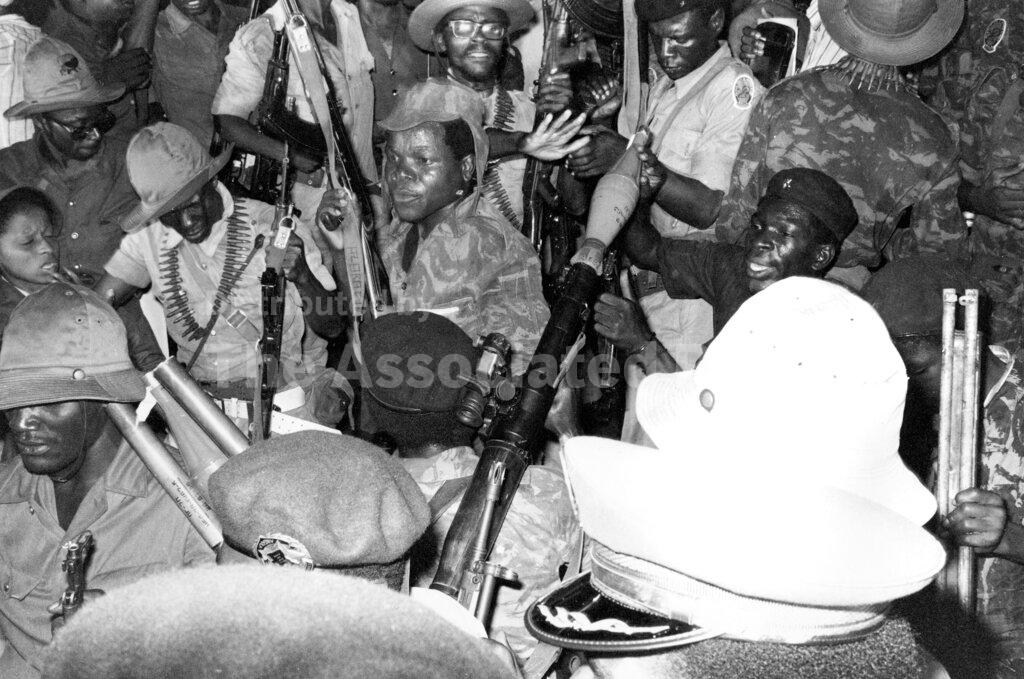
The Soviet Union today broke diplomatie relations with Uganda in a move seen as a setback to Soviet ambitions in Africa. The break was forced by Sunday’s challenge from the Uganda President, Idi Amin, I who gave Leonid I. Brezhnev 48 hours to explain the Soviet Union’s involvement in Angola. Three: rival factions there have carried their struggle for supremacy into Angola’s independence yesterday. The Soviet Union today extended diplomatic recognition to one of the rival factions, the Popular Movement for the Liberation of Angola, which it views as the effective government. President Nikolai V. Podgorny told President Agostinho Neto that the Soviet Union “has been on the side of the fighting people of Angola and has given their patriotic forces every assistance and support.”
Angola became independent after five centuries of being ruled as a colony of Portugal. The last High Commissioner, Admiral Leonel Cardoso, had ordered the Portuguese flag lowered at sundown the evening before, and that the ships, transporting the remaining Portuguese troops, leave Angolan waters by midnight. At Luanda, poet Agostinho Neto was sworn in as president. Two competing governments were proclaimed in Angola on its first day of independence from Portugal. Dr. Agostinho Neto, head of a Soviet-backed Popular Movement for the Liberation of Angola, was installed in Luanda as head of a People’s Republic. Two other groups, one pro-Western, the other backed by China and Zaire, announced the joint formation of a Democratic People’s Republic with its interim capital in Nova Lisboa, which reverted officially to its older name of Huambo.
Portugal has given independence to Angola, a colony for 500 years, but never has that land seemed so close. Angola is the subject of heated table conversations, of long press reports and of street demonstrations. The emotion clearly runs much deeper than in the days after independence was granted Portugal’s other African colonies: Mozambique, Portuguese Guinea, the Cape Verde Islands and Sã Tomé e Principe. Angola has always been something special for the Portuguese. Even during the long, unpopular colonial wars, they would still rally around and chant, “Angola e nossa”—“Angola is ours.”
Rhodesia’s white rulers celebrated 10 years of independence from Britain but ceremonies were dimmed by growing pressure by blacks for more power. The nation, with 274,000 whites ruling 5.4 million blacks, declared independence from Britain November 11, 1965. Prime Minister Ian Smith, facing escalating guerrilla warfare and a split in his Rhodesian Front Party, admits that Rhodesia may one day have a multiracial cabinet.
Reacting to the General Assembly vote equating Zionism and racism, both houses of Congress voted unanimously for a reassessment of the American relationship to the United Nations. A statement from President Ford deplored the Assembly’s resolution, which he said undermined the principles on which the organization is based. Some legislators suggested that it was time for the United States to pull out of the United Nations. A number of lawmakers indicated that the United States should, at the ‘very least, reduce its payments to the world organization and perhaps consider eliminating foreign assistance for “countries which consistently oppose the United States,” as one put it. A spokesman said Mr. Ford would not consider withdrawal from the world organization.
Rejecting bids by President Ford’s backers for a $395 billion spending lid, the House Rules Committee voted to send to the floor a bill raising the federal debt ceiling to $595 billion through March 15. Under current law the Treasury Department can issue up to $577 billion in debt through November 15, but that ceiling expires automatically on that date and drops to the permanent $400 billion ceiling if Congress does not act. This is far below the actual debt.
The Coast Guard found lifeboats and minor debris but no survivors of the 729-foot ore carrier Edmund Fitzgerald, which sank in a storm in Lake Superior Monday night with a crew of 29 aboard.
Senator Frank Church, the Idaho Democrat who heads the Select Committee on Intelligence, opposed in a Senate speech the nomination of George Bush as Director of Central Intelligence, calling President Ford’s choice ill-advised. The committee vice chairman, Senator John Tower, Republican of Texas, strongly backed the appointment of Mr. Bush. Church charged that appointment of former Republican National Chairman George Bush as director of the CIA would seriously undercut all the efforts to reform it. Sounding the start of a determined Senate campaign to defeat the nomination, he denounced President Ford’s choice of Bush as “astonishing.” “The Senate and the people we represent have the right to insist upon a CIA which is politically neutral and totally professional.” Church declared in a floor speech.
President Ford, pressing for last-minute revision of energy legislation, declared here tonight that economic recovery was threatened by “a shortage of determination in the Congress.” In a speech to 1,500 Republicans at a $100‐a‐plate dinner in the Charleston Civic Center, the President did not specifically threaten to veto a measure, nearing final Congressional approval, that would force an election‐year reduction in the price of domestic crude oil. But he said that the search for a way to reduce American dependence on imported fuels was “at a standstill.” He urged Congress to act “responsibly” on comprehensive energy legis lation now, rather than put off “politically difficult decisions” until after the 1976 elections. “The choice,” Mr. Ford said, “is up to the Congress — to stand still in energy, to retreat from responsibility and reality, to threaten our economic recovery, or to move forward with legislation that will produce energy and economic stability for this nation.”
The house of Senator Charles McC. Mathias Jr. (R-Maryland), a member of the Senate Select Committee on Intelligence, was burglarized over the weekend but little of value was taken, according to Montgomery County, Maryland, police. It was the second burglary in three months at the home of a member of the committee, which is investigating the CIA and other government intelligence activities. In both last weekend’s break-in of Mathias’ home in Chevy Chase and the August 8 burglary of the home of Senator Howard H. Baker Jr. (R-Tennessee), the thieves bypassed items normally taken in household burglaries. Mathias said the only item that appeared to be missing was $25 worth of Swiss francs, although every drawer and closet had been opened. Valuables also were left untouched in Baker’s home.
The Watergate special prosecutor’s office said it was investigating Gulf Oil Corp.’s allegedly illegal campaign contributions to members of Congress between 1960 and 1972. A spokesman, however, refused to be specific. But he noted that Gulf’s problems in the 1972 election were covered in 1973, when the company pleaded guilty in connection with $125,000 in contributions to the campaigns of Richard M. Nixon, Rep. Wilbur D. Mills (D-Arkansas) and Senator Henry M. Jackson (D-Washington). But it was learned from court papers that another former Gulf official had said he delivered sealed envelopes to at least 15 other present and former members of Congress between 1960 and 1972.
Two influential conservative Republicans moved toward support of federal action to prevent a New York City default. Representative John Rhodes of Arizona, the House minority leader, said he would support short-term loan guarantees to assure the city’s cash flow if the city adopted a plan to put its fiscal house in order. Dr. Arthur Burns, chairman of the Federal Reserve Board, told a House Republican conference that his concern had deepened and that he might support federal assistance if the financial markets began to deteriorate noticeably.
The Supreme Court agreed to decide whether private schools may refuse admission to black children because of their race. It will review a 4-to-3 ruling by the United States Court of Appeals that the current version of the Civil Rights Act of 1966 prohibits rejection of a black applicant when race is the only basis for rejection. The Supreme Court’s action is almost certain to affect the future of private schools for white children set up in the South since public school desegregation.
The son of a wealthy dairyman buried his wife alive in a pasture with a bulldozer, police said in Callahan, Florida, and there were indications she may have submitted voluntarily. William P. Wright Jr., 26, was charged with first-degree murder in the death of Laura, 19. Roy F. Dorn, a state attorney’s investigator, said Wright and his wife of two months were riding on the dairy’s pastures late Monday night. “They became involved in a heated discussion,” he said, “and she became despondent. According to him, she told him she was ready to end it all and he said he could oblige her if she wanted.”
A Polish boat was seized by the Coast Guard for allegedly fishing within the U.S. 12-mile limit. The 290-foot Humbak refused to stop when it first was sighted by a Coast Guard aircraft off Boston harbor, a Coast Guard spokesman said. The ship was pursued by two cutters and was boarded and seized 30 miles east of Boston. It was being escorted back to Boston, where it will be held pending legal action.
Establishment by Congress of a single federal authority to apply all local, state and federal laws relating to location and construction of nuclear power plants was urged by a spokesman for an association of power companies, testifying before the Joint Atomic Energy Committee in Washington, D.C. William Gould, representing the Southern California Edison Co. and speaking as an officer of the Edison Electric Institute, said the institute’s 198 members are interested in dealing with a single agency instead of an array of federal, state and local authorities.
A conservationist group’s suit seeking to halt construction of a sewage project in Yosemite National Park was continued until December 11 by U.S. District Judge Charles B. Renfrew in San Francisco. The judge also put off until then a government motion to transfer the case to Sacramento. Friends of Yosemite, claiming 1,000 members, wants to stop construction of a Tuolumne Meadows sewage collection pond and a sewage pipeline from the west end of Yosemite Valley to a new treatment plant in nearby El Portal.
A nickel deposit on beer and soft drink containers sold on federal property was proposed by the Environmental Protection Agency to help clean up the estimated 300,000 tons of beverage container litter each year on federal property. The proposed guidelines would require vendors at all federal, military, and national park facilities to charge a refundable 5-cent deposit on all drink containers, including disposables.
Dow Jones Industrial Average: 838.55 (+3.07, +0.37%)
Born:
G. Reid Wiseman, American astronaut (NASA Astronaut Group 20; Expedition 40/41 (TMA-13M), 2014; Artemis II circumlunar mission, to be flown 2026), in Baltimore, Maryland.
Andy McCullough, NFL wide receiver (Arizona Cardinals), in Dayton, Ohio.
Died:
Richard Paul Pavlick, 88, retired postal worker who had conspired to assassinate U.S. President-elect John F. Kennedy on December 11, 1960.
 History Diaries