The Italian invasion of Egypt began. Italian forces advanced against British positions in eastern Libya. The advancing Italians included five infantry divisions and the ad hoc “mechanized” Maletti Group. The advance included most of the available Italian units in Libya. Italian Army Marshal Rudolfo Graziani ordered his troops in Libya to march toward British positions, with troops of the Italian 10th Army under General Mario Berti as spearhead; the Italian goal was to capture the Suez Canal. Italian aircraft bombed British defensive positions while British aircraft flew sorties against Italian supply dumps and troop concentrations.
The Luftwaffe has bombed London for several days now as of 9 September 1940, and basically gotten whatever benefit there is to be gotten — assuming there is any real benefit to the German war effort, which is highly debatable (the effect on British morale is the opposite of what the German leaders expect). It might be a good time, strategically, to go back to suppressing the RAF instead of continuing the pointless attacks on London.
Instead, the Luftwaffe doubles down. The command staff at the Luftwaffe high command (OKL) organizes the attacks, suggesting they are not going to stop any time soon. Night raids will be carried out by Luftflotte 3 and day raids by Luftflotte 2. London is divided into different sectors for bombing priority, Area A being the East End and dock, Area B being the power stations and other priority installations in West London:
“The maintaining of the attack against London is intended to take place by day through Luftflotte 2 with strong fighter and destroyer units; by night Luftflotte 3 will carry out attacks with the object of destroying harbor areas, the supply and power sources of the city. The city is divided into two target areas, the eastern part of London is target A with its widely stretched out harbor installations. Target area B is the west of London, which contains the power supplies and the provision installations of the city. Along with this major attack on London the destruction raids will be carried on as much as possible against many sectors of the armament industry and harbor areas in England in their previous scope.”
This order confirms and codifies the new change in objectives. The armaments industry is mentioned only in passing, and RAF airfields and radar stations not at all.
In addition, the OKL begins to recognize that the RAF is far from defeated. It issues orders that any formation facing strong opposition is allowed to break off contact and head home.
Weather over Great Britain: Cloud overnight becoming showery with the possibility of a thunderstorm in the east. Rain periods in the west while the north and Scotland should remain cloudy but dry. Showers were expected to clear from Channel areas by midday.
It was now obvious to Dowding and Park that the Luftwaffe was going to leave the 11 Group aerodromes alone, well, for the time being anyway. Already damaged airfields were just about back to any reasonable sort of order, the personnel that had been toiling both night and day busily rebuilding to make all airfields fully operational again could ease off a little. Aircraft and supplies had been replenished and although Fighter Command was nowhere yet back to full strength, they were a lot stronger than they were just seven days ago. Again, no enemy formations were detected during the morning or the early and midafternoon sessions. Park shared with his chief controller Willoughby de Broke and also so Dowding by telephone, that the Luftwaffe tactics when targeting the aerodromes, commenced generally with a morning attack, with the last few days, when his aerodromes had been left alone, there had been no early morning attacks. It seemed that bombing raids on London seemed be be forming a pattern of commencing a few hours after midday. Park issued the order that Hornchurch, Biggin Hill and Kenley push some of their squadrons forward to their satellite stations.
1620 Hours: All the radar stations along the Kent coast picked up signals on their CRTs of formations that were located in different areas, but most of them were massing in the Calais-Boulogne area. The information was immediately sent to Fighter Command and the Group Headquarters. Park exclaimed to his controllers, “When will they ever learn…..same time, same course and the same target I would say.” Immediately he called a number of squadrons to ‘readiness’ This time he was going to be ready for them. He knew just how long it would take then to cross the coast, he knew just how long it would take them to maneuver to get into place for their run to the target.
1650 Hours: At the various Observer Corps posts along the Kent coast from Folkestone to Margate, all eyes were glued out to sea and across the Channel looking high into the sky for any hint of enemy formations. The weather was now clear so they would have little trouble, although Bf 109s at high altitude was always to pose a problem. One by one, the formations were detected. A number of Bf 109s this time were slightly ahead of the main bomber force, obviously hoping that they would draw British fighters into the air. Park instructed that the advance party of Bf 109s were to be left alone. The observer Corps reported that there were four groups of 50 plus, 30 plus, 20 plus and 12 plus, the fighter escort cover was estimated at 60 plus, but were too high for an accurate reading.
1700 Hours: With the German bombers following a similar course as they did just two days previous, it seemed obvious that the target was again London. 66 Squadron Kenley (Spitfires) and 92 Squadron Biggin Hill (Spitfires) were ordered to patrol over South London keeping both aerodromes within sight. 222 Squadron Hornchurch (Spitfires), 253 Squadron Kenley (Hurricanes) and 605 Squadron (Hurricanes) were to cover the northern section of Kent, while later 303 Squadron Northolt (Hurricanes) were ordered to patrol from Tonbridge to Folkestone. From Tangmere, 607 Squadron (Hurricanes) were ordered towards Guildford to cover the area over Surrey as far as Biggin Hill. Up at 12 Group, Douglas Bader kept an ear to the radio listening to what was going on down south. He got to a point of no return and telephoned Woodall at Duxford requesting in no uncertain terms that we (the 12 Group squadrons) should be airborne and on the way down. Finally Duxford released 19 Squadron Duxford (Spitfires), 242 Squadron Coltishall (Hurricanes) and 310 Squadron (Hurricanes) and they were vectored to a point between Hornchurch and North Weald and at 20,000 feet providing close protection in the absence of the 11 Group fighters.
Again Bader was to ignore orders. the late afternoon sun would be setting in the west by the time they would be near London, and he wanted to make any attack with the sun behind him so he ordered the squadrons to the west of London and climb to 22,000 feet.
1730 Hours: 607 Squadron Tangmere (Hurricanes) were one of the first squadrons to make contact. A leading formation of He 111s and Do 17s with Bf 109 escort were just to the east of Guildford heading towards Weybridge and Brooklands. They lined up the formation and went in before the escorts could get down at them. Coming in just in time was 605 Squadron Croydon (Hurricanes) who also commenced an attack on the bombers. One Do 17 was brought down by 607 Squadron, but one of the Hurricanes of 605 Squadron collided with a He 111 shearing off a portion of wing while taking evasive action in trying to avoid gunfire from both the 607 Squadron Hurricanes and the bombers and Bf 109s. The Heinkel was believed to have crashed at Alton in Hampshire. Another Hurricane of 605 Squadron was hit by crossfire and the pilot Bailed out safely. The German raid was aborted.
1745 Hours: A number of German bomber formations were approaching London from the east when they were intercepted by 222 Squadron Hornchurch (Spitfires) and 242 Squadron Coltishall (Hurricanes). The German formation consisted of Do 17s and Bf 110s with Bf 109 escorts. 222 Squadron make their attack and claim a damaged Do 17 but P/O Tim Vigors is attacked by Bf 109s and finds his engine shattered when hit by cannon fire and is forced to crash land his aircraft. Douglas Bader takes his squadron into his first attack for the day, he calls on 19 Squadron Duxford to follow him in line astern, but 19 Squadron had been scattered.
In the corner of his eye a scatter of fighters darted out of the sun and he thought with a surge of joy that more friendly fighters had arrived: only a few pilots behind saw that they were 109’s and wheeled back to fight them off. Diving now on the first swarm he saw they were mixed Dorniers and 110’s. A Dornier was slightly in front leading, and he plunged for it, firing almost point-blank for two seconds, then diving past and under, pulled up again, but the leading Dornier was falling over on its back, smoke pouring from both engines. Other bombers above! He kept zooming up like a dolphin, squirting at them, seeing flashes as the armor-piercing incendiary bullets hit. The mind was racing again in the deadly confusion of high-speed battle.
To the side another Dornier was diving, trailing fire and smoke, and a voice shouted in his ears, “F-f-f-flamer!” Powell-Sheddon had scored. Black twisting bombs were suddenly falling on Bader as the bombers jettisoned over the fields and turned south-east to flee. He steep-turned out of the way of the bombs, seeing that only about twenty of the bombers still clustered in ragged formation, the rest straggling over the sky, hunted by darting fighters.
Half a mile ahead was a Dornier; he chased it and was soon pulling it back. Five hundred yards now. Two Hurricanes suddenly dived in from each side in front of him converging on the Dornier. Damn! Daylight robbery! Swiftly the two fighters swept together behind the bomber, and he suddenly screamed into his microphone: “Look out. You’re going to collide.” A moment later they did. The left wing of the Hurricane on the right folded and ripped away, and it spun instantly; the other Hurricane, crabbing crazily on, smashed into the Dornier’s tail and the air was full of flying fragments. The two broken aircraft wrenched apart and spun, followed by torn pieces twisting and floating down. It was over in seconds.
By now, both 19 Squadron had reformed and was joined by 310 Squadron and the “Big Wing” was now in place and was about to show how 33 fighter aircraft could cause havoc amongst the Germans. Between them, they were to claim 21 German aircraft destroyed with many others damaged and a few claimed as probables. If Bader had adhered to orders, they would have been flying helplessly around North Weald and Hornchurch which neither was attacked because German formations had turned back under relentless defense from Fighter Command. Park would have lodged an official complaint for the Duxford Wing disobeying orders, but in light of its success, no complaint was ever lodged.
1800 Hours: While the combat action by the Duxford Wing over South London was still in progress, most of the squadrons were still in the air scattering the bomber formations from Thames Haven to West London. But the great significance of the day was that very few bombers got through to their targets. The remnant of the formations made the most of their retreat back across the Channel and although Fighter Command did sustain a number of losses, it could only be claimed as being not only a tactical victory for the RAF but a morale boosting one as well.
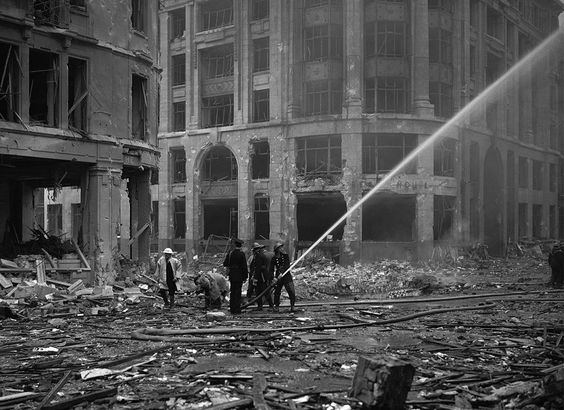
Evening: The after dark attacks continued. What Kesselring’s Luftflotte 2 had failed to do during the day, Sperles Luftflotte 3 succeeded at night. By 2000 hours, 250 bombers again came over and attacked the city. Fires were burning around St Pauls and buildings on both sides of Ludgate Hill were ablaze. The area around the Guildhall and the Bank of England suffered considerably, while a women’s hospital suffered many casualties when it was hit. In the East End again bombs fell on the dockland area and a number of nearby residential houses were destroyed including a school which was being used as a temporary shelter to homeless families. Altogether, over 400 people were killed in this night’s attacks and 1,400 people were injured. The toll was steadily mounting.
The people of London were now experiencing the heaviest raids of the entire war which was now just a few days over a year old. All the precautions and training by the defense forces were now being put into practice, but at a cost. Police, firemen, civil defense workers, nurses, gas and electricity workers were all now being put to the test.
It was not known at the time, but this was to be the commencement of a fifty-seven day long onslaught by the German bombers on London. They were determined to crush the city and its people. Communal shelters, whether it was the large concrete ones built along the sides of many of London’s streets, Underground Stations, large shelters built underneath departmental stores, were to be the mecca of activity in the nights that followed. Many people made arrangements to meet at the shelter the following night knowing full well that another air raid ‘would be on’.
For Fighter Command, the Battle of Britain was going through a lull. The only combat action taking place was during the late afternoon when the first waves of German bombers crossed the Channel with sights set on the London docks and surrounding industrial targets. Most of these had to be aborted because Fighter Command was well up to the task. But Park knew, that night bombing could only be done discriminately, they would be guided in by the fires still burning as a result of previous raids, but sooner or later, Göring would have to turn to daylight raids which would allow him far more accurate bombing of British targets. Keith Park was willing to wait, while in the meantime his airfields and men were slowly nearing full operational strength, which in Parks view would be “his (Göring’s) greatest mistake, and one that would cost him the Battle of Britain.”
RAF Casualties:
1730 Hours: Goudhurst. Hurricane P2728. 607 Squadron Tangmere
P/O G.J. Drake killed. (Engaged combat with enemy aircraft and shot down over Mayfield)
1730 Hours: Farnborough. Hurricane L2059. 605 Squadron Croydon
P/O G.M. Forrester killed. (Caught in enemy crossfire and collided with He 111 losing part of wing)
1730 Hours: Mayfield. Hurricane P3574. 607 Squadron Tangmere
P/O S.B. Parnall killed. (Shot down during combat with Do 17s and Bf 109s. Crashed at Cranbrook)
1735 Hours: Croydon. Hurricane P3888. 310 Squadron Duxford
F/O J.E. Boulton killed. (Collided with Hurricane of 310 Sqn during attack on enemy aircraft)
1735 Hours: Mayfield. Hurricane P3117. 607 Squadron Tangmere
P/O J.D. Lenahan killed. (Shot down by Bf 109 during attack on Do 17. Crashed at Cranbrook)
1745 Hours: Thames Haven. Hurricane P3087. 242 Squadron Coltishall
P/O K.M. Sclanders killed. (Shot down in combat with Do 17s and Bf 110s. Crashed at Caterham Surrey)
Although records show that only six pilots lost their lives, there were quite a number of aircraft that were damaged or lost in combat operations where pilots managed to survive. They are:
19 Squadron Duxford. 2 Spitfires damaged and both repairable.
66 Squadron Kenley. 1 Spitfire destroyed but pilot bailed out and was safe.
92 Squadron Biggin Hill. 2 Spitfires destroyed with both pilots injured and 1 damaged and repairable.
222 Squadron Hornchurch. 2 Spitfires damaged and repairable with both pilots unhurt.
242 Squadron Coltishall. 1 Hurricane destroyed but pilot safe after bailing out.
253 Squadron Kenley. 2 Hurricanes damaged and both repairable. Both pilots unhurt.
303 Squadron Northolt. 1 Hurricane destroyed and pilot injured and 1 damaged with pilot safe.
310 Squadron Duxford. 1 Hurricane destroyed with pilot safe and 1 damaged and pilot unhurt.
602 Squadron Westhampnett. 1 Spitfire destroyed and 1 damaged with both pilots injured.
605 Squadron Croydon. 1 Hurricane destroyed and pilot injured.
607 Squadron Tangmere. 2 Hurricanes destroyed and 1 damaged with all pilots safe.
Douglas Bader shot down a German Do 17 aircraft and damaged the rudder of a He 111 aircraft using his propeller.
Hans-Joachim Marseille was awarded Iron Cross 2nd Class.
Overnight, London was heavily bombed again.
RAF Bomber Command dispatches 7 Blenheims to Belgian and Dutch ports during the day; turned back because of lack of cloud cover. 1 aircraft lost.
RAF Bomber Command dispatches 76 Battles, Blenheims, Wellingtons and Whitleys overnight to 5 targets in Germany and to Channel ports, 1 Battle and 1 Whitley lost. RAF Bomber Command No. 51 Squadron raids Berlin, specifically targeting the Neuköln gasworks. Other targets during the night include the docks and shipyards at northern German ports Hamburg, Kiel, Bremen, Wilhelmshaven and Wismar, warehouses in Krefeld, Brussels, and the usual airfields in northwest Europe. Particular attention is paid to the ports where invasion barges are thought to be gathering, including Ostend, Calais, Flushing, and Boulogne. The big coastal guns at Cap Gris Nez also are attacked, without effect.
Berliners are instructed to sleep dressed and to go to bed early so that they can get in some sleep and then run to the shelters should bombers appear overhead at midnight as usual.
British Skua aircraft of 801 Squadron took off from Royal Naval Air Station Hatston, Orkney, Scotland to attack German shipping off Bergen, Norway; 1 of the Skua was lost during the attack, with two airmen killed.
The air war in North Africa between the Italian and British air forces began. The Regia Aeronautica Fiat CR.42 Falco fighters and RAF Gladiator biplane fighters fought over the skies over eastern Libya and western Egypt. The RAF also bombed Tobruk and other staging areas in the Italian rear and the Italians bombed British positions along the planned invasion route.
Aircraft from HMS Illustrious and HMS Eagle attacked Italian airfields on the island of Rhodes, Greece; Eagle lost 4 aircraft in this attack.
At Malta, there are no air raids.
Tel Aviv in the British Mandate of Palestine was bombed by Italian aircraft causing 137 deaths.
Marshal Rodolfo Graziani complies with Mussolini’s order and sends troops led by the 10th Italian Army (General Mario Berti) toward British positions in Egypt at Bardia, Sidi Azeiz, Gabr Saleh and Sidi Omar. The Italians have no offensive deployments or plans and heretofore have been in a purely defensive orientation. The advance by five divisions and seven tank battalions (with two in reserve at Tobruk) is almost entirely limited to the vulnerable coast road, open to both air and naval assault.
The Italian equipment is inferior, most noticeably in the lack of adequate transport to support the advance. The Regia Marina only has about 300 combat airplanes total in the theater, though more planes can be dispatched from Italy across the Sicilian Narrows.
There is no ground combat today (apparently the Italians don’t even cross the border yet), but the RAF swings into action. RAF Nos. 55, 113 and 211 Squadrons raid both the advancing troops and airfields in Italian Libya. Italian aircraft bomb British defensive positions ahead of the advance and make a fighter sweep by 27 CR. 42s over Buq Buq. There are unusual dogfights over the desert involving biplanes on both sides, Regia Aeronautica Fiat CR.42 Falco fighters and RAF Gladiators.
93 were killed in the Treznea massacre that took place in Treznea, Sălaj during the handover of Northern Transylvania from Rumania to Hungary. In Treznea, Sălaj, the handover of Northern Transylvania goes very badly. There are roughly 93 deaths during the Treznea massacre. There are varying versions of the incident, with the Hungarians claiming that an uprising was started by a local Rumanian Orthodox priest, and the Rumanians claiming that many of the local (minority) Hungarians participated in the incident and instigated the situation in hopes of taking sole possession of the region — and perhaps getting a little revenge for past perceived slights. Local Rumanians are taken to a nearby cliff and machine-gunned, but the Hungarians stop when retreating Rumanian army units are called. Needless to say, this inflames tensions between the two nations that already are red hot.
Rumania acted today to eliminate certain religious sects not recognized by the new regime and to curb Jews. It was decreed that all Jewish “communities” must vacate synagogues unless they could establish memberships of 400 in the larger towns and 200 in villages.
All political parties in Norway were dissolved except for Quisling’s Nasjonal Samling Party, which was installed as the pro-Nazi Norwegian government. The meaning of Adolf Hitler’s recent meeting with Norwegian politician Vidkun Quisling becomes clear. The Germans ban all political parties there save for Quisling’s pro-German Nasjonal Samling Party.
Walther von Brauchitsch issued a plan for the future military occupation of Britain which, among other things, called for the rounding up of males between the age of 17 and 35 to be sent to continental Europe as forced laborers and the systematic looting of British goods; this type of harsh treatment was not even implemented in German-occupied Poland at this time.
Germany announces an unrestricted war zone around the British Isles.
Around this time, a German crew spends two days filming practice landings by the Kriegsmarine of troops and tanks near Antwerp. The objective is to have footage of the invasion available for the newsreels, the theory being that a landing at night can’t be filmed.
Adolf Hitler postponed Operation SEA LION, the invasion of Britain.
German long-range guns shelled Dover, England.
The Royal Navy, concerned about a prospective invasion, resorts to sinking old and damaged ships at harbor entrances as blockships.
Amid welcoming cheers by lower-working-class families, many of whom had been made homeless by German bombs, King George today toured London’s congested East End, where the Nazi Luftwaffe had been showering many high explosives.
The Italians start trying something that will be a recurrent theme throughout the war: appealing to local ethnic/religious resentments as a motivating tool. Leaflets are dropped on Jaffa to promote the idea that Palestinian Arabs will become free if they join the Axis war effort. In fact, there is tremendous sympathy for the Axis throughout the Arab world for several different reasons, so these leaflets drop on fertile ground (so to speak). The British administer Mandatory Palestine, but the obvious subtext is an appeal to anti-Semitic/anti-British groups such as the Black Hand. They have been causing problems for the British for years, most significantly during the Arab Revolt of 1936-1939.
French intelligence reported a possible invasion of Dakar in West Africa by General de Gaulle’s forces, supported by the British. In response, French cruisers Georges Leygues, Montcalm, and Gloire, supported by three destroyers, departed Toulon in southern France to reinforce Dakar.
U-28, commanded by Kapitänleutnant Günter Kuhnke, sank steamer Mardinian in 56-37N, 09W. At 0447 hours the Mardinian (Master Joseph Every) in convoy SC.2 was hit underneath the bridge by one torpedo from U-28 and sank after 30 minutes about 100 miles north-northwest of Bloody Foreland. Six crew members were lost. The master 19 crew members and one gunner were picked up by HMS St. Apollo and landed at Belfast. Ten crew members landed at Leverburgh, South Uist and one crew member was rescued by HMS Aurania (F 28) (A/Capt I.W. Whitehorn). The 2,434-ton Mardinian was carrying pitch and was headed for London, England.
U-47, commanded by Kapitänleutnant Günther Prien, sank Greek steamer Possidon from convoy SC.2 in 56-43N, 09-16W. At 0024 hours U-47 fired a single torpedo at the convoy and missed the intended target but hit the Possidon. The U-boat then had to avoid another merchant of the convoy that passed on collision course in only 50 meters distance without noticing the enemy. The 3,840-ton Possidon was carrying sulfur phosphate and was headed for Glasgow, Scotland.
Italian submarine Comandante Faà Di Bruno torpedoed and damaged tanker Auris (8030 BRT) in 36N, 22W.
Destroyer HMS Bedouin was docked at Scapa Flow for repairs to her asdic directing gear. She was the first destroyer to use the newly constructed dock, Admiralty Floating Dock, AFD.12 which had arrived on 26 August. On docking, further defects were found, and damage to her rudder was also repaired.
Destroyer HMS Jaguar departed Greenock for Scapa Flow where she arrived at 0850/10th.
Destroyers HMS Vanoc and HMS Viscount were in a collision at Plymouth. Vanoc received temporary repairs at Devonport, completing on the 10th, and later received permanent repairs at Portsmouth from 18 to 25 November. Viscount was repaired in one week.
British aircraft of the 801 Squadron from Hatston attacked German shipping in the Bergen area. One Skua was lost on its return and the crew, Petty Officer H. C. Kimber and Petty Officer Airman A G. Clayton, were killed. The raid was repeated on the 13th, when two Skuas were shot down. Petty Officer E. G. R. Harwin and Naval Airman J. R. Maunder from one aircraft were killed, and Lt T. E. Gray and Lt J. C. W. Iliffe from the other were captured.
S/Lt L. A de Sandoval Sievier, in a Battle of RAF Squadron 103 from Newton, was killed when his aircraft was shot down over Calais. The two RAF crew were killed.
Steamer Minnie De Larringa (5049grt) was sunk by German bombing in the Port of London, but without casualties. She was later salved and sunk as a blockship at Dover on 5 February 1941. Steamer Ryal (367grt) was damaged, also in the Port of London.
Trawler John Baptish (290grt) was sunk on a British defensive minefield south of Coningbeg Light Vessel.
Minesweeping trawler HMS Dervish (346grt) was sunk on an aerial mine laid by aircraft of German IX Air Division, 2.6 miles 156° from the Humber Light Vessel. Four crewmen were lost, and eleven rescued.
Trawler Harvest Moon (72grt) and drifter Alfred Colebrook (56grt) were sunk as blockships in Richborough Channel.
German destroyers Lody, Galster, Riedel, Eckholdt, and Ihn departed Wilhelmshaven for Cherbourg, arriving on the 11th, and escorting minelayers Schiff 23 (steamer Cairo: 4778grt), Tannenberg, Cobra, Togo, and Schwerin.
Late on the 8th and into early 9th, German torpedo boats T.5, T.6, T.7, and T.8 of the 2nd Torpedo Boat Flotilla laid minefield Hannelore in the southwest North Sea.
French Force Y (Contre Amiral C. J. L. Bourrague), composed of light cruisers Georges Leygues (CV A G. Lemonnier), Montcalm (CV M. H. M. Ferriere), Gloire (CV J. P. L. Broussignac) and large destroyers Fantasque (CV P. A B Still), Malin (C. F. E. J. M. L. Deprez), and Audacieux (C. F. E. Derrien) departed Toulon for Dakar.
Destroyers HMS Hotspur, HMS Griffin, and HMS Encounter departed Gibraltar on the 9th for an anti-submarine sweep between Gibraltar and Alboran Island.
Light cruiser HMS Dragon departed Simonstown for Lagos.
Light cruiser HMS Delhi departed Pointe Noire.
Sloop HMS Bridgewater arrived at Freetown from Lagos.
Convoy OA.212 departed Methil escorted by anti-aircraft cruiser HMS Cairo until the 11th, and by sloop HMS Rochester and corvette HMS Clematis.
Convoy FN.277A departed Southend, escorted by destroyer HMS Vivien, sloop HMS Londonderry, and patrol sloop HMS Guillemot, and arrived in the Tyne on the 11th.
Convoy FN.277B departed Southend, escorted by destroyers HMS Vanity, HMS Wolsey plus patrol sloops HMS Mallard, HMS Shearwater, and HMS Widgeon, and arrived in the Tyne on the 11th.
Convoy MT.164 departed Methil, and arrived in the Tyne later that day.
Convoy FS.276 departed the Tyne, escorted by destroyer HMS Verdun and sloop HMS Black Swan, and arrived at Southend on the 11th.
Convoy HX.72 departed Halifax escorted by Canadian destroyer HMCS Saguenay plus auxiliary patrol vessels HMCS French, HMCS Laurier, and HMCS Reindeer. At 1815, patrol vessel French departed the convoy. At 1200/10th, steamer Tudor Prince (7199grt) joined the convoy. Canadian destroyer Saguenay left the convoy to the ocean escort, armed merchant cruiser HMS Jervis Bay at 1750/10th, which herself detached on the 20th.
Convoy BHX.72 departed Bermuda on the 8th escorted by ocean escort, armed merchant cruiser HMS Voltaire. The convoy rendezvoused with HX.72 on the 13th and the armed merchant cruiser was detached. On 21 September, destroyers HMS Scimitar, HMS Shikari, HMS Skate, sloop HMS Lowestoft, with corvettes HMS Calendula, HMS Heartsease, and HMS La Malouine joined the convoy, which was then dispersed on the 21st.
The first eight US destroyers, US Destroyer Divisions 65 and 67, were transferred to the Royal Navy at Halifax.
United States Navy Name — Royal Navy Name — Commanding Officer
USS Buchanan (DD-131) — HMS Campbeltown — Lt I W T Beloe
USS Aaron Ward (DD-132) — HMS Castleton — Cdr F H.E Skyrme Rtd
USS Hale (DD-133) — HMS Caldwell — Lt Cdr M W Tomkinson
USS Crowninshield (DD-134) — HMS Chelsea — Lt Cdr R D.H.S Pankhurst
USS Abel P Upshur (DD-193) — HMS Clare — Lt CdrC Gwinner (emgcy)
USS Welborn C. Wood (DD-195) — HMS Chesterfield — Lt Cdr G EC Wood, Lt Cdr E Gleave RNR, before sailing to England
USS Herndon (DD-198) — HMS Churchill — Cdr G R Cousins DSC
USS Welles (DD-257) — HMS Cameron — Lt Cdr P G Merriman
The U.S. Senate completed Congressional action on the Wheeler-Lea Transportation Bill, defeated a motion to approve the Burke-Wadsworth Compulsory Military Training Bill as passed by the House and sent the bill to conference, and recessed at 5:34 PM until noon tomorrow. The Finance Committee made further revisions of the Excess Profits Tax Bill.
The House passed a bill for the reorganization of the government of the District of Columbia; completed Congressional action on a bill authorizing a Reconstruction Finance Corporation loan for the development of strategic minerals, passed a bill authorizing Jesse Jones to serve simultaneously as Secretary of Commerce and Federal Loan Administrator, passed a bill providing for construction of Navy drydocks in New York Harbor and elsewhere, and adjourned at 3:49 PM until noon tomorrow. The Rules Committee approved the Defense Housing Bill.
The Navy Department awarded contracts for 201 ships at a cost of $3,861,053,312, following the signing by President Roosevelt of the $5,246,000,000 Supplemental Defense Appropriation Act.
After a two-hour debate marked by acrimonious exchanges, the Senate voted today to reject the House draft of Burke-Wadsworth Selective Military Service Bill and to ask for a conference. The debate turned chiefly on two motions offered by Senator Clark, of Missouri. The first was to instruct the Senate conferees to insist on the Senate’s limitation of the draft registration to men between the ages of 21 and 31 against the House bill’s provision for the registration of men between 21 and 45.
The second motion by Senator Clark called on Senate conferees to accept the Fish amendment to the House bill for a sixty-day test of volunteer enlistments before the draft becomes effective. Mr. Clark’s first motion was defeated, 44 to 23, while the second went down 48 to 19, the latter vote leading both House and Senate members to agree that the Fish amendment will be eliminated. When a proposal for a similar test of volunteer enlistments was first presented in the Senate it falled of adoption by only two votes, and today’s vote on the Clark proposal was thus taken to show a strong Senate shift of opinion against a further trial.
Under the repeated urging of the National Defense Advisory Commission, the Senate Finance Committee today! struck from the Excess Profits Tax Bill, approved by the House, a Treasury-sponsored provision seeking to project government control over disposition of new private plant facilities built for national defense beyond the period of the preparedness emergency. Yielding to still another request of the defense experts, the committee reconsidered and deleted an amendment it had written into the bill late last week, adding a 10 percent extra tax — above the excess profits rate prescribed for all corporations — on that part of a company’s excess earnings directly attributable to national defense orders.
Republicans apparently won all congressional posts at stake in Maine’s general election yesterday and rolled up a plurality in the gubernatorial race that, with two-thirds of the votes counted, brought a concession from the Democratic nominee. Republican leaders at Washington interpreted the returns to “clearly indicate that the country is getting back to Republicanism.” The national party chairman, Joseph W. Martin, said that “a Republican clean sweep in Maine by the wide margins recorded in the incomplete returns means without any doubt the election of Wendell Willkie, Senator McNary and a Republican majority in the house of representatives in November.”
In the face of serious threats to the “American way of life,” viewed as evident to “all except the willfully blind or the victims of foreign propaganda,” the American Bar Association through its legislative body, the House of Delegates, today coupled a demand for preservation of “constitutional methods and procedures” with a warning against use of “alleged constitutional rights” as “a screen to hide efforts to undermine our system.” The twofold problem with respect to dealing with civil liberties in a time of emergency was set forth in a report of the association’s special committee on the Bill of Rights, which received the overwhelming endorsement of the delegates
The U.S. Navy awarded contracts for 201 new construction ships including 12 aircraft carriers and 7 battleships. Completion of the building program will give the U. S. fleet 32 battleships, 18 aircraft carriers, 85 cruisers, 368 destroyers and 185 submarines an aggregate of 688 fighting vessels. Many of the battleships will be 45,000-ton dreadnaughts.
One-fourth of the new warships for the United States’ two-ocean navy will be built on the Pacific coast and half of that in the San Francisco bay region. Under the $5,251,000,000 defense appropriation bill signed today by President Roosevelt, a total of 24 naval vessels to cost in excess of $277.800,000 will be constructed at the Union Iron works plant of the Bethlehem Steel Co. in San Francisco and at Mare Island navy yard. The work will provide employment for more than 12,000 men, mainly skilled craftsmen, for a period of several years.
U.S. Secretary of the Navy William “Frank” Knox broke his flag on the aircraft carrier USS Enterprise (CV-6) to observe operations. The USS Enterprise was being used as fleet flagship for a trial period by Admiral James O. Richardson, Commander in Chief, U.S. Fleet. Knox would fly in to Pearl Harbor in the Enterprise Air Group Commander’s SBC Helldiver scout plane to emphasize the rapid pace of modern naval operations.
Aircraft carrier USS Yorktown (CV-5) and submarine USS Shark (SS-174) are damaged in collision, Hawaiian Operating Area.
Colonel Carl Spaatz, having completed his tour as a special military observer in England, departs for the US via Lisbon to become an assistant to the head of the Army Air Corps, with a promotion to Brigadier General.
U.S. National Championship Men’s Tennis, Forest Hills, New York: Donald McNeill beats fellow American Bobby Riggs 4–6, 6–8, 6–3, 6–3, 7–5 for his second major singles title.
U.S. National Championship Women’s Tennis, Forest Hills, New York: Defending champion Alice Marble beats Helen Jacobs 6–2, 6–3 for her third U.S. singles title.
Major League Baseball:
The Indians lose their 7th game in the last eight as White Sox lefty Thornton Lee beats them, 2–1. The Tigers take over first place with the Yankees one game back. Tomorrow’s opener in Cleveland with the Yankees will be rained out.
The Dodgers’ Vito Tamulis couldn’t hold a three-run lead and after the first inning Brooklyn couldn’t do much against Hal Schumacher, so it all ended with the Giants winning by a 7–4 count. As a result the idle Reds gained a half game and now lead the Dodgers by seven lengths.
No other games scheduled.
Chicago White Sox 2, Cleveland Indians 1
Brooklyn Dodgers 4, New York Giants 7
German armed merchant cruiser Schiff 16/Atlantis sank tanker Athelking (9557grt) at 21-52S, 67-20E. Four crew were killed and 36 made prisoners of war. The East Indies Station at Colombo received Athelking’s raider report and dispatched light cruisers HMS Neptune, HMS Capetown and armed merchant cruisers HMS Arawa and HMS Westralia, none of which made contact with the German ship.
French forces in India join the Free French movement.
Chinese military circles denied today a report that Chinese troops had crossed into French Indo-China. They declared the report was Japanese inspired. A dispatch from Hanol to the Vichy government had said that Chinese troops were repulsed by French colonial forces after a sharp engagement. Generalissimo Chiang Kai-shek conferred at length today with his Ministers regarding the situation in Indo-China. Severe fighting was reported in Shansi Province, where the Chinese assert that 3,000 Japanese were killed.
Japanese official statements today regarding the situation in Hanoi, French Indo-China, were largely negative in character and tended to confirm the impression that matters there were moving somewhat slowly. Reports of clashes on the border between Chinese troops and Indo-Chinese forces, which had obtained publicity in the Japanese press, were denied. Yakichiro Suma, spokesman of the Foreign Office, also denied that the United States had made representations on Indo-China.
Negotiations between the Japanese mission and the Vichy-appointed Governor General are still proceeding, he said. He declared, however, that since the military authorities are empowered to work out any local arrangements with the French authorities and since these are still under discussion, nothing can be said at present. Mr. Suma states that the main points were already settled, but that the Foreign Office had no concrete. information. When reports published in the United States regarding Japan’s secret demands on Indo-China were read out, the spokesman said that these reports were not well founded.
Dow Jones Industrial Average: 129.73 (-3.05)
Born:
Joe Negroni, American pop vocalist (Frankie Lymon & The Teenagers — “Why Do Fools Fall In Love”), in New York, New York (d. 1978).
Naval Construction:
The Royal Australian Navy Bathurst-class minesweeper-corvette HMAS Katoomba (J 204) is laid down by Poole & Steel Pty. Ltd. (Sydney, New South Wales, Australia).
The Royal Navy Flower-class corvette HMS Narcissus (K 74) is laid down by J. Lewis & Sons Ltd. (Aberdeen, Scotland).
The Royal Navy destroyers HMS Clare (I 14), HMS Churchill (I 45), HMS Chesterfield (I 28), HMS Chelsea (I 35), HMS Castleton (I 23), HMS Campbeltown (I 42), HMS Cameron (I 05), and HMS Caldwell (I 20) are commissioned after transfer from the U.S. Navy.
 History Diaries