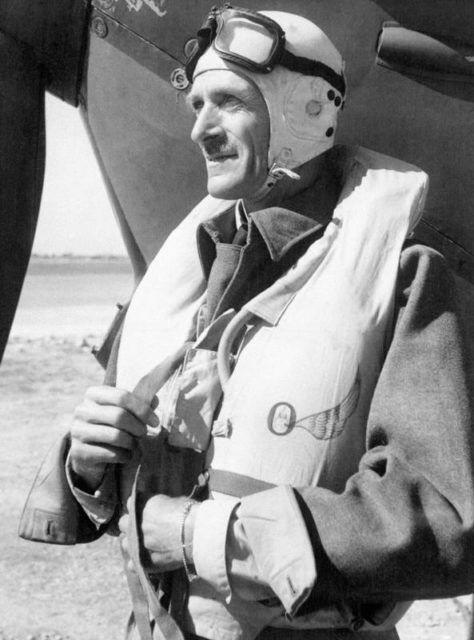
The British War Cabinet is pleased with the progress of the air battle to date. However, Air Vice Marshall Keith Park, in charge of Fighter Command, is not so sure that this will last, stating:
“It’s too quiet; at least I’ve managed to re-establish my airfields, but the blighters are up to something.”
RAF Fighter Command Order of Battle
8th August 1940
11 Group
SECTOR — SQN — AIRCRAFT — BASED AT — COMMANDER
Biggin Hill — 32 — Hurricane — Biggin Hill — S/L J. Worrall
— 501 — Hurricane — Gravesend — S/L H.A.V Hogan
— 610 — Spitfire — Biggin Hill — S/L J Ellis
— 600 — Blenheim — Manston — S/L D.De B Clarke
North Weald — 56 — Hurricane — North Weald — S/L G.A.L Manton
— 151 — Hurricane — North Weald — S/L E.M Donaldson
(One Flight) — 85 — Hurricane — Martlesham — S/L P.W Townsend
— 25 — Blenheim — Martlesham — S/L K.A.McEwan
Kenley — 64 — Spitfire — Kenley — S/L A.R.D MacDonell
— 615 — Hurricane — Kenley — S/L J.R Kayll
— 111 — Hurricane — Croydon — S/L J.M Thompson
Operational on 17 Aug:
— 1 RCAF — Hurricane — Croydon — S/L E.A.McNab
Hornchurch — 65 — Spitfire — Hornchurch — S/L A.L.Holland
— 74 — Spitfire — Hornchurch — S/L F.L White
— 54 — Spitfire — Hornchurch — S/L J.L Leathart
Until 9th Aug:
— 41 — Spitfire — Hornchurch — S/L H.West
Tangmere — 43 — Hurricane — Tangmere — S/L J.V.C Badger
— 145 — Hurricane — Westhampnet — S/L J.R.A Peel
— 601 — Hurricane — Tangmere — S/L E.F Ward
Debden — 17 — Hurricane — Debden — S/L R.I.G.McDougal
(One Flight) — 85 — Hurricane — Debden — S/L P.W Townsend
Northolt — 1 — Hurricane — Northolt — S/L D.A Pemberton
— 257 — Hurricane — Northolt — S/L H.Harkness
— 303 — Hurricane — Northolt — S/L R.G Kellett
10 Group
SECTOR — SQN — AIRCRAFT — BASED AT — COMMANDER
Filton — 87 — Hurricane — Exeter — S/L T.G Lovell-Gregg
— 213 — Hurricane — Exeter — S/L H.D.McGregor
Pembrey — 92 — Spitfire — Pembury — S/L P.J.Sanders
Middle Wallop — 609 — Spitfire — Middle Wallop — S/L H.S Darley
— 238 — Hurricane — Middle Wallop — S/L H.A Fenton
— 604 — Blenheim — Middle Wallop — S/L M.F Anderson
— 152 — Spitfire — Warmwell — S/L P.K Devitt
St Eval — 234 — Spitfire — St Eval — S/L J.S O’Brien
— 247 — Gladiator — Roborough — F/L H.A Chater
Coastal Command:
— 236 — Blenheim — Thorney Island — S/L P.E.Drew
12 Group
SECTOR — SQN — AIRCRAFT — BASED AT — COMMANDER
Duxford — 19 — Spitfire — Fowlmere — S/L P.C Pinkham
— 310 — Hurricane — Duxford — S/L D.G.M Blackwood
P/O A.Hess
Coltishall — 66 — Spitfire — Coltishall — S/L R.H.A Leigh
— 242 — Hurricane — Coltishall — S/L D.R.S Bader
Kirton-in-Lindsay — 222 — Spitfire — Kirton-in-Lindsay — S/L J.H Hill
— 264 — Defiant — Kirton-in-Lindsay — S/L P.A Hunter
Digby — 46 — Hurricane — Digby — F/L J.R McLachlan
— 611 — Spitfire — Digby — S/L J McComb
— 29 — Blenheim — Digby — S/L S.C Widdows
Wittering — 229 — Hurricane — Wittering — S/L H. J Maguire
— 266 — Spitfire — Wittering — S/L R.L.Wilkinson
— 23 — Blenheim — Collyweston — S/L G.F.W Heycock
Church Fenton — 73 — Hurricane — Church Fenton — S/L J.W.C.More
— 616 — Spitfire — Leconfield — S/L M.Robinson
— 249 — Hurricane — Church Fenton — S/L J Grandy
13 Group
SECTOR — SQN — AIRCRAFT — BASED AT — COMMANDER
Catterick — 219 — Blenheim — Catterick — S/L J.H.Little
From 9th Aug — 41 — Spitfire — Catterick — S/L H.R.L Hood
Usworth — 607 — Hurricane — Usworth — S/L J.Vick
— 72 — Spitfire — Acklington — S/L A.R Collins
— 79 — Hurricane — Acklington — S/L J.H Heyworth
Turnhouse — 141 — Defiant — Prestwick — S/L W.A.Richardson
— 253 — Hurricane — Turnhouse — S/L T.P Gleave
— 602 — Spitfire — Drem — S/L A.V.R Johnstone
— 605 — Hurricane — Drem — S/L W.Churchill
Dyce — 263 — Hurricane — Grangemouth — S/L H.Eeles
(“A” Flight) — 603 — Spitfire — Montrose — S/L G.Denholm
(“B” Flight) — 603 — Spitfire — Dyce —
Wick — 3 — Hurricane — Wick — S/L S.F.Godden
— 504 — Hurricane — Castletown — S/L J Sample
(One Flight) — 232 — Hurricane — Sumburgh — F/L M.M.Stephens
Aldergrove — 245 — Hurricane — Aldergrove — S/L E.W.Whitley
The Battle of Britain: During the day the Luftwaffe’s main effort, which developed into three successive attacks involving about 300 aircraft, was directed against one convoy off the south coast of England. There was light minelaying activity at night.
Weather: Cloudy in the morning with the possibility of showers in the south-east. Cloudy inland but remaining dry. Cloud cover should break up during the afternoon. Visibility good with cloudy periods with bright intervals in the west.
The quiet of the last few days helped both Dowding and Keith Park as well as the pilots, it enabled the necessary repairs to be made to the many damaged aircraft sustained during the months of June and July. The aircrew enjoyed a more relaxed and enjoyable period of peace and tranquility, no doubt either in the mess or down at the ‘local’. Park told Dowding “….it’s too quiet, but at least I’ve managed to re-establish my airfields, but the blighters are up to something”. A saying that Park often used.
Across the Channel, the story was very much the same, as the German pilots rested and relished the quiet, almost balmy situation that precede the orders that were soon to come through from Luftwaffe HQ. Close to the Normandy coast, the Luftwaffe No.2 Wing of the 27th Fighter Group that was based at Crepon were soon to receive news that the tranquility of the last few days were over and that the next day, August 8th the Wing was given orders that they would be placed on 24 hour standby.
Everyone, from Hitler down to the Luftwaffe aircrew had their own opinion as to how long it would take to knock out the British and how soon it would be before we could see contingents of German personnel walking the country lanes of the English countryside. Germany had a swift and easy victory in France and it was felt that they would have a similar ambition and success in Britain.
“For the first time in modern history the people of England are now to feel the full and direct impact of war on their own soil. Their morale is expected to deteriorate in consequence”
- Reich Marshal Herman Göring
Göring spoke with his Chief of Air Staff Hans Jeschonnek, a forty-two years old who had a sarcastic and facetious attitude that infuriated Generals and officers alike in the Luftwaffe. Jeschonnek was confident of a victory against England and Göring asked him if in his opinion that all out attacks on Britain would be successful and how long he thought it would take to achieve victory. Jeschonnek replied that with the Luftwaffe proven air superiority, the immense strength of the German Panzer Divisions and the combined strength of the German armies that the he thought that the air attacks would be successful and that it would only be a matter of about six or seven weeks to complete the invasion.
Göring knew and understood the British, he knew of their courage and determination and he knew only too well that their strategy must not be underestimated. He replied to Jeschonnek that he very much doubted that they would be walking on English soil with six weeks.
“You must understand, a German will fight on even if Berlin was totally destroyed, and an Englishman is not to be any easier than a German. No……he will fight on, even if London is destroyed, the British were not like the French who, when we marched into Paris and occupied their capital, simply gave up the struggle to fight for their country. An Englishman is like a wounded bull, he is most dangerous when he is injured”
Had Adolph Hitler devoted more time and interest into the intended invasion of Britain, it outcome may have had different consequences. Instead Hitler seemed more intent on what was going on in Eastern Europe. Other than his maniacal ideas on driving out all Jews from the face of the earth, he was afraid that communism would take over and destroy him and his power. In reality it was left to Herman Göring and other Luftwaffe Generals to figure out a way in which Britain could be invaded. But Göring was not a strategic genius, he had ideas, he laid down plans, and even his major plans was discarded as being strategically impossible by Hitler. When Hitler finally issued his Directive No.16, if we look closely at it, the directive had many similarities to the original plan of invasion as set down by Göring.
The problem was the Channel, a large expanse of water that separated the French coast from England. It was at its narrowest at the Straights of Dover, just 21 miles across, but as one went westwards the Channel got wider and wider. The task was easier on the European mainland when Germany could use the might of their Panzer Divisions backed up by Luftwaffe aerial attacks and the hundreds of German Infantry Divisions that could march into such countries as Poland, Belgium and France. This method of invasion could not be used against Britain. The idea of using thousands of landing craft with Luftwaffe protection could also not be used as Britain had a powerful navy and as up till now the Germans had realized the RAF were not to be taken lightly. The possibility of using paratroopers although it had merit because one of the plans was a mass paratroop landing all across southern England and into the midlands, but the large aircraft needed to take the paratroopers across would have been slow and cumbersome and the fighters of Fighter Command would be able to pick them off like flies, Germany could ill afford to do that as each German troop carrier shot down would have cost at least a hundred military personnel that would have been on board.
Germany, must, before any thought be given to any planned invasion of England get control of the skies, they must reduce the RAF to shreds. They had tried it up until the July of 1940 but had not succeeded, now after a few weeks of only spasmodic attacks with the Luftwaffe almost in relaxed holiday mood, Germany had managed to rest and refresh its aircrew and at the same time build up its strength of airpower. In the late spring of 1940 the Luftwaffe had lost some 2,600 planes, and the British almost as many, but what Germany underestimated was that Britain was by now manufacturing far more planes than they were. Germany’s intention now was to repeat the combat missions as they had done previously, but this time they would do it with advanced numbers and attack much harder than before.
So, Keith Park was correct when he said “…the blighters are up to something”. Little did he know that this time he was to be proved correct. The lull of the last few days was not to happen for a long while to come, but like the Luftwaffe the pilots and aircrew had been rested and aircraft production had been increased and Park had now many planes at his disposal. Soon, on this day August 8th, the first day of the second phase of the battle, seven squadrons from 11 Group and two from 10 Group would be engaged in fierce combat that would prove costly to the RAF, said by many as the first day of the ‘real Battle of Britain’.
On August 7th Generalfeldmarschall Albert Kesselring had earlier called a top level meeting at his headquarters. “Things are from now on going to very different” he said obviously quite excited after returning from an all-important Karinhall conference, “we are now going to attack their airfields”. But any plans for an attack on British airfields on August 8th were thrown out of the window.
One of the reasons for a period of lull in the last few weeks was because of the lack of British shipping in the Channel. But the 8th of August saw a huge British shipping convoy of about 25 merchant ships with armed Royal Navy escort being detected coming through the Straits of Dover and heading westwards towards the Atlantic Ocean. This was to be the first time for two weeks that a merchant convoy was going to attempt passage through the English Channel. The convoy had assembled at Southend the previous evening ready to pass through the Dover Straits during the hours of darkness en route for Swanage in Dorset. But the German radar Freya had picked them up, and it was a gift that was not to be missed.
Kriegsmarine E-boats and S-boats head out before dawn on the 8th, scattering the convoy moving south which they learned about around dusk on the 7th. There is mass mayhem, with two colliers colliding (only one of them sinks) and the “convoy” reduced to fleeing refugees seeking to save their skins. For once, the scatter strategy works, minimizing ship losses. The E-boats sink two or three ships (Fife and Holme) at a cost of one of their own boats.
German torpedo boats attacked first in the half light of dawn, then out went the order to the 8th Flying Corps at Abbeville to send out all available Ju 87 Stuka dive-bombers and the fighters based at the Luftwaffe 27 Group at Carquebut and Crepon and all aircraft to set course for the British convoy CW9 codenamed “Peewit” by the RAF. In all, some 300 Ju 87’s and 150 Bf 109s took to the air and planned to attack the convoy during the early morning.
An odd circumstance occurs which is of huge portent. The Luftwaffe is slow to react because Luftlotten 2 and 3 disagree over whose zone of operations the ships lie within. As they argue about it, the ships sail on. This is a perpetual problem within the Wehrmacht, both in Luftwaffe settings and also the army (Heer), and everybody notices it but nobody ever solves it.
Fighter Command of the RAF could see what was happening through the ‘eyes of the defense system’ — the radar. On the large table that lay before them, Dowding and Park could see that something was ‘brewing’, the number that the girl in WAAF uniform placed a large number next to the position in the channel off the French coast. It was a larger number than usual, “I wonder what the bastards are up to,” came the remark. “Alert Kenley and Biggin” said Park with enthusiastic authority “we need at least four or five squadrons at least”. So the nerve center at Fighter Command became the height of activity and under the circumstances we shall disturb them no further.
41 Squadron down in the south from Catterick (Spitfires), 64 Squadron Kenley (Spitfires), 65 Squadron Hornchurch (Spitfires) and 610 Squadron Biggin Hill (Spitfires) scrambled immediately and headed for the Channel to intercept the German formation. The torpedo boats sank three ships and damaged another three before full light of the morning. The RAF managed to meet the Luftwaffe onslaught before they reached the convoy, and the ensuing dogfight cost the RAF four Spitfires with all pilots killed except one who managed to bail out, two others were damaged and were forced to return to base while another is reported to have crash landed on the Kent coast. The German losses were only one Bf 109 shot down and its pilot failing to bail out, four others tried to make it back to base but crash landed in Northern France while another did manage to get back to its base but with considerable damage. Only one ship received damage by one of the Ju 87 Stukas that managed to get through, but with the onset of low cloud and the defences of the Royal Navy and the Spitfires that circled above the 70,000 ton convoy “Peewit” continued its journey.
Further down the coast, the convoy ran into better weather, the low cloud had dispersed and the waters of the Channel were bathed in brilliant sunshine. Sperle had ordered Stuka and Bf 109 Squadrons from his Luftwaffe 3 bases to attack and destroy “Peewit” just off the Isle of Wight. The order went out to attack, and the Ju 87’s caused severe damage to the large convoy. Fighter Command picked up the action and immediately sent 145 Squadron Westhampnett/Tangmere (Hurricanes), 257 Squadron Northolt (Hurricanes), 609 Squadron Middle Wallop (Spitfires) and 238 Squadron Middle Wallop (Hurricanes) to meet the Luftwaffe who were already engaged with the convoy. By the time that the RAF fighters arrived, the Stukas were low on fuel and ammunition and had to return to their bases, but in the ensuing dogfight that followed between the Bf 109’s and the Spitfires and Hurricanes of the RAF was intense.
Many of the pilots that took to the skies that day could only be classed as ‘green’, once upon a time it took at least six months to train a fighter pilot, in these hard fought days when Dowding needed every pilot and aircraft that he could lay his hands on, a pilot training period was just four weeks. Many missed out on essential training in navigation, hence after many a dogfight they became so disorientated that they didn’t know which way was the way home. Others had no proper training as to take offs and landings and were ridiculed by the more experienced pilots. This was typical of 238 Squadron based at Middle Wallop who were scrambled to intercept the “Peewit” mission, the Squadron was formed so quickly and with much haste that the pilots had never even flown a training flight together and this was to be their inauguration into fighter combat, that’s being thrown in at the deep end for sure. What happened was that as soon as the German formation was spotted over the Channel, they immediately opened fire and dashed in guns blazing, yet the enemy was still three quarters of a mile away.
Many of the Bf 109’s started to return to base, low fuel and ammunition being a prime consideration, we must remember that both Stukas and the fighter cover had earlier attacked the convoy off Weymouth. But by this time at about 1630hrs, more than 89 Ju 87 Stukas had arrived on the scene that were escorted by 70 Bf 109’s and Me110’s to destroy “Peewit”. Göring was now true to his word, he would be sending aircraft in vast numbers to attack, and to draw out the RAF. With some aircraft of 145 Squadron returning to base to refuel and rearm, they were again scrambled, along with 43 squadron Tangmere (Hurricanes), and headed to the south of the Isle of Wight to engage the reassembled Stukas and fighters.
Although the RAF had sent out more aircraft than usual, they had not put into the air the amount of aircraft that Göring had expected, in fact for every two German planes, there was only one RAF fighter. For the Merchant Navy, it was a disastrous result, as the Spitfires and Hurricanes were forced to dogfight with the Bf 109’s, only the occasional one managing to make an attack on a Stuka. Therefore, the Ju 87’s constantly bombarded the convoy almost at will. Debris from the convoy scattered the Channel for miles, burnt out hulks of the merchantmen bellowing palls of thick black smoke that could be seen for miles. Further explosions came from the ships as they were left to die where they were, life jackets bobbed up and down in the chilly waters and many men, clinging to pieces of debris, life jackets and life rafts tried desperately to avoid the many slicks of burning oil that lay on the surface.
The RAF had lost 13 Hurricanes in defending “Peewit”, five others suffered damage including one that was to make a forced landing. Only one Spitfire was destroyed while two others sustained damage. But the action saw 13 RAF pilots killed with three sustaining severe injuries. It was 145 Squadron from Westhampnett in the Tangmere Sector that suffered the worst for the day, five pilots were killed and their aircraft destroyed.
The Luftwaffe fared no better, they too had a high attrition rate. They lost a total of 8 Bf 109’s, one Bf 110, and 7 Ju 87 Stukas although two 109s, five 110s, and eleven Ju 87’s sustained damage many of them being past repair and they became spare parts for the Luftwaffe. But it was the convoy Peewit that had suffered most. Of the 23 ships that had commenced the journey the previous night, only four had managed to limp into either Poole and Portsmouth Harbors without damage.
The Stukas are mauled throughout the day. While they are absolutely phenomenal at the precision bombing of ships, they also are proving themselves to be phenomenally easy targets for RAF fighters. This is not a cause for concern by the Luftwaffe — yet — because the fighter pilots are full of stories about their own successes which tend to exaggerate the reality of the situation. The Stuka losses, though, are becoming painful and are there to see when the planes (don’t) return.
It was a costly business for both sides in the “Peewit” battle, especially as it was an unplanned battle, it was really just that “Peewit” was a target of opportunity that the Luftwaffe could not resist and that Fighter Command were obligated to respond.
After dark, the Luftwaffe sends Heinkel He 111s of I,/KG 55 against their usual target of the Bristol Aeroplane Company at Filton and II,/KG 55 against Bristol proper. Heinkels of II,/KG 27 also raid the Bristol area, trying to knock out searchlights in the area.
Some major decisions flow from today’s events.
— The Admiralty suspends collier convoys. Only four of the original 20 ships reach their destination of Swanage, Dorset, with six others damaged and making any port that they can. Future coal shipments can and will be made by rail, which in fact was a superior alternative all along.
— Based on all sorts of assumptions about the progress of the battle that are highly sketchy — such as that the RAF is running low on fighters, which is not the case — the Luftwaffe high command issues the order for Operation Adlerangriff, the full-out assault on the RAF, to begin on the next convenient day of good flying weather.
RAF Statistics for the day: 152 patrols were flown involving 689 aircraft. Luftwaffe casualties: Fighters — 35 confirmed, 5 unconfirmed; Bombers — 17 confirmed, 9 unconfirmed. RAF casualties: 18 aircraft of which 15 pilots were killed or missing.
RAF Casualties:
0905 hours. Sth of Isle of Wight. Hurricane P2955. 145 Squadron Westhampnett. (Crashed in Channel)
P/O L.A. Sears Missing. (Last seen in combat with Bf 109’s, failed to return to base)
0915 hours. Sth of Isle of Wight. Hurricane P3381. 145 Squadron Westhampnett. (Crashed in Channel)
Sgt E.D. Baker Missing. (Last seen in combat with Ju 87’s and Me110’s, failed to return to base)
1140 hours. Manston. Spitfire K9911. 65 Squadron Hornchurch. (Aircraft destroyed)
Sgt D.I. Kirton Killed. (Hit by gunfire from Bf 109 and crashed in flames near airfield)
1145 hours. Manston. Spitfire K9905. 65 Squadron Hornchurch. (Aircraft destroyed)
F/Sgt N.T. Phillips Killed. (Shot down by Bf 109 and crashed in flames)
1155 hours. Ramsgate. Blenheim L8665. 600 Squadron Manston. (Went down in flames off beach)
F/O D.N. Grice, Sgt F.D.Keast, AC1 J.B.W.Warren. All killed after pilot avoided town and crashed into sea)
1200 hours. St Catherines Point. Hurricane R4094. 257 Squadron Northolt. (Presumed crashed into Channel)
Sgt K.B. Smith. Missing. (Failed to return to base after action over Channel protecting convoy CW9)
1200 hours. St Catherines Point. Hurricane P2981. 257 Squadron Northolt. (Crashed into Channel)
F/Lt N.M. Hall Killed. (Hit by gunfire from Bf 109, crashed into sea)
1205 hours. Dover. Spitfire L1039. 64 Squadron Kenley. (Aircraft destroyed)
P/O P.F. Kennard-Davies Died of Injuries. (Hit by enemy gunfire, Bailed out but sustained serious burns)
1205 hours. St Catherines Point. Hurricane P3058. 257 Squadron Northolt. (Presumed crashed into Channel)
F/O B.W.J. D’Arcy-Irvine Missing. (Last seen in combat with Bf 109’s over Channel, failed to return)
1245 hours. Sth of Isle of Wight. Hurricane P3823. 238 Squadron Middle Wallop. (Crashed in Channel)
F/L D.E. Turner Missing. (Shot down while engaging enemy over convoy CW9, failed to return to base)
1250 hours. Off Isle of Wight. Hurricane P3617. 238 Squadron Middle Wallop. (Crashed into Channel)
F/O D.C. MacCaw Killed. (Shot down while engaging enemy over convoy CW9, crashed into sea)
1640 hours. Off Isle of Wight. Hurricane P2957**. 145 Squadron Westhampnett. (Crashed in Channel)
P/O E.C.J. Wakeham Missing. (Last seen in combat with Ju 87’s and Me110’s, failed to return to base)
1640 hours. Sth of Isle of Wight. Hurricane P3163. 145 Squadron Westhampnett. (Crashed into Channel)
F/O Lord R.U.P. Kay-Shuttleworth Missing. (Failed to return after combat over convoy CW9)
1645 hours. Sth of Isle of Wight. Hurricane P3545. 145 Squadron Westhampnett. (Crashed into Channel)
S/Lt F.A. Smith Missing. (Shot down in attacking Ju 87’s but possibly hit by gunfire from by Bf 109)
1645 hours. Sth of Isle of Wight. Hurricane P3781. 43 Squadron Tangmere. (Crashed into Channel)
P/O J. Cruttenden Missing. (Hit by enemy gunfire and crashed into the sea)
1645 hours. Sth of Isle of Wight. Hurricane P3468. 43 Squadron Tangmere. (Crashed into Channel)
P/O J.R.S. Oelofse Killed. (Hit by enemy gunfire and crashed into the sea)
RAF Bomber Command dispatches 15 Blenheims to attack Schiphol airfield and Valkenburg airfield in the Netherlands during the day. 1 lost. Six Blenheims in sea sweep.
RAF Bomber Command dispatches 46 Hampdens and Wellingtons to attack seven targets in Germany overnight. 1 Hampden lost.
The Luftwaffe continues moving its units to forward bases along the Channel. III,/JG3 moves to a converted football field at Desvres.
Extensive air-to-air combat occurs between Italian and RAF aircraft in the Western Desert. The RAF and Italian Regia Aeronautica have been sparring lightly over the Libyan/Egyptian desert, and today a major battle develops. The Italians lose 7 planes and the RAF 2 Gloster Gladiator biplanes.
The Italians once again buzz Malta during the afternoon with half a dozen aircraft, but nothing comes of it. The War Office promises to send supplies on 7,000 tons of shipping space that has opened up for it, with the government of Malta to pay for civilian goods so as to ensure secrecy.
The Regia Aeronautica begins attacks on British vessels in the Gulf of Aden, but has little success, and also on British positions at Berbera. The Fleet Air Arm operating from Australian cruiser HMAS Hobart, meanwhile, counters with attacks on Italian headquarters in Zeila. RAF aircraft retreat to bases in Aden.
Wages of British military personnel increased by 6 pence per day; with this increase, a British Army private’s weekly pay was increased to 17 shillings and 6 pence.
Troops of the 2nd Battalion, UK (Scottish) Black Watch arrived in British Somaliland to reinforce against the Italian invasion.
Victoria Cross awarded to RAF fighter pilot James B. Nicholson posthumously.
Adolf Hitler ordered Walter Warlimont, Alfred Jodl’s deputy, to determine the positions of Soviet troops in preparation for Operation Barbarossa. On the same day, Wilhelm Keitel signed the Aufbau Ost directive, which called for the mobilization of the German military in eastern Germany.
Pierre Laval orders the arrest of Georges Mandel in Morocco. This is done by General Charles Nogues. He is taken to the Château de Chazeron, where all of the former French leaders are being held. This is of particular interest to British Prime Minister Winston Churchill, who does not really like Charles de Gaulle and would prefer Mandel as the leader of the Free French.
Mandel was one of the few in the French government who wished to carry on the fight against the Germans from North Africa. Mandel also happens to be Jewish. He had the opportunity to flee with de Gaulle but refused because he felt it would look bad for a Jew to run.
The Vichy “War Guilt” Trial begins in Riom, France.
Rumania promulgated racial laws modeled after those of Nazi Germany. Laws restricting education and employment were introduced. This is an obvious attempt by the regime to ingratiate itself with the Germans.
Rumanian police today seized and sent to a concentration camp twenty-two journalists, including seventeen Jews, in the beginning of what is expected to be a major round-up of “alarmists” by the proAxis and anti-Semitic regime of Premier Ion Gigurtu.
Marshal Rodolfo Graziani was given a dressing down by Italian Minister of Foreign Affairs Count Galeazzo Ciano for failing to meet the deadline set by Mussolini for invading Egypt. The meeting was designed to stiffen Graziani’s resolve but failed to remove Graziano’s doubts. Graziani argued that Italy’s preparations were incomplete and unprepared to fight a desert campaign.
Italian troops advance toward British defenses at Tug Argan pass in British Somaliland. The British, having given up the key ports to the west, set up a defensive perimeter on six hills overlooking the road into Berbera. They use their recent reinforcements of the 1/2nd Punjab Regiment and the 2nd Battalion of the Scottish Black Watch to man these key positions. The Italian troops advance toward this position, which guards the British stronghold at Tug Argan pass.
U-37, commanded by Kapitänleutnant Victor Oehrn, sank British steamer Upwey Grange in 54-20N, 15-28W. At 1314 hours the unescorted Upwey Grange (Master William Ernest Williams) was hit on the port side by one torpedo from U-37 and sank by the stern about 184 miles west of Achill Head, Co. Mayo. The crew and passengers abandoned ship in the lifeboats but the boats were separated in the bad weather and the boat in charge of the master was never seen again. The master, 31 crew members, one gunner and three passengers were lost. 42 crew members and eight passengers (one DBS) were picked up after three days by the British trawler Naniwa (Master J. Nightingale) about 50 miles from Achill Head, transferred to HMS Vanquisher (D 54) (Cdr C.B. Alers-Hankey, DSC, RN) and landed at Liverpool. The 9,130 ton Upwey Grange was carrying passengers, frozen meat, and canned meat and was headed for London, England.
Destroyers HMS Express, HMS Esk, HMS Icarus, HMS Impulsive, and HMS Ivanhoe departed Immingham and joined four motor anti-submarine boats from Harwich. During the night of 8/9 August, the destroyers laid minefield MP (A), an extension of the MN minefield to Falls Bank and to back up the MN minefield. During the night of 10/11 August, the same destroyers conducted MP (B). After MP (B), the destroyers returned to Immingham.
Polish destroyer ORP Burza made three attacks at 1410 on a submarine contact in 52-21N, 5-06. 5W. Destroyer Burza was en route to Scapa Flow to work up after repairs. She arrived on the 9th at 1900.
Destroyers HMS Bulldog of the 1st Destroyer Flotilla and HMS Fernie departed Portsmouth to support Convoy CW.9. In convoy CW.9 British steamers Holme Force (1216grt) off Newhaven and Fife Coast (367grt) ten to fifteen miles west of Beachy Head were sunk by German motor torpedo boats S.21 and S.27. The Master, two crew, three gunners were lost on the steamer Holme Force. Four crewmen and one naval rating were lost on the steamer Fife Coast. In addition to S.21 and S.27, S.20 and S.25, all of the 1st Flotilla made attacks on this convoy.
British steamers John M (500grt) ten miles south of Needles, Iow and Polly M (380grt) 15 miles 190° from Cape Wrath were damaged by German motor torpedo boat attacks.
British steamer Ouse (1004grt) was sunk off Newhaven in a collision with British steamer Rye (1048grt) while avoiding a torpedo from one of the motor torpedo boats. Twenty three survivors were rescued from steamer Ouse.
In air attacks on convoy CW.9, British steamers Coquetdale (1597grt) and Empire Crusader (1042grt) were sunk fifteen miles west of St Catherine’s Point. The entire crew of steamer Coquetdale was rescued. The Master, two crew, two naval gunners were lost on the steamer Empire Crusader.
Dutch steamer Ajax (942grt) was sunk by German bombing fifteen miles west of St Catherine’s Point. Four crewmen on the Dutch steamer were lost.
Dutch steamers Veenenburgh (433grt), Omlandia (400grt), Surte (244grt) were damaged by German bombing fifteen miles west of St Catherine’s Point.
British steamers Scheldt (497grt) and Balmaha (1428grt) were damaged by German bombing fifteen miles west of St Catherine’s Point.
Norwegian steamer Tres (946grt) was damaged by German bombing 1950 yards 036° from Nodes Point, St Helen’s Roads. Steamer Tres later sank in St Helens Bay.
During these attacks, anti-submarine yachts HMS Wilna and HMS Rion and anti-submarine trawlers HMS Cape Palliser, HMS Kingston Chrysoberyl, HMS Kingston Olivine, and HMS Stella Capella were damaged by German bombing in the area. In the HMS Rion, Cdr J. K. B. Birch was wounded and died of wounds on the 14th. In the HMS Wilna, Temporary Lt S. Behennah, RNVR, and Temporary Lt H. H. Dimmick, RNVR, were wounded.
Three Italian air raids were launched on Berbera. Australian light cruiser HMAS Hobart, sloop HMS Auckland, anti-submarine trawler HMS Amber, and several steamers were in port. Light cruiser HMAS Hobart and armed boarding vessel HMS Chakdina were damaged by splinters from near misses.
Destroyers HMS Hero, HMS Hasty, and HMS Imperial departed Haifa to patrol east and north of Cyprus. Destroyer Hasty was detached off Haifa to escort a local convoy. Destroyers Imperial and Hero arrived back at Alexandria on the 10th. Destroyer Hasty arrived later on the 10th.
In Operation TUBE, submarine HMS Proteus, which departed Gibraltar on the 1st, arrived at Malta with spares and ground equipment for the Hurricanes brought to Malta by HURRY. In Harbor, submarine Proteus was in a collision with British tug Andromeda. The submarine was repairing until 22 August.
Light cruiser HMS Durban completed her refitting begun at Singapore in July.
Light cruiser HMS Dragon arrived at Lobito to refuel prior to joining convoy RS.5. The cruiser departed the next day and joined the convoy on the 11th.
German armed merchant cruiser Widder sank Dutch steamer Oostplein (5095grt), bound for Buenos Aires, Argentina, in the Central Atlantic 200 miles south of the Azores. The crew was made prisoners of war and they were landed at St Nazaire on 9 October.
Italian minelayer Scilla escorted by torpedo boats Antares and Sagitario laid mines off Pantelleria. Destroyer HMS Hostile was lost later this month on this minefield.
Convoy FN.246 departed Southend, escorted by sloops HMS Black Swan and HMS Hastings and patrol sloop HMS Shearwater. The convoy arrived in the Tyne on the 10th.
Convoy MT.134 departed Methil. The convoy arrived in the Tyne later that day.
Convoy FS.246 departed the Tyne, escorted by destroyer HMS Valorous and sloop HMS Stork. The convoy arrived at Southend on the 10th.
Convoy HX.64 departed Halifax escorted by Canadian destroyer HMCS Assiniboine and auxiliary patrol boat HMCS French at 1630. Destroyer HMCS Saguenay and auxiliary patrol boat HMCS Laurier departed escorted SHX.64 and joined at sea. Patrol boat French returned to Halifax after dark on the 8th and destroyer Assiniboine remained with the convoy until 2030/9th leaving the convoy to ocean escort, armed merchant cruiser HMS Rajputana. The armed merchant cruiser was detached on the 20th.
Convoy BHX.64 departed Bermuda on 7 August escorted by her ocean escort of light cruiser HMS Caradoc. The convoy rendezvoused with convoy HX.64 on the 12th and the light cruiser was detached. On the 20th, destroyer HMS Warwick, sloop HMS Sandwich, and corvettes HMS Gardenia and HMS Mallow joined the convoy. They arrived with the convoy at Liverpool on the 23rd.
By the overwhelming vote of 71 to 7, the U.S. Senate today passed and sent to the House the administration bill empowering the president to call out the national guard and army reserves for a 12-months period of duty anywhere in the western hemisphere, American possessions or the Philippine islands. First, however, the chamber adopted an amendment permitting guardsmen with wives or children dependent on their salaries or wages to resign. On a vote of 39 to 38, the chamber rejected an amendment by Senator Adams, Colorado Democrat, limiting service of the guard to continental United States, American possessions and the Philippine islands (and thus excluding Latin America). After passage of the bill, the senate, still smarting under a week of turbulent and caustic debate, squared away for a possibly historic battle over the issue of civilian conscription, presented in a bill calling upon all men between 21 and 30, inclusive, to register for the nation’s first peacetime military draft. During the debate on the National Guard bill, critics made much of certain wording in it. They asserted Mr. Roosevelt and the war department had said the guard should be mobilized for “training” but the bill which the president sent to the capitol called for “active military service.”
Postmaster General James A. Farley handed in his portfolio as a member of the Roosevelt cabinet today and a long political and official alliance between “Smiling Big Jim’ and the chief he affectionately called “F. D.” thus ended. To the big happy Irishman who twice led his campaigns for the White House President Roosevelt sent an exceedingly friendly letter accepting the resignation, effective August 31. Farley has persistently been reported planning to head a syndicate to buy the New York Yankee baseball team, although other reports have linked him with possible management of Willys-Overland Motors, Inc. “Big Jim” was the guiding genius of the campaign which put Franklin D. Roosevelt in the White House in 1933. He directed the highly successful 1936 campaign which brought the president four more years in office. But in recent months, when it became increasingly apparent Mr. Roosevelt would accept the nomination, Farley was reported frequently to have differed with “the boss” on the third term issue.
A discussion of the campaign issues facing the Administration in the third-term battle occupied President Roosevelt today as he conferred with Secretary Wallace, candidate for the Vice Presidency, at Hyde Park. Harry L. Hopkins, Secretary of Commerce and political confidant of Mr. Roosevelt, also came to Hyde Park as a house guest, but was not present at this conference, a spokesman for the President emphasized. In the afternoon Mr. Roosevelt broke an afternoon drive to call at Val Kill, Mrs. Roosevelt’s cottage, where he spoke briefly to some 800 invited guests made up of Democratic women workers from five New York counties. To these women Mr. Roosevelt expressed the belief that he and Mr. Wallace, his companion on the drive, would continue their arguments over corn for the next four years, and concluded by telling them that “we are counting on the Hudson River counties, too.”
An assertion that “machines now in control of the Democratic party do not make for good government” came today from Wendell L. Willkie. The Republican presidential nominee voiced the comment in announcing he had asked Thomas E. Dewey, whom he defeated for the nomination, to make a series of speeches for him in the Midwest “on the relationship between political machines and good government.” Willkie also told his press conference he has “come to the philosophy that 50 per cent of the money spent in political campaigns is wasted money.” He did not elaborate. His statement regarding campaign expenditures was made in response to questions about a statement by Samuel F. Pryor, eastern campaign manager, which indicated party finances might be decentralized this year. Willkie declined specific comment on Pryor’s statement, however. Reiterating he would like to close all the loopholes in the Hatch act, Willkie said that law, if properly amended, would clean up American politics.
The United States, disturbed by Japan’s new “Greater East Asia” policy, appeared tonight seeking friendlier relations with Soviet Russia. After two unusually long conferences with Soviet Ambassador Constantine Oumansky, within a week, Acting Secretary of State Sumner Welles said today they had discussed many questions involving relations between the two countries. The discussions, he said, had proceeded in a friendly and constructive spirit on both sides with a view to adjusting any differences as equitably as possible.
William S. Knudsen, production member of the National Defense Advisory Commission, said tonight in a special radio program, over a nationwide hookup, that the United States was producing military airplanes at the yearly rate of 10,800 and by January 1 would reach 18,000 a year.
The House Committee on Immigration and Naturalization favorably reported today a bill removing the “red tape” surrounding the admission of children from war zones to this country, and throwing about the child refugees safeguards of American law relating to their support and parental care.
German-held patents on elements vital to defense-weapon manufacture are holding up the United States rearmament program, Assistant Attorney General Thurman Arnold revealed in Washington. A grand jury in New York is investigating the matter. One material controlled and restricted by such patents is magnesium, vital in airplane building, Mr. Arnold said.
The estimated billions of assets of invaded countries that have been “frozen” in the United States will remain in that condition until the government has some assurance as to American investments in Europe and as to the debts for the last war, Secretary of the Treasury Morgenthau said. France owes $4 billion on her war debt, and has frozen assets in the United States estimated to be at least $1,000,000,000.
All important naval operations on the Atlantic Coast north of New York City will be inspected by President Roosevelt during a three-day weekend tour on which he starts from Hyde PaRK tomorrow night.
The adventure film “Boom Town” starring Clark Gable, Spencer Tracy, Claudette Colbert and Hedy Lamarr premiered at Grauman’s Chinese Theatre in Hollywood.
Major League Baseball:
DiMaggio was the star today in the Yankees-Red Sox game in Boston, but unfortunately for New York, it was Dom, not Joe. Joe’s brother had four hits to pace the Sox to a 6–5 win. One of Dom’s hits singled in the game winner during a two-run Boston rally in the ninth.
The Indians and Browns split a doubleheader. The Indians won the opener, 7–4, as fireballer Bob Feller won his 19th game of the year. But the Browns salvaged a split in the nighcap, winning 2–1, behind the pitching of Elden Auker.
The Athletics beat the Senators, 6–4, today with a splurge of doubles in the ninth and tenth innings. With Philadelphia trailing by a run in the ninth, Catcher Frank Hayes batting in a pinch-hitter’s spot, doubled home Bennie McCoy to tie up the game at 4–4.
Dolf Camili blasts a three-run homer in the twelfth inning off Bill Lohrman to give the Dodgers a 6–3 victory over the Giants and a sweep of the series. The Dodgers have not lost in seven games at the Polo Grounds this season. Pee Wee Reese’s two-run seventh-inning homer had tied it after an early Giants lead.
The Boston Bees, behind Jim Tobin’s seven-hitter, won their fourth in a row from the Philadelphia Phillies, 6–2. Shortstop Eddie Miller hit a two-run homer for Boston, his 4th in the four-game series.
Southpaw Larry French allowed two hits in each of three frames today and the Reds made all but one count to defeat the Cubs, 3–1. Cincinnati thus gained an even break in the series and gave Bucky Walters his sixteenth triumph of the year. The Cubs got nine hits, but hit into three double plays.
New York Yankees 5, Boston Red Sox 6
Chicago Cubs 1, Cincinnati Reds 3
Brooklyn Dodgers 6, New York Giants 3
Boston Bees 6, Philadelphia Phillies 2
Cleveland Indians 7, St. Louis Browns 4
Cleveland Indians 1, St. Louis Browns 2
Philadelphia Athletics 6, Washington Senators 4
Britain appealed to India today to give her vast strength in the empire’s fight for life and held out to the 350,000,000 subject peoples of that fabulously wealthy possession the prospect of independence after the war. In a statement announced simultaneously in the House of Commons by L. S. Amery, the British secretary of state for India, and in that far-off land by the Indian viceroy, the Marquess of Linlithgow, the government proposed a “free and equal partnership” for India in the British commonwealth of nations for the future. The British government accepted the demand for Constituent Assembly in India in principle through the offer made by Viceroy Lord Linlithgow. The offer stipulated that after the end of the war, a body representative of principle elements in India’s national life would be set up to devise the framework of the new constitution. This was the first time Britain acknowledged the Indian demand for self-representation but the offer was rejected by the Indian National Congress.
Nationalist leader Aung San departs Burma to escape arrest and travels to China where he finds Japanese support for aspirations of independence.
A group of 126 members of the Japanese Diet (House of Representatives) yesterday presented to the government a resolution advocating strong measures to exterminate British influences in East Asia. The resolution was adopted shortly after the newspaper Asahi had declared that Japan would push her program for a Greater East Asia “in silence and firm determination” regardless of the attitude of the United States. The Asahi comment was in connection with the visit of United States Ambassador Joseph C. Grew to Foreign Minister Yosuke Matsuoka yesterday.
Japan, following her self-proclaimed destiny of dominance In “greater east Asia,” was reported tonight to be hastening preparations for a lightning drive toward French Indo-China and the Netherlands East Indies. Trustworthy foreign sources predicted Japan’s southward push would be geared to Germany’s blitzkrieg machinery and would begin within 48 hours after the Germans start invasion of the British isles. Such timing would take advantage of British attention to home defense. Britain is the only belligerent defender of the rich East Indies and Indo-China. If Adolf Hitler fails to move it was believed the Japanese would proceed more slowly and more cautiously, but further efforts to extend Japanese Influence were regarded as inevitable.
Dow Jones Industrial Average: 125.13 (+0.01)
Born:
Dennis Tito, American engineer, entrepeneur, and civilian astronaut (ISS EP-1: Soyuz TM-32/TM-31), in Queens, New York, New York.
Fred Miller, NFL defensive tackle (NFL Champions, Super Bowl V-Colts, 1970; NFL Champions, lost Super Bowl II to the Jets, 1968; Pro Bowl 1967, 1968, 1969; Baltimore Colts), born in Homer, Louisiana (d. 2023).
Died:
Johnny Dodds, 48, American jazz clarinetist and alto saxophonist.
Naval Construction:
The Royal Navy Bangor-class (Reciprocating-engined) minesweepers HMS Fraserburgh (J 124) and HMS Felixstowe (J 126) are laid down by Lobnitz & Co. Ltd. (Renfrew, Scotland).
The Royal Navy Shakespeare-class minesweeping trawler HMS Horatio (T 153) is launched by Cook, Welton & Gemmill (Beverley, U.K.); completed by Holmes.
The Royal Navy Flower-class corvette HMS Arrowhead (K 145) is launched by Marine Industries Ltd. (Sorel, Quebec, Canada). She is transferred to the Royal Canadian Navy before completion and commissions as HMCS Arrowhead (K 145).
The Royal Navy Flower-class corvette HMS Snowberry (K 166) is launched by the Davie Shipbuilding and Repairing Co. Ltd. (Lauzon, Quebec, Canada). She is transferred to the Royal Canadian Navy before completion and commissions as HMCS Snowberry (K 166).
The Nihon Kaigun (Imperial Japanese Navy) battleship HIJMS Yamato (大和), lead ship of her class of 2 (plus one converted to an aircraft carrier and two cancelled), is launched by the Kure Naval Arsenal, Kure, Hiroshima Prefecture, Japan.

