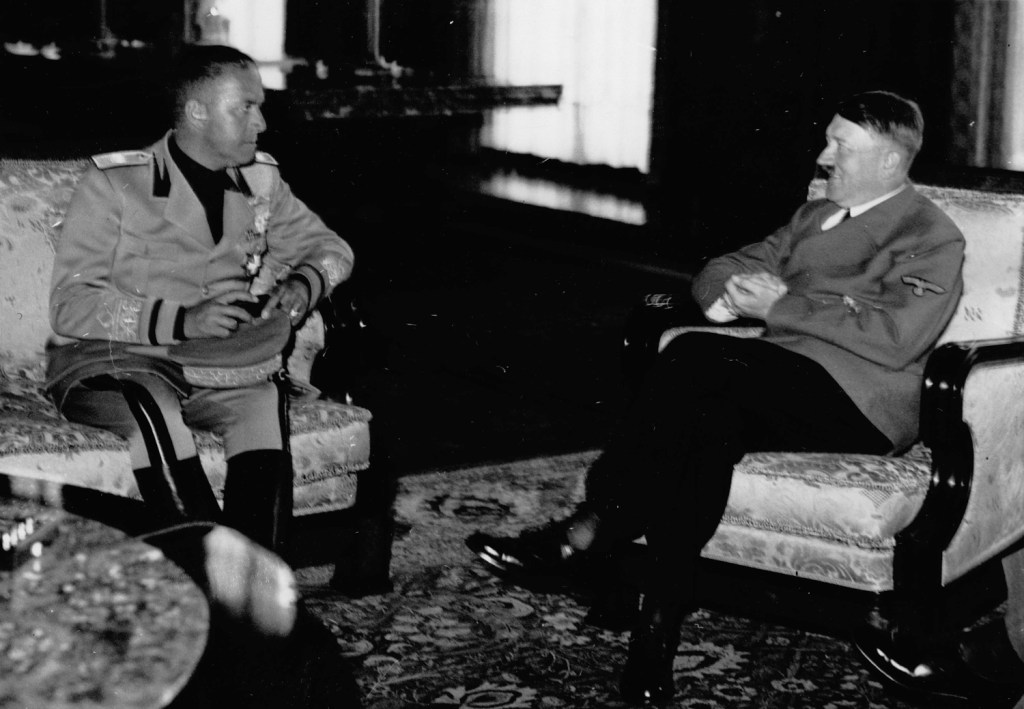
Adolf Hitler and Count Galeazzo Ciano, Italy’s foreign minister, conferred for two hours today, presumably mapping the Rome-Berlin axis course remaking Europe. As the leaders talked in the Führer’s chancellery workroom, the high command reported German planes hammering hard blows at the British fleet, now deprived of aid from its former French ally in its attempt to blockade most of Europe. Hitler tells Italian Foreign Minister Ciano the hour has not arrived for an attack on Yugoslavia.
Any expectation that an important announcement would be made today following the conference between Chancellor Hitler and Count Ciano, the Italian Foreign Minister, proved to be abortive. The stony silence that so frequently shrouds the conversations between the Axis leaders was maintained today. Count Ciano arrived according to schedule at 11:15 AM this morning and was greeted with the usual honors and ovation. He spent one hour and thirty-five minutes with Herr Hitler and the only statement relative to the visit was the following communiqué: “The Führer received the Royal Italian Foreign Minister, Count Ciano, at noon. Sunday for a lengthy discussion In the presence. of the Reich’s Foreign Minister [Joachim] von Ribbentrop. The Royal Italian Ambassador in Berlin [Dino] Alfieri and the German Ambassador in Rome [Hans-Georg Viktor] von Mackensen took part in the reception.”
Well-informed Wilhelmstrasse circles furthermore were no more than the terse communicative communiqué. It was announced tonight, however, that Count Ciano had left on a special train for a visit of the occupied territories in the west. It is expected that the trip will take two days. Meanwhile there were rumors that the coming week will witness momentous decisions, but official quarters warned against rash prophecies and suggested that events of a sensational nature should not be. expected in the immediate future. Although there have been rumors of an impending Reichstag session, there are no indications in Berlin at present that such a session will be convened in the next few days.
The French in Dakar, Senegal, refuse to surrender to the British or choose an acceptable alternative, so the British send half a dozen Swordfish from the small aircraft carrier HMS Hermes to attack. They score a torpedo hit on the Richelieu, sinking it in shallow water, and a torpedo boat also drops off commandos who damage the Richelieu with mines. The damage, however, is not serious and is quickly repaired. This is all a continuation of Operation Catapult.
Italy granted France permission to keep her Mediterranean bases armed.
Vichy Government in France orders the first arrests of Jewish refugees.
René-Émile Godfroy agreed to keep the French Navy Force X at Alexandra, Egypt, which included the battleship Lorraine and four cruisers, according to British demands. Godfroy secured Andrew Cunningham’s pledge that the ships would remain under Godfroy’s command and that the sailors would be repatriated.
Evacuations of children from large British cities continues.
British submarine HMS H 43 landed Lieutenant Hubert Nicolle on the Channel Island of Guernsey during the night to collect intelligence for the planned commando raid code named Operation AMBASSADOR.
Horia Sima resigns for the Rumanian Cabinet after realizing, he says, just how cowardly King Carol is in dealing with the Soviets.
Soviet General Dmitrii Pavlov becomes commander-in-chief of the Western Special Military District, which controls the direct route between Germany and Moscow.
An Italian battalion crosses from Ethiopia and occupies Kurmuk, Sudan.
Kanalkampf: Six British fighters were shot down during aerial battles with German aircraft, killing four. It is a bad day for the RAF Fighter Command. The Luftwaffe stages numerous small raids along the coast, which draws out the defenders and causes several losses.
During the afternoon, II/JG51 and II/JG51 engage with Spitfires over England. The Bf 109s shoot down three Spitfires of RAF No. 54 Squadron over Manston. Another dogfight over Folkestone sends four RAF fighters down, three Spitfires and a Hurricane.
In the evening, some fighters of JG27 shoot down three Spitfires of RAF No. 64 Squadron.
Dornier Do 17s raid the West Country, killing five people.
A night flight by He 11 bombers of 4/KG55 is intercepted by British fighters over Portland, Dorset. The bombers sustain damage but make it back to base.
RAF Bomber Command dispatches 24 Blenheims to attack airfields and barges during the day in the Netherlands; only 3 aircraft bombed, 2 aircraft lost.
RAF Bomber Command dispatches aircraft to attack various targets overnight in Germany and the Netherlands. 54 aircraft are sent to various targets and minelaying. 1 Hampden lost.
At Malta, there is an air raid at 09:17 which drops bombs on Benghalsa and the dockyards. Eight civilians perish (seven from one family, a mother with her six young children), and eight civilians and an officer are wounded. The RAF responds and a Hurricane shoots down one of the bombers. Another attempted raid in the afternoon is chased off by the RAF before it reaches the island.
The Regia Aeronautica catches British submarine HMS Olympus in port at Malta and bombs it, severely damaging it.
Italian air force attacks Alexandria with eleven S-81 bombers overnight.
Eight Skuas of 801 Suqadron departed Hatston to attack oil tanks at Bergen. No damage was done to intended targets and no aircraft were lost.
U-30 arrived at Lorient. She was the first U-boat to use a French port. U-boats U-34, U-52, and U-99 followed later in the month.
U-34, commanded by Kapitänleutnant Wilhelm Rollmann, sank Dutch motor tanker Lucretia (2584grt) in 49-50N, 08-07W. At 0714 hours the unescorted and unarmed Lucrecia (Master Cornelis Smit) was hit on the starboard side underneath the bridge by one G7e torpedo from U-34 about 70 miles west of the Isles of Scilly. The explosion broke the back of the ship, ignited a fuel tank ahead of the bridge and killed the master who was probably asleep in his cabin. The crew immediately abandoned ship in one lifeboat and some rafts, while the burning tanker settled slowly and sagged in the middle. The column of smoke attracted a patrol aircraft from St. Eval which was shortly thereafter joined by two Sunderland flying boats and the nearby HMCS Restigouche (H 00) (Cdr H.N. Lay, RCN) was ordered to investigate. In the meantime, the submerged U-boat remained in the vicinity in order to wait for the wreck to sink. At 1520 hours, the Germans spotted another ship near the attack position but could not get closer due to the aircraft and eventually left the area. They had observed how the Portuguese steam merchant Alferrarede picked up the survivors and then proceeded on her voyage to Oporto, where eight officers and 22 crewmen were landed on 11 July. The chief officer had died of his wounds on 8 July and was buried at sea the next day. The 2,584-ton Lucrecia was carrying fuel oil and was headed for Falmouth, England.
U-99, commanded by Kapitänleutnant Otto Kretschmer, torpedoed and sank the British steam merchant Sea Glory approximately 80 miles south of south of Fastnet, Ireland in 49° 39’N, 10° 25’W. At 0053 hours the unescorted Sea Glory (Master Stanley Winston Harvey) was hit on the port side just ahead of the bridge by one of two G7e torpedoes from U-99 and sank by the bow within two minutes about 110 miles south-southwest of Fastnet. The master, 27 crew members and one gunner were lost. Kretschmer had not intended to fire two torpedoes in this attack, a second torpedo tube was only prepared to be fired as coup de grâce, but was launched too by mistake. The ship had been reported missing after leaving Fowey and was presumed lost on 11 July. The 1,964-ton Sea Glory was carrying china clay and was headed for Philadelphia, Pennsylvania.
U-99 also sank Swedish steamer Bissen (1514grt) in 50-06N, 10-23W. At 2312 hours the unescorted and unarmed Bissen (Master E. Svensson) was hit ahead of amidships by one torpedo from U-99 about 80 miles south-southwest of Cape Clear, Ireland. The explosion threw parts of the deck cargo all over the ship, blew a raft overboard and caused the ship to settle quickly by the head. The crew immediately abandoned ship in two lifeboats and noticed too late that the second officer was still aboard. It was difficult to get back to the sinking Bissen as the engines were still running and the ship was steaming slowly in circles, but after several attempts the boat in charge of the master managed to rescue him. The U-boat had to leave the area shortly after the attack because a destroyer was sighted. The survivors were picked up about one hour later by HMS Broke (D 83) (Cdr B.G. Scurfield, RN) and landed at Plymouth on 9 July. Of the ship’s complement, all 20 survived. The 1,514 ton Bissen was carrying pulp wood and pit props and was headed for Ridham Dock, England.
British oiler Cairndale and cable ship HMS Ariel departed Scapa Flow for the Clyde, escorted by anti-submarine trawlers HMS Thirlmere and HMS Windermere.
At 0054, Turkish minelaying sloop Yuzbasi Hakki (built in the UK and just completed) was damaged in a collision with destroyer HMS Broke, escorting convoy OA.178, at Plymouth. There was slight damage to the destroyer. The damage was repaired at Plymouth from 10 to 12 July. Destroyer Broke escorted the minelaying sloop to Falmouth for repairs.
British minefield BS.22 was laid by minelayer HMS Teviotbank and destroyers HMS Esk and HMS Intrepid.
Submarine H.43 (Lt G. R. Colvin) landed a reconnaissance party on Guernsey in Operation ANGER in preparation for operation AMBASSADOR, a commando raid to be held on the 14th.
Minesweeper HMS Mercury was damaged by German bombing at Portland. Four ratings were killed and three were wounded, including Temporary Acting LDR H. W. C. Hyde RNR.
German auxiliary submarine chaser UJ.D (trawler Treff VIII: 356grt) was sunk on a mine in 63-16N, 7-30E, laid by submarine HMS Narwhal on the 4th.
The British launched CATAPULT operations at French battleship Richelieu at Dakar. Aircraft carrier HMS Hermes, heavy cruisers HMS Dorsetshire and HMAS Australia, and sloop HMS Milford arrived off Dakar. Sloop Milford delivered an ultimatum to the French commander on Richelieu. The ultimatum was rejected and at 0210/8th a motor launch from aircraft carrier Hermes dropped depth charges under the stern of Richelieu. The attack failed due to shallowness of the water. Three hours later, six torpedo bombers of 814 Squadron from Hermes attacked Richelieu. The battleship was hit one of her propeller shafts was damaged and three compartments were flooded. At 1820/9th, Australian heavy cruiser Australia departed the Dakar CATAPULT force and on the 11th rejoined the convoy she had escorted earlier from Capetown. The convoy and heavy cruiser Australia arrived in the Clyde on the 16th and Scapa Flow on the 20th.
Italian air reconnaissance reported that two British cruisers had arrived at Malta that day. These ships were Destroyer HMS Jervis which came from Gibraltar and Destroyer HMS Diamond which came from Alexandria to assist in convoy operations from Malta. However, the presence of these ships set into motion considerable support for the Italian convoy at sea.
The Italian convoy that had departed Naples the day before was joined by another freighter and two more torpedo boats, carrying a total of 2,200 troops and 300 vehicles. It was being covered by Italian light cruisers Bande Nere and Colleoni of the 2nd Cruiser Squadron (Admiral F. Casardi) and destroyers Maestrale, Libeccio, Grecale, and Scirocco of the 10th Destroyer Division.
The covering force was joined by the flagship of the Second Squadron (Admiral R. Paladini), heavy cruiser Pola, departing Augusta at 1840 with destroyers Lancieri, Carabinieri, Corazziere, and Ascari of the 12th Destroyer Division: heavy cruisers Zara, Fiume, and Gorizia of the 1st Cruiser Division (Admiral P. Matteucci) departed Messina at 1410 with destroyers Alfieri, Carducci, Gioberti, and Oriani of the 9th Destroyer Division; heavy cruisers Bolzano and Trento of the 3rd Cruiser Division (Admiral C. Cattaneo) departed Messina at 1545 with destroyers Artigliere, Camicia Nera, Aviere, and Geniere; and light cruisers Eugenio, D’Aosta, Attendolo, and Montecuccoli of the 7th Cruiser Division (Admiral L. Sansonetti) departed Palermo at 1235 and destroyers Granatiere, Fucliere, Bersagliere, and Alpino of the 13th Destroyer Division.
Italian battleships Cavour and Cesare (Flagship Admiral Campioni) with destroyers Freccia, Saetta, Strale, and Dardo of the 7th Destroyer Division and Folgore, Fulmine, Baleno, and Lampo of the 8th Destroyer Division departed Taranto at 1410/7th for distant cover for the convoy.
Italian light cruisers Barbiano, Guissano, Cardona, and Diaz of the 4th Cruiser Squadron (Admiral A. M. Di Moriondo) and Abruzzi and Garibaldi of the 8th Cruiser Squadron (Admiral A. Legnani) departed Taranto at the same time as the battleship force with destroyers Pigafetti and Zeno of the 15th Destroyer Division and Da Recco, Pessagno, and Usodimare of the 16th Destroyer Division.
Italian destroyers Vivaldi, Da Noli, and Pancaldo of the 14th Destroyer Division later departed Taranto at 0618/9th to reinforce the Italian force.
However, light cruisers Diaz and Cadorna of the 4th Cruiser Division and destroyers Strale and Dardo of the 7th Destroyer Division and destroyer Da Noli of the 14th Destroyer Division developed mechanical defects.
The destroyers were allowed to return to Taranto, but the cruisers remained with the fleet.
The Mediterranean Fleet sortied from Alexandria to cover convoys MS.1 and MF.1 coming from Malta. The Fleet was divided into three sections.
Force A was light cruisers HMS Neptune, HMS Orion, HMS Gloucester, and HMAS Sydney under Vice Admiral J. C. Tovey on Orion with Australian destroyer HMAS Stuart which departed Alexandria and light cruiser HMS Liverpool which departed Port Said and joined the Force at sea.
Force B was battleship HMS Warspite (Admiral A. Cunningham’s flagship) with destroyers HMS Nubian, HMS Mohawk, HMS Hero, HMS Hereward, and HMS Decoy.
Force C was battleships HMS Royal Sovereign (Flagship Rear Admiral H. D. Pridham Wipple, BS.1) and HMS Malaya, aircraft carrier HMS Eagle, and destroyers HMS Hasty, HMS Hyperion, HMS Ilex, HMAS Voyager, HMAS Vampire, HMS Hostile, HMS Juno, HMS Janus, HMS Defender, and HMS Dainty. Destroyer HMS Imperial departed with this force, but a burst steam pipe caused her return to Alexandria.
Force D, which later departed Malta with the convoy, was destroyers HMS Diamond, HMS Jervis, and HMS Vendetta.
Destroyer HMS Hasty attacked two Italian submarines soon after the Fleet departure from Alexandria. Later that night, Italian submarine Beilul sighted and attacked the Mediterranean Fleet without success 32-40N, 28-10W. Later, she was able to report her sighting to the Supermarina.
Submarine HMS Olympus in dock at Malta was bombed and badly damaged in an Italian air attack. The submarine was slightly damaged in another air attack on 7 September. Submarine Olympus was repairing and refitting until 29 November.
German armed merchant cruiser Thor sank British steamer Delambre (7032grt) in the South Atlantic at 06-13S, 25-06W. Some of the crew were made prisoners of war.
Convoy OB.180 departed Liverpool and was routed north around Ireland. Bristol Channel ships reroute from Milford Haven as OBM convoys. The convoy was escorted by sloop HMS Sandwich and destroyer HMS Wanderer from 7 to 10 July when they were detached to convoy HX.54. Destroyers HMS Havelock, HMS Hesperus, HMS Wolverine, and HMS Witherington joined the convoy for 9 July, with the exception of destroyer Hesperus which escorted the convoy on 9 and 10 July. Destroyer HMS Highlander joined the convoy for 10 July.
Convoy FN.216 departed Southend, escorted by destroyer HMS Valorous, sloop HMS Stork, and patrol sloop HMS Sheldrake. The convoy arrived in the Tyne on the 9th.
Convoy MT.104 departed Methil. The convoy arrived in the Tyne on the 9th.
Convoy FS.216 departed the Tyne, escorted by sloops HMS Black Swan and HMS Hastings and patrol sloop Mallard. The convoy arrived at Southend on the 9th.
Convoy HX.56 departed Halifax escorted by Canadian destroyers HMCS Ottawa and HMCS Saguenay at 0730. The destroyers turned over the convoy beyond the local approaches on the 8th to Armed merchant cruiser HMS Comorin and arrived back at Halifax midmorning on the 8th. The armed merchant cruiser was detached on the 20th. Convoy BHX.56 departed Bermuda on the 6th escorted by ocean armed merchant cruiser HMS Ausonia. The convoy rendezvoused with convoy HX.56 on the 11th when the armed merchant cruiser was detached. On the 19th, destroyer HMS Warwick, sloops HMS Hastings, HMS Leith, and HMS Rochester, and corvette HMS Heartsease joined the convoy. Sloop Hastings was detached on the 20th. The remaining escort arrived with the convoy at Liverpool on the 22nd.
Convoy HG.37 of twenty two ships departed Gibraltar escorted locally by destroyers HMS Wishart and HMS Vidette on 7 and 8 July. Sloop HMS Enchantress from convoy OG.36 escorted the convoy from 8 to 16 July. The convoy arrived at Liverpool on the 16th.
Convoy BS.1 of eighteen ships departed Suez escorted by sloops HMS Grimsby and HMS Clive from 7 to 10 July. The convoy was dispersed on the 10th.
The War at Sea, Sunday, 7 July 1940 (naval-history.net)
Eight Skuas of 801 Squadron departed Hatston to attack oil tanks at Bergen.
No damage was done to intended targets and no aircraft were lost.
British oiler CAIRNDALE and cable ship ARIEL departed Scapa Flow for the Clyde, escorted by anti-submarine trawlers THIRLMERE and WINDERMERE.
At 0054, Turkish minelaying sloop YUZBASI HAKKI (built in the UK and just completed) was damaged in a collision with destroyer BROKE, escorting convoy OA.178, at Plymouth.
There was slight damage to the destroyer. The damage was repaired at Plymouth from 10 to 12 July.
Destroyer BROKE escorted the minelaying sloop to Falmouth for repairs.
British minefield BS.22 was laid by minelayer TEVIOTBANK and destroyers ESK and INTREPID.
Submarine H.43 (Lt G. R. Colvin) landed a reconnaissance party on Guernsey in Operation ANGER in preparation for operation AMBASSADOR, a commando raid to be held on the 14th.
Minesweeper MERCURY was damaged by German bombing at Portland.
Four ratings were killed and three were wounded, including Temporary Acting LDR H. W. C. Hyde RNR.
Convoy OB.180 departed Liverpool and was routed northabout Ireland. Bristol Channel ships reroute from Milford Haven as OBM convoys.
The convoy was escorted by sloop SANDWICH and destroyer WANDERER from 7 to 10 July when they were detached to convoy HX.54. Destroyers HAVELOCK, HESPERUS, WOLVERINE, and WITHERINGTON joined the convoy for 9 July, with the exception of destroyer HESPERUS which escorted the convoy on 9 and 10 July. Destroyer HIGHLANDER joined the convoy for 10 July.
Convoy FN.216 departed Southend, escorted by destroyer VALOROUS, sloop STORK, and patrol sloop SHELDRAKE. The convoy arrived in the Tyne on the 9th.
Convoy MT.104 departed Methil. The convoy arrived in the Tyne on the 9th.
Convoy FS.216 departed the Tyne, escorted by sloops BLACK SWAN and HASTINGS and patrol sloop MALLARD. The convoy arrived at Southend on the 9th.
Convoy HX.56 departed Halifax escorted by Canadian destroyers OTTAWA and SAGUENAY at 0730.
The destroyers turned over the convoy beyond the local approaches on the 8th to Armed merchant cruiser COMORIN and arrived back at Halifax midmorning on the 8th. The armed merchant cruiser was detached on the 20th.
Convoy BHX.56 departed Bermuda on the 6th escorted by ocean armed merchant cruiser AUSONIA. The convoy rendezvoused with convoy HX.56 on the 11th when the armed merchant cruiser was detached.
On the 19th, destroyer WARWICK, sloops HASTINGS, LEITH, and ROCHESTER, and corvette HEARTSEASE joined the convoy. Sloop HASTINGS was detached on the 20th. The remaining escort arrived with the convoy at Liverpool on the 22nd.
Convoy HG.37 of twenty-two ships departed Gibraltar escorted locally by destroyers WISHART and VIDETTE on 7 and 8 July.
Sloop ENCHANTRESS from convoy OG.36 escorted the convoy from 8 to 16 July. The convoy arrived at Liverpool on the 16th.
German auxiliary submarine chaser UJ.D (trawler TREFF VIII: 356grt) was sunk on a mine in 63-16N, 7-30E, laid by submarine NARWHAL on the 4th.
U-30 arrived at Lorient. She was the first U-boat to use a French port.
U-boats U-34, U-52, and U-99 followed later in the month.
U-34 sank Dutch motor tanker LUCRETIA (2584grt) in 49‑50N, 08‑07W.
Two crew were killed on the Dutch tanker. The survivors were picked up by Portuguese steamer ALFERRAREDE (1452grt).
U-99 sank Swedish steamer BISSEN (1514grt) in 50‑06N, 10‑23W and damaged another steamer whose identity may be British steamer SEA GLORY (see 6 July).
The entire crew of the steamer BISSEN was rescued.
The British launched CATAPULT operations at French battleship RICHELIEU at Dakar.
Aircraft carrier HERMES, heavy cruisers DORSETSHIRE and HMAS AUSTRALIA, and sloop MILFORD arrived off Dakar.
Sloop MILFORD delivered an ultimatum to the French commander on RICHELIEU. The ultimatum was rejected and at 0210/8th a motor launch from aircraft carrier HERMES dropped depth charges under the stern of RICHELIEU. The attack failed due to shallowness of the water.
Three hours later, six torpedo bombers of 814 Squadron from HERMES attacked RICHELIEU. The battleship was hit one of her propeller shafts was damaged and three compartments were flooded.
At 1820/9th, Australian heavy cruiser HMAS AUSTRALIA departed the Dakar CATAPULT force and on the 11th rejoined the convoy she had escorted earlier from Capetown. The convoy and heavy cruiser AUSTRALIA arrived in the Clyde on the 16th and Scapa Flow on the 20th.
Italian air reconnaissance reported that two British cruisers had arrived at Malta that day.
These ships were Destroyer JERVIS which came from Gibraltar and Destroyer DIAMOND which came from Alexandria to assist in convoy operations from Malta.
However, the presence of these ships set into motion considerable support for the Italian convoy at sea.
The Italian convoy that had departed Naples the day before was being covered by Italian light cruisers BANDE NERE and COLLEONI of the 2nd Cruiser Squadron (Admiral F. Casardi) and destroyers MAESTRALE, LIBECCIO, GRECALE, and SCIROCCO of the 10th Destroyer Division.
The covering force was joined by the flagship of the Second Squadron (Admiral R. Paladini), heavy cruiser POLA, departing Augusta at 1840 with destroyers LANCIERI, CARABINIERI, CORAZZIERE, and ASCARI of the 12th Destroyer Division: heavy cruisers ZARA, FIUME, and GORIZIA of the 1st Cruiser Division (Admiral P. Matteucci) departed Messina at 1410 with destroyers ALFIERI, CARDUCCI, GIOBERTI, and ORIANI of the 9th Destroyer Division; heavy cruisers BOLZANO and TRENTO of the 3rd Cruiser Division (Admiral C. Cattaneo) departed Messina at 1545 with destroyers ARTIGLIERE, CAMICIA NERA, AVIERE, and GENIERE; and light cruisers EUGENIO, D’AOSTA, ATTENDOLO, and MONTECUCCOLI of the 7th Cruiser Division (Admiral L. Sansonetti) departed Palermo at 1235 and destroyers GRANATIERE, FUCLIERE, BERSAGLIERE, and ALPINO of the 13th Destroyer Division.
Italian battleships CAVOUR and CESARE (Flagship Admiral Campioni) with destroyers FRECCIA, SAETTA, STRALE, and DARDO of the 7th Destroyer Division and FOLGORE, FULMINE, BALENO, and LAMPO of the 8th Destroyer Division departed Taranto at 1410/7th for distant cover for the convoy.
Italian light cruisers BARBIANO, GUISSANO, CARDONA, and DIAZ of the 4th Cruiser Squadron (Admiral A. M. Di Moriondo) and ABRUZZI and GARIBALDI of the 8th Cruiser Squadron (Admiral A. Legnani) departed Taranto at the same time as the battleship force with destroyers PIGAFETTI and ZENO of the 15th Destroyer Division and DA RECCO, PESSAGNO, and USODIMARE of the 16th Destroyer Division.
Italian destroyers VIVALDI, DA NOLI, and PANCALDO of the 14th Destroyer Division later departed Taranto at 0618/9th to reinforce the Italian force.
However, light cruisers DIAZ and CADORNA of the 4th Cruiser Division and destroyers STRALE and DARDO of the 7th Destroyer Division and destroyer DA NOLI of the 14th Destroyer Division developed mechanical defects.
The destroyers were allowed to return to Taranto, but the cruisers remained with the fleet.
The Mediterranean Fleet sortied from Alexandria to cover convoys MS.1 and MF.1 coming from Malta.
The Fleet was divided into three sections.
Force A was light cruisers NEPTUNE, ORION, GLOUCESTER, and HMAS SYDNEY under Vice Admiral J. C. Tovey on ORION with Australian destroyer STUART which departed Alexandria and light cruiser LIVERPOOL which departed Port Said and joined the Force at sea. Force B was battleship WARSPITE (Admiral A. Cunningham’s flagship) with destroyers NUBIAN, MOHAWK, HERO, HEREWARD, and DECOY. Force C was battleship ROYAL SOVEREIGN (Flagship Rear Admiral H. D. Pridham Wipple, BS.1) and MALAYA, aircraft carrier EAGLE, and destroyers HASTY, HYPERION, ILEX, HMAS VOYAGER, HMAS VAMPIRE, HOSTILE, JUNO, JANUS, DEFENDER, and DAINTY.
Destroyer IMPERIAL departed with this force, but a burst steam pipe caused her return to Alexandria.
Force D, which later departed Malta with the convoy, was destroyers DIAMOND, JERVIS, and VENDETTA.
Destroyer HASTY attacked two Italian submarines soon after the Fleet departure from Alexandria.
Later that night, Italian submarine BEILUL sighted and attacked the Mediterranean Fleet without success 32‑40N, 28‑10W. Later, she was able to report her sighting to the Supermarina.
Submarine OLYMPUS in dock at Malta was bombed and badly damaged in an Italian air attack.
The submarine was slightly damaged in another air attack on 7 September.
Submarine OLYMPUS was repairing and refitting until 29 November.
Convoy BS.1 of eighteen ships departed Suez escorted by sloops GRIMSBY and CLIVE from 7 to 10 July.
The convoy was dispersed on the 10th.
German armed merchant cruiser THOR sank British steamer DELAMBRE (7032grt) in the South Atlantic at 06‑13S, 25‑06W.
Some of the crewmen were made prisoners of war.
President Roosevelt has made his historic decision on the third term issue. He disclosed it today to James A. Farley, national Democratic chairman. But Farley would not say whether Mr. Roosevelt had determined to attempt to shatter the third term precedent or leave the white house next January. The chief executive made his decision known to the man who has been for years one of his ablest political aides, but Farley merely told reporters: “I had a very satisfactory talk with the president and I have full knowledge of his thoughts and what he has in mind. But I will not discuss it with any individual.” Nor would he give any hint when Mr. Roosevelt might reveal to the nation what he was going to do about a third term. He said it was up to the president to make any announcement at the time of his choosing.
A new $1,000,000,000 annual increase in taxes may be proposed, it was reported today, as companion legislation to the projected $5,000,000,000 boost in national defense outlays. President Roosevelt is expected to send a special message to congress by the middle of the week asking for $4,000,000,000 in appropriations and contract authorizations for the army and $1,000,000,000 for the navy.
The attention of Congress this week before it recesses over the period of the Democratic National Convention in Chicago will be centered on three important matters. The nominations of Colonel Henry L. Stimson as Secretary of War and Colonel Frank Knox as Secretary of the Navy will come up in the Senate tomorrow with debate probably extending into two days and confirmation of the two Republicans as members of the Cabinet expected by nightfall Tuesday. Senate “isolationists,” who have accused the nominees of being “interventionists” and “warmongers,” are expected to make a wordy fight against them, but on the showdown Administration leaders expect less than a dozen Senators to vote negatively. The Senate Military Affairs Committee voted 14 to 3 to recommend confirmation of Colonel Stimson’s nomination and the Senate Naval Affairs Committee voted approval of Colonel Knox’s nomination by a vote of 9 to 5, the ballots absolving both of “interventionist” charges.
House interest will concern the Hatch bill to extend the “clean politics” act to State employees who are paid wholly or in part with Federal funds. The measure has had an up-and-down career in the House’s attitude toward it because of dislike of it by some of the Democratic leaders and many of the other Democrats. The Republicans have endorsed the bill, and they, with the Democratic sponsors, have managed finally to force it to the floor.
President Roosevelt is expected to submit his request for an additional $5,000,000,000 for the defense program in midweek. Leaders are hoping it will be ready by Thursday and thus permit recess that night for the Democratic convention, which opens a week from tomorrow. Delay in preparing the message, according to reports, has been caused by the question of the sums to be requested for specific purposes.
The Army is expected to send to Congress this week an endorsement of the selective military training system, but with recommendations for some changes in the Burke-Wadsworth bill which is receiving hearings before the Senate Military Affairs Committee. Army officers are said to be opposed to the proposal of the Burke-Wadsworth bill to pay conscripted soldiers $5 a month during their training period, the objection being that this would put into the military service men who might resent the difference in their pay and that of privates in the regular Army, who draw $21 a month. With the views of the Army before Congress, a renewed drive to put through the legislation probably will be undertaken when Congress reconvenes week after next. The House Military Affairs Committee is expected to start hearings soon, and some predict that within a month the bill will be on its way to the White House.
A marked business upturn in the United States in June in the face of events abroad was reported by the Commerce Department today. The gains were attributed to favorable prospects engendered by the national defense program.
The Defense Resources Committee of the Department of the Interior reported today to Secretary Harold L. Ickes that it is working or is prepared to be helpful on six different phases of the national defense program.
The sixth annual American Youth Congress closed its deliberations in College Camp, Wisconsin today by voting down by an overwhelming majority a resolution to name Soviet Russia, Germany, Italy, Japan and Franco Spain as political dictatorships and place the congress on record against them. The communists in the group will allow no criticism of the Soviets or Stalin.
The Cunard White Star liner Scythia, the third vessel from England in the last sixteen days to bring British children to the safety of this country, arrived in New York this afternoon with 71 child refugees evacuated from Great Britain.
U.S. President Franklin Roosevelt informed the U.S. Congress that he intended to deploy a U.S. Marine Corps brigade to Iceland.
Major League Baseball:
The Bees sting the Dodgers twice by one run, dropping Brooklyn out of first place. Manuel Salvo wins the opener, 1–0, when Johnny Cooney drives home Eddie Miller with the lone run off Whit Wyatt in the bottom of the eighth. Bill Posedel checks the Dodgers in the nitecap, 2–1, after the Bees score their runs in the first two innings.
The Reds, 4–3 winners at Chicago, take over the National League lead, which they will not relinquish. Cincinnati scored the winning run in the eighth after two were out. Frank McCormick walked and Willard Hershberger singled. Harry Craft was safe when Bill Herman erred on a ground ball. With the bases filled, Big Bill Lee walked Morrie Arnovich, sending McCormick home with the deciding tally.
The Pirates took over fifth place from the Cardinals today with a brace of victories, 7–6 and 4–1, although outhit in both games. Vince DiMaggio homered for the Pirates in the nightcap. Enos Slaughter hit his seventh home run of the year for the Cardinals in the opener.
The Giants and Phillies split their doubleheader. Behind gilt-edge pitching by Hal Schumacher and Bill Lohrman in the opener, the Giants won, 6–4, but in the second game Colonel Bill Terry started Roy (Line Drive) Joiner, his veteran rookie, and the Phils had him out of there after three innings. They scored all their runs off him in a 4–2 triumph.
The Indians and their pitching ace, Bob Feller, blew up in the ninth inning today and surrendered first place to Detroit as the White Sox defeated the Tribe, 3–1.
The Tigers wrested the American League lead from the Indians for the second time this season today when they conquered the St. Louis Browns, 5–2, while the Tribesmen were falling before the White Sox. Schoolboy Rowe held the Browns to five hits.
The Senators lost the first game of a doubleheader to the Red Sox, 7–1, today, but came back to take the second game, 7–4, and salvage one in the four-game series. Twenty-two thousand fans saw Lefty Grove hold Washington under control in the first game and Rene Monteagudo tighten in the pinches in the second to give each team a victory.
The largest crowd to see a ball game in Philadelphia in ten years, 37,129 persons, jammed Shibe Park today and saw the Yankees split a double-header with the Athletics. With a six-hit attack the champions from New York beat young Porter Vaughan in the opener, 6–3, to give Marv Breuer his seventh triumph of the campaign. But when Lefty Gomez made his second start since April 19 in the nightcap, the Athletics won by 10–5.
At the National League club owners meeting in St. Louis, Ford Frick proposes batting helmets for hitters. Frick admitted his idea had met with a lukewarm response when players and managers were polled. Frankie Frisch talked it over with the Pirates and most were against it.
Brooklyn Dodgers 0, Boston Bees 1
Brooklyn Dodgers 1, Boston Bees 2
Cincinnati Reds 4, Chicago Cubs 3
Chicago White Sox 3, Cleveland Indians 1
St. Louis Browns 2, Detroit Tigers 5
Philadelphia Phillies 4, New York Giants 6
Philadelphia Phillies 4, New York Giants 2
New York Yankees 6, Philadelphia Athletics 3
New York Yankees 5, Philadelphia Athletics 10
Pittsburgh Pirates 7, St. Louis Cardinals 6
Pittsburgh Pirates 4, St. Louis Cardinals 1
Boston Red Sox 7, Washington Senators 1
Boston Red Sox 4, Washington Senators 7
General elections were held in Mexico. Manuel Ávila Camacho was elected president, claiming 93.9% of the vote.
Mexico counted 100 or more slain and thousands injured, including two seriously wounded United States citizens, as rival political factions matched gunfire with each other and with soldiers in election violence. The wounded Americans were Edward J. Mallen Jr., of Davenport, Iowa, shot through the stomach and believed near death, and Leonard Durso, 18, a Georgetown university student of Union City, New Jersey, who suffered a rifle bullet in the left side. Both were shot in riots in the heart of the capital.
General Chang Tse-chung, one of Generalissimo Chiang Kai-shek’s leading commanders, was killed in action on May 16, it was announced today in Chungking.
Police today began a round-up of ultra-Nationalist agitators in Tokyo following an incident last night in the Hibiya Park public hall, during which a Nationalist agent attempted to attack Foreign Minister Hachiro Arita.
Japanese fighters shoot down a French Dewoitine D.338, F-AQBA, in the Gulf of Tonkin.
Born:
Ringo Starr [as Richard Starkey], drummer for The Beatles, in Dingle, Liverpool, England, United Kingdom.
Richard K. Armey, American economist and politician (Rep-R-Texas, 1985-2003), in Cando, North Dakota.
Samuel Little [Samuel McDowell], American serial killer (confessed to 93 murders), in Reynolds, Georgia (d. 2020).
Joe Bob Isbell, NFL guard (Dallas Cowboys, Cleveland Browns), in Gorman, Texas.
Tommie Bowens, ABA power forward (Denver Rockets, New York Nets, New Orleans Buccaneers), in Okolona, Mississippi.
Naval Construction:
The Royal Navy (ex-French) Elan-class minesweeper HMS La Capricieuse is commissioned. Her first commanding officer in British service is Lieutenant Commander Sidney Albert Jones, RNR.

