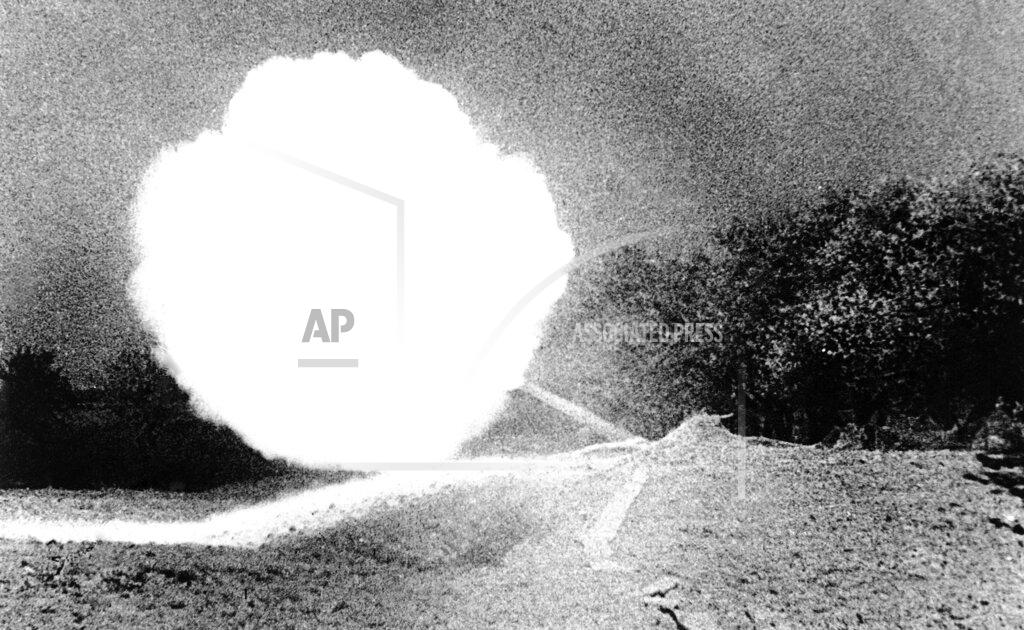
The French managed to halt the German advance at Oisemont, although both sides took heavy casualties. Further east, the French 6th Army was pushed back by the German 9th Army on the Ailette north of Soissons.
German 5th and 7th Panzer Divisions bypassed the strongpoints on the French Weygand defensive line, penetrating near Abbeville, Amiens, and Petonne. General Erwin Rommel’s 7th “Ghost” Panzer Division sidesteps the effective French artillery at Amiens and breaks through to the west of that city, advancing 20 miles between Abbeville and Amiens. This illustrates one of the inherent weaknesses of the “hedgehog” theory of defense, as there is no “line” to cross, but instead simply places to avoid. Nevertheless, the French hedgehog defense along the Weygand Line inflicted German tank losses, with the obsolete 75mm field guns performing surprisingly well as anti-tank guns.
The 51st Highland Division at Saint-Valery-sur-Somme at the mouth of the Somme is in deep trouble, but it has the good fortune of being the closest portion of the line to England.. RAF Bomber command supports it with a raid of 38 bombers.
Further east, between Amiens and Peronne, von Kleist’s Panzer Group is held. To the east of Kleist’s troops, Panzer Group Guderian seize bridgeheads across the Aisne.
The French 10th Army, 7th Army, and 6th Army are withdrawing under pressure. The French are using their 75mm field guns as anti-tank artillery, just as the Wehrmacht uses its 88 mm anti-aircraft guns in the same role. Firing at panzers over open sights is a dangerous occupation, but even the best panzers are susceptible to direct hits.
14 Panzer Corps is held up south of Amiens and Peronne, but the French defence gives way on either flank. On the west Rommel manages, late in the day, to advance another 9 miles. Finding themselves outflanked, the two left divisions of the Tenth Army, the 51st British and 31st French Infantry Divisions, fell back to the Bresle.
To the east the French Sixth Army was hard pressed, and by the end of the day the Germans seized the Chemin des Dames forced Touchon to withdraw south of the Aisne.
Weygand was then compelled to rearrange the line by pulling back No. 3 Army Group to the Bresle, the Avre, and the Aisne line.
The French send 21 LeO-451 bombers against German panzers at Chaulnes.
RAF Bomber Command dispatches 38 aircraft to support 51st Highland Division at St-Valery.
RAF Bomber Command dispatches 41 aircraft to attack German positions and communication lines overnight.
French minelayer Pollux arrived at Dover at 1345/6th for minelaying operation MI. On6/7 June, French minelayer Pollux escorted by French torpedo boat Melpomene and destroyer Vega laid mines in the Channel to Cherbourg in 51-20-24N, 02-02E. On 13/14 June, French minelayer Pollux and auxiliary minelayers Ingenieur Cachin (1310grt) and Alexis De Tocqueville (1256grt) escorted by torpedo boat Branlebas and auxiliary sloop Asie extended this minefield.
5,100 Allied personnel were transported to troop transports hiding in fjords near Narvik, Norway over the previous night. They then departed the area with about 15,000 troops aboard, escorted by destroyer HMS Arrow and sloop HMS Stork for the first phase of their trip back to Britain.
HMS Ark Royal and HMS Glorious continue to steam in company off Narvik. At 0200, Ark dispatches a trio of 800 Squadron Skuas (OC-Acting Major R. T. Partridge, RM) as relief fighter patrol over Risoy Sound. Simultaneously, she dispatches a single Swordfish with 810 Squadron’s lead crew (OC-Captain N
R. M. Skene, RM) to lead four further Swordfish from Glorious’ 823 Squadron, each armed with 4 x 250 lb. GP, 4 x 20 lb. Cooper, and 4 x 25 lb. incendiary bombs. The force was to be escorted by three additional Skuas from 800 Squadron, led by Lieutenant G. E. D. Finch-Noyes, RN), each armed with a single 250 lb. GP and 4 x 20 lb. Cooper bombs. The fighters were to escort the bombers and, if no aerial opposition was encountered, assist the attack on enemy positions around the village of Hunddalen. Unfortunately, the low clouds prevented the force from reaching the objective. Meanwhile, word arrived at the task force that the Admiralty believed that a force of German warships, including the two battleships Scharnhorst and Gneisenau had sortied from Germany and were heading for Northern waters either to breakout into the Atlantic, or perhaps to interfere with the evacuation. Unfortunately, while the forecast was entirely accurate, the source was not provided as the factual basis was “Ultra” intercepts, one of the first times the Royal Navy was to receive such information.
Submarine HMS Severn reported a U-boat sixty miles west, northwest of Aandalsnes.
Norwegian submarine HNoMS B-3 departed Harstad for the Tromsø area. En route, a battery explosion crippled the submarine. Unable to make the passage to England, B.3 was scuttled on 9/10 June in Gavlfjord near Tromsø.
After receiving orders at 1645, battleship HMS Valiant and destroyers HMS Mashona, HMS Tartar (D.6), HMS Bedouin, and HMS Ashanti departed Scapa Flow at 2130 to escort convoys evacuating Harstad.
Late on the 6th and into early 7 June, German Admiral Marschall reaching the latitude of Harstad refuelled his heavy cruiser Admiral Hipper and destroyers from German tanker Dithmarschen (10,816grt).
German minesweeper M-11 hits a mine and sinks off of Norway.
French Prime Minister Reynaud tells his Cabinet that if necessary the government and remaining French forces will withdraw to North Africa and continue to resist.
Paul Reynaud made over his cabinet early today, reinforcing it to face the critical phase of the war opened by the German offensive toward Paris and the prospects of Italian entry into the conflict. Reynaud himself – took the two most important posts of foreign minister and war minister in addition to the premiership and dropped Edouard Daladier, former premier and more recently foreign minister, along with other political holdovers from previous regimes. The new cabinet was announced two hours after a 50-minute cabinet session which began at 11:30 p.m. (2:30 p.m., P.S.T.) last night. A brief communique issued early this morning after the session with President Albert Lebrun at Elysee palace informed Frenchmen that the man whose energy and frankness in one of France’s great historical crises has won praise had become a one-man director of the war.
Pope Pius XII sent a signed message to Premier Benito Mussolini expressing a fervent hope that Italy will refrain from entering the war. Some quarters understood that the pontiff, in his message to Mussolini, emphasized that it would be his last appeal for peace addressed to the Italian leader. The message was said to have pointed out that the majority if not all the Balkan nations would be drawn into the conflict if Italy goes to war. In connection with the parallel “appeasement action” on the part of Washington and the Vatican, it is reported that Myron C. Taylor, special ambassador, conveyed to the pope assurances that Mr. Roosevelt would be disposed to offer the pontiff a place of refuge in the United States if war should force the papal court to abandon Rome.
Italy, poised for weeks on an apparently impending entry into war, declared a 12-mile zone around her coast and colonial possessions dangerous to navigation today as her axis partner Germany drove in a great offensive on Paris. The announcement of the danger zone did not say whether the coast al waters had been mined nor give the exact nature of the danger ships would face in the zone. Mining of the coastal waters of Italy and her possessions would make dangerous for navigation not only the immediate waters of the Italian “boot” but also close the Adriatic and the approaches to a large part of the African coast along Libya in the Mediterranean.
At Mussolini’s behest, Badoglio issues order for Italian armed forces to prepare for combat operations.
All ships of the Italian merchant marine received government orders to proceed immediately to Italian ports.
The Egyptian-Arab Legion, Egypt’s first Bedouin cavalry corps, which has been distributed along the Western desert oases, moved today into strategic positions near the border of Italian Libya.
Adolf Hitler arrived at the Wolfsschlucht headquarters at Brûly-de-Pesche, Belgium.
A memorandum created in the German Foreign Office proposed several measures for solving the “Jewish question”, including mass deportations to the French colony of Madagascar.
Germans begin releasing Flemish-speaking Belgian POWs but deporting French-speaking Belgian POWs to Germany
All Austrian and German citizens in the United Kingdom were ordered to turn in privately-owned radios.
The British government banned the manufacture of a large number of household goods.
The Duke of Windsor, who holds the rank of major general, has relinquished his post as liaison officer with the British and French armies for reasons that are not given. It is understood he is now at Nice.
The Kremlin issued an ultimatum to Latvia, demanding it the allow Soviet occupation.
Sir Stafford Cripps named ambassador to Moscow.
RAF Bomber Command dispatches 24 aircraft to attack Hamburg and other targets overnight.
RAF 4 Group (Whitley) is bombing the marshalling yards at Rheydt and Euskirchen, and troops and transport at Doullens. RAF 10 Squadron sends nine aircraft to Rheydt and Euskirchen. Eight bombed. RAF 51 Squadron sends eight aircraft to Doullens. All bombed.
Adolf Galland was appointed Gruppenkommandeur III/JG 26.
U-46, commanded by Oberleutnant zur See Engelbert Endrass, torpedoed armed merchant cruiser HMS Carinthia (Captain J. F. B. Barrett Rtd) at 1312 west of Ireland in 53 13N, 10 40W. HMS Carinthia (Capt J.F.B. Barrett, RN) was hit aft by one G7e torpedo from U-46 west of Galway Bay. The Germans then observed how the ship turned apparently uncontrolled in circles and dropped depth charges from the stern. At 1347 hours, a G7e coup de grâce was fired which missed and was answered by gunfire from the armed merchant cruiser. Endrass decided not to waste another torpedo and left the area because the burning ship was settling by the stern, developing a port list and the crew began to abandon ship. Temporary Lt (E) R. Yeates RNR, Temporary S/Lt (E) J. D. Linklater RNR, were lost on the cruiser. Destroyers HMS Volunteer, which departed the Clyde at 0115 for Scapa Flow, HMS Wren, from the Clyde, escort vessel HMS Gleaner, and tugs HMS Brigand and HMS Marauder were sent to assist her. Destroyer HMS Berkeley, just completed, was sent from the Western Approaches. The destroyers reached the armed merchant cruiser Carinthia at 0400/7th. Tug Marauder took Carinthia in tow, but the armed merchant cruiser sank at 1900/7th. Destroyer Volunteer arrived at Scapa Flow at 2150/8th. Destroyer Wren arrived in the Clyde at 1830/8th.
Battleship HMS Nelson, escorted by destroyers HMS Warwick, HMS Amazon, and HMS Witch departed Portsmouth at 1700 for the Clyde, arriving at 1115/8th.
Destroyers HMS Wolverine, HMS Witherington, and HMS Viscount arrived off Scapa Flow at 0800. They anchored off Cantick Head in thick fog. Destroyers Wolverine and Viscount entered harbor at 1500 during a temporary fog clearance. Destroyer Witherington arrived at Scapa Flow at 1900.
Destroyer HMS Verity was damaged in a collision with mine tender HMS Nightingale at Portsmouth. The destroyer was repaired to complete on the 15th.
Escort destroyer HMS Berkeley was completed. She was sent on this day to assist damaged armed merchant cruiser HMS Carinthia and later the torpedoed steamer Eros. Two days later, she departed Cammell Laird yard at Birkenhead and arrived at Milford Haven for working up on the 9th. Following working up, destroyer Berkeley was attached to the Home Fleet.
The German commerce raider Atlantis, disguised as the Dutch freighter MV Abbekerk, fired upon, stopped, and captured the 7,230 ton Norwegian freighter Tirranna in the southern Atlantic Ocean. The Tirranna was en route from Mombasa from Australia, with a cargo of wheat, flour, bales of wool, 178 army trucks, beer, tobacco, canned peaches, and jam for the Australian troops fighting in the Middle East. Of the Tirranna’s complement, 5 died. A prize crew was put on board but due to the vessel having insufficient fuel to make it back to Europe, she was sent south to wait until the Atlantis could capture a tanker.
German armed merchant cruiser Widder refueled from German steamer Konigsberg (6466grt) at 26N, 46W. Widder had already fuelled twice from German tanker Nordmark (10,845grt) in the North Atlantic since sailing on 6 May.
German armed merchant cruiser Thor departed Kiel to raid in the Central and South Atlantic, via the Denmark Strait. She was escorted through the Skagerrak by torpedo boats Jaguar and Falke and arrived at Sorgulenfjord near Skudesnes where she remained until 11 June.
British steamer Harcalo (5081grt), formerly in convoy HG.32F, was sunk on a mine in 51 19N, 01 32E, near Goodwin Knoll Buoy. Three crewmen were lost on the British steamer. The steamer was beached three cables northwest of Gull Buoy. Tug Lady Brassey investigated the steamer, but found her beyond salvage.
Anti-submarine trawler HMS Kingston Olivine (378grt) at 0715 made an attack on a submarine contact off Dungeness. The contact was later found to be a wreck.
Anti-submarine trawler HMS Kingston Andalusite (415grt) at 1925 attacked a submarine contact two miles 177° from Port War Signal Station. The contact was later found to be a wreck.
British trawler HMS Lapwing (217grt) was sunk on a British defensive minefield in 54 00N, 01 10E. The entire crew was rescued.
Destroyer HMS Vortigern, after escort duty with convoy HG.32, arrived at Gibraltar and was taken in hand for refitting.
Italian submarines Barbarigo and Nani departed Naples for patrol off Algiers.
Italian submarines Salpa, Guiliana, Bagnolini, and Tarantini departed Taranto for patrol south of Crete.
Italian submarines Settimo and Uebi Scebi departed Taranto for patrol to the south of the Otranto Strait and off Cerigo, respectively.
Convoy FN.190 departed Southend, escorted by destroyer HMS Wallace. The convoy arrived at the Tyne on the 8th.
Convoy MT.83 departed Methil, escorted by destroyer HMS Vivien. The convoy arrived at the Tyne later that day.
Convoy FN.189 departed the Tyne, escorted by destroyer HMS Vivien. The convoy arrived at Southend on the 8th.
The War at Sea, Thursday, 6 June 1940 (naval-history.net)
U-46 torpedoed armed merchant cruiser CARINTHIA (Captain J. F. B. Barrett Rtd) at 1312 west of Ireland in 53 13N, 10 40W.
Temporary Lt (E) R. Yeates RNR, Temporary S/Lt (E) J. D. Linklater RNR, were lost on the cruiser.
Destroyers VOLUNTEER, which departed the Clyde at 0115 for Scapa Flow, WREN, from the Clyde, escort vessel GLEANER, tugs BRIGAND and MARAUDER were sent to assist her. Destroyer BERKELEY, just completed, was sent from the Western Approaches.
The destroyers reached the armed merchant cruiser CARINTHIA at 0400/7th.
Tug MARAUDER took CARINTHIA in tow, but the armed merchant cruiser sank at 1900/7th.
Destroyer VOLUNTEER arrived at Scapa Flow at 2150/8th.
Destroyer WREN arrived in the Clyde at 1830/8th.
Battleship NELSON, escorted by destroyers WARWICK, AMAZON, and WITCH departed Portsmouth at 1700 for the Clyde, arriving at 1115/8th.
After receiving orders at 1645, battleship VALIANT and destroyers MASHONA, TARTAR (D.6), BEDOUIN, and ASHANTI departed Scapa Flow at 2130 to escort convoys evacuating Harstad.
Destroyers WOLVERINE, WITHERINGTON, and VISCOUNT arrived off Scapa Flow at 0800. They anchored off Cantick Head in thick fog.
Destroyers WOLVERINE and VISCOUNT entered harbour at 1500 during a temporary fog clearance.
Destroyer WITHERINGTON arrived at Scapa Flow at 1900.
Destroyer VERITY was damaged in a collision with mine tender NIGHTINGALE at Portsmouth.
The destroyer was repaired to complete on the 15th.
Escort destroyer BERKELEY was completed. She was sent on this day to assist damaged armed merchant cruiser CARINTHIA and later torpedoed steamer EROS. Two days later, she departed Cammell Laird yard at Birkenhead and arrived at Milford Haven for working up on the 9th.
Following working up, destroyer BERKELEY was attached to the Home Fleet.
Submarine SEVERN reported a U-boat sixty miles west, northwest of Åndalsnes.
Submarine STURGEON departed Blyth on patrol.
Norwegian submarine B.3 departed Harstad for the Tromsø area. En route, a battery explosion crippled the submarine. Unable to make the passage to England, B.3 was scuttled on 9/10 June in Gavlfjord near Tromsø.
French minelayer POLLUX arrived at Dover at 1345/6th for minelaying operation MI.
On6/7 June, French minelayer POLLUX escorted by French torpedo boat MELPOMENE and destroyer VEGA laid mines in the Channel to Cherbourg in 51-20-24N, 02-02E.
On 13/14 June, French minelayer POLLUX and auxiliary minelayers INGENIEUR CACHIN (1310grt) and ALEXIS DE TOCQUEVILLE (1256grt) escorted by torpedo boat BRANLEBAS and auxiliary sloop ASIE extended this minefield.
Convoy FN.190 departed Southend, escorted by destroyer WALLACE. The convoy arrived at the Tyne on the 8th.
Convoy MT.83 departed Methil, escorted by destroyer VIVIEN. The convoy arrived at the Tyne later that day.
Convoy FN.189 departed the Tyne, escorted by destroyer VIVIEN. The convoy arrived at Southend on the 8th.
Late on the 6th and into early 7 June, German Admiral Marschall reaching the latitude of Harstad refueled his heavy cruiser ADMIRAL HIPPER and destroyers from German tanker DITHMARSCHEN (10,816grt).
German armed merchant cruiser WIDDER refueled from German steamer KONIGSBERG (6466grt) at 26N, 46W.
WIDDER had already fueled twice from German tanker NORDMARK (10,845grt) in the North Atlantic since sailing on 6 May.
German armed merchant cruiser THOR departed Kiel to raid in the Central and South Atlantic, via the Denmark Strait. She was escorted through the Skagerrak by torpedo boats JAGUAR and FALKE and arrived at Sorgulenfjord near Skudesnes where she remained until 11 June.
British steamer HARCALO (5081grt), formerly in convoy HG.32F, was sunk on a mine in 51 19N, 01 32E, near Goodwin Knoll Buoy.
Three crew were lost on the British steamer.
The steamer was beached three cables northwest of Gull Buoy. Tug LADY BRASSEY investigated the steamer, but found her beyond salvage.
Anti-submarine trawler KINGSTON OLIVINE (378grt) at 0715 made an attack on a submarine contact off Dungeness. The contact was later found to be a wreck.
Anti-submarine trawler KINGSTON ANDALUSITE (415grt) at 1925 attacked a submarine contact two miles 177° from Port War Signal Station. The contact was later found to be a wreck.
British trawler LAPWING (217grt) was sunk on a British defensive minefield in 54 00N, 01 10E.
The entire crew was rescued.
Destroyer VORTIGERN, after escort duty with convoy HG.32, arrived at Gibraltar and was taken in hand for refitting.
Italian submarines BARBARIGO and NANI departed Naples for patrol off Algiers.
Italian submarines SALPA, GUILIANA, BAGNOLINI, and TARANTINI departed Taranto for patrol south of Crete.
Italian submarines SETTIMO and UEBI SCEBI departed Taranto for patrol to the south of the Otranto Strait and off Cerigo, respectively.
Convoy BC of steamers ASKA, KARANJA, KENYA, RAJULA, ROHNA, and TALAMBA departed 6 June from Bombay and arriving 19 June at Durban, escorted by heavy cruiser KENT.
On 20 June, steamers ASKA, KARANJA, and KENYA departed Durban escorted by heavy cruiser CORNWALL. They arrived at Capetown on the 23rd.
Liners REINA DEL PACIFICO and ORION departed Durban on the 22nd, escorted by light cruiser DRAGON, arrived at Capetown the next day.
Heavy cruiser CORNWALL departed Capetown on the 24th with steamers ASKA, KARANJA, and KENYA. They arrived at Takoradi 1 July. They departed Takoradi on 2 July with CORNWALL and arrived at Freetown 5 July.
Escorted by heavy cruiser HMAS AUSTRALIA, the convoy of REINA DEL PACIFICO, ORION, and STRATHEDEN departed on the 24th and arrived at Freetown on 3 July.
Convoy of troopships REINA DEL PACIFICO, ORION, STRATHEDEN, KENYA, KARANJA, and ASKA departed Freetown 6 July, escorted by CORNWALL. The convoy was joined on 11 July by heavy cruiser AUSTRALIA and on 15 July by destroyers HAVELOCK, ST LAURENT, WALKER, and WESTCOTT.
The heavy cruisers arrived at Liverpool late on 16 July and the convoy and the destroyers arrived at 0700 on 17 July.
In Washington, President Roosevelt conferred with the Advisory Defense Council, with Governor Lehman of New York and with Edward O’Neal, president of the Farm Bureau Federation.
The Senate completed Congressional action on the $1,492,000,000 Navy appropriation bill, received the Sheppard bill to set up a National Industrial Defense Corps and the Pepper resolution calling for United States aid short of war to the Allies, considered the bill to permit the Army to acquire and store war materials, defeating the Austin amendment to set up a board to administer the preparedness program and adjourned at 6:25 PM until noon on Monday.
The House considered amendments to the National Labor Relations Act and recessed at 5:02 PM until 8 PM when it re-convened to consider its private calendar. The Rules Committee granted a rule for House consideration of the Hatch bill and the Military Affairs Committee considered the bill authorizing the President to call out the National Guard.
The United States Navy tonight made 50 of its warplanes available for immediate sale to the allies, now locked in a life-or-death struggle with Germany. Whether this move would be followed speedily by other assistance to the hard-pressed British and French was not officially announced, but it was known this government, which has received urgent pleas from the allied capitals, was considering selling surplus World War I material, including rifles, machine-guns, artillery, and ammunition. Navy officials said the 50 planes were Curtiss SBC Helldiver scout bombers, single engine carrier planes acquired by the navy in the last two years and especially adapted to dive bombing. The Navy announced the planes were being flown to Buffalo to be turned in to the Curtiss Airplane Company on future deliveries of new planes “of a superior type, equipped with leak-proof tanks and armor.”
The U.S. Navy issued orders to various Naval Reserve Air Bases (NRABs) to ferry SBC-4’s to the Curtiss plant in Buffalo, New York where they to be modified to French standards. The 50 aircraft came from NRAB Washington, District of Columbia (8 aircraft), NRAB New York, New York (Floyd Bennett Field) (9 aircraft), NRAB Chicago, Illinois (7 aircraft), NRAB St. Louis, Missouri (3 aircraft), NRAB Kansas City, Missouri (7 aircraft), NRAB Minneapolis, Minnesota (6 aircraft), , NRAB Detroit, Michigan (7 aircraft) and NRAB Boston, Massachusetts (3 aircraft). Nineteen of the aircraft had less than 50 hours on the airframe, 27 had less than 100 hours and one had only 7.7 hours. The aircraft were flown to Buffalo where the Browning machine guns were replaced by Darne 7.7mm guns and the aircraft were repainted in French markings and camouflage and given US civil registration.
The next step was to ferry the aircraft to Halifax, Nova Scotia where they would be loaded on a French ship for delivery to France. Since the pilots who had flown the aircraft to Buffalo were naval reservists, they were offered US$250 plus return rail fare from Halifax to ferry the aircraft from Buffalo to Canada. The flight would proceed from Buffalo to Burlington, Vermont; Augusta, Maine; Houlton, Maine; and finally to Halifax. The pilots would have to remove anything identifying them as U.S. Naval personnel.
Unfortunately, someone forgot the U.S. Neutrality Laws and when the planes got to Houlton, Maine, the pilots were forbidden to fly the aircraft across the border to New Brunswick, Canada. A number of tractors and cars were rounded up and the aircraft were towed across the border to a pasture, the pilots walked across the border and the planes took off on the Canadian side and flew on to Halifax. One aircraft never made it to Halifax; the weather was so bad that the pilot got lost and never made it to Burlington, Vermont. The aircraft was returned to Buffalo and its fate is unknown. The French aircraft carrier Bearn was docked at Halifax awaiting the aircraft. Unfortunately, there was only space for 44 aircraft on the ship and five were left at Halifax. These five eventually went to the RAF.
The United States is warned today by Virginio Gayda in Rome that it had better keep out of this war or it may see Europeans invade the Americas.
Canada likely will be among the first purchasers of some of the World War war stocks which this country possesses and may make available to the Allies.
The Hatch bill to extend the “clean politics” law to State employes paid wholly or in part with Federal funds leaped another hurdle today when it was reported to the House by the Rules Committee.
As the House drove today toward a possible final vote tomorrow on changes in the National Labor Relations Act proposed by the Smith committee, the committee accepted four amendments to the labor act suggested by the American Federation of Labor. In return the Smith committee received the support of the A.F.L. for its remaining proposals. Representative Smith, chairman of the committee, read to the surprised House a letter from William Green, president of the A.F.L., presenting the four federation amendments. The chamber then went on with an acrimonious debate which ended the general talk on the proposed Smith amendments. The compromise with the A.F.L. means, according to some members of Congress, that not only will the Smith committee have the backing of the A.F.L.’s friends in the House when the committee’s proposals come up for vote but it will also serve “to turn the heat” on the Senate, which had been expected to ignore any attempts to effect changes in the act at this session.
Attorney General Jackson said today that any inference that the Justice Department contemplated “a mass drive or wholesale arrests” in connection with the defense program was “wholly unwarranted.”
U.S. Army Major General C.M. Wesson, the Army’s chief of ordnance, today ordered all arsenals to go on a six-day-aweek, three-shift basis, so as to speed production of munitions.
Major League Baseball:
Captain Jimmy Foxx’s fourteenth homer of the season, made with two out, two mates on base and two strikes against him in the ninth inning, enabled the veteran Bob “Lefty” Grove to gain his third 1940 victory for the Red Sox today, a 3–1 decision over the Browns. It was the first time the southpaw had gone the full distance since he opened the season.
Bill Dickey made the throw to first base, all right, while the Yankees watched with admiration. Then, to their horror, they discovered home plate had been left uncovered. In the confusion two White Sox runners scored, in the sixth. The Sox ralied for two more in the ninth, and the Yankees lost, 4–3, despite a solid performance by New York starting pitcher Spud Chandler.
A three-run rally in the eighth inning broke a tie and gave the Athletics a 7–4 victory over the Detroit Tigers today. Singles by Benny McCoy, Wally Moses and Bob Johnson, followed by a double steal and an outfield fly furnished the winning runs against Pitcher Al Benton, who took the mound after Buck Newsom went out for a pinch-hitter.
Lou Boudreau and Ray Mack, the Indians’ sensational keystone combination, today put on a hitting act to beat the Senators, 5–4, in eleven innings. Mack tied the score for the Indians in the eighth when he belted a homer into the left-field bleachers with Beau Bell on base, and Boudreau won the game when he singled Frank Pytlak home. Pytlak had tripled with none out.
Maintaining a pace as torrid as the St. Louis weather, the Dodgers today downed the Cardinals, 9–5, to sweep the two-game series and extend their victory string to five games. Dixie Walker’s third inning homer started a rally that gave the Dodgers a 4–0 lead they never relinquished. Johnny Mize and Joe Orengo homered for the Cards.
The struggling Pirates, aided by triples off the bats of Rookies Bob Elliott and Frankie Gustine, tallied six runs in the third inning today to overcome the hapless Boston Bees, 7–6. The result brought the two teams into a tie for the last two posts in the National League race.
Bill Nicholson homered twice and Phil Cavarretta hit three consecutive doubles today as Chicago’s Cubs went on their biggest 1940 batting spree — seventeen hits for thirty-one total bases — to trounce the Phillies 11–5, and sweep the three-game series.
Warren Spahn, who will become the winningest left-hander in baseball history with 363 victories, signs a contract with the Boston Bees (Braves). Due to a clash with manager Casey Stengel and his enlistment in the U.S. Army, the 19 year-old southpaw will have to wait six years before he gets his first major league win.
St. Louis Browns 1, Boston Red Sox 3
Philadelphia Phillies 5, Chicago Cubs 11
Chicago White Sox 4, New York Yankees 3
Detroit Tigers 4, Philadelphia Athletics 7
Boston Bees 6, Pittsburgh Pirates 7
Brooklyn Dodgers 9, St. Louis Cardinals 5
Cleveland Indians 5, Washington Senators 4
Battle of Tsaoyang-Ichang: Japanese 11th Army captures Chingmen, Shihlipu, and Shihhuichiao.
The Japanese threat to Ichang became serious yesterday when Japanese forces crossed the Han River in large numbers and began a drive toward the western Hupeh port on the Yangtze River from the north and east, a Chinese military spokesman admitted today. About 15,000 Japanese had crossed the Han in three new places near Shayang, directly east of Ichang and on the main Hankow-Ichang highway. The Japanese had 60,000 more men on the east bank of the Han ready to follow, he stated.
Meanwhile, the 12,000 Japanese who earlier crossed the Han farther north and occupied Siangyang, were said to have turned southward toward Ichang. The Japanese troops east of Ichang are now less than forty miles from the city, it is believed in Chungking. The Japanese, it is thought, may try to drive along the banks of the Yangtze below Ichang before attacking the city. They could thus try to capture and destroy the boom across the Yangtse east of Shansi to clear the river so gunboats could move up for the assault on Ichang. Saying the Chinese had long anticipated the attack on Ichang, the Chungking spokesman asserted they had prepared a strong defense.
Japanese Army aircraft attacked Baishi Yi airfield near Chungking, China; one of the I-15bis fighters of Chinese 21st Pursuit Squadron claimed one Japanese Ki-21 bomber shot down. The Japanese resumed air raids in Szechuan yesterday after a lapse of a few days because of bad weather. Points near Chungking were bombed. The Chinese claimed to have shot down one bomber. The British, French and Soviet Embassies and consulates here have rejected Japanese requests that they move because of the danger from bombings.
Information from Chungking agents on the China coast has given rise to the belief in official circles in the Nationalist capital that a Japanese move against the British and French is highly likely in the event that Italy joins Germany in the European war. Reports to Chungking say the Japanese are planning to take over the International Settlement and French Concession at Shanghai and that this move might coincide with an attack from the island of Hainan upon French Indo-China. A detailed plan is said to have been worked out for assuming control of the Shanghai foreign areas, which the Japanese would cooperate with Italian forces and the concessions would be “returned to China,” Premier Wang Ching-wei’s puppet Nanking government assuming nominal authority over them. It is stated that action might be taken only against the French Concession if the Japanese decided not to risk a clash with the United States by moving against the Settlement.
In connection with the predicted attack on Indo-China, military leaders here say they have reliable information that six Japanese divisions, together with two naval squadrons, including aircraft carriers, are now concentrated at Hainan. It is said the Japanese might confine themselves to occupying Haiphong on the ground that they must halt the flow of supplies to China. British circles here admit they are worried over the Shanghai outlook. Ambassador Sir Archibald Clark Kerr is planning to leave for Shanghai Saturday. United States Ambassador Nelson T. Johnson will go to Shanghai early in July. He plans later to spend a month in North China.
Dow Jones Industrial Average: 114.48 (+1.23)
Born:
Richard Paul, American actor, in Los Angeles, California (d. 1998).
Phillip Rhodes, American composer, in Forest City, North Carolina.
John Rudometkin, NBA small forward (New York Knicks, San Francisco Warriors), in Santa Maria, California (d. 2015).
Died:
E. E. Clive, Welsh actor (“Night Must Fall”, “Dark Hour”).
Arthur Zimmermann, 75, German diplomat.
Naval Construction:
The Royal Canadian Navy patrol vessel HMCS Anna Mildred commences conversion in Quebec City, Canada.
The Nihon Kaigun (Imperial Japanese Navy) No.13-class submarine chaser Ch-14 is laid down by Tama Shipbuilding (Okajima, Japan).
The Royal Navy “U”-class (Second Group) submarine HMS Unique (N 95) is launched by Vickers Armstrong (Barrow-in-Furness, U.K.).
The Nihon Kaigun (Imperial Japanese Navy) Type B1 (I-15-class) submarine I-27 is launched by the Sasebo Naval Arsenal (Sasebo, Nagasaki Prefecture, Japan).
The Royal Navy Flower-class corvette HMS Delphinium (K 77) is launched by Henry Robb Ltd. (Leith, U.K.); completed by Ailsa Shipbuilding Company Ltd. (Troon, Scotland).
The Royal Navy anti-aircraft ship HMS Foylebank is commissioned. Her first and only commanding officer is Captain (retired) Henry Percival Wilson, RN.
The Royal Navy Hunt-class (Type I) escort destroyer HMS Berkeley (L 17) is commissioned. Her first commanding officer is Lieutenant Commander Hugh Greaves Walters, RN.
 History Diaries