The British voted overwhelmingly to remain in the Common Market, ending a long-standing political debate over the country’s role in Europe. The final tally of Thursday’s national referendum — the first in Britain’s history — showed that 67.2 percent of the voters said “yes” to the Market. The margin of more than 2 to 1 surprised the most fervent pro-Market politicians. The results were greeted with relief in other capitals of the Community. The uncertainty and Britain’s efforts over the last 15 months to obtain new terms for her membership slowed the Market’s machinery. Chancellor Helmut Schmidt of West Germany said: “A Europe without Britain would not have been strong enough.” In the voting results from 68 counties and regions, the only majorities against the Market were among the 6,500 voters in the Shetland Islands, north of Scotland, and the 11,000 in the Outer Hebrides, off the western coast of Scotland. Elsewhere there were repeated refrains of “yes” by comfortable margins as the results were announced.
A night express train doing 70 to 80 miles an hour jumped the tracks and crashed into a station platform today, killing seven persons aboard and injuring 36, the police reported. Two of the dead were children. The accident occurred at 1:55 AM as the Caledonian Express approached the Trent Valley station at Nuneaton, 97 miles northwest of London. British Rail officials said it was not immediately known how many passengers were on the 15‐car train, heading for Glasgow from London, but reports ranged from 94 to 140. Agriculture Minister Fred Peart, 61 years old, was in a sleeper on the train. He was pulled from the wreck in his nightclothes and taken to a hospital where he was reported suffering from shock and severe bruises.
Portugal’s military rulers announced that the Socialist newspaper Republica would be allowed to resume publication as soon as its owners ask the military authorities to remove the seal that officially closed the newspaper building in Lisbon on May 20. The military appeared to yield, at least temporarily, to a demand by the Socialist party that the newspaper be permitted to publish, or the party would withdraw from the government. The paper had been closed when Communist-led printers sought the removal of the publisher and a voice in the paper’s policy. However, the announcement by the military rulers said that the current press law, which forbids newspaper employes from taking job actions to influence the editorial stance of a publication, should be immediately changed because it was “inadequate in the actual context of this phase of the Portuguese revolution.”
Portugal has asked the European Economic Community for urgent financial aid before she runs out of foreign currency reserves, possibly this summer, according to an informed diplomatic source. The country is losing foreign reserves at an accelerated rate. The closing of Republica, a Socialist paper, two weeks ago has affected the economic situation. It was learned that last Monday when Portugal’s financial problem was put to Garret FitzGerald, the Irish Foreign Minister and the current president of the ministerial council of the European Economic Community, Mr. FitzGerald raised the question of Républica as a test of Portugal’s ability to remain on a democratic course.
Leonid I. Brezhnev, who has not been seen in public for nearly a month, is expected to reappear next Friday to deliver a major speech in the Kremlin in connection with the Russian Republic’s single‐slate election. The announcement was made today in a manner that was curious — but not untypical — on the front page of the Moscow weekly television and radio listings. The 20‐page publication, “Moscow Speaks and Shows,” reported in bold type that the Soviet leader would be making a speech to his constituents from the Baumansky District of Moscow next Friday. The speech, which is to represent Mr. Brezhnev’s formal appearance as a candidate for a seat in the republic’s parliament, is to be carried live by nationwide radio and television. Today’s disclosure indicated that Mr. Brezhnev was regarded as sufficiently healthy to make such an appearance. The 68‐year‐old party chief was last seen here in public on May at a Kremlin reception commemorating the 30th anniversary of the World War II victory over Nazi Germany.
Soviet farmers were reported today to have almost completed sowing spring grain crops, and there were indications that the Soviet Union was possibly heading for a record harvest. Agricultural reviews in the press said that by the beginning of this week, 229.6 million acres had been sown in spring grains and that almost all regions of the country had received rain in the last 10 days of May. Soviet planners are aiming for a grain harvest of about 216 million tons—or 20 million tons more than last year. The record harvest, 222.5 million tons, was in 1973.
General Paul Stehlin was on the payroll of the Northrop Corporation as an overseas consultant while he was a vice president of the French National Assembly, according to an auditor’s inquiry into Northrop’s operations made public by the Senate Foreign Relations subcommittee on multinational corporations. General Stehlin was forced to resign last November after he precipitated a storm by writing to President Valery Giscard d’Estaing to the effect that American aircraft were cheaper and had undergone more impressive flight tests than French-built Mirages.
General Paul Strehlin, former French Air Force Chief of Staff, was run over by a bus in Paris tonight, hours after being revealed to have secretly been on the payroll of the Northrop aircraft manufacturing company. General Stehlin is in a Paris hospital, in critical condition, following a traffic accident last night in Paris at 6:33 P.M., about the time it was disclosed in Washington that he was on the payroll of Northrop. General Stehlin is in a maximum care unit and has undergone a tracheotomy to assist in breathing. He has a fractured skull and other fractures, according to his son, Marc. He would die of his injuries on June 22.
Secretary of State Kissinger sent a warning to the nonaligned bloc today that the United States would “strongly oppose” any effort to suspend Israel from participation in the United Nations General Assembly. He refused, however, to join in an emerging debate on what the United States should do in the event such action is taken by the bloc, which controls nearly 100 votes in the United Nations. In a related development, President Ford was reported to have complained during a meeting with Congressional leaders that a letter signed by 76 Senators urging strong aid for Israel was unhelpful to him in his recent talks with President Anwar el‐Sadat of Egypt. But Mr. Ford said he had been able to deal with Mr. Sadat anyway.
Two Iranian destroyers sailed up the newly reopened Suez Canal today in a demonstration of the highly active role that Shah Mohammed Reza Pahlevi has developed for his country since the Arab-Israeli war of October, 1973.The Iranian destroyers were with three Egyptian warships in a convoy that sailed from Suez, at the southern end of the canal, to Ismailia, about halfway along the waterway. Another convoy, consisting of one merchant ship each from Italy, Japan, Pakistan and the Sudan, followed the military vessels. The journey of the two convoys completed the festive reopening of the canal, which had been closed for eight years, since the Arab‐Israeli war of June 1967.
A Laotian official said today that the sale of rice received as foreign aid had been temporarily suspended because of lack of deliveries. Soukhamthat Chounlamany, vice president of the committee that handles foreign assistance, said in an interview with the local press that “the balance of rice offered by friendly countries has not yet arrived in Laos.” At the same time, however, the Government announced that Australia had offered nearly 300,000 pounds of rice for distribution in 11 provinces throughout Laos.
The Provisional Revolutionary Government of South Vietnam has held its first Cabinet meeting, but there is no indication when it is to take over power from Saigon’s Military Administrative Committee. The official Saigon newspaper, Giải Phóng, said today that the meeting was held Wednesday, with a representative of the committee sitting in. It was decided, the paper said, to permit some banks to reopen as part of the process of speeding the revolution, but no date was given. The formal decision followed a recent statement by Lieutenant General Trần Văn Trà, the head of the Military Administrative Committee, that the bank holiday would be ending soon.
The last American B‐52 bombers in Southeast Asia began flying home today, eight years after they began bombing targets in Vietnam. The first of the 16 remaining planes took off under overcast early morning skies after low-key departure ceremonies. All the camouflaged, drooped‐wing bombers will be removed by Sunday as part of the United States withdrawal from Thailand. A Thai officer presented each of the departing plane crews with a garland of flowers.
During the last few days the Argentine Government has begun a serious effort to tackle its mounting economic problems, from inflation and heavy trade deficits‐to labor‐absenteeism and shortages. It is putting into effect harsh measures that have brought a backlash from organized labor, publicly reacting against the Peronist Government for the first time. In the face of such reaction, President Isabel Martinez de Perón, in a speech today, apparently decided to abandon wage guidelines the Government had just issued, and said that wage increases would be decided between trade union groups and business associations. She traced Argentina’s mounting economic difficulties to a world economic recession and guerrilla bands who “are trying to destroy the country by creating chaos in major industries.”
Some 40,000 people may have died in the drought in Ethiopia and Somalia, relief workers have estimated. The eight‐month drought, in the Ogaden region of Ethiopia and across the border in Somalia, has affected 800,000 people, they said. Reports indicate that the famine may prove worse than the one that struck Ethiopia in 1973, in which thousands died. The relief workers said figures showed that from October last year to mid‐May a total of 16,685 deaths had been recorded in Somalia relief camps alone. At the rate of more than 50 deaths a day, “the toll there must be nearing 18,000,” one official said.
Rival liberation movements have suffered heavy casualties in fighting in the Angolan capital of Luanda and there are at least 33 dead and 82 wounded among Portuguese troops and civilians, it was officially an nounced here tonight. The Presidency said that three Portuguese soldiers had died and two had been injured in the fighting. Casualties among the liberation movements were “high although not yet fully ascertained,” the Presidency said. The statement blamed troops belonging to the Marxist Popular Movement for the Liberation of Angola for staging attacks against the National Union for the Total Independence of Angola, but said the Marxist soldiers were “apparently” acting independently of their high command. The other movement involved in the fighting has been the Zaire‐based National Front for the Liberation of Angola.
Britain, France, and the United States vetoed tonight a resolution in the U.N. Security Council that would have imposed a mandatory arms embargo on South Africa in an effort to compel that nation to relinquish her control over neighboring South‐West Africa. Ten members of the Council voted for the resolution jointly proposed by five third world members. Italy and Japan abstained. The 10 countries that voted for the resolution were Byelorussia, Cameron, China, Costa Rica, Guyana, Iraq, Mauritania, Sweden the Soviet Union and Tanzania. It was the second time in United Nations history that three of the Council’s permanent members cast their vetoes together on a resolution. The first triple veto was cast on October 30 last year, to prevent South Africa’s expulsion from the United Nations — an action that was followed by a successful move that suspended South Africa from the last General Assembly session, but not from the world organization.
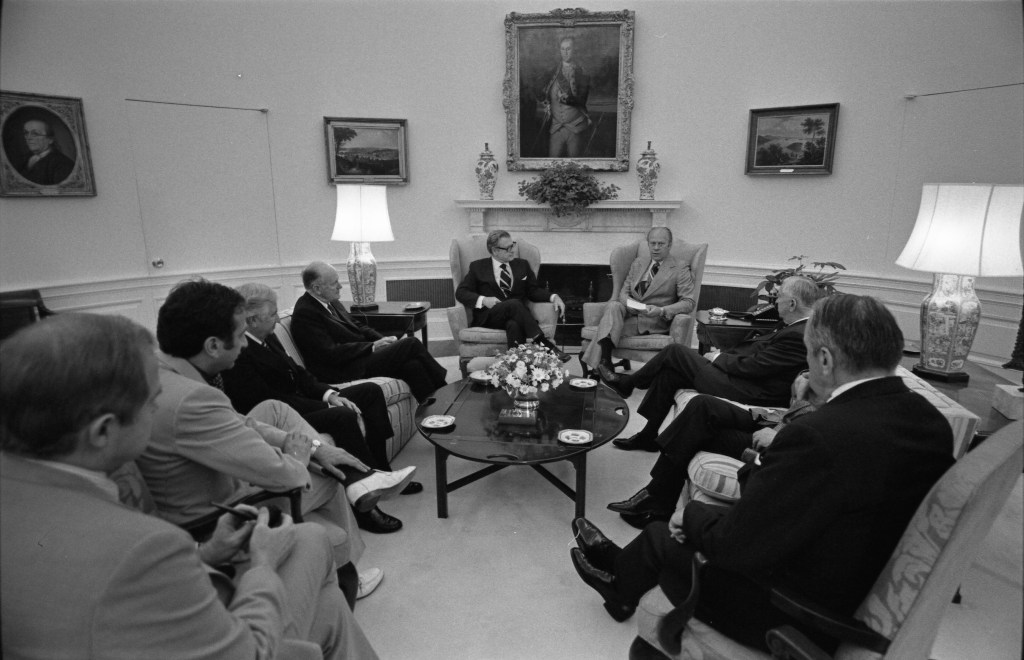
President Ford received a report on Central Intelligence Agency activities. But there were doubts about whether it would be made public and contradictions about the handling of the investigation of alleged assassination plots. Vice President Rockefeller presented a 299-page volume detailing the findings of his special commission created last January to investigate certain activities of the agency. Mr. Rockefeller told the President that the commission “did not have time to review the assassination attempts, but we will turn over to you the information we’ve gathered.”
The decision today by President Ford to delay indefinitely the publication of Vice President Rockefeller’s report on activi ties of the Central Intelligence Agency raised the clear possibility that the outcome of the five‐month‐long White House inquiry would be the opposite of what had been intended. The President had hoped to assure the nation, as he noted in accepting the blue‐bound report of Mr. Rockefeller’s blue ribbon commission this morning, that the intelligence community would operate “within the law.” But the White House announcement that the report would not be made public until Mr. Ford had read it — if then — and the circumstances surrounding the presentation of the report by Mr. Rockefeller threatened to diminish the credibility of the commission’s findings when they did emerge.
The transmittal ceremony in the President’s Oval Office occurred amid reports that the White House had ordered Mr. Rockefeller to delete from his commission’s findings a long section dealing with charges of C.I.A. involvement in plots to assassinate foreign leaders. Mr. Rockefeller insisted that it had never been meant to include the subject in the commission’s formal published findings. Ron Nessen, the White House press secretary, strenuously denied that Mr. Ford or his aides had any involvement in shaping the commission’s report. But their statements appeared to conflict with earlier ones. Moreover, spokesmen for the White House and the commission kept referring questions to one another, and neither gave a satisfactory explanation for the abandonment of the commission’s plans to make the report public this weekend.
The Labor Department said the national unemployment rate rose again in May, although the total number of the employed increased for the second consecutive month. The unemployment rate in May was 9.2 percent of the labor force, up from 8.9 percent in April and the highest since 1941. Both employment and unemployment can rise at the same time in an expansion of the labor force — those at work or looking for jobs. That is what happened in May. Although there are almost one million “discouraged workers” who have dropped out of the labor force, according to the latest quarterly report, it is evident from the rapid growth of the labor force in recent months that job‐seeking is still the norm, even with high unemployment. The proportion of the working age population in the labor force last month was the highest in the postwar period.
The Senate overwhelmingly approved today a $25‐billion measure authorizing the Defense Department’s weapons procurement and research programs, after voting to extend Israel’s authority for credits to buy American military equipment. The bill, which passed by a vote of 77 to 6, now goes to a Senate‐House conference to be reconciled with a $26.5‐billion measure passed May 20 by the House of Representatives. The final version of the Senate bill — it would also permit women to be admitted to the military service academies — was regarded as a victory for the Ford Administration, which has been warning against sharp cuts in defense spending after the recent American withdrawal from Indochina. In three days of votes, the Senate repeatedly turned back efforts by liberals to cut funds for various weapons programs, such as the Air Force’s B‐1 strategic bomber and the development of more accurate and powerful warheads for intercontinental ballistic missiles.
Liberal Democrats did manage to save one narrow victory late this afternoon when the Senate voted, 43 to 41, to write into the measure a provision barring any funds for flight-testing of new missile warheads being developed — known as MARV’s — or maneuvering re‐entry vehicles. Under the amendment sponsored by Senator Hubert H. Humphrey, Democrat of Minnesota, the funds for flight testing would be barred unless the President certified that the Soviet Union was testing similar warheads, or had taken other action that made the tests essential for national security. Mr. Humphrey noted that development would continue on the warheads. They had not been scheduled to be flighttested for another five years. It was not clear, however, whether the provision would survive in a Senate‐House conference, because the House has rejected a similar amendment by a wide margin.
Arthur Burns, chairman of the Federal Reserve Board, relayed to the Internal Revenue Service President Nixon’s order that the agency make special investigations of student protesters, black militants and anyone who was financing them, according to a report issued by the staff of the congressional Joint Committee on Internal Revenue Taxation. The staff has been investigating the use of the I.R.S. to impede the activities of people and groups regarded as “extremist.” Dr. Burns sent the order to the I.R.S. in June, 1969, when he was a presidential counselor, the report said. A group called the Special Services Staff was organized for this purpose in the Nixon Administration, and it ultimately collected files on 8,555 persons and 2,873 organizations.
A helicopter landed inside the grounds of the Southern Michigan Prison at Jackson at 11:05 am, picked up long time inmate Dale Remling, and departed again. Remling was re-captured two days later in Leslie, Michigan. A man armed with a knife hijacked a helicopter soon after its takeoff from a Detroit-area airport and forced its pilot to land him inside the walls of Southern Michigan Prison in Jackson and whisk away a waiting prisoner. The inmate was identified as Dale Remling, 46 years old, of Sidney, Mich. The police announced two arrests in connection with the intricately planned escape, but the inmate, described as a “real hard case,” was still at large.
The three American astronauts assigned to next month’s joint space mission with the Soviet Union said today that they had no lingering doubts about the reliability of the Soviet spacecraft that their Apollo is to link up with in earth orbit. Brigadier General Thomas P. Stafford of the Air Force, the Apollo commander, said at a news conference here that the flight posed “no additional risk over any mission we fly.” General Stafford was commenting on recently published reports, primarily from Senator William Proxmire, Democrat of Wisconsin, that the planned link‐up between an Apollo and a Soyuz spacecraft was an unnecessarily risky venture. The critics have cited the number of malfunctions that have plagued some of the Soyuz flights, including the aborted launching of a manned Soyuz in April.
The Justice Department is looking into the possibility that letters and documents removed from the office of J. Edgar Hoover immediately after his death in 1972 contained sensitive information on public figures or otherwise bore on the F.B.I.’s operations, according to a spokesman for the agency. The existence of “secret” files maintained by the late director of the Federal Bureau of Investigation, long rumored in Washington, was confirmed for the first time last February by Attorney General Edward H. Levi. Testifying before a subcommittee of the House Judiciary Committee, Mr. Levi reported that 164 file jackets, marked “O.C.,” for “Official and Confidential,” some of which contained derogatory information on Presidents, members of Congress and others, were taken from Mr. Hoover’s office to that of W. Mark Felt, then the associate director, shortly after Mr. Hoover’s death on May 2, 1972.
In an attempt to reduce illegal trafficking in pistols, the United States Attorney in South Carolina has obtained indictments of eight gun dealers and three of their employes for selling pistols to minors or to out-ofstate residents, in violation of the Gun Control Act of 1968.
Major League Baseball:
California’s Nolan Ryan’s bid for a second no-hitter in a row is foiled by Hank Aaron’s single in the 6th inning. Aaron’s hit was a sharp grounder that whizzed past the mound and eluded the shortstop, Billy Smith, who was playing deep in the hole against the pull-hitting home run king. Ryan gives up one other hit in overpowering the Brewers 6–0. Ryan, 10–3, struck out six batters to raise his major league leading total to 102 en route to the 101st triumph of his career.
Having at one time been flustered by the fluttering knuckleball of Wilbur Wood, the New York Yankees turned on the Chicago White Sox pitcher tonight, flattened out his pitches and drove him out within three innings en route to a 5–1 victory. Bobby Bonds socked his thirteenth homer and Rudy May got his sixth win.
Cleveland Manager Frank Robinson shows his players how to hit as he connects for two 3–run homers in a 7–5 win over the Rangers. Robinson, who has now hit two home runs in a game 54 times in his 20‐year major league career, wiped out a 5–4 Ranger lead in the eighth inning with a blast into the left‐field seats. The blow followed a single by Rick Manning, a sacrifice by George Hendrick and an error by Ferguson Jenkins, the Ranger starter and loser, who has a 5–6 won‐lost record.
In a barnburner at Boston, Dwight Evans hits two homers, including a grand slam, and drives in 6 runs as Boston holds on to beat the Twins, 13–10. Evans put the Red Sox in front, 4–0, in the first with his grand slam after Joe Decker had walked Carl Yastrzemski, Fred Lynn and Jim Rice. Evans connected again in the third, a five‐run inning that put Boston ahead to stay. Luis Tiant, who got credit for Boston’s 11–9 victory in Minnesota last Sunday, pitched five innings to post his seventh triumph.
Paul Blair’s bases‐loaded sacrifice fly scored Jim Northrup with the winning run in the 11th inning as the Orioles edged the Royals, 3–2. Grant Jackson was the winner, pitching 1 ⅔ innings of scoreless relief.
Mickey Lolich became the leading left-handed strikeout pitcher in major league history Friday night when he surpassed Hall of Famer Warren Spahn in pitching the Detroit Tigers to an 11–2 victory over the Oakland A’s. Lolich struck out Reggie Jackson leading off the fourth inning to record the 2,584th strikeout of his 13-year major league career and pass Spahn. Lolich needed two strikeouts for the record coming into the game and ended up with four in his six innings of work for a career total of 2,586. The stocky, 34-year-old Lolich now ranks fifth on the all-time strikeout list, which is led by the late Walter Johnson with 3,508.
The Cardinals blanked the Astros, 6–0. The Cardinals scored their runs in the sixth inning, three of them on a homer by Ken Reitz. Bob Forsch pitched two‐hit ball, handing the Astros their sixth straight defeat. Cesar Cedeno singled for Houston’s first hit in the first inning and Larry Dierker, losing his sixth game, singled in the third. Willie Davis, just traded to St. Louis from Texas, doubled his first time at bat and singled in the sixth.
Phil Niekro, 36‐year‐old knuckleball specialist, stopped the Mets on six hits as he pitched the Atlanta Braves to a 4–1 victory that also stopped New York’s winning streak at four games. It was the 13th time in his career that Niekro had bamboozled the Mets, who have bamboozled him only five times in return. Moreover, on their current trip, the Braves have won only three games in 10 — all three thanks to the Niekro knuckles.
The Pirates scored five runs in the sixth inning, highlighted by successive home runs by Dave Parker and Richie Zisk, as they routed the Giants, 7–2. Rennie Stennett started the rally with a single to left. Before Jim Barr could retire the side, Richie Hehner doubled for one run, Al Oliver singled for another, and Parker hit a two‐run blow, his seventh, and Zisk added his blast, his second. The victory went to Bruce Kison (6–1).
Don Gullett hurled a five‐hitter and George Foster socked a two‐run homer in the second inning as the Reds rolled over the Cubs, 5–1. Gullett’s victory was his seventh against three defeats. It also was the Cincinnati left‐hander’s sixth complete game and lowered his earned run average to 2.20.
The Dodgers beat the Phillies, 3–2. Jimmy Wynn’s double and Ron Cey’s single in the sixth inning provided the winning run and Burt Hooton earned his fourth victory in nine decisions although he had to leave after six innings. Mike Marshall came on for the first time since he strained a rib on May 9 and protected the one‐run lead to collect his second save. Mike Schmidt hit his 11th homer for the Phils, his fifth homer in the last four games.
Kansas City Royals 2, Baltimore Orioles 3
Minnesota Twins 10, Boston Red Sox 13
Milwaukee Brewers 0, California Angels 6
New York Yankees 5, Chicago White Sox 1
Chicago Cubs 1, Cincinnati Reds 5
Texas Rangers 5, Cleveland Indians 7
St. Louis Cardinals 6, Houston Astros 0
Atlanta Braves 4, New York Mets 1
Detroit Tigers 11, Oakland Athletics 2
Los Angeles Dodgers 3, Philadelphia Phillies 2
San Francisco Giants 2, Pittsburgh Pirates 7
Dow Jones Industrial Average: 839.64 (-2.51, -0.30%)
Born:
Nina Kaczorowski, American actress (“In Montauk”, “Austin Powers in Goldmember”), in New Jersey.
Staci Keanan [Anastasia Love Sagorsky], American actress (“My Two Dads”, “Step by Step”), in Devon, Pennsylvania.
Niklas Sundström, Swedish NHL right wing, left wing, and forward (New York Rangers, San Jose Sharks, Montreal Canadiens), in Ornskoldsvik, Sweden.
David Lamb, MLB shortstop, second baseman, and third baseman (Tampa Bay Devil Rays, New York Mets, Minnesota Twins), in West Hills, California.
Corey Thomas, NFL wide receiver (Detroit Lions), in Wilson, North Carolina.
Died:
Larry Blyden, 49, American stage actor and producer who won the Tony Award for Best Featured Actor in a Musical in 1972 for his performance in “A Funny Thing Happened on the Way to the Forum,” as well as a game show host known for of “What’s My Line?”, died of injuries sustained in an auto accident in Morocco on May 31.

